Open Plan Living Space Conversion Costs
By Housey · Last reviewed 7th of May 2026
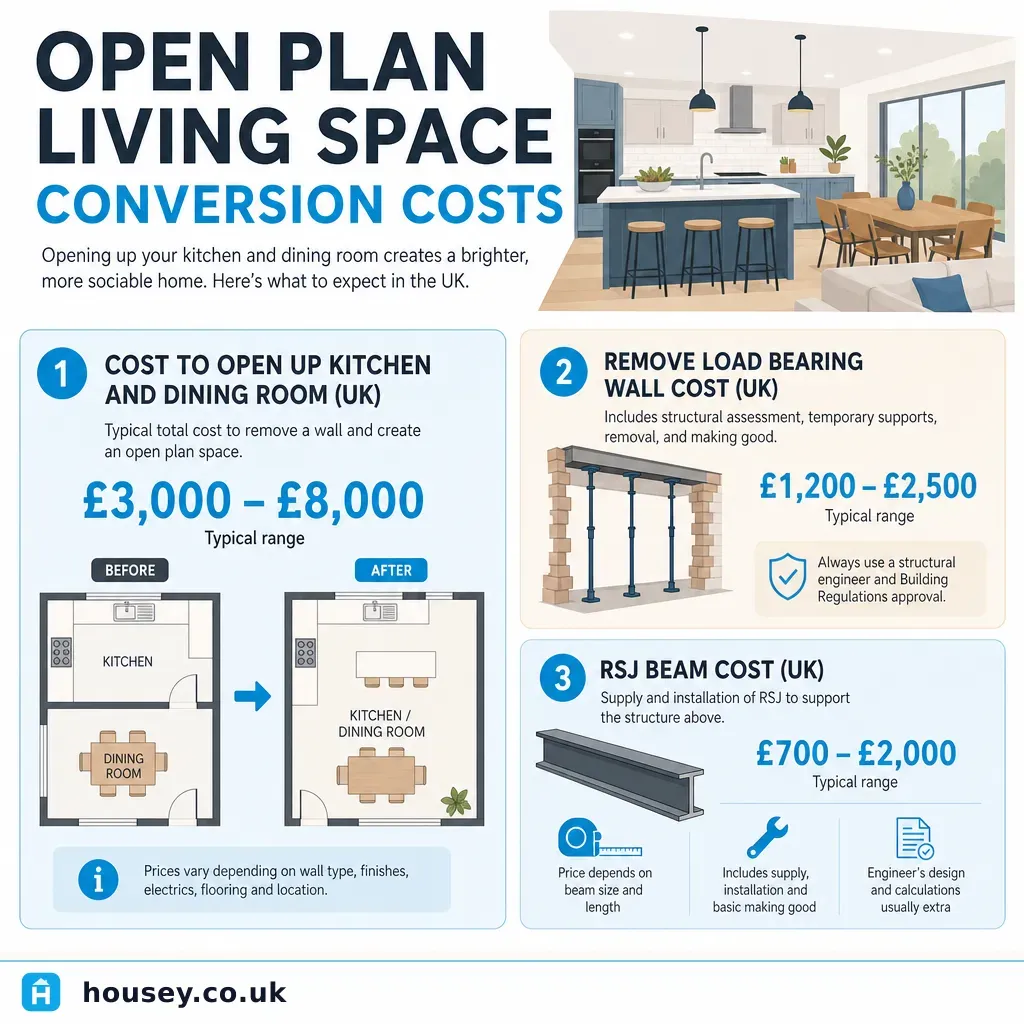
Open Plan Living Space Conversion Costs
Creating an open plan living space is one of the most popular home improvements in the UK, typically combining a kitchen, dining area, and sitting room by removing one or more internal walls. The cost and complexity vary considerably depending on whether those walls are load-bearing, which services run through them, and how much remodelling follows the structural phase. Getting the structural and regulatory elements right before work starts is essential to both safety and a successful Building Regulations sign-off.
Key points
- Removing a single load-bearing wall including a structural steel beam, temporary propping, and making good typically costs £3,500–£8,000+; non-load-bearing partition removal costs £800–£2,500. Indicative UK costs, last reviewed 2026-05-07.
- All load-bearing wall removals require a structural engineer's calculations and Building Regulations approval under the Building Regulations 2010 — this is a legal requirement.
- A Party Wall Agreement under the Party Wall etc. Act 1996 may be needed if the wall adjoins a neighbour's property, as is common in semi-detached and terraced houses.
- Gas pipes, electrical wiring, water pipes, and boiler flues may run through walls and must be rerouted by appropriately registered tradespeople before structural work begins.
- Full open plan kitchen-dining-living conversions including a new kitchen, flooring, and decoration commonly cost £15,000–£50,000+ depending on specification and location.
What does an open plan conversion cost?
Costs depend on what is being removed, which services are affected, and the extent of finishing works.
Scope of work | Indicative cost range | Key variables |
|---|---|---|
Remove single non-load-bearing partition | £800–£2,500 | Wall construction, debris, making good |
Remove single load-bearing wall (beam included) | £3,500–£8,000 | Beam size, propping complexity, padstones |
Remove chimney breast (ground floor) | £2,000–£5,000 | Upper-floor support; HETAS advice if solid fuel |
Full kitchen-dining open plan (no extension) | £8,000–£25,000 | Services rerouting, flooring, decoration |
Full kitchen-dining-living with new kitchen | £20,000–£60,000+ | Kitchen spec, appliances, underfloor heating |
Indicative UK costs, last reviewed 2026-05-07. Obtain a minimum of three itemised quotes based on the same structural specification.
Load-bearing vs non-load-bearing walls
Establishing whether a wall is load-bearing is the most important step before any open plan conversion.
| Load-bearing wall | Non-load-bearing (partition) wall |
|---|---|---|
Function | Transfers loads from floors, roof, or upper walls to foundations | Divides space only; carries no structural load |
Typical location | Often central, gable-end, or perpendicular to floor joists | Often parallel to floor joists; may have been added at any time |
How to confirm | Structural engineer's written assessment — never assume | Visual builder check, plus structural confirmation in writing |
Building Regulations | Required — structural engineer calculations and BC approval | Not required for the removal itself (other triggered works may be) |
Beam required? | Yes — steel section or engineered timber | No |
Typical cost | £3,500–£8,000+ | £800–£2,500 |
Never assume a wall is non-load-bearing on visual appearance alone. In 1930s semi-detached houses, the wall between front and rear reception rooms is frequently load-bearing. Victorian terraces can have load-bearing walls in unexpected positions due to decades of alterations.
Building Regulations and structural requirements
Removing a load-bearing wall is notifiable work under the Building Regulations 2010 in England and Wales. There is no Competent Person scheme for structural alterations of this type, so formal building control approval is required — from your local authority building control service or an approved inspector.
The typical process:
- A structural engineer assesses the existing structure and specifies the beam size and bearing details.
- A Building Regulations application (Full Plans or Building Notice) is submitted before or at the start of work.
- A building inspector visits to check temporary propping, beam installation, and padstones.
- Final inspection and sign-off once work is complete and made good.
Failure to obtain approval can make your home difficult to sell — a buyer's solicitor will ask for evidence, and the local authority can require reinstatement of the wall.
Party wall and hidden services
If the wall being removed is shared with a neighbour, the Party Wall etc. Act 1996 may require you to serve notice before starting work. A party wall surveyor can confirm whether notice is needed; this typically adds £500–£1,500 to costs but protects both parties.
Before a builder can price accurately, walls and floor zones must be assessed for gas supply pipes (Gas Safe registered engineer to reroute), electrical wiring (NICEIC- or NAPIT-registered electrician to reroute and certify), water pipes, boiler flues, and underfloor heating. Hidden services discovered mid-project are one of the most common causes of cost overruns.
Red flags to watch for
Pause and seek independent professional advice if you encounter any of the following:
- A builder who says a wall "looks non-load-bearing" without a structural engineer's written confirmation.
- A quote that does not explicitly include temporary propping, beam installation, padstones, and Building Regulations application.
- No services survey before a fixed price is agreed.
- A chimney breast being removed without advice on supporting any chimney breast in rooms above.
- No contingency allowance for hidden defects or service diversions.
- An unusually low quote with no structural cost breakdown.
Homeowner checklist
Before instructing a builder for an open plan conversion:
Important limitations
This article provides general information about open plan conversion costs and the regulatory process in England and Wales. Structural behaviour, building control requirements, and party wall obligations vary with every property. Building regulations in Scotland (Building (Scotland) Regulations 2004) and Northern Ireland differ from those in England and Wales. Nothing in this article constitutes structural, legal, or professional advice. A qualified structural engineer must assess your specific property before any structural work is carried out.
When this becomes urgent
Stop work and seek professional help immediately if: you have begun removing a wall without first establishing whether it is load-bearing; the structure behaves unexpectedly during temporary propping; you notice sudden new cracks, movement, or sagging in the floor above after removal has started; or you suspect gas pipes or electrical services have been disturbed. Do not re-enter a room where structural supports have been removed until a structural engineer has assessed the situation. For any gas concerns, contact a Gas Safe registered engineer without delay.
What to ask a qualified professional
Before instructing a structural engineer or appointing a builder, ask:
- Is this wall load-bearing, and will you confirm your assessment in writing?
- What beam type and size do you recommend, and what are the implications for ceiling height and bearing conditions?
- Will you submit structural calculations to building control on my behalf?
- Does the Party Wall etc. Act 1996 apply, and have you reviewed the neighbouring property configuration?
- Are there services in the wall that need to be identified and rerouted before structural work begins?
- What is your professional body registration and professional indemnity insurance level?
- What contingency should I allow for unforeseen conditions?
When to get professional help
Do not proceed without professional input if you are unsure whether the wall is load-bearing; the wall adjoins a neighbour's property; you notice existing signs of structural movement such as cracks, sloping floors, or sticking doors and windows; the wall contains or is adjacent to a chimney breast; or gas or water services are known to run through the wall or adjacent floor zone.
How Housey can help
Housey can connect you with experienced extension builders and renovation contractors who manage open plan conversions from structural work through to final fit-out. For the design and drawings stage, architects and architectural technologists can coordinate the structural engineer and prepare any necessary documentation. Where controlled internal demolition is part of a larger project, demolition contractors can handle this safely and in compliance with site waste management requirements.
Frequently asked questions
Do I need Building Regulations approval to remove an internal wall?
If the wall is load-bearing, Building Regulations approval is a legal requirement under the Building Regulations 2010. You must notify a building control body before or at the start of structural work, and a building inspector must sign off the completed job. For non-load-bearing partition walls, the removal itself may not be notifiable, but associated electrical or heating alterations often are.
How do I know if a wall is load-bearing?
The only reliable confirmation is a structural engineer's written assessment. Visual indicators — such as the wall running perpendicular to floor joists, or sitting directly above a wall on the floor below — can suggest a load-bearing function, but are not definitive. Never rely on a builder's visual opinion alone for a decision with structural safety implications.
How long does an open plan conversion take?
A straightforward load-bearing wall removal typically takes one to three weeks for the structural phase, including temporary propping, beam installation, and making good. A full open plan kitchen-dining-living conversion including a kitchen refit, new flooring, and decoration may take six to fourteen weeks. Timescales depend on scope, services diversions needed, and trade availability.
Do I need planning permission for an open plan conversion?
Internal structural alterations generally do not require planning permission. However, if the property is a listed building, Listed Building Consent is required for any internal work that affects its character or fabric. Check with your local planning authority if you are unsure of your property's listing status before starting work.
What steel beam is typically used when removing a load-bearing wall?
The most common choice is a hot-rolled steel section — typically a Universal Beam (UB) or Universal Column (UC). The correct size is calculated by a structural engineer based on the span, load above, and bearing conditions at each end. Never accept a beam specification that has not been calculated and signed off by a qualified structural engineer.
Sources and further reading
- Building regulations approval: overview — GOV.UK
- Party Wall etc. Act 1996: explanatory booklet — GOV.UK
- Planning Portal: Listed buildings and alterations — Planning Portal
- Gas Safe Register: find a registered engineer — Gas Safe Register
- NICEIC: find a registered electrician — NICEIC
- Party wall disputes — Citizens Advice
Useful next reads
 Improvement & Build
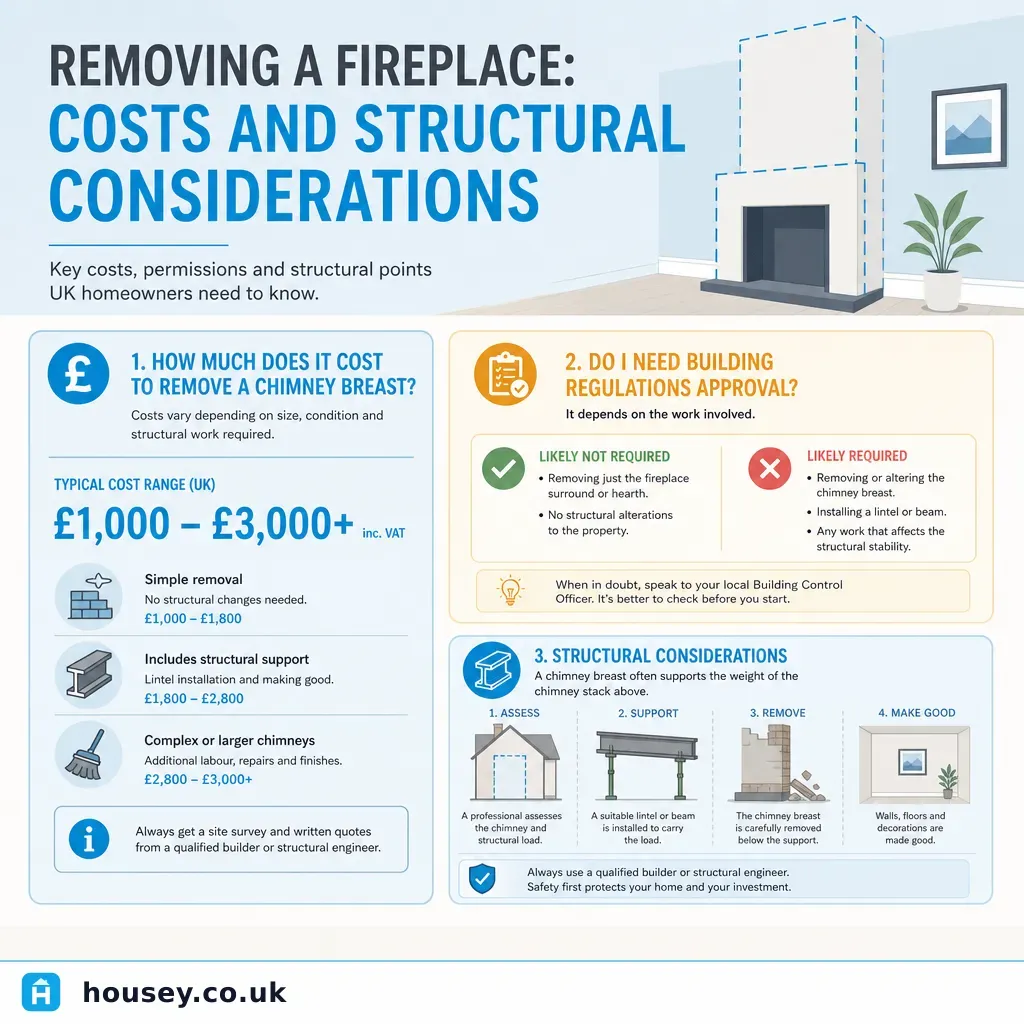
Removing a Fireplace: Costs and Structural Considerations
Removing a fireplace surround and hearth is generally non-structural and does not require Building Regulations approval.
 Improvement & Build
Who Provides House Demolition Services
House demolition in the UK is carried out by specialist demolition contractors, often members of the National Federation of Demolition Contractors (NFDC).
 Improvement & Build
Cost of converting a window to a door
Converting a window to a door in the UK typically costs £1,500–£5,000 or more, depending on wall construction (cavity, solid, or timber frame), the type of door fitted, and whether a new or enlarged lintel is required.
 Improvement & Build
Patio Door Types and Styles for Home Extensions
For most UK home extensions, sliding doors suit openings up to 3.
 Improvement & Build
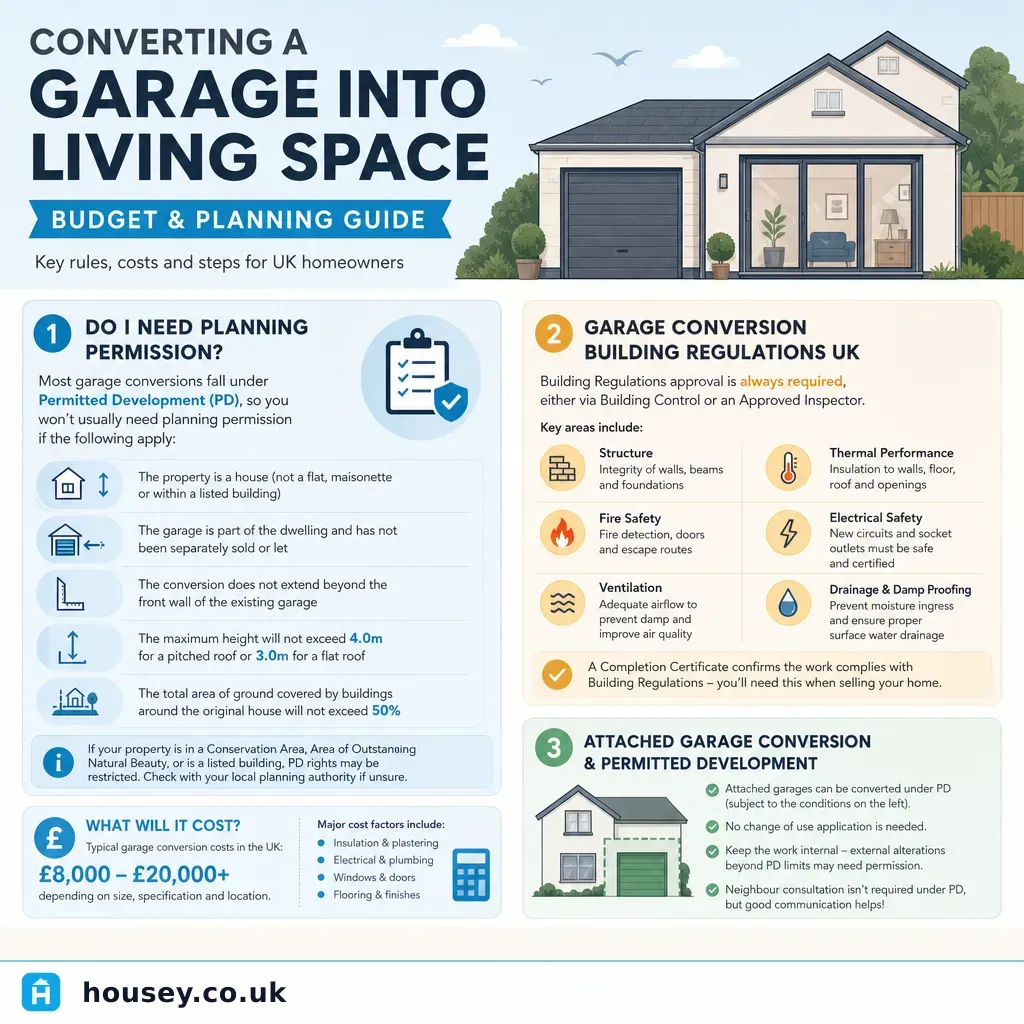
Converting a Garage into Living Space: Budget and Planning Guide
A single-garage conversion typically costs £8,000–£20,000 in the UK.