Adding A Bathroom: Planning And Installation Costs
By Housey · Last reviewed 30th of May 2026
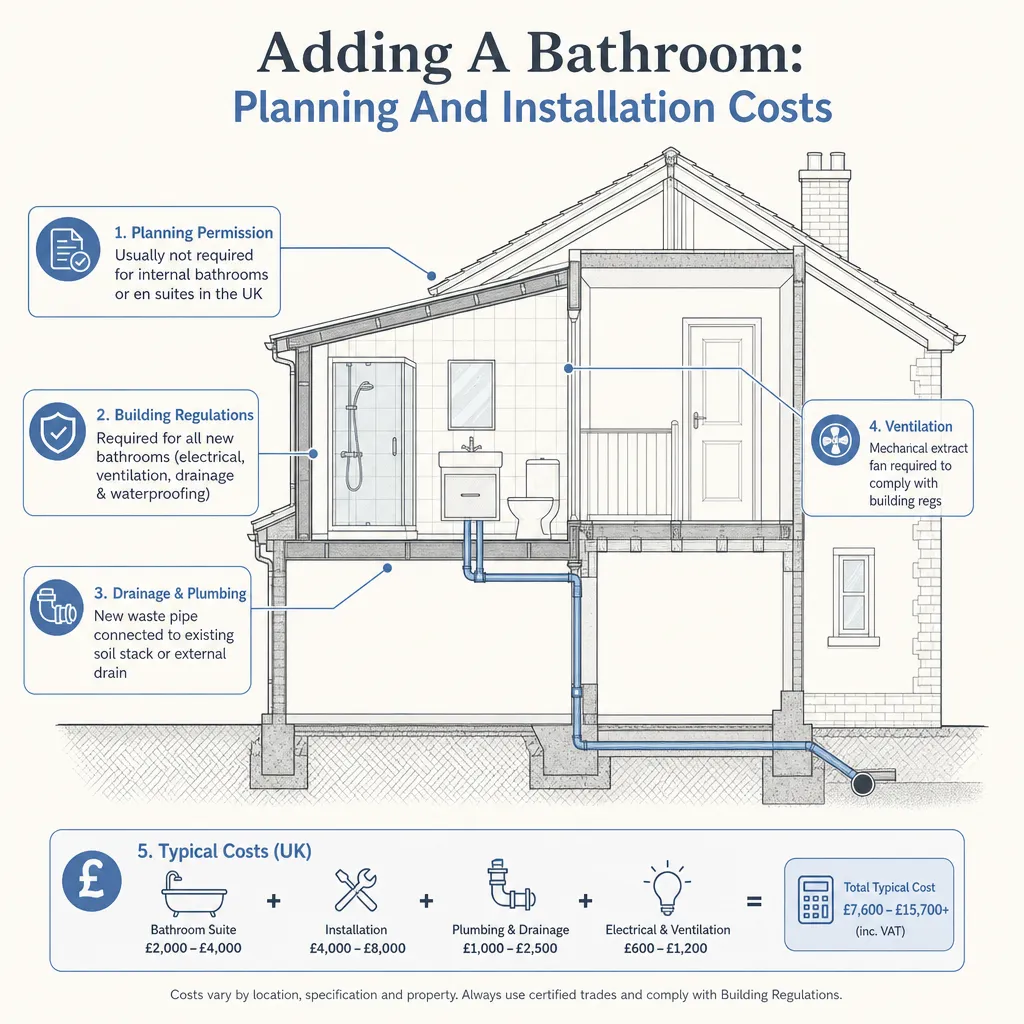
Adding A Bathroom: Planning And Installation Costs
Adding a bathroom — whether an en suite off a master bedroom, a second family bathroom, a downstairs cloakroom, or a full wet room — is one of the more involved home improvement projects because it combines plumbing, electrical work, tiling, and sometimes structural changes. The costs and regulatory requirements vary considerably depending on whether you are fitting out an existing room or creating new space, and on how far the new room sits from your existing soil stack and drainage runs.
Key points
- Planning permission is not usually required to add a bathroom within the existing footprint of your home, as it is treated as an internal alteration under the Town and Country Planning Act 1990.
- Building Regulations 2010 approval is required in most cases: Approved Document H (drainage), Approved Document G (sanitation and hot water), and Approved Document P (electrical safety) all commonly apply.
- Any new or altered electrical circuits in a bathroom are notifiable work under Part P and must be carried out by a registered competent person (NICEIC, NAPIT, or similar) or notified to your Local Authority Building Control (LABC).
- Indicative costs range from approximately £2,500–£5,500 for a basic downstairs cloakroom to £8,000–£15,000+ for a full en suite with new plumbing runs — indicative UK costs, last reviewed 2026-05-30; figures vary significantly by region, access, and specification.
- In a leasehold flat, you may need landlord or freeholder consent before making any plumbing or drainage changes — check your lease before instructing any contractor.
Do you need planning permission?
For the vast majority of bathroom additions within the existing envelope of your home, planning permission is not required in England. Internal alterations are excluded from the planning control system under the Town and Country Planning Act 1990.
Decision tree: when planning permission may be needed
- Internal addition within existing footprint: planning permission not required in most cases — proceed to building regulations considerations.
- Addition requires an extension or new roof structure: full planning permission is required if the extension exceeds permitted development limits for householder extensions.
- Property is listed at any grade: Listed Building Consent is likely required for any internal alteration — check with your LPA before starting.
- Loft or basement conversion to create the bathroom space: permitted development rules apply to the conversion itself; building regulations will definitely apply regardless.
- Unsure about your property's status: consult your Local Planning Authority or use the Planning Portal's interactive guidance tool before committing to any design.
Building regulations: what applies?
Even where planning permission is not required, building regulations will apply to most bathroom installations. The relevant Approved Documents are:
Approved Document | What it covers | When it applies to a bathroom addition |
|---|---|---|
Part H — Drainage | Foul drainage connections, pipe sizing, drain ventilation | Any new WC, basin, bath, or shower |
Part G — Sanitation and hot water | Water efficiency, overflow provision, unvented cylinder requirements | New hot water outlets, unvented cylinders |
Part P — Electrical safety | Wiring in special locations (bathrooms are Zone 1 and Zone 2) | Any new or altered electrical circuit |
Part F — Ventilation | Minimum extract ventilation rates | Any bathroom without an openable window |
Part A — Structure | Load-bearing floors and walls | Where floor structure may be affected by drainage or weight |
A competent person scheme registration — such as NICEIC or NAPIT for electrical work — allows the installer to self-certify Part P compliance without a separate building control notification. Always request the competent person certificate at completion; you will need it for your records and on future sale.
Where a new drain connection to a public sewer is required, consent must be sought from your sewerage undertaker (your water company) before work begins.
How much does it cost to add a bathroom?
Costs depend on the new bathroom's location, the complexity of new plumbing runs, fittings specification, and your region. The table below gives indicative ranges — always obtain at least three written quotes before proceeding.
Indicative UK costs, last reviewed 2026-05-30
Bathroom type | Indicative cost range | Key cost drivers |
|---|---|---|
Downstairs cloakroom (WC + basin) | £2,500–£5,500 | Proximity to soil stack, tiling specification |
En suite to existing bedroom | £4,000–£9,000 | Plumbing run length, drainage routing, floor type |
Second full bathroom (upstairs) | £5,000–£12,000 | Whether room is already plumbed, joinery, fittings quality |
Wet room with full tiling | £6,000–£15,000+ | Waterproofing system (tanking), underfloor heating, drainage channel |
Loft conversion bathroom | £7,000–£18,000+ | Access complexity, new soil pipe run, structural changes |
Figures exclude VAT unless otherwise agreed with your contractor. Prices vary substantially by region — London and the South East typically run 20–30% above the national average. Obtain multiple written quotes before committing.
Key cost drivers to discuss with any contractor:
- Distance from the nearest soil stack and cold-water supply.
- Whether floors or walls must be opened up for new pipe runs.
- Floor structural capacity — relevant for heavy cast iron or stone baths, or wet room drainage channels.
- Fittings specification: a basic bathroom suite starts from approximately £300; a premium specification can exceed £3,000 before fitting costs.
What to ask before accepting a quote
- What is included and excluded — tiling, sanitaryware, electrical work, plastering, and decoration?
- Who will carry out the plumbing and electrical work, and are they registered with a competent person scheme?
- What building regulations notifications will be made, and who handles them?
- What assumptions does the quote make about access to existing pipes and drainage?
- What happens if hidden problems are found once walls or floors are opened?
- Is VAT included in the quoted price?
- What completion documentation will I receive — competent person certificates, building control sign-off?
- What is the planned programme and sequence of trades?
When to get professional help
Most bathroom additions need a plumber and electrician who both hold competent person registration. Consider involving an architecture practice if the project requires new space through an extension or loft conversion, where drawings and planning submissions will be needed. Seek professional involvement before finalising your design if:
- There is no obvious route for drainage or soil pipe connections from the proposed location.
- The floor structure needs reinforcing for a heavy freestanding bath, stone tiles, or a wet room drainage channel.
- The room is in a basement, where tanking and drainage are more complex.
- The property is a leasehold flat — you will likely need freeholder consent before any plumbing changes.
- The bathroom will be above a kitchen or living room where water damage would be costly.
- The project involves any structural alteration to walls, floors, or ceilings.
How Housey can help
For smaller internal additions, a specialist plumber and Part P electrician are usually sufficient. If the project requires new space through an extension, an architecture practice can prepare drawings and manage the planning process. For full project management from design to completion, a design-and-build firm or an extension builder can coordinate all trades. A building control consultant can help you navigate the regulatory process if you are unsure what approvals are needed. Housey connects you with vetted local professionals across all these disciplines — compare written quotes in one place.
Frequently asked questions
Do you need planning permission to add a bathroom in the UK?
In most cases, no. Adding a bathroom entirely within your existing home is treated as an internal alteration and does not require planning permission in England. Exceptions include listed buildings, where Listed Building Consent may be required for any internal work, and projects that require an extension or structural change exceeding permitted development limits.
Is a second bathroom worth adding to a UK home?
Adding a second bathroom or en suite typically improves a property's marketability, particularly for family homes where only one bathroom is currently shared. The return on investment varies by property type, size, and local market. Speak to a local estate agent for guidance specific to your area before committing to the cost.
Can a plumber do all the bathroom work?
A plumber can handle pipework, drainage, and sanitaryware installation. However, any new or altered electrical circuits — lighting, extractor fans, heated towel rails, electric underfloor heating — must be carried out by an electrician registered with a Part P competent person scheme such as NICEIC or NAPIT, or notified to your Local Authority Building Control.
How long does it take to fit a new bathroom?
A straightforward en suite installation typically takes 5–10 working days for an experienced team. Projects involving new drainage runs, structural changes, or full wet room tiling can take 2–4 weeks or longer. Ask your contractor for a detailed programme before work begins, including the planned sequence of trades.
Do I need a building control inspection for a new bathroom?
If you submit a building notice before work starts, your LABC may inspect at key stages — such as before drainage is covered and at completion. Where trades self-certify under competent person schemes for electrical and drainage work, a council visit is not always required. You should still receive completion certificates for your records and future property transactions.
Sources and further reading
Useful next reads
 Improvement & Build
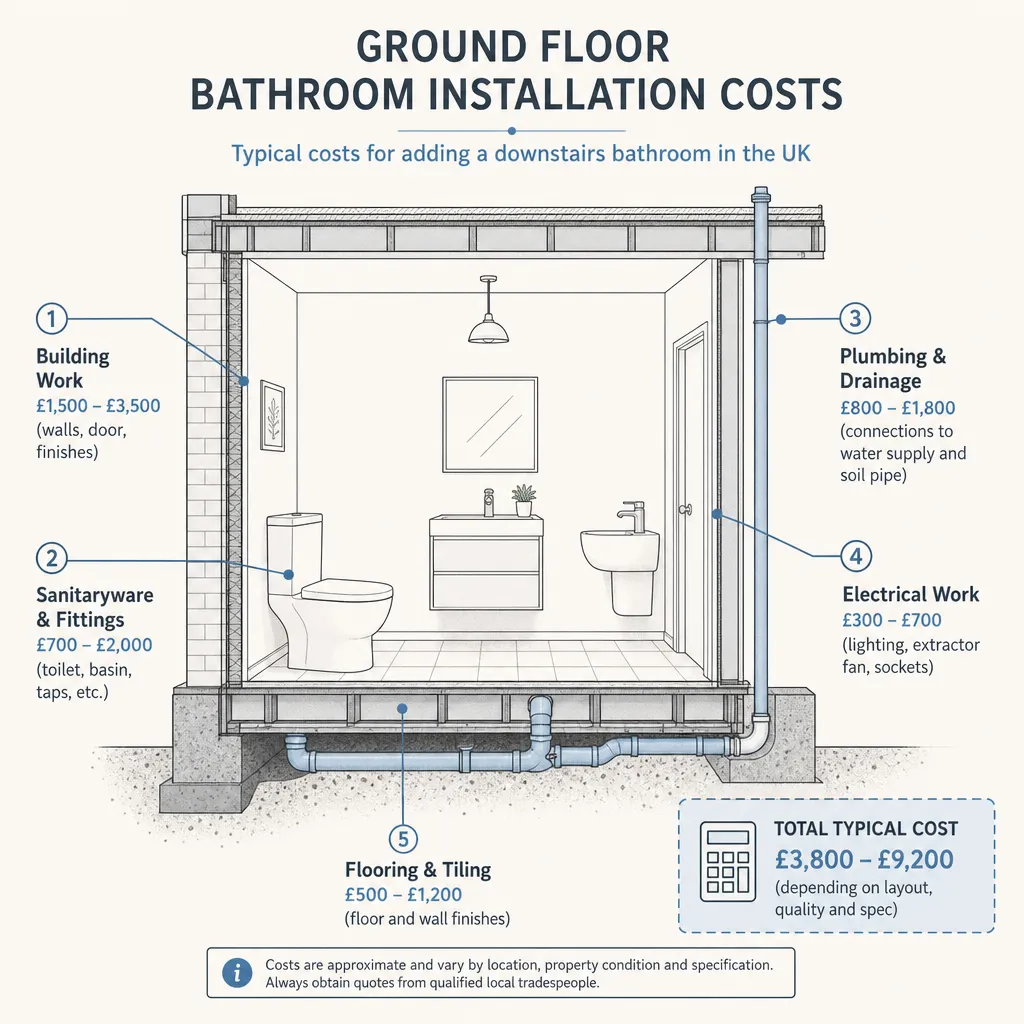
Ground Floor Bathroom Installation Costs
Installing a ground floor bathroom in the UK costs roughly £2,000–£5,000 for a basic cloakroom and £5,500–£15,000 for a shower room or wet room.
 Improvement & Build
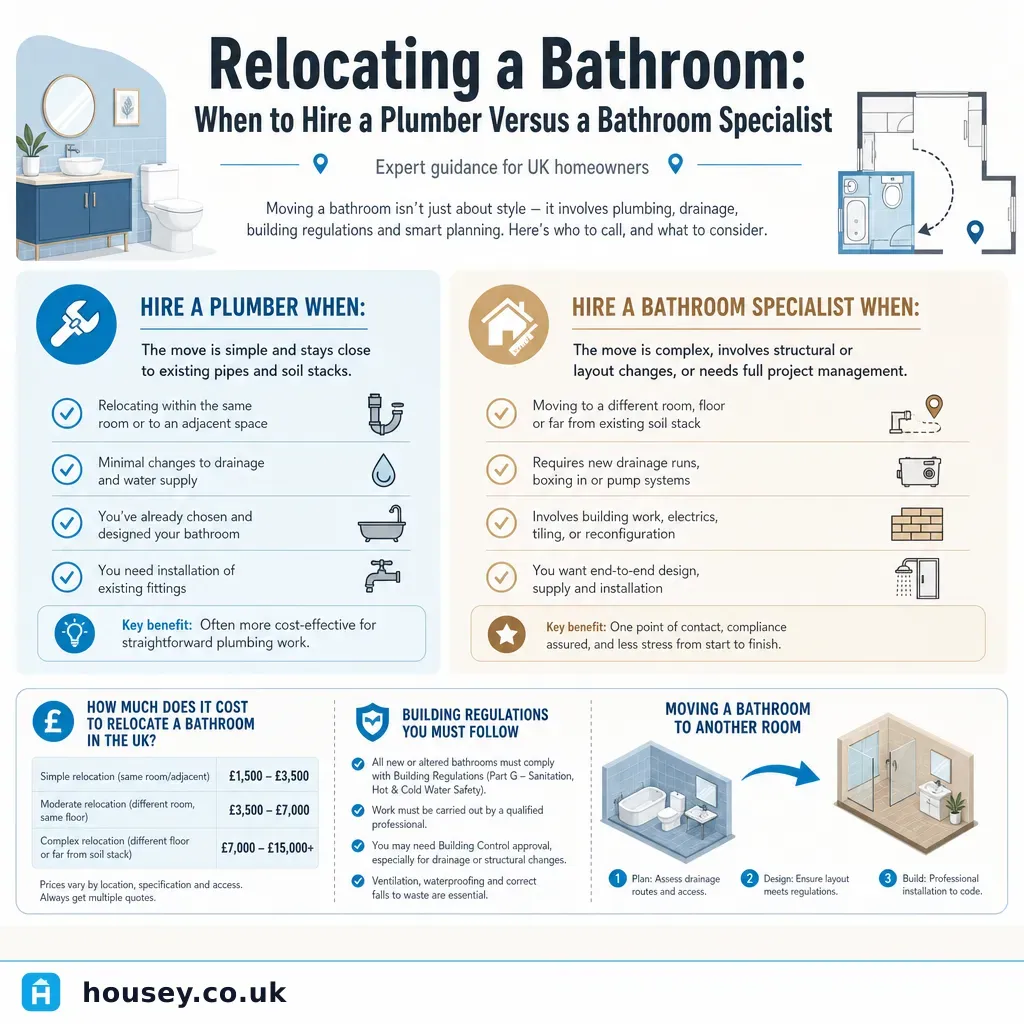
Relocating a Bathroom: When to Hire a Plumber Versus a Bathroom Specialist
Relocating a bathroom usually requires both a qualified plumber for pipework and drainage and other specialist trades for electrics, tiling, and finishes.
 Improvement & Build
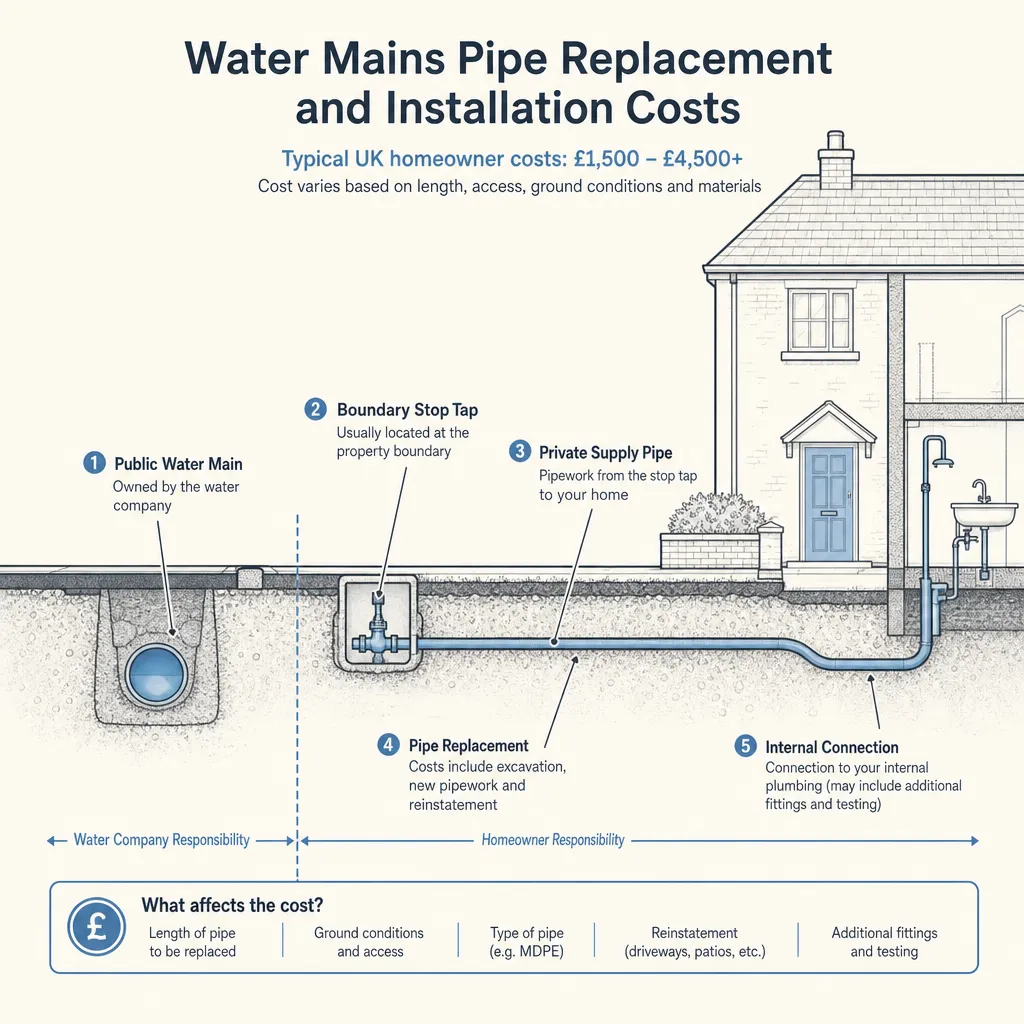
Water Mains Pipe Replacement and Installation Costs
Replacing the supply pipe from the boundary stopcock to your home typically costs £1,500–£3,500 in the UK, depending on pipe length, ground conditions, and whether any hard surfacing must be excavated.
 Improvement & Build
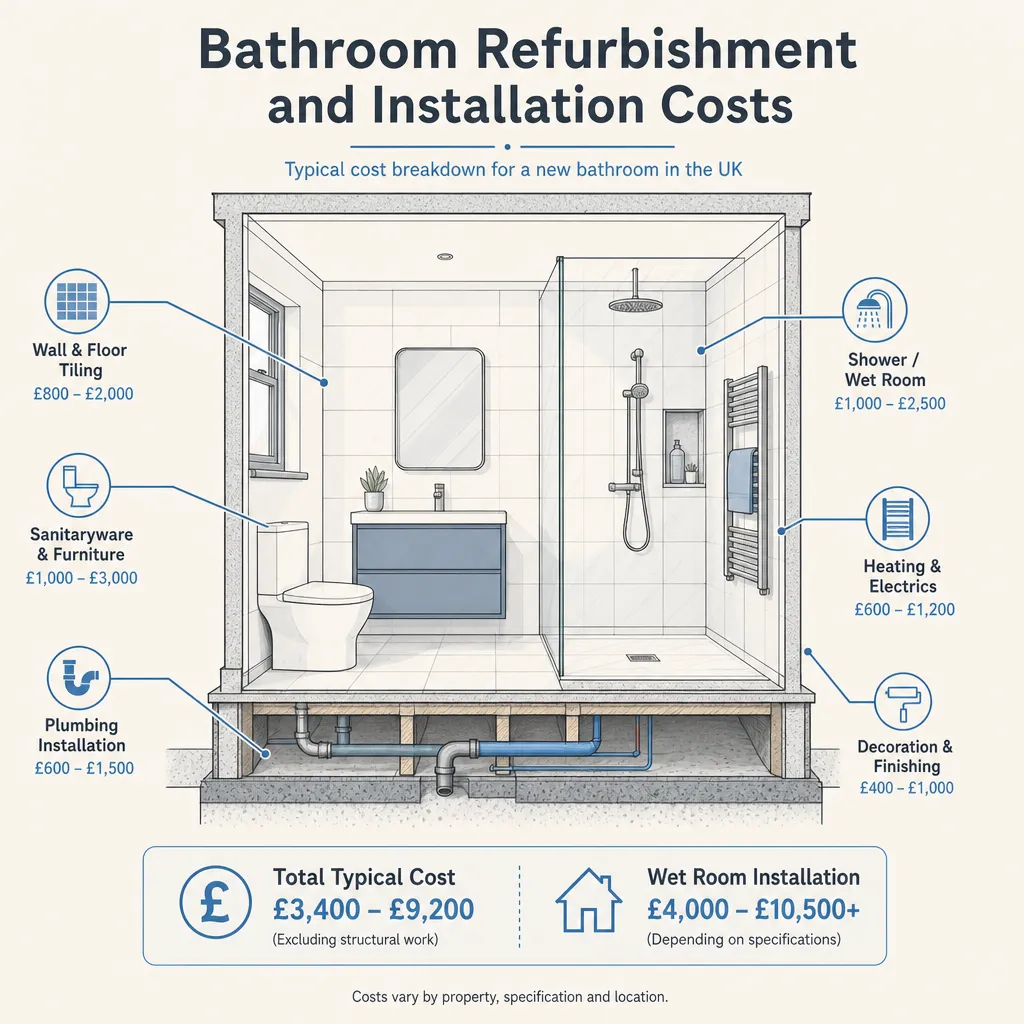
Bathroom Refurbishment and Installation Costs
A basic UK bathroom refurbishment typically costs £2,500–£5,000; a mid-range renovation with a revised layout runs £5,000–£10,000; a high-end or wet room installation can reach £12,000–£16,000 or more.
 Improvement & Build
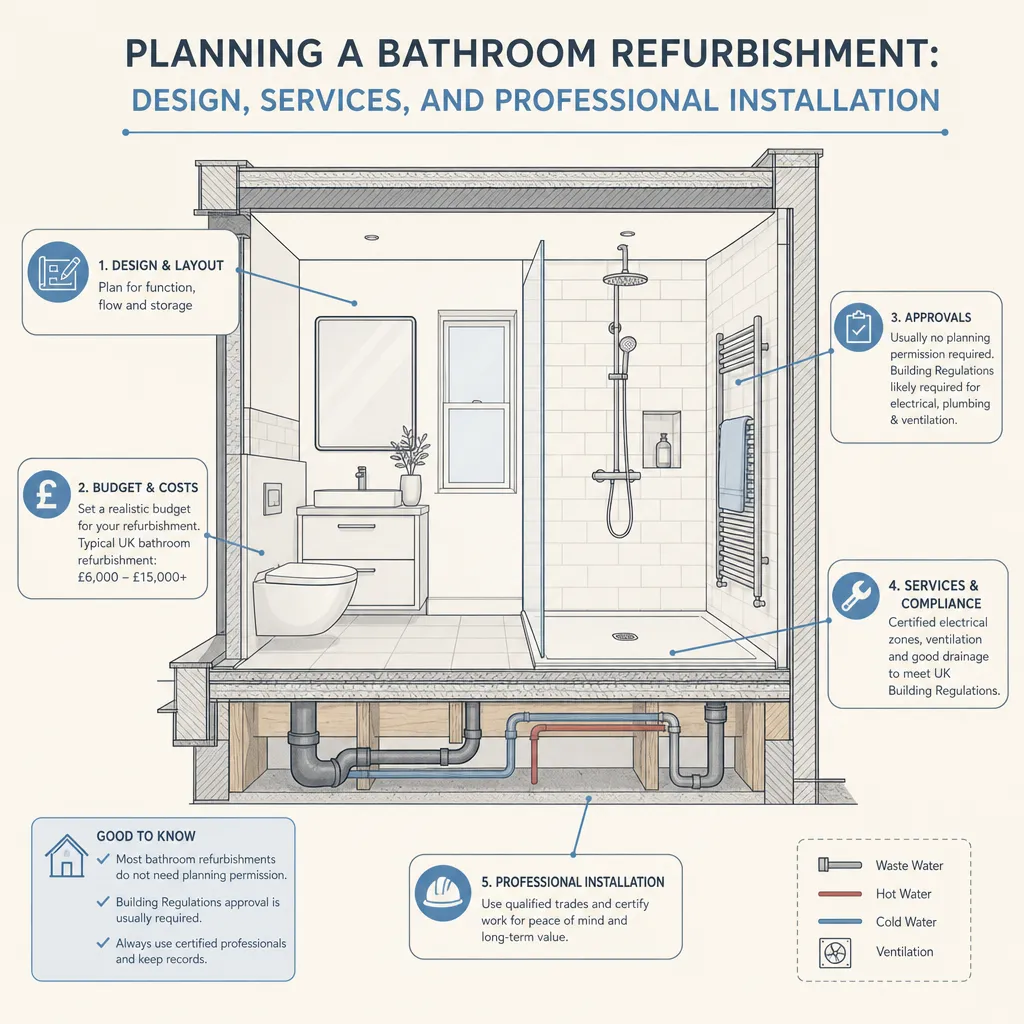
Planning a Bathroom Refurbishment: Design, Services, and Professional Installation
A bathroom refurbishment in the UK typically involves at least three trades — plumber, electrician, and tiler — and costs £4,000–£12,000 for a full project.