Ground Floor Bathroom Installation Costs
By Housey · Last reviewed 7th of May 2026
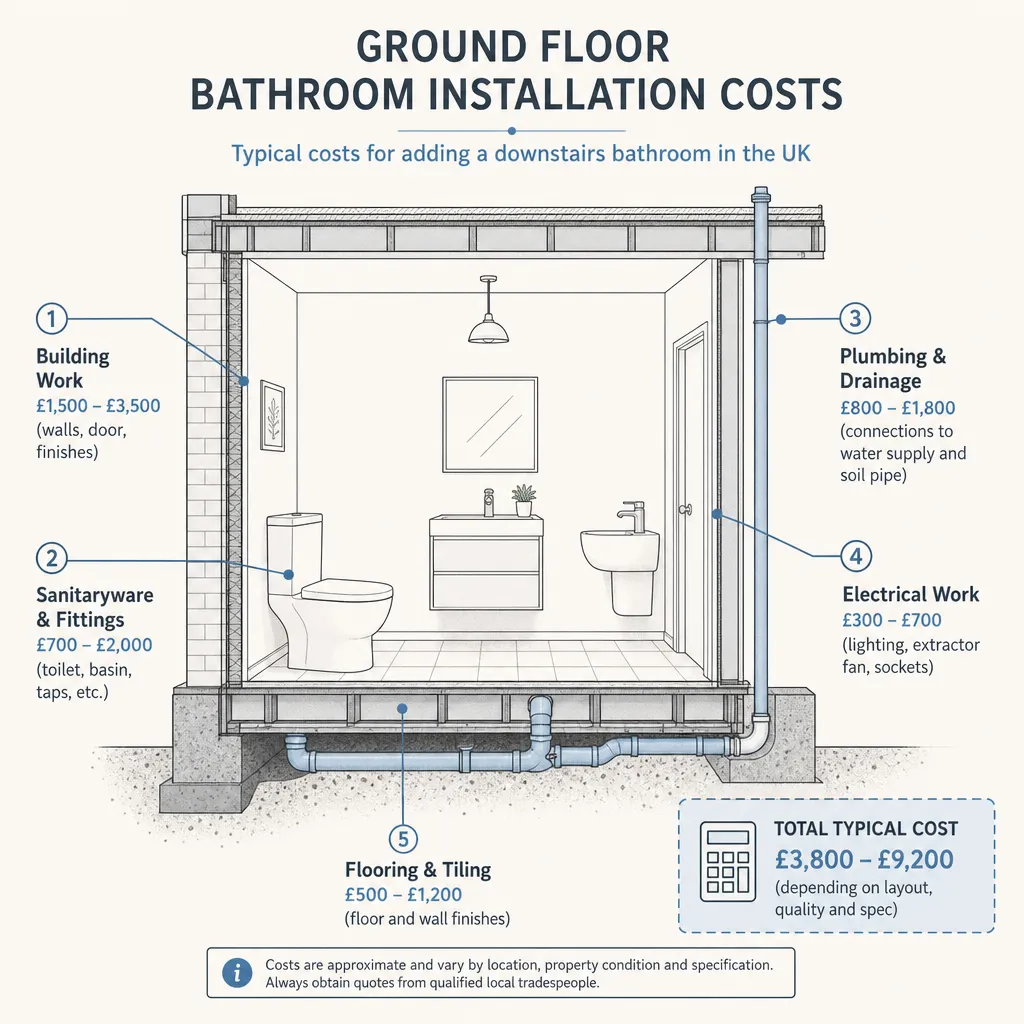
Ground Floor Bathroom Installation Costs
Adding a bathroom at ground floor level — whether a compact cloakroom, a shower room, or a fully tanked wet room — is one of the more impactful improvements a homeowner can make. The project typically arises when a growing family is sharing a single upstairs bathroom, when a household member needs level-access facilities close to hand, or when a ground floor extension creates space to add washing facilities. Costs vary considerably depending on scope, drainage access, and site conditions.
Key points
- Building Regulations approval is required for any new bathroom where drainage connections are made, under Approved Documents G (sanitation) and H (drainage); planning permission is generally not needed for purely internal works.
- Connecting to an existing soil stack within approximately 3 metres horizontally keeps drainage costs substantially lower than longer runs, which may need a pumped macerator unit or concrete floor excavation.
- A basic ground floor cloakroom (toilet, basin, extractor fan) typically costs £2,000–£5,000 installed; a full shower room or wet room costs £5,500–£15,000 or more depending on finishes and drainage complexity.
- Approved Document F (Building Regulations) requires mechanical extraction in bathrooms without an openable window of adequate area; a humidistat fan is the standard solution.
- Water supply connections must comply with the Water Supply (Water Fittings) Regulations 1999, and certain fittings require notification to the water undertaker.
What determines the cost of a ground floor bathroom?
Two factors dominate: the scope of the installation and the site conditions. Before requesting quotes, it helps to understand which apply to your property.
Scope:
- Cloakroom (toilet and basin only) vs shower room (enclosed shower, toilet, basin) vs full wet room (level-access, fully tanked floor and walls, linear drain).
- Whether new partition walls or structural alterations are needed to form the room.
- Quality of sanitary ware and finishes specified.
Site conditions:
- Drainage access: proximity to an existing soil stack. Longer horizontal runs may require a pumped macerator or floor break-out.
- Floor type: solid concrete floors require breaking out for gravity drainage; suspended timber floors allow underfloor pipe runs with less disruption.
- Water supply: distance from existing hot and cold pipework.
- Existing condition: electrics for fan and lighting, existing plaster, and structural integrity of the space.
Worked example: converting an under-stair cupboard in a 1930s semi
Scenario: A 1930s semi-detached house in the East Midlands. The owners want to convert a 2m × 1.8m under-stair cupboard into a cloakroom. The soil stack runs on the external rear wall approximately 2.5 metres from the proposed WC position. The solid concrete floor needs breaking out to run the drain connection.
Work element | Indicative cost |
|---|---|
Concrete floor break-out and reinstatement | £300–£600 |
Drainage pipework to soil stack | £400–£900 |
Cold and hot water supply pipework | £200–£500 |
WC and basin (mid-range fittings) | £400–£900 |
Humidistat extractor fan | £80–£200 |
Floor and partial wall tiling | £300–£700 |
Plastering and decoration | £200–£500 |
Building Regulations application fee | £150–£400 |
Labour (plumber and general builder) | £800–£1,800 |
Total (indicative) | £2,830–£6,500 |
Indicative UK costs, last reviewed 2026-05-07. Quotes vary by region, trade availability, and site conditions. Obtain at least three comparative quotes.
Full shower room and wet room costs
A shower room with enclosed enclosure, toilet, basin, and tiling at ground floor level typically runs £5,500–£12,000 installed for a mid-range specification. A wet room — fully tanked floor and walls, level-access linear drain, no enclosure — adds waterproofing complexity and often requires specialist drainage work; £7,000–£15,000 is a reasonable indicative range.
Key cost drivers:
- Tanking and waterproofing: a wet room requires full tanking to at least 1.8m wall height, adding £500–£2,000 depending on floor area.
- Level-access drainage in concrete: cutting a channel and fitting a linear drain in a solid slab is significantly more involved than a standard trap and waste.
- Enclosure vs open wet room: a shower enclosure costs less than full tanking but limits accessibility — relevant for later-life adaptations.
- Specification: designer sanitaryware and natural stone tiling can add £2,000–£8,000 over a functional mid-range fit-out.
Building Regulations: what you need to know
A new ground floor bathroom always triggers Building Regulations, regardless of whether planning permission is needed. Two main application routes exist:
Full plans application: Detailed drawings submitted before work starts. Building control approves them in advance — useful for mortgage lenders and future conveyancing.
Building notice: Notify building control and proceed, with inspections during the build. Less upfront documentation but generally acceptable for straightforward bathroom installations.
Typical building control fees: £150–£400 via the local authority or a registered approved inspector.
Key regulations:
- Approved Document G — minimum sanitation standards, hot water safety (scalding limits at taps), and water efficiency requirements.
- Approved Document H — drainage fall gradients, trap sizing, and ventilation of drainage runs to prevent siphonage.
- Approved Document F — mechanical extraction: minimum 15 litres per second intermittent, or 8 litres per second continuous, for a bathroom.
- Water Supply (Water Fittings) Regulations 1999 — backflow prevention, and notification requirements for certain water fittings.
Drainage options compared
Drainage option | Best for | Main limitation | Indicative additional cost |
|---|---|---|---|
Gravity drainage to nearby soil stack | Stack within ~3m horizontally | Concrete break-out may be needed | Lowest — standard pipework |
Macerator/pump unit (e.g. Saniflo) | Long runs or difficult gravity levels | Cannot serve as sole WC in dwelling; needs electricity | £300–£700 for unit |
Concrete floor break-out, new drain run | Longer gravity drainage routes | Disruptive, longer programme | £500–£1,500+ |
Pipe run under suspended timber floor | 1930s–1970s houses with floor void | Limited by void depth | £200–£600 typically |
Macerator units are a practical solution for cloakrooms with difficult drainage access. Under Building Regulations, they cannot be used for the sole WC in a dwelling — only as an additional WC where a gravity-draining WC already exists elsewhere in the home.
What to ask before accepting a quote
- Does the quote include Building Regulations submission and building control inspection fees?
- Who will make the drainage connection, and do they have experience with concrete floor installations?
- Is VAT included in the price?
- What happens if the floor reveals unexpected complications — reinforcement bars, buried services, or unusual depth?
- Will the plumber notify the water undertaker if required under the Water Fittings Regulations?
- What warranty applies to the labour, and separately, to fixtures and fittings?
- Who is responsible for making good after building control inspection visits?
- What is the programme, and are there sequencing risks such as waiting for an inspection before closing the floor?
When to get professional help
Building Regulations compliance is not optional for new bathroom drainage connections. Use a qualified plumber for all supply and drainage work. Where a gas-fed combination boiler supplies hot water and modifications to the primary circuit are needed, a Gas Safe registered engineer must carry out that element.
Seek specialist input if:
- The proposed drainage level is at or below the level of the public sewer — this may require a sewage pumping station rather than a simple macerator.
- There is suspected asbestos in existing floor tiles, textured coatings, or pipe lagging, which is particularly common in pre-1985 properties. Do not disturb suspect materials before a survey is carried out.
- Existing drains show signs of blockage, slow drainage, or damp odours that could indicate a structural fault in the drainage system.
- A structural wall needs removal or modification to create the bathroom space.
How Housey can help
Housey connects you with vetted drainage contractors who understand ground floor drainage constraints and building control requirements, and with extension builders if your bathroom is part of a larger build or conversion project. Comparing at least three quotes through Housey helps you benchmark what your specific project should cost before committing.
Frequently asked questions
Do I need planning permission for a ground floor bathroom?
In most cases, no. Adding a bathroom within the existing footprint of a home is an internal alteration that does not require planning permission. If the bathroom forms part of a new extension, permitted development rules apply depending on size and location. Building Regulations approval is always required when new drainage connections are made, regardless of planning status.
Can a macerator pump be used for a ground floor bathroom?
Yes, with a key limitation. Macerator units such as Saniflo are useful where gravity drainage is impractical. Under Building Regulations, a macerator cannot serve as the sole WC connection in a dwelling — it must connect to a gravity drain. If the ground floor installation is an additional bathroom where a gravity-draining WC already exists, a macerator is generally acceptable.
How long does a ground floor cloakroom installation take?
A straightforward cloakroom — toilet, basin, basic tiling, and extractor fan — typically takes three to five working days for an experienced plumber and builder working together, assuming no major drainage complications. A full shower room or wet room may take one to three weeks depending on the extent of tanking, tiling, and required drying times between trades.
Does adding a ground floor bathroom add value to a property?
A ground floor cloakroom is widely cited by estate agents as improving saleability, particularly for family homes with a single upstairs bathroom. Indicative value uplift varies considerably by property type and local market; some agents suggest a downstairs cloakroom can add around 5% to perceived value, though this is not guaranteed. A qualified RICS valuer can give a property-specific view.
Do I need to notify my insurer before bathroom works?
It is good practice to notify your buildings and contents insurer before significant plumbing works begin. Some policies contain conditions relating to undisclosed alterations or water damage arising during works. Check your policy wording or speak to your broker before work starts, and ensure the contractor holds appropriate public liability insurance.
Sources and further reading
- Approved Document G: Sanitation, hot water safety and water efficiency — GOV.UK
- Approved Document H: Drainage and waste disposal — GOV.UK
- Approved Document F: Ventilation — GOV.UK
- Water Supply (Water Fittings) Regulations 1999 — legislation.gov.uk
- Finding a builder or tradesperson — Citizens Advice
Useful next reads
 Improvement & Build
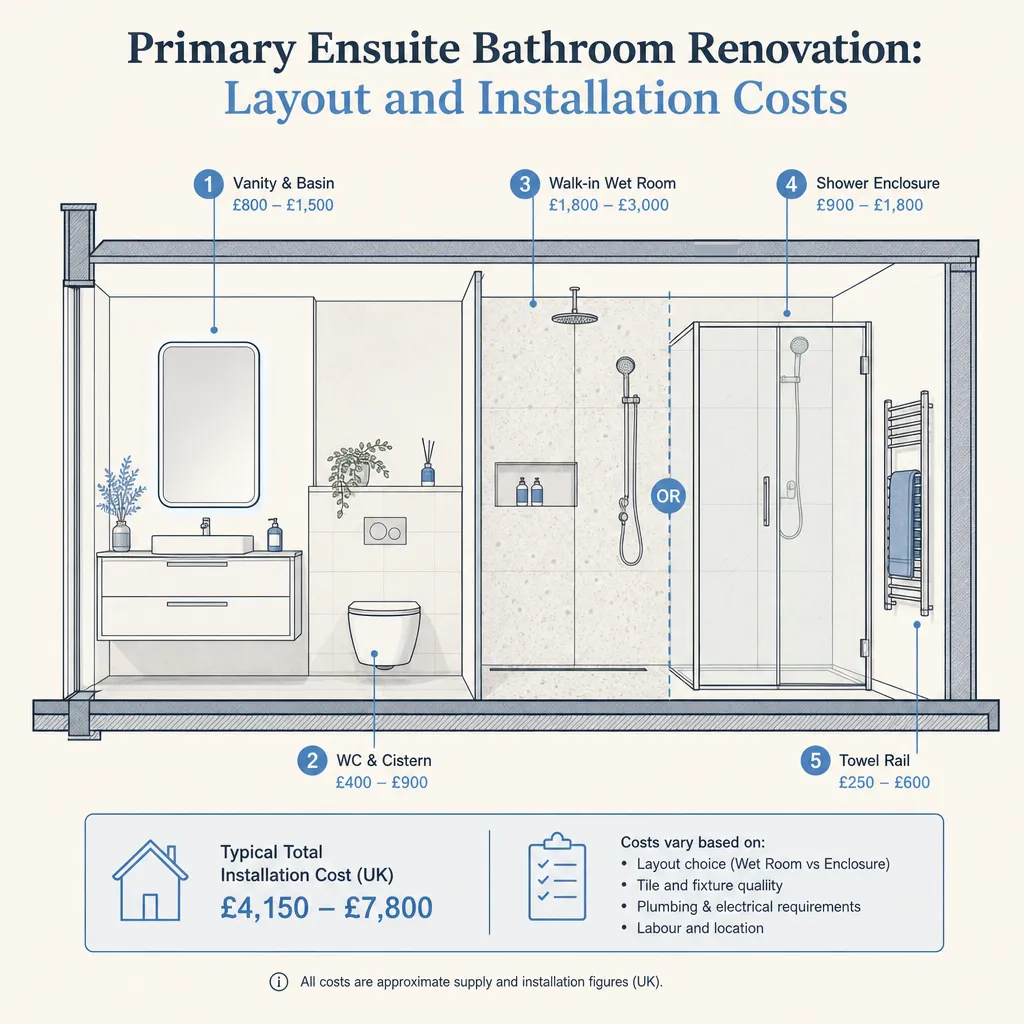
Primary Ensuite Bathroom Renovation: Layout and Installation Costs
A primary ensuite renovation in the UK typically costs between £3,000 and £12,000, depending on size, layout, and specification.
 Improvement & Build
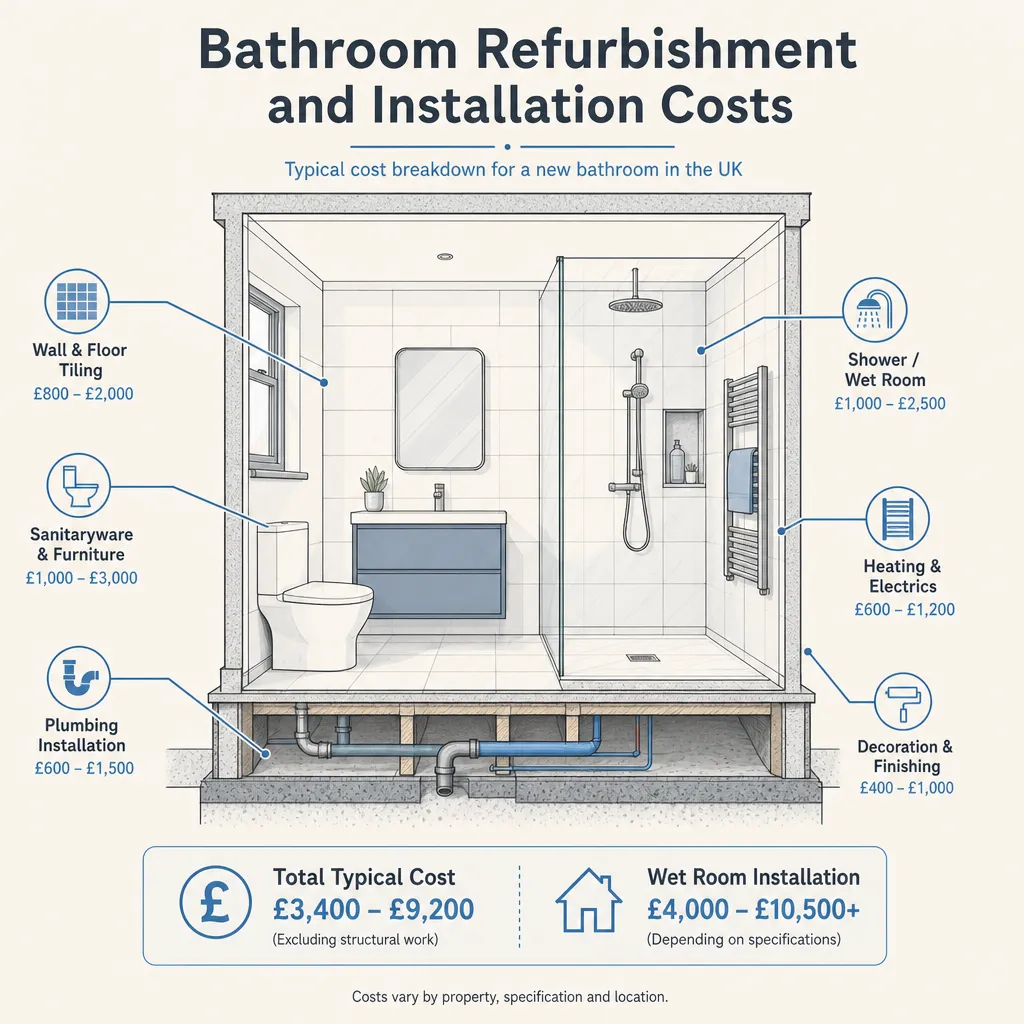
Bathroom Refurbishment and Installation Costs
A basic UK bathroom refurbishment typically costs £2,500–£5,000; a mid-range renovation with a revised layout runs £5,000–£10,000; a high-end or wet room installation can reach £12,000–£16,000 or more.
 Improvement & Build
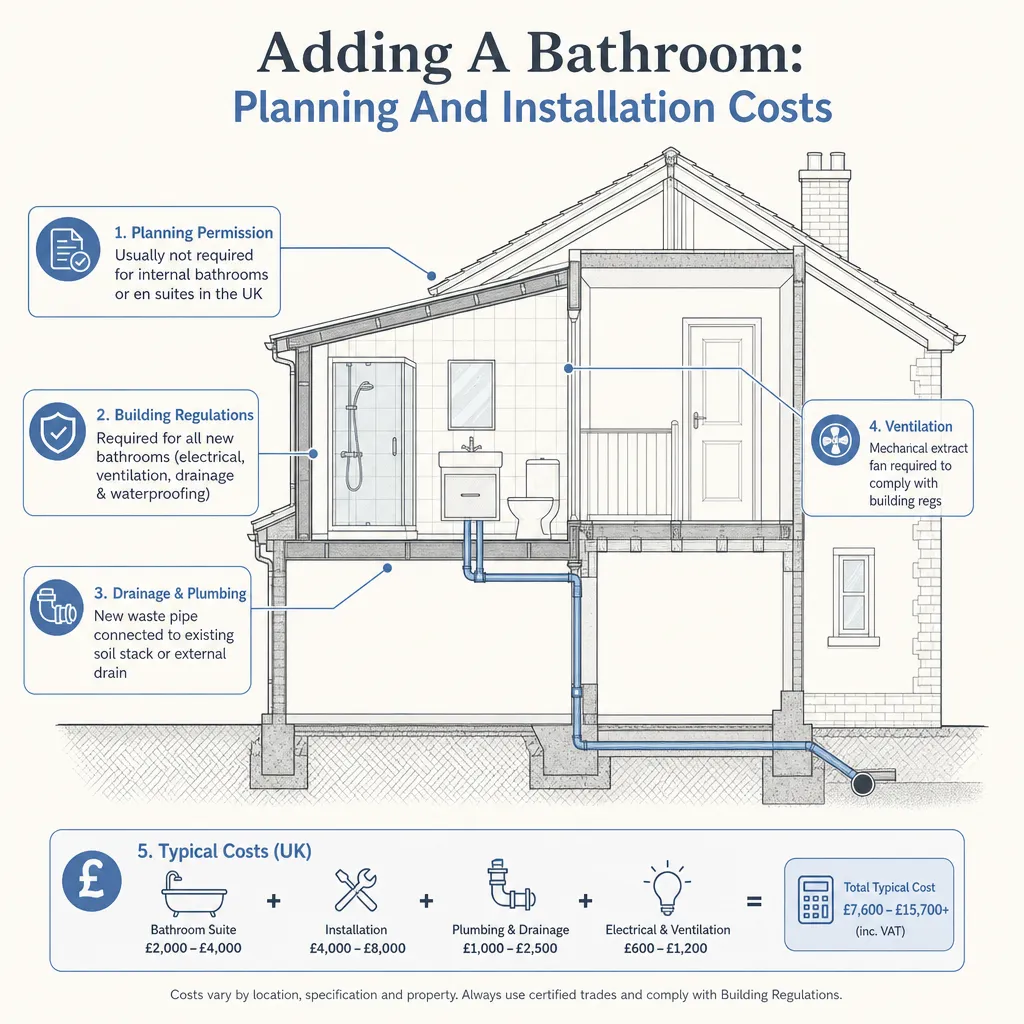
Adding A Bathroom: Planning And Installation Costs
Adding a bathroom within the existing footprint of your UK home usually does not require planning permission.
 Improvement & Build
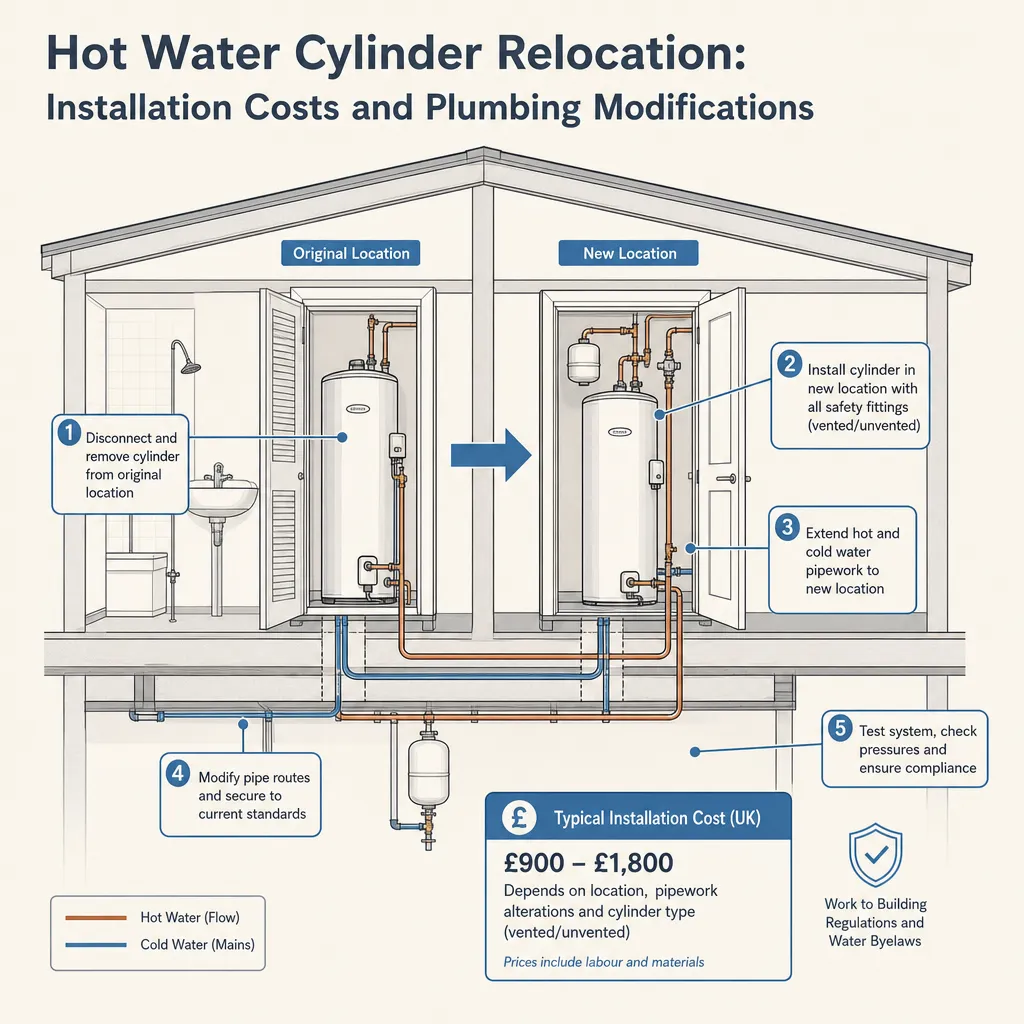
Hot Water Cylinder Relocation: Installation Costs and Plumbing Modifications
Relocating a hot water cylinder typically costs £800–£2,500 in the UK, depending on cylinder type, distance of the move, and the pipework involved.
 Improvement & Build
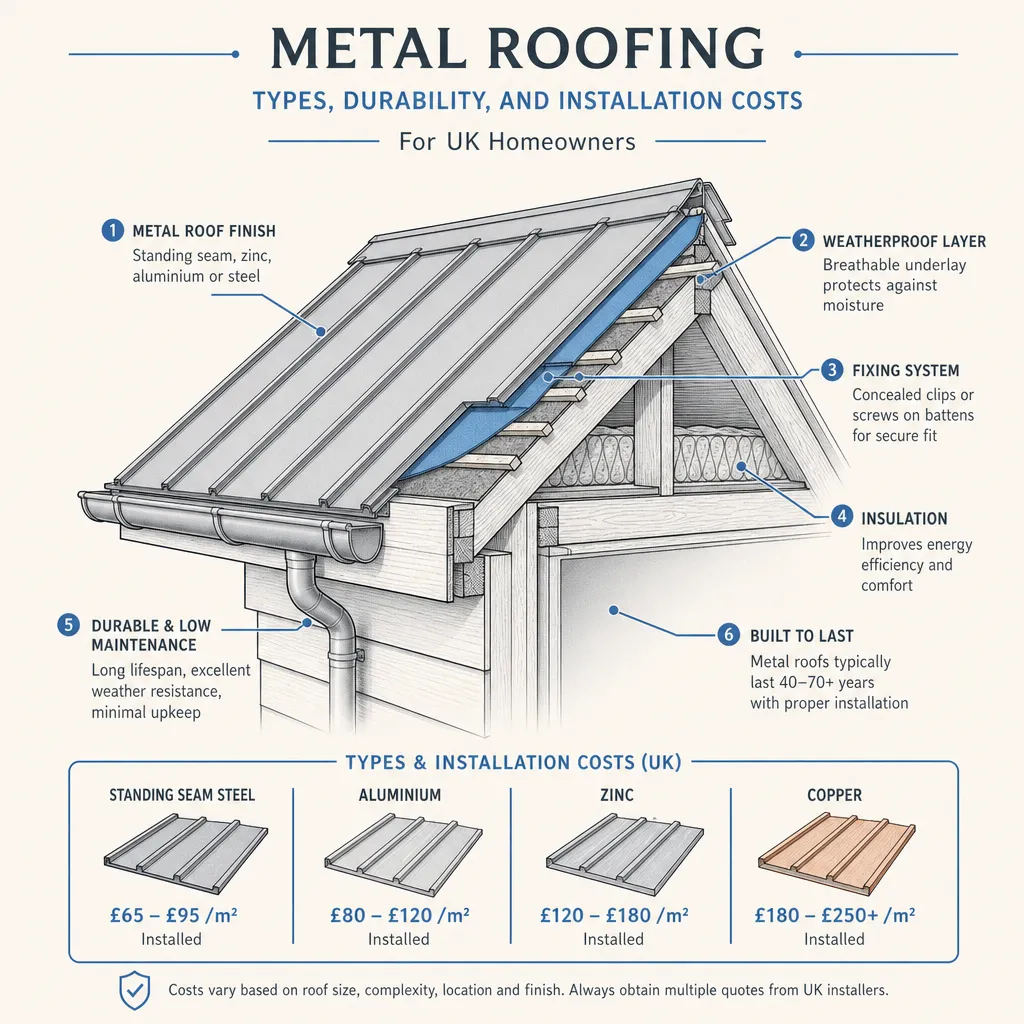
Metal Roofing: Types, Durability, and Installation Costs
Metal roofing in the UK includes standing seam, corrugated sheet, and metal tile systems in steel, aluminium, zinc, or copper.