Relocating a Bathroom: When to Hire a Plumber Versus a Bathroom Specialist
By Housey · Last reviewed 3rd of May 2026
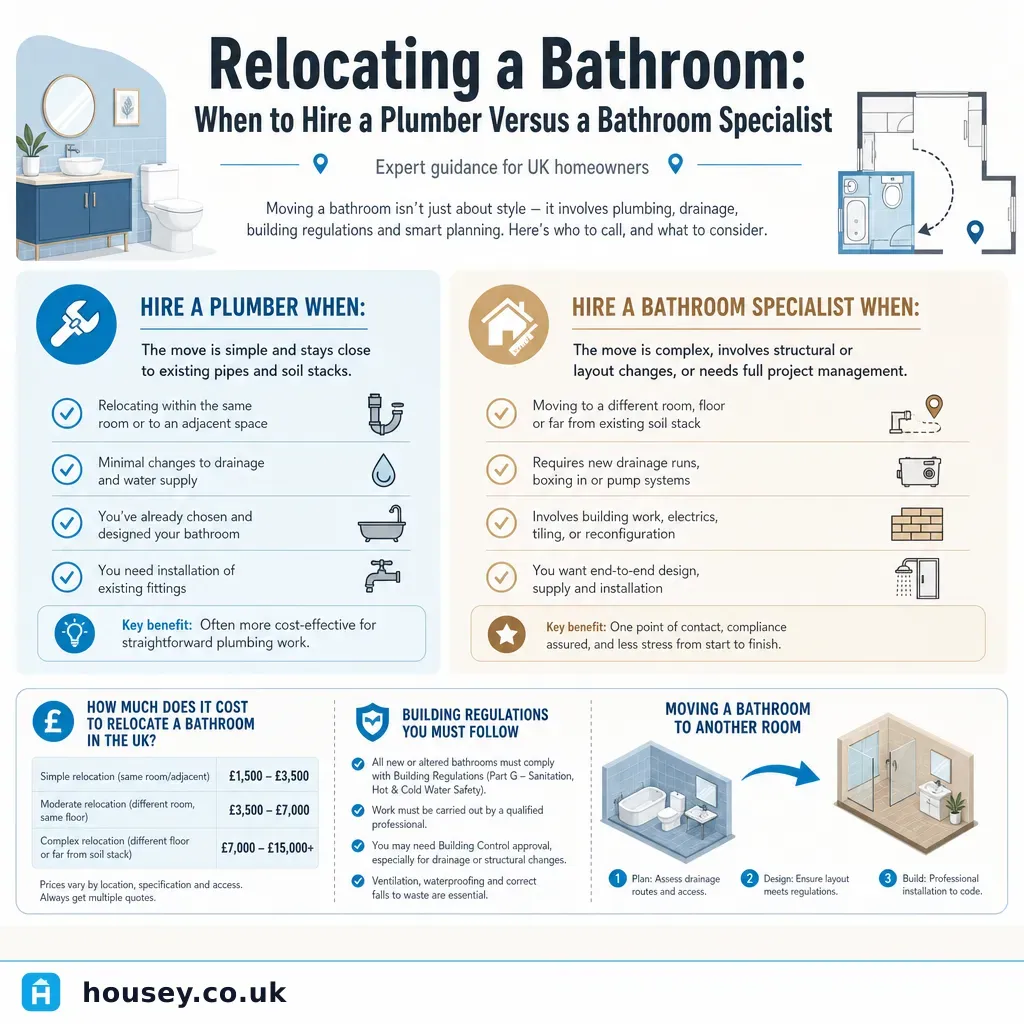
Relocating a Bathroom: When to Hire a Plumber Versus a Bathroom Specialist
Moving a bathroom to a different room or position within a house is one of the more complex domestic projects homeowners undertake. It typically arises when reconfiguring a property layout — perhaps combining two bedrooms, adding an en-suite to a loft conversion, or reorganising a ground-floor extension — and involves coordinating several trades, regulatory requirements, and building fabric considerations. Getting the professional mix wrong can result in costly rework, building control complications, or water damage that takes months to become apparent.
Key points
- Relocating a bathroom involves notifiable work under Building Regulations Part H (drainage), Part P (electrical installations in bathrooms), and potentially Part A (structural) if joists or walls are modified to accommodate new pipe runs.
- Moving or adding a soil pipe connection requires building control notification or sign-off through a registered competent person scheme; a new WC connection cannot simply be made without compliance sign-off.
- A qualified plumber can re-route supply pipes and waste connections but is not typically trained to plan layouts, specify finishes, or coordinate tiling, electrical, and carpentry trades.
- A bathroom specialist or design-and-install company manages the full project scope — layout, sanitaryware procurement, tiling, and multi-trade coordination — but will usually subcontract the specialist plumbing and Part P electrical work.
- Indicative UK costs for bathroom relocation, last reviewed 2026-05-03: expect to budget £4,000–£8,000 for a same-floor move at standard specification, and £8,000–£15,000 or more where structural alterations, new soil stack connections, or cross-floor moves are involved.
What relocating a bathroom actually involves
There is a wide spectrum of complexity in bathroom relocation projects, and the right professional depends significantly on where on that spectrum your project falls.
Moving sanitaryware within the same room: Repositioning a bath or toilet by a metre or two mainly involves extending or re-routing short waste pipe runs and adjusting supply feeds. This is often manageable by a single qualified plumber working alongside a tiler and electrician for the finishes.
Moving a bathroom to an adjacent room on the same floor: More significant. The soil pipe connection and hot and cold supply feeds must be extended across a greater distance. The decommissioned bathroom room must be properly finished — waterproofing stripped, floor made good, walls replastered. Multiple trades are almost always involved, and a bathroom specialist or experienced project manager typically makes the process more efficient.
Moving a bathroom to a different floor or into a new extension: The most complex scenario. A new or extended soil stack may be required, penetrations through floor structures must be managed structurally, and the drainage fall calculations must be carefully worked out. This usually warrants a design-and-build firm or experienced project manager to coordinate all trades and manage the building control process.
Plumber versus bathroom specialist: a decision guide
The right professional depends on the scope of your project and how much coordination you want to manage yourself.
Criterion | Qualified plumber | Bathroom specialist / fitter | Design-and-build firm |
|---|---|---|---|
Re-routing waste and supply pipes | Core scope | Usually subcontracted | Usually subcontracted |
Soil pipe and stack modifications | Core scope | May subcontract | Coordinates or subcontracts |
Layout planning and 3D visualisation | Not typically offered | Often included | Included |
Tile selection and installation | Not in scope | Core scope | Included |
Trade coordination (electrician, plasterer) | Not in scope | Often managed | Always managed |
Part P electrical sign-off | Only if dual-qualified | Typically subcontracted | Subcontracted to NICEIC/NAPIT registrant |
Building control liaison | Possible | Sometimes | Usually managed |
Sanitaryware and finishes supply | Not in scope | Core offering | Included |
Choose a qualified plumber if the project is essentially a limited re-route of existing pipework in the same room and you are comfortable coordinating the other trades yourself.
Choose a bathroom specialist if you want a single point of contact for layout, procurement, fitting, and trade coordination, and the project involves a full room changeover.
Choose a design-and-build firm if the bathroom move is part of a wider project — an extension, loft conversion, or structural reconfiguration — that requires drawings, building regulations submissions, and multi-trade management over several weeks.
Building regulations: what is notifiable
Bathroom relocation commonly triggers several areas of Building Regulations, and understanding which apply helps you choose the right contractor and avoid compliance gaps.
Part H — Drainage and waste disposal: Any new or modified connection to the drainage system — including extending waste pipes, installing a new soil pipe connection, or relocating a WC — is notifiable. Work must achieve adequate pipe falls (typically 1:40 to 1:80 for horizontal waste runs), correct branch connection angles, and access provision for maintenance. The Approved Document H sets out the technical requirements.
Part P — Electrical safety in dwellings: Adding or modifying electrical circuits in a bathroom — including lighting, extract fans, heated towel rails, or underfloor heating — is notifiable work. It must be carried out or certified by a Part P registered electrician (NICEIC, NAPIT, or equivalent scheme member) unless the homeowner notifies building control directly. An unregistered electrician carrying out this work without notification places the homeowner at risk when selling the property.
Part A — Structure: If floor joists must be notched or trimmed to accommodate new pipe runs, the structural integrity of the floor must be maintained in accordance with Approved Document A guidance on permissible notching zones and depths. Notching outside permitted zones requires engineered assessment.
Part F — Ventilation: Bathrooms require mechanical extract ventilation — typically 15 litres per second for a room with a bath or shower, or 6 litres per second for a separate WC only. Moving a bathroom to a room without existing extract means providing a new compliant fan installation, which must be coordinated with the Part P electrical work.
What not to assume
- Do not assume a bathroom fitter includes full plumbing competence. Many bathroom fitters focus on fitting, tiling, and installation rather than major pipe re-routing or soil connection work. Ask specifically what pipework they will carry out and what they subcontract — and to whom.
- Do not assume the soil pipe can be re-routed without structural implications. A 110 mm soil pipe requires a fall, which means it occupies significant depth through a floor void. On an upper floor, this may require joist modification, boxing in, or a dropped ceiling below — all of which have cost and programme implications.
- Do not assume planning permission is needed. Internal bathroom relocation within an existing house does not normally require planning permission unless the property is listed.
- Do not assume VAT is included in initial quotes. Bathroom contractors and plumbers typically charge 20% VAT; always confirm whether figures are inclusive or exclusive before comparing quotes.
- Do not assume one quote covers all trades. A plumber's quote typically excludes electrical work, tiling, plastering, and decoration. The total cost across all trades can be significantly higher than the first number you receive.
Worked UK property scenario
Scenario: The owners of a 1930s semi-detached house in the East Midlands want to move the family bathroom from its existing first-floor landing position into a rear bedroom, which is being combined with an adjoining box room. The original bathroom room will become a storage cupboard off the enlarged landing.
The project required:
- A plumber to extend the soil stack connection through the floor void (requiring notched joists, which needed a structural assessment), re-route hot and cold supply pipes, and connect the new WC, bath, and basin wastes
- A Part P registered electrician to install a new dedicated lighting circuit and an extract fan wired to the lighting circuit with overrun timer
- A plasterer to prepare the new bathroom walls and ceiling
- A tiler to apply wall and floor tiling to the wet zones
- A carpenter to fit bathroom furniture and boxing
- Building control notification for the drainage alteration, joist notching, and electrical work
The homeowners appointed a bathroom specialist who project-managed the works and engaged their regular plumber, electrician, and tiler. The soil stack assessment was handled by a structural engineer engaged by the specialist. Total project cost: approximately £9,800 including sanitaryware supply, all trades, building control fee, and structural assessment — delivered over four weeks on site. All notifiable elements were inspected and signed off.
When to get professional help
Professionals should be involved before work begins — not after problems emerge — in the following situations:
- The relocation requires penetrating a structural floor, especially an upper floor with timber joists that may be weakened by notching
- The property shares a drainage system with a neighbour, which is common in Victorian and Edwardian terraces — check the drainage plan or consult a drainage contractor before assuming a simple connection is possible
- The soil stack is in a shared or party wall — modifications may require serving a party wall notice under the Party Wall etc. Act 1996 before work starts
- The project forms part of a larger extension or structural alteration, in which case the bathroom relocation should be coordinated through the lead contractor from the outset
How Housey can help
If your bathroom relocation is part of a wider renovation or extension project, Housey can help you request quotes from experienced design-and-build firms who manage multi-trade coordination from design through to building control sign-off. For bathroom moves forming part of a structural or ground-up project, you can also request quotes from extension builders with experience of internal reconfiguration work.
Frequently asked questions
Do I need building regulations approval to move a bathroom?
In most cases, yes — at least in part. Moving a WC or bath involves notifiable drainage work under Part H. Adding or modifying electrical circuits in the bathroom is notifiable under Part P. If joists are notched or trimmed for new pipe runs, Part A structural requirements apply. You can either use competent person scheme members who self-certify, or notify your local authority building control directly and pay for inspections.
Can a plumber relocate a bathroom on their own?
A qualified plumber can handle the pipework and drainage aspects of a bathroom relocation. However, a full project typically also requires a Part P registered electrician for lighting, extract ventilation, and any heated towel rail circuits, plus a tiler and plasterer for finishes. Unless you are coordinating those trades yourself, a bathroom specialist or design-and-build firm often provides a more efficient single point of contact.
How much does it cost to relocate a bathroom in the UK?
Indicative UK costs, last reviewed 2026-05-03: moving a bathroom within the same floor typically costs £4,000–£8,000 for a basic project including labour and standard sanitaryware. Moving across floors, or where structural alterations or new soil stack connections are involved, commonly costs £8,000–£15,000 or more. Costs vary substantially by region, property type, and specification. Obtain at least three detailed, itemised quotes before committing.
Does moving a bathroom need planning permission?
Internal bathroom relocation within an existing house does not usually require planning permission. Exceptions include listed buildings, where any alteration may need listed building consent, and in rare cases where a change of room use affects the building's classification. Check with your local planning authority if the property is listed or in a conservation area, or if the relocation forms part of a larger change-of-use project.
What is the difference between a plumber and a bathroom fitter?
A plumber is qualified in pipework, drainage, and often heating systems. A bathroom fitter specialises in installing bathroom furniture, sanitaryware, and tiling, and typically subcontracts complex plumbing or electrical work. For a full bathroom relocation, you generally need both skill sets — either from separate contractors you coordinate yourself, or through a bathroom specialist who manages both as a single package.
Sources and further reading
- Building Regulations Approved Document H: Drainage and waste disposal — GOV.UK
- Building Regulations Approved Document P: Electrical safety in dwellings — GOV.UK
- Building Regulations Approved Document F: Ventilation — GOV.UK
- Party Wall etc. Act 1996: guidance for people carrying out building work — GOV.UK
- NICEIC: Find a registered electrician — NICEIC
Useful next reads
 Improvement & Build
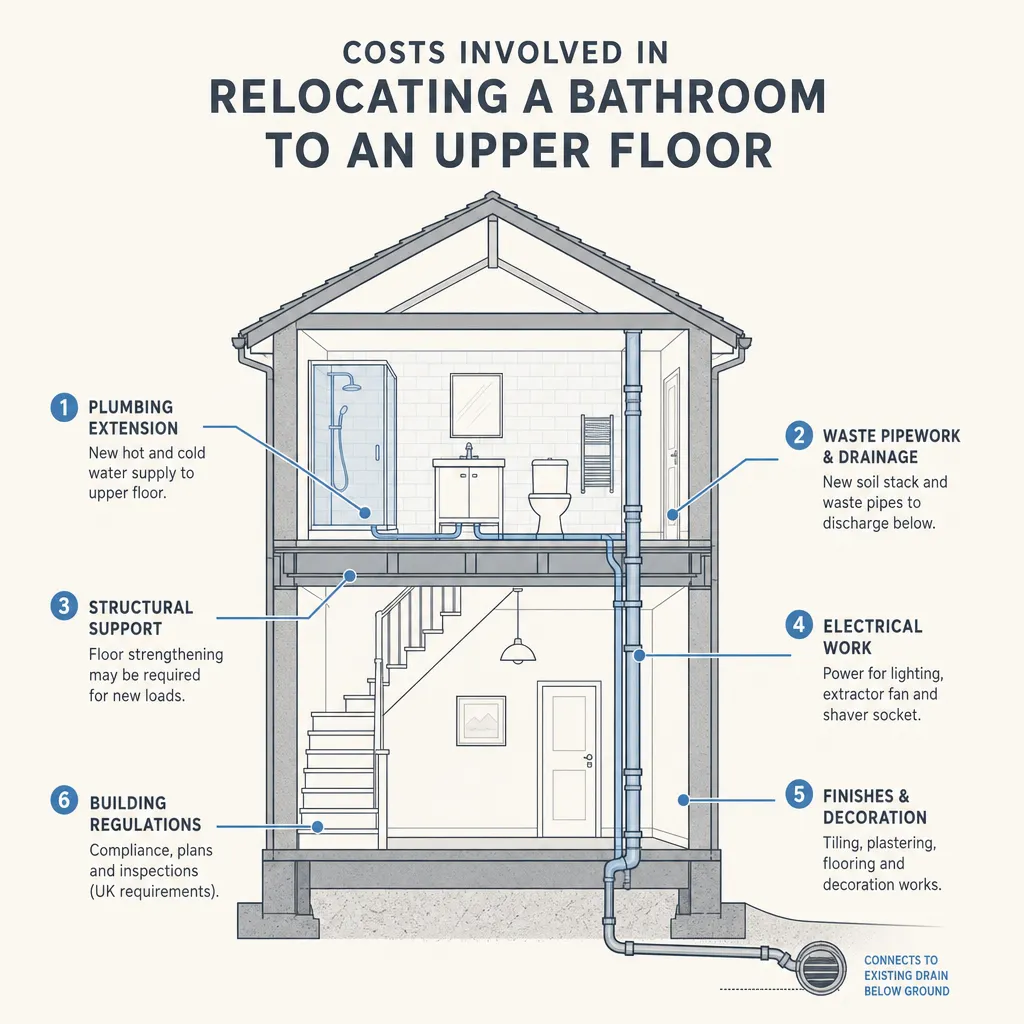
Costs Involved in Relocating a Bathroom to an Upper Floor
Moving a bathroom to an upper floor in a UK home typically costs £7,000 to £20,000 or more, depending on drainage method, structural work required, and finishes chosen.
 Improvement & Build
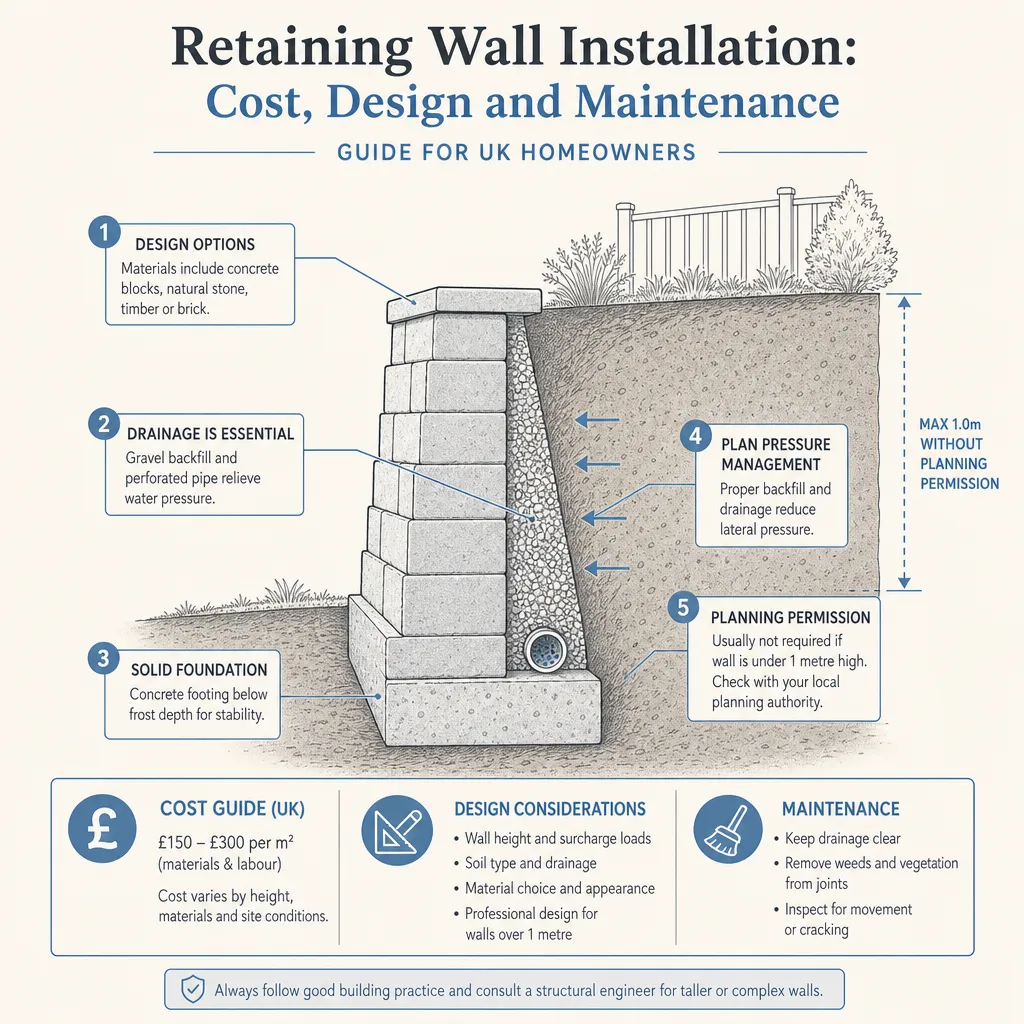
Retaining Wall Installation: Cost, Design and Maintenance
A retaining wall holds back soil on a sloped or banked site.
 Improvement & Build
Evaluating And Planning Renovations For Properties Requiring Modernisation
Start by commissioning a condition survey — RICS Level 3 for pre-1919 properties — to identify structural defects, damp, and services issues before finalising a budget.
 Improvement & Build
Repiping Your Home: Water Supply Line Replacement
Repiping is typically needed when lead, iron, or early polybutylene pipes corrode, leak, or restrict flow.
 Improvement & Build
Expanding Doorways: Planning, Costs, and Building Requirements
Expanding a doorway in a load-bearing wall requires Building Regulations Part A approval and a structural engineer's lintel design.