Adding a bedroom or living space above an existing garage
By Housey · Last reviewed 6th of May 2026
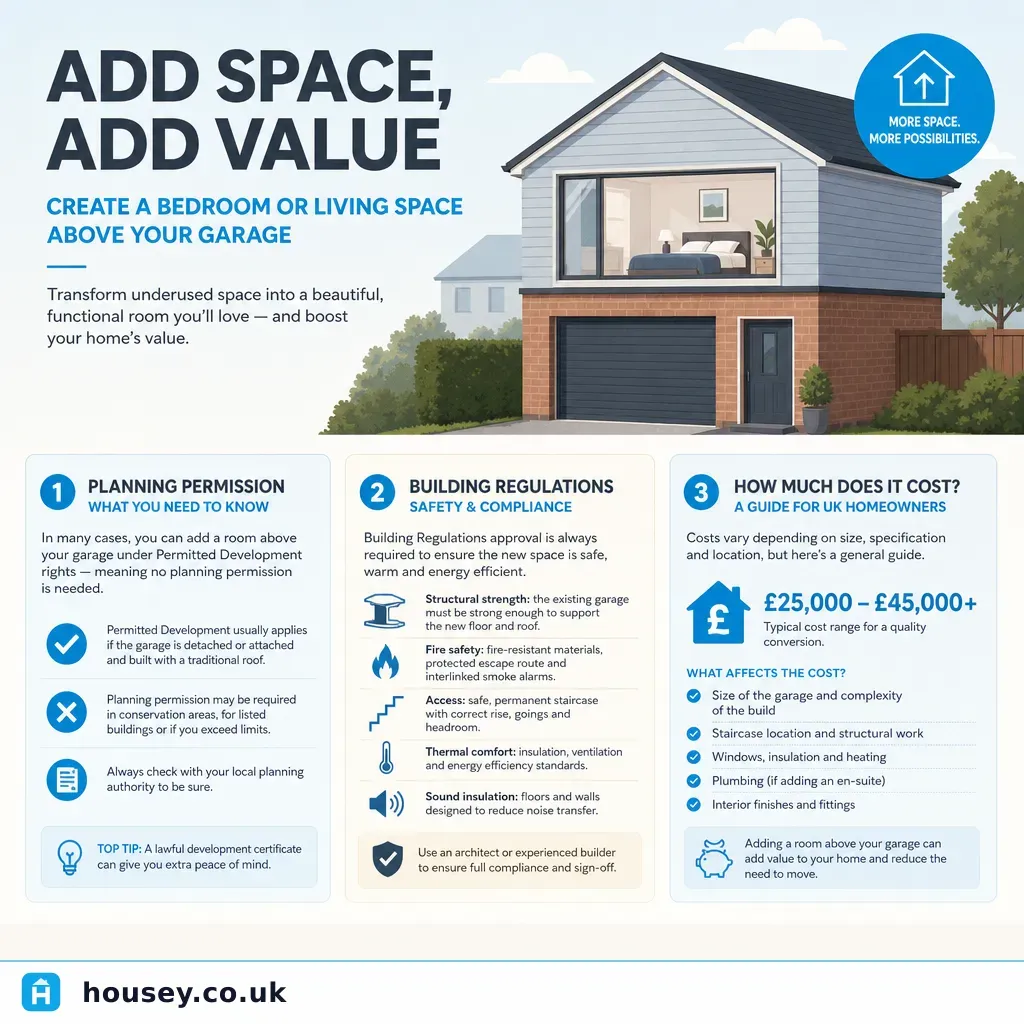
Adding a bedroom or living space above an existing garage
Building above an existing garage is one of the more ambitious ways UK homeowners create extra rooms without extending the property's footprint on the ground. The appeal is clear — there is often an underused single-storey structure that could become a bedroom, home office, or guest suite, using land already within the curtilage. But because this project adds significant load to a structure designed for single-storey use, and because it almost always requires formal planning and building control permissions, it sits firmly in the category of works that need professional input before a single drawing is produced.
Key points
- Adding habitable space above a garage almost always requires planning permission from the Local Planning Authority; Permitted Development rights under the Town and Country Planning (General Permitted Development) (England) Order 2015 rarely cover adding a new storey to a garage structure.
- Building Regulations approval under Parts A, B, C, F, L, and P is required separately from planning permission and cannot be bypassed, regardless of planning status.
- A structural engineer must assess whether existing garage walls, foundations, and the surrounding structure can safely carry the additional dead and live loads — this assessment should be commissioned before any design drawings are produced.
- The Party Wall etc. Act 1996 may require formal notices to neighbours if the garage shares a wall or if excavation is planned within 3 metres of a neighbouring structure.
- Indicative total project costs range from £35,000 to £90,000+ depending on structural complexity, floor area, specification, and access arrangements. Indicative UK costs, last reviewed 2026-05-06.
Does adding a room above a garage need planning permission?
In most cases, yes. Permitted Development (PD) rights for householder extensions (Class A of the 2015 GPDO) are calculated from the original dwelling and do not generally cover adding a new upper storey to a detached or attached garage. The most common reasons a full planning application is required include:
- Adding height to the garage to accommodate a new habitable storey.
- Any resulting increase in total curtilage floor area that breaches PD limits.
- Properties in a conservation area, National Park, or Area of Outstanding Natural Beauty, where PD rights are further restricted or removed.
- Listed buildings, which require Listed Building Consent as well as planning permission.
- Properties on estates where PD rights were removed by an Article 4 Direction at the time of construction.
Always apply for a Lawful Development Certificate (LDC) from your Local Planning Authority to confirm whether PD rights apply to your specific situation, or submit a full householder planning application if they do not. Most LPAs offer a pre-application advice service that can flag policy concerns before you pay for full drawings — use it.
Building Regulations requirements
Building Regulations approval is a separate legal requirement from planning permission and is always needed when creating new habitable space. The key Parts applicable to most above-garage conversions in England are set out below.
Building Regulations Part | What it covers | Typical requirement |
|---|---|---|
Part A (Structure) | Loads and stability | Structural engineer's report; new steel floor beams; upgraded or new walls |
Part B (Fire safety) | Means of escape, fire spread | Fire-resistant door between habitable space and remainder of the house; escape window or protected staircase route |
Part C (Resistance to moisture) | Damp and weather-tightness | Continuous DPC; suitable wall and roof construction for the new storey |
Part F (Ventilation) | Air quality | Trickle vents or Mechanical Ventilation with Heat Recovery (MVHR) depending on airtightness level achieved |
Part L (Energy efficiency) | Insulation performance | Wall, floor, and roof U-values to comply with Approved Document L |
Part P (Electrical safety) | Fixed wiring | Notifiable electrical work carried out or certified by a registered NICEIC or NAPIT electrician |
Your building control body — the local authority building control officer (BCO) or a registered Approved Inspector — will inspect at key stages and issue a Completion Certificate on satisfactory completion. Without this certificate, mortgage lenders and future conveyancers will treat the works as unauthorised.
Structural considerations: what needs to change?
A standard UK garage is typically constructed with 100 mm blockwork or brickwork walls on a modest strip foundation designed for single-storey loads. Adding habitable space above introduces substantial new loading:
- Floor dead loads (steel beams, joists, boarding, plaster finishes, furnishings): approximately 1.5–2.5 kN/m²
- Imposed (live) loads from occupancy: 1.5 kN/m² for residential rooms to BS EN 1991-1-1
- Additional wall and roof loads from the upper-storey structure above
A structural engineer will assess whether the existing foundations, walls, and lintels can carry these loads and design new structural elements. New steelwork — typically universal steel beams (RSJs) — is commonly required to span the garage opening and carry the new floor. The garage door opening is a particular structural challenge: a robust new frame must carry the floor above independently of any door mechanism.
Which professional do you need? A decision guide
- Appoint a structural engineer first — before any other professional — to confirm feasibility and provide early cost guidance on structural elements. Without this assessment, design costs could be wasted.
- Appoint an architect or architectural technologist to produce planning drawings, design the room layout, staircase, and new façade, and to coordinate Building Regulations submissions.
- Engage a building control body early to agree the design approach; a full plans application is strongly recommended for complex structural projects over a building notice.
- Instruct a party wall surveyor if the garage adjoins or shares a wall with a neighbour's property.
- Appoint a main contractor or specialist conversion builder only after drawings and structural calculations are complete and permissions are in place.
- If the garage is fully detached, also consider a building services engineer to plan new heating, electrical, and plumbing connections.
- If there is any sign of cracking, movement, damp, or settlement in the existing garage structure, arrange a structural condition survey before commissioning design work.
Pre-application checklist for homeowners
Before submitting a planning application, work through this checklist:
What should you budget?
Costs vary considerably depending on the structural condition of the existing garage, the floor area being created, location, and finish specification. The table below gives indicative ranges for professional fees and construction costs.
Cost element | Indicative range | Notes |
|---|---|---|
Structural engineer (assessment + calculations) | £800–£2,500 | More complex structures and multi-party situations cost more |
Architect or architectural technologist | £2,500–£6,000 | Planning drawings plus full Building Regulations package |
Planning application fee (England) | Confirm with LPA | Fees are subject to change; check GOV.UK planning fee guidance |
Building Regulations fee | £400–£900 | Varies by local authority and declared project value |
Party wall surveyor (if required) | £700–£2,000 | Per surveyor; both parties may instruct their own |
Construction (main works, all-in) | £30,000–£75,000+ | Highly variable: floor area, structural complexity, specification, location |
Estimated total | £35,000–£90,000+ | Obtain at least 3 priced contractor quotes after drawings are issued |
Indicative UK costs, last reviewed 2026-05-06. All figures exclude VAT unless stated. New construction works typically attract VAT at 20%.
Important limitations
This article provides general information about the typical planning, structural, and regulatory requirements for adding habitable space above an existing garage in England. Planning and building regulations rules differ in Scotland (where a Planning Permission and Building Warrant process applies), Wales, and Northern Ireland.
Nothing in this article constitutes structural, legal, planning, or building regulations advice. Every property is different: the age and construction method of your garage, the condition of its foundations, your Local Planning Authority's adopted policies, any restrictions in your title deeds or lease, and the proximity and relationship to neighbouring structures all affect what is possible and what is legally required. A qualified structural engineer, architect, and planning professional should assess your specific property before any commitment to design work or construction is made.
What to ask a qualified professional
Before instructing any professional on an above-garage conversion project, ask the following:
Structural engineer
- Are the existing foundations adequate to carry a full upper storey, or will they need widening or underpinning?
- What new steelwork or structural elements will be needed, and can you provide a rough cost indication at this stage?
- Are there any immediate concerns about the current condition of the garage structure?
Architect or architectural technologist
- Is this project likely to be Permitted Development, or will a full planning application be needed for this specific property?
- What are the most probable planning policy concerns for this proposal?
- Can you coordinate both the planning application and the Building Regulations submission under one fee arrangement?
Building control body
- Should this project be submitted as a full plans application or a building notice, given the structural complexity?
- What inspection stages will you require, and at what programme points should I notify you?
- Will a Completion Certificate be issued on satisfactory completion of all works?
Contractor
- Have you completed comparable above-garage conversions? Can you provide references and photographs of similar projects?
- How do you manage the interface between structural steelwork and the existing building?
- What professional indemnity and public liability insurance cover do you hold?
When to get professional help
This type of project always requires professional input — it is not a works category where a homeowner should attempt to manage design or structural decisions independently. Engage a structural engineer before commissioning any design work if:
- There are visible cracks, out-of-plumb walls, signs of settlement, or persistent damp in the existing garage structure.
- The garage is semi-detached, or its walls abut or are close to a neighbour's property.
- The property is listed, within a conservation area, or subject to an Article 4 Direction.
- Your title deeds contain restrictive covenants limiting alterations.
- You are uncertain about the position of gas, electrical, or drainage services running through or near the garage.
Do not begin any structural or construction work until planning permission (where required) has been formally granted and Building Regulations drawings have been approved by the building control body — or a building notice has been formally accepted.
How Housey can help
Housey connects homeowners with vetted professionals at every stage of an above-garage conversion. Find experienced garage conversion specialists who have handled structural above-garage projects, commission a structural engineering assessment of your existing garage before any design work begins, work with building control consultants to navigate the approvals process efficiently, or engage architectural technologists to produce planning and Building Regulations drawings.
Frequently asked questions
Can I add a room above a garage under Permitted Development?
In most cases, no. Permitted Development rights for householder extensions do not typically cover adding a new storey to a garage, whether attached or detached. Apply for a Lawful Development Certificate from your Local Planning Authority to confirm your specific situation before committing to design costs. Properties in conservation areas, National Parks, or those that are listed face additional restrictions.
How long does the planning and Building Regulations process take?
A householder planning application in England typically takes 8 weeks from valid submission to a decision. Building Regulations full plans approval takes around 5 weeks. Contractor procurement and construction typically add a further 4–6 months depending on programme and site conditions. Allow 9–18 months from initial brief to Completion Certificate as a realistic overall timeline.
Will my home insurance cover an above-garage conversion?
Existing building insurance does not automatically cover structural alterations or an increased rebuild value. Notify your insurer before works start and arrange appropriate contract works insurance for the construction phase. Once complete, update your sum insured to reflect the additional floor area, new structural elements, and any premium finishes.
Do I need a Party Wall Agreement for this type of conversion?
If your garage shares a wall with a neighbouring property, or if any excavation is planned within 3 metres of a neighbouring structure, the Party Wall etc. Act 1996 applies. You must serve formal written notice on affected neighbours before work begins. Failure to do so can result in injunctions halting the project. Allow at least two months for the party wall process.
Sources and further reading
- Planning permission: when you need it — GOV.UK
- Building regulations approval: overview — GOV.UK
- The Party Wall etc. Act 1996: explanatory booklet — GOV.UK / MHCLG
- Approved Document A: Structure — GOV.UK
- Approved Document B: Fire safety (dwellings) — GOV.UK
- Town and Country Planning (General Permitted Development) (England) Order 2015 — legislation.gov.uk
Useful next reads
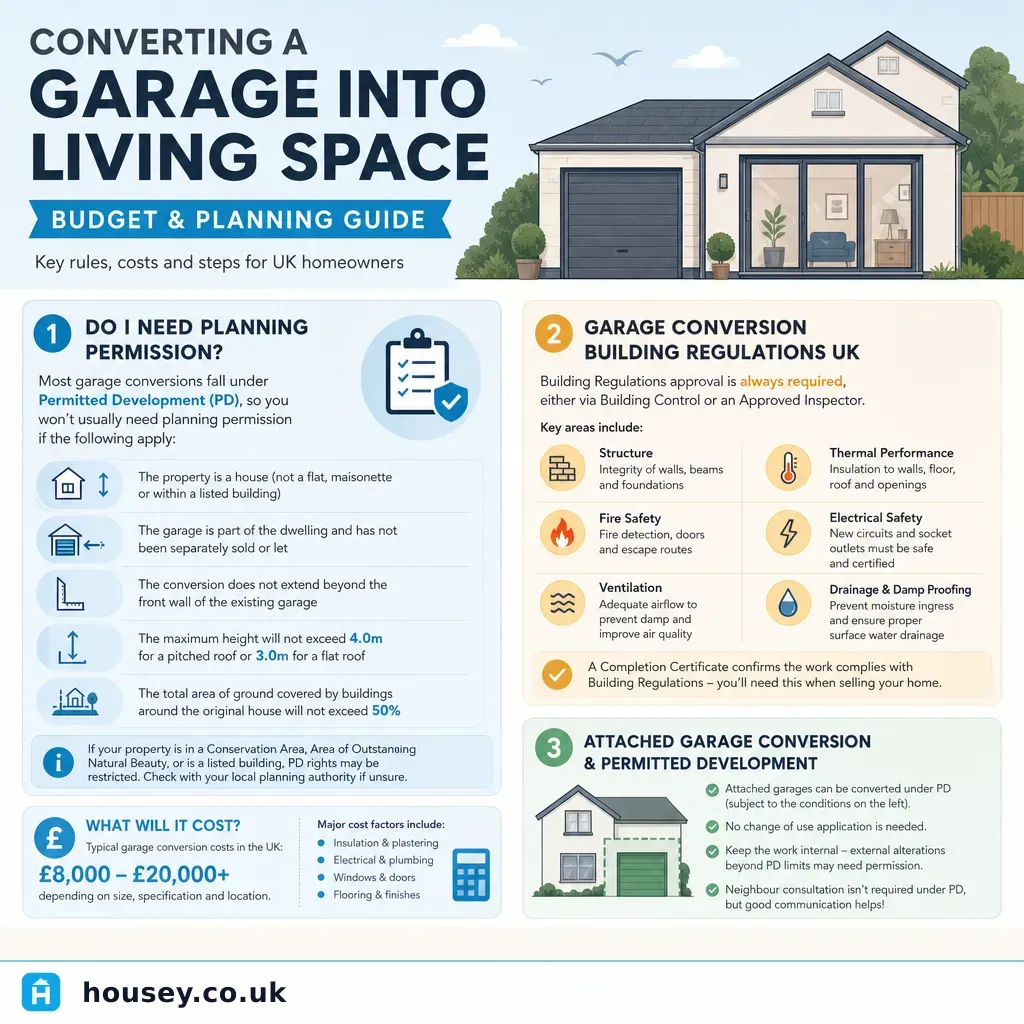 Improvement & Build
Converting a Garage into Living Space: Budget and Planning Guide
A single-garage conversion typically costs £8,000–£20,000 in the UK.
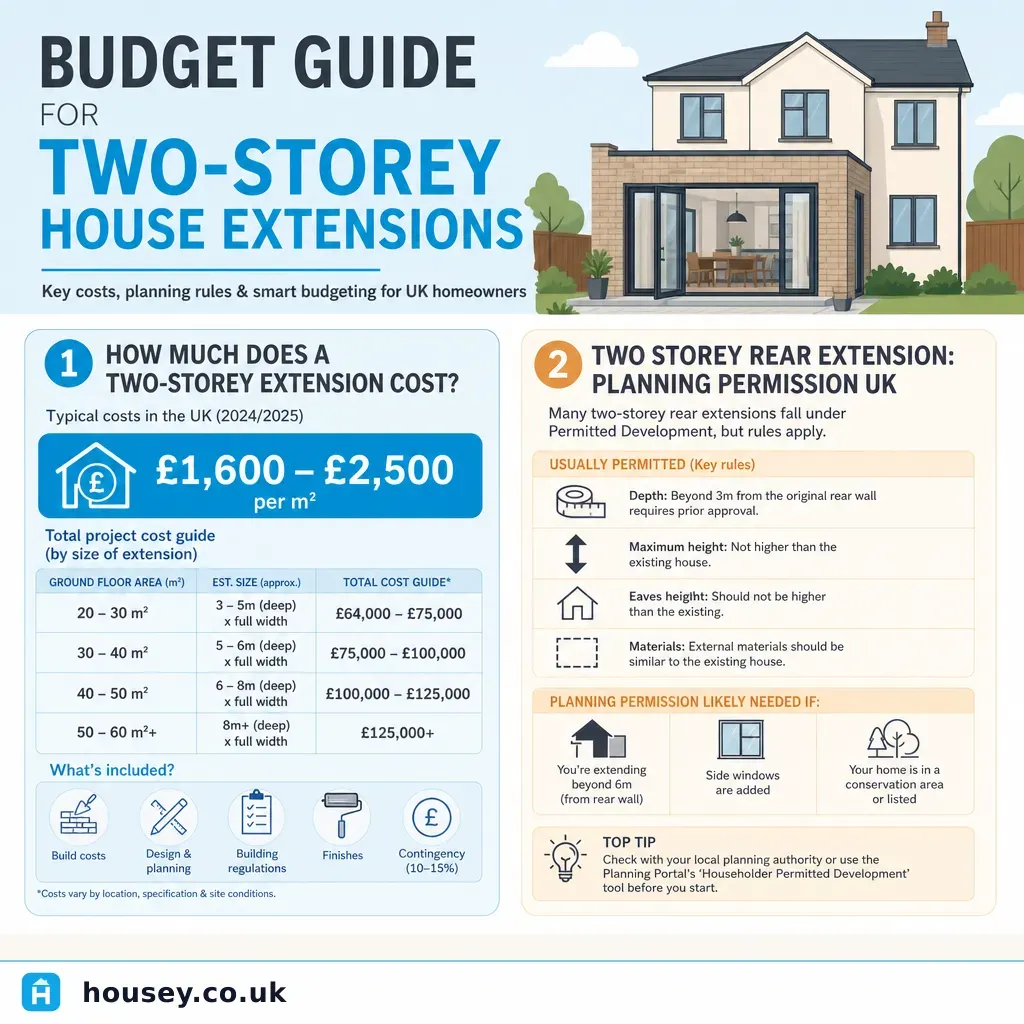 Improvement & Build
Budget Guide for Two-Storey House Extensions
A two-storey house extension in the UK typically costs £1,800–£3,000+ per square metre for the build alone.
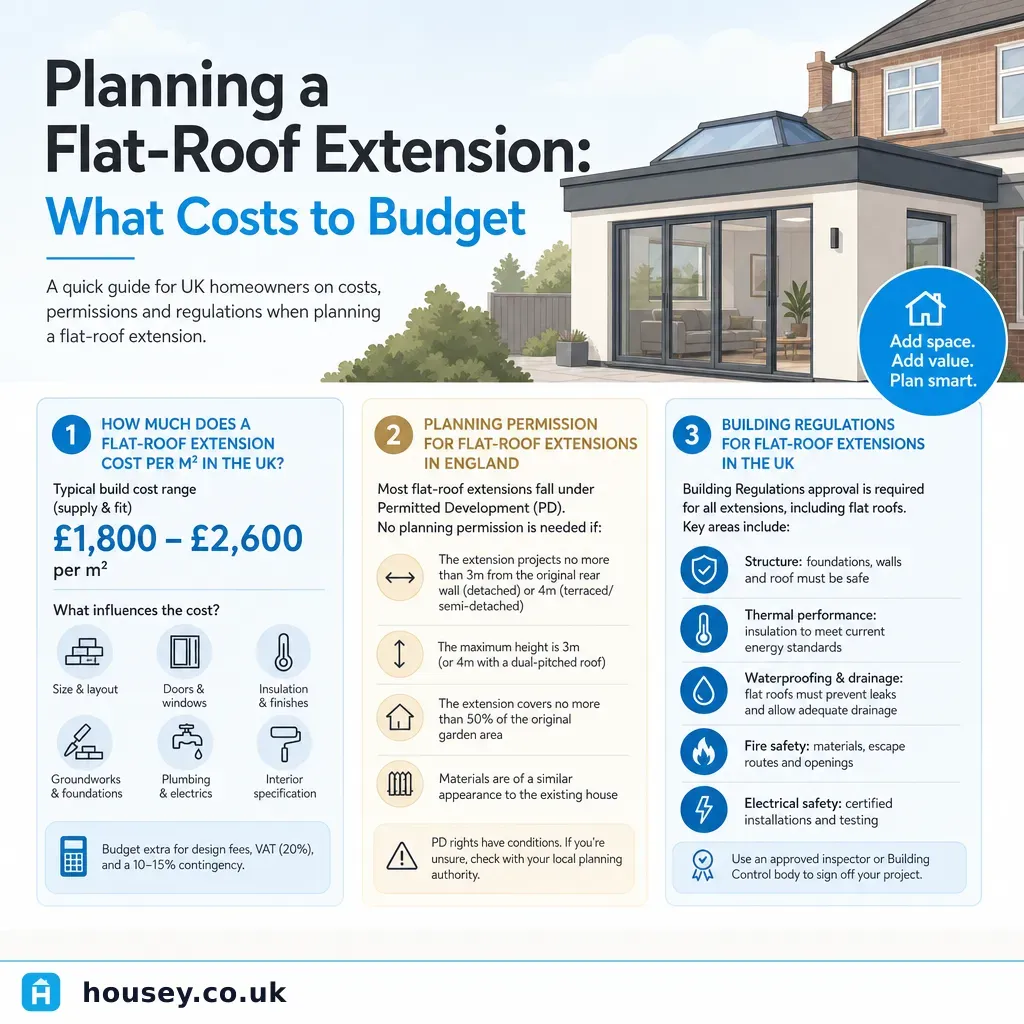 Improvement & Build
Planning a Flat-Roof Extension: What Costs to Budget
A flat-roof single-storey extension typically costs £1,500–£3,000 per m² in the UK, depending on size, specification, location, and roof membrane choice.
 Improvement & Build
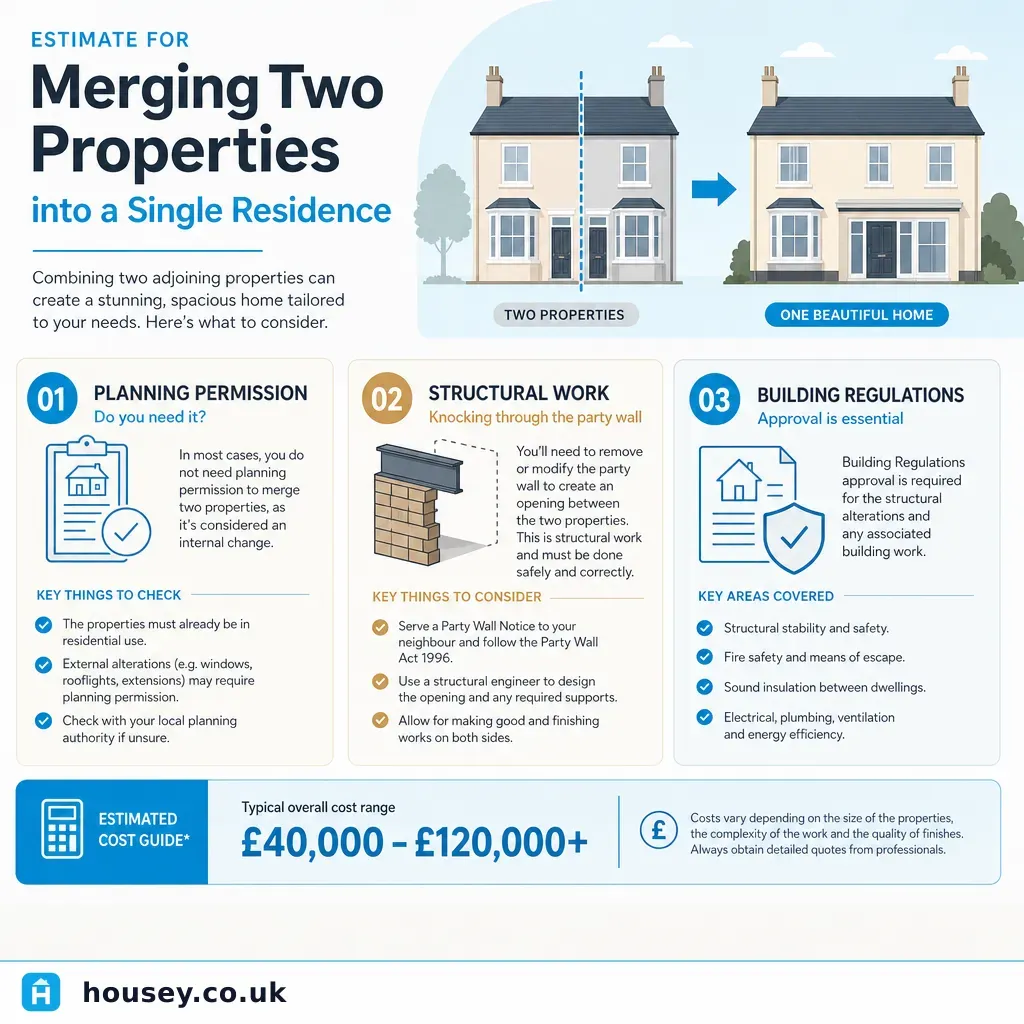
Estimate for Merging Two Properties into a Single Residence
Merging two properties into one typically costs £30,000–£120,000 or more, depending on property type, structural complexity, and professional fees.
 Improvement & Build
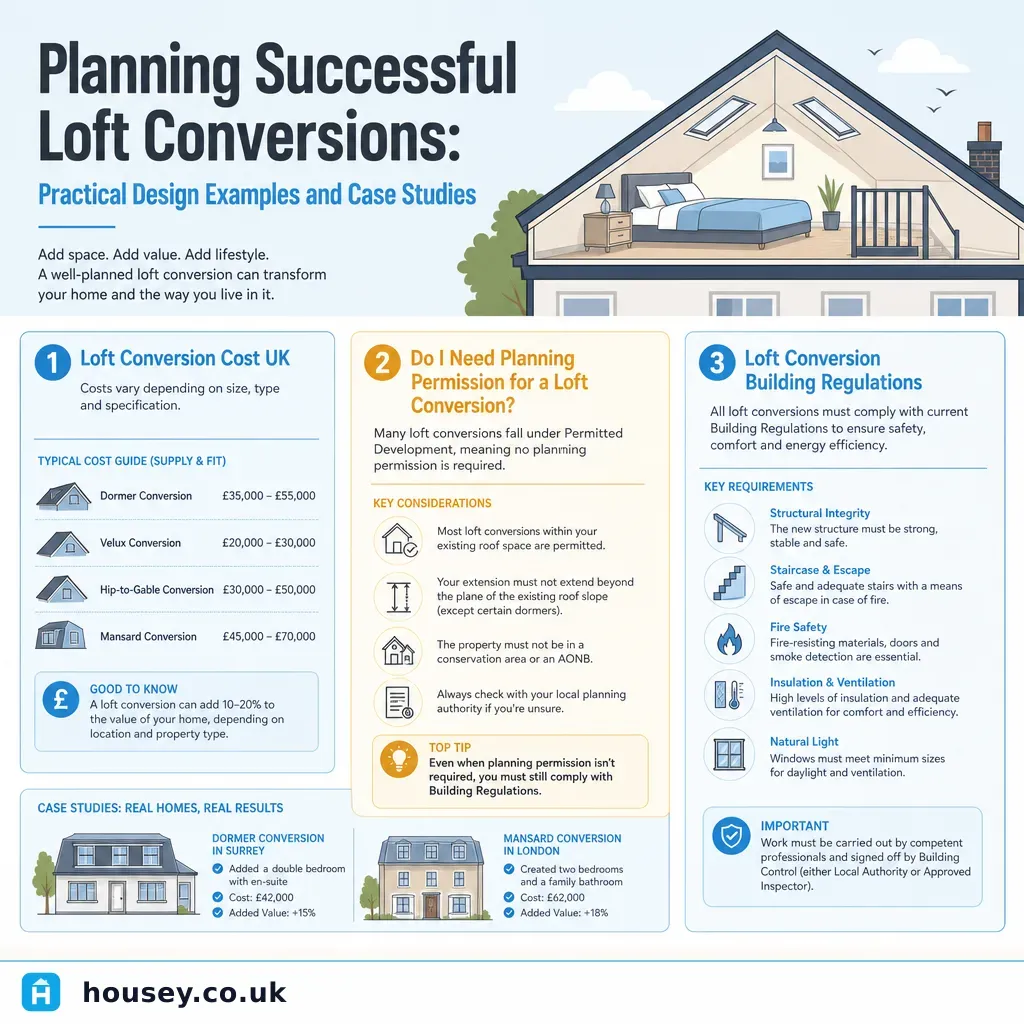
Planning Successful Loft Conversions: Practical Design Examples and Case Studies
Most UK loft conversions are permitted development and do not need planning permission, provided they remain within the volume allowances — 40 m³ for terraced houses and 50 m³ for detached or semi-detached properties.