Budget Guide for Two-Storey House Extensions
By Housey · Last reviewed 6th of May 2026
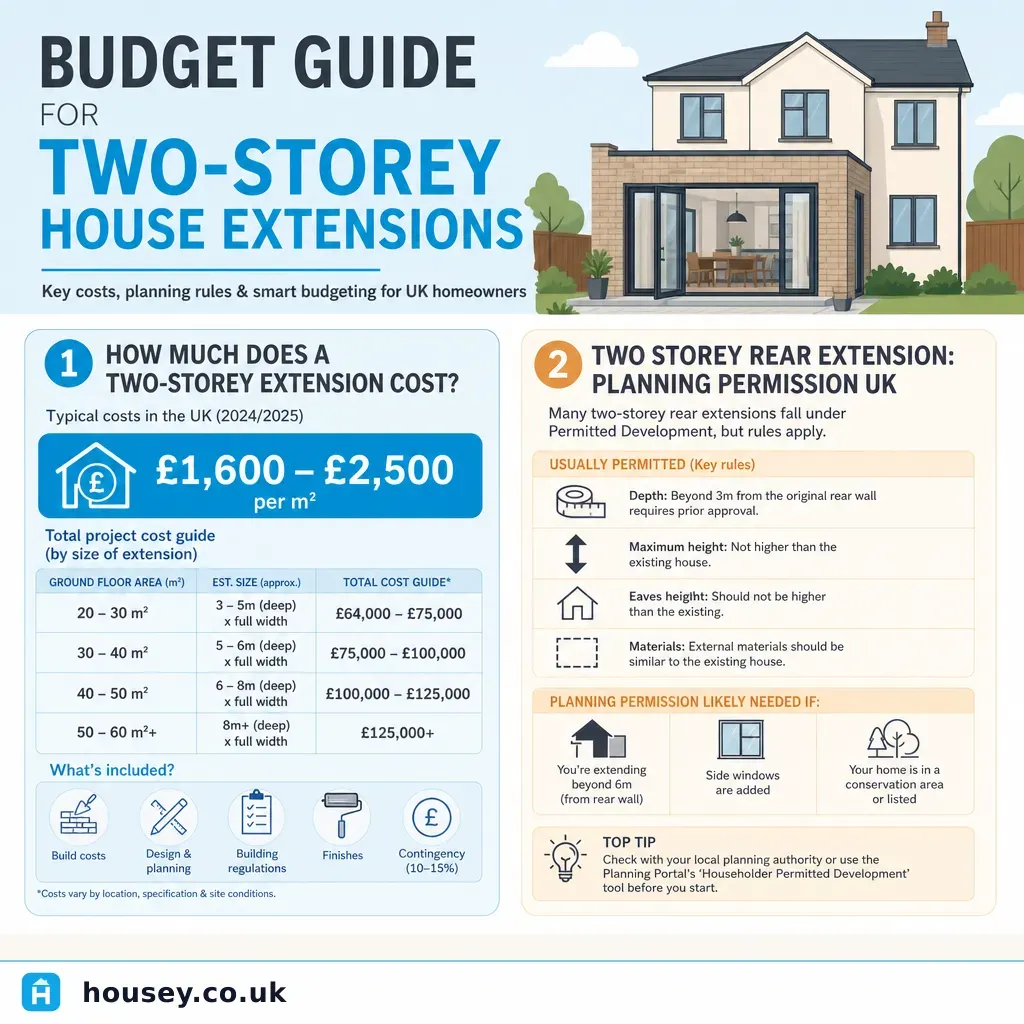
Budget Guide for Two-Storey House Extensions
A two-storey extension can nearly double the usable floor space you gain compared with a single-storey build — and for only a modest increase in cost — making it one of the most space-efficient ways to add bedrooms, bathrooms, and living areas to a UK family home. The decision typically arises when a growing household needs more room but moving is unaffordable or undesirable, or when a homeowner wants to maximise value from a property with an underused rear or side plot. Getting the budget right from the start requires understanding not just build costs but also planning fees, professional fees, statutory consents, and the contingency that almost every structural project ends up needing.
Key points
- Full planning permission is required for almost all two-storey extensions — permitted development rights do not cover two-storey rear or side additions in most circumstances.
- Build costs typically range from £1,800 to £3,000+ per m² for structure, finishes, and basic fit-out, depending on specification and region (Indicative UK costs, last reviewed 2026-05-06).
- Professional fees — architect or architectural technologist, structural engineer, and building control — typically add 10–18% on top of build costs.
- The Party Wall etc. Act 1996 requires formal notices to adjoining neighbours if construction involves excavations within 3m of a shared or adjoining foundation.
- Building Regulations approval is mandatory and covers structural integrity, thermal performance (Part L), fire safety (Part B), and drainage (Part H).
Do you need planning permission?
Yes, in almost all cases. Permitted development rights under Class A of the Town and Country Planning (General Permitted Development) (England) Order 2015 allow certain single-storey rear extensions but specifically exclude any addition that is more than one storey. Side extensions of more than one storey and those involving a hip-to-gable change also require full planning permission.
As a practical rule for homeowners:
- If your extension will be two storeys, apply for full householder planning permission before finalising the design.
- If you are in a conservation area, Article 4 direction area, AONB, or the property is listed, restrictions are tighter and pre-application advice from your LPA is strongly recommended.
- Leasehold properties may require freeholder consent before a planning application is even submitted.
Planning applications for householder extensions take eight weeks to determine in most straightforward cases, though complex or contested applications may take longer.
What does a two-storey extension cost?
Costs vary significantly by size, specification, region, and site conditions. The ranges below are indicative for typical UK projects as at 2026.
Cost component | Indicative range | Notes |
|---|---|---|
Build cost (structure, roof, windows, basic fit-out) | £1,800–£3,000 per m² | London and South East typically at the upper end |
Architect or architectural technologist fees | 5–10% of build cost | Planning drawings, Building Regs drawings, site visits |
Structural engineer fees | £800–£2,500 | Beam calculations, foundation design |
Building control fees | £500–£1,500 | Local authority or approved inspector |
Party Wall surveyor fees (if applicable) | £700–£2,000 per neighbour | Only if Party Wall Act applies |
Planning application fee (England, 2026) | £258 per dwelling | Standard householder application fee |
Internal fit-out (kitchen, bathrooms, flooring) | £5,000–£30,000+ | Highly variable depending on rooms added |
Contingency (strongly recommended) | 10–15% of total budget | For unforeseen ground conditions, drainage, or structural issues |
Indicative UK costs, last reviewed 2026-05-06. Obtain at least three written, itemised quotes before committing.
Worked example: 1970s semi-detached in the East Midlands
A homeowner adds a two-storey rear extension to a three-bedroom semi-detached house: 4.5m wide × 3.5m deep footprint, giving approximately 31.5m² of new floor space per floor (63m² total across both storeys). The upper floor creates a new bedroom and en-suite; the ground floor extends the kitchen and dining area.
Item | Estimated cost |
|---|---|
Build (63m² × £2,200/m²) | £138,600 |
Architectural technologist (planning + Building Regs) | £7,500 |
Structural engineer | £1,400 |
Building control (local authority) | £900 |
Planning application fee | £258 |
Internal fit-out (bedroom, en-suite, extended kitchen) | £18,000 |
Contingency (12%) | £19,900 |
Total estimated cost | ~£186,500 |
This is a worked illustration only. Your actual costs will differ based on specification, contractor rates, location, and site conditions. Always obtain detailed, itemised quotes from at least three contractors.
Which professionals do you need?
Professional | Role | When needed |
|---|---|---|
Architect or architectural technologist | Design, planning application, Building Regs drawings | Always |
Structural engineer | Foundation and beam design, load calculations | Always |
Building control surveyor | Compliance inspections and completion certificate | Always |
Party Wall surveyor | Serve and agree party wall notices | When excavating within 3m of a neighbour's foundation |
Planning consultant | Pre-application advice, complex or sensitive sites | For difficult sites, conservation areas, or after a refusal |
Main contractor or extension builder | Construction on site | Always |
Appointing an architectural technologist or architect before approaching contractors is the recommended sequence — detailed drawings are needed for planning, Building Regulations, and obtaining accurate quotes from extension builders.
The construction process step by step
- Appoint a design professional — agree brief, fee, and programme before anything else.
- Submit a planning application — typically eight weeks to a decision for a straightforward householder application.
- Prepare Building Regulations drawings — requires structural engineer input for foundations, beams, and load paths.
- Serve Party Wall notices if required — allow at least two months before starting work; the Act requires minimum notice periods.
- Appoint a contractor and agree a contract — a JCT Minor Works or HomeOwner contract is recommended for works of this scale.
- Groundworks and foundations — this stage often reveals unforeseen ground conditions; your contingency exists for exactly this.
- Structural frame, first-floor structure, and roof — building control inspections are required at key structural stages.
- Weathertight shell — external windows, doors, and roof covering.
- First and second fix trades — electrics, plumbing, and heating.
- Internal fit-out — plastering, flooring, kitchen and bathroom installation, decoration.
- Final building control inspection and issue of completion certificate.
For a typical semi-detached house, construction alone takes four to eight months from contractor start on site.
Document preparation checklist
Before appointing a contractor, gather or obtain the following:
- Title register and title plan from HM Land Registry (available online for a small fee)
- Existing planning permissions and building control completion certificates for any prior works on the property
- Any party wall awards or neighbour agreements from previous projects
- Current Energy Performance Certificate (EPC), required for Building Regulations Part L compliance assessment
- Drainage plan, if available from when the property was built or previously extended
- Utility search or survey to identify buried services beneath the proposed footprint
Important limitations
This article provides general cost and process guidance for informational purposes only. Construction costs, planning policies, and Building Regulations requirements vary by property type, location, ground conditions, and specification. The figures given are indicative UK ranges as at May 2026 and must not be treated as quotes or guarantees of final costs. A qualified architect or architectural technologist, structural engineer, and building control consultant should assess your specific property before any design or construction decisions are made. Planning policy and permitted development rights can change; always verify current guidance with your local planning authority.
What to ask a qualified professional
Before appointing an architect or architectural technologist:
- What planning application strategy do you recommend for this site, and what is your assessment of the risk of refusal?
- Will you coordinate structural engineering input, or should I appoint an engineer separately?
- What does your fee include — planning drawings, Building Regs drawings, and site inspection visits?
- Do you have experience with extensions on properties of this age and construction type in this local authority area?
Before appointing a structural engineer:
- Have you worked on similar extensions to properties of this construction type?
- Will you visit the site before and during groundworks to verify foundation conditions?
- What are the likely beam and foundation specifications, and how will these affect cost and programme?
Before appointing a main contractor:
- Are you registered with a recognised trade body such as the Federation of Master Builders (FMB) or NHBC?
- What is the proposed contract form, and does it include a defects liability period?
- What insurance do you hold — public liability, employer's liability, and contractor's all risks?
- What is the payment schedule, and is a deposit required?
- What is your proposed programme from mobilisation to practical completion?
When to get professional help
Appoint a qualified architect, architectural technologist, or structural engineer before any design or construction work is undertaken. A two-storey extension is not a project that can be safely planned without professional involvement at the design stage — structural miscalculation, failure to comply with Building Regulations, or overlooking the Party Wall Act can result in costly remediation, enforcement action, or neighbour disputes that delay or halt the project.
If groundworks reveal unexpected conditions — unusual bearing capacity, proximity to tree roots, drainage problems, or buried obstructions — stop work and seek specialist advice before proceeding.
How Housey can help
Housey can connect you with qualified professionals at every stage of a two-storey extension project. Start with architectural technologists to prepare drawings and a planning application, commission a structural engineer for foundation and beam design, compare quotes from experienced extension builders, appoint building control consultants for statutory inspections, or request an early build cost estimate before committing to a final specification.
Frequently asked questions
Can a two-storey extension be built under permitted development?
In almost all circumstances, no. Permitted development rights cover certain single-storey rear extensions but do not extend to two-storey additions. You will need to submit a full householder planning application to your local planning authority. Check the Planning Portal and your LPA's website for current guidance specific to your area and property.
How long does a two-storey extension take to build?
Once planning permission is granted and a contractor is appointed, construction typically takes four to eight months for a standard two-storey rear or side extension. The full project timeline from first design appointment to completion — including planning, professional appointments, and any Party Wall procedures — is often 12–18 months.
Does a two-storey extension always need a structural engineer?
Yes. A structural engineer is required to design the foundations, specify steelwork or timber beams to carry new loads, and produce structural calculations for Building Regulations approval. Building control will not approve the works without signed structural calculations. This applies regardless of the size of the extension.
What is the Party Wall Act, and does it apply to a two-storey extension?
The Party Wall etc. Act 1996 requires homeowners to give formal written notice to adjoining neighbours before certain building work, including excavations within 3m of an adjoining foundation. Two-storey extensions frequently trigger this requirement. If a neighbour objects, a party wall award must be agreed by appointed surveyors before work can start.
Does a two-storey extension add value to a property?
Generally yes, particularly when it adds a bedroom or bathroom. However, value uplift depends on the local market, quality of construction, and whether the extension brings the property into line with comparables in the area. Avoid over-extending relative to similar nearby properties. An independent RICS-registered valuer can advise on likely value impact before you commit.
Sources and further reading
- Planning Portal: Extensions and permitted development — Planning Portal
- GOV.UK: Building regulations approval — GOV.UK
- GOV.UK: Party Wall etc. Act 1996 guidance — GOV.UK
- RICS: Home extension cost guidance — RICS
- HM Land Registry: Search the property register — HM Land Registry
Useful next reads
 Improvement & Build
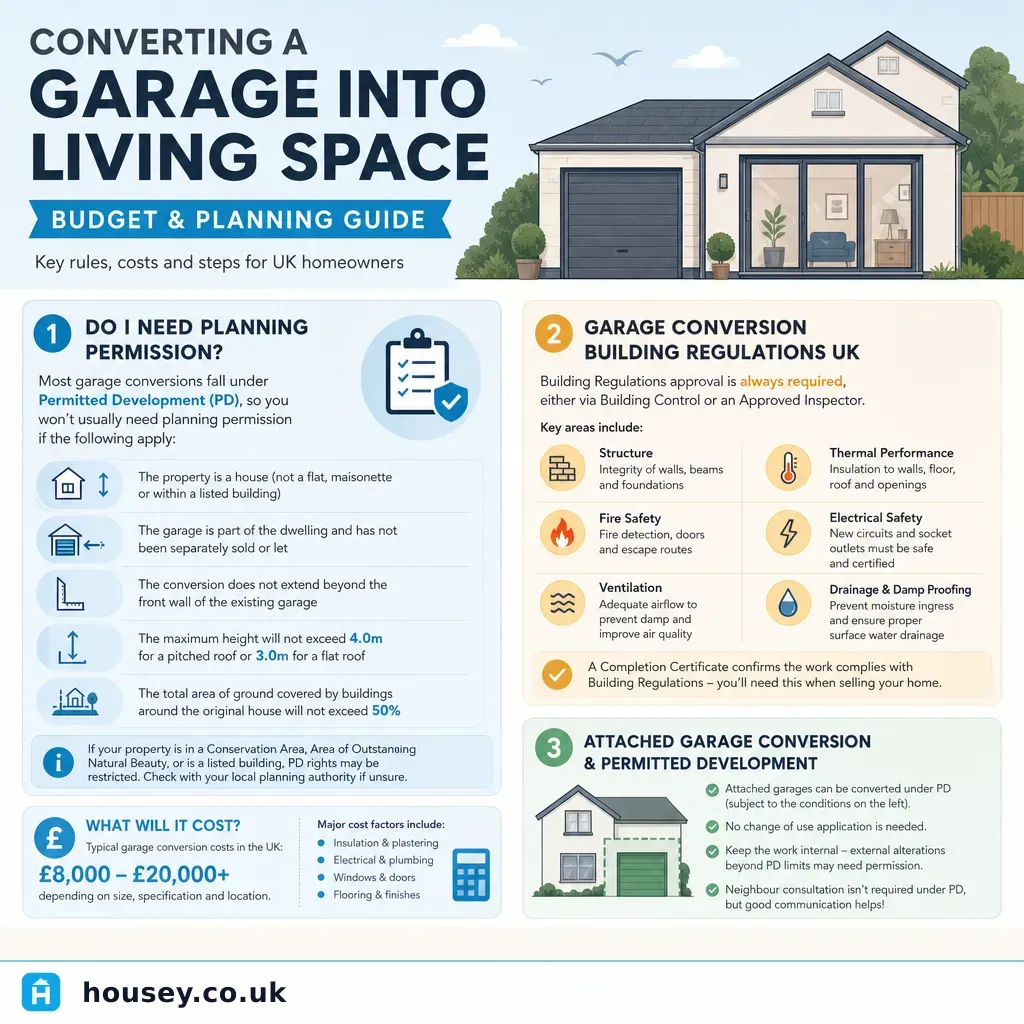
Converting a Garage into Living Space: Budget and Planning Guide
A single-garage conversion typically costs £8,000–£20,000 in the UK.
 Improvement & Build
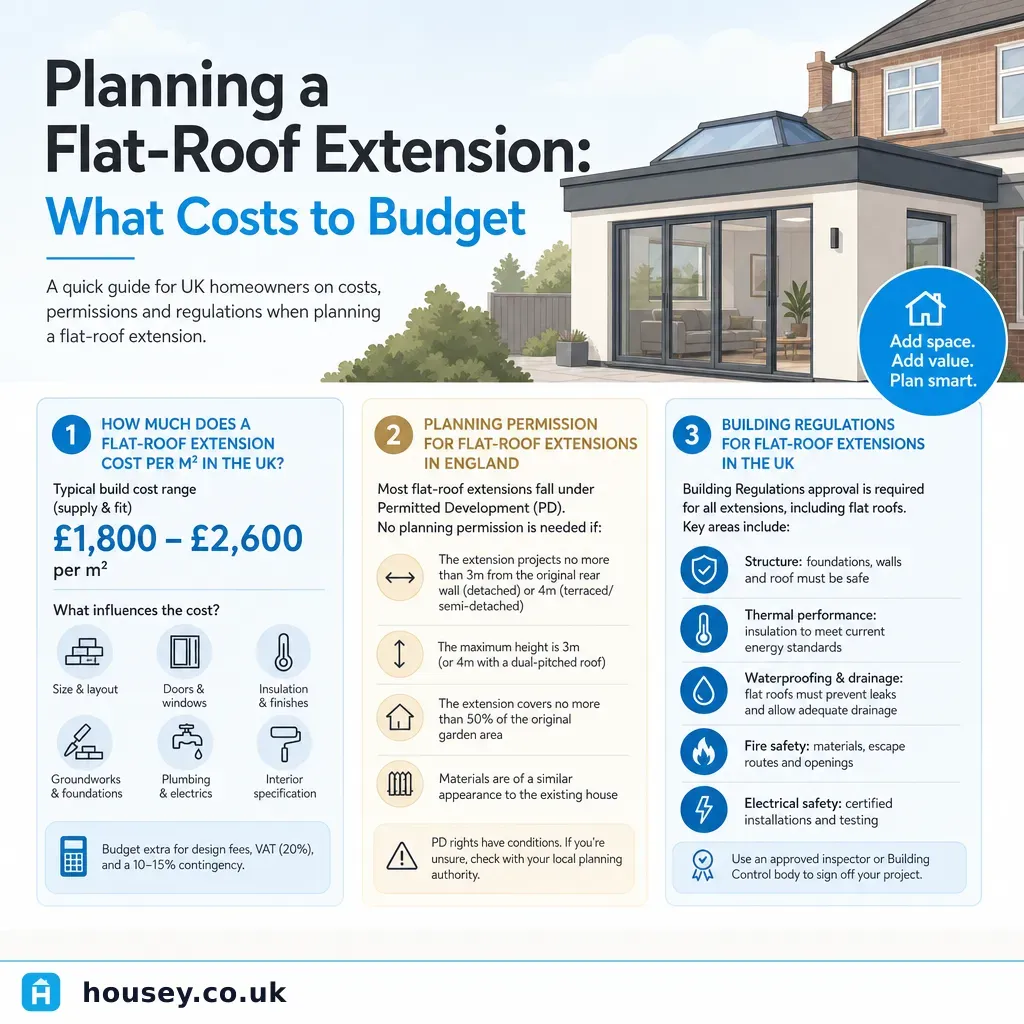
Planning a Flat-Roof Extension: What Costs to Budget
A flat-roof single-storey extension typically costs £1,500–£3,000 per m² in the UK, depending on size, specification, location, and roof membrane choice.
 Improvement & Build
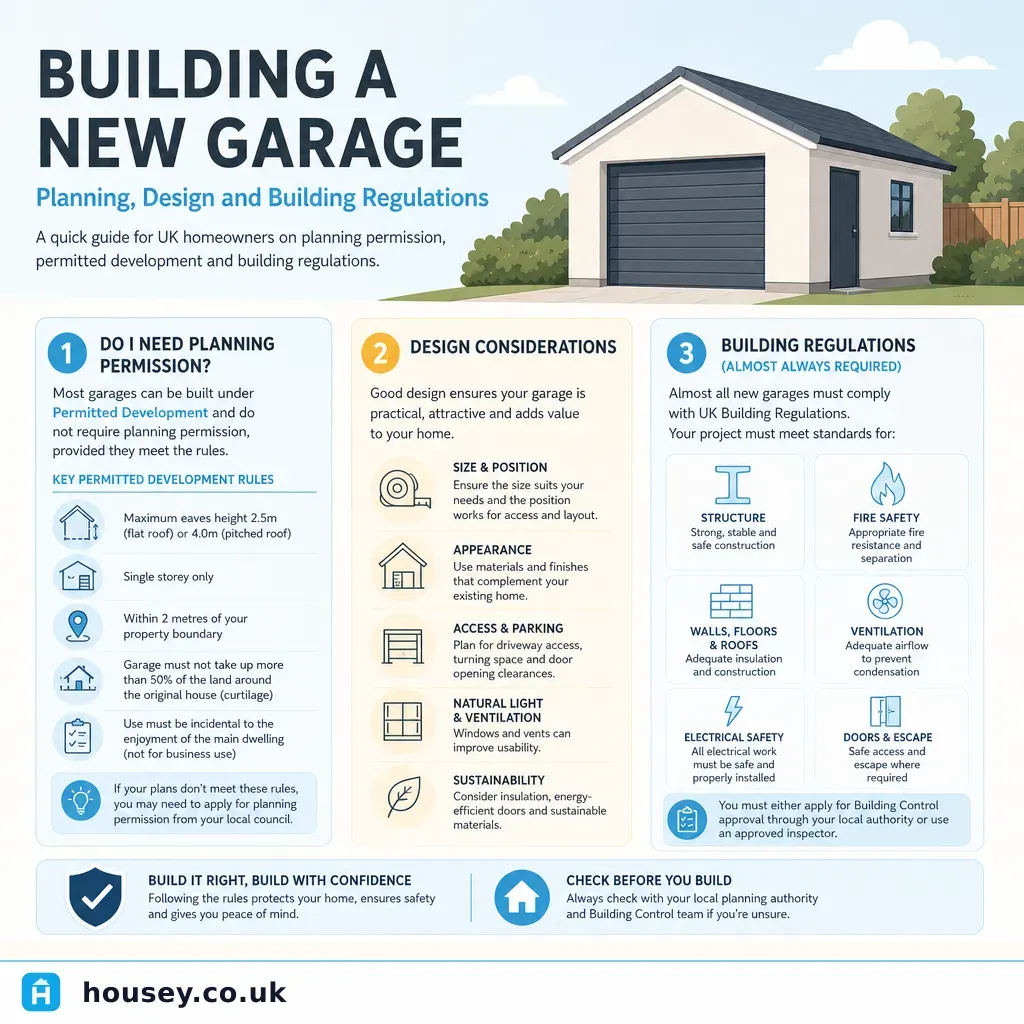
Building a New Garage: Planning, Design and Building Regulations
Most new detached garages in England qualify as permitted development and do not need planning permission, provided they stay within size, height, and coverage limits and are not within 5m of the dwelling.
 Improvement & Build
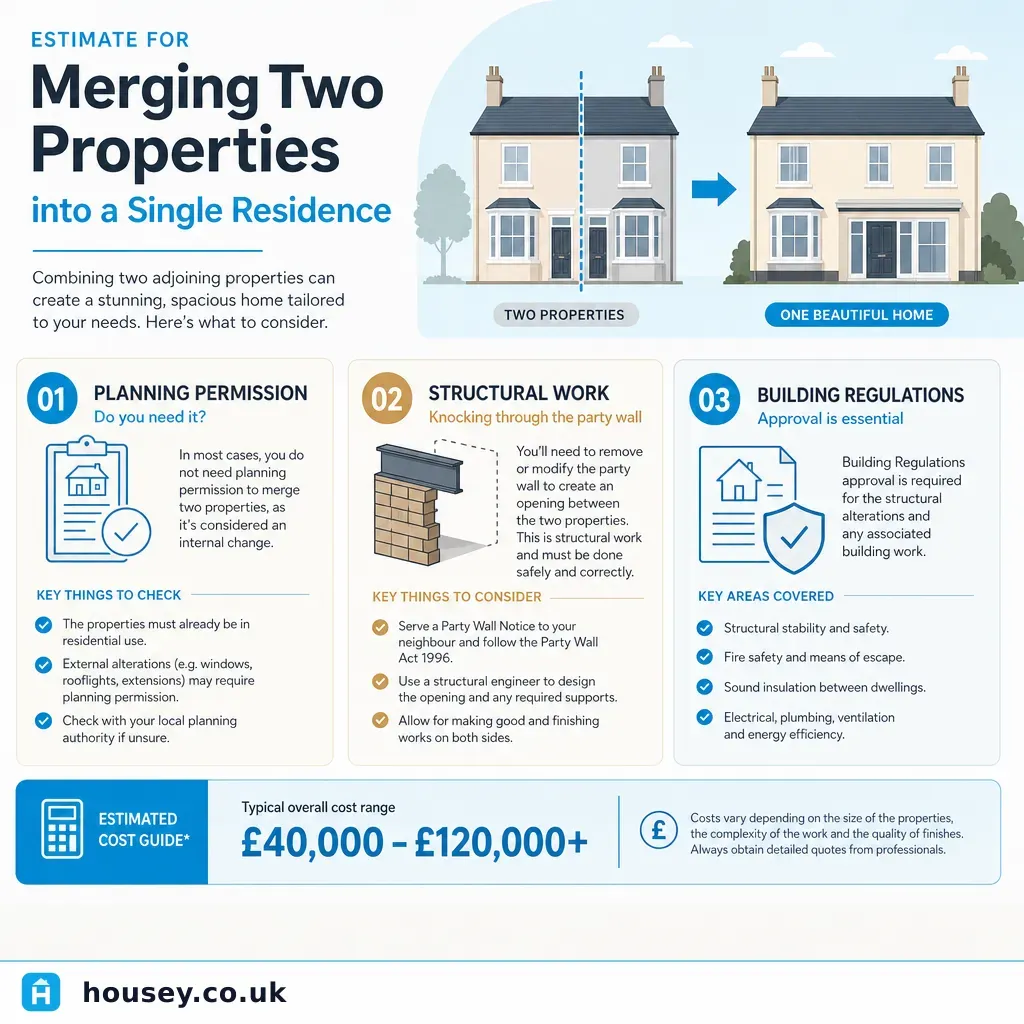
Estimate for Merging Two Properties into a Single Residence
Merging two properties into one typically costs £30,000–£120,000 or more, depending on property type, structural complexity, and professional fees.
 Improvement & Build
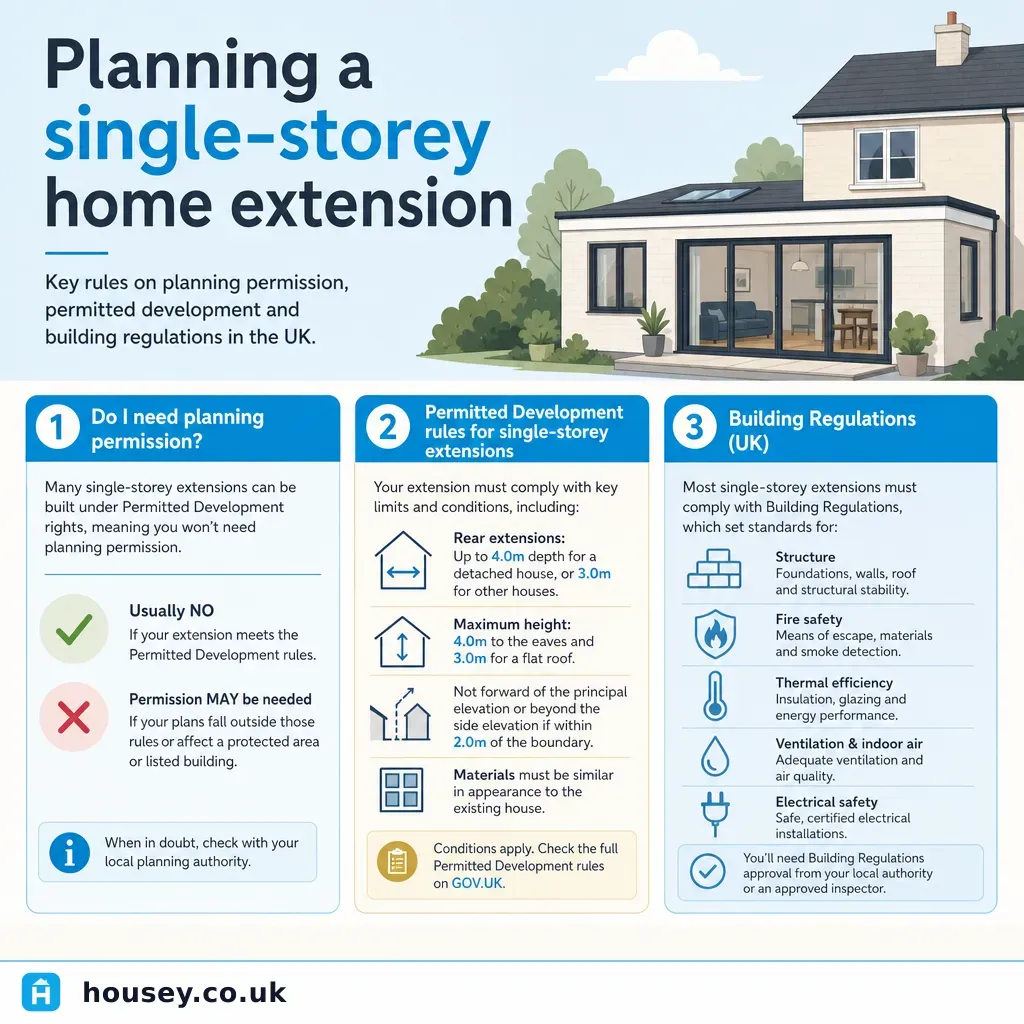
Planning a single-storey home extension
A single-storey extension may fall under permitted development rights, avoiding full planning permission, but only if it meets size, height, and boundary conditions simultaneously.