Converting a Garage into Living Space: Budget and Planning Guide
By Housey · Last reviewed 7th of May 2026
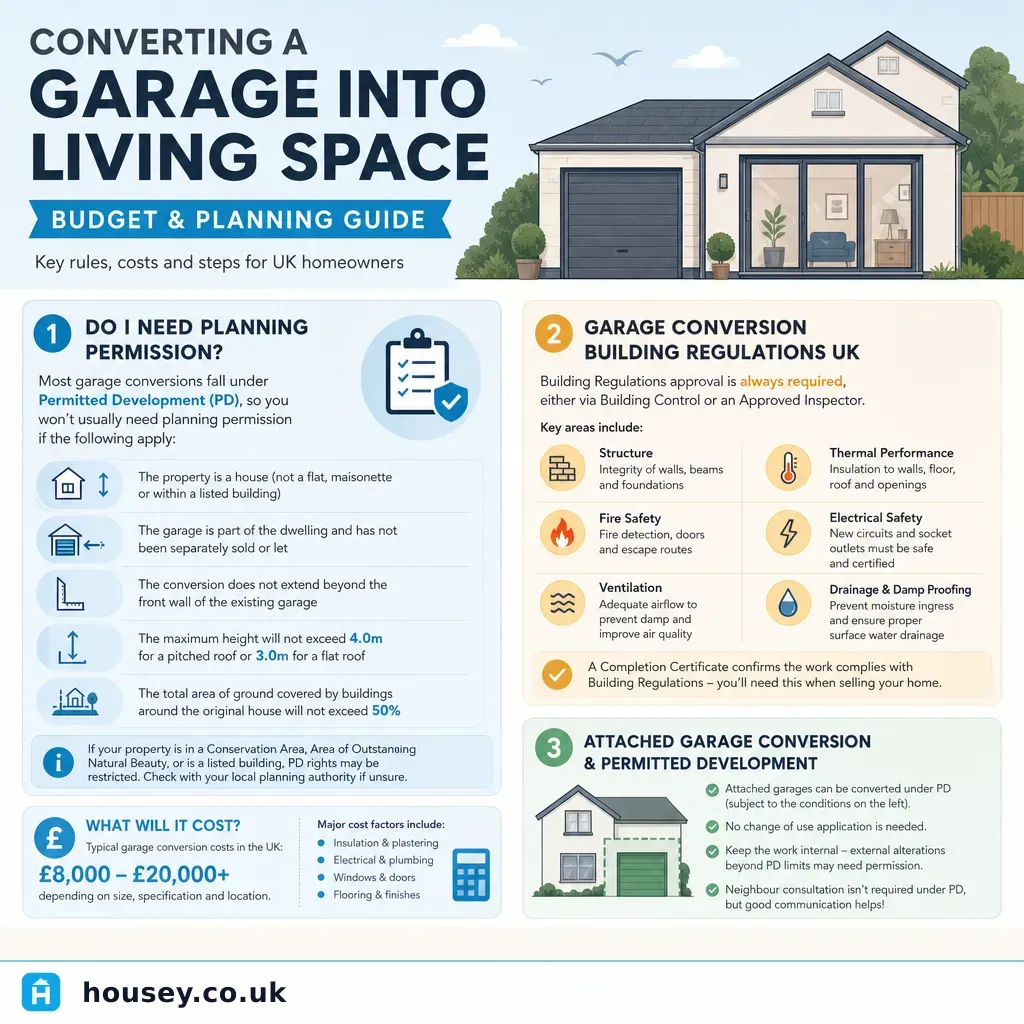
Converting a Garage into Living Space: Budget and Planning Guide
Garage conversions are consistently popular with UK homeowners — but the difference between a smooth project and one that stalls at the point of sale is often traceable to the regulatory groundwork done before the first wall is insulated. Whether the garage is attached, integrated, or detached will affect which planning and building regulations rules apply, and those rules matter well beyond the construction phase.
Key points
- Most attached or integral garage conversions in England fall under permitted development (PD) rights and do not require a planning application, but PD rights are removed in conservation areas, for listed buildings, for flats, and on estates subject to Article 4 Directions.
- Building regulations approval is required for almost all garage conversions, regardless of whether planning permission is needed — covering structure (Part A), fire safety (Part B), damp-proofing (Part C), thermal insulation (Part L), ventilation (Part F), and electrical safety (Part P).
- Walls in a converted garage must achieve a U-value of no worse than 0.28 W/m²K and floors no worse than 0.22 W/m²K under Approved Document L (Conservation of Fuel and Power).
- Indicative UK costs range from £8,000 to £20,000 for a single-garage conversion and up to £30,000+ for a double garage with high-specification finishes (Indicative UK costs, last reviewed 2026-05-07; costs vary by location and scope — obtain at least three quotes).
- A completion certificate issued by building control at the end of the project is important evidence for mortgage lenders and conveyancers when you sell the property; conversions carried out without one will need regularising.
Do you need planning permission?
Most single attached or integral garage conversions in England can proceed under permitted development rights — meaning no formal planning application is needed. However, PD rights are restricted or removed in several common situations:
- Conservation areas, Areas of Outstanding Natural Beauty (AONBs), World Heritage Sites, or National Parks: Certain changes to a dwelling's appearance are curtailed. Check with your Local Planning Authority (LPA) before starting.
- Listed buildings: All works require listed building consent, in addition to any planning permission that may be needed.
- Flats and maisonettes: Permitted development does not apply; a planning application is required.
- Properties where PD rights have been removed by condition: Some new-build estates have Article 4 Directions that remove standard PD rights. Check the original planning consent or ask your LPA.
- Detached garages being converted into a separate dwelling: These require full planning permission and usually a change-of-use application.
In Wales, Scotland, and Northern Ireland, permitted development rules differ from those in England. Check with the relevant devolved planning authority before starting any work.
Decision tree: do you need a planning application?
- Is the garage attached or integral to the main house, in England? → Likely permitted development — continue below.
- Is the property in a conservation area, AONB, or is it listed? → Contact your LPA before starting.
- Has your property had its PD rights removed by an Article 4 Direction? → A planning application is required.
- Are you creating a self-contained dwelling in a detached garage? → Full planning permission is required.
- Are you in Wales, Scotland, or Northern Ireland? → Consult devolved guidance; rules differ from England.
- None of the above apply? → Building regulations approval is still required — proceed to the next section.
Building regulations: what's required
Regardless of planning permission, building regulations approval is required for almost all garage conversions in England and Wales. This ensures the new room is structurally safe, energy-efficient, and fit for habitation.
Regulation area | What it covers | Approved Document |
|---|---|---|
Structure | Walls, roof, and floor integrity for habitable use | Part A |
Fire safety | Escape windows, fire doors, smoke alarms, separation from integral garage | Part B |
Damp and weatherproofing | Damp-proof membrane in floor, tanking of walls where needed | Part C |
Thermal insulation | Wall, roof, and floor U-values to current requirements | Part L |
Ventilation | Background ventilation (trickle vents), extract fans where applicable | Part F |
Electrical safety | New circuits notified to a registered electrician or building control | Part P |
You can seek building regulations approval via three routes:
- Full plans application: Submit drawings and calculations before work starts. Recommended for complex conversions — gives the most certainty upfront.
- Building notice: Notify your local authority building control (LABC) before starting; inspectors visit as work progresses. Simpler, but offers less upfront certainty.
- Registered Building Control Approver: A private building control body can act as an alternative to LABC following reforms under the Building Safety Act 2022.
Typical costs for a UK garage conversion
Indicative UK costs, last reviewed 2026-05-07. Costs vary significantly by region, scope, and structural condition. Obtain at least three quotes.
Conversion type | Indicative cost range |
|---|---|
Single garage, basic fit-out (office or utility room) | £8,000 – £14,000 |
Single garage, full habitable room (bedroom or living space) | £12,000 – £20,000 |
Double garage, full fit-out | £18,000 – £30,000+ |
Integral garage with structural alterations | £15,000 – £25,000+ |
Key cost drivers to discuss with any contractor:
- Floor insulation: Solid garage floors often need a new insulated screed, particularly where no damp-proof membrane (DPM) exists beneath the slab.
- Drainage: Adding a WC or en-suite requires drain connections — a significant additional cost item.
- Structural changes: Widening the front opening for a window or bi-fold doors requires a structural lintel and may need engineering input.
- Heating: Extending the central heating system or fitting electric heating alternatives adds to the final cost.
- Location: Labour rates in London and the South East are typically higher than elsewhere in the UK.
What to ask before accepting a quote
- What is explicitly included and excluded from the price?
- Is building regulations approval — including fees and all inspections — included in the quote?
- Who will carry out the work, and what trade qualifications or accreditations do they hold?
- What structural work is assumed — and is a structural engineer's input factored in?
- Will you provide a completion certificate and all sub-contractor compliance documents (Part P electrical certificate, Gas Safe certificate if gas is extended)?
- Is VAT included?
- What could cause the price to increase — for example, discovery of no existing DPM or an inadequate lintel?
- What is the programme and payment schedule?
Worked UK property scenario
Property: 1970s semi-detached house in the East Midlands. Integral single garage with an existing internal door into the hallway.
Goal: Convert the garage into a home office with a downstairs cloakroom/WC.
Planning: Permitted development applies — no planning application needed. The homeowner applies for a Lawful Development Certificate (LDC) via the Planning Portal as a record for a future sale. Check the Planning Portal fee calculator for the current LDC application fee, as planning fees are periodically updated by the Government.
Building regulations: Full plans submission via the LABC. Drawings prepared by a local architectural technologist.
Works required: New insulated floor screed (no existing DPM), timber-framed insulated stud wall to the front elevation, new uPVC window, damp-proofing to walls, plastering, WC drain connected to the existing soil stack, electric underfloor heating notified under Part P, interconnected smoke alarm.
Indicative cost: Approximately £16,000–£19,000 all-in, including building regulations fees, structural lintel, and WC fit-out (Indicative UK costs, last reviewed 2026-05-07).
Outcome: Completion certificate issued. At the subsequent property sale, the solicitor confirmed the LDC and completion certificate with no queries raised by the buyer's conveyancer — an outcome that would not have been possible without both documents in place.
Red flags to watch for
- A contractor who says building regulations are not required for a garage conversion — they almost always are.
- No mention of a completion certificate in the quote or scope of works.
- Part P electrical work proposed without reference to a registered electrician or a building control notification process.
- A quote that omits thermal insulation to Part L standards — any habitable room must meet current U-value requirements.
- Any suggestion that converting a detached garage into a separate self-contained dwelling is permitted development — it is not.
- Signs of existing damp in the garage floor or walls that are not addressed in the scope of works.
- No mention of building control inspection stages (pre-concrete, damp-proof course level, pre-plaster, completion).
Important limitations
This article provides general information about garage conversions in England. Planning and building regulations requirements vary by property type, location, and design. Rules in Wales, Scotland, and Northern Ireland differ from those described here. Nothing in this article should be treated as a substitute for advice from a qualified professional who has inspected your specific property and is familiar with your local planning authority's policies.
What to ask a qualified professional
Before instructing a contractor or building control body:
- Does my property have an Article 4 Direction or other planning condition that removes permitted development rights?
- Is it worth obtaining a Lawful Development Certificate, and how do I apply for one?
- Does the existing garage structure require a structural assessment before insulation and internal finishes are applied?
- Which route to building regulations approval — full plans, building notice, or registered building control approver — is most appropriate for my project?
- Will I need separate structural engineer calculations for any new opening or load-bearing changes to the front or side walls?
- What building control inspection stages should I expect, and what must be accessible at each stage?
When to get professional help
A garage conversion involves several regulated stages where professional input is important. Seek qualified advice before starting if:
- Your property is listed, in a conservation area, or subject to an Article 4 Direction.
- The garage floor shows signs of damp, cracking, or uneven settlement.
- You plan to add a bathroom, bedroom, or en-suite (drainage, fire door, and ventilation requirements add regulatory complexity).
- The project involves removing or altering a structural wall, or creating a new opening in a load-bearing structure — a structural engineer should review the design.
- You are converting a detached garage into a separate unit for rental or independent occupation.
- A previous conversion was carried out without building regulations approval — this will need regularising before sale.
How Housey can help
Housey connects you with experienced garage conversion specialists who can manage the project from initial design through to building regulations sign-off. If your conversion involves structural alterations, you can request quotes from a structural engineer through the same platform, or find a building control consultant to advise on the most appropriate approval route for your property type.
Frequently asked questions
Do I always need building regulations approval for a garage conversion?
In almost all cases in England and Wales, yes. Building regulations apply regardless of whether planning permission is needed. They cover structural safety, insulation, ventilation, fire safety, and damp-proofing. The only rare exception would be a very minor change of use with no structural or services work, but in practice most conversions trigger at least one requirement. Always check with your local authority building control before starting.
Will a garage conversion add value to my home?
A well-executed garage conversion that meets building regulations and adds usable living space can increase a property's market value. However, the loss of dedicated parking may reduce value in some markets, particularly where off-street parking is scarce. Speak to a local estate agent about your specific street and property type before committing to the project.
How long does a garage conversion take?
A straightforward single-garage conversion typically takes four to eight weeks once work begins, assuming no major structural complications. Obtaining building regulations approval adds time before and during the project. A full plans submission requires approval before work starts; a building notice allows an earlier start but requires staged inspections at each construction phase throughout.
Can I convert a garage in a leasehold property?
You will likely need written consent from your freeholder or management company before making any structural or significant alterations. Check your lease before instructing any contractor. Failure to obtain consent can result in a breach of lease conditions, which can cause serious difficulties when selling. Always review your lease carefully and seek legal advice if you are unsure of your obligations.
What is a Lawful Development Certificate and do I need one?
A Lawful Development Certificate (LDC) is a formal document from the local planning authority confirming that a development is lawful — for example, that it falls within permitted development rights. It is not legally required to carry out a permitted development conversion, but it provides useful evidence when selling the property that no planning breach occurred. Apply via the Planning Portal.
Sources and further reading
- Permitted development rights for householders: technical guidance — GOV.UK
- Building Regulations: Approved Documents — GOV.UK
- Garage conversions — Planning Portal
- Approved Document L: Conservation of fuel and power — GOV.UK
- Building Safety Act 2022 — legislation.gov.uk
Useful next reads
 Improvement & Build
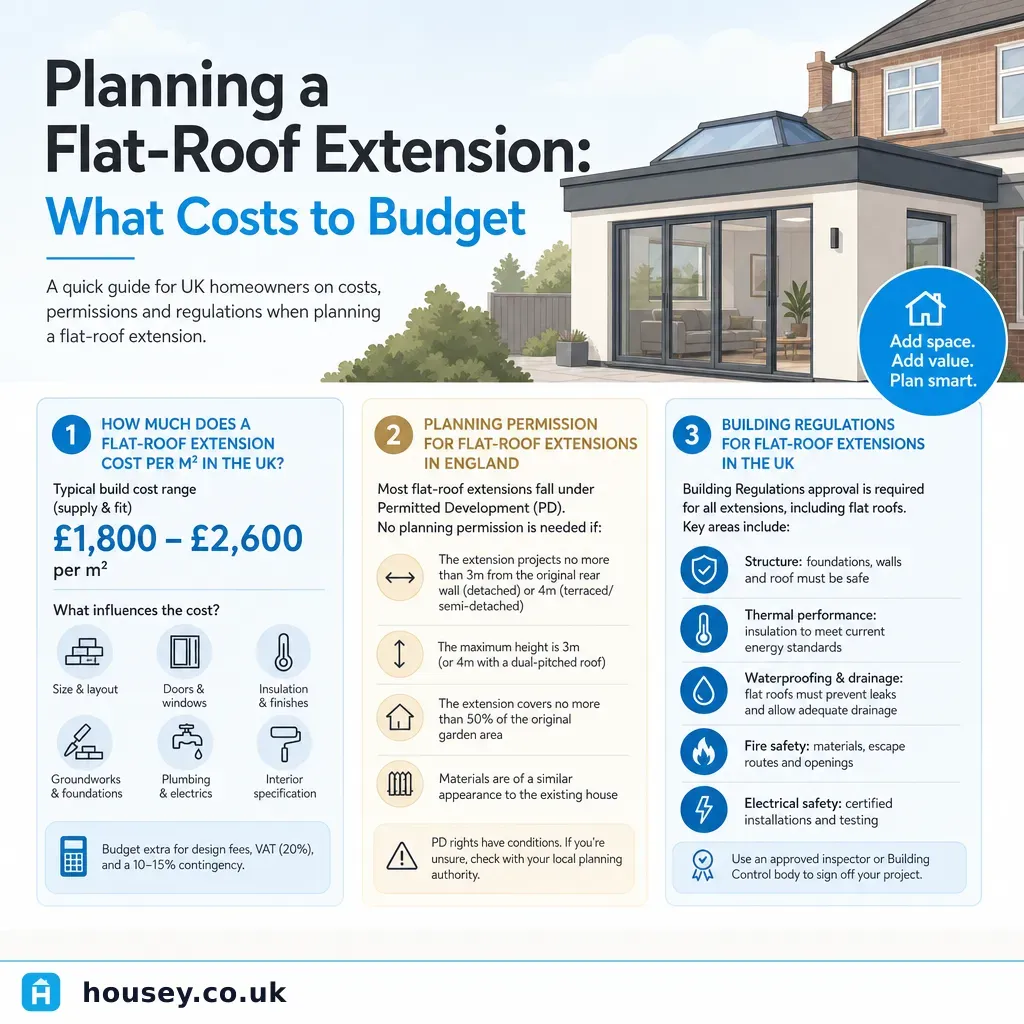
Planning a Flat-Roof Extension: What Costs to Budget
A flat-roof single-storey extension typically costs £1,500–£3,000 per m² in the UK, depending on size, specification, location, and roof membrane choice.
 Improvement & Build
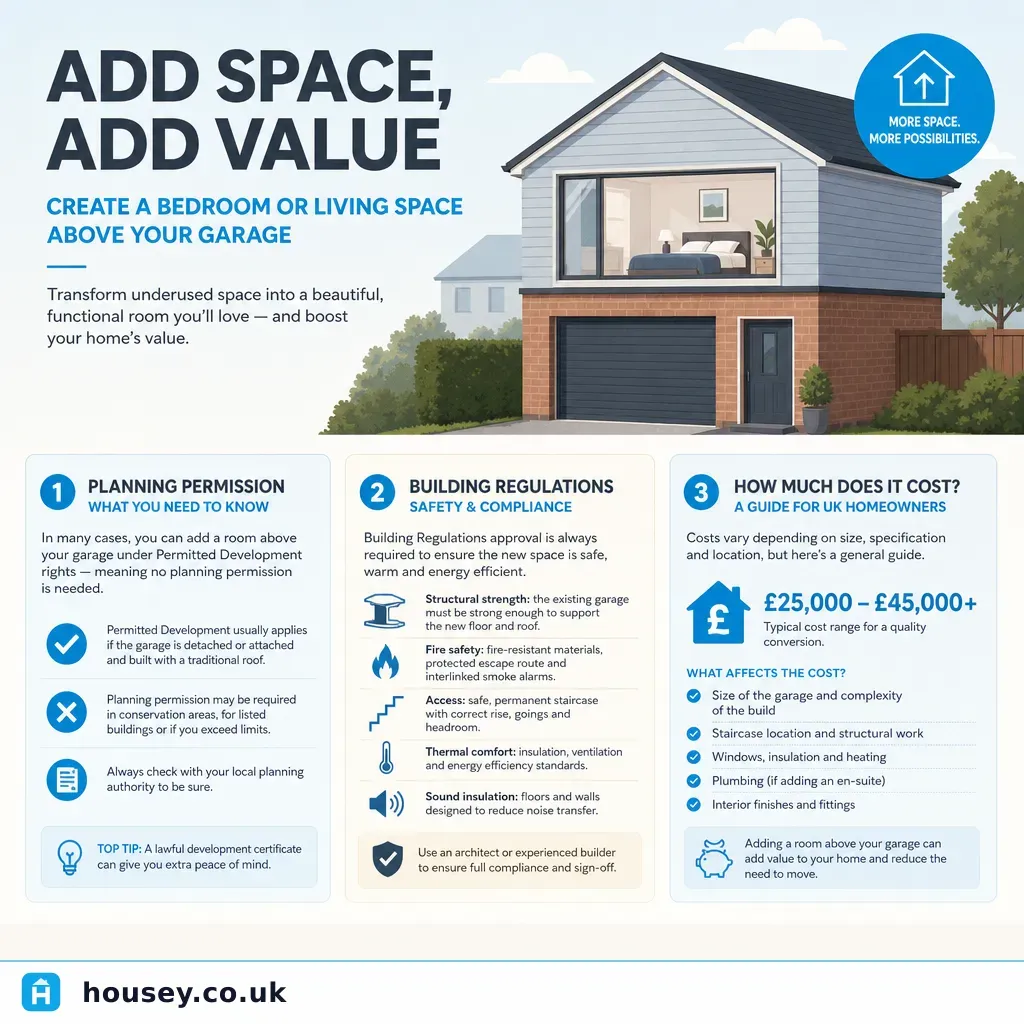
Adding a bedroom or living space above an existing garage
Adding habitable space above an existing garage almost always requires planning permission and Building Regulations approval in the UK.
 Improvement & Build
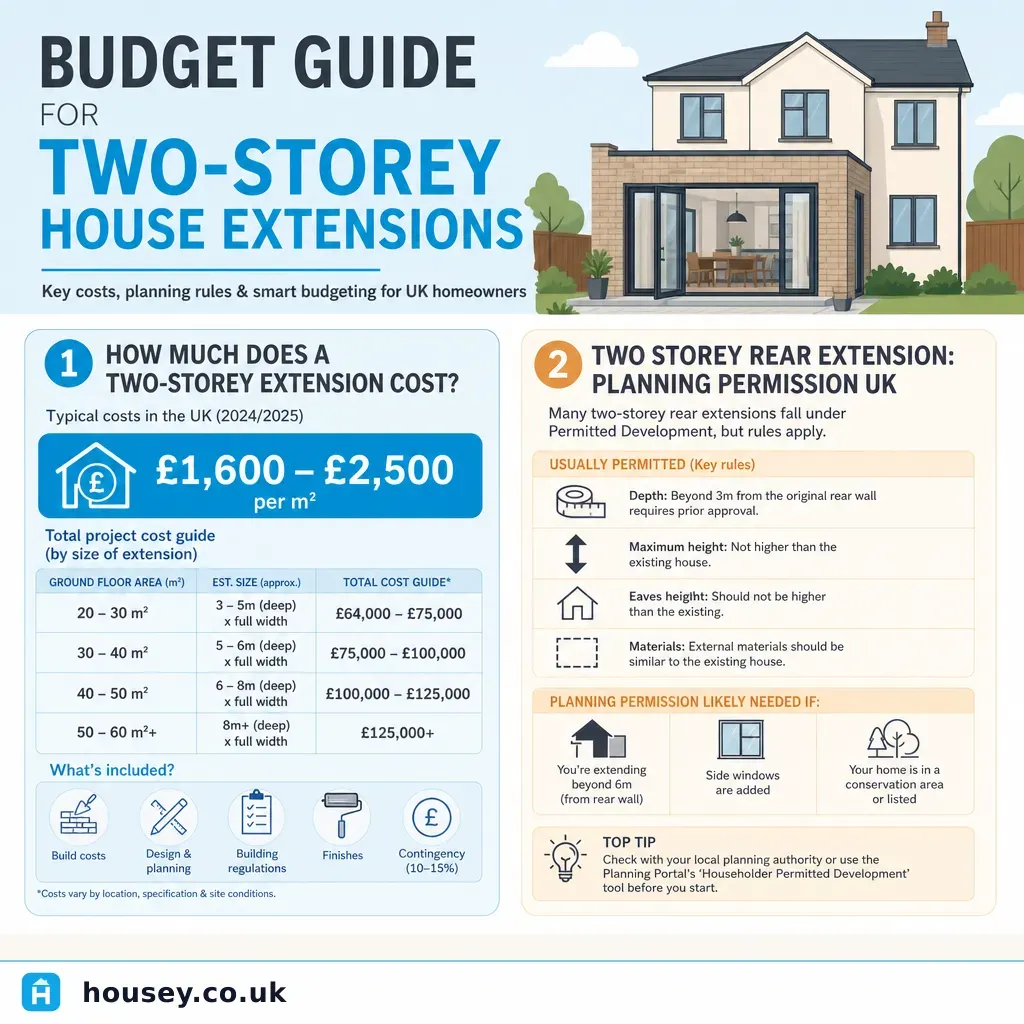
Budget Guide for Two-Storey House Extensions
A two-storey house extension in the UK typically costs £1,800–£3,000+ per square metre for the build alone.
 Improvement & Build
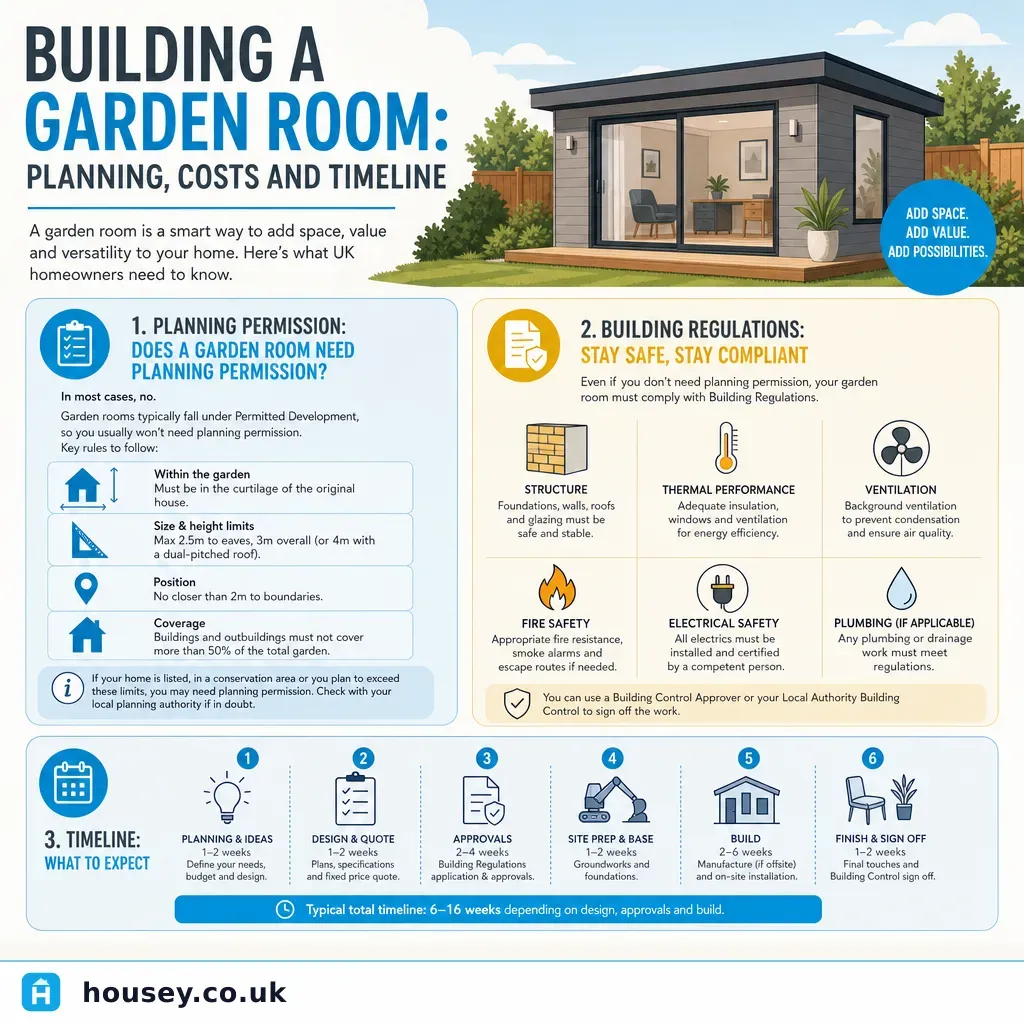
Building a Garden Room: Planning, Costs and Timeline
Most garden rooms in England fall under permitted development and don't need planning permission, provided the structure meets height, coverage, and boundary conditions.
 Improvement & Build
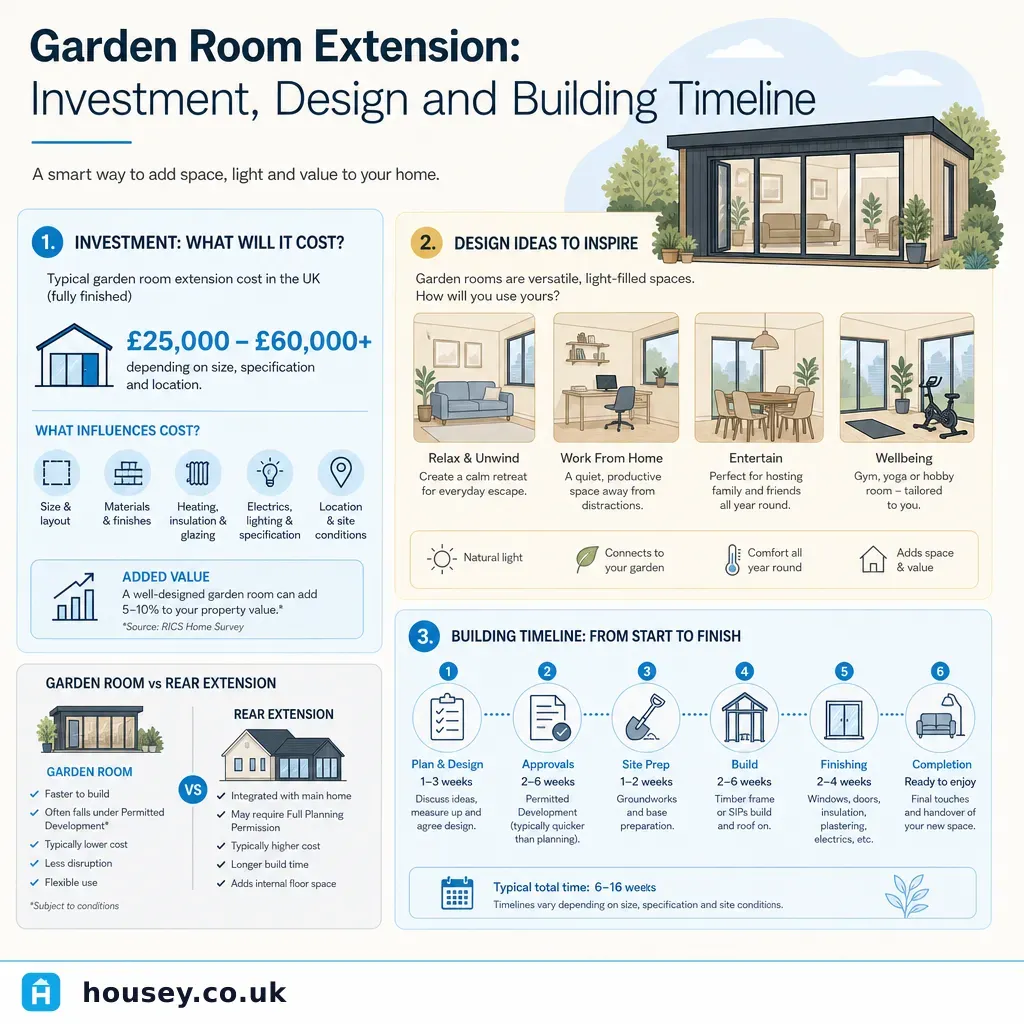
Garden Room Extension: Investment, Design and Building Timeline
A garden room or garden extension can add usable year-round space without always requiring planning permission.