Planning Successful Loft Conversions: Practical Design Examples and Case Studies
By Housey · Last reviewed 17th of May 2026
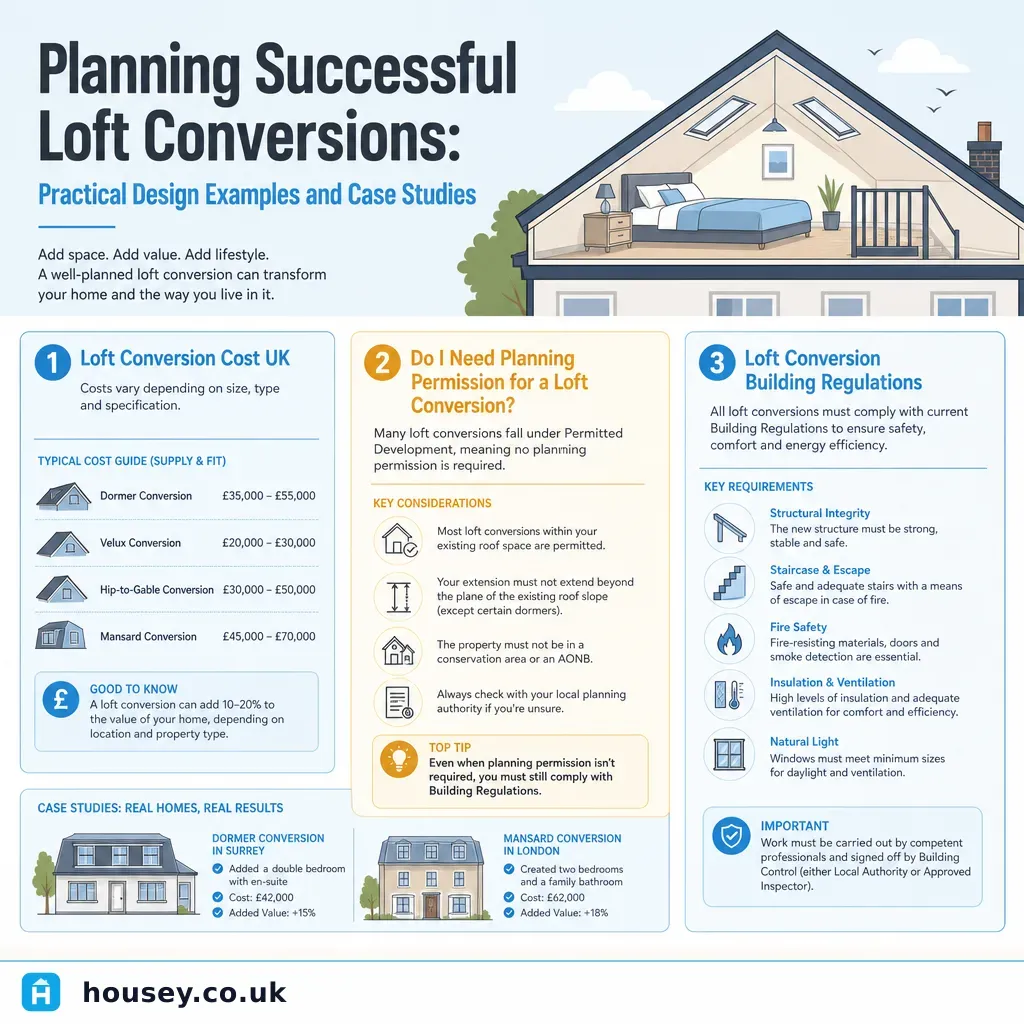
Planning Successful Loft Conversions: Practical Design Examples and Case Studies
Loft conversions are among the most frequently undertaken home improvements in the UK, particularly in Victorian terraces, 1930s semis, and post-war housing where roof voids offer genuine habitable potential. They sit at the intersection of structural engineering, building regulations, fire safety, and design — which means understanding what each conversion type requires before approaching contractors will help you choose the right approach, set a realistic budget, and avoid costly changes mid-project.
Key points
- Terraced houses may convert up to 40 m³ of roof space under permitted development; detached and semi-detached houses may convert up to 50 m³ — under Class B, Schedule 2, Part 1 of the Town and Country Planning (General Permitted Development) (England) Order 2015 (GPDO 2015).
- Building regulations approval is always required for a loft conversion regardless of whether planning permission is needed — covering structural works, fire safety (protected staircase, linked smoke alarms, upgraded fire doors), thermal insulation to Part L, and means of escape.
- A minimum head height of approximately 2.2 m at the highest point is the practical threshold for a habitable loft room — properties with less than this may have limited or no viable options without significant and costly roof alteration.
- The Party Wall etc. Act 1996 may apply if structural works affect a shared party wall or party structure in a terraced or semi-detached property — a Party Wall Award may be required before works begin.
- Permitted development rights may be removed by Article 4 Directions, restrictive title conditions, or prior use of the allowance — always confirm your position with the local planning authority before proceeding, and consider applying for a Lawful Development Certificate.
Types of loft conversion: which is right for your property?
The conversion type that works best depends on your roof structure, existing head height, property age and construction, and what you need the new space to do.
Type | How it works | Best for | Permitted development? | Approximate cost (2026) |
|---|---|---|---|---|
Roof light (Velux) | Insulates floor, reinforces joists, adds roof windows only — no roofline alteration | Properties with existing head height above 2.2 m; simple bedroom or study | Usually yes, within volume limits | £15,000–£25,000 |
Dormer (flat-roof box) | Vertical-faced box extension to rear slope, maximising floor area and head height | Victorian and Edwardian terraces, 1930s semis | Usually yes to rear; not to principal elevation facing a highway | £25,000–£55,000 |
Hip-to-gable | Converts a sloping hip end to a vertical gable wall, increasing usable floor area | Detached and semi-detached houses with hipped roofs | Often yes for single-storey hips; check combined PD volume | £35,000–£55,000 |
Mansard | Near-vertical rear slope with flat or shallow-pitched roof; maximum floor area | Properties requiring the maximum new space; some London terraces | Usually requires planning permission — roofline changes significantly | £45,000–£75,000 |
L-shaped dormer | Two dormers joined in an L-shape, typically over a rear addition | Mid-terraced Victorian and Edwardian properties with back extensions | Often yes to rear; check combined volume carefully | £40,000–£70,000 |
Indicative UK costs, last reviewed 2026-05-17. Costs exclude VAT unless agreed otherwise. Obtain at least three quotes — costs vary significantly by location, specification, and site conditions.
Planning permission: when you need it and when you don't
Most loft conversions fall under permitted development (PD) for dwellinghouses in England, meaning no planning application is required. The key conditions under Class B, Schedule 2, GPDO 2015 are:
- The addition must not exceed the volume limits: 40 m³ for terraced houses, 50 m³ for detached and semi-detached properties.
- Any addition must not protrude beyond the plane of the existing roof slope on any elevation facing a highway.
- No addition can be higher than the highest part of the existing roof.
- Materials should be similar in appearance to those of the existing house.
- Any side-facing windows must be obscure-glazed and non-opening below 1.7 m from the floor of the room.
Planning permission is likely required if:
- The property is a flat or maisonette (permitted development rights do not apply in the same way).
- The property is listed or within a conservation area.
- An Article 4 Direction has removed PD rights (common in some London boroughs and conservation areas).
- A mansard or hip-to-gable conversion significantly alters the roofline profile.
- Prior extensions have already used the permitted development volume allowance.
Always apply for a Lawful Development Certificate (LDC) from your local planning authority to confirm PD status before starting works. This provides legal certainty and matters at the point of sale.
Building regulations: always required
Planning permission and building regulations are separate processes — building regulations approval is always required for loft conversions. The key Approved Documents that apply:
- Part A (Structure): New floor joists, steel beams, and any modified roof elements must be structurally adequate. A structural engineer's calculations are required and must be approved by building control.
- Part B (Fire safety): Habitable loft rooms must have a protected escape staircase with 30-minute fire-resistant construction, and interlinked smoke alarms. Existing doors on the escape route may need upgrading to FD30 standard.
- Part F (Ventilation): Background ventilation and purge ventilation for new habitable rooms.
- Part K (Protection from falling): Balustrade requirements where applicable, including Juliet balconies.
- Part L (Energy efficiency): Roof insulation to current U-value standards — typically 0.18 W/m²K for pitched roofs.
Building control may be managed through your local authority building control (LABC) or an approved Registered Building Inspector. Submit full plans rather than a building notice alone, so structural details are reviewed and approved before work begins.
A worked UK property scenario
A homeowner in Manchester has a 1900s mid-Victorian terrace. The existing loft has a ridge height of 2.7 m measured from the ceiling below. The property is not listed and there is no Article 4 Direction on the street.
An L-shaped dormer is identified as appropriate: the main rear dormer provides a double bedroom and the side leg accommodates an en-suite. The combined added volume is 38 m³, within the 40 m³ permitted development limit for a terraced house. A Lawful Development Certificate is applied for before works begin to confirm the planning position.
A structural engineer prepares calculations for new floor joists (replacing existing ceiling joists rated only for dead load) and a new steel beam to carry modified roof loads. A building regulations application is submitted with full drawings prepared by an architectural technologist. Building control inspects at key stages: floor structure, roof modification, fire doors and protected escape stair, and final completion.
Approximate project cost: £38,000–£48,000 inclusive of structural engineer fees, architectural drawings, building control fee, and construction. Indicative only. Costs vary significantly by location, specification, and site conditions. Indicative UK costs, last reviewed 2026-05-17.
Important limitations
This article provides general information only. Loft conversion rules, structural requirements, and planning conditions depend on the specific property, its construction, age, location, tenure, and history. Permitted development rights vary and may be removed by Article 4 Directions, title conditions, or prior works. Rules in Scotland, Wales, and Northern Ireland differ from those in England. A qualified professional should assess your specific property before you commit to any contractor or spend money on drawings.
When this becomes urgent
Stop and seek immediate professional advice if:
- A surveyor, structural engineer, or builder identifies unexpected defects in the existing roof structure — particularly if purlins, rafters, or tie beams show signs of movement, rot, or inadequate bearing.
- Insulation in the roof void is loose-fill and granular, which in pre-1990 properties may indicate vermiculite containing asbestos — do not disturb this material under any circumstances; arrange a professional asbestos survey first.
- A Party Wall notice was required under the Party Wall etc. Act 1996 but has not been served — proceeding without one where legally required exposes you to enforcement risk and potential injunctions.
- There is any uncertainty about whether proposed works fall within permitted development, especially if prior extensions have already been carried out at the property.
What to ask a qualified professional
Before appointing a contractor or specialist, ask:
- Are you a member of a recognised professional body — RIBA (architect), CIAT (architectural technologist), or IStructE/ICE (structural engineer)?
- Will you apply for the Lawful Development Certificate on my behalf, or should I instruct a planning consultant separately?
- Do you manage the building regulations application, or do I need to commission structural calculations separately and from whom?
- Who will be the building control body — local authority or an approved inspector — and who pays their fee?
- What fire safety measures will be required, and will my existing internal doors need upgrading to meet the protected escape route standard?
- Does the Party Wall etc. Act 1996 apply to my proposed works, and if so, will you advise me on serving notices?
- What warranties or guarantees do you provide on the completed works, and will these transfer to a future buyer?
When to get professional help
Loft conversions always require a qualified structural engineer for calculations and building control for inspections — there is no safe DIY route for the structural or fire safety elements. Seek professional advice from the outset if:
- Your property has a trussed rafter roof (common in homes built after approximately 1965) rather than a traditional cut-roof — trussed roofs require more extensive and costly structural intervention than cut-roof properties.
- There is any evidence of existing structural movement, moisture penetration, or rot in the roof space.
- Works will come within 3–6 m of a shared party wall or party structure (the relevant thresholds under the Party Wall etc. Act 1996).
How Housey can help
Housey connects homeowners with experienced loft conversion companies, structural engineering specialists, and building control consultants who can assess your property and manage your project from initial feasibility to completion sign-off. You can also find professionals who produce building regulations drawings through the Housey marketplace.
Frequently asked questions
How long does a loft conversion take?
From first appointment to practical completion, a typical loft conversion takes three to five months: four to eight weeks for design drawings, structural calculations, building regulations application, and any planning or Lawful Development Certificate application; eight to fourteen weeks for construction. Mansard conversions requiring full planning permission take longer. Party Wall procedures and complex site conditions add further time.
Does a loft conversion add value to my home?
Adding a bedroom and en-suite in the right property and location is consistently cited as one of the higher-return home improvements in the UK — commonly referenced as adding 10–20% to market value, though this varies by area, property type, and market conditions. A RICS-registered valuer can provide the most reliable assessment of the likely uplift for your specific property.
Do I need a structural engineer for a loft conversion?
Yes. Building regulations (Approved Document Part A) require that all structural elements — new floor joists, steel beams, and any modified roof or load-bearing structure — are designed by a qualified structural engineer whose calculations are submitted to and approved by building control. This applies regardless of the conversion type chosen.
Can I convert a loft in a leasehold flat?
Leasehold flats present additional complications. The roof structure is typically common property under the lease, so you will need the freeholder's consent — and possibly consent from other leaseholders — before proceeding. The lease may need to be varied to include the new space. A solicitor with residential leasehold experience should be instructed before committing to any design or construction work.
Sources and further reading
- Planning Portal: loft conversions — Planning Portal
- GOV.UK: Approved Documents (Building Regulations) — GOV.UK
- GPDO 2015, Schedule 2, Part 1, Class B — legislation.gov.uk
- Party Wall etc. Act 1996 — legislation.gov.uk
- LABC: homeowners and loft conversions — Local Authority Building Control
Useful next reads
 Improvement & Build
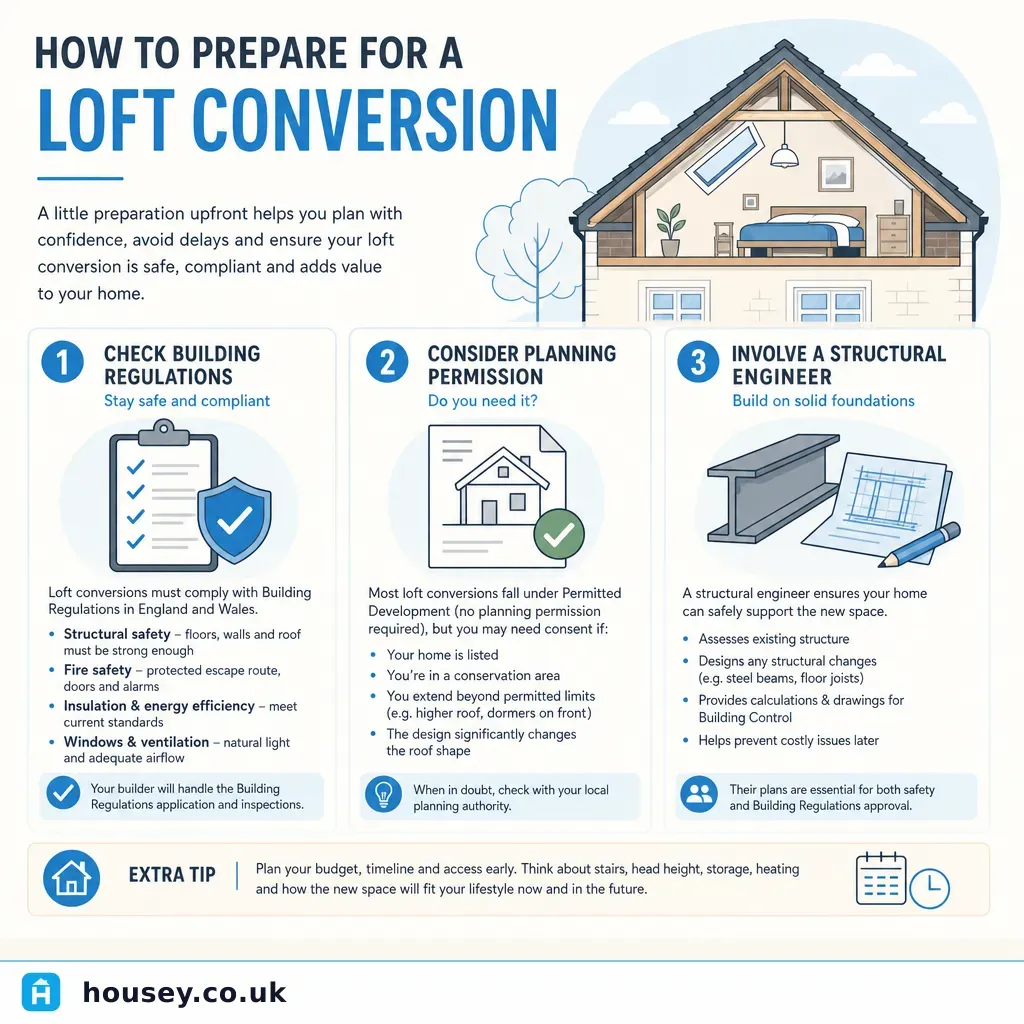
How to Prepare for a Loft Conversion
Before a loft conversion starts, you need a structural engineer to assess your roof, a Building Regulations application covering Parts A, B, F, K, and L, and — where a shared party wall is involved — a notice served under the Party Wall etc.
 Improvement & Build
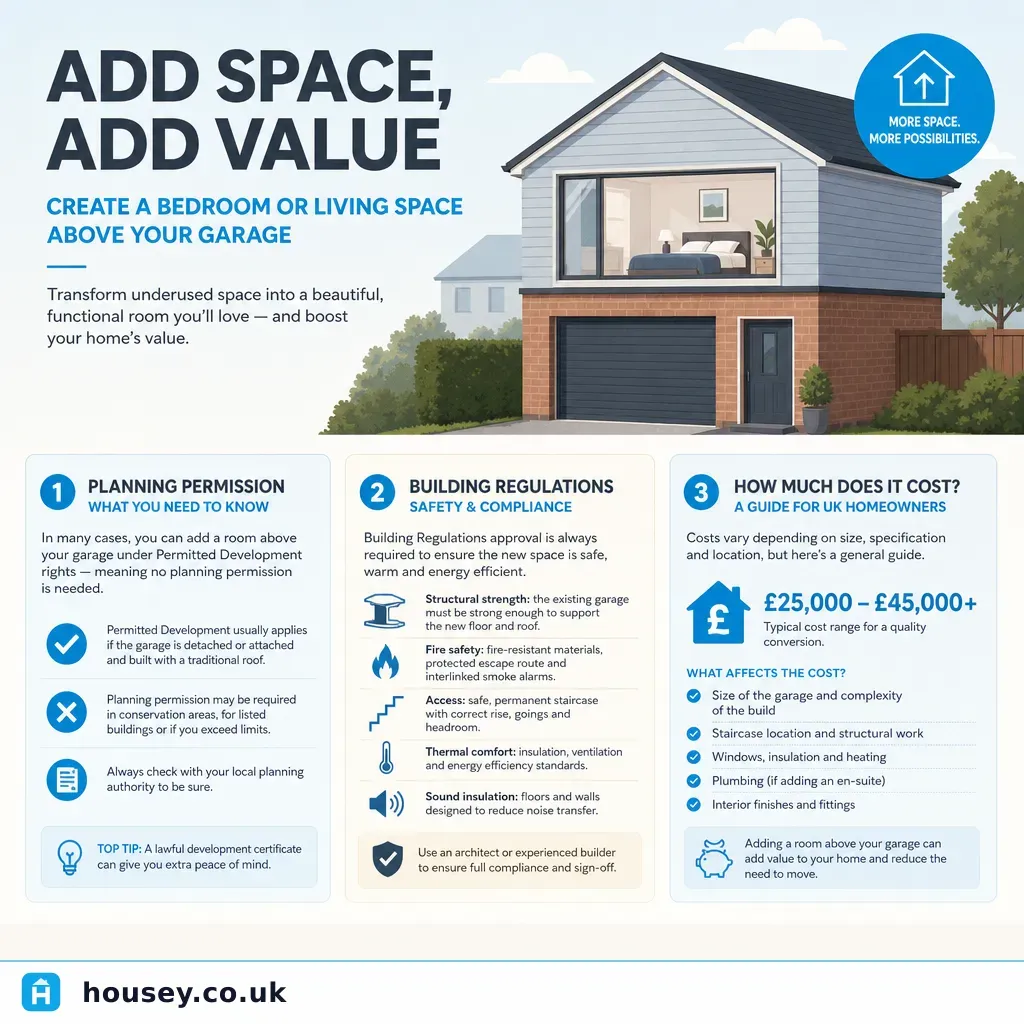
Adding a bedroom or living space above an existing garage
Adding habitable space above an existing garage almost always requires planning permission and Building Regulations approval in the UK.
 Improvement & Build
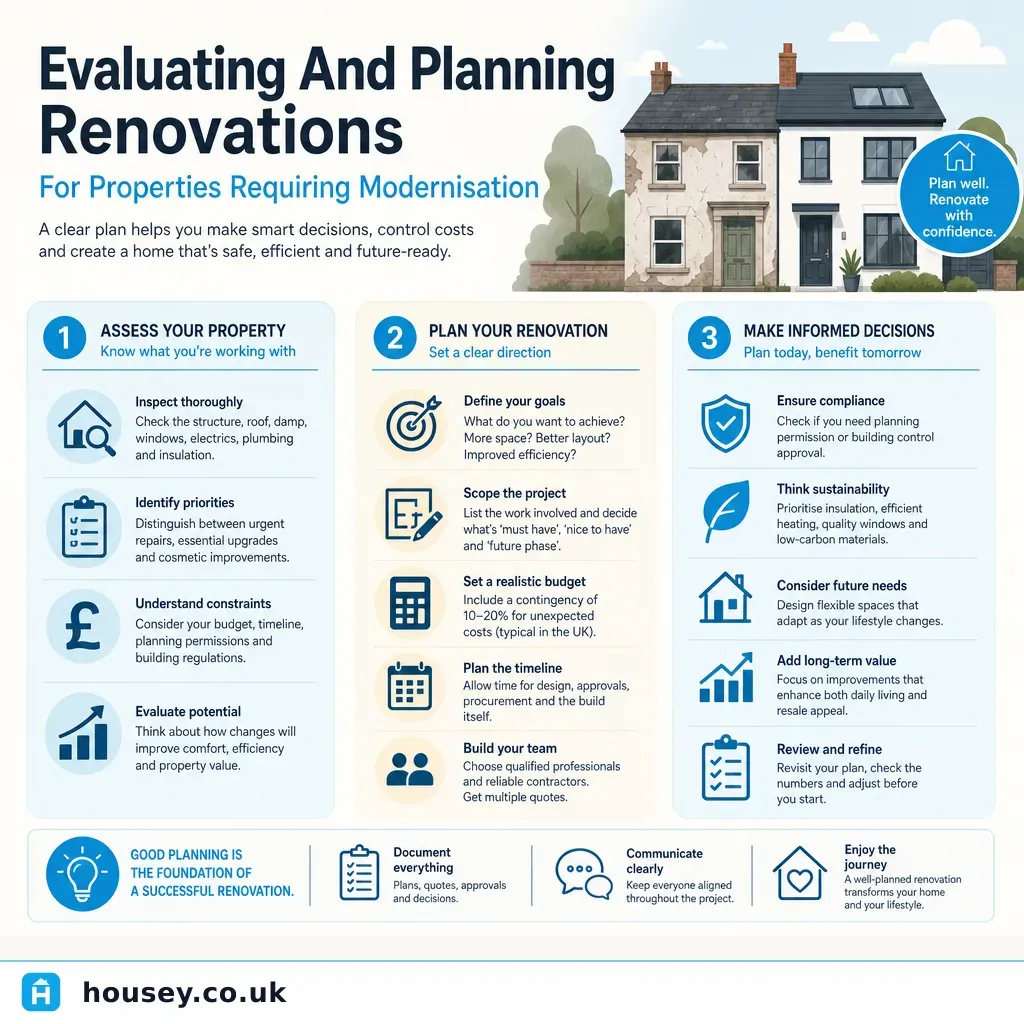
Evaluating And Planning Renovations For Properties Requiring Modernisation
Start by commissioning a condition survey — RICS Level 3 for pre-1919 properties — to identify structural defects, damp, and services issues before finalising a budget.
 Improvement & Build
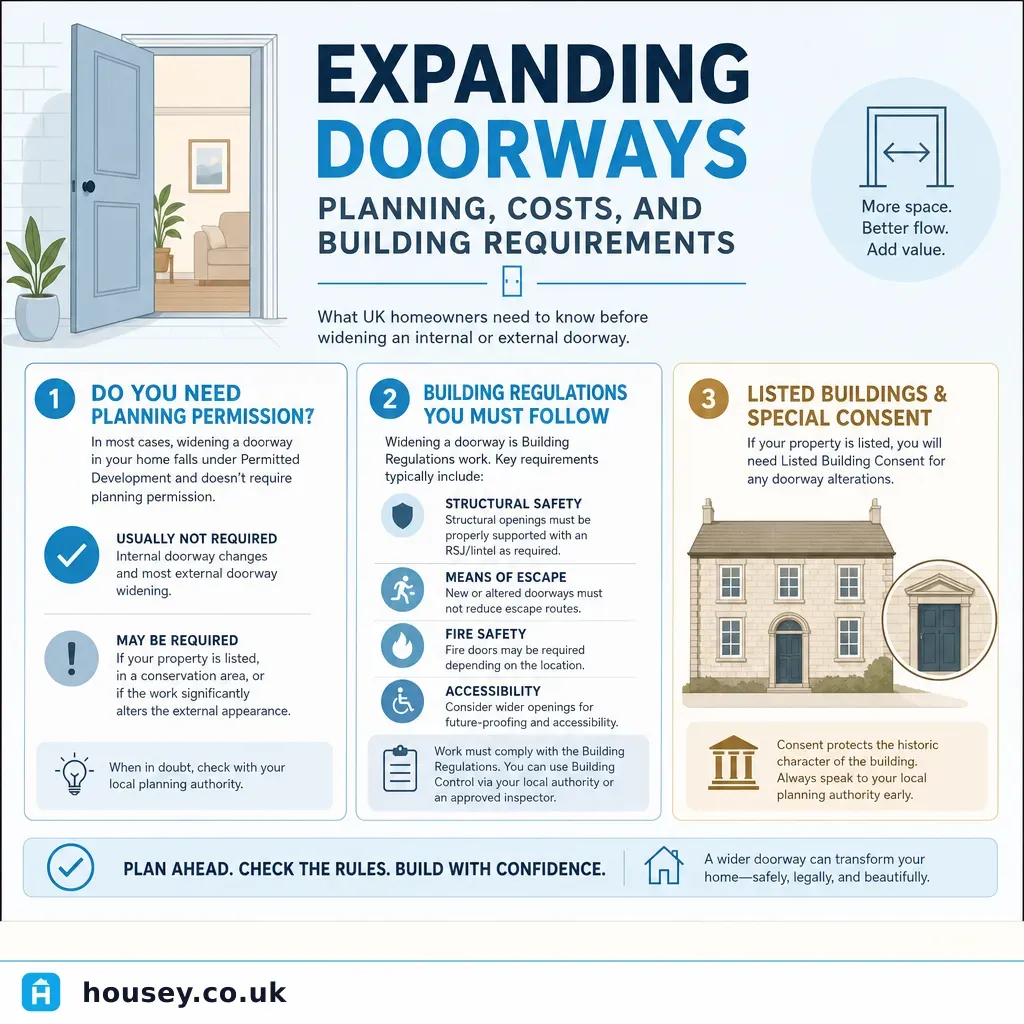
Expanding Doorways: Planning, Costs, and Building Requirements
Expanding a doorway in a load-bearing wall requires Building Regulations Part A approval and a structural engineer's lintel design.
 Improvement & Build
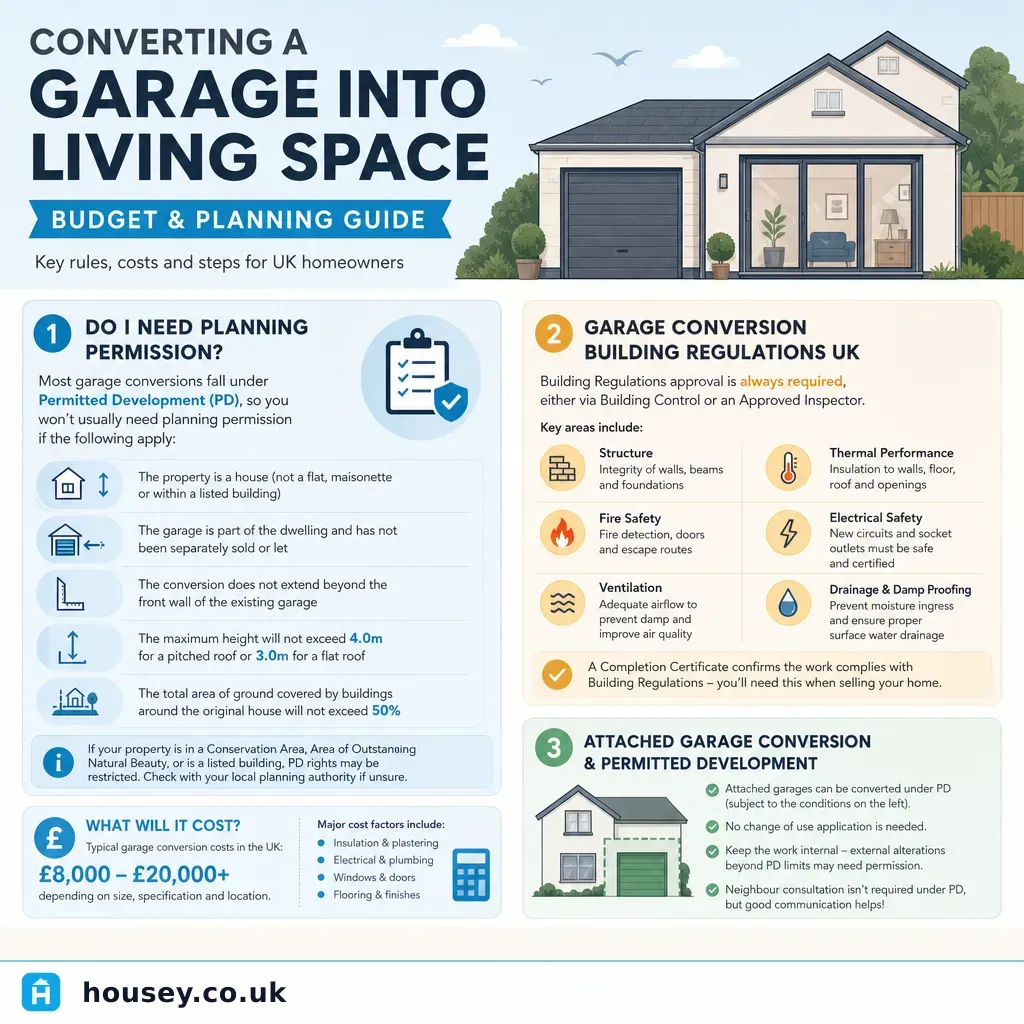
Converting a Garage into Living Space: Budget and Planning Guide
A single-garage conversion typically costs £8,000–£20,000 in the UK.