Estimate for Merging Two Properties into a Single Residence
By Housey · Last reviewed 6th of May 2026
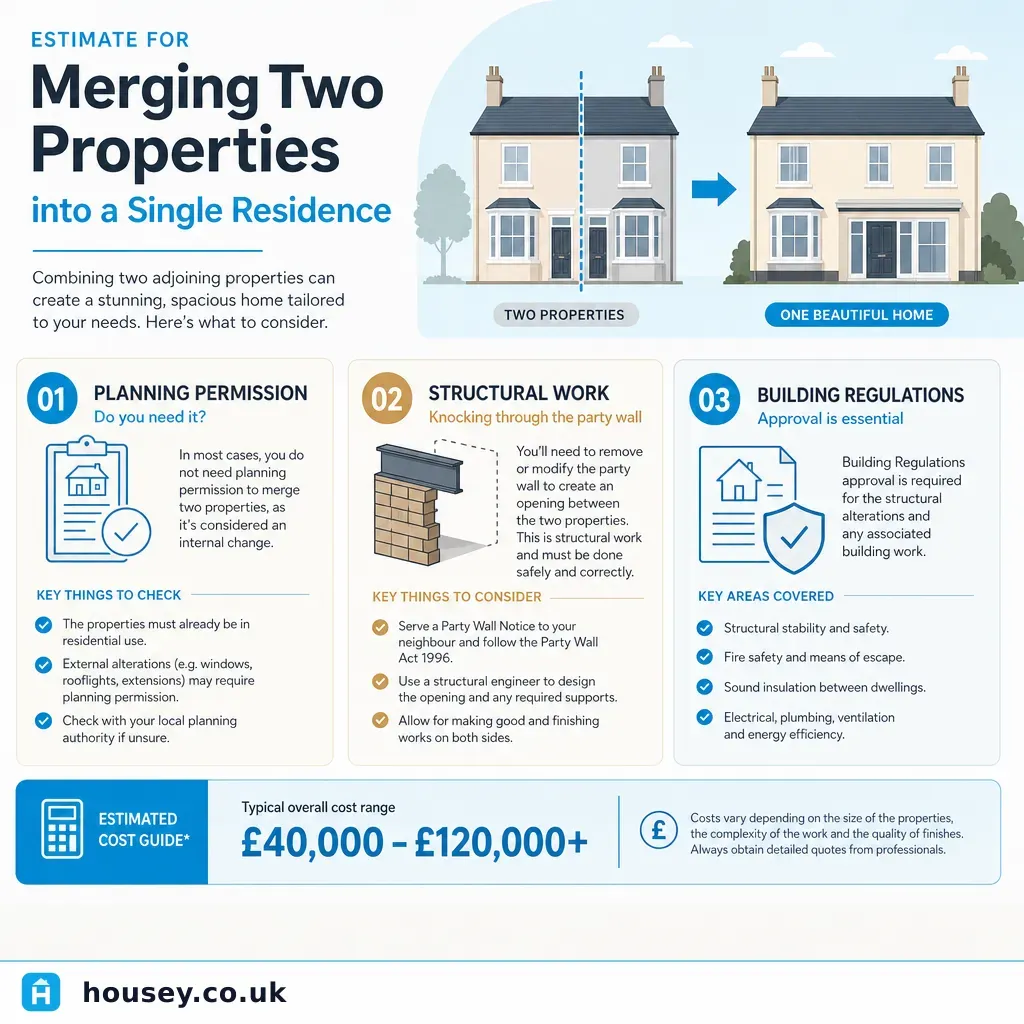
Estimate for Merging Two Properties into a Single Residence
Joining two adjacent properties — whether a pair of Victorian terraced houses, two flats on the same floor, or a maisonette above a ground-floor flat — is one of the most structurally and legally complex residential projects a homeowner can undertake in the UK. The question typically arises when an investor acquires a neighbouring unit, a growing family needs more space than one property provides, or a freeholder wants to consolidate a historic conversion. The regulatory, structural, and legal work involved means that costs vary enormously before a single brick is touched, and the professional-fee component alone can rival a substantial home extension.
Key points
- In England, merging two dwellings into one almost always requires planning permission as it constitutes a material change of use under the Town and Country Planning Act 1990 — it is not covered by Permitted Development rights.
- The Party Wall etc. Act 1996 applies to any structural work affecting a shared or adjacent wall; a party wall award is typically required before structural works start.
- Building Regulations approval is mandatory for structural alterations, any new or altered drainage, electrical rewiring, and changes to fire compartmentation between the former dwellings.
- Professional fees — architect or architectural technologist, structural engineer, building control inspector, and party wall surveyor — commonly add 15–25% on top of construction costs.
- If either property is leasehold, freeholder consent and potentially a solicitor-drafted deed of variation or lease surrender are required before any structural works may proceed.
Does merging two properties need planning permission?
In England, removing a dwelling from the housing stock is a material change of use under the Town and Country Planning Act 1990. Most local planning authorities treat a merger of two self-contained dwellings as development requiring a planning application — it is not permitted development. Wales and Scotland have broadly equivalent requirements under their respective planning legislation, though policy frameworks differ.
A planning application is usually needed even when the two properties share a party wall and appear structurally similar. Many councils have adopted Article 4 Directions specifically to prevent the loss of self-contained homes. National planning policy in England (the NPPF) also steers authorities to protect housing supply. Always check your local authority's development management policies before commissioning any professional work.
Decision tree: does your merger need planning permission?
- Both properties are currently self-contained dwellings → a planning application will almost certainly be required in England and Wales.
- Either property is a listed building or in a conservation area → listed building consent or additional conservation-area conditions are also required.
- Either unit is a leasehold flat → freeholder consent and a solicitor-drafted deed of variation are required before any structural work.
- The properties are in Scotland → check with the relevant local authority; broadly similar rules apply under Scottish planning legislation.
- You are unsure whether the merger counts as change of use → seek pre-application advice from the local planning authority (fees typically £50–£250 for a written response).
What structural work is typically involved?
The scope of structural works depends heavily on whether the properties sit side by side (as in a pair of terraced houses) or are stacked vertically (flats on different floors). The table below sets out the most common elements.
Work element | Side-by-side merger | Vertical merger (flats) |
|---|---|---|
Forming a new opening | New doorway or double door through party wall — structural steel lintel and padstones required | New staircase opening cut through concrete or timber floor — structural engineer calculations essential |
Removing internal walls | Often achievable with RSJ or steel frame; loadbearing assessment needed | Flat soffits may conceal structural beams or service runs; full assessment required |
Party wall or floor | Party wall award under the PWA 1996; adjoining owners must be served notice | Structural floor between flats may be load-bearing — detailed engineering calculations required |
Fire compartmentation | The former boundary between dwellings becomes internal space; Approved Document B compliance must be addressed | Fire separation between floors must be reinstated or removed in compliance with Part B |
Services and meters | Two incoming service connections (gas, water, electric) must be rationalised; utility company involvement needed | May require meter removal and new distribution board; DNO and gas network notification likely |
Drainage | Separate soil stacks and WCs may need consolidating; Part H compliance required | Drainage routes between floors may need major alteration |
A structural engineer must assess and design any new opening through a load-bearing party wall or floor slab. Do not instruct a builder to cut openings before structural calculations and building-regulations drawings are in place.
What are the typical costs of merging two properties?
Indicative UK costs, last reviewed 2026-05-06. The ranges below are broad planning-level estimates; actual costs vary significantly by region, property type, size, condition, contractor, and specification. Always obtain at least three independent quotes.
Cost element | Indicative range | Notes |
|---|---|---|
Planning application fee (England, change of use) | £578 per dwelling removed | GOV.UK planning fee schedule 2024 |
Pre-application planning advice | £50–£250 | Varies by local authority |
Structural engineer fee | £1,500–£5,000+ | Number of openings, floor/wall complexity |
Architect or architectural technologist | £3,000–£12,000+ | Design, planning drawings, building-regs submissions |
Building control (LA or approved inspector) | £800–£3,000+ | Based on project value and complexity |
Party wall surveyor (per surveyor) | £700–£2,500 | Each owner may appoint their own; see PWA 1996 |
Structural opening through party wall (per opening) | £2,500–£8,000 | Steel beam, padstones, making good both faces |
New staircase (vertical merger) | £5,000–£20,000+ | Structural opening, joinery, fire compartmentation |
Full rewire of merged unit | £6,000–£20,000+ | Size and existing condition dependent |
Decoration and finishes | £5,000–£25,000+ | Highly variable |
Total project cost (excluding property purchase) | £30,000–£120,000+ | Complex or large properties may exceed this substantially |
Source: indicative ranges informed by BCIS (Building Cost Information Service) guidance and published trade body cost data. Verify all figures with independent contractor quotes before budgeting.
Worked UK property scenario
Two adjacent Victorian terraced houses, each three-bedroom, approximately 90 m², in South-East England. Both freehold, owned by the same person.
A planning application for change of use is submitted; the council approves it subject to conditions after 10 weeks, as neither property falls within a housing-protection zone. An architectural technologist prepares planning and building-regulations drawings (£4,500). A structural engineer designs a new RSJ opening through the shared party wall and produces calculations for reconfiguring the first-floor layout (£3,200). A party wall award is agreed with the adjoining owner to the other side, covering the structural works; total surveyor costs amount to £2,100. Two structural openings are formed (£14,000 including steelwork and making good), the first floor is reconfigured to create a single landing and open-plan living area (£18,000), both properties are rewired under a single consumer unit (£9,500), and decoration and finishes are completed (£22,000).
Total project cost excluding property acquisition: approximately £75,000–£80,000 over a 20-week programme. This scenario is illustrative; costs in London, listed buildings, or more complex structural situations would differ substantially.
Red flags: when your project may be more complicated
- Either property is a leasehold flat — freeholder consent and likely a lease variation or surrender are needed before structural works; this can add months and significant legal cost.
- The shared wall or floor is load-bearing concrete — do not instruct a builder before a structural engineer has assessed it and produced stamped calculations.
- Either property is a listed building — listed building consent is required in addition to planning permission; carrying out unauthorised works on a listed building is a criminal offence.
- Different council tax bands or separate Land Registry titles with charges — mortgagee consent and Land Registry title unification add legal complexity.
- An outstanding mortgage on one or both properties — lender written consent is required before any structural alterations proceed; some lenders refuse or impose conditions.
- Missing building-regulations completion certificates for previous works — these will likely need to be regularised before a merger project can be signed off by building control.
- Any material suspected to be asbestos — common in pre-2000 properties; do not disturb. Arrange an asbestos survey before stripping out.
Important limitations
This article provides general information to help homeowners understand the scope and typical costs of merging two properties. It is not structural, legal, planning, or financial advice. Costs, planning policies, structural requirements, and legal obligations vary by property, local authority, tenure, and condition. Rules change; always verify current requirements with the relevant authority. A qualified professional — including a chartered structural engineer, architect or architectural technologist, planning consultant, and solicitor — should assess your specific properties before any commitment is made.
When this becomes urgent
Seek immediate professional input if you have already started work without planning permission or building-regulations approval — unauthorised works can result in enforcement notices, costly reversal, and complications on future sale. If you discover cracking, bowing, or structural movement during strip-out, stop work and instruct a structural engineer before proceeding. If any material removed looks like it may contain asbestos, stop work and arrange an asbestos survey.
What to ask a qualified professional
Before instructing anyone, ask:
- Does this merger require a planning application, and has the local authority's housing-protection or Article 4 policy been checked?
- Which Approved Documents apply — Part A (structure), Part B (fire), Part G (drainage and sanitation), Part L (energy efficiency), and Part F (ventilation)?
- Will a party wall award be needed, and which neighbouring owners must be served notice under the Party Wall etc. Act 1996?
- Are there any restrictive covenants, leasehold conditions, or mortgage consents that must be obtained before works commence?
- What is the recommended building-control route — local authority building control or an approved inspector — and what are the relative costs?
- What is the anticipated programme, and what are the key dependencies that could cause delays (e.g. party wall disputes, planning conditions, utility diversions)?
- What professional indemnity insurance do you hold, and does it cover this project type and value?
When to get professional help
A structural engineer should be instructed before any wall or floor openings are formed. An architectural technologist or architect is needed for planning drawings and building-regulations submissions. If either property is leasehold, involves a listed building, or carries a mortgage, a specialist solicitor should be consulted at the earliest stage.
Consult a professional if you observe any of the following during survey or strip-out:
- Cracks wider than 5 mm, stepped cracking through brickwork, or walls that appear to lean or bow.
- Evidence of previous underpinning, subsidence, or unrecorded structural alterations.
- Materials that may be asbestos — do not disturb; arrange an asbestos survey first.
- Any signs of active damp, rot, or pest infestation in the structural frame.
How Housey can help
Property merger projects require co-ordinated input from several disciplines. Housey connects homeowners with qualified UK professionals including structural engineering services, building control consultants, and architectural technologists, so you can request comparable quotes and understand fees before committing to the project.
Frequently asked questions
Do I always need planning permission to merge two houses in England?
In most cases, yes. Merging two self-contained dwellings into one is treated as a material change of use under the Town and Country Planning Act 1990, and Permitted Development rights do not cover the loss of a dwelling. Some councils have Article 4 Directions that impose stricter conditions. Always check with your local planning authority before instructing professionals.
How long does it take to merge two properties from start to finish?
A realistic programme from initial professional instruction to practical completion is typically 12–24 months. This allows for planning determination (8–13 weeks in England), building-regulations approval, party wall awards, contractor procurement, and construction. Leasehold complications, listed-building status, or complex structural work can extend this considerably.
Will I need to update the Land Registry title after merging two properties?
Yes. Once works are complete and planning conditions are discharged, HM Land Registry must be notified so that the two separate titles can be merged into one. Your solicitor handles this process; a Land Registry fee based on the property value is payable. It is important to resolve this promptly to avoid conveyancing complications if you later sell or re-mortgage.
Can I merge two leasehold flats I own?
This is significantly more complex than merging freehold houses. You will need written consent from the freeholder, and the leases may need to be varied, surrendered, or replaced with a single new lease. Some leaseholders pursue freehold acquisition first. Specialist leasehold solicitor advice should be sought at the very earliest stage before any structural work is commissioned.
Will merging two properties affect the council tax banding?
Yes. Once the merger is complete, the Valuation Office Agency reassesses the council tax banding for the combined property. Two separate band entries are replaced with a single new banding, which is often higher than either individual band. You are responsible for notifying the VOA; contact your local billing authority to start the process after practical completion.
Sources and further reading
- Planning permission: when you need it — GOV.UK
- Fees for planning applications in England — GOV.UK
- The Party Wall etc. Act 1996 — legislation.gov.uk
- Building Regulations Approved Documents — GOV.UK
- HM Land Registry: registering and changing titles — HM Land Registry
- RICS guidance on party wall matters — RICS
Useful next reads
 Improvement & Build
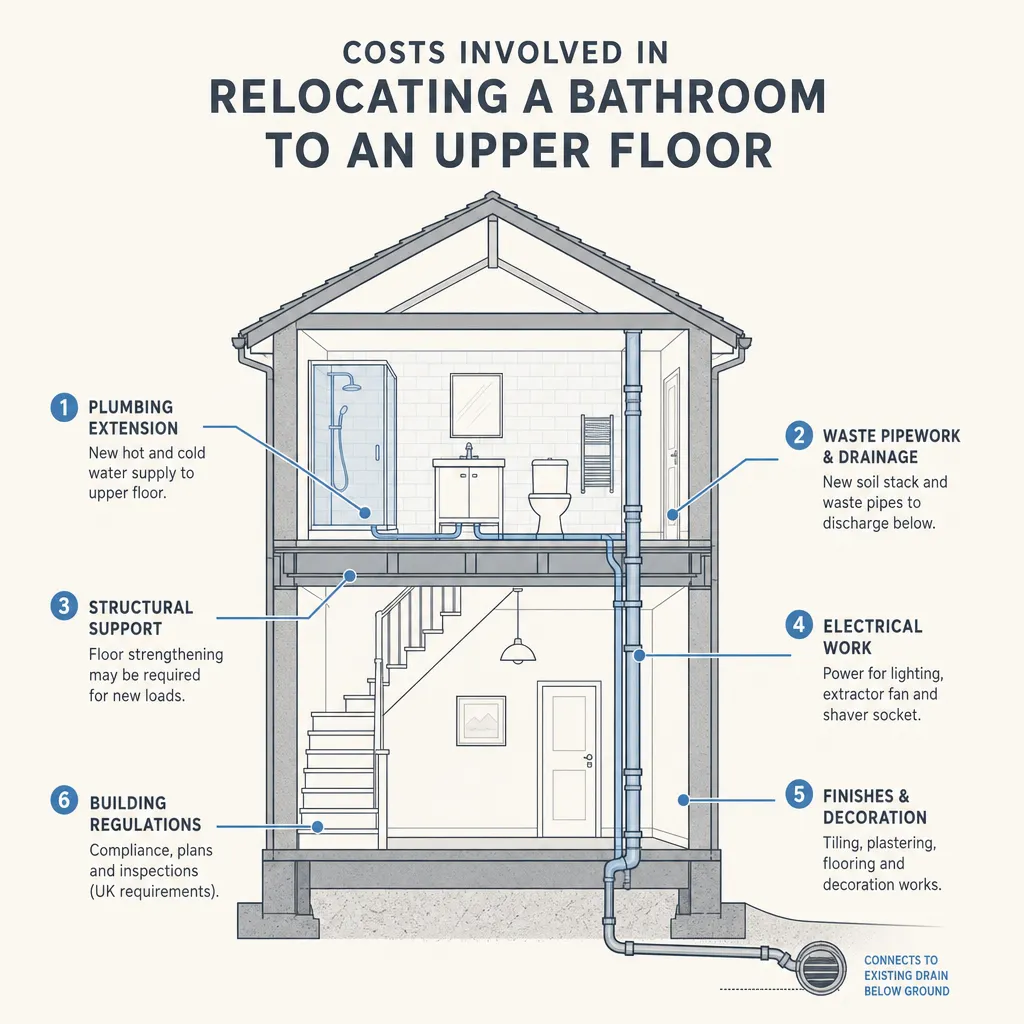
Costs Involved in Relocating a Bathroom to an Upper Floor
Moving a bathroom to an upper floor in a UK home typically costs £7,000 to £20,000 or more, depending on drainage method, structural work required, and finishes chosen.
 Improvement & Build
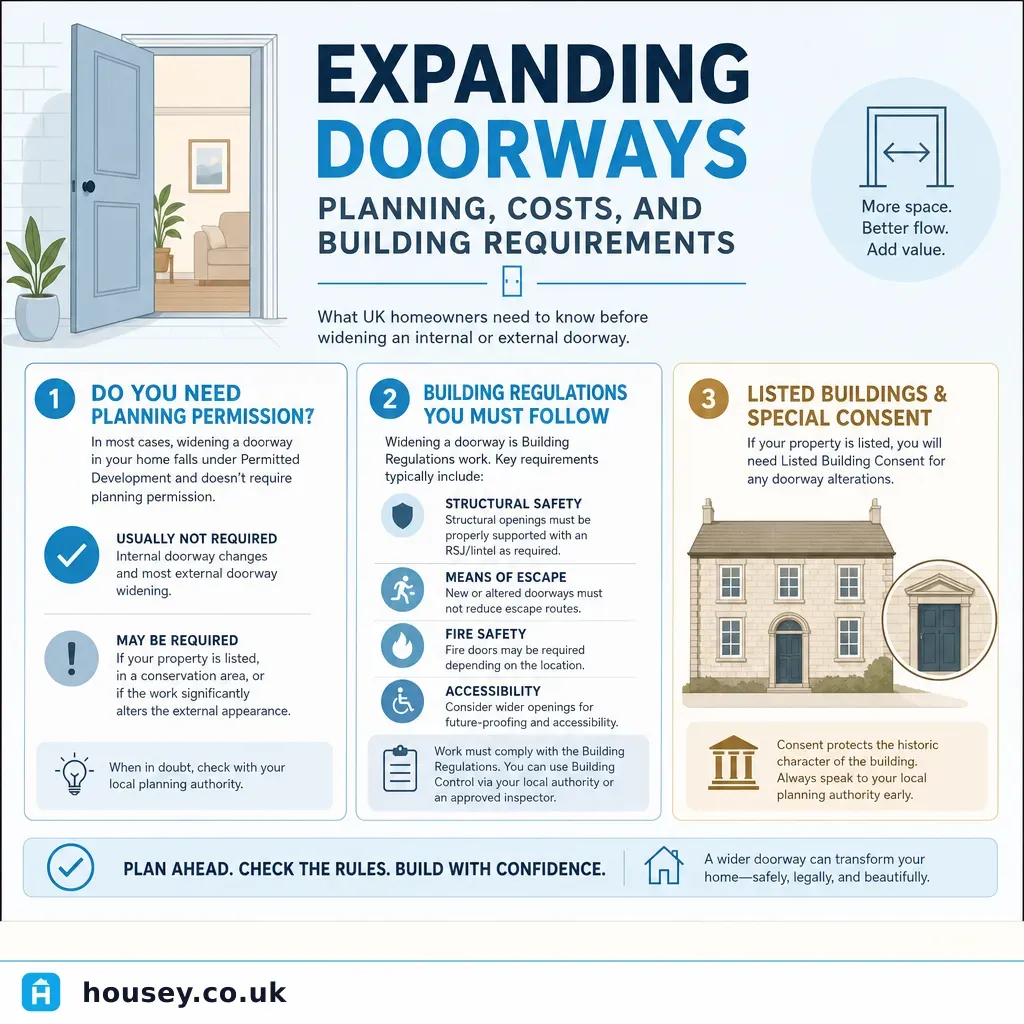
Expanding Doorways: Planning, Costs, and Building Requirements
Expanding a doorway in a load-bearing wall requires Building Regulations Part A approval and a structural engineer's lintel design.
 Improvement & Build
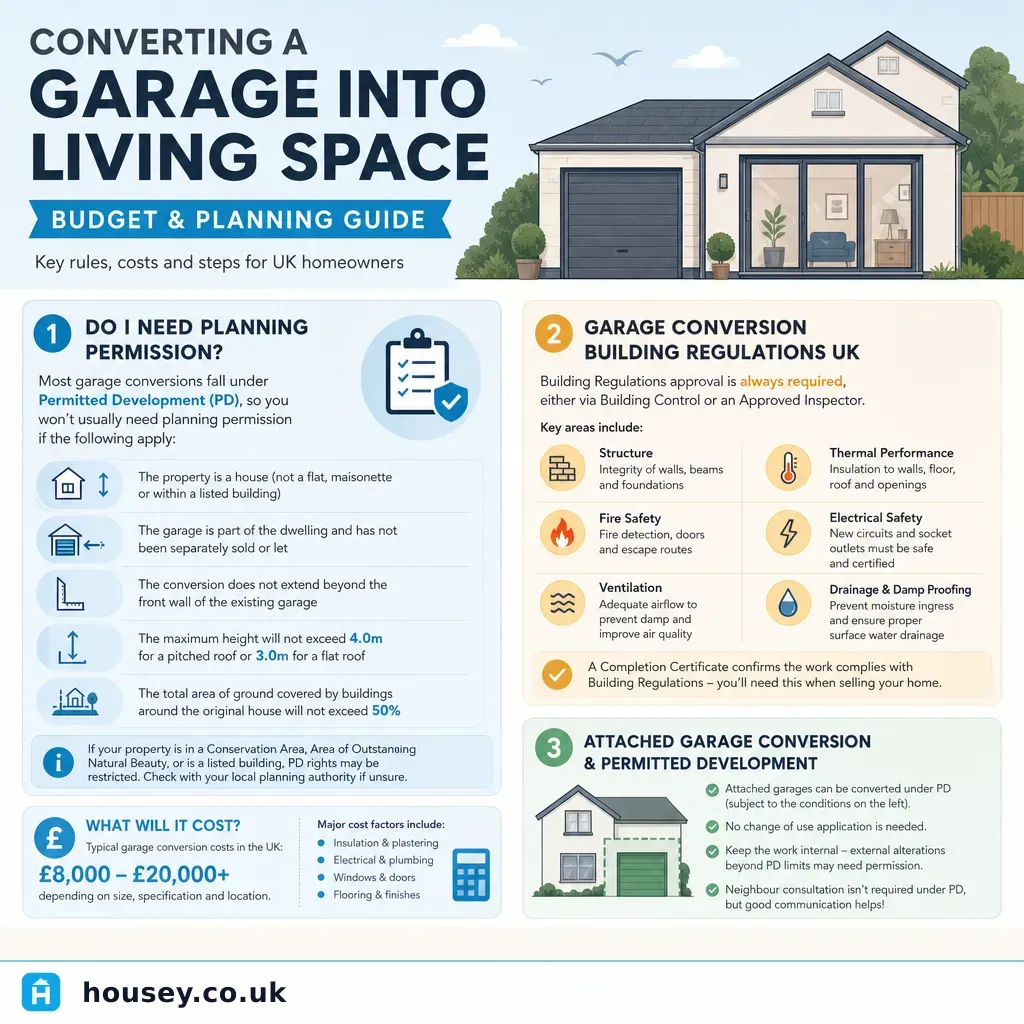
Converting a Garage into Living Space: Budget and Planning Guide
A single-garage conversion typically costs £8,000–£20,000 in the UK.
 Improvement & Build
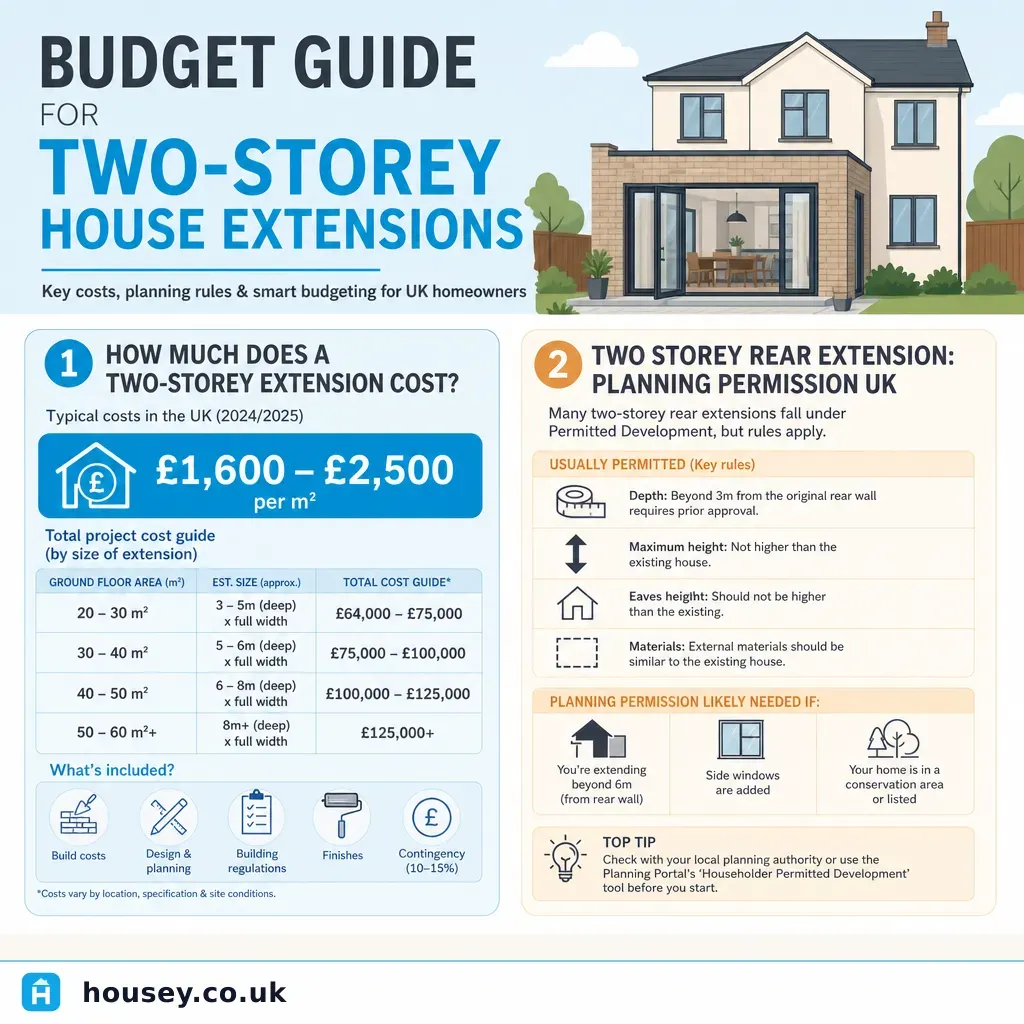
Budget Guide for Two-Storey House Extensions
A two-storey house extension in the UK typically costs £1,800–£3,000+ per square metre for the build alone.
 Improvement & Build
Planning a Flat-Roof Extension: What Costs to Budget
A flat-roof single-storey extension typically costs £1,500–£3,000 per m² in the UK, depending on size, specification, location, and roof membrane choice.