Adhesive vs Mechanical Fixing for Plasterboard Installation
By Housey · Last reviewed 1st of June 2026
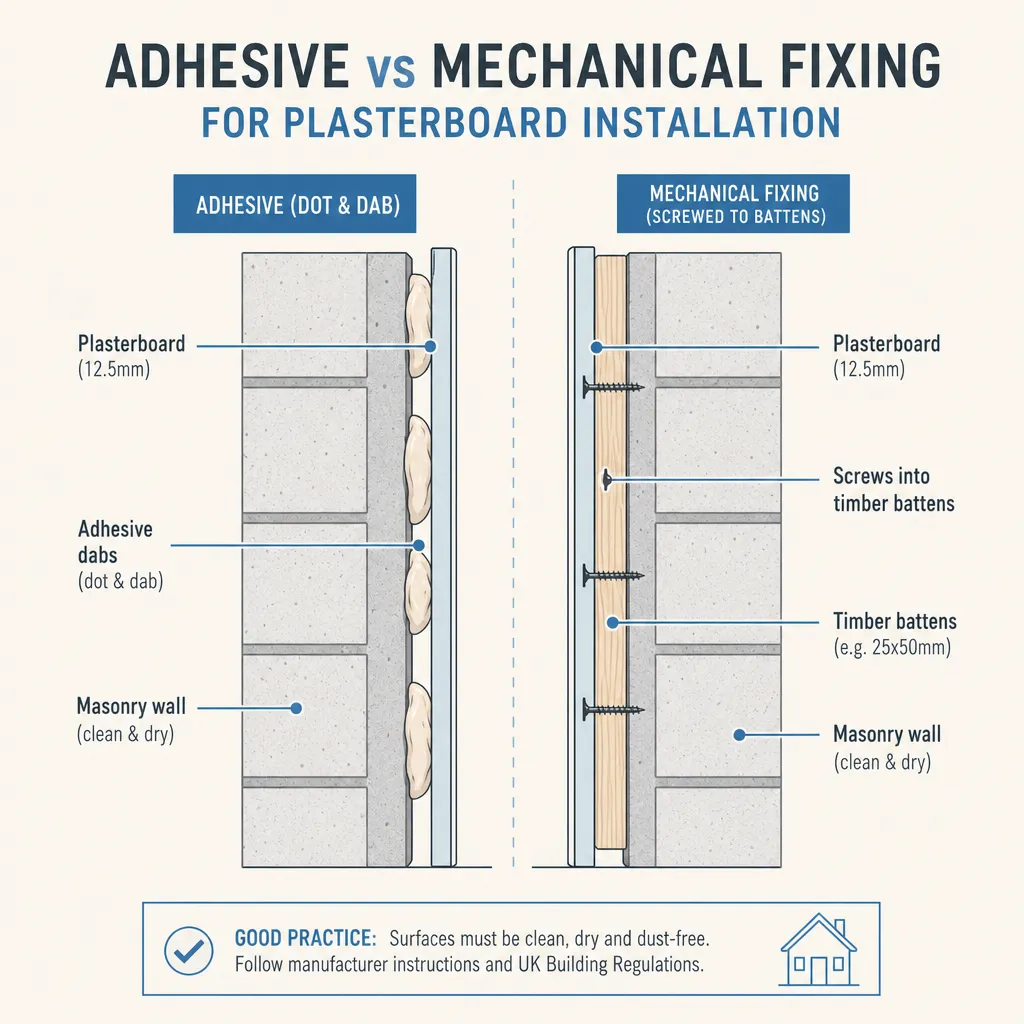
Adhesive vs Mechanical Fixing for Plasterboard Installation
When drylining internal walls, the fixing method you choose affects considerably more than convenience. It influences fire compartmentation, acoustic performance, thermal efficiency, and the long-term stability of the finished surface. Both dot-and-dab adhesive and mechanical fixing are widely used across UK residential construction, from 1930s semi-detached houses being updated to new-build extensions, but each has distinct advantages and situations where it is the wrong choice.
Key points
- Dot-and-dab adhesive creates a 10–25 mm void between the plasterboard and the masonry substrate, which must be addressed with cavity barriers to maintain fire compartmentation under Building Regulations Approved Document B.
- Mechanical fixing to timber or metal studwork is the standard and preferred method for fire-rated partitions, separating walls, ceilings, and wet areas.
- Building Regulations Approved Document E sets minimum sound insulation standards for party walls (typically 45 dB Rw for airborne sound); the fixing method and board specification both affect compliance.
- Adhesive fixing is not suitable on wet, contaminated, or heavily uneven substrates, or where services will be installed behind the board.
- British Gypsum and Knauf publish detailed technical specifications (the White Book and equivalent guides) that govern board type, adhesive application pattern, and fixing centres for UK drylining work.
Adhesive fixing (dot and dab): what it is and when to use it
Dot-and-dab involves applying blobs of gypsum-based adhesive to a masonry wall in a regular grid, then pressing the board against the dabs to create a series of contact points. The board sits 10–25 mm proud of the masonry surface.
Advantages of adhesive fixing:
- Faster to install than building a stud frame — no timber or metal track required
- Suitable for sound, dry, reasonably flat masonry (brick, blockwork, dense concrete)
- Lower material cost in straightforward applications
- Easier to achieve a flat finished surface on slightly uneven brickwork
Limitations of adhesive fixing:
- The void behind the board can allow fire to travel between rooms or floors if cavity barriers are not installed at all junctions, edges, and around service penetrations
- Can reduce the effective acoustic mass of a party wall if not specified and constructed correctly
- Not suitable where pipework or cabling will be run behind the board
- Requires a sound, dry substrate — loose existing plaster, contaminated walls, rising damp, or persistent condensation will cause adhesive failure
- Not appropriate for ceilings — gravity and long-term creep make adhesive-only overhead fixing unsafe
Mechanical fixing: what it is and when to use it
Mechanical fixing means attaching plasterboard directly to a structural substrate — typically a timber stud frame, a metal C-stud and track partition, or in some cases directly into masonry using plugs and screws. Screws are the standard fastener for stud systems.
Advantages of mechanical fixing:
- Direct board-to-frame contact eliminates the adhesive void, improving fire resistance and acoustic mass
- Preferred or required for fire-rated partitions, ceilings, party walls, and separating floors
- Suitable for wet and humid environments with moisture-resistant (MR) board, where adhesive bond may fail
- Allows services (pipes, cables, insulation) to be installed within the stud cavity before boarding
- Provides reliable fixing for wall-mounted items if noggings are correctly positioned
Limitations of mechanical fixing:
- Requires a stud frame to be built first, which takes longer and reduces floor area slightly (typically 70–100 mm from the face of the masonry)
- Higher combined material and labour cost for straightforward wall applications
- Timber frames can be affected by moisture if not properly detailed and protected
Comparison: adhesive vs mechanical fixing
Factor | Dot-and-dab adhesive | Mechanical fixing (stud frame) |
|---|---|---|
Installation speed | Faster for walls | Slower — frame must be built first |
Material cost | Lower | Higher (studwork + fixings) |
Fire performance | Void requires cavity barriers at junctions | Better — direct contact, no void |
Acoustic performance | Adequate if correctly specified on internal walls | Better options for mass and isolation |
Ceilings | Not suitable | Standard method |
Wet and humid areas | Poor — adhesive can fail | Good with MR board |
Services behind board | Difficult | Easy — services in stud cavity |
Substrate required | Sound, dry masonry | Timber or metal frame |
Building Regulations (Part B, E) | Check void and cavity barrier requirements | Preferred for rated construction |
Decision tree: which method should you choose?
- Use dot-and-dab adhesive if the wall is an internal, non-party masonry wall in a dry room, the substrate is sound and free from damp, no services need to run behind the board, and the application has no fire-resistance or acoustic rating requirement.
- Use mechanical fixing to a stud frame if you are boarding any ceiling, the wall is a party wall or fire-rated partition, the room is wet or humid (bathroom, utility, kitchen splash zone), services will be concealed behind the board, or Building Regulations specifically require it.
- Consider direct mechanical fixing into masonry (plugs and screws through the board) if a stud frame is impractical, the masonry is solid and sound, and the specific plasterboard and application support this method per the manufacturer's technical data sheet.
- Consult a specialist dryliner, builder, or building control body if the wall is on an external elevation with damp concerns, if a fire-resistance or acoustic rating must be achieved, or if the project involves a party wall under the Party Wall etc. Act 1996.
Building Regulations and standards
The choice of fixing method is not purely practical — it carries Building Regulations implications in several common scenarios:
Approved Document B (Fire safety): Walls that form fire compartment boundaries — between flats in a converted house, between a habitable room and an integral garage, or in corridors serving multiple dwellings — must achieve specified fire-resistance periods. A dot-and-dab system with a void behind the board requires cavity barriers at all edges, junctions, and service penetrations. Omitting these is a common and potentially serious oversight that may not be discovered until a building control inspection or, worse, a fire incident.
Approved Document E (Resistance to sound): Party walls between dwellings must meet minimum sound insulation standards (45 dB Rw for airborne sound is the typical separating-wall requirement). The fixing method, board specification, and any insulation within the cavity all affect whether the finished construction meets the standard. Robust Details or pre-completion acoustic testing may be required for new-build or conversion projects.
Approved Document L (Thermal performance): Where insulated plasterboard (PIR or phenolic core) is used to improve wall U-values as part of an extension or refurbishment, the manufacturer's specification will specify whether adhesive or mechanical fixing is appropriate for the particular product.
For any notifiable building work, notify your local authority building control (LABC) or an approved inspector before starting work.
Red flags: when to stop and get advice
Pause and consult a specialist if you encounter:
- Damp patches, efflorescence, or salt staining on the masonry — dot-and-dab adhesive will fail and you risk sealing moisture behind the board, which can cause mould and damage structural fabric.
- Cracks or movement in the existing substrate — boarding over an unstable wall conceals the problem and may cause the board to crack or delaminate later.
- The wall forms a fire or acoustic boundary — party walls, walls separating a garage from living space, or any wall with a required resistance rating need to be specified and signed off by building control.
- Hidden services exist behind or within the wall — pipes, cables, and ducts affect both fixing method and fire compartmentation strategy.
- The wall is an external leaf or subject to wind-driven rain — incorrect boarding of external-facing walls can trap moisture in the fabric, leading to mould, timber decay, or spalled masonry.
When to get professional help
For straightforward internal walls in a dry, non-rated situation, an experienced tradesperson following manufacturer guidance (British Gypsum White Book, Knauf technical literature) can install plasterboard competently. Professional input is advisable — and in some cases mandatory — when:
- The project is a notifiable building alteration, extension, or change of use requiring building control approval.
- Party walls, fire-rated partitions, or acoustic separating walls are involved.
- The substrate is damp, uneven, or otherwise uncertain.
- Wall insulation is being added and Part L compliance must be demonstrated.
How Housey can help
If your plasterboard work is part of a larger build or extension project, a qualified extension builder can advise on the correct fixing method for your specific walls, carry out the installation to Building Regulations standard, and ensure any fire or acoustic requirements are properly documented for building control sign-off.
Frequently asked questions
Can I use dot-and-dab adhesive on an external wall?
You can, but with caution. External walls in UK homes are often subject to moisture ingress and interstitial condensation. If the wall has any existing damp, or if insulation is being added, a specialist should specify the correct build-up. Wrong detailing can trap moisture behind the board, leading to mould growth or structural deterioration. Always check the wall is sound and dry before proceeding.
How many dabs of adhesive do I need per standard board?
British Gypsum and Knauf guidance typically specifies dabs applied at 300 mm centres in three vertical columns across a standard 1,200 mm-wide board, with additional perimeter dabs at edges and around openings. Always follow the manufacturer's current technical data sheet for the specific adhesive and plasterboard combination you are using, as specifications can vary by product.
Does plasterboard need noggings for mechanical fixing to a stud frame?
Yes. Boards fixed to timber studwork need horizontal noggings at mid-height and at all board joints to provide adequate support and prevent movement or cracking. Noggings also provide secure fixing points for wall-mounted items such as radiators, shelving, or sanitary ware. Metal studwork systems use horizontal channel sections for the same purpose.
Is adhesive or mechanical fixing better for a bathroom?
For bathrooms and wet areas, mechanical fixing with moisture-resistant plasterboard to a metal or treated timber stud frame is the preferred method. Standard adhesive can fail when repeatedly exposed to humidity, and the masonry substrate may also be prone to moisture. In shower enclosures, cement board or a dedicated tile-backer board fixed mechanically is the appropriate substrate — not standard plasterboard.
Can I mix adhesive and mechanical fixing on the same wall?
In some circumstances yes — supplementary screws through the board into the masonry can be used alongside adhesive to improve stability on tall runs or where the substrate is slightly uneven. Always check the relevant manufacturer's technical data sheet and the applicable Building Regulations guidance for your specific situation before combining methods.
Sources and further reading
- Approved Document B: Fire Safety — GOV.UK — fire compartmentation and cavity barrier requirements
- Approved Document E: Resistance to Sound — GOV.UK — acoustic performance standards for party walls
- British Gypsum White Book — British Gypsum — drylining system specifications and fixing guidance
- Knauf UK Technical Downloads — Knauf UK — plasterboard installation guides and data sheets
- Approved Document L: Conservation of Fuel and Power — GOV.UK — thermal performance requirements for walls
Useful next reads
 Improvement & Build
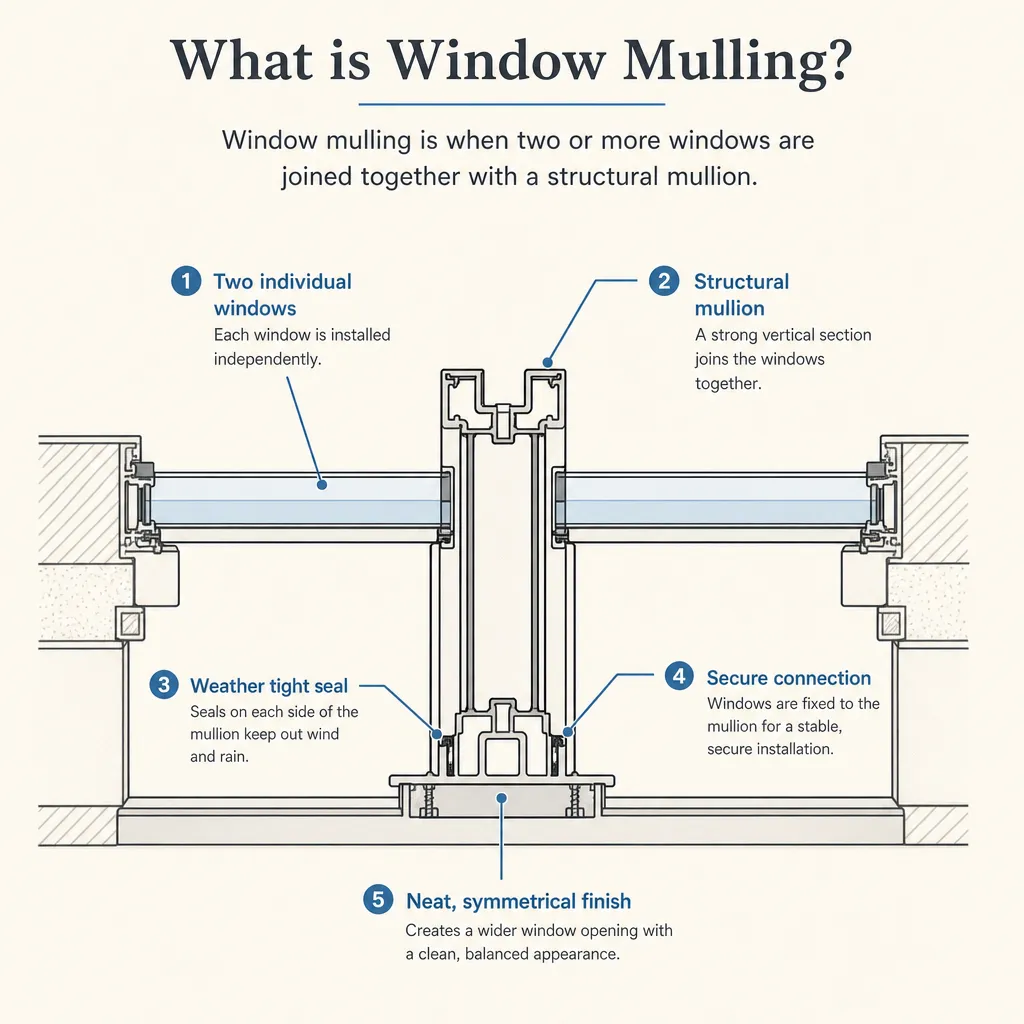
What is window mulling in window installation
Window mulling is the process of joining two or more individual window frames together using a mullion bar or mulling kit, so they function and appear as a single combined window assembly.
 Improvement & Build
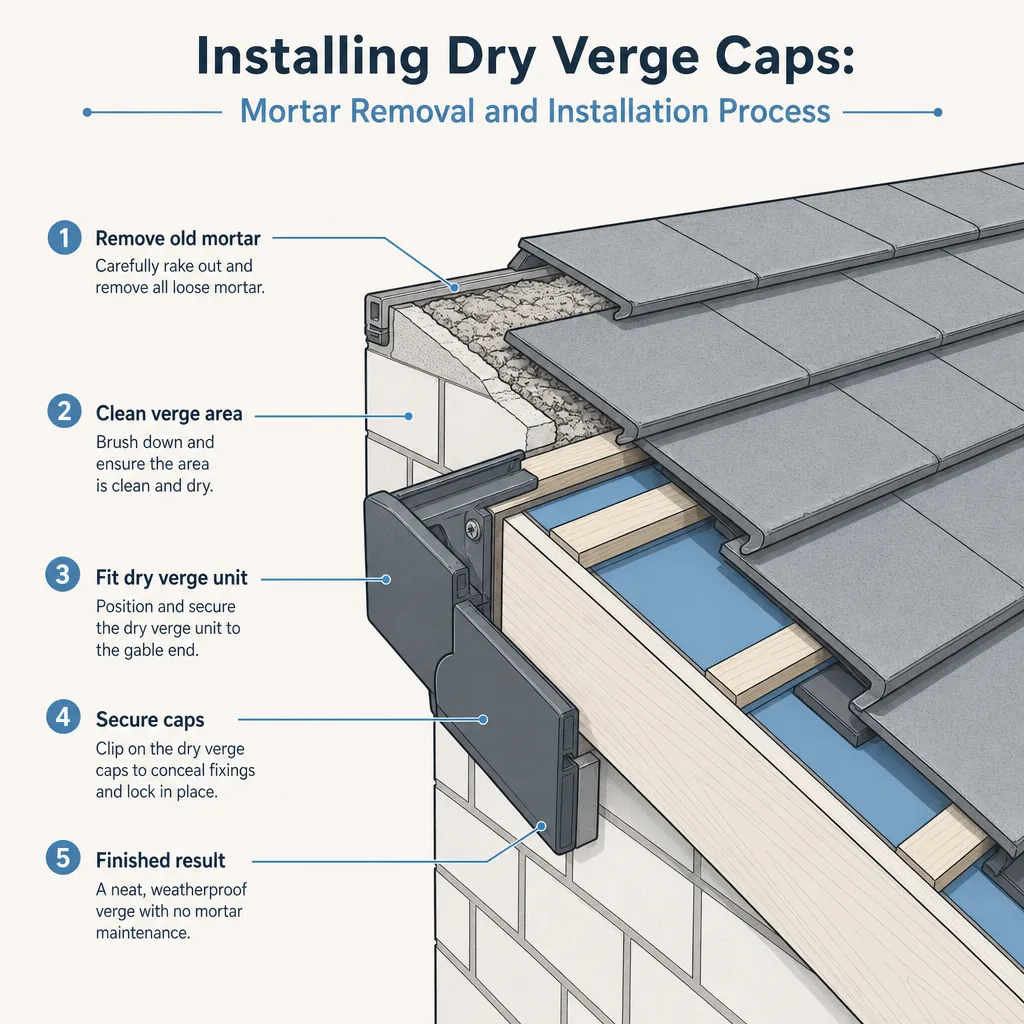
Installing Dry Verge Caps: Mortar Removal and Installation Process
Installing dry verge caps on a UK roof involves removing all existing mortar from the gable verge, inspecting and repairing the underlay, then clipping interlocking uPVC or aluminium caps from eaves to ridge.
 Improvement & Build
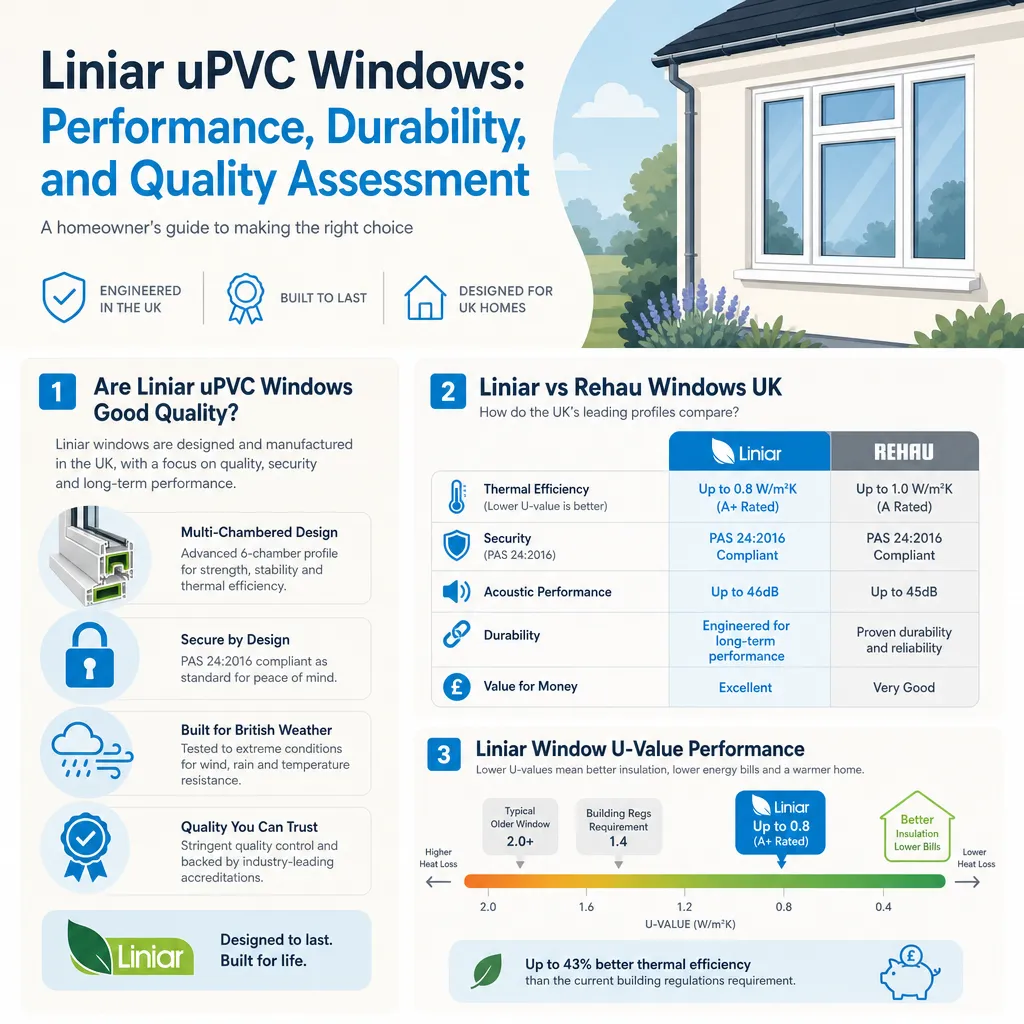
Liniar uPVC Windows: Performance, Durability, and Quality Assessment
Liniar uPVC window profiles are manufactured in the UK using multi-chambered, foamed frames.
 Improvement & Build
Garden Tap Installation with Hot and Cold Water: Plumbing Options
Adding a cold garden tap is a common DIY project, but routing hot water outdoors requires a plumber to connect to your domestic hot water system and comply with the Water Supply (Water Fittings) Regulations 1999.
 Improvement & Build
Sealing and Maintaining Historic Leaded Glass Windows: Preservation and Performance
Leaded glass windows are maintained using traditional linseed oil cement — not silicone or modern sealants, which prevent natural movement in the lead came.