Liniar uPVC Windows: Performance, Durability, and Quality Assessment
By Housey · Last reviewed 3rd of May 2026
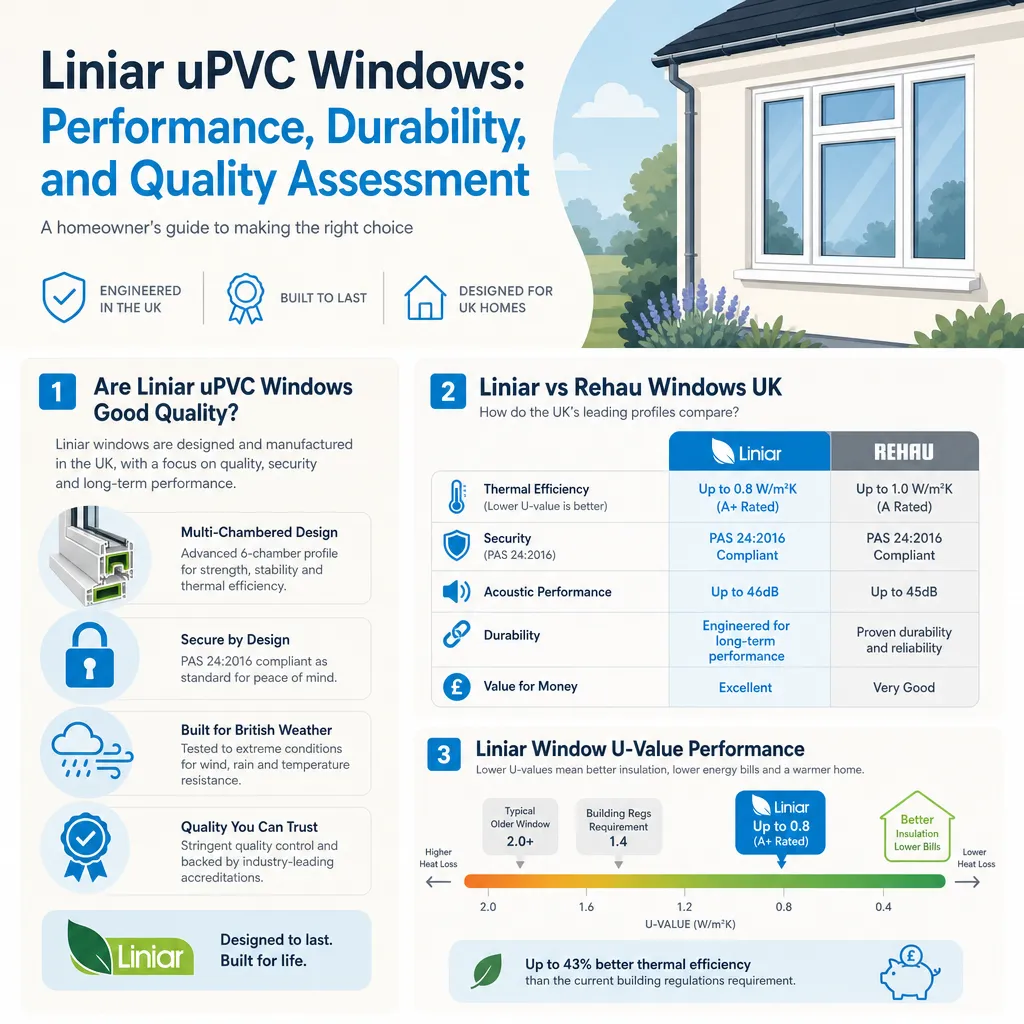
Liniar uPVC Windows: Performance, Durability, and Quality Assessment
Liniar is a UK-based uPVC profile manufacturer whose window systems are widely used by installers across England, Scotland, and Wales. Homeowners replacing windows often encounter Liniar profiles when comparing quotes and want to understand whether they represent good value and lasting quality before committing. The choice matters: windows that fall short on thermal performance or weatherproofing increase energy bills and may require earlier replacement than expected.
Key points
- Replacement windows in England must achieve a minimum Window Energy Rating (WER) of Band C or a whole-window U-value of no more than 1.6 W/m²K under Building Regulations Part L; Scotland and Wales have equivalent requirements under their own building standards.
- Liniar's multi-chambered, foamed-outer-chamber uPVC profiles are manufactured in Derbyshire and can achieve centre-pane U-values around 1.0–1.2 W/m²K with appropriate argon-filled, low-emissivity double glazing.
- All replacement window installers must hold FENSA or CERTASS registration to self-certify compliance with building regulations, or notify the local authority building control department directly.
- Liniar frames carry a 10-year profile guarantee from the manufacturer; installer workmanship warranties are separate and vary by company — always ask for both in writing.
- Foil-finish Liniar profiles (such as anthracite grey RAL 7016 or rosewood) require specialist cleaning products and should not be cleaned with abrasive compounds, which can damage the surface layer.
What Liniar makes and how its profiles differ
Liniar is a vertically integrated manufacturer, producing its own uPVC compound and extruded profiles at its Derbyshire site. This means the raw material composition — including UV stabilisers and impact modifiers — is controlled in-house, which the company argues results in more consistent quality than manufacturers that source compound from third parties.
The defining technical feature of Liniar's profiles is the multi-chamber design. Internally, the frame and sash sections are divided into sealed chambers that reduce heat loss by creating layers of still air resistant to conduction. The outermost chambers in Liniar profiles are filled with a foamed material that adds further insulation and improves impact resistance. Many mainstream uPVC profiles use steel box sections as reinforcement inside the chambers; Liniar uses a combination of reinforcement approaches depending on the product range.
Liniar's main residential profiles include:
- Chamfered profile — a traditional square-edged look widely used in new-build and volume replacement markets
- Sculptured profile — with more pronounced rebates, often preferred for a heritage-influenced appearance
- Flush sash — the sash sits flush with the outer frame, increasingly popular in conservation-adjacent settings and contemporary renovations
Profiles are available in white, cream, and foil finishes including rosewood, Irish oak, anthracite grey, and grey-on-white.
Thermal performance and energy ratings
Building Regulations Part L (England) requires replacement windows to achieve a WER of Band C or better, or a whole-window U-value of 1.6 W/m²K or below. The actual energy rating of a completed window unit depends on the frame, glazing specification, spacer bar type, and gas fill — not the profile in isolation.
A well-specified Liniar double-glazed unit with low-emissivity (low-e) glass, argon fill, and a warm-edge spacer bar can reach a centre-pane U-value in the region of 1.0–1.2 W/m²K, giving a whole-window figure (which accounts for the frame's thermal bridge) of around 1.2–1.4 W/m²K. Triple glazing can push this lower, though the marginal performance benefit is modest in most UK climates and adds weight and cost.
Liniar profiles are assessed by the British Fenestration Rating Council (BFRC). Always ask the installer for the BFRC product data sheet for the specific unit being installed — not just a general claim that the windows are "A-rated".
Indicative thermal performance comparison (figures reflect typical specifications; actual values depend on glazing package, spacer bar, and site-specific factors):
Window system | Typical whole-window U-value | WER band | Best suited to |
|---|---|---|---|
Liniar double-glazed (argon, low-e, warm-edge) | ~1.2–1.4 W/m²K | A–B | Most UK replacement projects |
Standard uPVC (non-foamed chamber, aluminium spacer) | ~1.4–1.6 W/m²K | B–C | Budget replacements |
uPVC triple-glazed (any profile) | ~0.8–1.0 W/m²K | A+ | High-performance retrofit |
Thermally broken aluminium | ~1.4–1.8 W/m²K | B–C | Contemporary aesthetics, wider spans |
Indicative UK figures, last reviewed 2026-05-03. Confirm specifications using the installer's BFRC data sheet.
Durability and lifespan
uPVC profiles have a widely cited lifespan of 20–35 years, depending on specification quality, installation, and exposure. Liniar's inclusion of UV stabilisers in its compound is designed to reduce discolouration and surface embrittlement over time — a known failure mode in cheaper profiles lacking adequate stabilisation.
The foamed outer chambers also contribute to impact resistance and reduce the risk of warping under repeated temperature cycles, which is relevant for south-facing elevations that experience high solar gain in summer.
However, lifespan depends heavily on installation quality. Poorly set frames, inadequate drainage channel provision, missing or incorrect sealants, and cold aluminium spacer bars can all cause premature failure regardless of profile grade.
Red flags to watch for when comparing window quotes
- A quote that does not state the BFRC energy rating or whole-window U-value of the complete unit being installed
- No mention of FENSA or CERTASS registration, or an installer who cannot provide a current membership number
- Spacer bars described only as "standard" — ask specifically whether they are warm-edge, as cold aluminium spacers create thermal bridges and increase the risk of condensation on the glass edge
- No written guarantee covering both the profile and the installation workmanship as separate items
- Unusually low pricing that suggests a non-compliant glazing specification or unregistered labour
- A quote that includes Liniar frames but does not specify the glass package — the frame alone does not determine performance
What to ask before accepting a quote
- What is the BFRC energy rating and whole-window U-value of the units being installed?
- Are you FENSA or CERTASS registered, and will you provide the compliance certificate on completion?
- What spacer bar type is included — warm-edge or aluminium?
- What is the manufacturer's guarantee on the profile, and what does your workmanship guarantee cover and for how long?
- Is the glass argon-filled, and what low-e coating is applied to the pane?
- What happens if frames warp, seals fail, or a glass unit fails within the guarantee period?
- Is VAT included in this quote, and are there any provisional sums?
When to get professional help
Most homeowners source windows through an installer who handles surveying, manufacturing coordination, and fitting. There are situations where additional professional input is worth seeking:
- If the property is in a conservation area or is listed, check with your local planning authority before replacing windows — permitted development rights may not apply, and replacements may need to match the original style and material.
- If a quoted specification uses unfamiliar glazing designations, request the BFRC product data sheet and verify the figures yourself at bfrc.org.
- If windows are being replaced as part of a larger renovation, an architect or project manager can specify minimum performance standards and hold installers to account through a contract.
Always verify that the installer holds current FENSA or CERTASS registration at the time of installation — membership can lapse.
How Housey can help
Housey connects homeowners with vetted window and door installers who can survey your home, recommend the appropriate Liniar or alternative profile specification, and provide FENSA-registered installation with compliance certification. You can compare quotes from local providers before committing.
Frequently asked questions
Are Liniar windows made in the UK?
Yes. Liniar manufactures its uPVC profiles at its factory in Derbyshire and produces its own uPVC compound on site. This in-house control over raw materials — including UV stabilisers and impact modifiers — is intended to deliver more consistent quality than manufacturers who buy compound from third-party suppliers. The company is a member of the British Plastics Federation.
Do Liniar windows meet Building Regulations?
When correctly specified and installed by a FENSA or CERTASS registered company, Liniar window units can meet or exceed the Part L requirement of WER Band C or a whole-window U-value of 1.6 W/m²K. Compliance depends on the full unit specification — frame, glass, spacer bar, and gas fill — not the profile alone. Ask your installer for the BFRC data sheet for the specific unit being installed.
How long do Liniar uPVC windows last?
uPVC windows, including those using Liniar profiles, typically last 20–35 years when correctly installed and maintained. Lifespan depends on the UV stabiliser quality in the compound (which Liniar controls in-house), installation quality, and solar exposure. Foil finishes such as anthracite grey or rosewood may show wear before the structural life of the frame ends.
What colours are Liniar windows available in?
Liniar profiles are available in white, cream, and a range of foil finishes including anthracite grey (RAL 7016), rosewood, Irish oak, and grey-on-white (grey exterior, white interior). Foil finishes require gentle cleaning using products specified by the installer — abrasive cleaners can damage the surface layer and void the finish element of any guarantee.
Do I need planning permission for uPVC replacement windows?
In most cases, replacing windows under permitted development does not require planning permission provided the replacements are of a similar appearance to the originals. Properties in conservation areas, Article 4 direction areas, or listed buildings may require consent before changing window materials or style. Check with your local planning authority before proceeding.
Sources and further reading
- Building Regulations Approved Document L: Conservation of fuel and power — GOV.UK
- FENSA: Find a registered installer — FENSA (competent person scheme for window and door replacement)
- British Fenestration Rating Council: Energy ratings explained — BFRC
- Planning Portal: Windows and doors permitted development guidance — Planning Portal
Useful next reads
 Improvement & Build
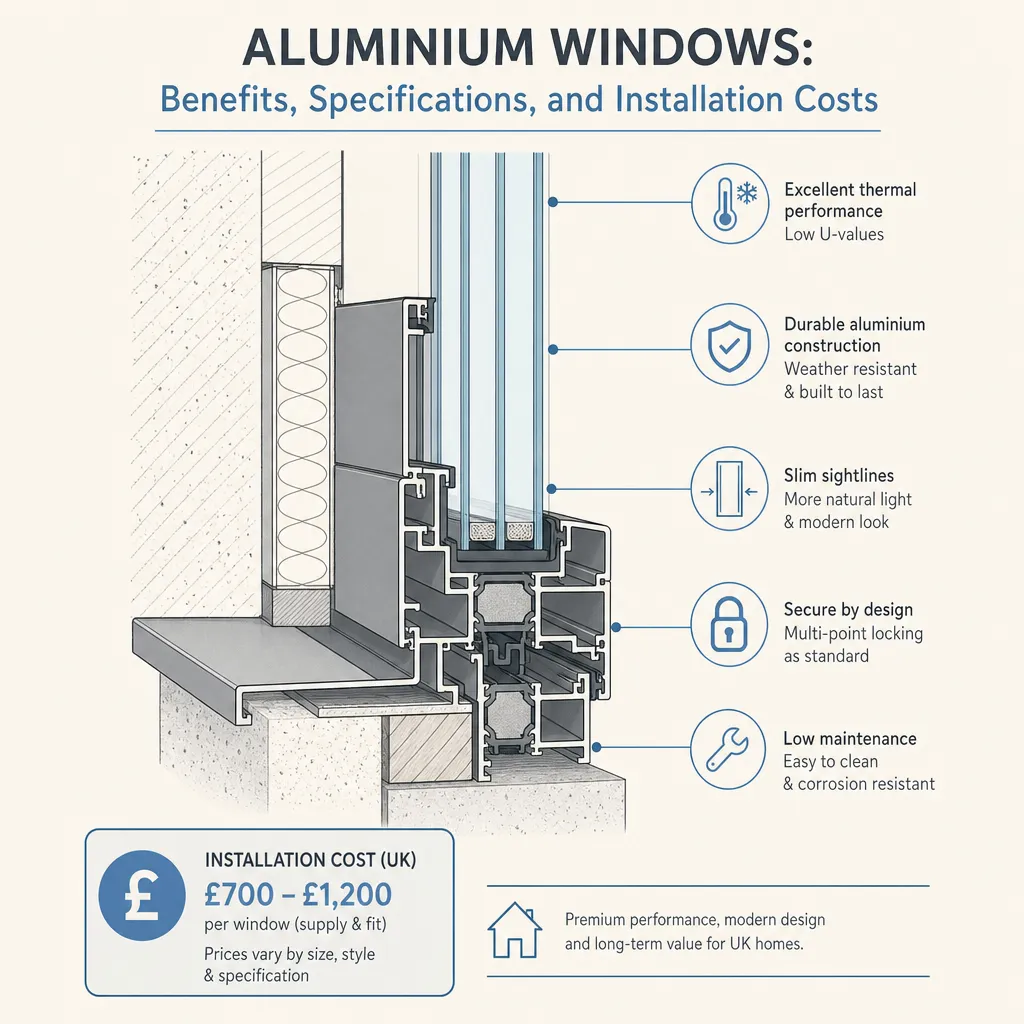
Aluminium Windows: Benefits, Specifications, and Installation Costs
Aluminium windows typically cost £600–£1,800 per window installed in the UK, depending on size and specification.
 Improvement & Build
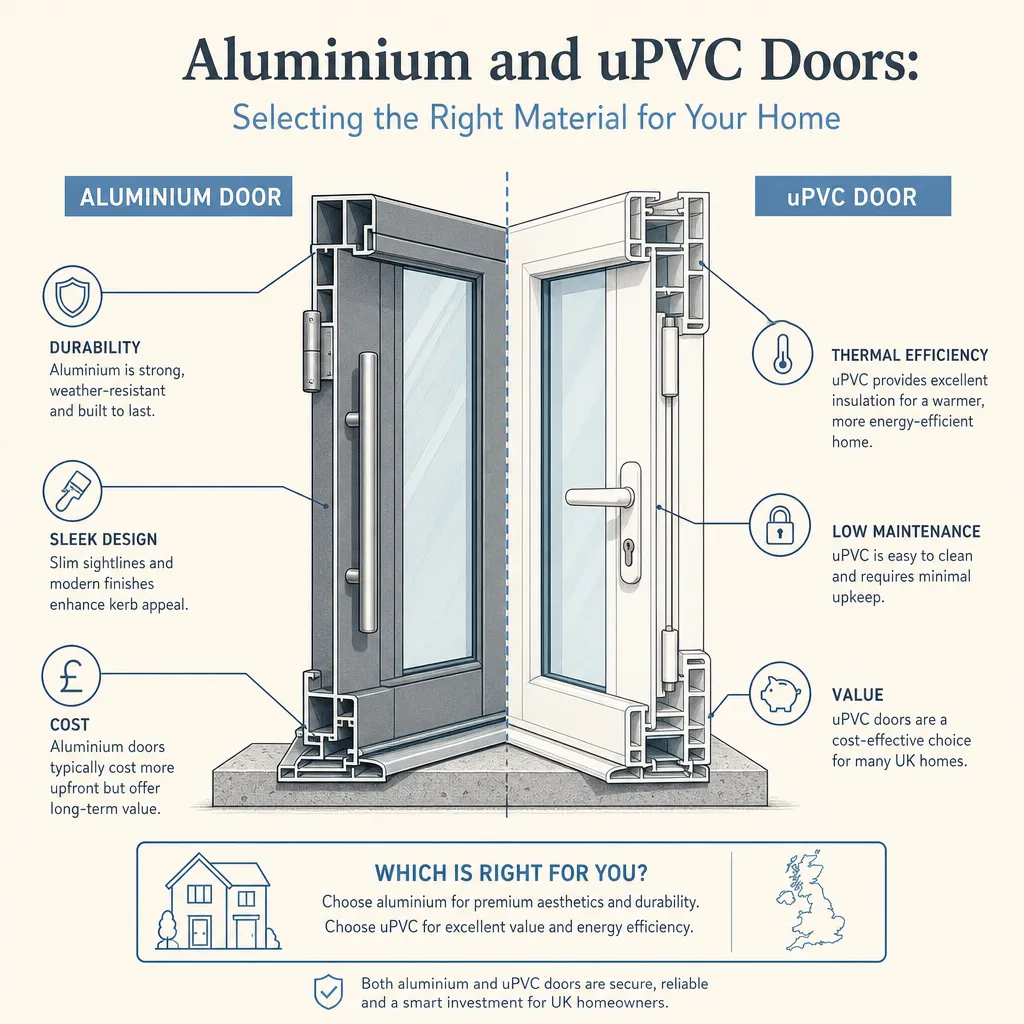
Aluminium and uPVC Doors: Selecting the Right Material for Your Home
uPVC doors are lower-cost and low-maintenance, making them a practical choice for most UK homes.
 Improvement & Build
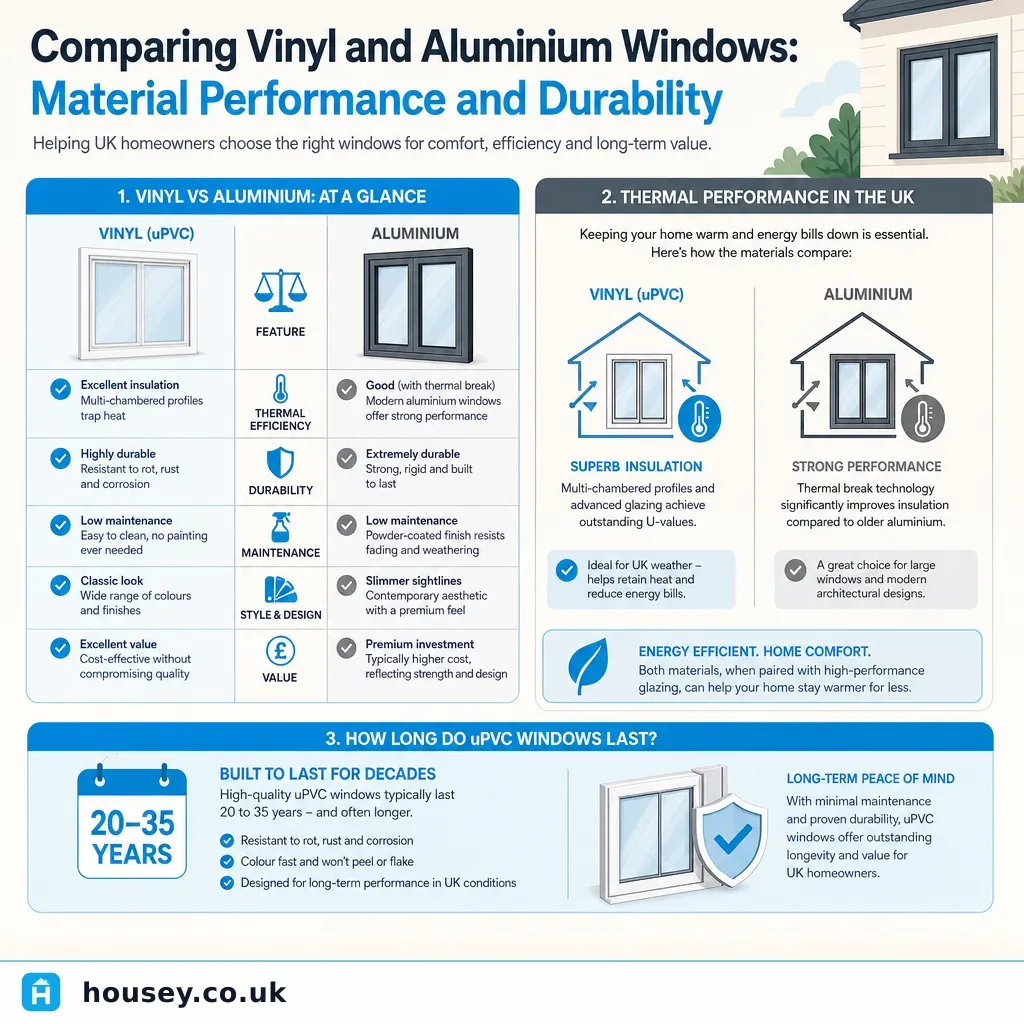
Comparing Vinyl and Aluminium Windows: Material Performance and Durability
uPVC (vinyl) and aluminium windows both meet UK Building Regulations Part L when properly specified.
 Improvement & Build
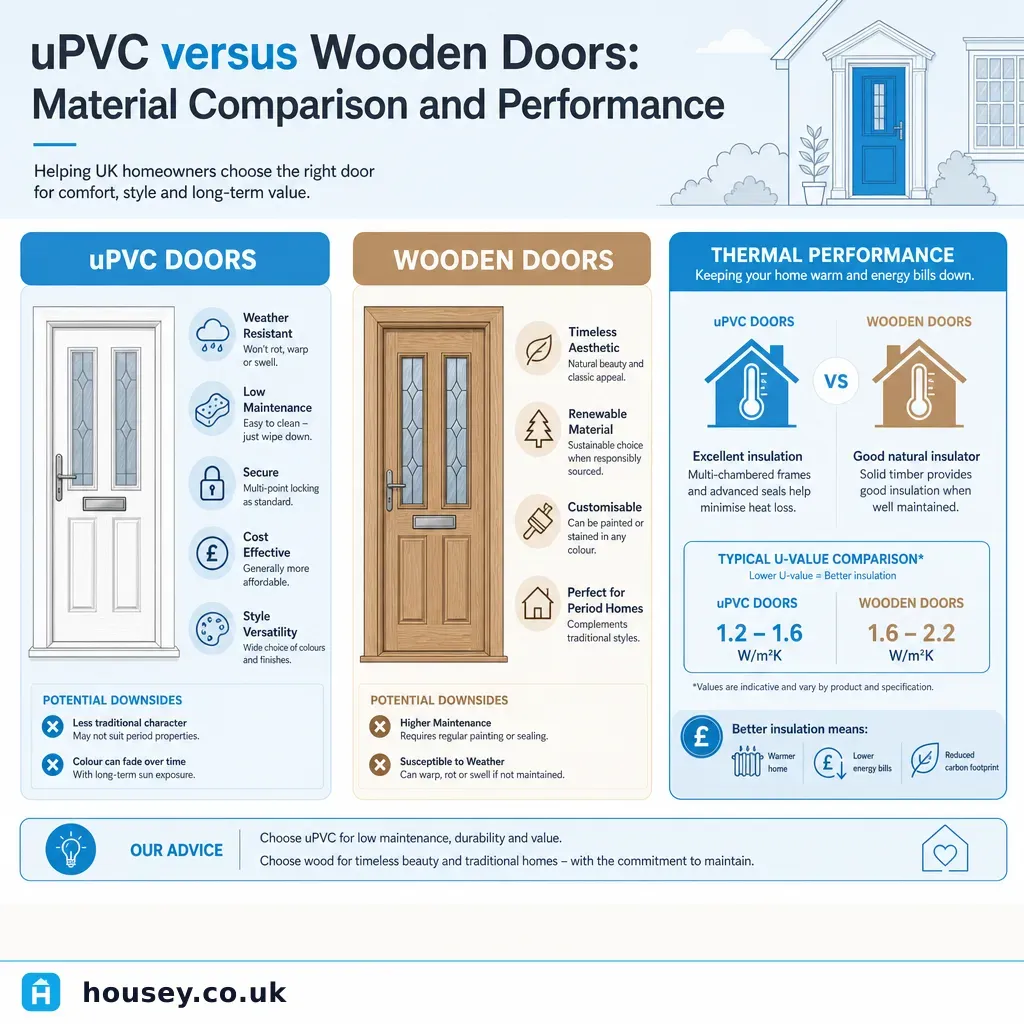
uPVC versus Wooden Doors: Material Comparison and Performance
uPVC doors are generally lower maintenance, better draught-sealed from the factory, and cheaper to install than timber doors.
 Improvement & Build
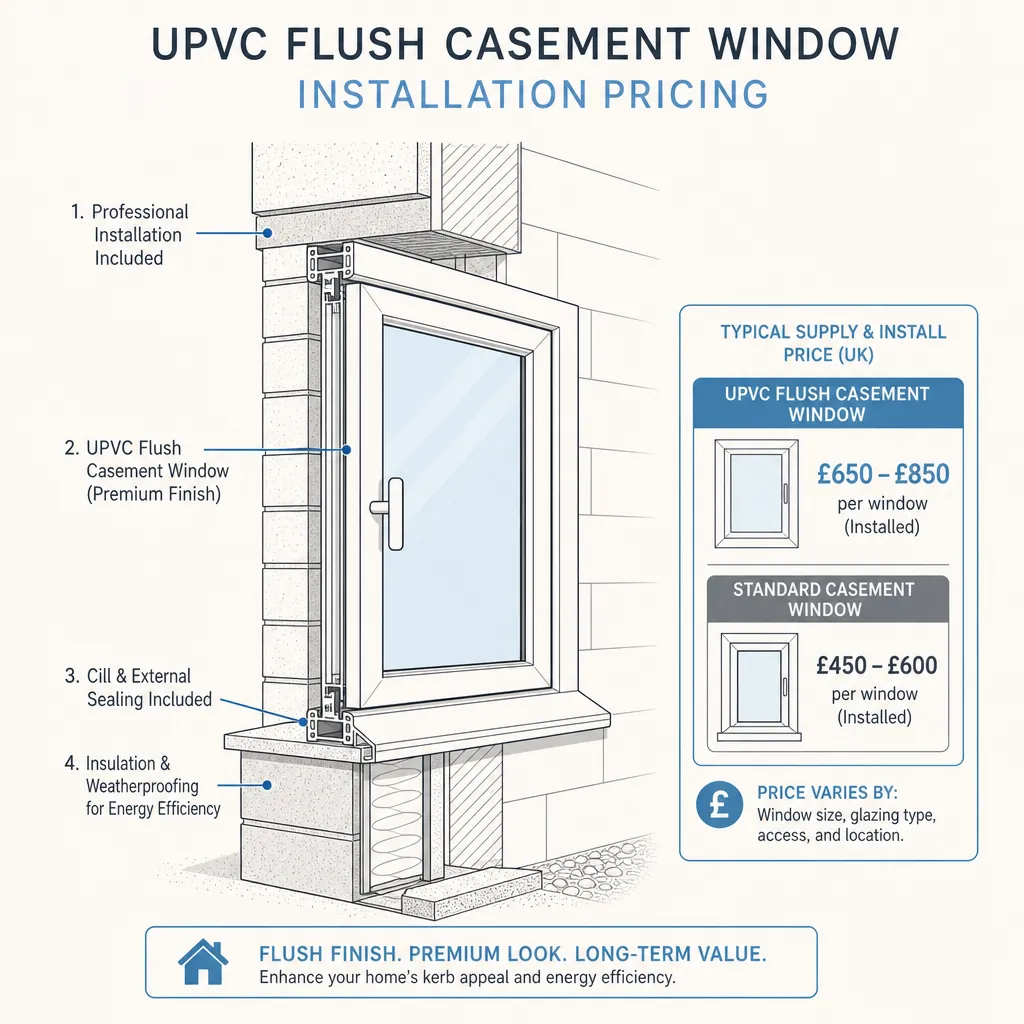
UPVC Flush Casement Window Installation Pricing
UPVC flush casement windows typically cost £400–£900 per window supplied and fitted in the UK, depending on size, glazing specification, and finish.