Agricultural and Pole Barn Construction Costs
By Housey · Last reviewed 8th of May 2026
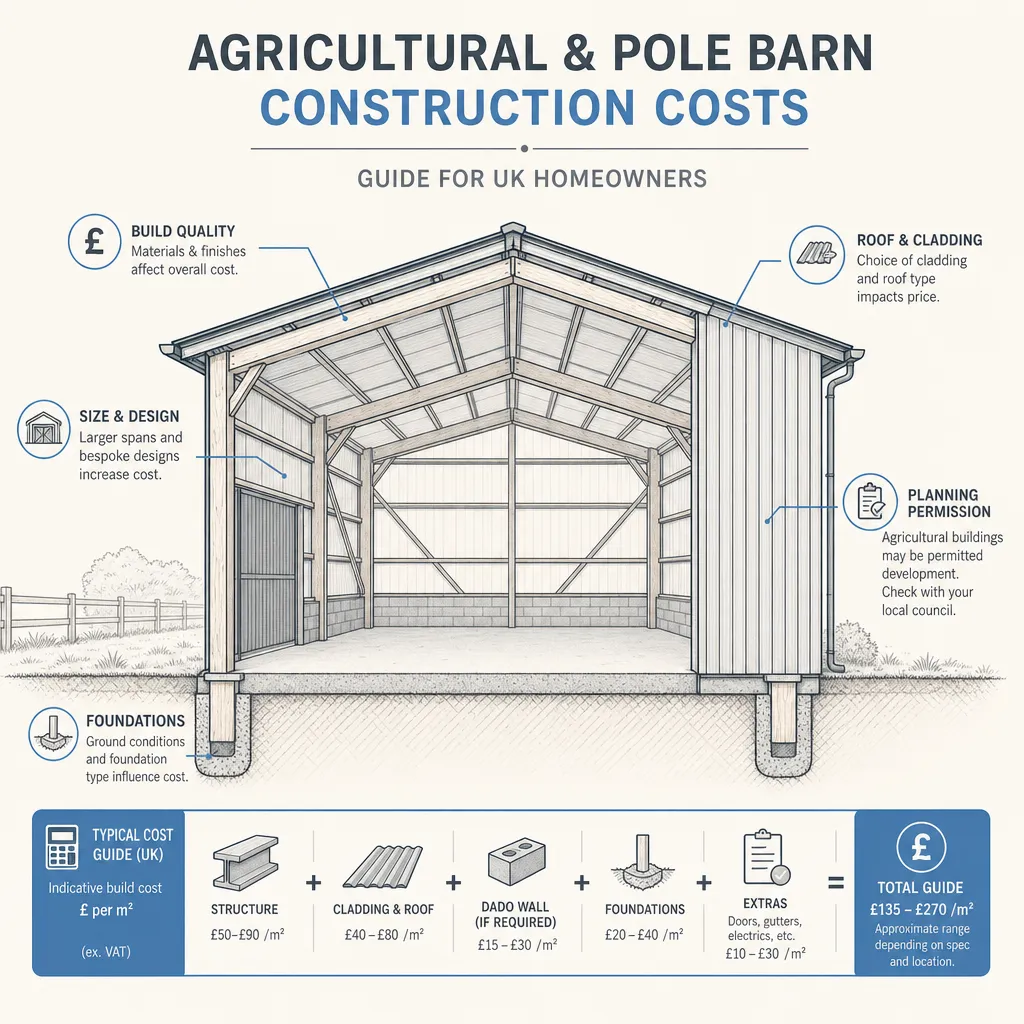
Agricultural and Pole Barn Construction Costs
Agricultural buildings and pole barns cover a broad range of structures — from open-sided hay stores and machinery shelters to insulated livestock housing — and the cost question typically arises when a landowner, smallholder, or rural property buyer needs to understand what a new build will realistically involve. Getting the budget right early matters because foundation choice, cladding specification, and planning status can each shift the total cost significantly.
Key points
- Agricultural buildings under 465 m² on a holding of 5 hectares or more may qualify for Permitted Development under Class A of the Town and Country Planning (General Permitted Development) (England) Order 2015, but prior approval from the local planning authority is usually still required before work begins.
- Indicative UK costs for a basic timber pole-frame agricultural building start at roughly £40–£80 per m²; a fully clad steel portal-frame structure typically costs £100–£180+ per m² (Indicative UK costs, last reviewed 2026-05-08).
- Pole barns use posts set into ground sockets or on concrete pads, reducing or eliminating the need for a full reinforced concrete slab — a meaningful saving on groundwork costs compared with traditional masonry or steel-frame construction.
- Any agricultural building converted to residential or commercial use after construction will need full planning permission and, in most cases, building regulations compliance, regardless of its original exempt status.
- VAT on new agricultural construction is generally charged at the standard rate of 20%; confirm the applicable rate for your specific works with your contractor and a VAT adviser, as reduced-rating rules can apply in limited circumstances.
What is a pole barn?
A pole barn is a building type in which structural loads are carried by vertical poles or posts fixed into the ground or onto concrete pad footings, rather than by a continuous foundation wall or perimeter slab. This system is common in North American agriculture and is increasingly used across the UK for:
- Machinery storage and rural workshops
- Hay, straw, and fodder stores
- Livestock housing (cattle, equine, sheep, pigs)
- Covered yards and feed passages
- Small-scale rural workspace and commercial storage
The key structural advantage is speed and economy: frames can be erected quickly, and because there is no perimeter foundation wall, groundwork costs are lower than for a traditional masonry or full-steel-portal building. Cladding is usually corrugated or box-profile steel, or timber weatherboard. Roofing options include box-profile steel, fibre cement sheeting, or polycarbonate panels where natural light is needed.
Planning permission for agricultural buildings
In England, planning rules for agricultural buildings are set out in the GPDO. Under Class A Permitted Development, buildings on holdings of 5 hectares or more may be erected without a full planning application, subject to conditions:
- The building must be reasonably necessary for agricultural purposes on that holding.
- It must not exceed 465 m² ground area (cumulative with any building erected in the preceding two years) or 12 metres in height (3 metres within 3 km of a licensed aerodrome).
- It must not be within 25 metres of a classified road.
- It must not be located within a National Park, Area of Outstanding Natural Beauty, National Scenic Area, or other designated area where different rules apply.
- Prior approval from the local planning authority covering siting, design, and external appearance is required before work begins.
Holdings between 0.4 and 5 hectares fall under Class B, which sets tighter size thresholds. Scotland and Wales have equivalent but distinct permitted development regimes — consult the relevant planning authority before proceeding. If equestrian use (leisure horse-keeping) is intended, agricultural permitted development does not apply and a full planning application is needed.
Pole barn vs steel portal frame: which is right for your project?
Feature | Timber pole barn | Steel portal frame |
|---|---|---|
Foundation requirement | Posts into ground or pad footings | Full concrete slab or strip foundation usual |
Erection speed | Fast — frames often up in days | Moderate — fabrication lead time, then erection |
Indicative cost per m² | £40–£80 (basic, open-sided) | £100–£180+ (fully clad) |
Typical clear span | Up to 15–18 m | 15–30+ m |
Indicative design life | 30–50 years with maintenance | 50+ years |
Insulation suitability | Moderate — possible with rigid or spray-foam | Good — standard for livestock and workshops |
Planning treatment | Agricultural PD if criteria met | Same GPDO thresholds apply |
Best suited to | Open shelters, hay stores, smallholdings | Larger machinery stores, commercial farms |
Indicative UK costs, last reviewed 2026-05-08. Costs vary by region, ground conditions, and specification.
What drives the cost?
Groundwork and ground conditions: Clay-heavy or waterlogged ground may require deeper post embedment, concrete haunching, or a drainage scheme before the frame goes up. This is where costs can escalate unexpectedly. A preliminary ground investigation is worth considering for larger structures on unknown ground.
Size and span: A 10 × 15 m open-sided shelter is very different in cost and engineering from a 20 × 30 m insulated livestock building with a concrete floor, water supply, and drainage channels.
Cladding and roofing specification: An open-sided structure with a steel roof is the most economical option. Fully clad walls with insulated composite panels add considerably to the total cost.
Access and site constraints: Rural sites with poor road access, steep gradients, or narrow gateways increase crane hire, delivery costs, and erection time.
Services and fit-out: Electricity, lighting, water supply, drainage, ventilation, and internal divisions all add to the final figure.
Planning and professional fees: Prior approval applications in England currently cost £120 (correct as of 2026-05-08, per the GOV.UK planning fee schedule). Full planning applications carry higher fees and require professional drawings.
What to ask before accepting a quote
- What does the price include — groundwork, frame supply and erection, cladding, roofing, guttering, and doors?
- What ground conditions is the quote based on, and what happens if site conditions are worse than expected?
- Who is responsible for submitting the prior approval or planning application?
- What structural calculations, drawings, or guarantees are supplied with the frame?
- Is VAT included, and at which rate?
- What is the payment schedule, and what milestones trigger each stage payment?
- What trade body memberships, qualifications, or accreditations does the contractor hold?
- What is the programme, and what could extend the timeline?
When to get professional help
Most agricultural buildings benefit from structural engineering input on post sizing, spacing, and foundation design — particularly for spans over 12 metres, areas with significant snow loads, or buildings that will house livestock where welfare requirements affect loading assumptions.
Seek professional advice if:
- Your holding is under 5 hectares and agricultural permitted development does not apply.
- The site is within a National Park, AONB, conservation area, or near a scheduled monument.
- You plan to convert the building to residential use now or in future — this requires separate planning consent and is a distinct legal process.
- Ground conditions are unknown, waterlogged, or in close proximity to drainage infrastructure or watercourses.
- The structure will carry mechanical handling equipment, overhead gantry cranes, or substantial roof-mounted solar arrays.
How Housey can help
If your project involves significant site preparation — concrete pads, drainage runs, or ground levelling — connecting with a qualified groundworker early will help you understand site constraints before committing to a frame design. For more complex rural builds or hybrid structures involving conversion or extension work alongside the agricultural building, extension builders with rural or agricultural experience may also be relevant. Housey can help you request quotes from relevant UK providers.
Frequently asked questions
Does a pole barn need building regulations approval?
Agricultural buildings used purely for farming are generally exempt from building regulations under Schedule 2 of the Building Regulations 2010. However, if the building includes offices, staff welfare facilities, or any non-agricultural use, regulations apply in full. Converting an agricultural building to residential or commercial use always requires compliance, regardless of the original exemption status.
Can I build a pole barn on equestrian land?
Equestrian use — keeping horses for leisure rather than commercial farming — is not classified as agriculture under planning law. Agricultural permitted development rights are therefore not available for stables, hay stores, or arenas on equestrian land. A full planning application is required, and many local planning authorities have specific policies on equestrian development in rural and green-belt settings.
How long does a timber pole barn last?
A well-constructed timber pole barn using pressure-treated or naturally durable posts typically lasts 30–50 years. Steel-framed agricultural buildings generally carry design lives of 50+ years. Durability depends on the quality of post embedment, drainage at base level, and ongoing maintenance of cladding fixings, roof seals, and guttering.
Do I need a structural engineer for a pole barn?
For small, simple structures, many manufacturers supply pre-engineered frame packages with included calculations. For larger buildings, unusual spans, livestock housing, or any structure where failure could endanger people or animals, independent structural engineering input is advisable and may be required by the frame manufacturer's warranty conditions or your insurer.
Sources and further reading
- Planning permission for farms: agricultural buildings — GOV.UK
- Town and Country Planning (General Permitted Development) (England) Order 2015 — legislation.gov.uk
- Building Regulations 2010, Schedule 2: Exempt buildings and work — legislation.gov.uk
- Fees for planning applications — GOV.UK
Useful next reads
 Improvement & Build
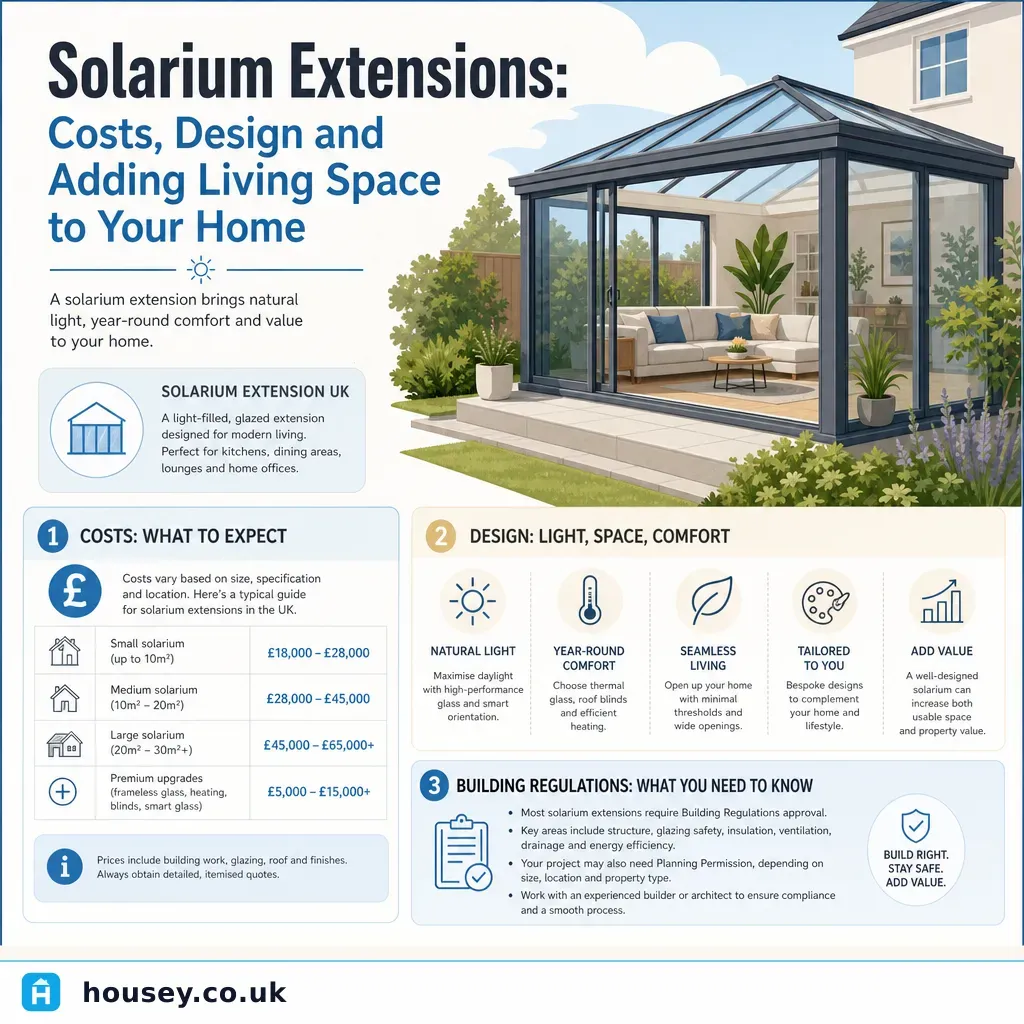
Solarium extensions: costs, design and adding living space to your home
A solarium extension is a predominantly glazed room addition with a structural glass roof, typically costing £28,000–£130,000 in the UK depending on size and specification.
 Improvement & Build
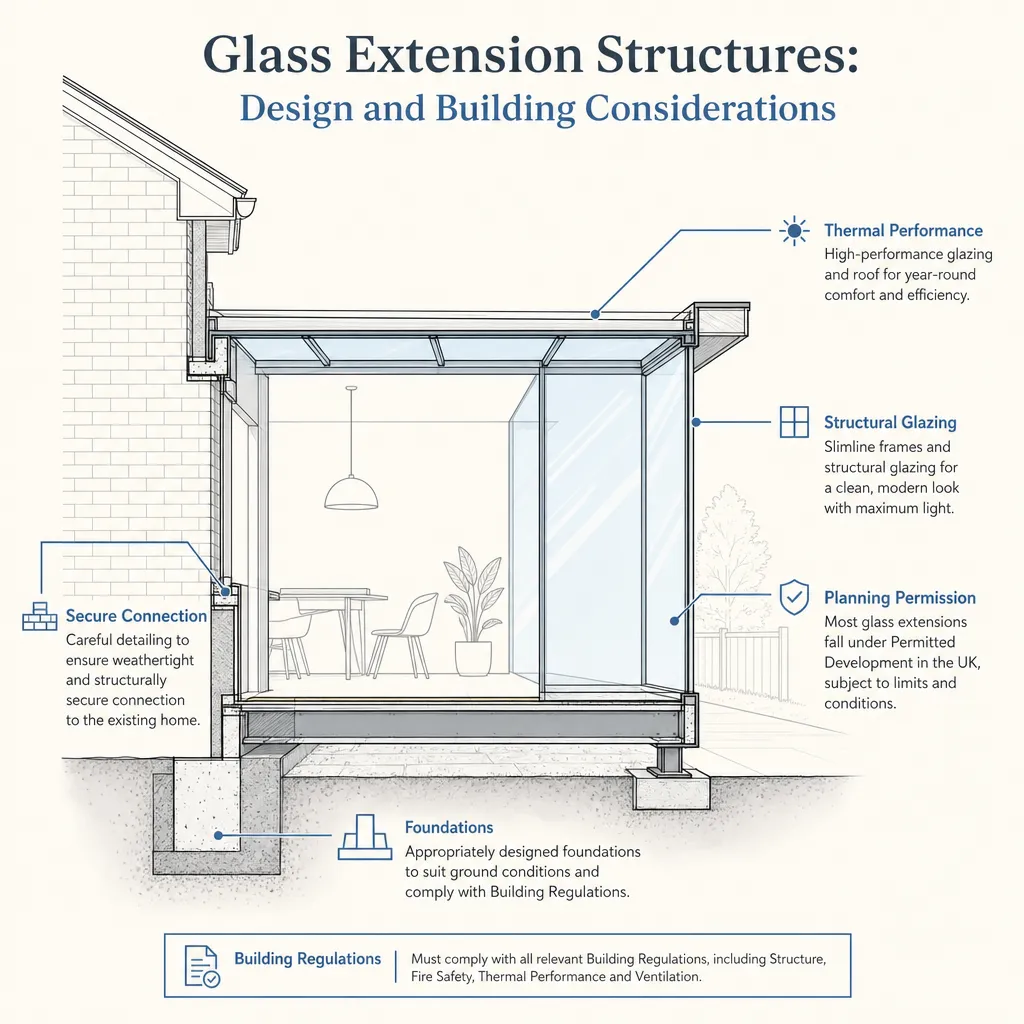
Glass Extension Structures: Design and Building Considerations
A glass extension uses structural glazing for walls, roof, or both to create a light-filled space connected to the garden.
 Improvement & Build
Spring Garden Transformations: Design Ideas to Enhance Your UK Property
Spring is the best time to transform a UK garden, with mild temperatures and longer days ideal for planting and landscaping.
 Improvement & Build
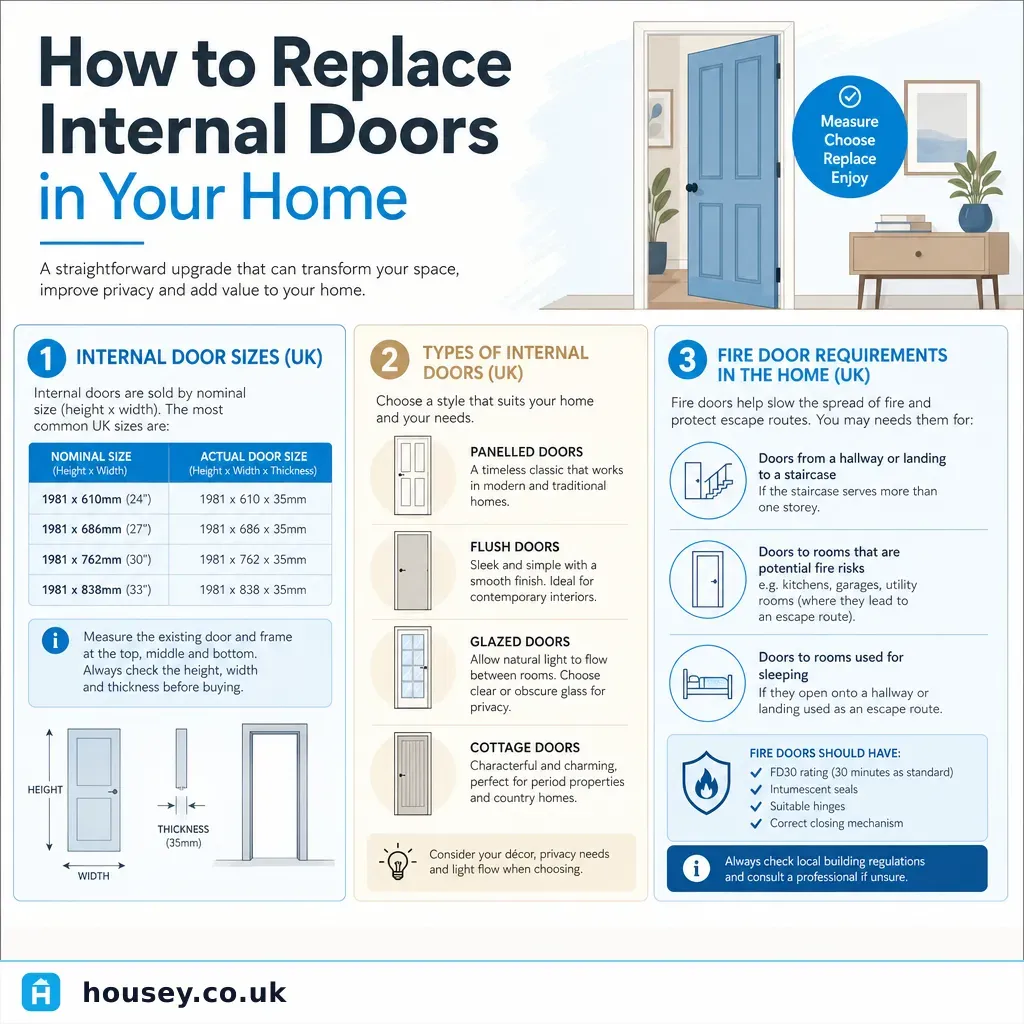
How to Replace Internal Doors in Your Home
Replacing internal doors is a straightforward home improvement that most competent DIYers or a joiner can complete.
 Improvement & Build
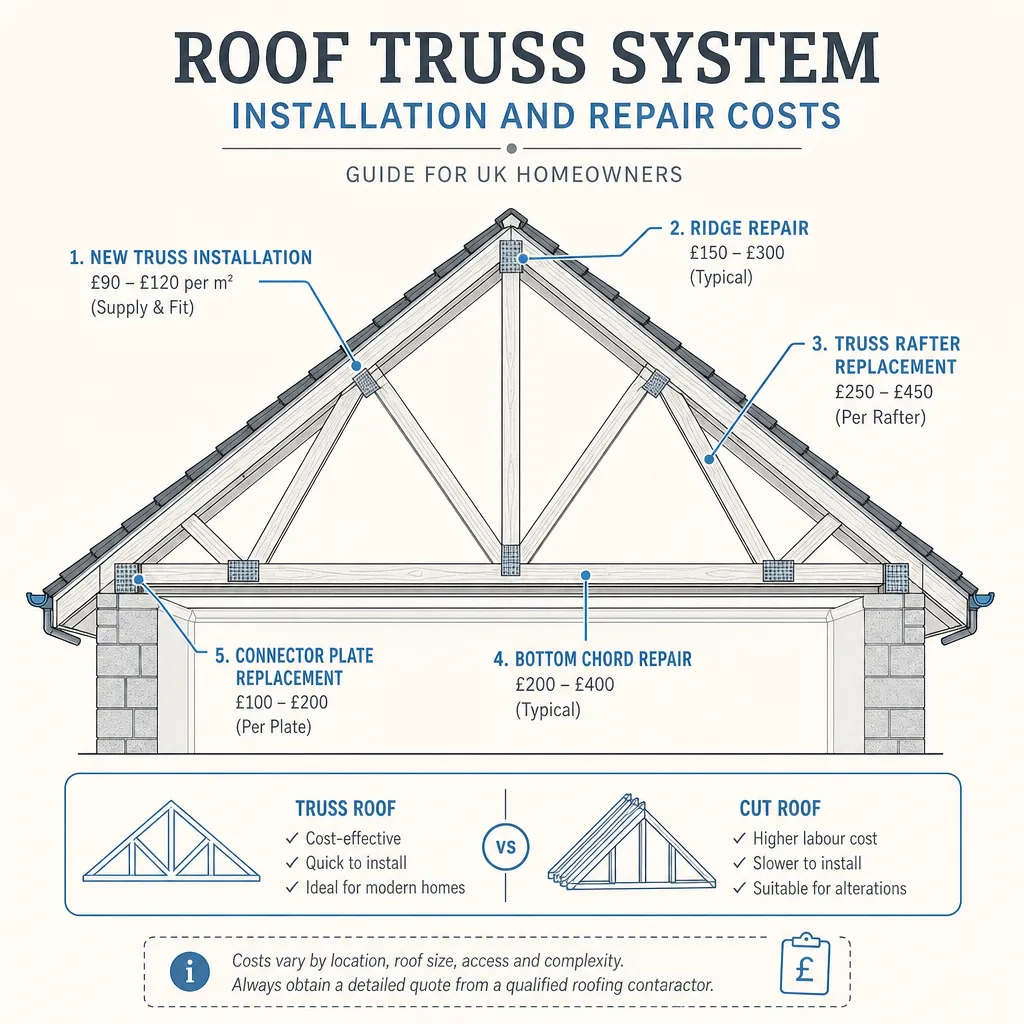
Roof Truss System Installation and Repair Costs
Roof truss installation in the UK typically costs £3,000–£7,000 for a standard semi-detached house, covering manufacture, delivery, crane hire, and erection but excluding roofing materials.