How to Replace Internal Doors in Your Home
By Housey · Last reviewed 19th of May 2026
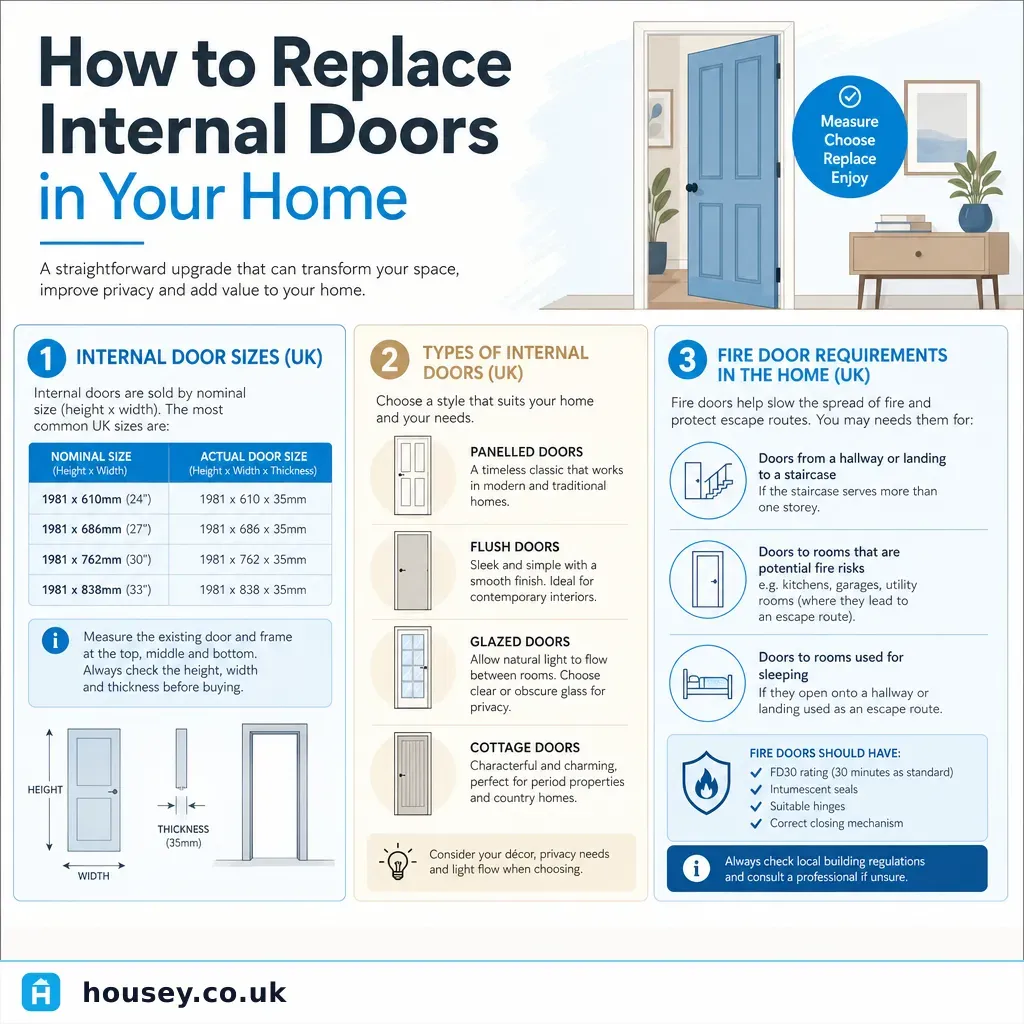
How to Replace Internal Doors in Your Home
Fresh internal doors can significantly change how a home feels — visually, acoustically, and in daily use. The question typically arises when moving into an older property with worn or mismatched doors, during a broader interior renovation, or when upgrading to period-appropriate timber doors in a Victorian or Edwardian house. Fire door requirements under Approved Document B add a compliance dimension that is often overlooked at this stage.
Key points
- Standard UK internal door heights are 1981 mm; common widths are 686 mm, 762 mm, and 838 mm — but older UK properties frequently have non-standard openings requiring bespoke or modified doors.
- Fire doors rated FD30 are required under Approved Document B (Volume 1, Dwellings) for the door between an integral garage and the habitable part of a house, and on escape routes created by loft conversions.
- Hollow-core doors offer minimal sound insulation; solid-core doors (typically 35–44 mm thick) significantly improve acoustic performance between rooms.
- A fire door must be installed with the correct intumescent strips, smoke seals, and UKCA- or CE-marked door furniture — fitting the door leaf alone without compliant hardware does not create a compliant installation.
- Door leaf prices range from around £30 for a basic hollow-core flush door to £300–£600 or more for solid hardwood or period-style doors; professional fitting typically costs £50–£150 per door (Indicative UK costs, last reviewed 2026-05-19).
Understanding UK door sizing
Before ordering a door, measure the existing frame opening — not the existing door leaf. Old properties often have out-of-square frames, so measure the width at the top, middle, and bottom and use the smallest measurement. Also measure the frame opening height and note the floor-finish thickness if new flooring is being laid, as this affects the required clearance gap at the bottom of the leaf.
If the opening matches a standard size, you can buy an off-the-shelf door and trim it to fit — most internal doors allow up to 6 mm of trimming per side and up to 12 mm at the bottom. If the opening is significantly non-standard, a bespoke door or a large door blank trimmed to size will be needed.
Most modern door linings are designed for a 35 mm door leaf. Victorian and Edwardian properties often have deeper linings suited to 44 mm doors. Check the lining depth before ordering to avoid a mismatch.
Choosing the right door type
Door style | Best for | Not ideal for | Key consideration |
|---|---|---|---|
Hollow-core flush | Modern homes, budget refits | Acoustic separation, high-traffic areas | Poor sound insulation; lightweight feel |
Solid-core flush | Most UK homes | Period properties seeking character | Better acoustic performance; heavier |
Glazed or part-glazed | Hallways, rooms needing borrowed light | Privacy-sensitive rooms | Consider obscure vs clear glass |
Four- or six-panel | Victorian, Edwardian, Georgian properties | Ultra-modern interiors | Available in pine, hardwood, and MDF |
Bifold or sliding | Small rooms, cupboard openings | Soundproofing requirements | Require compatible lining and hardware |
Fire door (FD30) | Garage-to-house, flats with escape routes | Standard room-to-room positions | Must be installed with full compliant hardware |
Fire door requirements in UK homes
Fire door requirements catch out many homeowners. Under Approved Document B (Volume 1, Dwellings), fire doors are required in:
- The doorway between an integral garage and the habitable part of the house — this must be a self-closing FD30S fire door with intumescent and smoke seals.
- A loft conversion that creates a new habitable storey — doors on the new escape route must be FD30S.
- Flats and maisonettes — doors opening onto a protected corridor or communal escape route must be fire doors and comply with the lease and the building's fire risk assessment.
A fire door must be installed with intumescent strips and smoke seals, UKCA- or CE-marked hinges and latch, and a self-closing device where required by the rating. Fitting a fire-rated door leaf alone without compliant hardware does not create a compliant installation. If there is any doubt about whether a position requires a fire door, consult a qualified installer or building control officer before proceeding.
DIY or hire a professional?
- DIY is practical for a straightforward like-for-like leaf replacement in a sound, square lining, in a standard-sized opening, with no fire compliance requirement.
- Hire a joiner or door fitter if the frame needs adjustment, the opening is out of square, floor levels are changing, or you are fitting a complete door set — leaf plus new lining.
- Always use a professional for fire door installations — incorrect fitting of a fire door is a safety and compliance issue, not merely a quality one.
Replacing a door leaf: pre-fitting checklist
Before hanging a new door leaf in an existing lining, check each of the following:
The general sequence for a standard (non-fire) leaf replacement: remove the existing door; trim and prepare the new leaf; mark and cut hinge recesses to match the existing lining positions; hang the door and check it swings freely; fit the latch and handle hardware; adjust the strike plate so the latch engages cleanly.
Do not follow this sequence for fire door installations — fire doors require a certified installer using the correct intumescent hardware throughout.
When to get professional help
Consult a professional joiner or window and door installer if:
- The existing door lining is damaged, rotten, twisted, or the wrong depth for the replacement door.
- The opening size is non-standard and requires lining adjustment or replacement.
- You are installing or replacing a fire door in any regulated position.
- The door opens onto a communal corridor in a flat — consult the building manager and check your lease before making any changes.
- The property is listed — changes to door style or material may require listed building consent from your local planning authority.
How Housey can help
For anything beyond a straightforward leaf swap, window and door installers on Housey can handle measuring, supply, and fitting — including fire door compliance where required. Submit your requirements to receive quotes from vetted local professionals.
Frequently asked questions
Do I need building regulations approval to replace internal doors?
For a simple like-for-like replacement in a standard room, building regulations approval is not generally required. However, if you are installing a fire door in a regulated position — such as the garage-to-house door or a door on a loft conversion escape route — the installation must comply with Approved Document B. An incorrectly fitted fire door is both a safety issue and a compliance failure.
What size internal door do I need for a UK property?
Standard UK internal door heights are 1981 mm and 2040 mm. Common widths are 686 mm, 762 mm, and 838 mm. Older UK properties frequently have non-standard openings — always measure the frame opening at multiple points before ordering, and account for any planned change in floor finish thickness when calculating the required clearance gap at the bottom.
What is the difference between a hollow-core and solid-core internal door?
A hollow-core door has a cardboard or honeycomb infill between two thin facings: it is lightweight, inexpensive, and adequate for low-traffic rooms. A solid-core door has a continuous timber, MDF, or engineered composite core; it is significantly heavier and provides notably better sound attenuation. Solid-core doors are commonly specified for bedrooms and home offices.
How long does it take to fit an internal door?
A competent joiner can replace a door leaf in an existing lining in around 1–2 hours for a standard opening. If the lining needs adjustment, or for a fire door installation requiring hardware fitting and sealing, allow 3–4 hours per door. Fitting a complete door set including a new lining takes longer still.
Sources and further reading
- Approved Document B: Fire Safety – Volume 1 (Dwellings) — GOV.UK / MHCLG
- Building Regulations: overview — GOV.UK
- Fire Door Safety Week guidance — Fire Door Safety Week (BRE Trust initiative)
- Competent Person Schemes for building work — GOV.UK
Useful next reads
 Improvement & Build
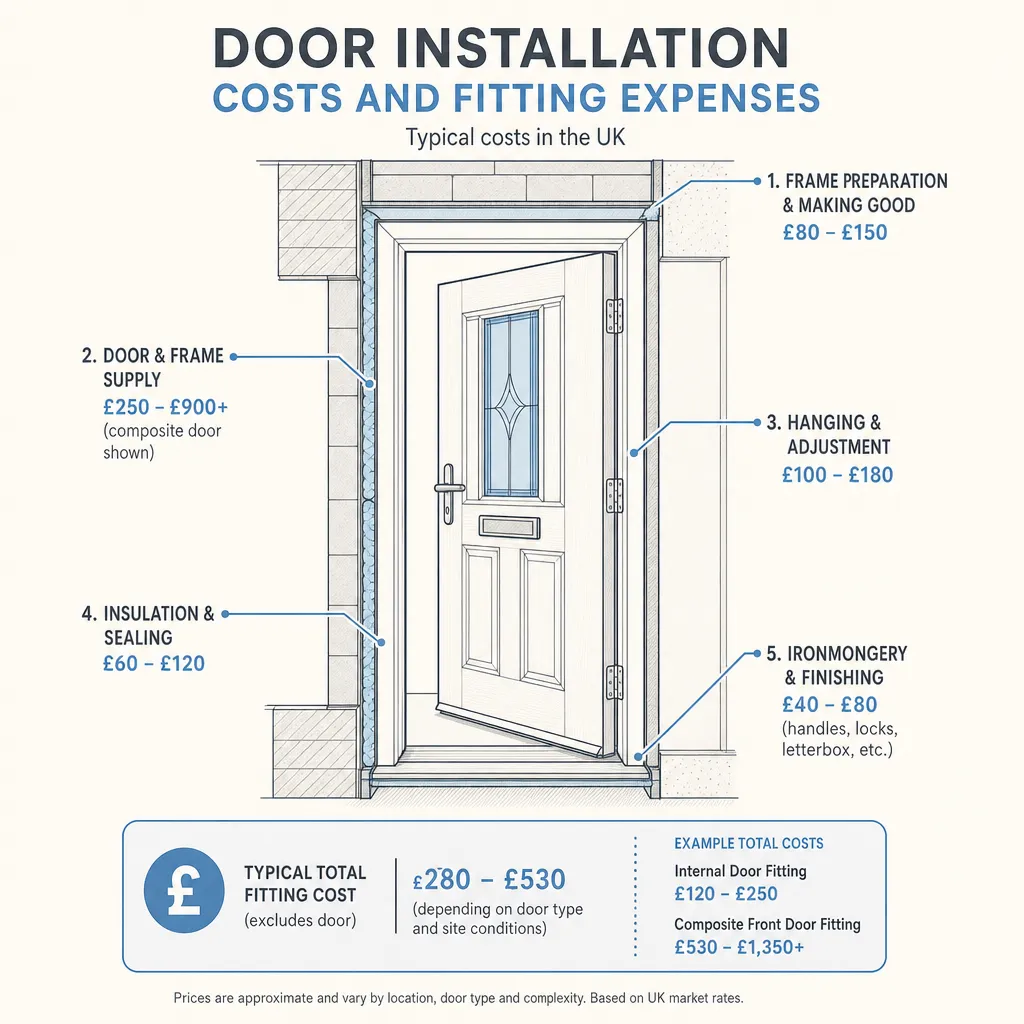
Door Installation Costs and Fitting Expenses
Door installation costs in the UK typically range from £50–£150 labour for an internal door to £400–£900 installed for a UPVC external door, or £800–£2,000+ for a composite front door.
 Improvement & Build
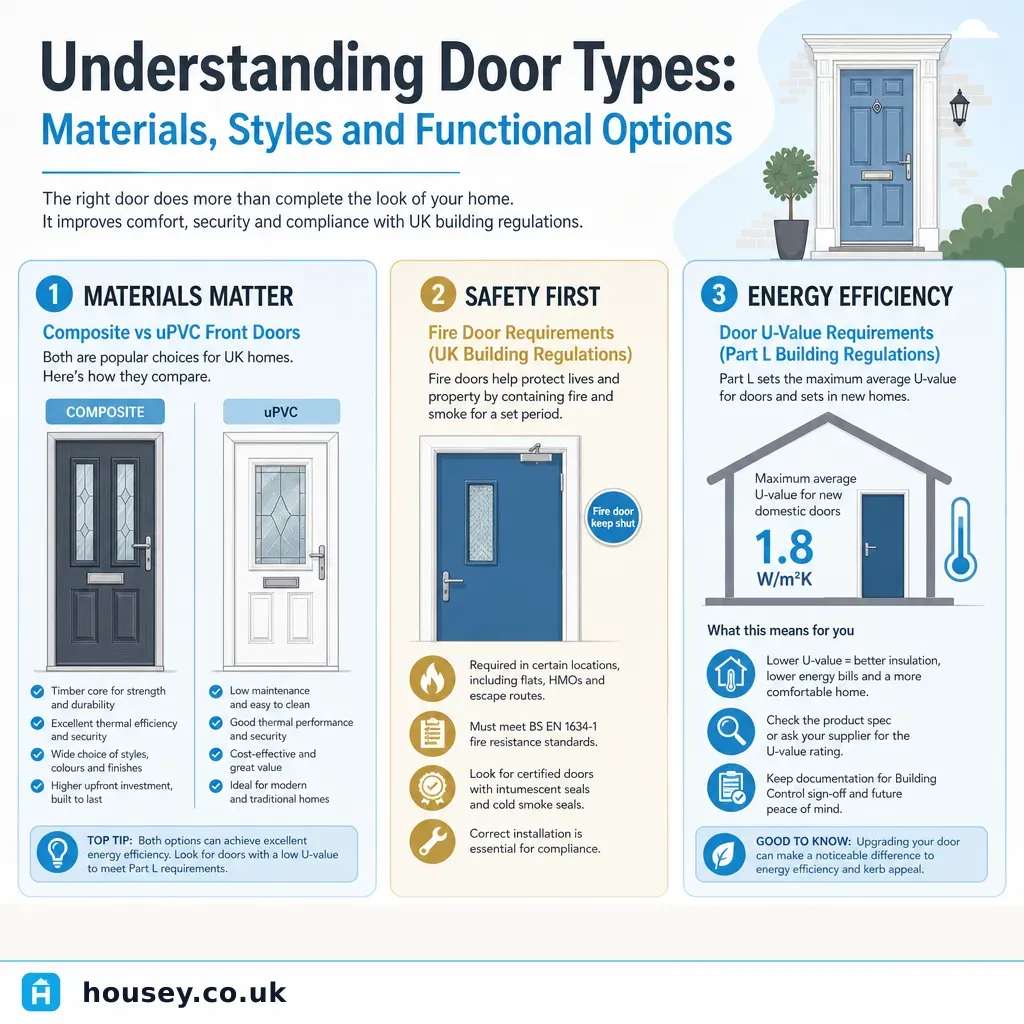
Understanding Door Types: Materials, Styles and Functional Options
Doors are available in timber, uPVC, aluminium, steel, and composite materials, each suited to different budgets, locations, and performance requirements.
 Improvement & Build
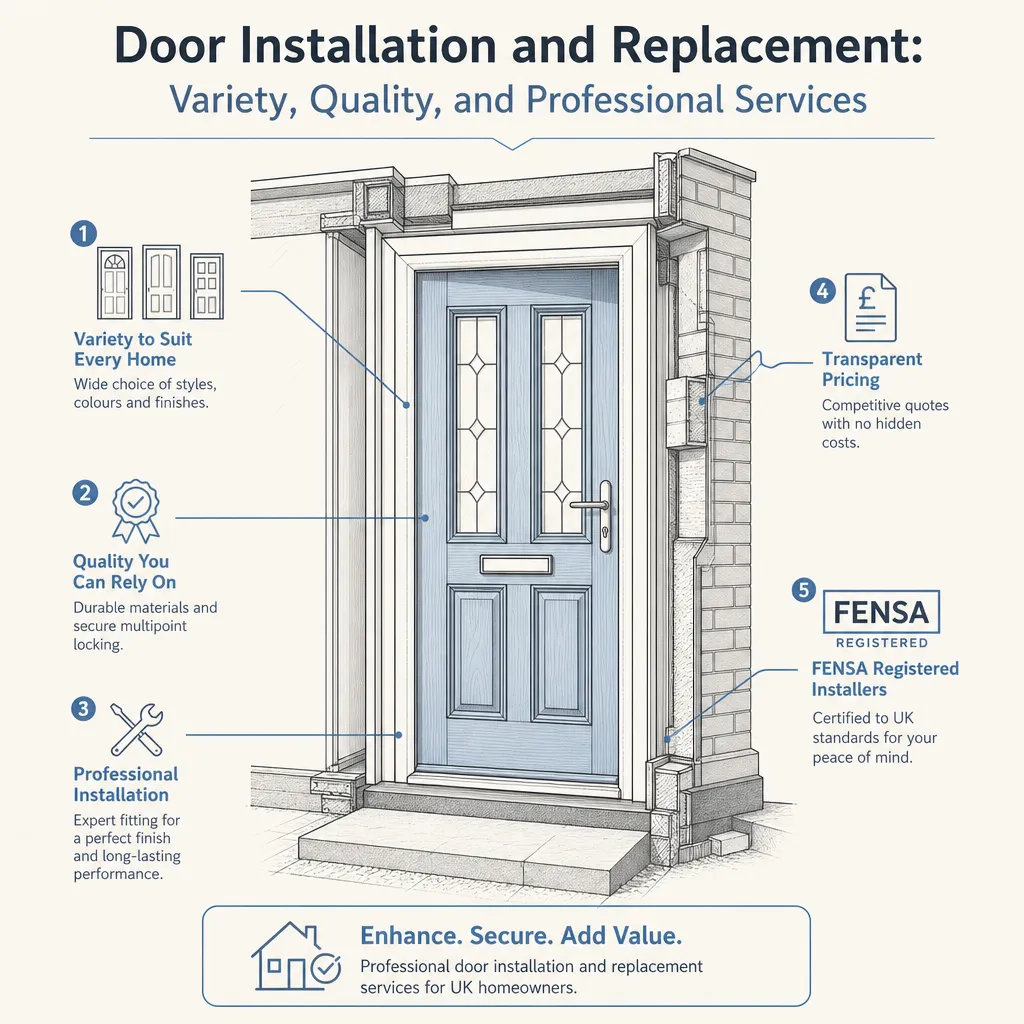
Door Installation and Replacement: Variety, Quality, and Professional Services
Door installation in UK homes ranges from straightforward interior hanging, which requires few regulations, to external replacements subject to Building Regulations Part L.
 Improvement & Build
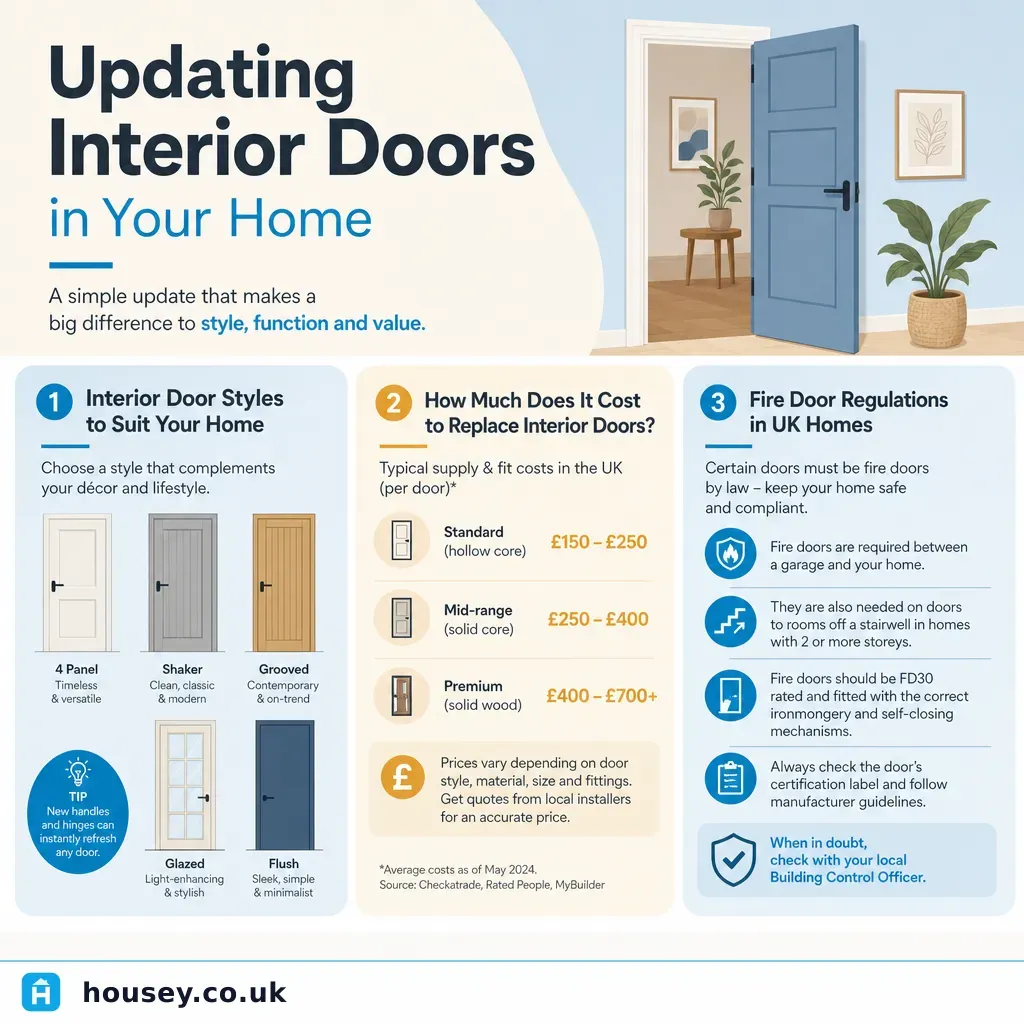
Updating Interior Doors in Your Home
Replacing interior doors is one of the more impactful home upgrades a UK homeowner can make without building regulations approval.
 Improvement & Build
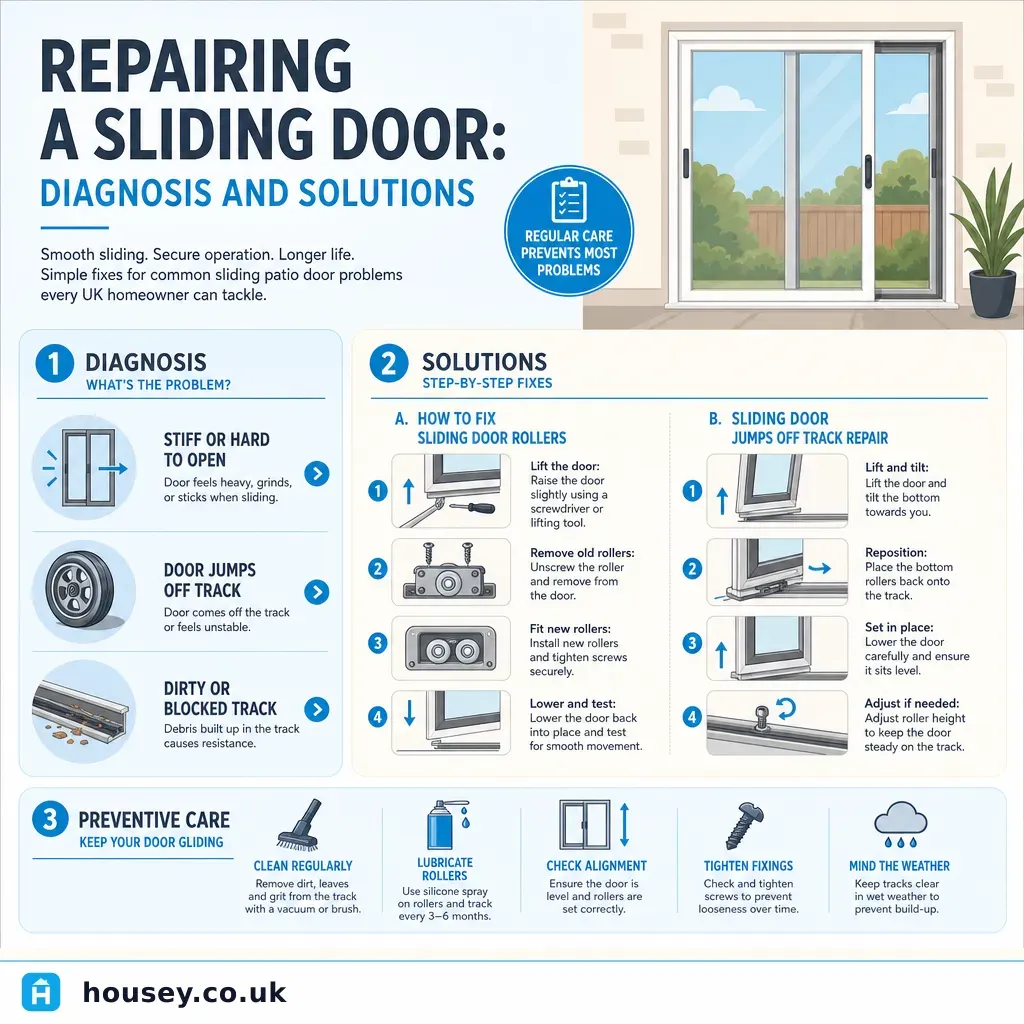
Repairing a Sliding Door: Diagnosis and Solutions
Most sliding door problems — stiffness, jumping off track, or draughts — are caused by dirty tracks, worn rollers, or misaligned guides.