Air Source Versus Ground Source Heat Pumps: Which Is Right for Your Property?
By Housey · Last reviewed 11th of May 2026
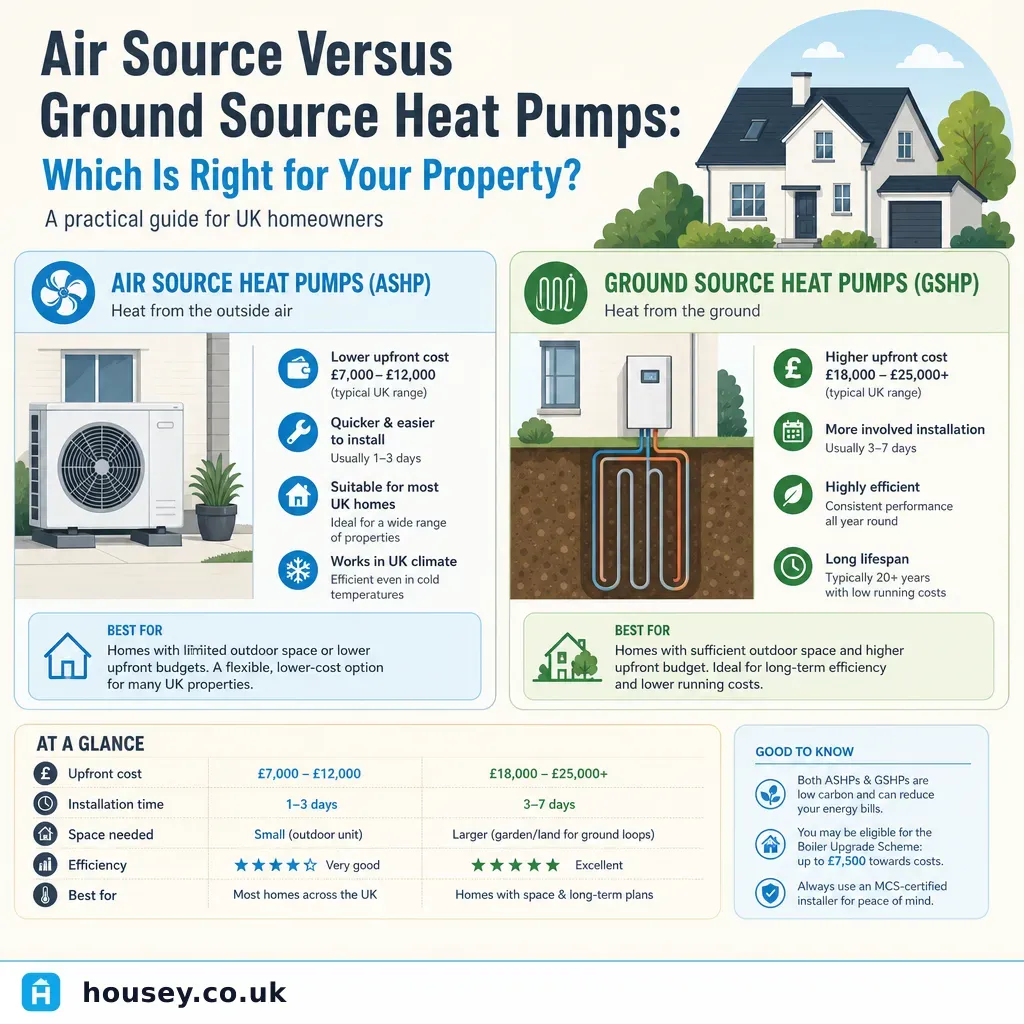
Air Source Versus Ground Source Heat Pumps: Which Is Right for Your Property?
Choosing between an air source heat pump (ASHP) and a ground source heat pump (GSHP) is one of the most consequential decisions in a low-carbon heating retrofit — and the answer is rarely straightforward. The right system depends on your property's construction, insulation standard, available land, and long-term heating goals, and getting it wrong is an expensive mistake that a good assessment at the outset can prevent.
Key points
- Both ASHP and GSHP systems require MCS-certified installers and are eligible for the Boiler Upgrade Scheme (BUS) grant — check the current grant amount on GOV.UK before budgeting, as amounts are subject to change.
- ASHP systems extract heat from outdoor air; GSHP systems extract heat from the ground via horizontal pipe trenches or vertical boreholes, giving a more stable heat source year-round.
- GSHP installation costs are significantly higher than ASHP due to groundworks — trenching or borehole drilling — which also require substantial accessible land or ground space.
- A full heat loss calculation to MCS Design Guide standards and a PAS 2035 retrofit assessment are strongly recommended before committing to either technology; undersized or poorly matched systems underperform and waste energy.
- Both technologies work best in well-insulated properties; poor fabric forces either system to run at higher flow temperatures, reducing efficiency and raising running costs.
How each technology works
Air source heat pumps absorb heat from outdoor air — modern units can extract useful heat at temperatures as low as −15 °C — and compress it to produce warmth for space heating and hot water. The outdoor unit requires a clear, unobstructed location with good airflow; most are wall- or ground-mounted. Installation is relatively quick, usually taking one to three days, and requires no significant groundworks.
Ground source heat pumps extract stored solar energy from the ground. Horizontal ground arrays — pipes laid in trenches typically 1–1.5 m deep — need considerable garden area, usually around 1.5 to 2 times the heated floor area of the property. Where land is limited, vertical boreholes (commonly 80–150 m deep) are an alternative, though borehole drilling adds considerably to cost and complexity. Because ground temperature remains far more stable than air temperature through the seasons, GSHP systems typically achieve a higher seasonal performance factor (SPF), meaning more heat energy produced per unit of electricity consumed.
ASHP versus GSHP: a comparison
Feature | Air source heat pump | Ground source heat pump |
|---|---|---|
Heat source | Outdoor air | Ground (trenches or boreholes) |
Typical installed cost (indicative) | £8,000–£15,000 | £20,000–£45,000+ (inc. groundworks) |
Land requirement | Minimal (outdoor unit footprint) | Significant (trenches) or borehole drilling |
Installation disruption | Low (1–3 days typical) | High (groundworks may take days or weeks) |
Typical seasonal performance factor (SPF) | 2.5–3.5 | 3.5–4.5 |
Performance in cold weather | Reduces at very low temperatures | More stable year-round |
BUS grant eligibility | Yes | Yes |
Outdoor noise | Some noise from unit fan | Very low once installed |
Permitted development (England) | Usually yes, subject to conditions | Usually yes; boreholes — check with LPA |
Indicative UK costs, last reviewed 2026-05-11. Costs vary significantly by property, installer, groundwork type, and location — always obtain at least three quotes from MCS-certified installers.
Which heat pump is right for your property?
Use this as a starting guide — a qualified MCS-certified installer or retrofit coordinator should always confirm suitability for your specific home:
- Choose ASHP if you have limited land, want a quicker and less disruptive installation, and your property is reasonably well insulated (EPC C or above, or with planned insulation improvements).
- Choose GSHP if you have substantial accessible land or can accommodate boreholes, want maximum efficiency and quieter running, and can justify the higher upfront cost over the long term.
- Address fabric improvements first if your property's EPC rating is D or below — fitting either heat pump to a poorly insulated home is rarely cost-effective and may produce uncomfortable results.
- Consult a building professional if your property has unusual construction (solid stone walls, earth floors, thatched roof) that significantly affects heat loss and system design.
- Check with your LPA if your property is listed, in a conservation area, or subject to Article 4 restrictions before assuming permitted development rights apply.
Property suitability checklist
Before requesting quotes, work through these points:
Costs and grant funding
Both ASHP and GSHP are eligible for the Boiler Upgrade Scheme (BUS), administered by Ofgem and funded by the Department for Energy Security and Net Zero (DESNZ). The grant is applied directly by your MCS-certified installer at the point of installation — you do not apply separately. Check the current grant value on GOV.UK before budgeting; amounts have changed since the scheme launched and may change again.
Running costs depend on your electricity tariff, the system's real-world SPF, and your property's heat loss. A reputable MCS-certified installer should provide a predicted annual running cost estimate based on a proper heat loss calculation for your property — treat any quote that omits this step with caution.
Indicative UK installed costs, last reviewed 2026-05-11. Groundworks, cylinder upgrades, radiator replacements, electrical upgrades, and existing heating system removal are additional and vary widely.
Important limitations
Heat pump sizing and suitability assessment is a specialist technical process. Incorrectly sized systems — whether too large or too small — will cycle inefficiently and fail to maintain comfortable temperatures. Retrofit moisture risk is a real concern: improving a building's airtightness without appropriate ventilation can lead to condensation and damp. This article provides general guidance only. A PAS 2035 retrofit assessment and an MCS Design Guide-compliant heat loss calculation are essential before installation. Grant amounts, planning conditions, and regulatory requirements are subject to change — always verify with current GOV.UK guidance.
What to ask a qualified professional
Before instructing an installer or accepting a quote, ask:
- Are you MCS-certified for heat pump installations, and will you manage the BUS grant application?
- Have you carried out a full heat loss calculation (to MCS Design Guide standards) for this specific property?
- What flow temperature will the system operate at, and do my existing radiators need upgrading to work efficiently at that temperature?
- What seasonal performance factor (SPF) do you predict for this installation, and what assumptions underlie that estimate?
- For GSHP: what ground survey or soils assessment has informed the ground array or borehole design?
- What ventilation provisions are recommended alongside the installation?
- What ongoing servicing and aftercare do you offer, and what does the manufacturer's warranty cover?
When to get professional help
Seek professional guidance before committing to either system if:
- Your property's EPC rating is D or below and you have not yet planned fabric improvements.
- You have solid walls, unusual construction, or you suspect a particularly high heat loss.
- You are unsure whether your existing hot water or heating system is compatible with a heat pump.
- The property is listed or in a conservation area.
- You are combining a heat pump with solar PV or other low-carbon measures and want to optimise the overall system design.
How Housey can help
Housey can connect you with qualified professionals who carry out heat pump surveys — a critical first step before committing to either an ASHP or GSHP, covering property suitability, system sizing, groundwork requirements, and grant eligibility.
Frequently asked questions
Is an air source heat pump suitable for an older UK property?
An ASHP can work well in older properties, but fabric improvements — loft insulation, cavity or external wall insulation where feasible, and draught-proofing — are usually needed to bring heat loss down to a level where the system runs efficiently at low flow temperatures. A proper heat loss calculation is essential; a reputable MCS-certified installer will not quote without one.
Do I need planning permission for a heat pump in England?
In England, ASHP installations on dwellings are usually permitted development under Schedule 2, Part 14, Class G of the General Permitted Development Order 2015, subject to conditions including only one unit per property and minimum distances from the highway. GSHP horizontal ground arrays are generally also permitted development. Listed buildings and conservation areas are exceptions — always check with your LPA before proceeding.
How long do heat pumps last?
Well-installed and properly maintained ASHP units typically last 15–20 years. GSHP ground arrays often last 25 years or more, while the heat pump unit itself has a similar lifespan to an ASHP. Annual servicing by a qualified engineer is recommended to maintain performance, efficiency, and manufacturer warranty validity.
Can a heat pump fully replace my existing boiler?
In most cases, yes — a well-designed heat pump system can handle all space heating and domestic hot water. Some older properties with very high heat loss may benefit from a hybrid system (heat pump combined with a retained boiler) as an interim measure while fabric improvements are planned. A qualified designer should assess your specific property and heating demand before recommending an approach.
Sources and further reading
- Boiler Upgrade Scheme — GOV.UK
- Heat pumps explained — Energy Saving Trust
- MCS standards for heat pump installations — MCS
- PAS 2035:2023 — Retrofitting dwellings for improved energy efficiency — BSI
- Air source heat pumps — planning guidance — Planning Portal
Useful next reads
 Energy & Retrofit
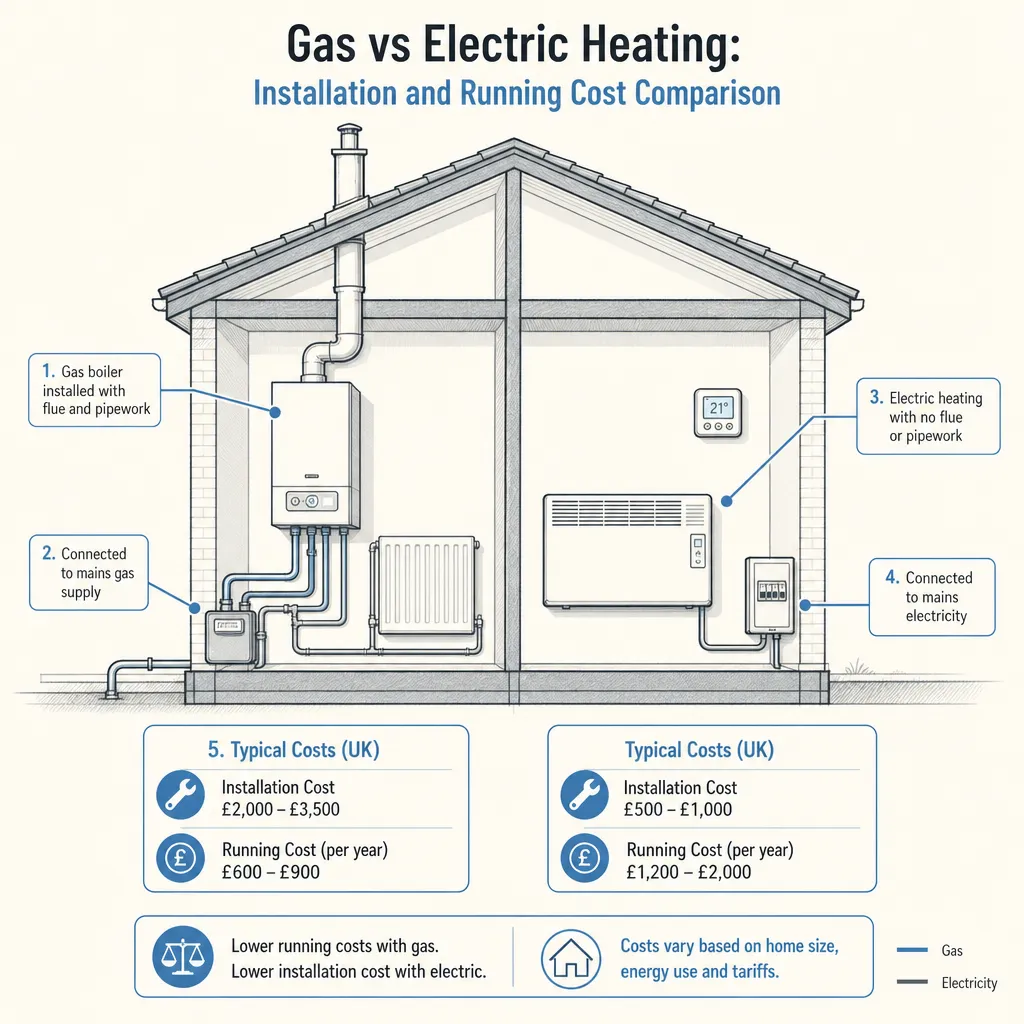
Gas vs Electric Heating: Installation and Running Cost Comparison
Gas central heating usually has lower running costs per kWh than direct electric heating in the UK, though heat pumps can change that equation.
 Energy & Retrofit
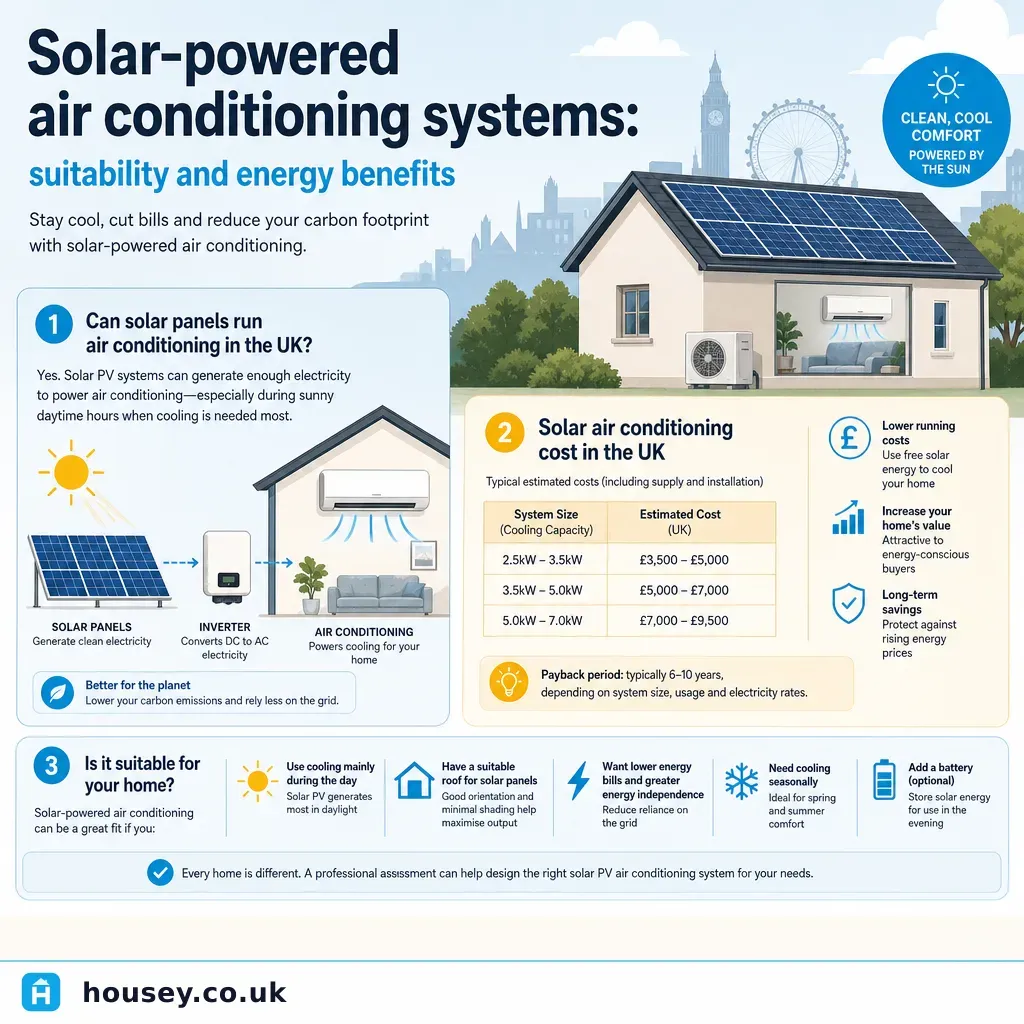
Solar-powered air conditioning systems: suitability and energy benefits
Solar-powered air conditioning pairs photovoltaic panels with an inverter-driven air conditioning unit to cool a home using renewable electricity.
 Energy & Retrofit
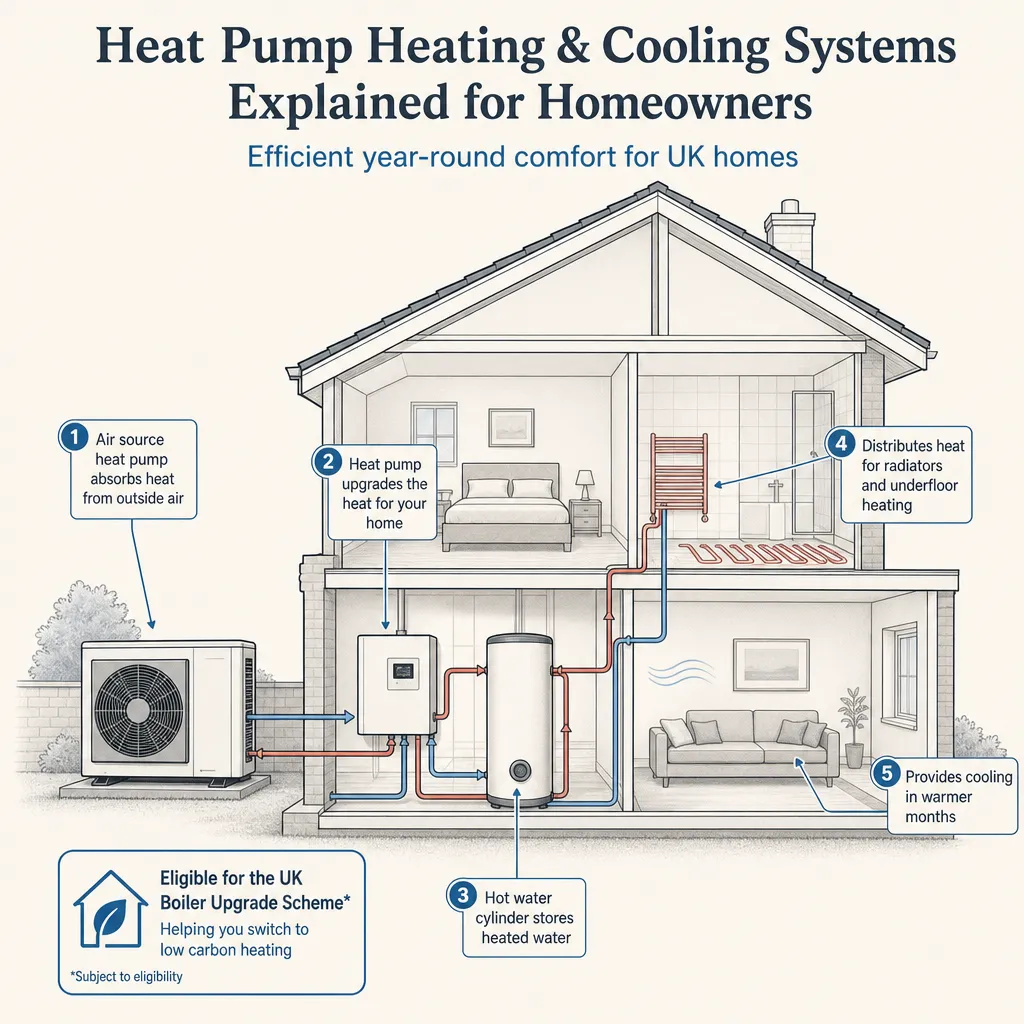
Heat pump heating and cooling systems explained for homeowners
A heat pump extracts heat from air or ground and transfers it indoors for heating, and can reverse the process for cooling.
 Energy & Retrofit
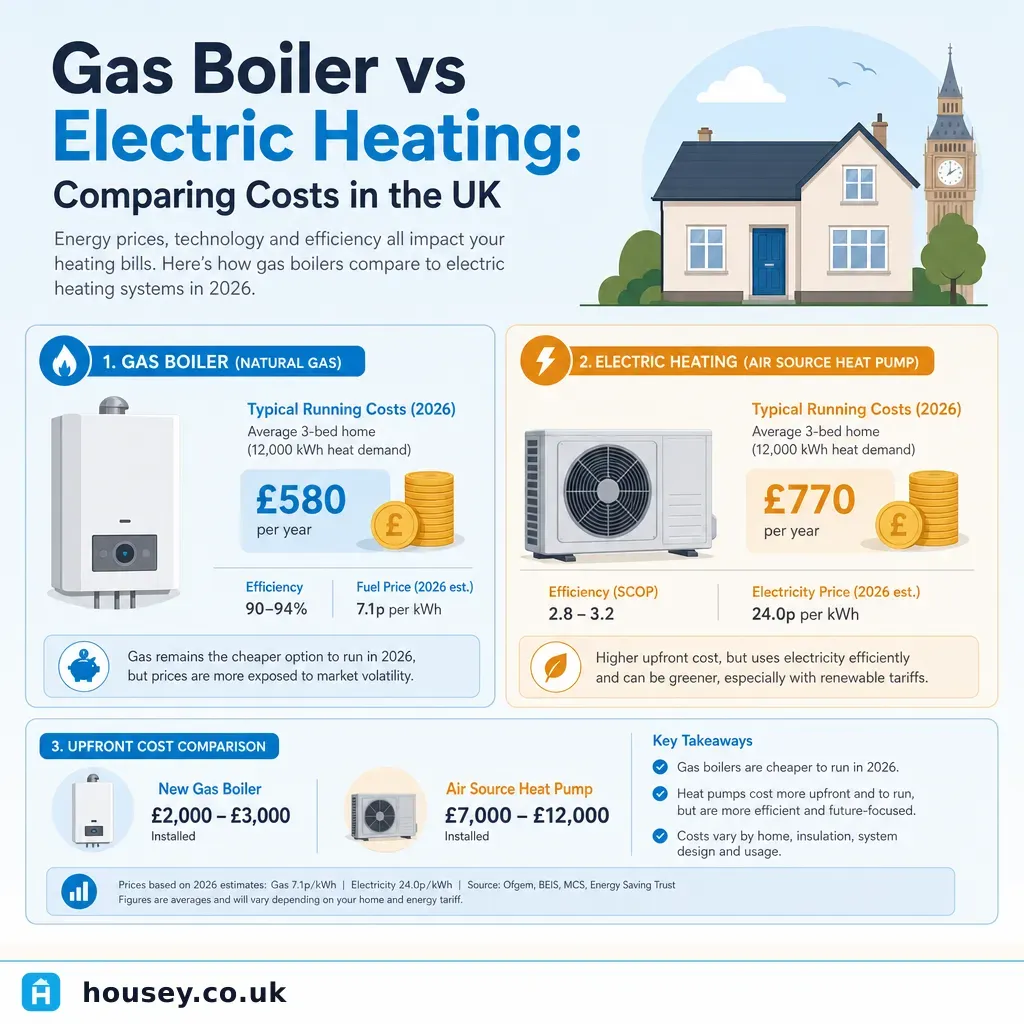
Gas Boiler vs Electric Heating: Comparing Costs in the UK
Gas boilers currently cost around 6.
 Energy & Retrofit
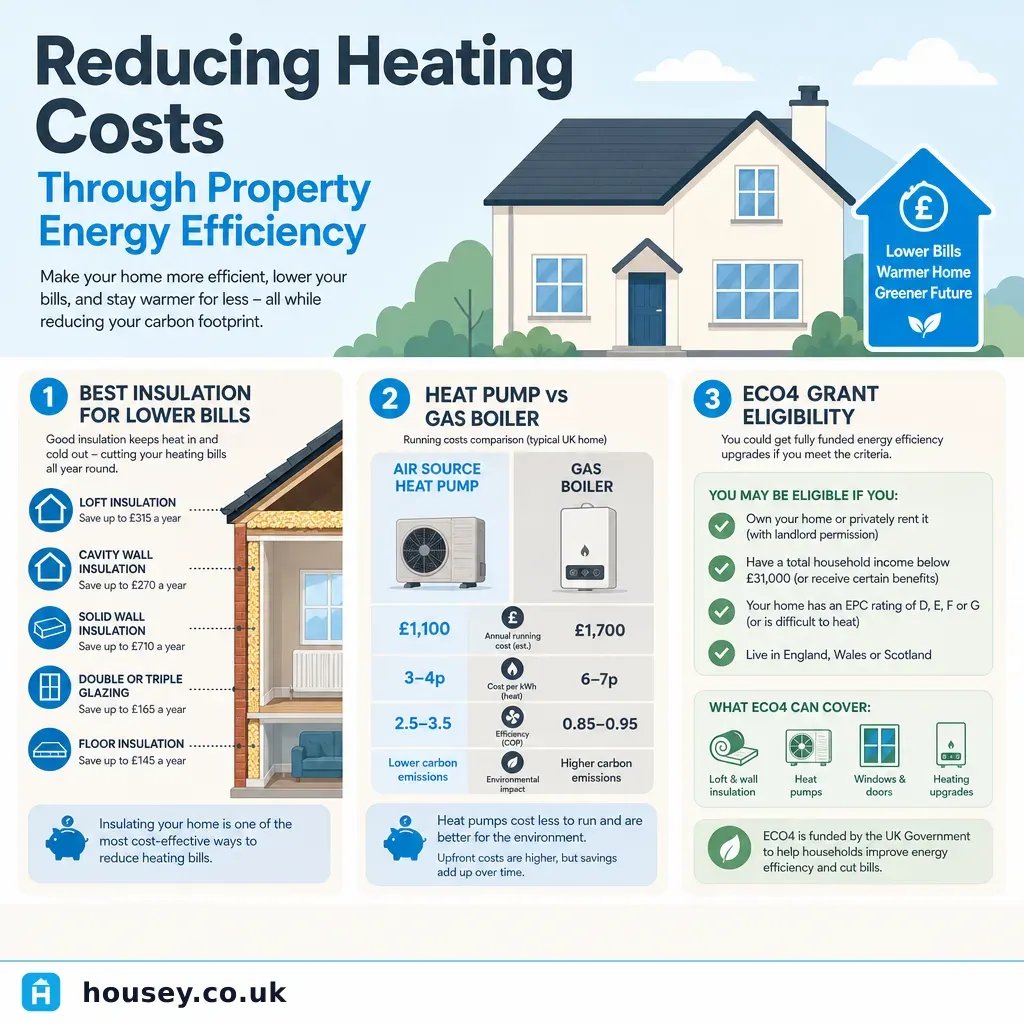
Reducing Heating Costs Through Property Energy Efficiency
Reducing heating costs starts with identifying where heat is lost — typically walls (30–35%), roof (20–25%), and windows.