Solar-powered air conditioning systems: suitability and energy benefits
By Housey · Last reviewed 31st of May 2026
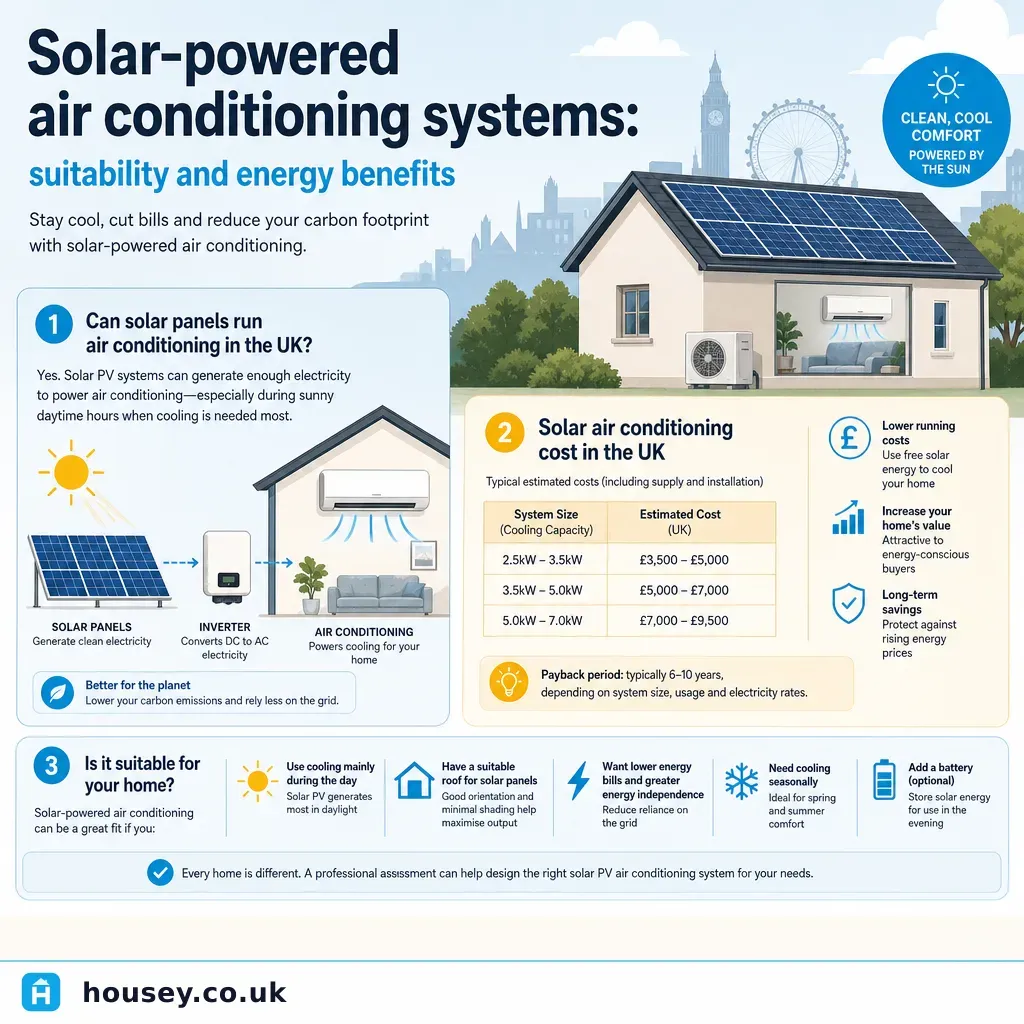
Solar-powered air conditioning systems: suitability and energy benefits
Cooling demand in UK homes has grown noticeably over recent summers, with sustained periods of high temperature making mechanical cooling a practical consideration for more households. Solar-powered air conditioning — pairing photovoltaic (PV) panels with an inverter-driven split or multi-split unit — is increasingly discussed alongside heat pump installations and whole-house retrofit programmes. The technology is well-established in warmer European markets but requires careful assessment for UK conditions, where annual solar irradiance is lower and the cooling season shorter than in southern Europe.
Key points
- UK homes receive an average of 1,000–1,200 peak sun hours per year, compared to 1,600–2,000 in southern Europe, which affects PV panel yield and the economic case for solar cooling.
- Modern inverter-split air conditioning units achieve a Seasonal Energy Efficiency Ratio (SEER) of 5–8, meaning 1kW of electricity consumed produces 5–8kW of cooling output.
- Solar PV installations up to 4kWp on a house roof do not currently require planning permission in England under permitted development rights, provided they comply with MCS installation standards.
- The Microgeneration Certification Scheme (MCS) requires that solar PV installers are MCS-registered as a condition of accessing Smart Export Guarantee (SEG) export payments.
- Refrigerant handling for air conditioning installation is regulated under UK F-Gas legislation (SI 2022/519) — only engineers holding City & Guilds 2079 or equivalent certification may legally work with refrigerants.
What is solar-powered air conditioning?
Solar-powered air conditioning uses electricity generated by rooftop PV panels to run an air conditioning unit, rather than drawing solely from the grid. In a UK residential setting, this almost always means a hybrid system: the AC unit draws primarily from the PV panels when generation is sufficient, and automatically supplements with grid electricity when solar output falls — for example, at night or during heavily overcast periods.
Three main configurations exist:
- DC-coupled solar AC: Specialist units connect directly to the DC output of the PV string without an inverter, making them efficient but less flexible to integrate with an existing PV installation.
- AC-coupled (grid-tied) solar AC: Standard inverter-split AC units are powered by an existing grid-tied PV system via a standard inverter. This is the most common approach for retrofitting to an existing solar installation.
- Hybrid solar with battery storage: A battery system allows solar energy generated during the day to power cooling in the evening, extending the solar contribution beyond daylight hours.
Is solar air conditioning suitable for your UK home?
Property type | Suitability | Key considerations |
|---|---|---|
South-facing detached house with 10–20 solar panels | Good | Sufficient roof space and PV output to meaningfully offset AC energy use in summer |
Semi-detached with existing 4kWp PV system | Moderate | May need to prioritise between EV charging, hot water, and cooling |
Victorian terrace with east-west split roof | Limited | Reduced peak solar output; longer payback period |
Top-floor flat (no roof access) | Poor | Shared roofs require freeholder consent; PV likely unavailable |
New-build with integrated solar and MVHR | Good | Already designed for integrated energy management; heat-pump cooling may also suit |
How much can you save?
Energy savings from solar-powered air conditioning in the UK depend on several variables:
- Cooling season length: In the UK, meaningful cooling demand typically runs from June to September — roughly 90–120 days. Southern Europe has 150–200 or more cooling days, so the proportional benefit of solar cooling is lower here.
- AC unit efficiency: Inverter-driven units with a SEER rating above 6 consume significantly less electricity than older fixed-speed units.
- PV system size: A 4kWp system in southern England generates approximately 3,400–3,800 kWh per year. During summer midday periods, this can easily power a 1–2kW AC unit at no grid cost.
- Electricity tariff: On a standard tariff of around 24–29p per kWh, avoiding 500 kWh of grid electricity per cooling season saves roughly £120–£145 per year.
Typical annual cooling energy cost savings from solar offset: £80–£250 per year, depending on system size, property, and usage pattern.
A worked UK example
A 1990s detached house in Surrey has a 3.6kWp south-facing PV system installed in 2022. The homeowners add a Mitsubishi Electric 2.5kW inverter-split unit to cool an open-plan kitchen-diner of approximately 40m².
During summer, the AC unit runs for an average of 4 hours per day on hot days (approximately 60 days). Total cooling energy: roughly 600 kWh. The PV system covers an estimated 350 kWh during daylight hours; the remaining 250 kWh is drawn from the grid at 27p per kWh (£67.50). Without solar, the full 600 kWh would cost approximately £162.
Estimated annual saving from solar offset: approximately £94. At an installed cost of £1,800 for the AC unit (supply and installation), payback from energy savings alone is around 19 years. However, the unit also provides heat-pump heating in winter, spreading the installation cost across year-round use and improving overall economics.
Which system configuration should you choose?
- Choose AC-coupled with existing PV if you already have a grid-tied solar system and want to add cooling — this is the simplest and lowest-cost approach.
- Choose DC-coupled specialist solar AC if you are installing solar and cooling from scratch and want maximum efficiency — consult an MCS-registered installer for system design.
- Choose a hybrid system with battery storage if you need evening cooling (particularly bedrooms) and want to extend the solar contribution beyond daylight hours.
- Consider a heat pump with cooling function instead if you are also looking to decarbonise space heating — many air source heat pumps (ASHP) provide reversible heating and cooling, and may qualify for the Boiler Upgrade Scheme (£7,500 grant as at 2026).
- Ask an MCS-registered assessor if you are unsure whether your roof orientation, shading, and available space justify expanding your solar installation for cooling.
- Check with your freeholder or managing agent if you live in a leasehold flat — adding external AC condenser units or rooftop PV generally requires freeholder consent and may be restricted by your lease.
When to get professional help
Always use qualified professionals for the following:
- PV installation or expansion: Must be carried out by an MCS-registered installer to qualify for Smart Export Guarantee payments and to comply with G99/G98 grid connection requirements.
- Air conditioning installation and commissioning: Refrigerant handling is regulated under UK F-Gas legislation — only engineers with City & Guilds 2079 or equivalent F-Gas certification may legally handle refrigerants.
- Electrical connection: Connecting an AC unit to an existing PV system or consumer unit must comply with BS 7671 (IET Wiring Regulations 18th Edition) and requires a qualified electrician or Part P notification.
Do not attempt to connect solar panels, AC units, or battery storage systems yourself. Incorrectly installed systems can be unsafe, void warranties, and may affect building insurance.
How Housey can help
Before committing to a solar-powered cooling system, a solar survey will assess your roof's orientation, shading, and structural suitability and help size a PV system correctly for your property. Our energy-efficiency consultants can also review your whole-house energy profile to determine whether solar-plus-cooling delivers better value than alternative measures such as external shading, loft insulation, or a heat pump.
Frequently asked questions
Does solar air conditioning work in cloudy weather?
Yes, but at reduced output. Modern PV panels generate electricity in diffuse light, not only direct sunlight. A 4kWp system in England may still produce 20–40% of its rated output on an overcast day. The AC unit automatically draws the balance from the grid, so cooling continues regardless of cloud cover.
Do I need planning permission for a solar AC system?
In England, rooftop solar PV on a house is generally permitted development if panels do not protrude more than 200mm from the roof surface and stay below the roof's highest point. Ground-level AC condenser units on a house are also generally permitted development. Listed buildings, conservation areas, and flats have different rules — check with your local planning authority.
Can solar air conditioning also heat my home?
Most inverter-split AC units operate as heat pumps and can both cool in summer and heat in winter. In heating mode, the unit draws electricity from either the PV system or the grid. The dual function improves overall economics by spreading the installation cost across year-round use rather than summer cooling alone.
What qualifications should my installer have?
For solar PV, look for an MCS-registered installer — registration is required to access Smart Export Guarantee payments. For the air conditioning unit, the engineer must hold F-Gas certification (City & Guilds 2079 or equivalent) to legally handle refrigerants. For electrical connections, a Part P registered electrician or equivalent qualified engineer is required.
Sources and further reading
- MCS — Microgeneration Certification Scheme — MCS
- Permitted development rights for householders: technical guidance — HM Government
- Boiler Upgrade Scheme — HM Government
- F-Gas regulations guidance — HM Government
- Solar panels — Energy Saving Trust
Useful next reads
 Energy & Retrofit
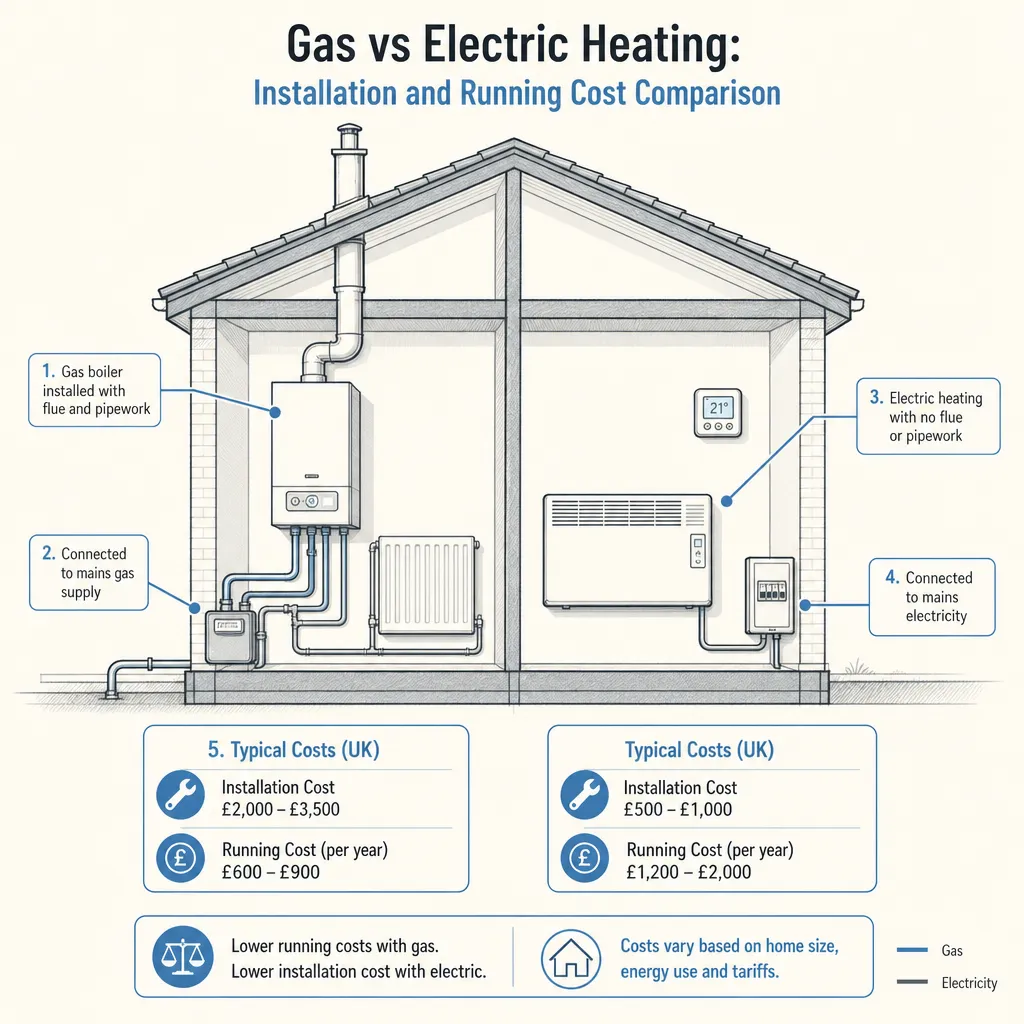
Gas vs Electric Heating: Installation and Running Cost Comparison
Gas central heating usually has lower running costs per kWh than direct electric heating in the UK, though heat pumps can change that equation.
 Energy & Retrofit
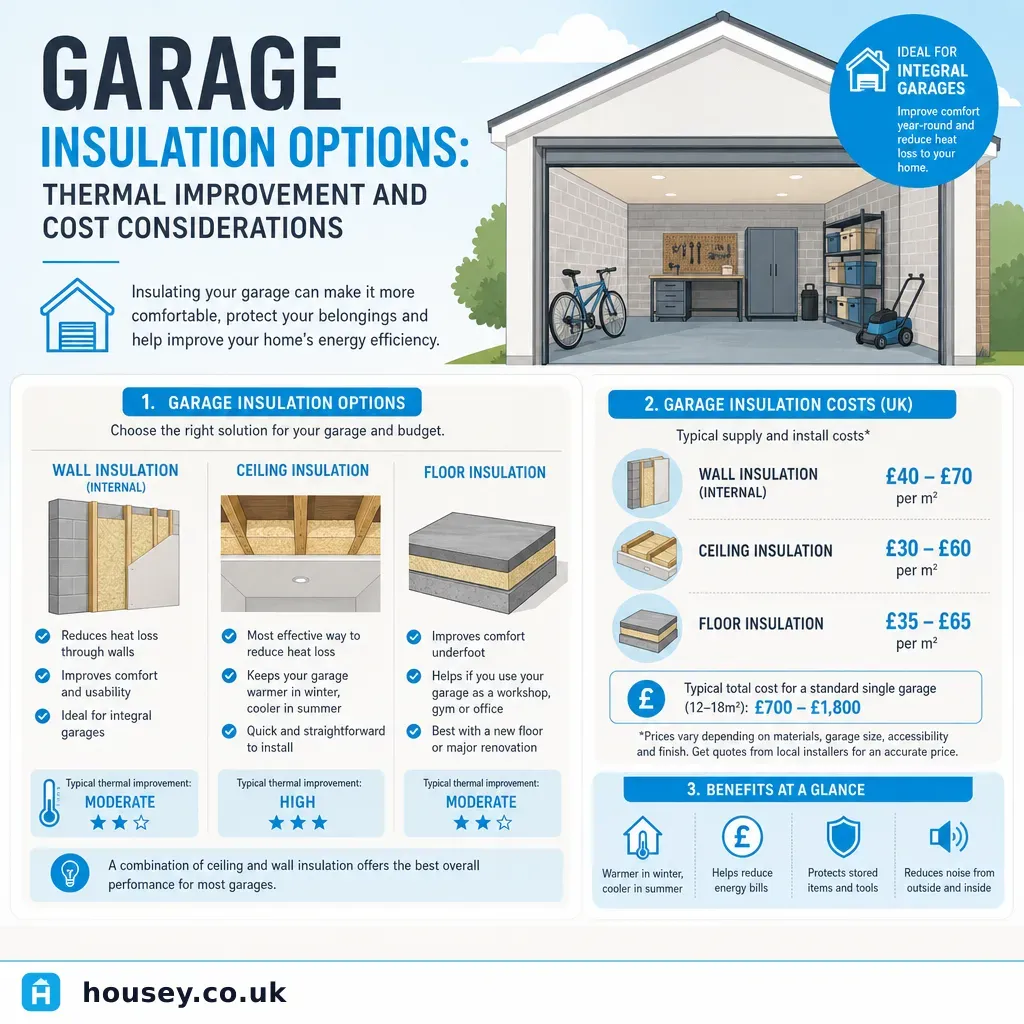
Garage Insulation Options: Thermal Improvement and Cost Considerations
Garage insulation options in the UK include mineral wool batts, rigid foam boards (PIR or EPS), and insulated garage doors.
 Energy & Retrofit
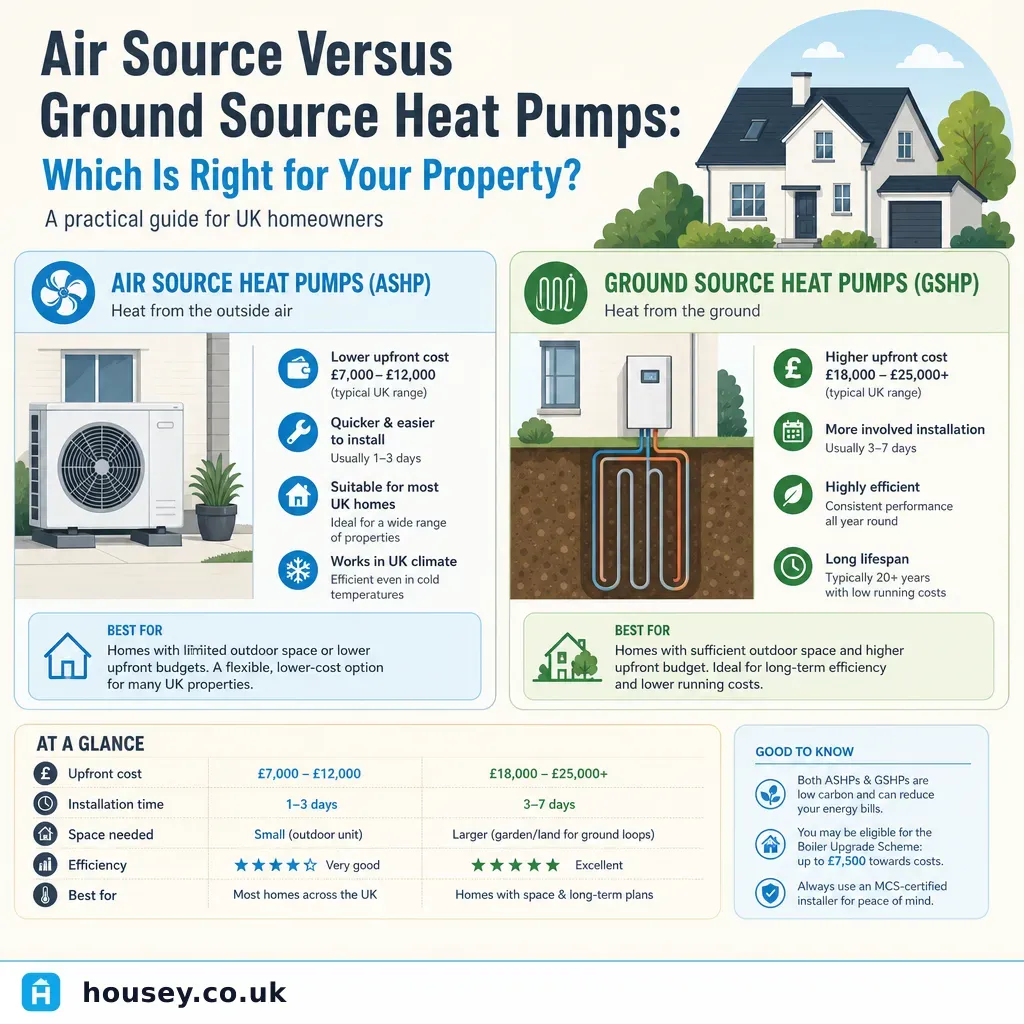
Air Source Versus Ground Source Heat Pumps: Which Is Right for Your Property?
Air source heat pumps (ASHPs) suit most UK properties with modest land requirements and faster installation, while ground source heat pumps (GSHPs) offer higher year-round efficiency but need significant land or borehole drilling and cost considerably more.
 Energy & Retrofit
Soy-based foam insulation: renewable insulation materials and energy savings
Soy-based foam insulation uses polyols derived from soybean oil to replace some petroleum-based components in conventional spray foam.
 Energy & Retrofit
Reducing Heating Costs Through Property Energy Efficiency
Reducing heating costs starts with identifying where heat is lost — typically walls (30–35%), roof (20–25%), and windows.