Aluminium vs uPVC Windows: Which Material Is Right for Your Home?
By Housey · Last reviewed 17th of May 2026
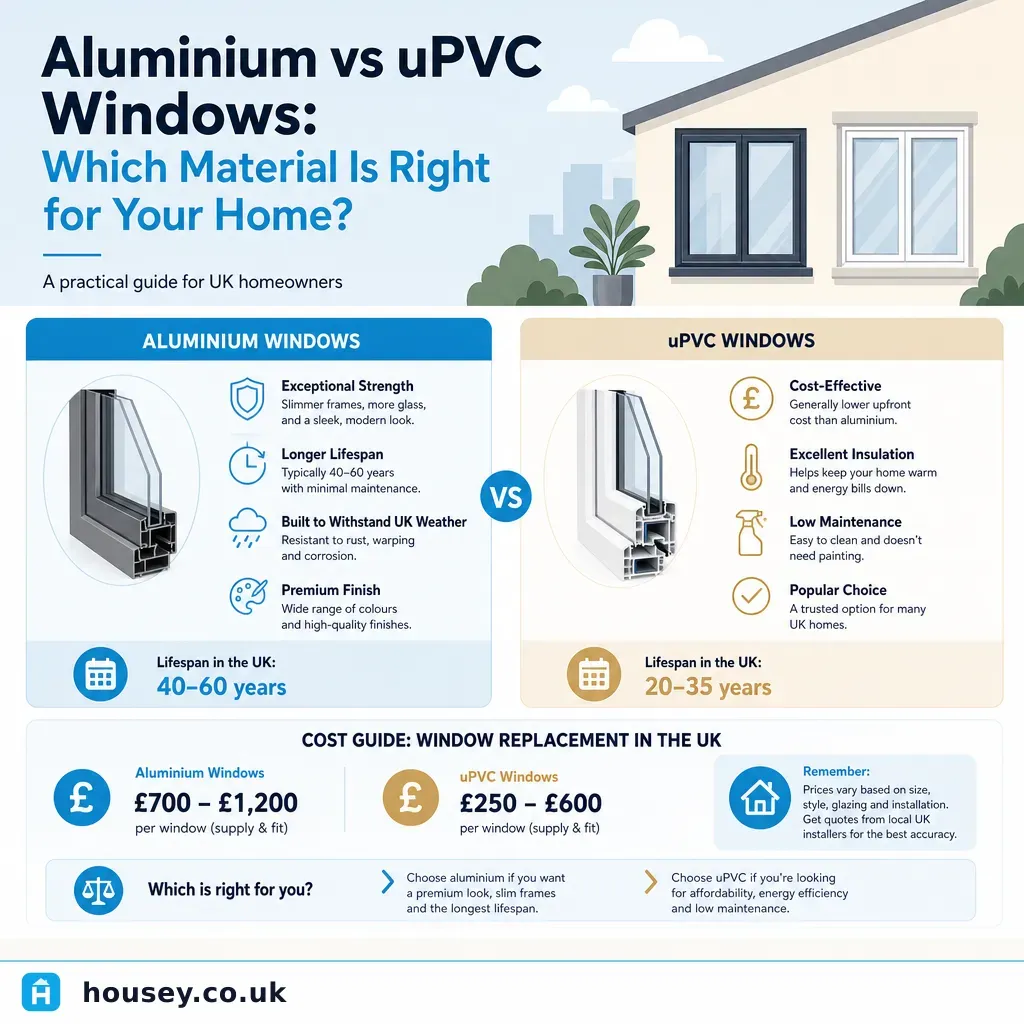
Aluminium vs uPVC Windows: Which Material Is Right for Your Home?
Choosing replacement windows touches on budget, energy efficiency, planning rules, and kerb appeal — all at once. Whether you are renovating a 1930s semi or updating a new-build flat, the material you choose will affect how your home looks, performs, and costs to maintain for the next 20 to 60 years. In the UK, the vast majority of homeowners choose uPVC, but aluminium has gained ground rapidly as prices have fallen and architectural tastes have shifted towards slimmer, more contemporary profiles.
Key points
- uPVC windows account for the majority of window replacements across UK housing stock and are typically 30–60% cheaper than aluminium equivalents on a like-for-like basis.
- Aluminium frames can be as thin as 45–60 mm, compared to 70–100 mm for standard uPVC profiles, giving you meaningfully more glass area per opening.
- All replacement windows in England and Wales must meet Building Regulations Part L thermal performance requirements — a whole-window U-value of 1.4 W/m²K or better.
- FENSA-registered installers can self-certify compliant window replacements, removing the need for a separate local authority building control application.
- uPVC windows typically last 20–35 years; aluminium frames often exceed 40–60 years with minimal maintenance.
uPVC windows: what you need to know
uPVC (unplasticised polyvinyl chloride) — sometimes called vinyl in North American markets — is the dominant window material in the UK for replacement projects. Its combination of affordability, low maintenance, and adequate thermal performance makes it the practical default for most terraced houses, semis, and flats.
Advantages:
- Lower upfront cost: typically £300–£600 per window supply-and-fit (indicative UK costs, last reviewed 2026-05-17; quotes vary by frame size and glazing specification)
- Good thermal performance: modern uPVC double-glazed units routinely achieve whole-window U-values of 1.2–1.4 W/m²K
- Low maintenance: frames do not rust and rarely need painting; wipe clean with mild detergent
- Wide installer availability: most window companies specialise in uPVC, giving you more competitive quotes
Disadvantages:
- Thicker profiles: uPVC frames are typically 70–100 mm wide, which can reduce daylight and look bulky on certain property styles
- Limited colour durability: white uPVC can yellow slightly after 10–15 years; coloured foils can fade or peel over time
- Less sustainable at end of life than aluminium, which is almost infinitely recyclable
- Can look dated on contemporary or heritage-style architecture
Aluminium windows: what you need to know
Aluminium has long been associated with commercial architecture, but thermally broken aluminium systems — where a plastic thermal break interrupts the frame to prevent cold bridging — have become genuinely competitive on energy performance. They are popular for extensions, large glazed openings, and contemporary renovations across all UK property types.
Advantages:
- Slimmer sightlines: frames of 45–60 mm are achievable, maximising glass area and suiting modern and Crittal-style designs
- Exceptional longevity: properly powder-coated aluminium frames typically last 40–60 years or more
- Colour stability: powder coating holds colour well over decades; a wide RAL colour range is available
- High recyclability: aluminium can be recycled repeatedly without quality loss
- Structural strength: suits large, heavy glazed sections, bifold doors, and picture windows
Disadvantages:
- Higher cost: typically £600–£1,200+ per window supply-and-fit for thermally broken aluminium (indicative UK costs, last reviewed 2026-05-17; quotes vary significantly by size and finish)
- Fewer local installers: not every window company offers aluminium systems
- Thermal bridging risk: cheaper non-thermally-broken aluminium performs poorly in cold weather — always specify thermally broken systems for habitable rooms
How they compare: a side-by-side view
Feature | uPVC | Aluminium |
|---|---|---|
Typical supply-and-fit cost per window | £300–£600 | £600–£1,200+ |
Frame width (typical) | 70–100 mm | 45–60 mm |
Typical lifespan | 20–35 years | 40–60+ years |
Whole-window U-value achievable | 1.2–1.4 W/m²K | 1.0–1.4 W/m²K (thermally broken) |
Maintenance | Low (wipe clean) | Low (powder coat rarely needs attention) |
Colour range | White + foiled colours | Wide RAL palette, powder coated |
Best suited to | Post-war to 1990s homes, budget renovations | Contemporary builds, large glazed areas, Crittal replicas |
Recyclability | Limited | High |
Indicative UK costs, last reviewed 2026-05-17. Quotes vary by size, specification, and installer.
Which window material should you choose?
- Choose uPVC if your budget per window is under £600, your property is a conventional post-war house or flat, and you want a straightforward replacement that meets Part L without a premium.
- Choose aluminium if you want a contemporary or Crittal-style aesthetic, you have large glazed openings, or you prefer spending more upfront for a frame likely to outlast two rounds of uPVC replacement.
- Consider timber if your property is listed or in a conservation area and the local planning authority requires material-matching to original windows.
- Ask a specialist installer if your property has non-standard openings, structural glazing, or if you are combining windows with bifold or sliding door systems.
- Check with your local planning authority before replacing windows on listed buildings or in conservation areas, where permitted development may not apply and material or style restrictions could limit your choices.
Planning permission and building regulations
For most standard replacement windows on non-listed homes, permitted development rights apply — you do not need planning permission provided the new windows are similar in appearance to the existing ones. However:
- Listed buildings almost always require listed building consent before replacing windows.
- Conservation area properties may face restrictions; check with your local planning authority before ordering.
- All replacement windows must comply with Building Regulations Part L (whole-window U-value of 1.4 W/m²K or better) and Part K (safety glazing in critical locations such as low-level panels near doors).
- Using a FENSA-registered installer means they self-certify compliance and notify building control on your behalf. If your installer is not FENSA-registered, you will need to apply to local authority building control separately and pay the associated application fee.
When to get professional help
Most window replacements are straightforward, but seek specialist advice if:
- You are replacing windows in a listed building or conservation area property
- You are replacing structural glazing or windows in a load-bearing masonry reveal where the lintel condition is unknown
- Existing frames are in a non-standard material such as steel Crittal requiring restoration rather than replacement
- A surveyor has flagged window reveals or lintels in a condition report
- You are combining window replacement with external wall insulation (EWI), which can change reveal depths and affect window positioning
How Housey can help
Housey connects you with vetted window and door installers who can survey your property, provide itemised quotes for uPVC and aluminium options, and handle FENSA self-certification on your behalf. Comparing quotes from multiple installers before committing to a material or specification will give you a clearer picture of what is realistic for your home and budget.
Frequently asked questions
Do I need planning permission to replace windows in England?
For most homes, replacing like-for-like windows is permitted development and does not require planning permission. Exceptions include listed buildings (which require listed building consent), properties in conservation areas (where design restrictions may apply), and some flats where the lease or freeholder imposes additional requirements. Always check with your local planning authority if uncertain.
How much do replacement windows cost in the UK?
uPVC double-glazed windows typically cost £300–£600 per window supply-and-fit, while thermally broken aluminium windows range from £600 to £1,200 or more. Triple glazing adds roughly 20–40% to glazing costs but improves thermal performance. Costs vary by frame size, specification, and installer. Always obtain at least three written quotes. Indicative UK costs, last reviewed 2026-05-17.
How long do uPVC windows last compared to aluminium?
uPVC windows typically last 20–35 years before frames degrade or lose weather-tightness, though the sealed glazing unit may need replacing sooner. Aluminium frames, properly powder-coated and maintained, commonly last 40–60 years or more. Over a 60-year period you might replace uPVC windows twice, whereas a thermally broken aluminium frame may not need replacing at all.
What U-value do replacement windows need in the UK?
Under Building Regulations Part L for England, replacement windows must achieve a whole-window U-value of 1.4 W/m²K or better. Both modern uPVC double-glazing and thermally broken aluminium double-glazing can meet this standard. Triple glazing typically achieves 0.7–1.0 W/m²K. Requirements in Scotland, Wales, and Northern Ireland differ slightly; check the relevant devolved regulations.
Sources and further reading
- Approved Document L: Conservation of Fuel and Power — HM Government
- FENSA: Fenestration Self-Assessment Scheme — FENSA
- Planning Portal: Windows and Doors — Planning Portal
- Energy Saving Trust: Double Glazing — Energy Saving Trust
- Glass and Glazing Federation Guidance — Glass and Glazing Federation
Useful next reads
 Improvement & Build
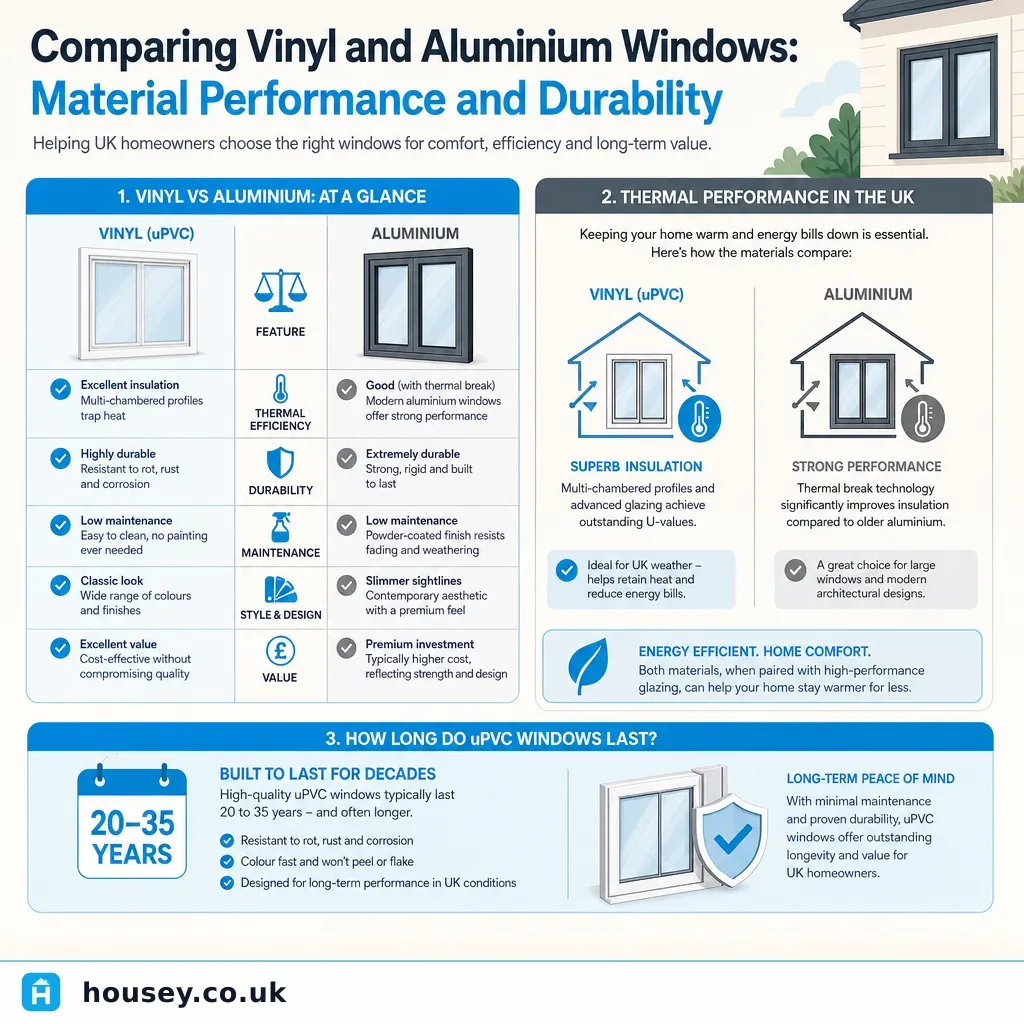
Comparing Vinyl and Aluminium Windows: Material Performance and Durability
uPVC (vinyl) and aluminium windows both meet UK Building Regulations Part L when properly specified.
 Improvement & Build
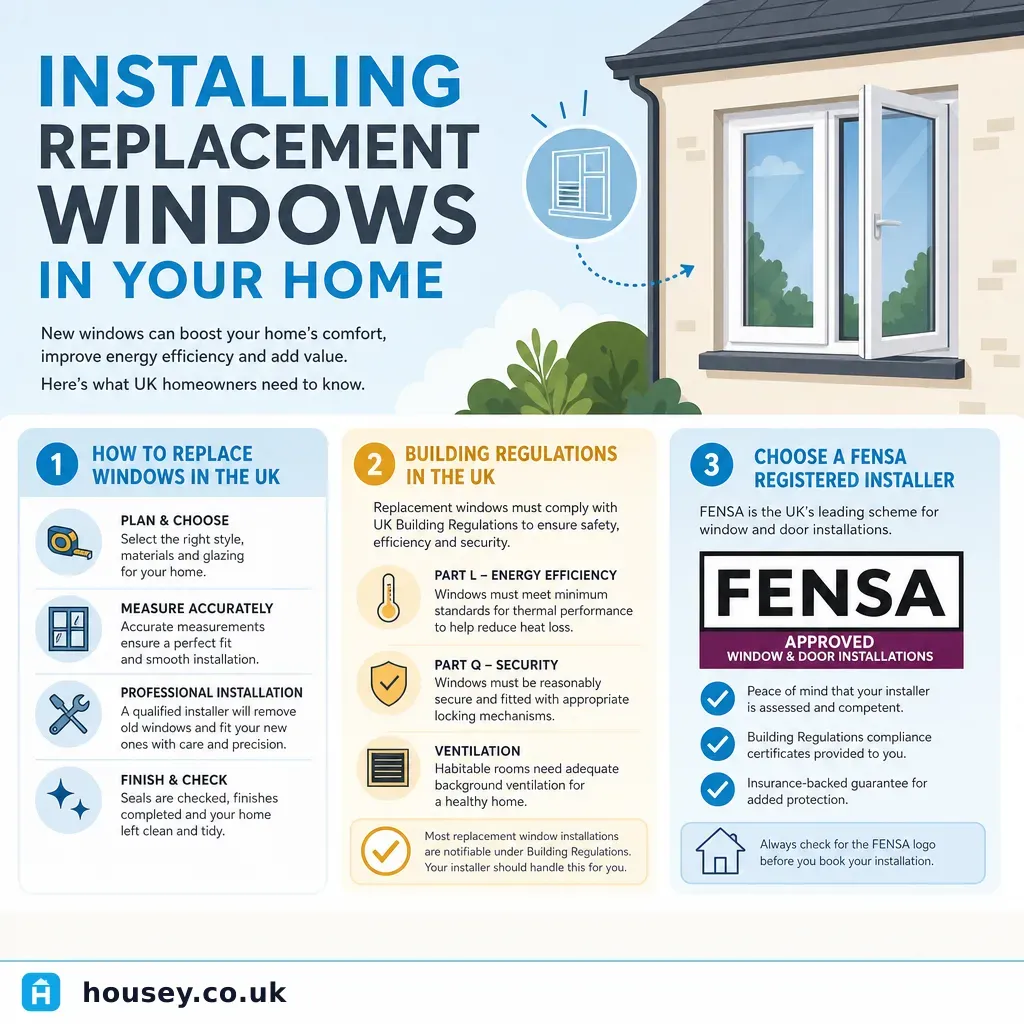
Installing Replacement Windows in Your Home
Replacing windows in the UK requires compliance with Building Regulations Part L — a minimum centre-pane U-value of 1.
 Improvement & Build
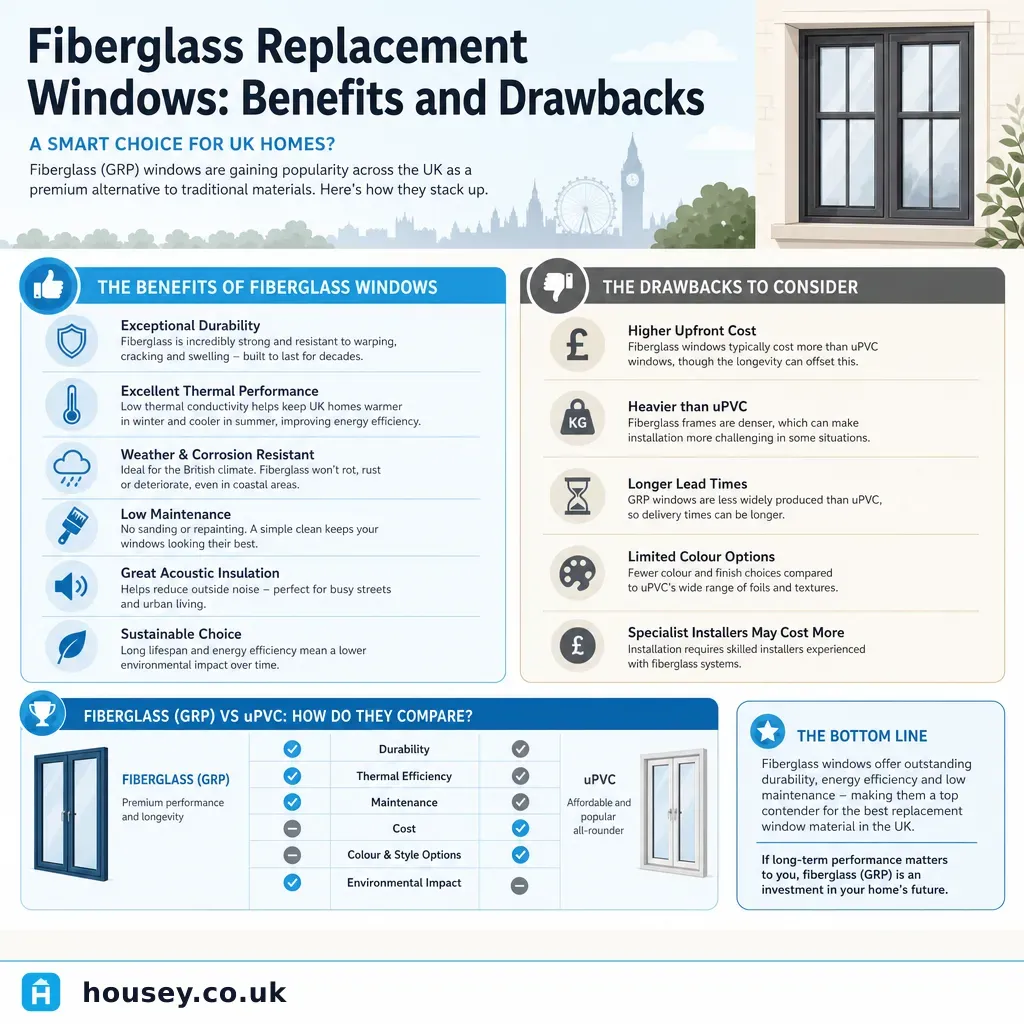
Fiberglass Replacement Windows: Benefits and Drawbacks
Fiberglass replacement windows offer high dimensional stability, exceptional durability, and low maintenance, but carry a higher upfront cost than uPVC and are available from fewer UK installers.
 Improvement & Build
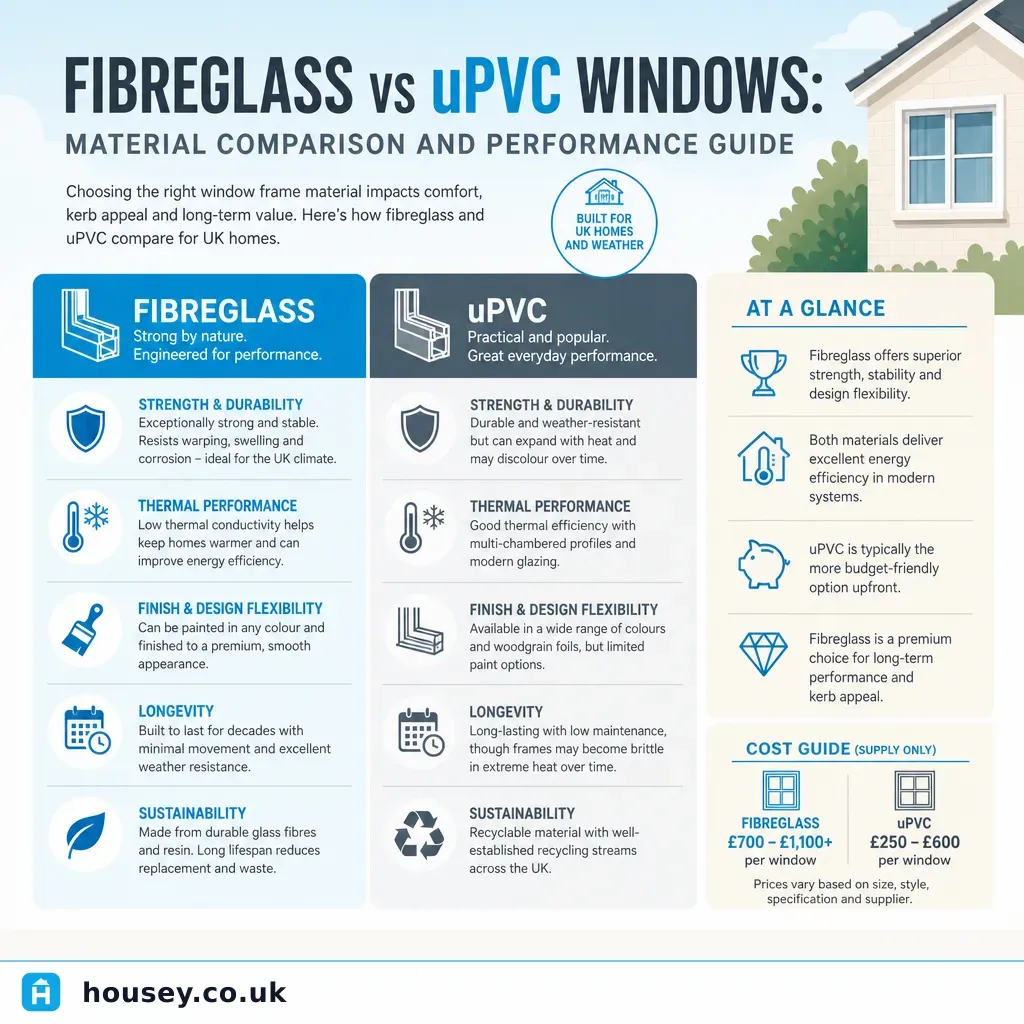
Fibreglass vs uPVC Windows: Material Comparison and Performance Guide
In the UK, vinyl windows are sold as uPVC — the dominant frame material for replacement windows.
 Improvement & Build
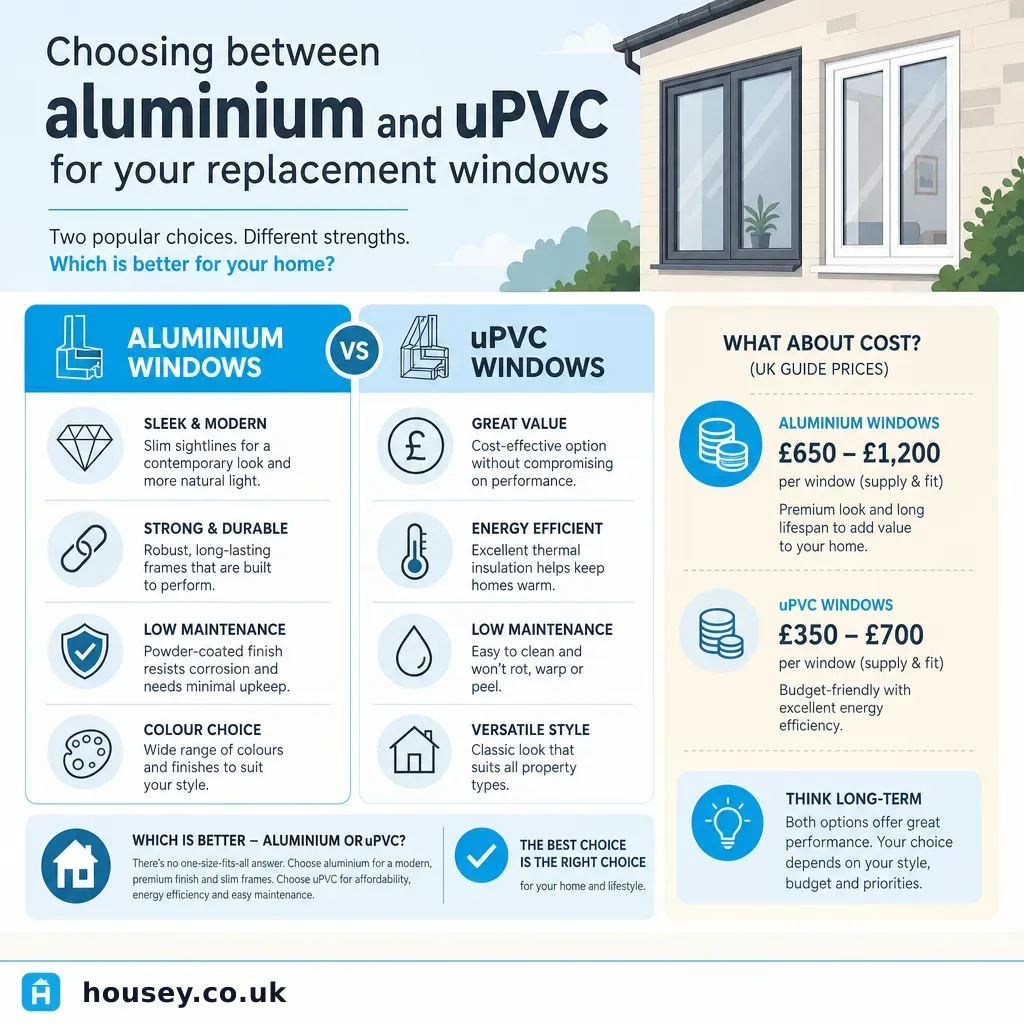
Choosing between aluminium and uPVC for your replacement windows
uPVC windows are typically the more affordable choice, offering good thermal performance and minimal maintenance, making them popular in most UK homes.