Comparing Vinyl and Aluminium Windows: Material Performance and Durability
By Housey · Last reviewed 1st of June 2026
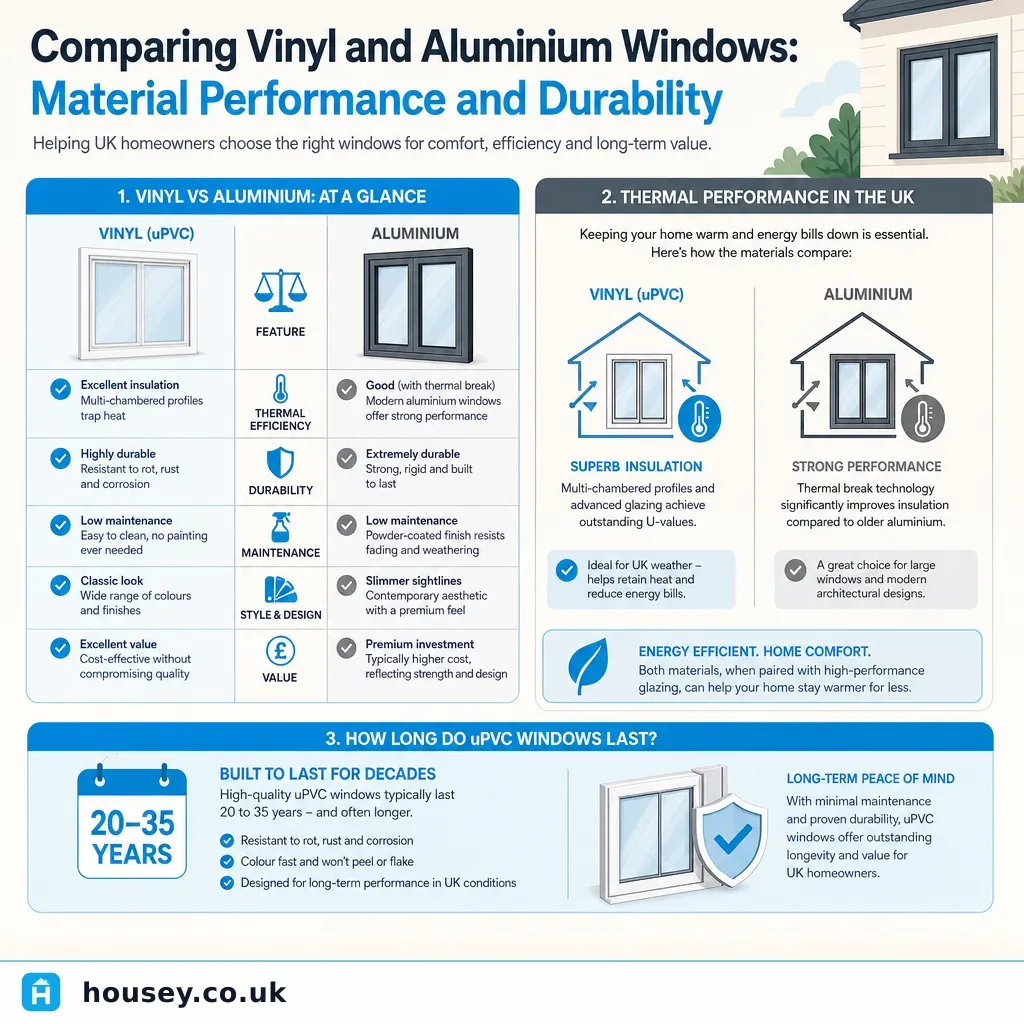
Comparing Vinyl and Aluminium Windows: Material Performance and Durability
Choosing between vinyl (uPVC) and aluminium window frames is one of the most common specification decisions UK homeowners face when replacing windows. Both materials dominate the replacement window market, yet they differ meaningfully in thermal performance, longevity, visual character, and environmental profile — and the right choice depends on your property type, planning constraints, and long-term priorities as much as it does on upfront cost.
Key points
- uPVC window frames typically deliver whole-window U-values of 1.2–1.4 W/m²K with standard double glazing; thermally broken aluminium systems can match or exceed this performance.
- Aluminium window frames have a manufacturer-stated service life of 45 years or more; uPVC frames typically carry 10-year warranties with an estimated lifespan of 20–35 years.
- Aluminium profiles are significantly slimmer than uPVC for equivalent structural strength, allowing larger visible glass areas — a material factor in conservation area or heritage contexts.
- uPVC cannot be conventionally painted on site; aluminium can be powder-coated in any RAL colour at the factory and re-coated during its lifetime, giving greater long-term flexibility.
- Both materials must comply with Building Regulations Approved Document L — the glazing specification, not the frame material alone, determines thermal compliance.
Frame material comparison: uPVC vs aluminium
Both uPVC and aluminium have evolved considerably since their introduction to the UK market. Modern uPVC profiles use multi-chamber internal structures to trap still air and improve thermal resistance. Modern aluminium frames incorporate thermal breaks — polyamide or polyurethane strips that interrupt the metal's high thermal conductivity and prevent cold bridging at the frame edges.
The table below summarises performance across the factors that matter most to UK homeowners.
Factor | uPVC (vinyl) | Aluminium |
|---|---|---|
Whole-window U-value (double-glazed) | Typically 1.2–1.4 W/m²K | Typically 1.2–1.6 W/m²K (thermally broken); high-spec systems can reach ≤ 1.0 W/m²K |
Whole-window U-value (triple-glazed) | Can achieve ≤ 0.8 W/m²K | Can achieve ≤ 0.8 W/m²K |
Typical manufacturer-stated lifespan | 20–35 years | 45 years or more |
Typical frame face width | 60–80 mm | 30–50 mm |
Colour options | White, woodgrain foils, limited factory colours | Any RAL powder-coat; can be re-coated |
Ongoing maintenance | Low — wipe clean; hardware lubrication every 1–2 years | Very low — durable powder coat; hardware lubrication every 1–2 years |
Recyclability | Limited; improving; some manufacturer take-back schemes | 100% recyclable; high recycled content commonly used |
Indicative relative cost | Lower upfront | Typically 20–50% more than uPVC for equivalent specification |
Common UK applications | Mass-market residential, 1970s–2000s properties | Contemporary new-build, high-end residential, heritage slim-profile replacement |
Conservation area acceptance | Rarely permitted where replacing original timber | More often accepted where slim profiles replicate historic sightlines |
Indicative UK costs, last reviewed 2026-06-01. Costs vary by opening size, specification, and installer. Obtain at least three quotes before committing.
Thermal performance: what really drives U-values
A common misconception is that frame material is the dominant factor in a window's thermal performance. In practice, the glazing unit accounts for roughly 70–80% of the window area and a disproportionate share of heat loss. The factors that significantly affect whole-window U-value are:
- Double vs triple glazing: triple-glazed units with argon or krypton gas fill and low-emissivity (low-e) coatings typically achieve centre-pane U-values of 0.5–0.7 W/m²K, versus 1.0–1.2 W/m²K for standard double glazing.
- Warm-edge spacer bars: replacing aluminium spacer bars with warm-edge alternatives (foam, stainless steel, or thermoplastic) reduces edge-of-glass heat loss and condensation risk.
- Frame contribution: the frame itself accounts for around 20–30% of the window area; a well-designed thermally broken aluminium frame and a well-designed multi-chamber uPVC frame will perform comparably in most UK climates when fitted with the same glazing unit.
When comparing quotes, ask for the whole-window U-value tested to BS EN ISO 10077 — not just the centre-pane value or a marketing claim. The British Fenestration Rating Council (BFRC) Window Energy Rating (WER) scheme provides an independent A–G rating that accounts for solar gain as well as heat loss and is a useful like-for-like comparison tool.
Durability and maintenance
uPVC durability is generally reliable for mid-range residential applications. The main long-term concerns are:
- UV degradation: older uPVC profiles yellowed and became brittle; modern profiles include titanium dioxide and UV stabilisers that significantly extend colour and structural life.
- Thermal expansion: uPVC expands and contracts more than aluminium across UK seasonal temperature ranges, which can stress corner welds and glazing seals over time.
- Hardware lifespan: hinges, friction stays, and multipoint locking mechanisms in uPVC frames typically need replacement or adjustment at 10–15 years, regardless of the frame's structural condition.
Aluminium durability is well-established in both commercial and residential contexts:
- Aluminium does not rot, warp, or corrode in normal UK inland environments.
- Powder-coated finishes are highly resistant to chipping and UV fading; most manufacturers offer 25-year coating guarantees.
- Coastal properties (within approximately 1–2 km of the sea) should specify a marine-grade finish — look for Qualicoat Class 2 or GSB Class A certification — as salt air can accelerate coating degradation on standard powder coats.
- Aluminium frames experience less thermal movement than uPVC, generally resulting in better long-term seal and hardware integrity.
Aesthetics and planning considerations
This is where the two materials diverge most consequentially for many UK homeowners.
uPVC is strongly associated with its standard white finish and comparatively chunky profiles. Coloured uPVC (anthracite grey, woodgrain foils) has improved its visual range, but profile face widths remain wider than aluminium equivalents at equivalent structural depth.
Aluminium achieves slimmer sightlines that more closely replicate the character of traditional steel Crittall-style windows common in 1930s properties, historic cast-iron frames, or slim original timber sections. For this reason, aluminium is often the preferred or required material in:
- Conservation areas where local design guidance requires slim profiles or expressly prohibits uPVC
- Listed buildings where like-for-like replacement in character forms part of the Listed Building Consent argument
- Contemporary extensions with large-format glazed panels where narrow sight lines matter visually
- High-end residential projects requiring bespoke RAL colour matching across all elevations
If your property is in a conservation area, check your local planning authority's published design guidance before specifying any material — some councils publish area-specific window guidance that is considerably more prescriptive than the general permitted development rules would suggest.
Worked UK property scenario
Scenario: a 1930s semi-detached house in a conservation area in south-east England
The property has original steel Crittall-style single-glazed windows. The local planning authority's conservation area character appraisal states: "Slim-profile, thermally broken aluminium windows in heritage powder-coat colours are generally acceptable as replacements; standard white uPVC profiles are not acceptable within the conservation area."
The homeowner specifies thermally broken aluminium frames in anthracite grey (RAL 7016), with double-glazed units achieving a whole-window U-value of 1.4 W/m²K — meeting Part L requirements. The FENSA-registered installer self-certifies the installation. The homeowner retains the FENSA certificate and the planning correspondence in their property file.
Had the homeowner specified standard white uPVC, the planning authority would likely have issued an enforcement notice requiring removal and replacement at the homeowner's cost — a significant financial and practical risk that prior specification advice could have avoided entirely.
What to ask before accepting a quote
Put these questions to each installer, whether you are considering uPVC or aluminium:
- What is the whole-window U-value for the specified product, tested to BS EN ISO 10077?
- Is the aluminium profile thermally broken — what is the thermal break material (polyamide or polyurethane) and its width in millimetres?
- What is the BFRC Window Energy Rating (WER) band for the complete window system?
- What are the separate warranty periods for the frame, the glazing sealed unit, and the hardware?
- For aluminium: is the powder coat a Qualicoat-certified finish, and what colour classes are available?
- For coastal locations: what specific marine protection coating is included in the quoted price?
- Are the windows UKCA-marked to EN 14351-1?
- Is VAT included in the quoted price, and what could cause the final cost to change?
When to get professional help
Most window replacements are routine jobs for a registered installer. Consider involving a professional in these situations:
- Listed buildings: window specifications may need Listed Building Consent and Historic England guidance regardless of which material is chosen.
- Conservation area projects: a chartered architect or conservation-accredited professional (RICS or RIBA) can advise on material suitability and planning risk before you commit to a specification.
- Whole-house retrofit: if windows form part of a broader energy improvement strategy, a Retrofit Coordinator operating under PAS 2035 can integrate the window specification into an energy model and fabric-first retrofit plan.
- Structural changes: enlarging openings or altering load-bearing reveals requires structural calculations and possibly a new lintel before installation can proceed.
How Housey can help
Housey connects you with vetted window and door installers experienced in both uPVC and aluminium systems — including conservation area and listed building projects. Request comparable quotes that include full glazing specifications, U-value data, and warranty terms so you can make an informed comparison between frame materials and suppliers.
Frequently asked questions
Is aluminium inherently better than uPVC for thermal performance?
Not automatically. The glazing unit — double vs triple glazed, gas fill, low-e coating, spacer bar — accounts for most of a window's thermal performance. A thermally broken aluminium frame with a high-spec triple-glazed unit will outperform standard uPVC double glazing, but equivalent glazing specifications in well-designed uPVC and thermally broken aluminium frames will achieve similar whole-window U-values. Always compare product data sheets rather than marketing claims.
How long do uPVC windows typically last in the UK?
Modern uPVC windows from reputable manufacturers typically last 20–35 years under normal UK conditions, with hardware such as hinges and locks sometimes needing replacement earlier. Older uPVC was prone to UV yellowing and brittleness; contemporary profiles include UV stabilisers that significantly improve longevity. Cheaper profiles without adequate UV stabilisation may degrade faster, particularly on south-facing elevations with prolonged sun exposure.
Can aluminium windows be installed in a conservation area?
Often yes — and in some conservation areas, slim-profile aluminium is the preferred alternative to uPVC precisely because it can replicate the sightlines of original steel or timber frames. Planning decisions are made case by case by the local planning authority. Always check your council's published conservation area design guidance, or seek pre-application advice before specifying any material.
Which frame material is more environmentally sustainable?
Aluminium has a higher embodied carbon at manufacture than uPVC, but is 100% recyclable and frequently contains a high proportion of recycled content. Its longer lifespan means fewer replacement cycles over a building's life. uPVC recycling in the UK is improving, with some manufacturers operating take-back schemes, but the material is not yet as circular as aluminium in practice over a building's full lifetime.
How much more expensive is aluminium than uPVC?
Indicative UK costs, last reviewed 2026-06-01. Aluminium windows typically cost 20–50% more than equivalent uPVC for the same opening sizes and glazing specification. The gap narrows where uPVC is upgraded with colour foils or triple glazing, and widens for bespoke aluminium colours or large-format panels. Obtain at least three quotes specifying identical opening dimensions and glazing performance before comparing materials directly.
Sources and further reading
- Approved Document L: Conservation of fuel and power — GOV.UK
- British Fenestration Rating Council: Window Energy Ratings explained — BFRC
- Planning Portal: Windows, doors and glazing guidance — Planning Portal
- Historic England: Guidance on windows in historic buildings — Historic England
- Energy Saving Trust: Double glazing and window advice — Energy Saving Trust
Useful next reads
 Improvement & Build
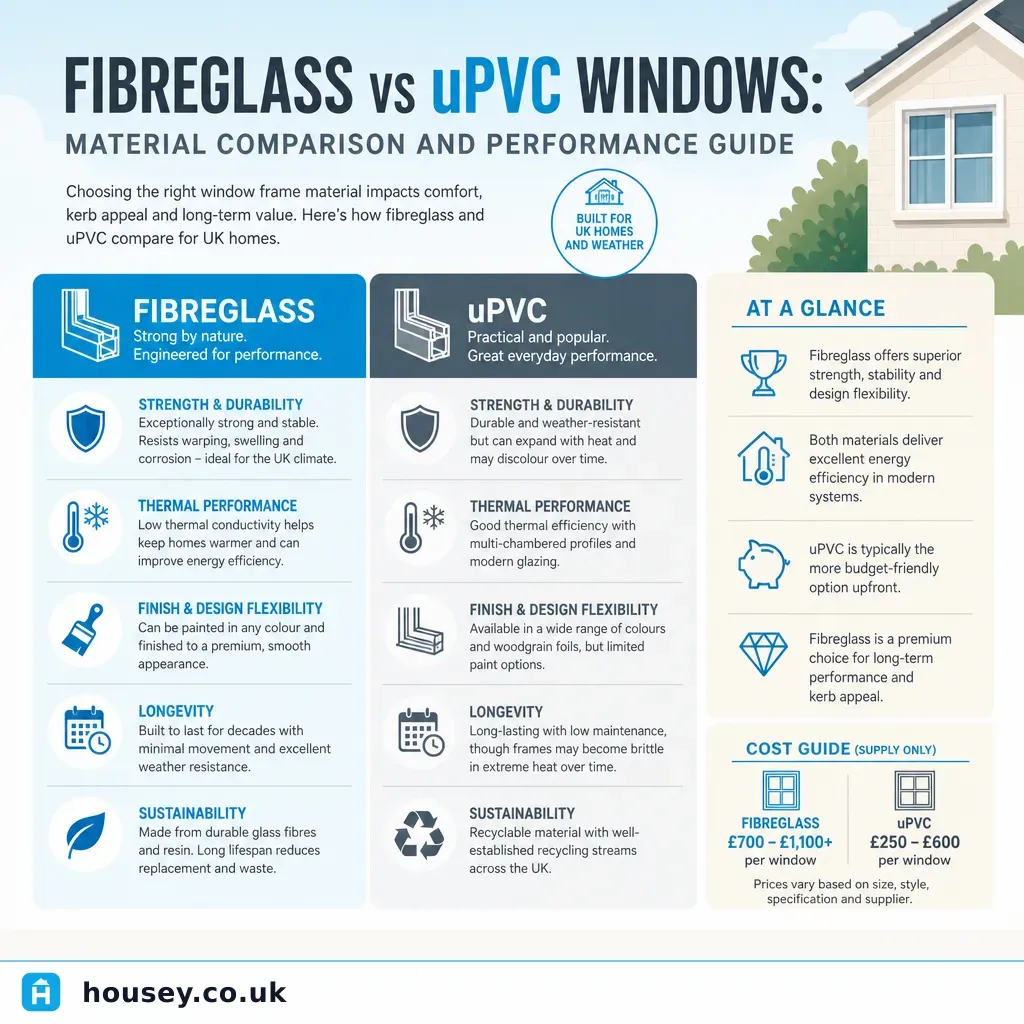
Fibreglass vs uPVC Windows: Material Comparison and Performance Guide
In the UK, vinyl windows are sold as uPVC — the dominant frame material for replacement windows.
 Improvement & Build
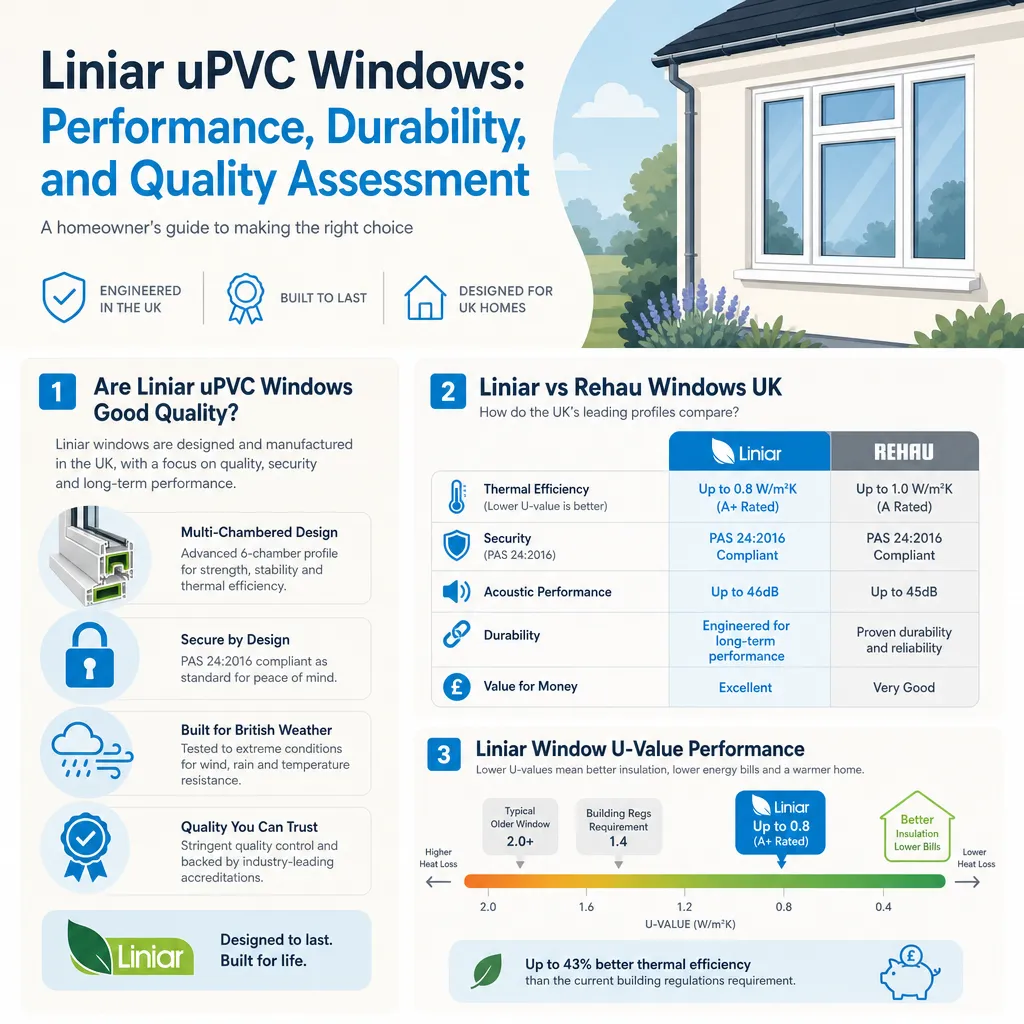
Liniar uPVC Windows: Performance, Durability, and Quality Assessment
Liniar uPVC window profiles are manufactured in the UK using multi-chambered, foamed frames.
 Improvement & Build
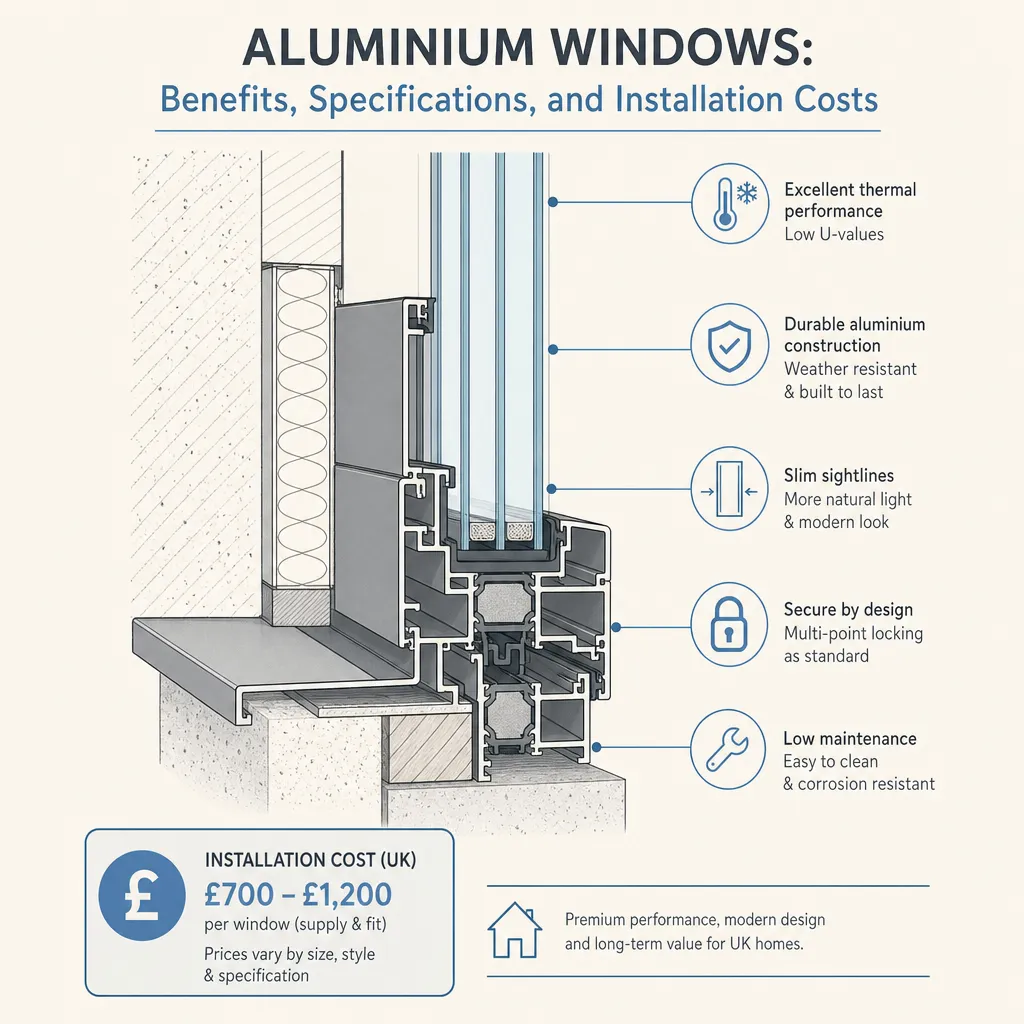
Aluminium Windows: Benefits, Specifications, and Installation Costs
Aluminium windows typically cost £600–£1,800 per window installed in the UK, depending on size and specification.
 Improvement & Build
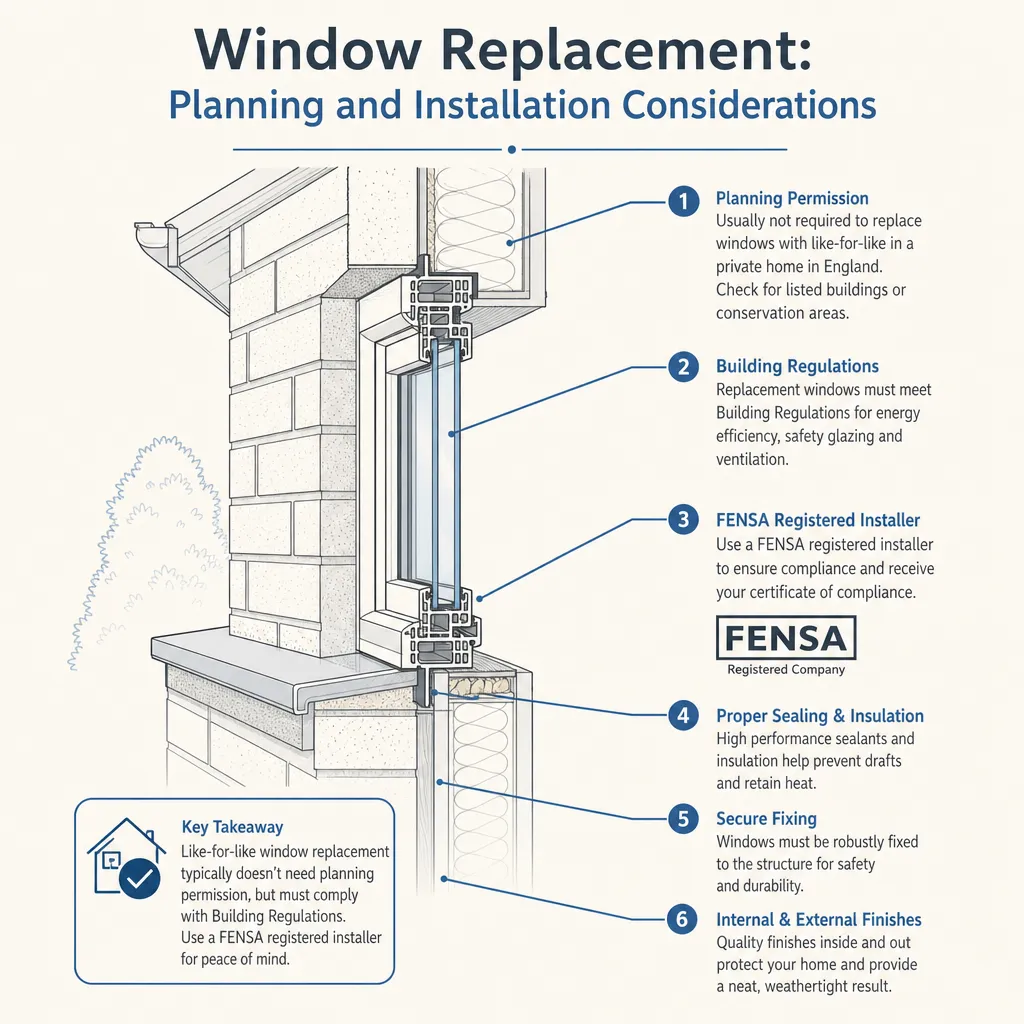
Window Replacement: Planning and Installation Considerations
Most window replacements in England fall under permitted development and do not need planning permission, though listed buildings, flats, and conservation areas are exceptions.
 Improvement & Build
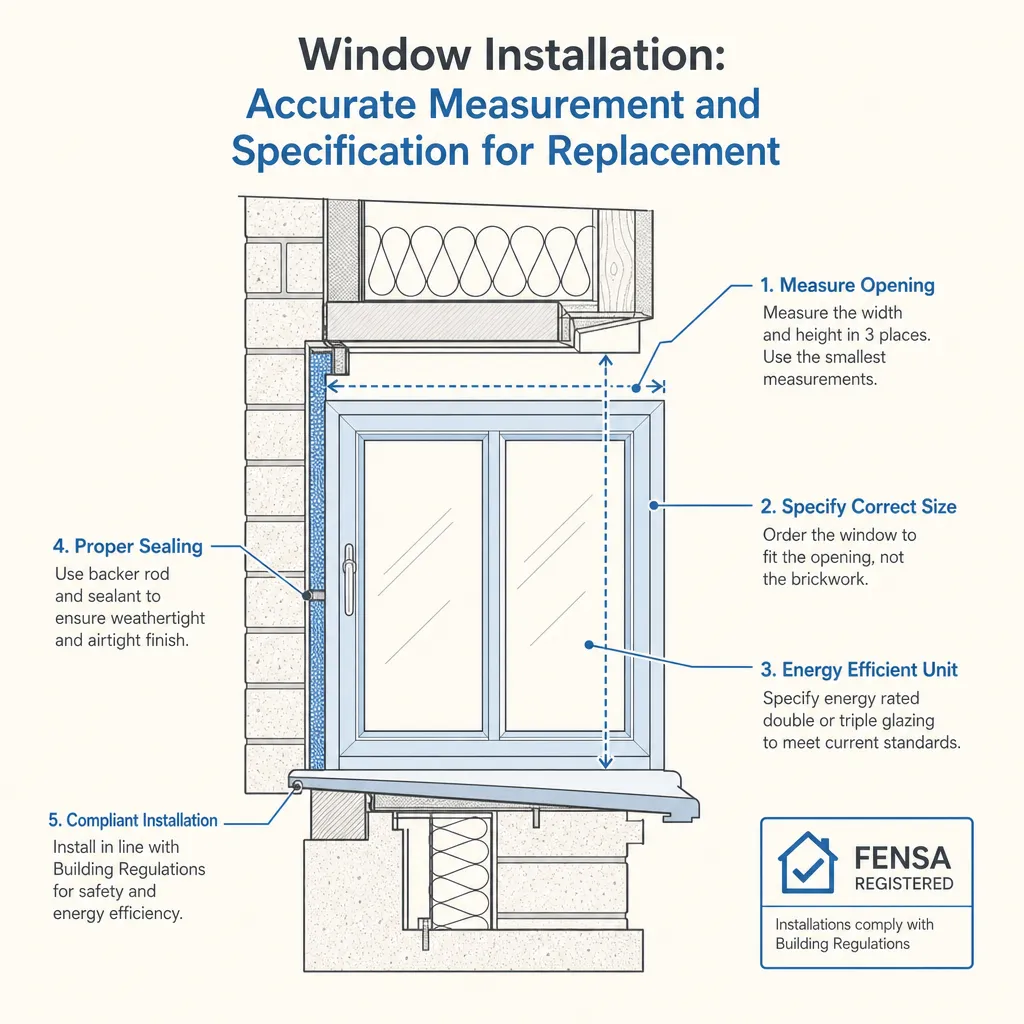
Window Installation: Accurate Measurement and Specification for Replacement
Accurate window measurement for replacement means recording the width and height of the existing frame opening in at least three places, noting the smallest dimension, and providing a full specification to your installer — including frame material, glazing type, opening style, and trickle ventilators.