Fibreglass vs uPVC Windows: Material Comparison and Performance Guide
By Housey · Last reviewed 1st of June 2026
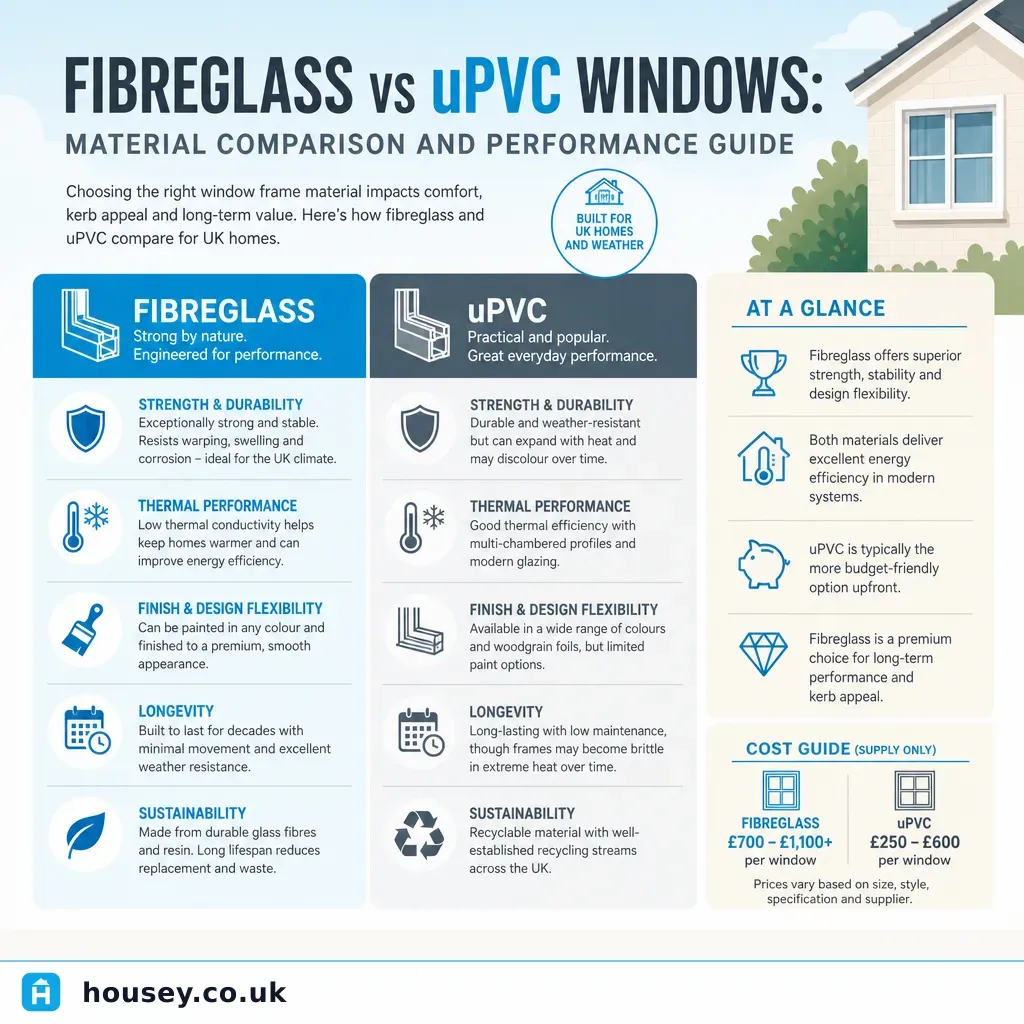
Fibreglass vs uPVC Windows: Material Comparison and Performance Guide
Choosing replacement windows involves more than picking a style — the frame material directly affects thermal performance, longevity, maintenance burden, and cost. For most UK homeowners, this decision arises during a renovation, when existing frames show signs of failure, or when improving energy efficiency ahead of an EPC assessment. Fibreglass (GRP) frames remain relatively uncommon in the UK compared with their popularity in North America, but growing demand for high-performance glazing has made them more widely available here. Understanding the differences between fibreglass and uPVC — the UK's dominant "vinyl" window material — helps you make an informed choice before approaching installers.
Key points
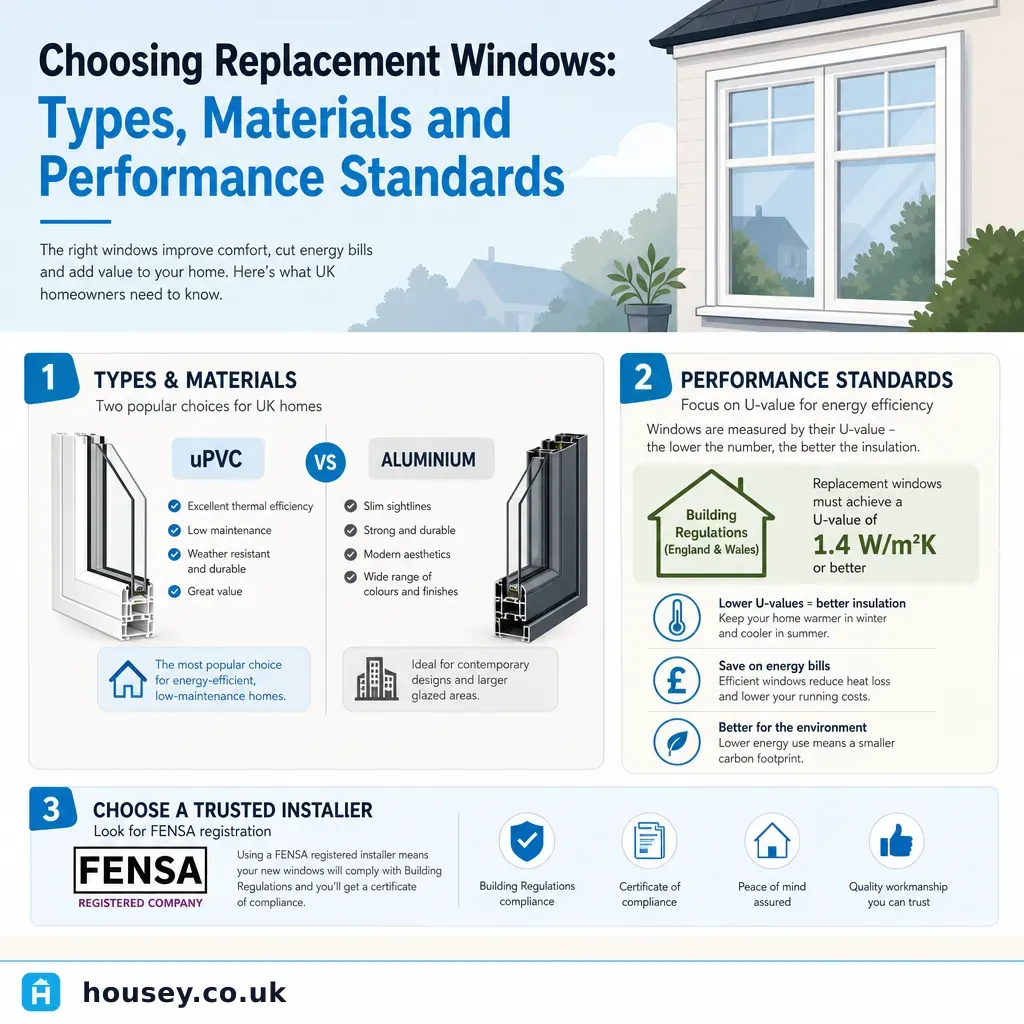
- Replacement windows must meet Building Regulations Part L, which sets a minimum whole-window U-value of 1.4 W/m²K; FENSA or CERTASS-registered installers can self-certify compliance without a separate local authority building control application.
- Fibreglass frames have a coefficient of thermal expansion roughly eight times lower than uPVC, making them less prone to warping, frame distortion, and glazing seal failure over time.
- FENSA-registered installers notify the local authority on your behalf and issue a compliance certificate — conveyancers typically require this document when the property is later sold.
- Modern UV-stabilised uPVC resists yellowing, but older frames — particularly pre-2000 installations — can discolour, develop corner cracks, or contain lead-based stabilisers.
- Whole-window energy performance is determined primarily by the glazing unit specification (double vs. triple glazing, gas fill, low-e coating) rather than frame material alone.
What are fibreglass and uPVC windows?
In the UK, "vinyl" windows are almost universally marketed and sold as uPVC (unplasticised polyvinyl chloride). uPVC has dominated the UK window replacement market since the 1980s and is the default frame choice across most housing stock — from Victorian terraces to 1990s estate homes.
Fibreglass frames — often described in UK trade literature as GRP (Glass Reinforced Plastic) — are made from glass fibres embedded in a resin matrix. They are considerably stronger and more dimensionally stable than uPVC, but harder to source from UK installers and typically more expensive.
Both materials are manufactured as hollow profiles that can be filled with insulating foam to improve thermal performance, and both accept double or triple glazing units. Fibreglass more convincingly replicates painted timber grain finishes, which is relevant for heritage or conservation-area properties where a traditional appearance is required or expected by planners.
Thermal performance compared
Whole-window U-values depend primarily on the glazing specification — not just the frame material. A well-specified uPVC frame with triple glazing can achieve a U-value below 0.8 W/m²K, comfortably exceeding current Part L requirements. Frame material nonetheless influences overall performance at the margins.
Feature | uPVC | Fibreglass |
|---|---|---|
Approximate frame thermal conductivity | ~0.17 W/mK | ~0.04 W/mK |
Thermal expansion | Higher — can stress seals and cause frame distortion | Very low — close to glass itself, minimal seal stress |
Risk of condensation on frame | Low | Very low |
Typical whole-window U-value (double-glazed) | 1.2–1.6 W/m²K | 1.0–1.4 W/m²K |
Typical whole-window U-value (triple-glazed) | 0.7–1.0 W/m²K | 0.6–0.9 W/m²K |
Indicative figures, last reviewed 2026-06-01. U-values vary by profile design, glazing specification, and installer. Always request certified test data from your chosen installer.
For most UK homes, the difference in frame conductivity is secondary to glazing specification. In properties with very large window openings, or those targeting Passivhaus-level retrofit performance, the lower conductivity and superior dimensional stability of fibreglass can offer a meaningful advantage.
Durability and maintenance
Both materials substantially outperform unprotected timber in maintenance demand, but they age differently.
uPVC can yellow on south-facing elevations in prolonged direct sunlight. Modern UV-stabilised formulations have improved significantly. Hollow profiles can crack under heavy impact, and older frames may contain lead-based stabilisers — a consideration when disposing of very old frames. uPVC is recyclable, though installer take-back schemes vary.
Fibreglass resists UV degradation, temperature extremes, and moisture more effectively. Its tensile strength is comparable to steel, making it highly resistant to warping or cracking under load. Fibreglass frames can be repainted if the surface finish degrades — a meaningful advantage over standard uPVC, which cannot easily be refinished. Manufacturer warranties typically run to 30–50 years, compared with 10–20 years for most uPVC products.
Red flags when assessing existing window frames
- Visible yellowing, chalking, or surface crazing on uPVC profiles
- Draughts, condensation between glazing panes, or sticking sashes
- Cracked or deformed corner joints
- Failed mastic seals around the frame perimeter
- Rust staining from steel reinforcing bar inside older uPVC profiles
Cost comparison
uPVC windows are consistently cheaper in the UK market due to manufacturing scale and a larger installer network.
Frame type | Approximate supply-and-fit cost per casement window (double-glazed) | Indicative lifespan |
|---|---|---|
uPVC | £300–£700 | 20–30 years |
Fibreglass | £600–£1,400 | 30–50 years |
Indicative UK costs, last reviewed 2026-06-01. Prices vary by window size, style, glazing specification, colour, and installer. Obtain at least three quotes.
Key cost drivers include the number and size of windows, opening type (casement, tilt-and-turn, sliding sash), glazing specification, colour or woodgrain finish, and whether structural lintels or reveals require adjustment. Request itemised quotes that separate supply, installation, and disposal of existing frames.
Which should you choose? A decision guide
- Choose uPVC if budget is a primary consideration, you want a large pool of local FENSA-registered installers to compare, and your property is a conventional post-war or modern home with standard-sized openings.
- Choose fibreglass if you are targeting high thermal performance, want a convincing timber-look finish for a heritage or conservation-adjacent property, or prefer a longer manufacturer warranty and can source a competent installer.
- Consult your local planning authority first if your property is listed or in a conservation area — both materials may be restricted, and permitted development rights do not apply to listed buildings.
- Check your lease if you are a leaseholder — window replacement often requires written freeholder consent regardless of frame material.
- Prioritise glazing specification over frame material if energy efficiency is your primary goal, since the glazing unit accounts for the majority of a window's thermal performance.
When to get professional help
Window replacement is a straightforward home improvement for most properties, but professional input is important in certain situations:
- Your property is listed or in a conservation area — unauthorised changes can result in enforcement action requiring reinstatement at your cost.
- Replacement requires structural adjustments to lintels or reveals — this falls under Building Regulations and requires a structural assessment before work begins.
- Existing frames may contain asbestos rope seals (possible in some pre-1980 properties) — do not disturb the material; arrange a survey with a competent asbestos professional before proceeding.
- You are unsure whether an installer is appropriately registered — check the FENSA or CERTASS registers before instructing.
How Housey can help
Housey connects UK homeowners with vetted FENSA-registered window and door installers who can assess your property, recommend the most appropriate frame material and glazing specification, and self-certify the installation as Building Regulations-compliant. Use Housey to compare quotes from multiple installers before committing.
Frequently asked questions
Are fibreglass windows widely available from UK installers?
Fibreglass (GRP) frames are available from specialist UK manufacturers and installers but remain far less common than uPVC. They are more frequently specified on heritage, high-specification, or Passivhaus projects. Finding a local FENSA-registered installer who offers fibreglass may require considerably more research than sourcing a uPVC installer.
Do replacement windows need building regulations approval in the UK?
Yes. Replacement windows must comply with Building Regulations Part L (thermal performance) and Part K (safety glazing where applicable). Using a FENSA or CERTASS-registered installer means the installer self-certifies compliance and notifies the local authority on your behalf, removing the need for a separate building control application.
Can I replace windows in a conservation area or listed building?
Permitted development rights for window replacement do not apply to listed buildings and may be restricted in conservation areas. Contact your local planning authority before ordering. Some councils accept slim-profile double-glazing units in traditional-style frames; others require single-glazed historic glass. Always check before placing an order.
How long do uPVC windows typically last?
Most uPVC manufacturers offer warranties of 10 to 20 years, and frames typically remain functional for 20 to 30 years in normal UK conditions. Performance may decline earlier if seals fail, frames warp in heat, or the glazing unit loses its argon fill. Regular maintenance of seals and hardware can extend service life.
Sources and further reading
- Building Regulations Approved Document L: Conservation of fuel and power — GOV.UK
- FENSA: find a registered window installer — FENSA
- Double glazing: energy saving advice — Energy Saving Trust
- Windows: planning permission guidance — Planning Portal
Useful next reads
 Improvement & Build
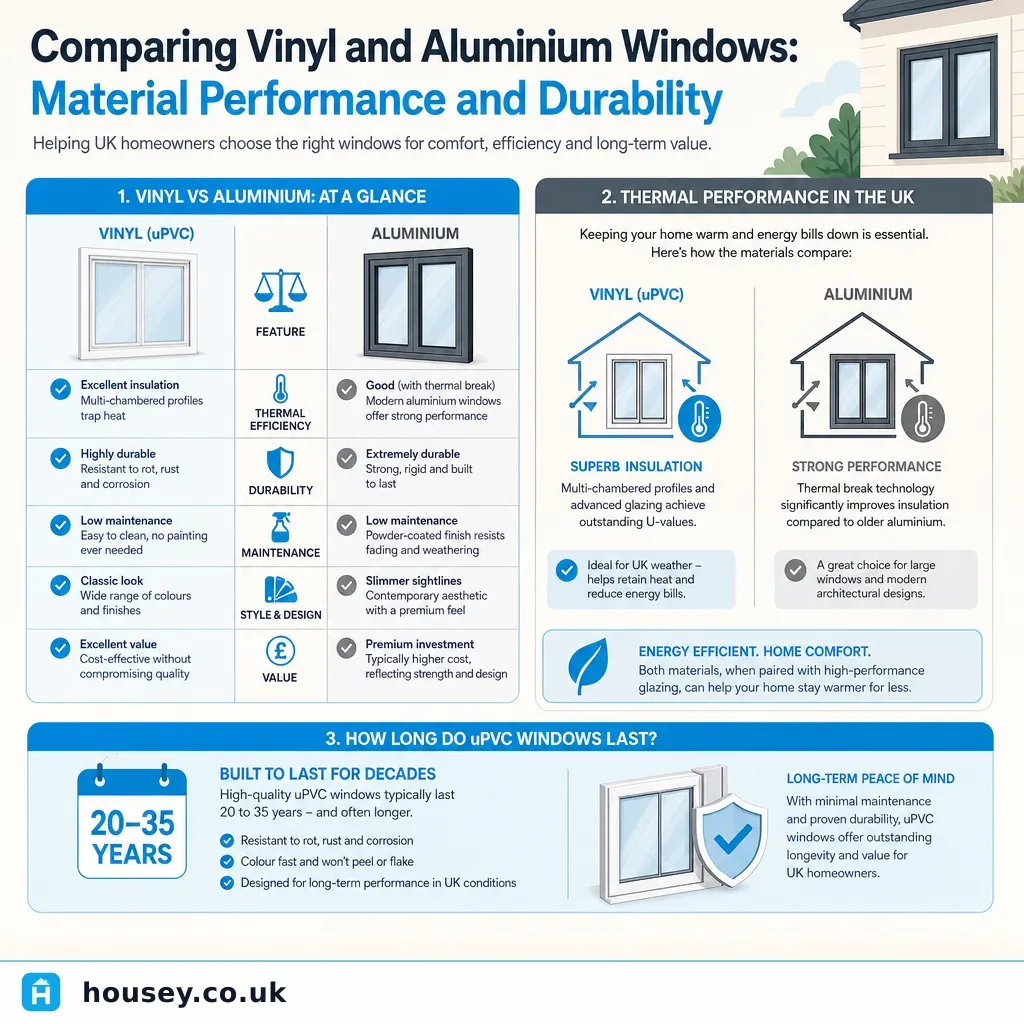
Comparing Vinyl and Aluminium Windows: Material Performance and Durability
uPVC (vinyl) and aluminium windows both meet UK Building Regulations Part L when properly specified.
 Improvement & Build
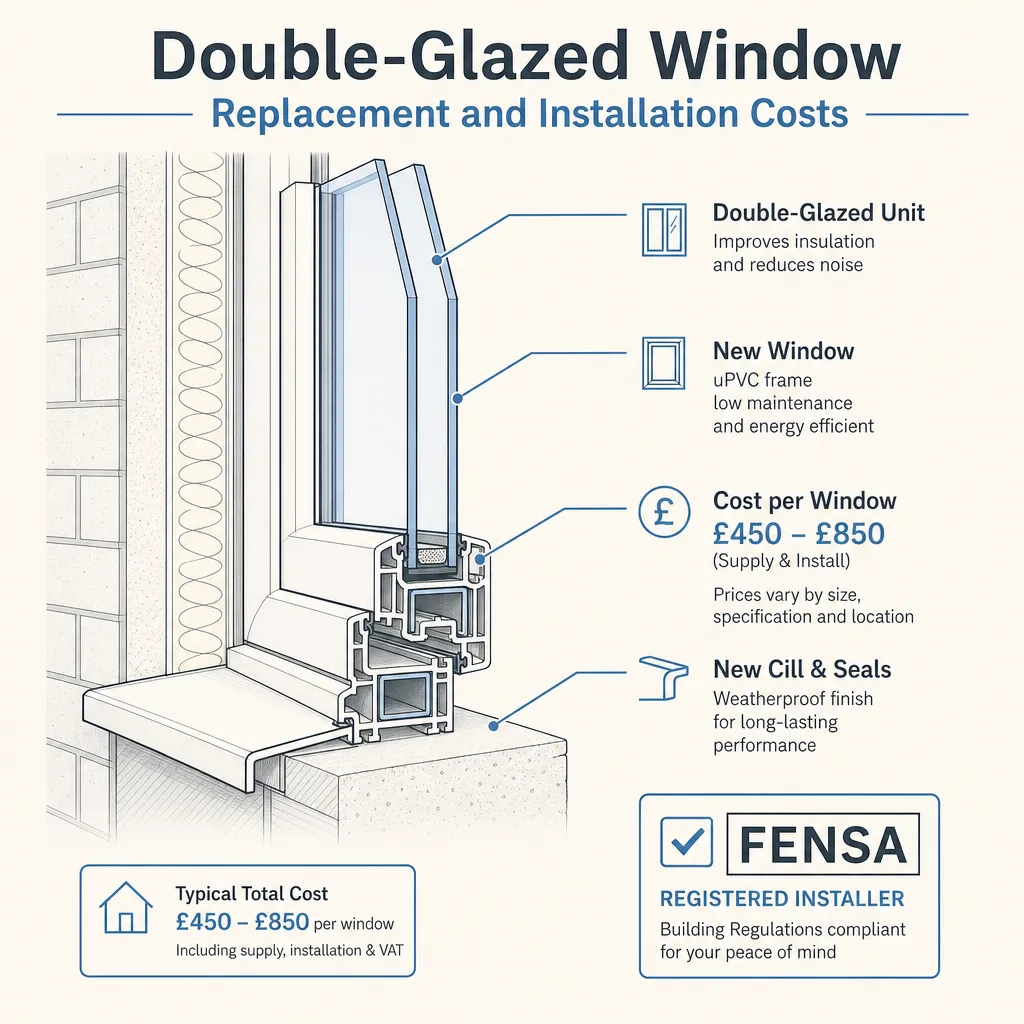
Double-Glazed Window Replacement and Installation Costs
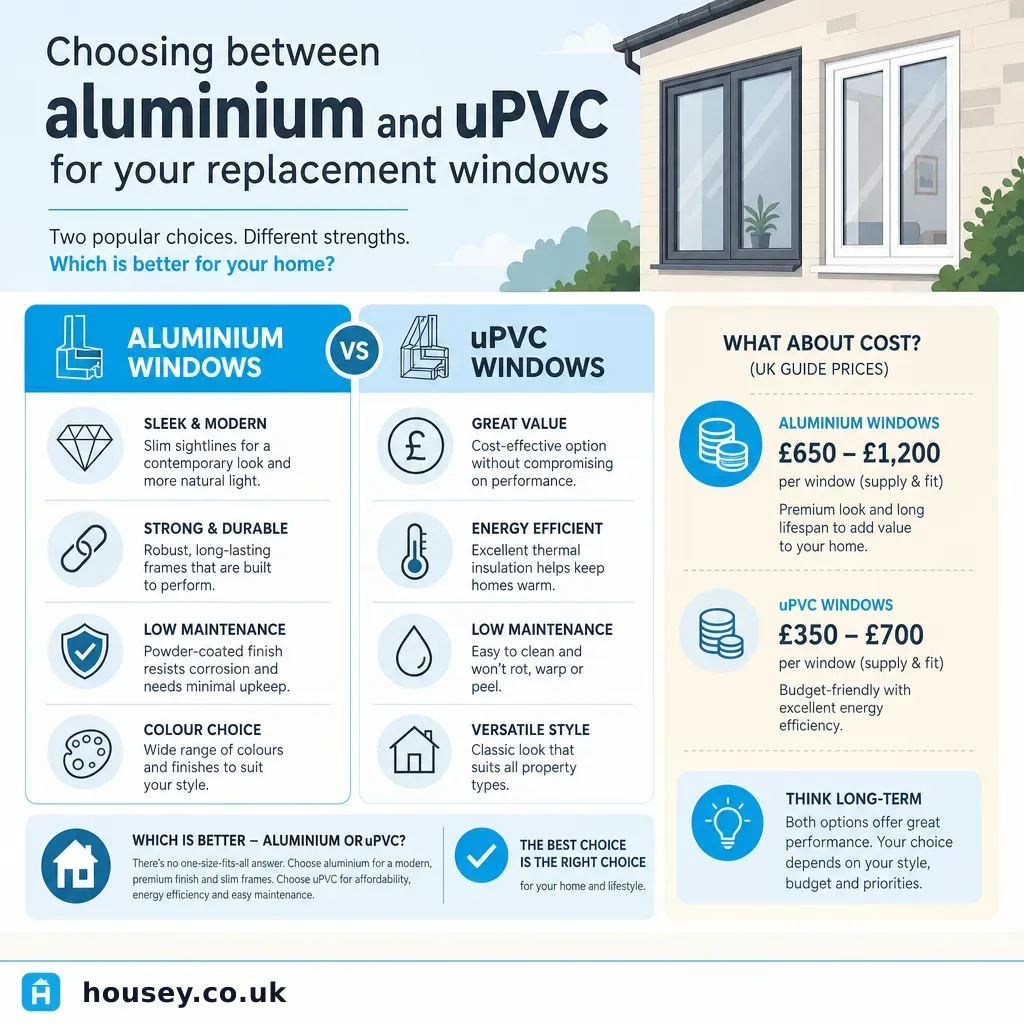
Replacing double-glazed windows in a typical UK home costs roughly £300–£600 per uPVC casement window installed, rising to £500–£1,200 for timber and £400–£800 for aluminium.
 Improvement & Build
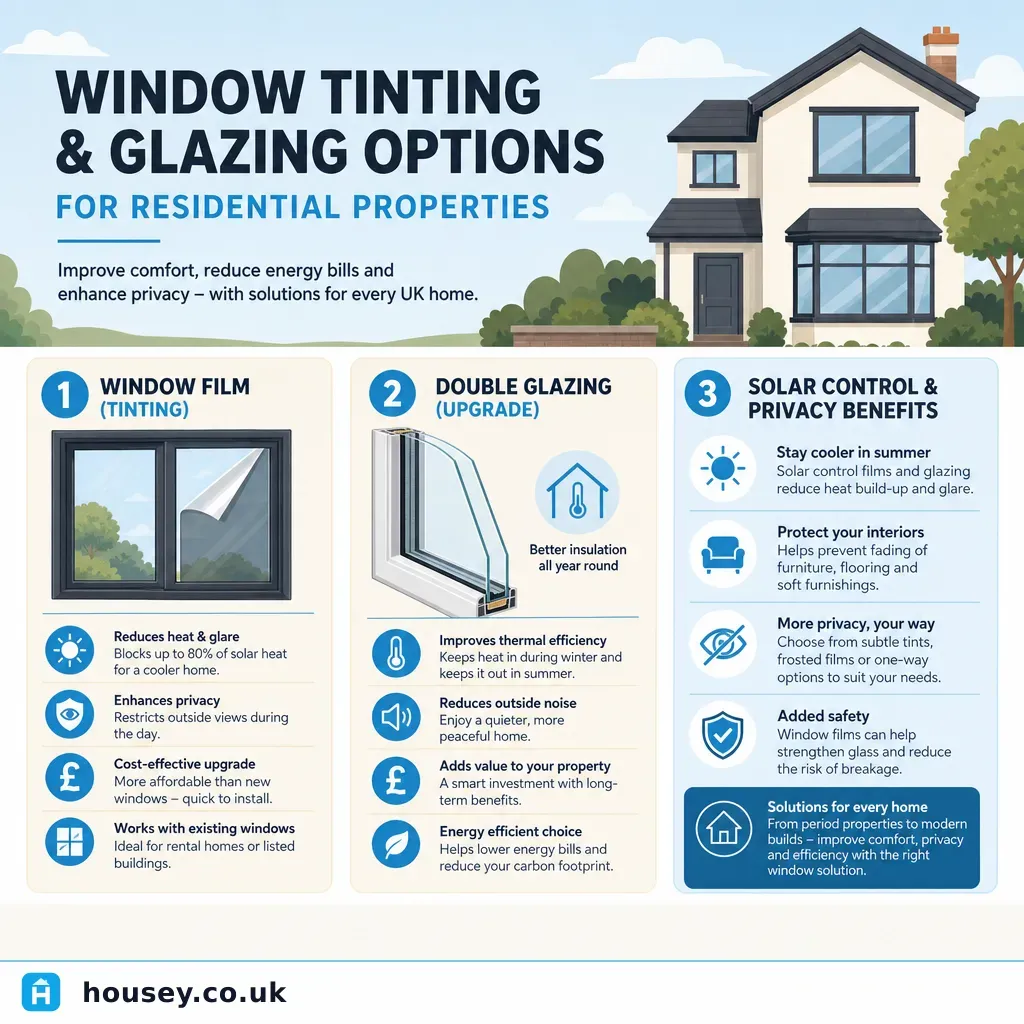
Window Tinting and Glazing Options for Residential Properties
Window tinting and specialist glazing give UK homeowners greater control over solar heat gain, privacy, and energy performance without always requiring full window replacement.
 Improvement & Build
Choosing Replacement Windows: Types, Materials and Performance Standards
Replacement windows in the UK must meet a whole-window U-value of 1.
 Improvement & Build
Choosing between aluminium and uPVC for your replacement windows
uPVC windows are typically the more affordable choice, offering good thermal performance and minimal maintenance, making them popular in most UK homes.