Installing Replacement Windows in Your Home
By Housey · Last reviewed 1st of June 2026
Installing Replacement Windows in Your Home
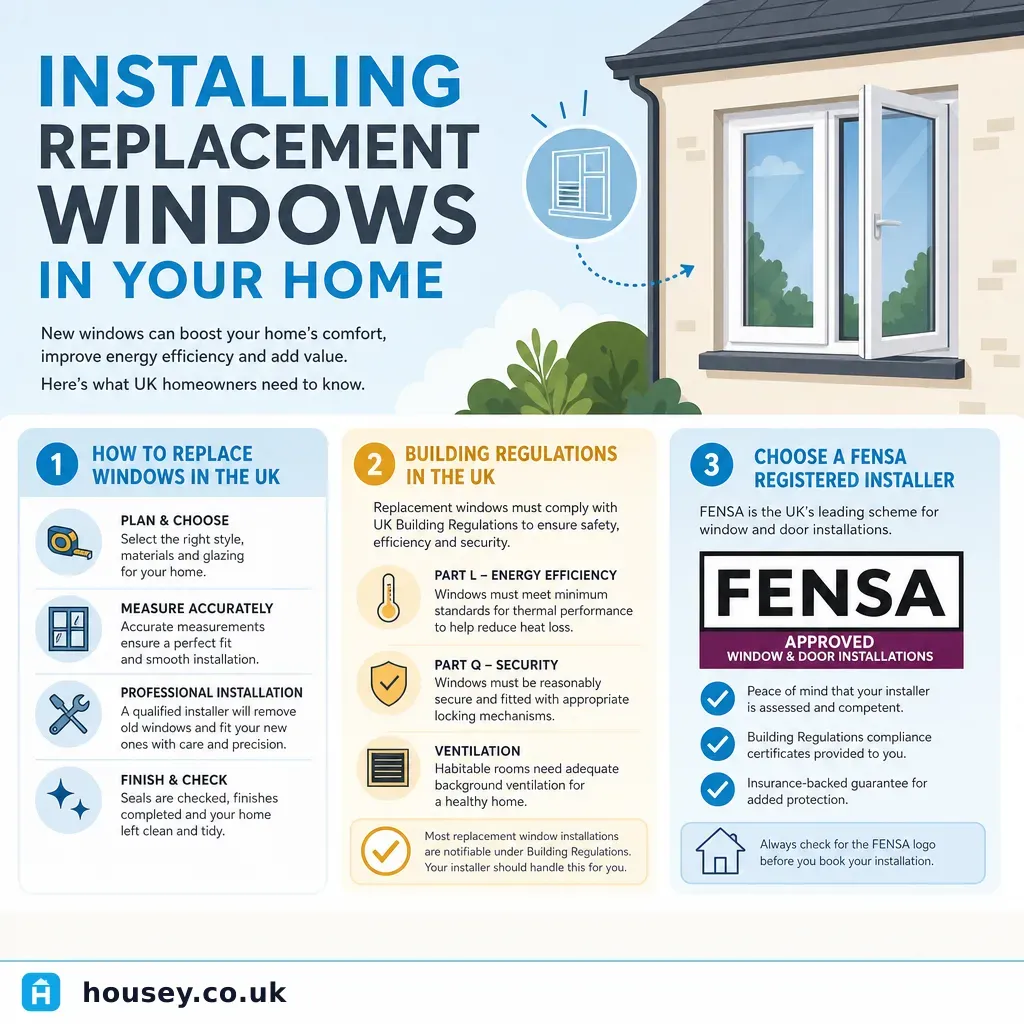
Window replacement is one of the most common home improvement projects in the UK, undertaken for reasons ranging from failed IGU seals and persistent draughts to upgrading energy performance or refreshing a property's appearance. The process involves more than simply swapping one unit for another — replacement windows must comply with Building Regulations, and properties in conservation areas or with listed building status face planning constraints that affect materials and profiles. Getting the process right from the outset avoids complications at resale and ensures you hold the compliance certificate a buyer's solicitor will expect to see.
Key points
- Replacement windows in England and Wales must comply with Building Regulations Part L — the minimum thermal performance is a whole-window energy rating of Band C or a centre-pane U-value no greater than 1.2 W/m²K.
- FENSA and CERTASS are government-authorised competent person schemes that allow registered installers to self-certify compliance with Building Regulations and issue a compliance certificate without a separate local authority building control application.
- Properties in conservation areas may need planning permission to replace windows with materially different materials or profiles — uPVC replacing original timber sash, for example, is often not permitted.
- Listed buildings require listed building consent before any window replacement, regardless of how like-for-like the substitution appears; unauthorised works are a criminal offence.
- For leasehold flats and maisonettes, check your lease before ordering — freeholder consent is commonly required for alterations that affect the building's structure or external appearance.
Do replacement windows need planning permission?
For most houses in England, replacing like-for-like windows is permitted development — no planning application is needed. There are important exceptions:
- Conservation areas: Windows visible from a highway that change the building's appearance materially may require planning permission. Local authorities differ in how strictly they interpret this — contact your local planning authority before ordering.
- Listed buildings: All window alterations require listed building consent. Unauthorised works to a listed building are a criminal offence under the Planning (Listed Buildings and Conservation Areas) Act 1990.
- Flats and maisonettes: Permitted development rights for individual flats are more restricted; confirm with your local authority whether they apply.
- Article 4 Directions: Some councils remove permitted development rights in specific areas. Check whether an Article 4 Direction applies to your property before assuming PD covers the works.
Your local planning authority can confirm whether permitted development applies, and many councils offer a free or low-cost pre-application enquiry service.
Which frame material should you choose?
The three most common frame materials for UK residential windows are uPVC, aluminium, and timber. Each has practical trade-offs for maintenance, aesthetics, and planning suitability.
Frame material | Best for | Maintenance level | Typical lifespan | Conservation area suitability |
|---|---|---|---|---|
uPVC | Modern homes, cost-effective replacement | Very low | 20–30 years | Often not permitted |
Aluminium | Contemporary aesthetics, slim sightlines | Low | 30–40+ years | Sometimes accepted — check with LPA |
Timber | Period properties, listed buildings, conservation areas | Higher — painting and treatment required | 30–60+ years with maintenance | Usually preferred or required |
Composite (aluminium-clad timber) | Premium renovation combining aesthetics and low maintenance | Low–Medium | 30–40+ years | Sometimes accepted |
Which replacement window option should you choose?
- Choose uPVC if cost and low maintenance are the priority and your property has no planning restrictions.
- Choose aluminium if you want slim, contemporary framing and are prepared to pay a premium over uPVC.
- Choose timber if your property is listed, in a conservation area, or if matching the original window profile is important.
- Choose composite if you want timber aesthetics without the ongoing painting and treatment requirements.
- Consult your local planning authority before committing to a frame material if your property is in a conservation area or is listed.
- Ask a FENSA-registered installer to confirm Part L compliance for your chosen specification before placing an order.
Understanding Building Regulations compliance
All replacement windows in England and Wales must comply with Approved Document L (Part L) — conservation of fuel and power. The key performance requirements are:
- A whole-window energy rating of Band C or better using the BFRC Window Energy Rating scheme, or
- A centre-pane U-value of no more than 1.2 W/m²K.
Limited exemptions exist — for example, windows in historic buildings where full compliance would unacceptably alter their character. Your installer should confirm whether any exemption applies.
Self-certification route (FENSA or CERTASS): The most straightforward route is using a registered installer. They self-certify that the installation meets Building Regulations, notify the local authority, and issue a compliance certificate. Retain this document — conveyancers check for it when you sell.
Local authority building control route: If you use an unregistered installer or carry out the work yourself on a ground-floor window, you must notify your local authority building control before work begins and pay an application fee. A building control officer will inspect the installation and issue a completion certificate.
Homeowner checklist for replacing windows
What to ask before accepting a quote
Before instructing an installer:
- Are you FENSA or CERTASS registered, and will you provide a compliance certificate?
- What is the BFRC window energy rating band for the units you are quoting?
- What are the U-values for the frame and centre-pane?
- What guarantees are offered on the units and the installation?
- Does the quote include removal and disposal of the existing windows?
- Is VAT included?
- What happens if structural or lintel issues are discovered during installation?
- Who carries out the work — your own employed team or subcontractors?
When to get professional help
Replacing windows is a skilled trade involving precise measurement, fitting to masonry or timber reveals, weatherproofing, and ensuring draught-free installation. Upper-floor window replacement involves working at height above 2 m, which carries a significant risk of serious injury — professional installation is strongly recommended for anything above ground level. Even for ground-floor windows, DIY replacement requires a local authority building control application if you are not using a FENSA or CERTASS-registered installer.
Seek professional advice if:
- The masonry around any window shows cracking, bulging, or distorted frames — this may indicate structural movement that should be investigated before replacement proceeds.
- You have original timber sash windows and are unsure whether repair is more appropriate than full replacement.
- You are in a conservation area or own a listed building.
- You are a landlord — Minimum Energy Efficiency Standards (MEES) apply to rental properties, and window upgrades may need to be coordinated with an EPC assessment.
How Housey can help
Housey connects you with vetted FENSA-registered window and door installers who can assess your property, specify the right windows for your situation, and manage Building Regulations compliance from survey to certificate — giving you the documentation you need for a smooth conveyance when you sell.
Frequently asked questions
What happens if I replace windows without building regulations approval?
Without a FENSA or CERTASS compliance certificate, or local authority building control sign-off, you may struggle to sell your property. Buyers' solicitors routinely request window installation certificates. You can apply for a retrospective regularisation certificate through your local authority building control, but fees and inspection requirements apply. It is simpler and less costly to comply from the outset.
How much do replacement windows cost in the UK?
Indicative UK costs, last reviewed 2026-06-01: a replacement double-glazed uPVC window typically costs £300–£700 per window including installation; aluminium frames are often 30–50% more expensive; timber frames vary more widely depending on profile and supplier. Triple-glazed units typically add 15–30% to unit costs. Always obtain written quotes from multiple FENSA-registered installers for accurate, site-specific pricing.
Can I replace windows in a conservation area?
You may be able to replace windows in a conservation area, but materials, profiles, and finishes are likely to be restricted. Timber like-for-like replacements are often accepted; uPVC is frequently not. Contact your local planning authority before ordering — many councils offer free or low-cost pre-application advice to confirm what is and is not permitted.
What is FENSA and do I need to use a FENSA-registered installer?
FENSA (Fenestration Self-Assessment Scheme) is a government-authorised competent person scheme that allows registered installers to self-certify that replacement window installations comply with Building Regulations. Using a FENSA-registered installer is the most straightforward route to a compliance certificate. You are not required to use a FENSA installer, but if you do not, you or your installer must apply to your local authority building control before work begins.
Sources and further reading
- Building Regulations Approved Document L — GOV.UK
- FENSA — Fenestration Self-Assessment Scheme — FENSA
- Planning Portal: Windows — Planning Portal
- Planning permission: when you need it — GOV.UK
- Windows and glazing — Energy Saving Trust
Useful next reads
 Improvement & Build
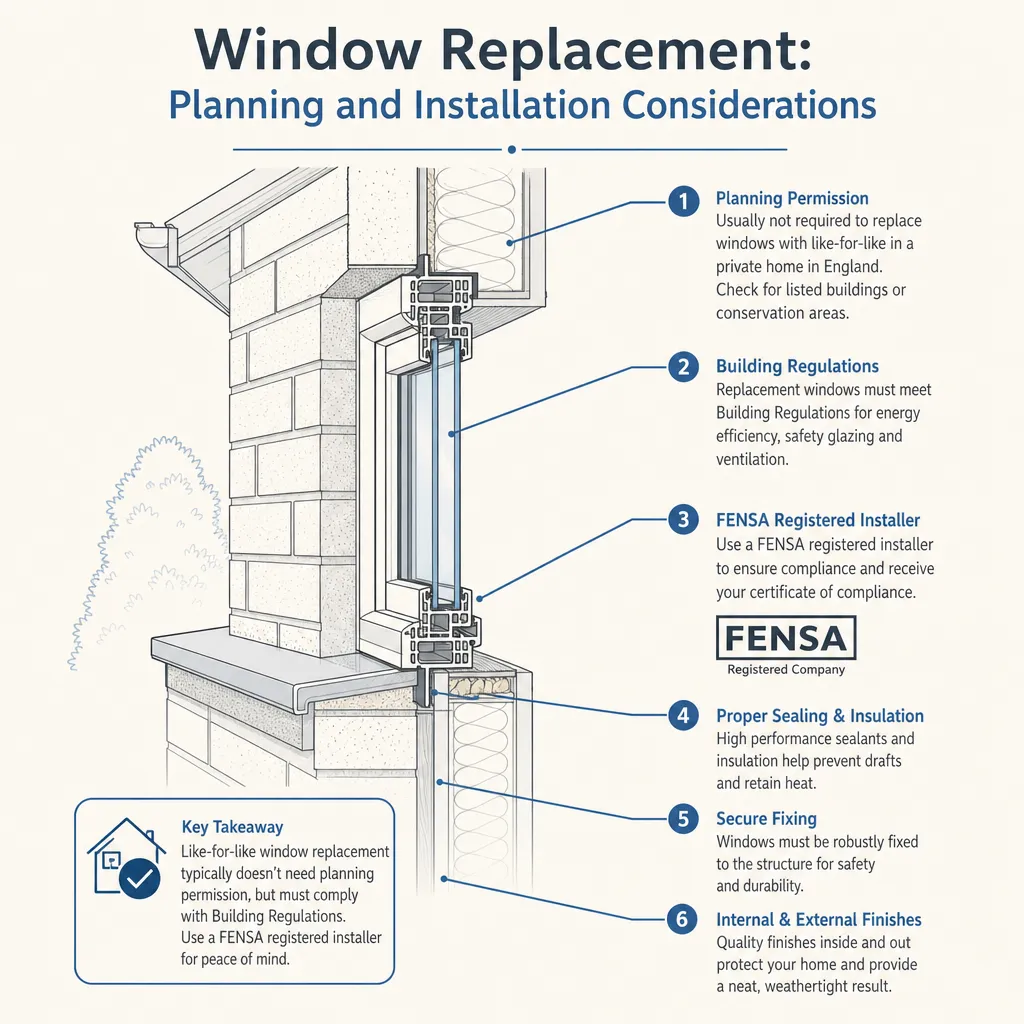
Window Replacement: Planning and Installation Considerations
Most window replacements in England fall under permitted development and do not need planning permission, though listed buildings, flats, and conservation areas are exceptions.
 Improvement & Build
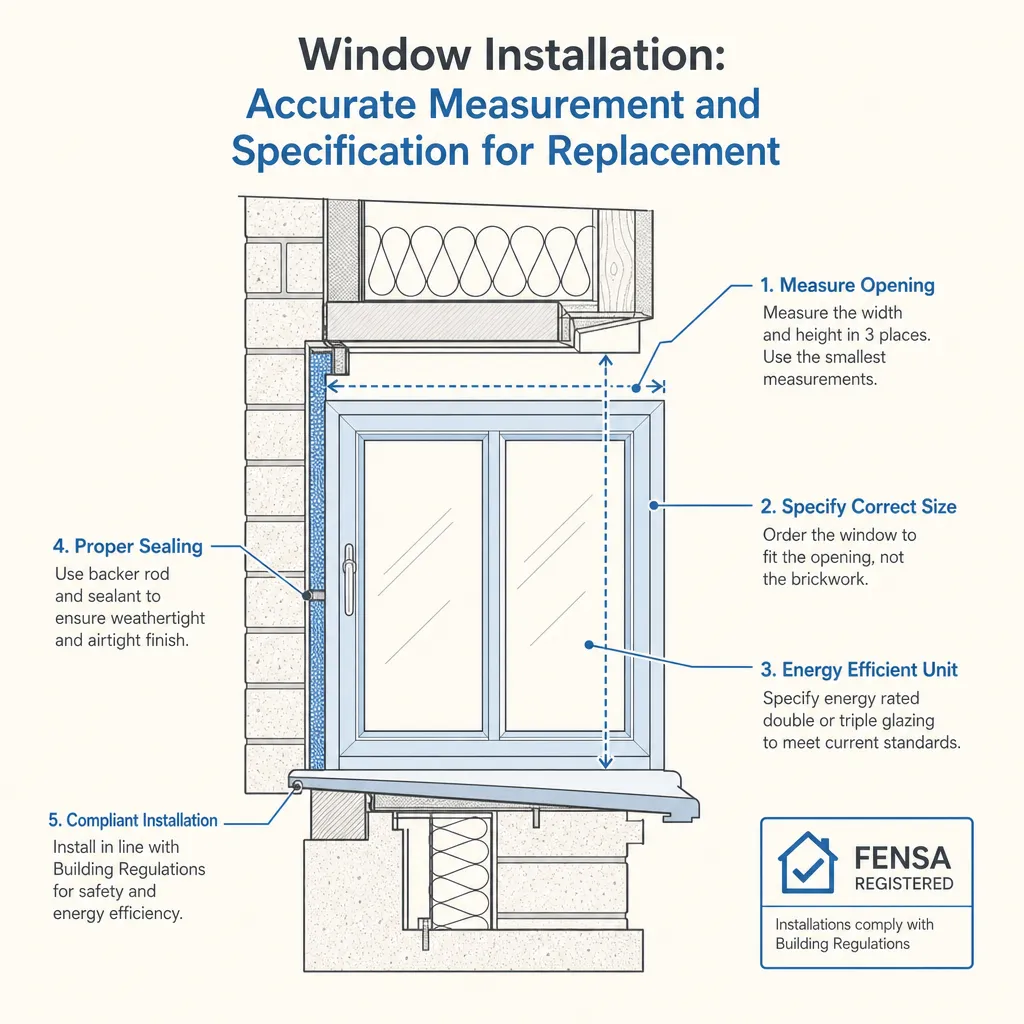
Window Installation: Accurate Measurement and Specification for Replacement
Accurate window measurement for replacement means recording the width and height of the existing frame opening in at least three places, noting the smallest dimension, and providing a full specification to your installer — including frame material, glazing type, opening style, and trickle ventilators.
 Improvement & Build
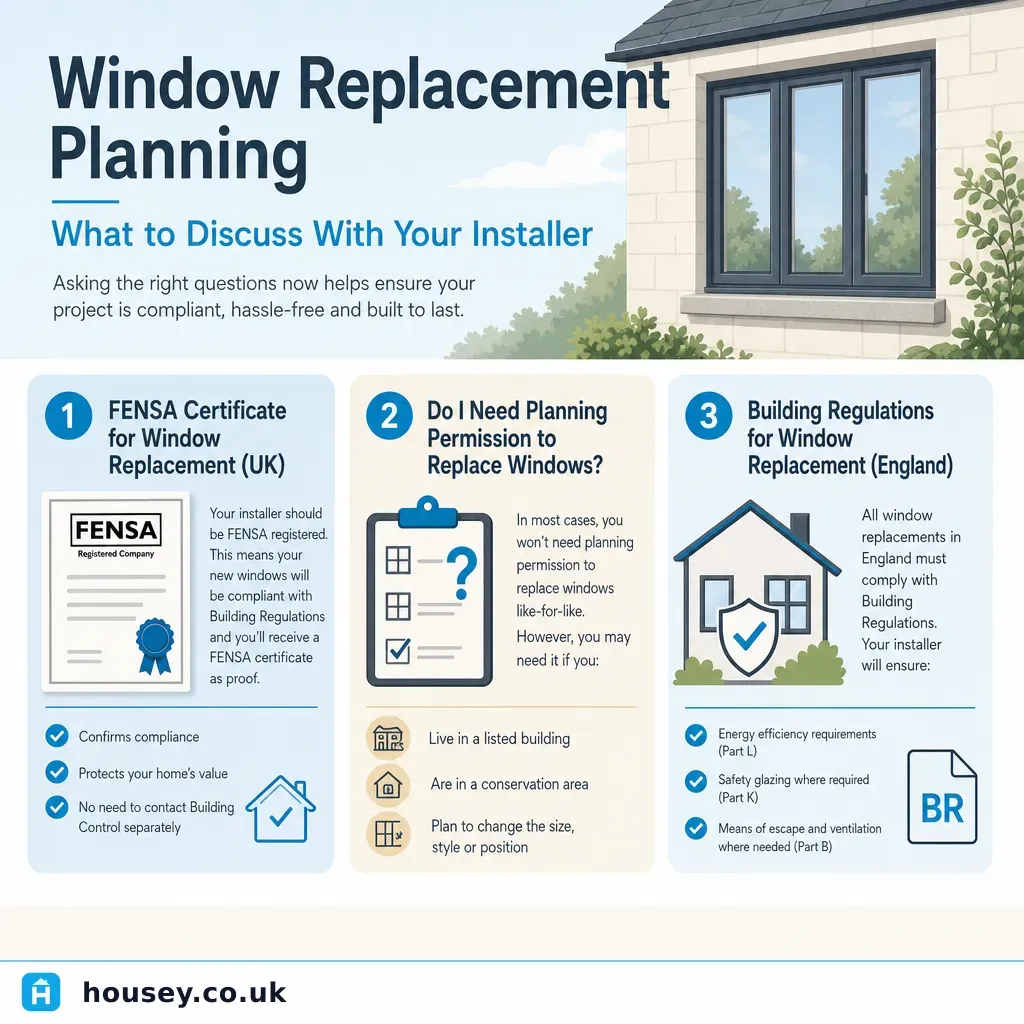
Window Replacement Planning: What to Discuss With Your Installer
Most window replacements in England fall under permitted development rights and do not require planning permission, but they must comply with Building Regulations Part L and Part K.
 Improvement & Build
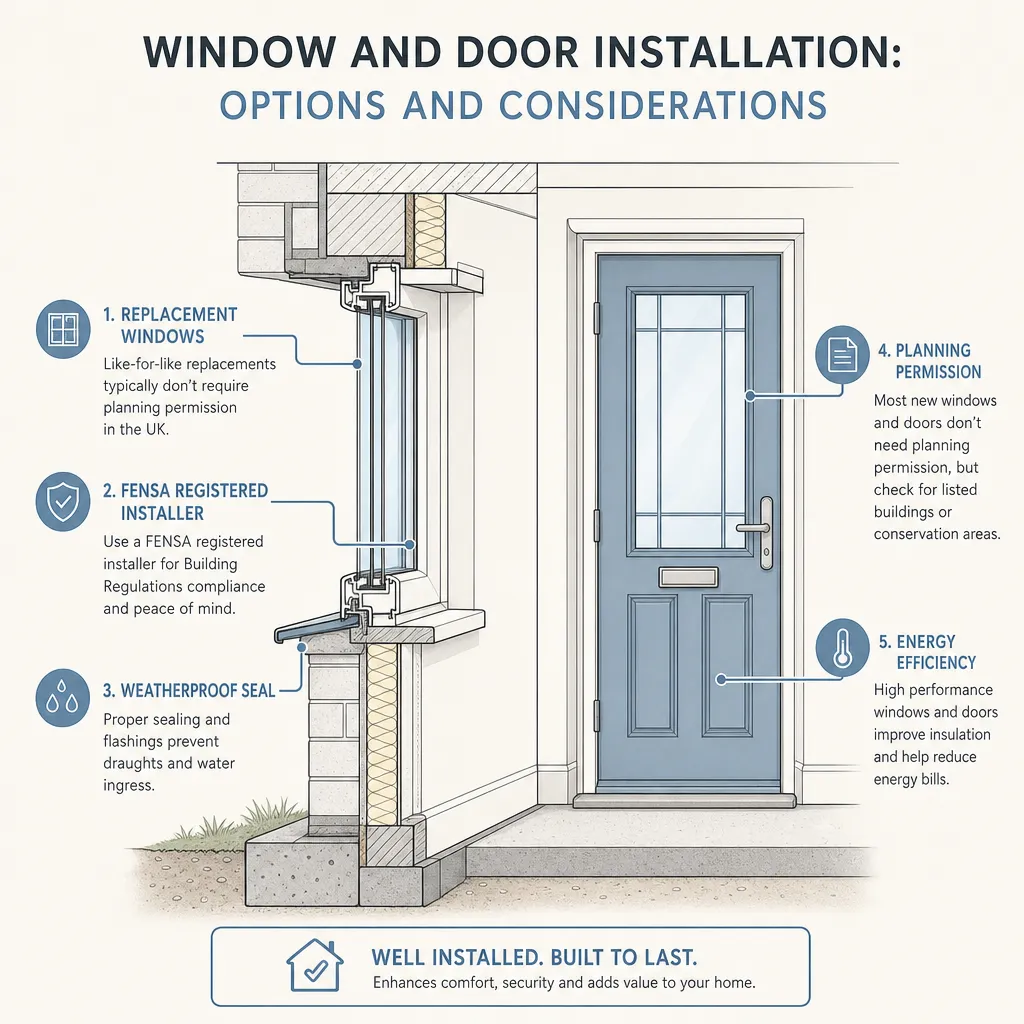
Window and Door Installation: Options and Considerations
Replacing windows and external doors in the UK requires compliance with Building Regulations Part L (thermal performance) and Part K (safety glazing).
 Improvement & Build
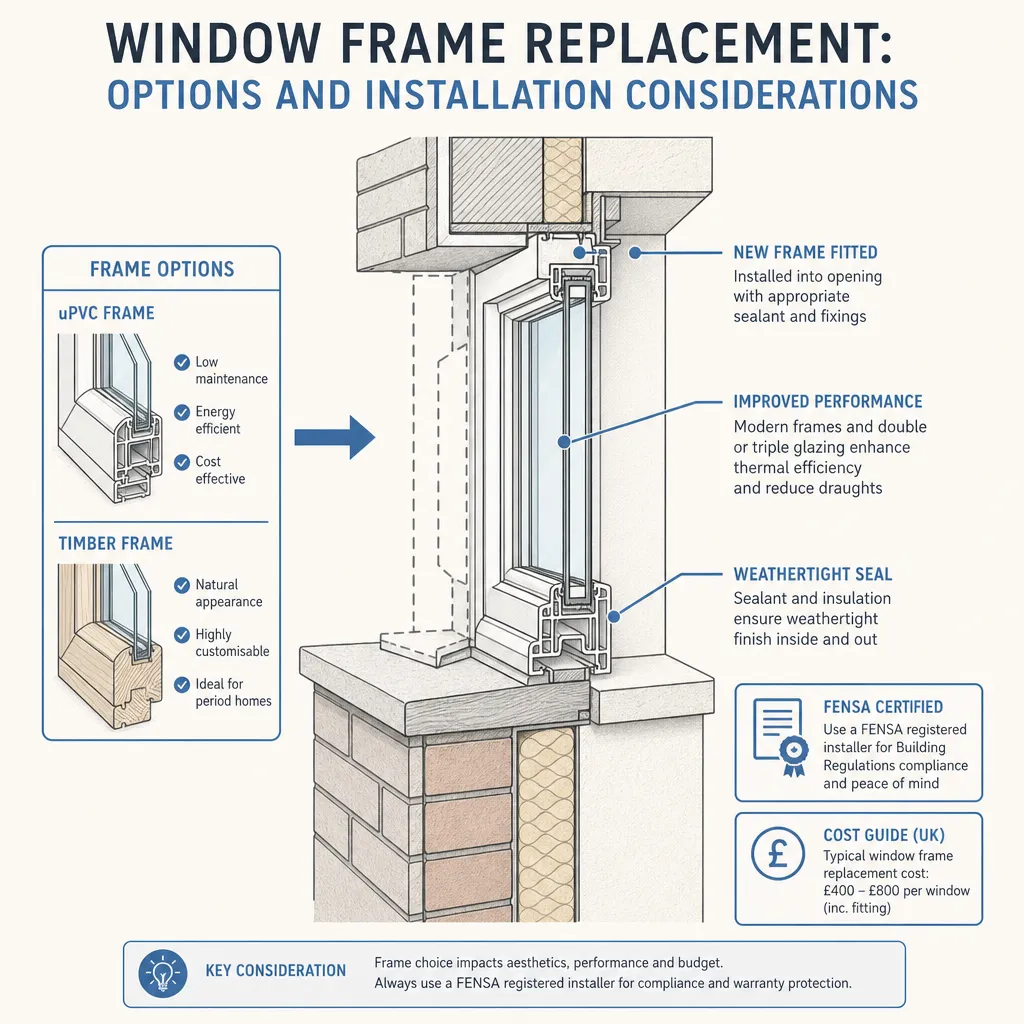
Window Frame Replacement: Options and Installation Considerations
Replacing window frames in the UK requires compliance with Part L of the Building Regulations and, in most cases, a FENSA or Certass certificate.