Fiberglass Replacement Windows: Benefits and Drawbacks
By Housey · Last reviewed 17th of May 2026
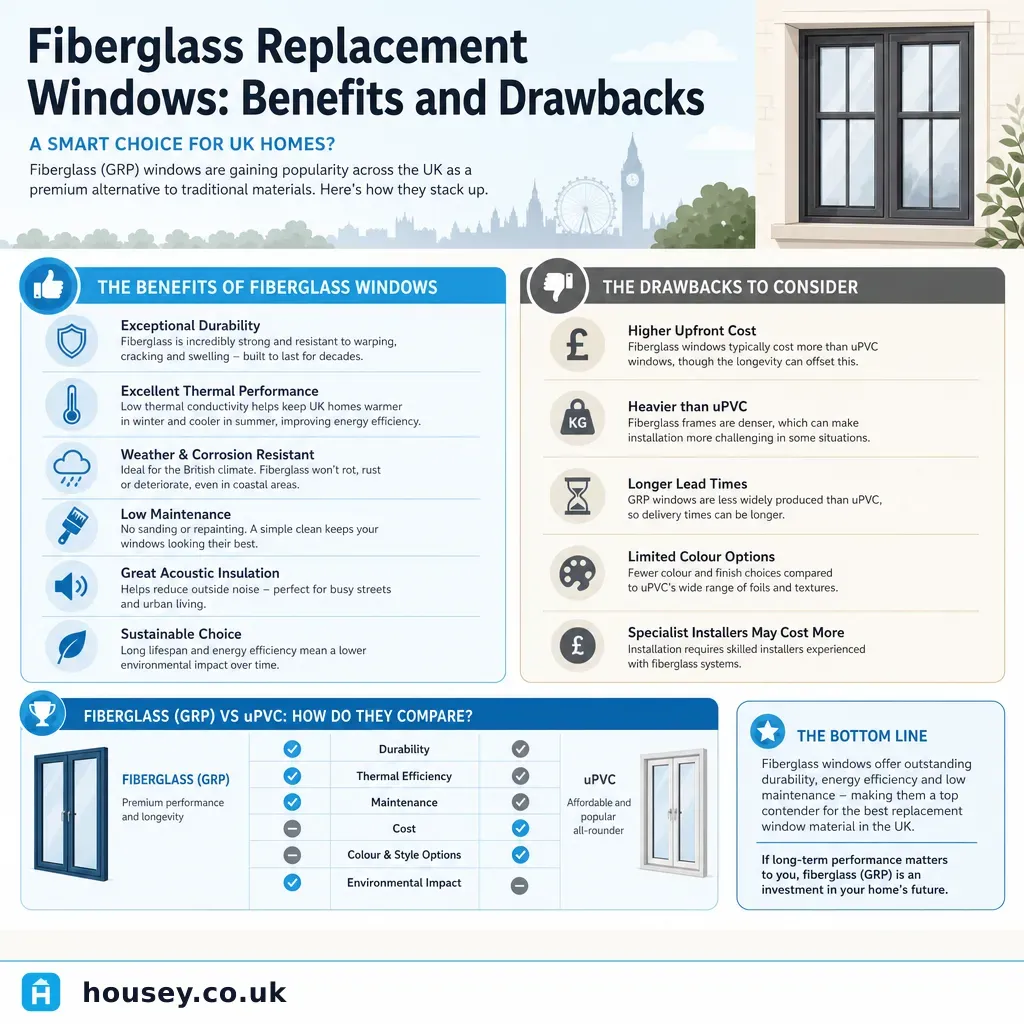
Fiberglass Replacement Windows: Benefits and Drawbacks
Replacing windows is one of the most consequential improvement decisions a UK homeowner makes — affecting thermal performance, security, kerb appeal, and maintenance obligations for decades. While uPVC dominates the UK replacement market, fiberglass (also marketed as GRP, glass-reinforced plastic) frames are produced by specialist manufacturers and are gaining attention among homeowners seeking a longer-lifespan, dimensionally stable alternative to standard uPVC.
Key points
- Building Regulations Part L (England) require replacement windows to achieve a whole-window U-value of 1.4 W/m²K or better, or a minimum Window Energy Rating (WER) of Band C under the BFRC scheme — fiberglass frames can comfortably meet this threshold when specified with quality glazing.
- FENSA or CERTASS registration enables installers to self-certify replacement window work under the Competent Persons Scheme; if your installer is unregistered, you must notify local building control before the work begins.
- Fiberglass has a thermal expansion coefficient very close to glass (~6 × 10⁻⁶ per °C), significantly reducing the mechanical stress on glazing seals that contributes to double-glazed unit misting and premature failure over time.
- Fiberglass frames are typically 15–30% more expensive than equivalent uPVC frames upfront, though manufacturers quote a service life of 50 years or more.
- Conservation areas and listed buildings may impose restrictions on frame material, colour, and glazing bar profile — always check with your local planning authority before ordering replacement windows.
How fiberglass compares to other frame materials
Frame material | Thermal performance | Durability | Maintenance | Relative upfront cost | Sightline width | UK installer availability |
|---|---|---|---|---|---|---|
uPVC | Good | 20–30 years typical | Very low | Lowest | Moderate–wide | Very high |
Fiberglass (GRP) | Very good | 40–50+ years | Very low; paintable | Moderate–high | Moderate | Limited |
Aluminium (thermally broken) | Good | 40+ years | Low | Moderate–high | Slim | High |
Timber | Variable | Indefinite if maintained | Moderate–high | Moderate–high | Slim–moderate | Moderate |
Composite (timber/aluminium) | Good | 30–40+ years | Low externally | High | Moderate | Moderate |
Indicative UK cost comparisons, last reviewed 2026-05-17. U-values vary significantly by glazing specification. Always request BFRC Window Energy Rating certificates from your installer.
The case for fiberglass frames
Dimensional stability. Fiberglass expands and contracts at a rate almost identical to the glass it holds. This reduces the cyclical mechanical stress on glazing seals — a recognised cause of double-glazed unit misting and failure in uPVC frames over time, particularly in properties that experience wide temperature swings.
Strength and slim profiles. Fiberglass is considerably stronger than uPVC for a given cross-section, allowing thinner frame profiles for the same structural performance. Slightly slimmer sightlines can matter in period properties or where original window proportions are architecturally important.
Paintability. Unlike most uPVC frames, fiberglass can be repainted using an appropriate exterior primer and topcoat system. This offers flexibility to change colour over the frame's lifetime — or to match specific heritage shades required by a conservation area consent at a future date.
Long service life. Well-installed fiberglass frames are routinely quoted with a 50-year or longer service life. While independently verified whole-life UK performance data is limited, the material's structural characteristics support this claim relative to standard uPVC.
Low maintenance. Fiberglass in its factory-coated finish requires no periodic resealing or specialist treatment. Maintenance demands are broadly comparable to uPVC in day-to-day terms.
The case against fiberglass frames
Higher upfront cost. Fiberglass frames typically carry a 15–30% price premium over equivalent uPVC frames before glazing costs. Across a whole-house replacement, this premium can amount to several thousand pounds.
Fewer UK installers. The UK replacement window market is dominated by uPVC and, to a lesser extent, aluminium. Fewer FENSA-registered installers stock fiberglass products, which limits competitive quoting — particularly outside major cities.
Less established UK supply chain. Most fiberglass window products sold in the UK are produced at smaller scale than uPVC, which can affect lead times and the future availability of hardware parts for repairs.
Limited off-the-shelf colour range. Standard fiberglass frames are available in a narrower range of factory colours than the broad RAL colour palette offered by most aluminium manufacturers. Paintability mitigates this over the frame's lifetime but does not resolve it at the point of purchase.
Not an automatic U-value advantage. A well-specified uPVC triple-glazed system can achieve comparable or better whole-window U-values to a standard fiberglass unit. The thermal advantage of fiberglass lies primarily in glazing-seal longevity over time, not necessarily in superior initial performance figures.
Which window frame material is right for you?
- Choose fiberglass if you plan to stay in the property long-term and want to minimise future glazed-unit seal failures.
- Choose fiberglass if your property is a traditional or period style and slightly slimmer sightlines than uPVC are architecturally desirable.
- Choose fiberglass if paintability is important — for example, to match a specific heritage colour in a conservation area over future decades.
- Choose uPVC if upfront cost is the primary constraint and you are comfortable with a 20–30 year replacement horizon.
- Choose aluminium if slim sightlines and a contemporary aesthetic are the priority and long-term repaintability is not a concern.
- Choose timber or composite if the property is listed or the local planning authority requires a timber-appearance frame.
- Consult your local planning authority before ordering any replacement windows if your property is in a conservation area or is listed.
Building Regulations and FENSA compliance
Any replacement window installation in England must comply with Building Regulations, principally Part L (conservation of fuel and power) and Approved Document K (glazing safety). The minimum standard for a replacement window in England is a whole-window U-value of 1.4 W/m²K or a WER of Band C or above, as rated by the British Fenestration Rating Council (BFRC).
Compliance can be achieved two ways:
- FENSA or CERTASS membership: The installer self-certifies compliance and notifies the local authority on your behalf. You receive a FENSA certificate — a legal compliance document required on conveyancing if you sell the property.
- Local building control application: If your installer is not FENSA or CERTASS registered, you must notify your local authority building control before work begins and pay the applicable fee.
Always request confirmation of FENSA or CERTASS registration before instructing work, and retain your compliance certificate securely.
Checklist: before you accept a window replacement quote
When to get professional help
For most standard residential window replacements, a FENSA-registered installer handles the technical and compliance aspects. Seek additional professional input if:
- Your property is listed or in a conservation area and the planning authority's requirements on frame material or colour are unclear.
- You are replacing windows in a leasehold flat where the lease may require freeholder consent before external alterations.
- Windows form part of a structural opening or the surrounding masonry appears in poor condition — a structural assessment may be advisable before installation proceeds.
- You are planning a change in window size or opening configuration, which may require a building regulations application beyond the standard Part L self-certification route.
How Housey can help
Housey connects homeowners with vetted window and door installers across the UK, making it straightforward to compare quotes from FENSA-registered tradespeople for fiberglass, uPVC, aluminium, or timber replacement windows.
Frequently asked questions
Are fiberglass windows available from UK manufacturers and installers?
Fiberglass window frames are available in the UK, but the market is considerably smaller than in North America. Most products come from specialist manufacturers rather than the large-volume uPVC fabricators that dominate the UK trade. Lead times may be longer than for standard uPVC, and installer availability varies by region — expect fewer options outside major cities.
Do fiberglass replacement windows need to comply with Building Regulations in the UK?
Yes. Replacement windows in England must comply with Building Regulations Part L (thermal performance), and installation must be certified via FENSA, CERTASS, or local building control. Frame material does not change the compliance route — what matters is achieving the required whole-window U-value of 1.4 W/m²K or a minimum Window Energy Rating of Band C.
How long do fiberglass window frames last?
Manufacturers typically quote a service life of 50 years or more for fiberglass frames under normal UK conditions. The sealed glazing units within the frames may need replacing before the frames themselves — standard guarantees on sealed units typically run to 10 years, though quality units often perform considerably longer in practice.
Can I paint fiberglass window frames?
Yes. Fiberglass frames can be repainted using a suitable exterior primer and compatible topcoat — a meaningful advantage over standard uPVC frames, which cannot normally be repainted to an equivalent finish. Consult the frame manufacturer's recommended paint system specification before proceeding to ensure adhesion and durability.
Sources and further reading
- Building Regulations Approved Document L: conservation of fuel and power — GOV.UK
- FENSA: Fenestration Self-Assessment Scheme — FENSA
- BFRC Window Energy Ratings — British Fenestration Rating Council
- Planning Portal: conservation areas and permitted development — Planning Portal / GOV.UK
Useful next reads
 Improvement & Build
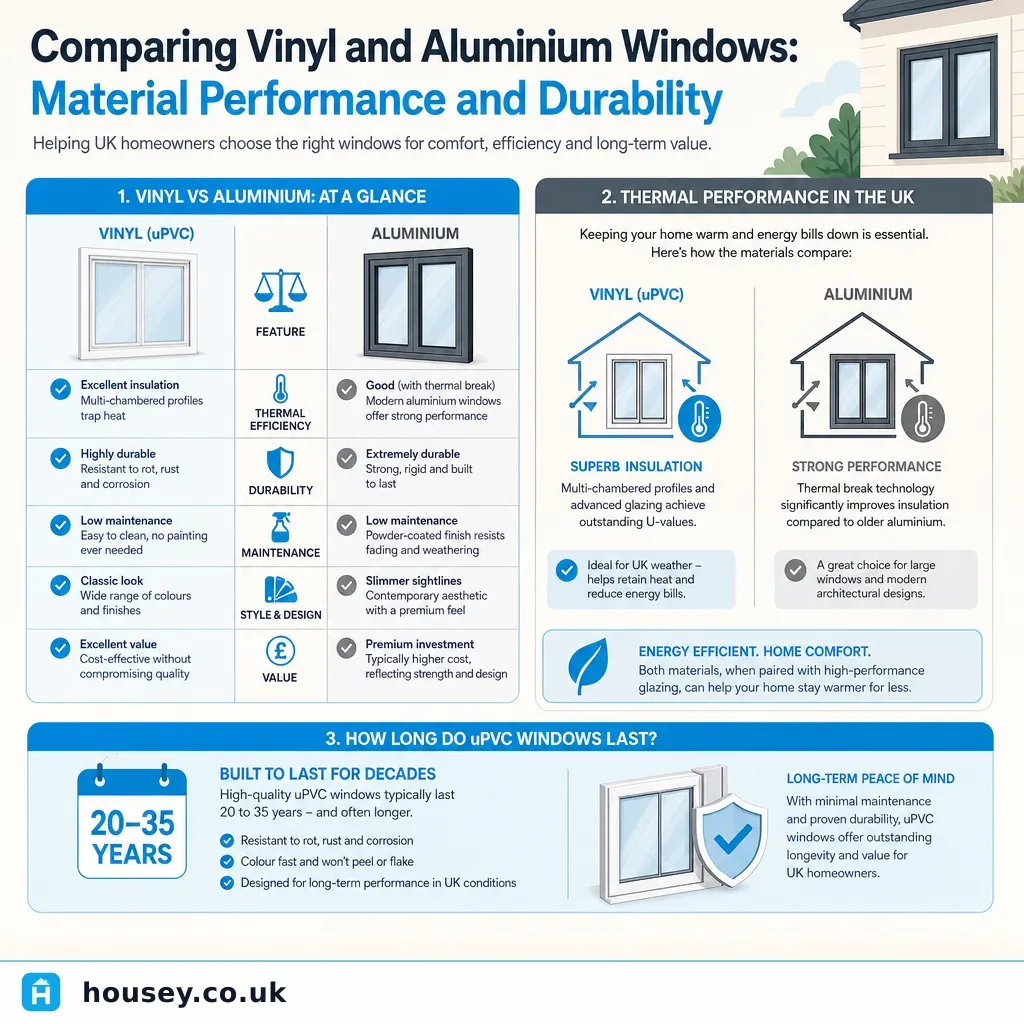
Comparing Vinyl and Aluminium Windows: Material Performance and Durability
uPVC (vinyl) and aluminium windows both meet UK Building Regulations Part L when properly specified.
 Improvement & Build
Window Replacement Planning: What to Discuss With Your Installer
Most window replacements in England fall under permitted development rights and do not require planning permission, but they must comply with Building Regulations Part L and Part K.
 Improvement & Build
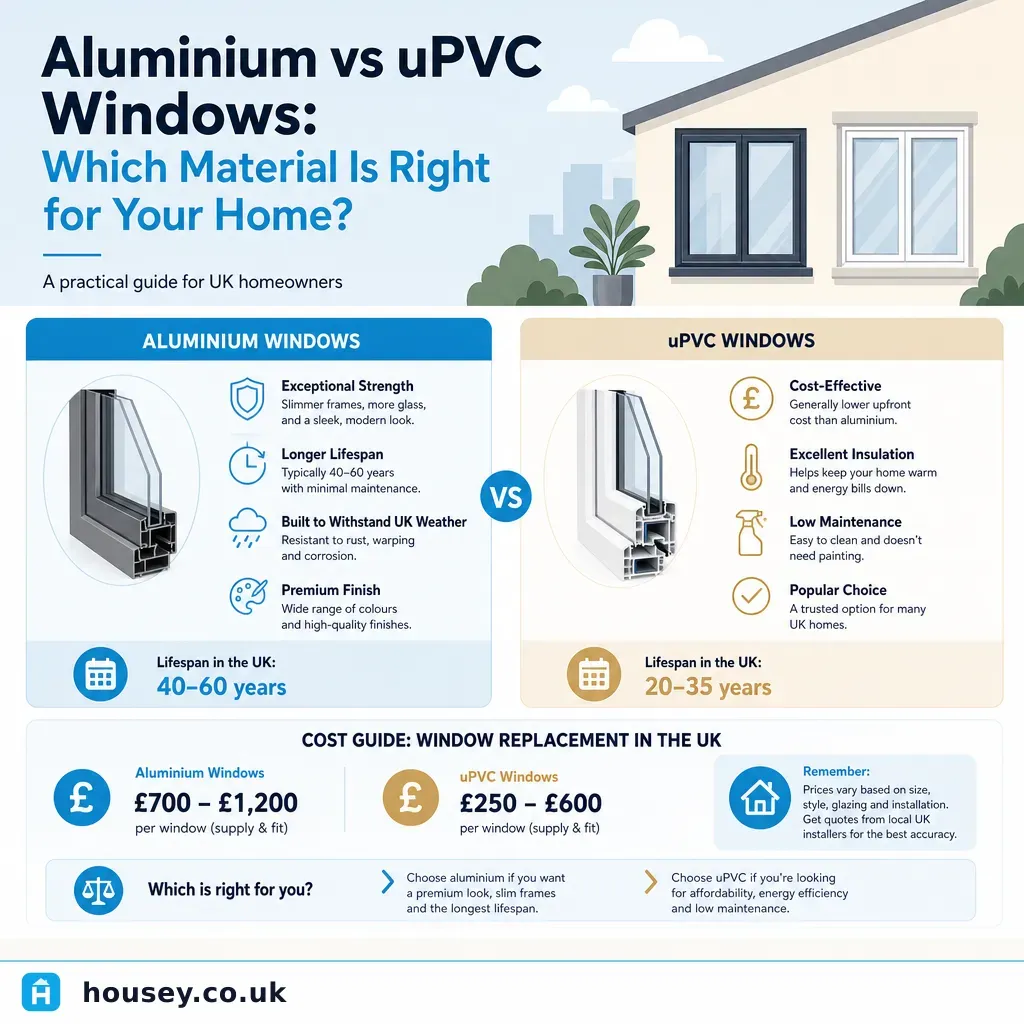
Aluminium vs uPVC Windows: Which Material Is Right for Your Home?
Aluminium windows offer slim, contemporary sightlines and exceptional longevity but cost significantly more than uPVC.
 Improvement & Build
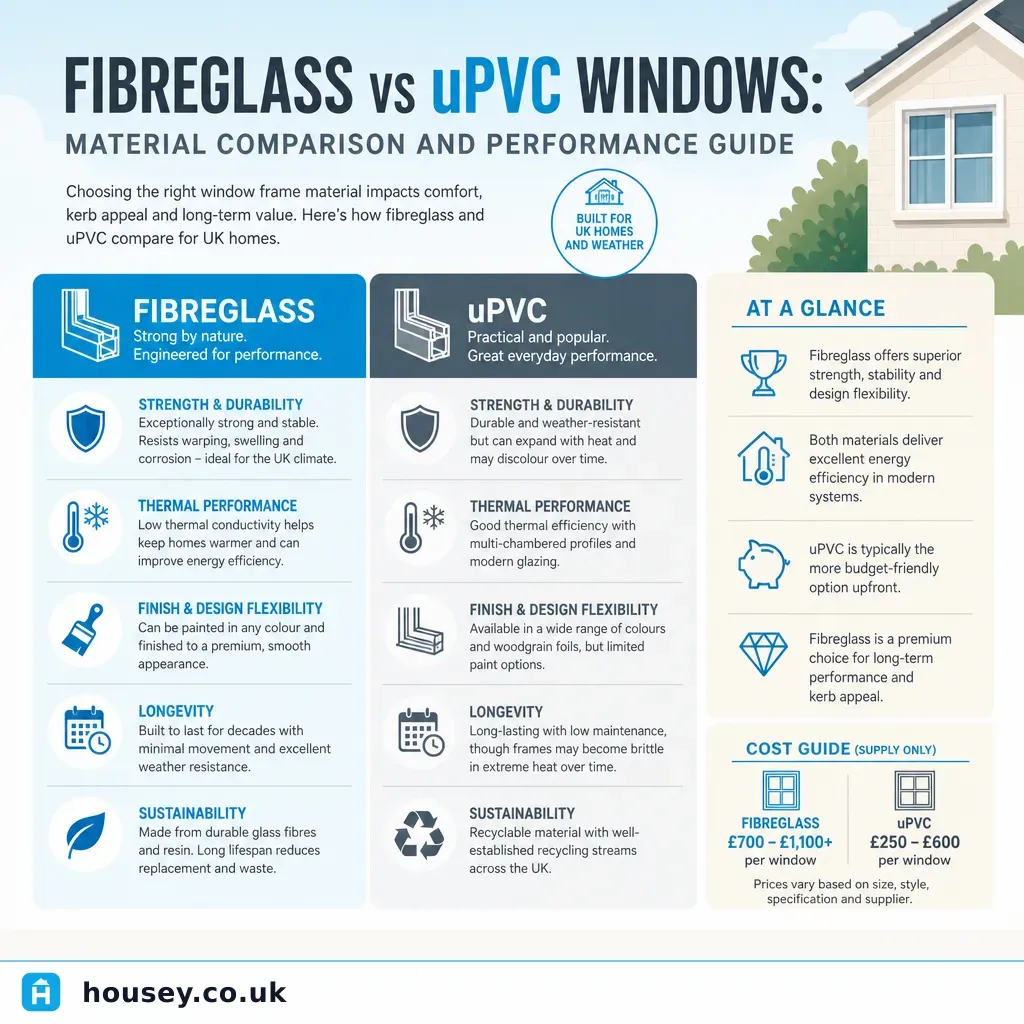
Fibreglass vs uPVC Windows: Material Comparison and Performance Guide
In the UK, vinyl windows are sold as uPVC — the dominant frame material for replacement windows.
 Improvement & Build
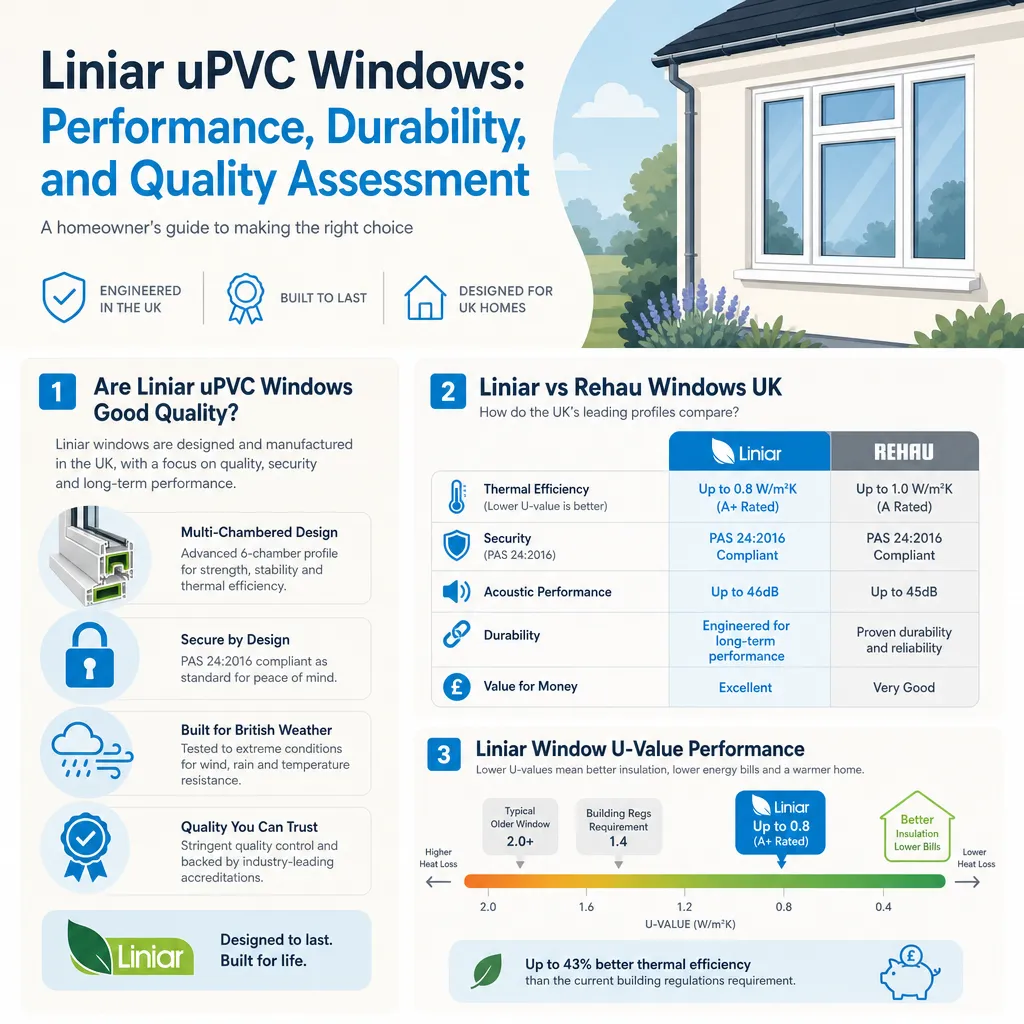
Liniar uPVC Windows: Performance, Durability, and Quality Assessment
Liniar uPVC window profiles are manufactured in the UK using multi-chambered, foamed frames.