Understanding Annual Property Maintenance Budgets and Running Costs
By Housey · Last reviewed 19th of May 2026

Understanding Annual Property Maintenance Budgets and Running Costs
Every UK property incurs ongoing costs beyond mortgage payments and utility bills — and the gap between what homeowners expect to spend on maintenance and what they actually face is one of the most common sources of financial stress in home ownership. The right maintenance budget depends on a property's age, construction type, size, and condition; there is no single figure that applies to all homes, but there are practical frameworks for estimating what to set aside and when to spend it.
Key points
- A widely used planning rule is to budget 1–3% of a property's purchase price per year for maintenance; older properties or those in poor condition typically fall at the higher end.
- Pre-1919 properties — solid-wall terraces, period cottages, Victorian semis — require more frequent and often more expensive attention to rooflines, chimneys, gutters, masonry, and damp management than post-war housing stock.
- Annual boiler servicing is required to maintain most manufacturer warranties and should be carried out by a Gas Safe registered engineer.
- Electrical Installation Condition Reports (EICRs) are recommended every 10 years for owner-occupied homes and are a legal requirement every 5 years for privately rented properties under The Electrical Safety Standards in the Private Rented Sector (England) Regulations 2020.
- Planned preventive maintenance (PPM) — addressing items before they fail — typically delivers significant cost savings compared with reactive repairs; a leaking flat roof left untreated can lead to structural timber decay costing several times the original repair.
The 1–3% rule and when it holds
The 1–3% of property value per year guideline is a useful planning tool, not a precise forecast. At a £300,000 purchase price, it implies a maintenance reserve of £3,000–£9,000 annually (indicative UK costs, last reviewed 2026-05-19; actual costs vary significantly by property, location, and condition).
The rule has real limitations: it does not account for property age, condition at purchase, or whether major capital items such as the roof, boiler, or windows were recently replaced. A newly built home with an NHBC Buildmark warranty will have very different near-term maintenance costs from a 1930s semi where the roof covering is original.
A more useful approach is to combine the percentage rule with an element-by-element lifecycle assessment — estimating the age and remaining useful life of major building components and building reserves accordingly.
Annual maintenance cost by property type
Property type | Key maintenance items | Typical annual cost range | Notes |
|---|---|---|---|
New-build (under 10 years) | Decoration, garden, gutters, minor snagging | £500–£2,000 | Often covered by NHBC Buildmark warranty initially |
1930s–1960s semi-detached | Roof, boiler, gutters, windows, damp monitoring | £1,500–£4,000 | Watch for cavity wall tie issues and concrete tile degradation |
Victorian or Edwardian terrace | Chimneys, roof slates, pointing, damp, drainage | £2,000–£6,000+ | Solid-wall construction; older drainage; high variation |
Purpose-built leasehold flat | Interior only; building exterior via service charge | £500–£2,000 + service charge | Check what the service charge actually covers |
Rural or listed property | Specialist materials, heritage compliance, roofing | £3,000–£10,000+ | Lime mortar, traditional slates; very significant variation |
Indicative UK costs, last reviewed 2026-05-19. Costs vary significantly by location, property condition, and contractor. Always obtain multiple quotes.
The annual maintenance checklist
A seasonal approach helps ensure nothing is overlooked. The following checklist covers the most common recurring tasks for a typical UK house:
Spring
- Inspect roof covering for missing or cracked tiles and slates (binoculars from the ground, or a professional check)
- Clear and check gutters, downpipes, and gully drains for blockages from winter debris
- Check external pointing and masonry for frost damage, particularly around chimney stacks and window lintels
- Inspect any flat roof coverings for blistering, splits, or ponding water
- Service air source heat pumps or mechanical ventilation units if fitted
Summer
- Treat or repaint external woodwork: fascias, soffits, window frames, external doors, and fences
- Repoint chimney stacks and check lead flashings if accessible and safe to do so
- Inspect loft space for signs of damp, condensation staining, or evidence of vermin
- Carry out any planned external works while weather is reliably dry
Autumn
- Clear gutters of fallen leaves — the primary blockage season in most of the UK
- Have boiler serviced by a Gas Safe registered engineer before the heating season
- Test smoke alarms and carbon monoxide detectors; replace batteries as needed
- Lag any external or loft-level pipework in exposed locations ahead of frost
Winter
- Monitor roof spaces and ceilings during and after heavy rainfall for new water ingress
- Check for frozen pipes or lag any that proved vulnerable in previous winters
- Bleed radiators if they have cold spots at the top; check boiler pressure
- Record any new damp patches, cracks, or water ingress for professional assessment in spring
What to prioritise with a limited budget
When funds are constrained, focus on fabric-first maintenance — the elements that protect the structure from water ingress and progressive deterioration:
- Roof covering and flashings — a failing roof can damage structural timbers, insulation, and internal finishes; repair costs rise sharply once rot sets in.
- Gutters and downpipes — blocked gutters are a leading cause of penetrating damp in UK homes; clearing costs very little compared with internal remediation.
- Boiler and heating system — annual servicing prevents mid-winter breakdowns and maintains carbon monoxide safety.
- Damp and drainage — address rising damp, penetrating damp, or blocked drains before they affect internal finishes or structural timbers.
- External joinery — well-maintained paintwork and sealant on timber windows and doors prevents water ingress at frames.
Cosmetic works such as internal decoration should be deferred in favour of fabric maintenance when budgets are tight.
Building a maintenance reserve
Rather than relying on year-to-year spending from current income, consider holding a dedicated maintenance reserve in a separate savings account. Calculate your target reserve by:
- Starting with 1% of property value as a base figure
- Adding 0.5–1% for pre-1919 solid-wall construction or significantly older drainage
- Reducing if major capital items — roof, boiler, windows — have been renewed within the last five years
- Adding a contingency of £1,000–£2,000 for unplanned reactive repairs
Review and replenish the reserve annually, and draw on it for both planned and reactive maintenance rather than meeting costs from current income at short notice.
When to get professional help
Annual maintenance is largely a practical matter, but professional assessment is warranted when:
- Cracks appear in external masonry — particularly stepped cracks through brick joints, horizontal cracks above window lintels, or any crack that is actively widening
- Damp patches on ceilings or walls do not respond to obvious fixes such as clearing gutters or improving ventilation
- The boiler makes unusual noises, loses pressure repeatedly, or fails to provide even heating
- The roof appears to sag visually, or multiple tiles or slates are missing in the same area
- You are buying a property and want to understand its likely maintenance cost profile — a RICS Level 3 Building Survey can identify defects, assess condition, and estimate repair costs before exchange
How Housey can help
Housey is building a marketplace connecting UK homeowners with vetted property professionals for surveys, inspections, planning, and improvement works. Whether you are assessing the condition of a property before purchase or planning a programme of preventive maintenance works, Housey can help you find and compare qualified professionals in your area.
Frequently asked questions
How much should I budget for home maintenance each year in the UK?
A practical starting point is 1–3% of your property's purchase price per year, with older or larger properties at the higher end. For a £250,000 home, that implies £2,500–£7,500 annually. Actual spend depends heavily on property age, condition, and whether major components such as the roof, boiler, or windows are near the end of their useful life. Indicative costs, last reviewed 2026-05-19.
What maintenance does a landlord have to carry out by law?
Landlords in England must arrange annual gas safety checks by a Gas Safe registered engineer under the Gas Safety (Installation and Use) Regulations 1998, conduct an EICR every five years under the Electrical Safety Standards in the Private Rented Sector (England) Regulations 2020, fit smoke and CO alarms as required by the Smoke and Carbon Monoxide Alarm (Amendment) Regulations 2022, and keep the property in good repair under the Landlord and Tenant Act 1985.
Is boiler servicing a legal requirement for homeowners?
Boiler servicing is not a legal requirement for owner-occupiers, but it is strongly recommended and is usually a condition of maintaining the manufacturer's warranty. Skipping annual services can also affect home insurance cover for boiler-related claims. For rented properties, an annual gas safety check by a Gas Safe registered engineer is a legal requirement under the Gas Safety (Installation and Use) Regulations 1998.
What is the difference between maintenance and home improvement for tax purposes?
The distinction matters primarily for landlords. Maintenance and repair costs — restoring an item to its original condition — are generally deductible against rental income. Improvements — enhancing the property beyond its original state — are capital expenditure and not deductible against income, though they may qualify for Capital Gains Tax relief on disposal. Consult a tax adviser or check HMRC guidance for your specific circumstances.
Sources and further reading
- Landlord and Tenant Act 1985 — legislation.gov.uk
- Electrical Safety Standards in the Private Rented Sector (England) Regulations 2020 — legislation.gov.uk
- Gas Safety (Installation and Use) Regulations 1998 — legislation.gov.uk
- Gas Safe Register: boiler servicing guidance — Gas Safe Register
- NHBC Buildmark warranty information — NHBC
Useful next reads
 Improvement & Build
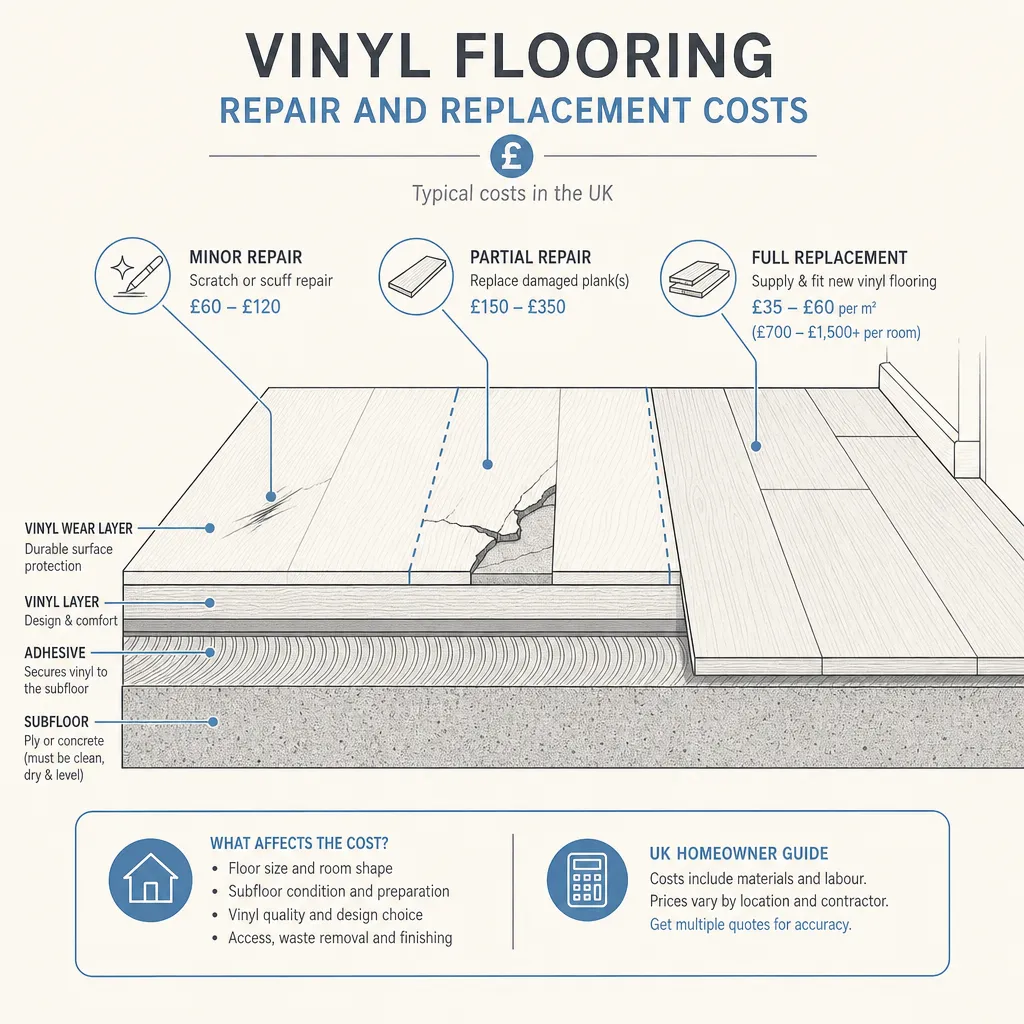
Vinyl Flooring Repair and Replacement Costs
Repairing a small area of vinyl flooring typically costs £50–£200 in the UK, while full replacement runs from £15–£35 per m² for luxury vinyl tile (LVT) plus labour of £10–£25 per m².
 Improvement & Build
Thatched Roof Installation and Repair Costs
A full re-thatch on a typical UK cottage costs £15,000 to £30,000 or more, depending on material, size, and location.
 Improvement & Build
Driveway Sealing: Concrete and Asphalt Maintenance Strategies
Sealing an asphalt driveway every 3–5 years with a bitumen emulsion, or a concrete driveway with a penetrating silane or siloxane sealer, protects against frost damage, UV oxidation, and water ingress.
 Improvement & Build
New Homeowner's Guide to Property Maintenance and Care
New UK homeowners should run seasonal checks on gutters, the boiler, roof, and damp at least twice a year and arrange an annual boiler service.
 Improvement & Build
Gutter Cleaning and Maintenance: Regular Care and Costs
Gutters should be cleaned at least twice a year — in late autumn after leaf fall and again in spring.