Gutter Cleaning and Maintenance: Regular Care and Costs
By Housey · Last reviewed 7th of May 2026

Gutter Cleaning and Maintenance: Regular Care and Costs
Neglected gutters are one of the most common — and most preventable — causes of water damage in UK homes. Whether you own a Victorian terrace, a 1930s semi, or a modern detached, the drainage system running around your roofline quietly protects walls, foundations, and interiors from rainwater. When that system blocks or fails, the consequences range from stained fascias to serious penetrating damp and progressive structural deterioration.
Key points
- Gutters should be cleaned at least twice a year: in late autumn after leaf fall and again in spring; properties with overhanging trees may need three or four cleans annually.
- Professional gutter cleaning for a standard semi-detached typically costs £60–£150 per visit; larger properties or those requiring scaffolding or specialist access equipment can cost £150–£400 or more. (Indicative UK costs, last reviewed 2026-05-07.)
- The most common gutter material in UK homes is UPVC, introduced widely from the 1970s onwards; it is low-maintenance but can crack in sustained frost or UV exposure and has a typical lifespan of 20–30 years.
- Leaking gutter joints — distinct from a blocked gutter — require re-sealing or bracket replacement and are a separate repair from a routine clean.
- Under Building Regulations Approved Document H, gutters and downpipes must be sized to handle the design rainfall intensity for their location; this matters when replacing or extending a drainage system.
How often should UK gutters be cleaned?
For most UK homes, twice a year is the standard minimum: once in late October or November after the main leaf fall, and again in March or April to clear debris accumulated over winter. Properties with overhanging mature trees — particularly oaks, sycamores, or conifers — should consider three or four cleans per year.
Flat-roof extensions, dormer windows, and properties in areas with heavy moss or lichen growth on the roof may see gutters block more quickly, as debris washes down during heavy rain.
Property type | Recommended cleaning frequency | Notes |
|---|---|---|
Typical semi-detached, clear of trees | Twice yearly | Autumn and spring |
Terrace or semi with overhanging trees | Three to four times yearly | After each major leaf fall |
Flat-roof extension or dormer | Twice yearly minimum | Debris from the flat roof surface can accumulate in valley gutters |
Leasehold flat (shared building) | Check lease or management agreement | Often a landlord or management company responsibility |
New-build (first two years) | Once yearly initially | Less debris, but check downpipes for construction grit |
What does a professional gutter clean include?
A professional gutter cleaning visit typically covers:
- Debris clearance — leaves, silt, moss, and bird droppings removed by hand or with a high-reach vacuum system, often from ground level using a pole and camera attachment.
- Flush and flow check — water run through the gutter to confirm fall angles are correct and the downpipe discharges freely.
- Visual inspection — identification of cracked joints, sagging sections, missing brackets, or damaged downpipes.
- Debris disposal — bagged and removed from site; confirm this is included when booking.
Some contractors also offer a written condition report or gutter camera survey for an additional fee, which is useful before purchasing a property or as part of a planned pre-winter maintenance programme.
What does gutter cleaning cost in the UK?
(Indicative UK costs, last reviewed 2026-05-07. Quotes vary by property size, access difficulty, and region. Obtain at least two or three quotes before instructing.)
Property type | Typical cost range | Main price drivers |
|---|---|---|
Small terraced or single-storey | £60–£100 | Short run, easy ground-level access |
Standard semi-detached (2 storey) | £80–£150 | Standard ladder or pole access |
Large detached (2–3 storey) | £150–£280 | More linear metres, possible platform hire |
Three-storey townhouse | £200–£400+ | May require scaffold or cherry picker |
Clean plus minor repair (joint seal, bracket) | Add £30–£100 | Depends on number of joints or brackets involved |
Prices are generally lower outside London and the South East. Some contractors charge per linear metre of guttering; others use a flat rate by property type.
Gutter materials: what is in UK homes?
The majority of UK homes built after the mid-1970s have UPVC gutters and downpipes. Older properties may have cast iron (common in Victorian and Edwardian homes) or, very rarely, asbestos cement.
Material | Common in | Approximate lifespan | Maintenance notes |
|---|---|---|---|
UPVC | Post-1970 homes | 20–30 years | Low-cost and light; can crack in hard frost; joints re-sealable |
Cast iron | Pre-1940 homes | 50–100+ years with care | Heavy; requires painting every 5–10 years to prevent rust |
Aluminium | Modern or replacement installs | 30–40 years | Lightweight, corrosion-resistant; seamless profiles available |
Asbestos cement | Pre-1970 (rare) | — | Do NOT cut, drill, or break; contact an HSE-licensed asbestos contractor |
Zinc or copper | Heritage or high-specification | 50–100 years | Expensive; patinas naturally; requires specialist fabrication |
Note on asbestos cement guttering: If you own a pre-1970 property and are unsure whether your guttering contains asbestos, do not disturb the material. Arrange a survey with an HSE-licensed asbestos professional before any work is carried out.
Common gutter problems and what they mean
Overflow during heavy rain
Most often caused by a blockage in the gutter run or downpipe. Can also indicate that the gutter has sagged and lost its fall toward the outlet, or that the gutter size is inadequate for the roof catchment area — check the outlet position and bracket spacing.
Staining or green growth on the fascia below the gutter line
Typically indicates a persistent overflow or leaking joint allowing water to run behind or over the front face of the gutter. Left untreated, this can rot timber fascias and introduce damp into the roof structure.
Dripping or weeping at a joint
UPVC joints use rubber seals that degrade over time. Re-sealing with specialist gutter sealant applied to a clean, dry surface is a straightforward minor repair in most cases, though a badly degraded joint may require the union piece to be replaced.
Sagging gutter section
Caused by broken, corroded, or missing brackets. The section needs re-pitching to restore fall toward the outlet. In cast iron systems, this is a more involved repair requiring specialist knowledge.
Damp patch on an internal wall near the roofline
Blocked or overflowing gutters are a common cause of penetrating damp at high level. If a damp patch appears near the top of an external wall, check the gutter run above that area before assuming a more serious structural cause.
Homeowner gutter maintenance checklist
Use this checklist twice a year — in autumn and spring:
Red flags: when a gutter problem needs urgent attention
The following signs suggest the issue goes beyond a routine clean:
- Water entering the roof space after rain — inspect for displaced slates or tiles alongside the gutter run; the problem may be roofing rather than drainage.
- Fascia boards that are soft, spongy, or visibly rotten — rot can extend behind the gutter into the rafter feet, which is a structural concern requiring prompt investigation.
- Multiple cracked or separated joints across the full run — systematic failure often means full gutter replacement is more cost-effective than ongoing repairs.
- Damp patches on internal walls — prolonged overflow can saturate masonry and cause interior staining requiring both drainage repair and damp remediation.
- Evidence of bird nesting inside gutters — nests can fully block a run; remove only outside the active nesting season and check Natural England guidance on protected species before disturbing nests.
When to get professional help
Most gutter cleaning and minor repairs can be carried out by a competent tradesperson without specialist qualifications. Seek professional assessment when:
- Fascia boards, soffits, or rafter ends show signs of rot — the repair scope may be more extensive than it first appears.
- The guttering may contain asbestos cement — do not disturb; engage an HSE-licensed asbestos contractor.
- The property is three or more storeys and requires scaffold or a mobile elevated work platform.
- Persistent damp on internal walls cannot be linked to an obvious external source.
- The full gutter run appears to need replacement — a roofer can advise on specification, fall calculations, and compliance with Building Regulations Approved Document H for any changes to the drainage system.
Working at height above 2m carries a significant risk of serious injury. Always confirm that any contractor working above this height has appropriate public liability insurance and, where scaffold or powered access equipment is involved, relevant working-at-height competency.
How Housey can help
If your gutters need more than a basic clean — or if an inspection has flagged fascia damage, persistent damp, or a full drainage system replacement — a qualified roofer can assess and carry out the work safely. Find and compare roofers on Housey to get quotes from local, vetted professionals.
Frequently asked questions
How often should I clean my gutters in the UK?
Most UK homes need gutters cleaned twice a year — in late autumn after the main leaf fall and again in spring. Properties with overhanging trees may need three or four cleans annually. Leasehold flats should check the lease or building management agreement to confirm whether cleaning is the leaseholder's or the freeholder's responsibility.
Can I clean gutters myself?
Single-storey gutters can sometimes be cleared safely using a ladder on firm, level ground, though working at height always carries a risk of falls. For anything above a single storey, or where access is awkward, a professional with a high-reach vacuum or pole system is the safer option. Never use a leaning ladder on a first-floor gutter without a standoff bracket and a second person present.
How long does a professional gutter clean take?
A standard semi-detached usually takes 30–60 minutes for a professional using a high-reach vacuum or pole system. Larger properties, heavily blocked downpipes, or cast iron gutter systems with multiple joints to inspect will take longer. Allow additional time if the contractor is also carrying out a condition inspection or minor repairs.
Does a new roof automatically include new gutters?
Not automatically. Many reroofing projects replace or repair guttering as part of the works, but this depends on the contractor's scope and the condition of the existing system. Always confirm in writing what is and is not included before work starts — gutter replacement, fascia and soffit renewal, and downpipe work are often priced separately from the roofing element.
My gutters are clear but water is still getting into the walls — what else could it be?
If the gutter run is clear and joints are sound, other common entry points include slipped or missing roof tiles, failed flashing around a chimney or dormer, deteriorated pointing on a parapet wall, or gaps around roof penetrations. A roofer or damp specialist can carry out a more thorough assessment to identify the source.
Sources and further reading
- Building Regulations Approved Document H: Drainage and Waste Disposal — GOV.UK / MHCLG
- Working at Height Regulations 2005: guidance for employers — HSE
- Asbestos: The Survey Guide (HSG264) — HSE
- Home energy and maintenance guidance — Energy Saving Trust
Useful next reads
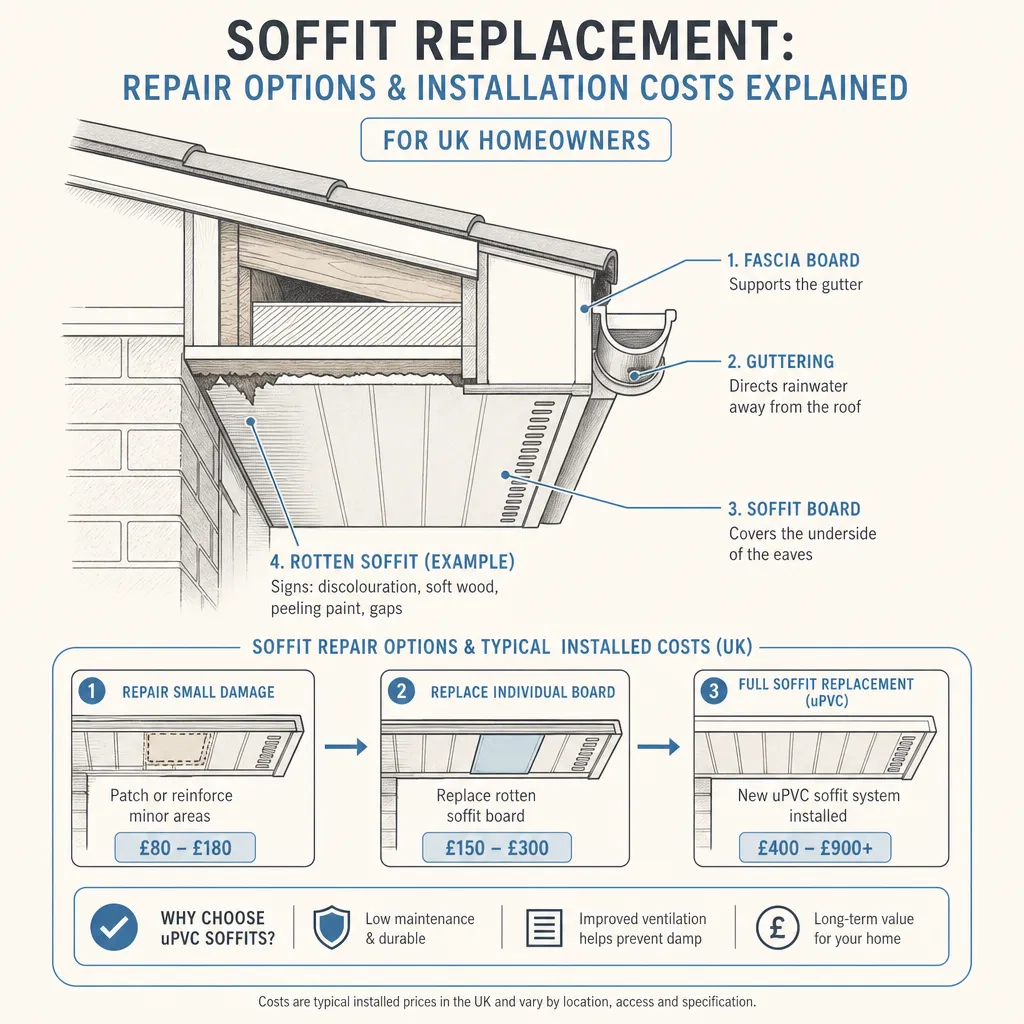 Improvement & Build
Soffit replacement: repair options and installation costs explained
Soffit replacement typically costs £500–£1,200 for a semi-detached home in the UK, depending on material choice and the extent of work.
 Improvement & Build
New Homeowner's Guide to Property Maintenance and Care
New UK homeowners should run seasonal checks on gutters, the boiler, roof, and damp at least twice a year and arrange an annual boiler service.
 Improvement & Build
Gutter Repair and Damage: Restoration Costs and Solutions
Most gutter repairs in the UK cost between £80 and £400, depending on the fault type, materials, and access height.
 Improvement & Build
Guide to Roof Repair and Maintenance
Regular roof inspections every 3–5 years, prompt repair of damaged tiles and failed flashings, and annual gutter clearance are the core of effective UK roof maintenance.
 Improvement & Build
Repairing a Sliding Door: Diagnosis and Solutions
Most sliding door problems — stiffness, jumping off track, or draughts — are caused by dirty tracks, worn rollers, or misaligned guides.