Arboricultural Surveys Before Tree Planting
By Housey · Last reviewed 11th of May 2026
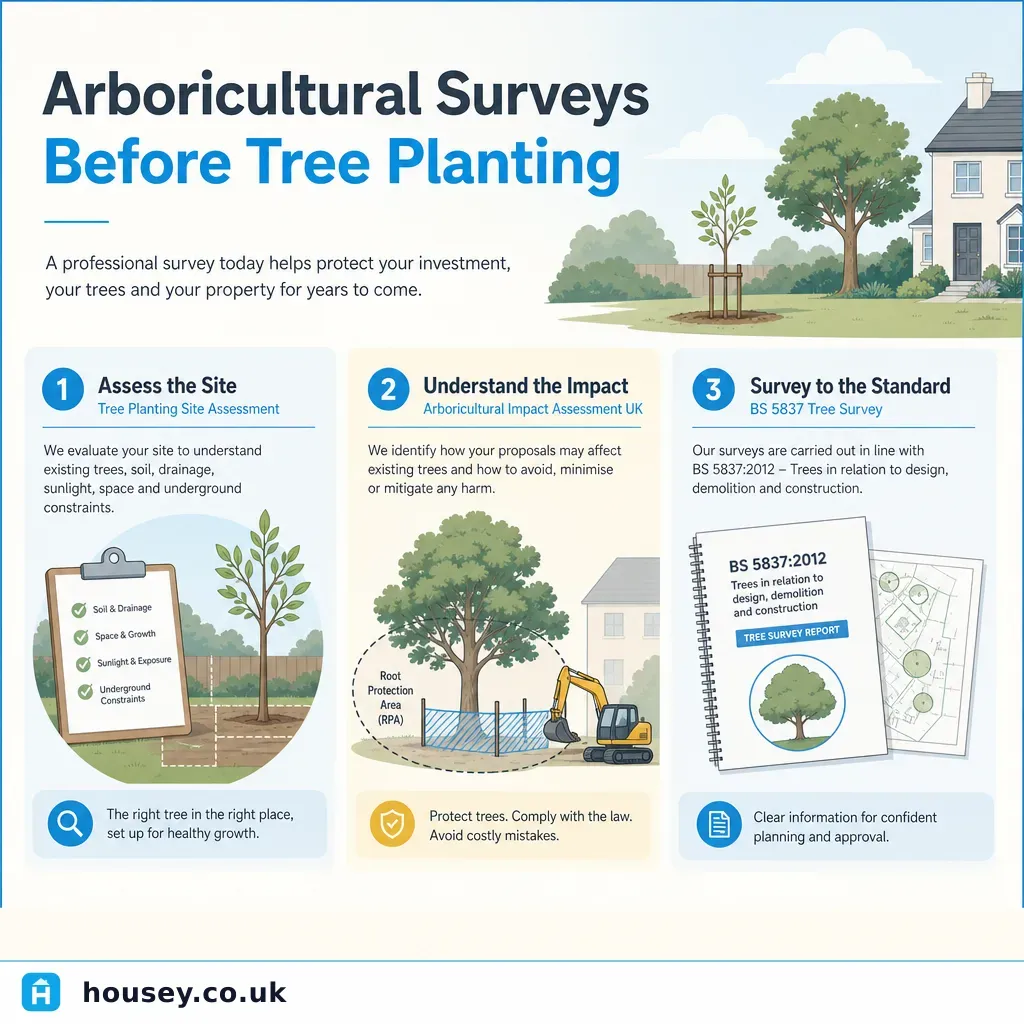
Arboricultural Surveys Before Tree Planting
Planting trees on a residential plot can feel like a straightforward gardening decision, but the long-term consequences of choosing the wrong species in the wrong location can be significant — from root damage to drains and foundations, to future conflicts with planning applications, to disputes with neighbours over overhanging canopies. An arboricultural survey assesses your site's soil conditions, existing vegetation, proximity to structures, and planning constraints before you commit to planting, helping you select species and positions that will thrive across decades rather than cause costly problems.
Key points
- BS 5837:2012 is the British Standard governing tree assessment in relation to design, demolition, and construction — required for most planning applications where trees are on or adjacent to the site.
- Root spread of mature trees can extend up to 1.5 times the crown radius; aggressive-root species such as willow and poplar can spread considerably further on shrinkable clay soils.
- NHBC Standards Chapter 4.2 provides guidance on minimum safe distances between trees and building foundations on shrinkable soils — a key reference for species selection near existing or proposed buildings.
- Tree Preservation Orders (TPOs) protect specified existing trees on or near your site; planting that encroaches on a protected tree's root protection area may require local planning authority approval.
- An Arboricultural Impact Assessment (AIA) is commonly required by local planning authorities as part of planning applications where trees are present on or near the site.
Why commission an arboricultural survey before planting?
Most homeowners select trees by canopy size and visual appeal. A qualified arboricultural consultant considers root architecture, soil moisture regime, drainage patterns, proximity to structures, overhead and underground utilities, and how a species behaves across 50–100 years — not just its first five.
A pre-planting arboricultural survey typically covers:
- Site conditions: Soil type, pH, drainage, aspect, wind exposure, and microclimate.
- Existing vegetation: Health, structure, and root protection areas of established trees on or near the site.
- Structural and drainage constraints: Location of foundations, drains, service corridors, and retaining walls within the root influence zone.
- Overhead and underground utilities: High-voltage cables, gas mains, and water and sewer runs affect both species selection and planting position.
- Planning constraints: Whether existing trees have TPOs, or whether the site is in a conservation area, affecting what planting can occur nearby.
- Species suitability: A recommended planting list matched to site conditions, often including native species where biodiversity is a planning requirement.
When is an arboricultural survey required versus merely advisable?
Situation | Survey required? | Why |
|---|---|---|
Planning application with trees on or adjacent to site | Usually required | Most local planning authorities expect a BS 5837:2012 compliant AIA |
Planting near existing TPO trees | Strongly advisable | Root protection zones must be respected; works near TPO trees may need LPA consent |
Planting within 5–10 m of a building on shrinkable clay | Strongly advisable | Root-related subsidence risk; NHBC Chapter 4.2 applies |
Planting near drains, services, or retaining walls | Strongly advisable | Root intrusion into drains is a common and costly issue |
Informal garden planting well away from structures | Not usually required | Lower risk; standard horticultural advice may suffice |
Planting to discharge a landscape planning condition | Required | Condition will specify compliance with an approved Arboricultural Method Statement |
Choosing the right tree for your UK site
Once site constraints are mapped, species selection becomes more straightforward. Key variables an arboricultural survey will help establish:
Soil type and drainage
Clay soils expand and contract with moisture — species with high water uptake (willow, poplar, elm) amplify this movement near buildings. Sandy or free-draining soils support a wider range of species with lower subsidence risk.
Available root zone
Paved or hard-landscaped areas dramatically limit the viable root zone. Small-pit urban planting often requires engineered soil cells and species with low-invasive root systems.
Mature dimensions
A common error is selecting a tree by its current nursery size rather than its mature canopy and root spread. A field maple can reach 15 m; a silver birch 20 m. Root spread at maturity may extend 12–25 m across.
Decision guide: which tree, and when do you need a consultant?
- Choose compact or fastigiate varieties (such as Carpinus betulus 'Fastigiata' or Prunus 'Amanogawa') if space is limited or proximity to buildings is less than 5 m.
- Choose native broadleaves (oak, field maple, hornbeam) for biodiversity and planning preference — but only where sufficient space exists for mature dimensions.
- Avoid willow and poplar within 30 m of buildings on clay soils (NHBC Standards Chapter 4.2 guidance).
- Commission an arboricultural consultant if the site has existing trees, is subject to a planning application, or planting is within 10 m of a building or drain.
- Check with your local planning authority before planting within the root protection area of a TPO tree, or if biodiversity net gain conditions apply to a planning permission.
- Confirm whether the Environment Act 2021 biodiversity net gain requirements apply — mandatory for most new planning permissions in England since February 2024.
What a pre-planting survey report includes
A qualified arboricultural consultant — typically a member of the Arboricultural Association — will:
- Visit the site to record existing trees and conditions.
- Assess soil type, drainage, and moisture regime — sometimes including soil sampling.
- Map existing tree root protection areas using BS 5837:2012 methodology.
- Identify utility corridors and structural constraints.
- Produce a written report with a species recommendation list, site plan, and constraints plan.
- Where required for planning, produce an AIA and/or an Arboricultural Method Statement.
Reports typically take one to two weeks after the site visit. For planning purposes, commission the report before submitting your application.
Indicative costs
Indicative UK costs, last reviewed 2026-05-11.
- Basic pre-planting site assessment (informal residential): £150–£350.
- Formal arboricultural survey report (BS 5837:2012 compliant, for planning): £500–£1,500+ depending on plot size and complexity.
- Arboricultural Impact Assessment for a planning application: £800–£2,500+.
Costs vary with site complexity and the consultant's location. Always request an itemised quote specifying the deliverables.
What to ask a pre-planting arboricultural consultant
- Are you a member of the Arboricultural Association, and do you hold relevant qualifications such as Level 3 Certificate in Arboriculture or ISA Certified Arborist status?
- Will your report comply with BS 5837:2012 if I need it for a planning application?
- What soil investigation is included — visual assessment only, or physical sampling?
- Will you map existing tree root protection areas as part of the survey?
- What deliverables will I receive — a site plan, constraints plan, and species recommendation list?
- If a formal AIA is needed, is that included in your quote or a separate instruction?
- What assumptions is your fee based on, and what could cause the cost to change?
When to get professional help
For most informal residential planting well away from buildings and drains, a formal survey is not required. However, always commission a qualified arboricultural consultant before:
- Planting within 10 m of a building, drain, or retaining wall — particularly on clay soil.
- Submitting a planning application where trees are present on or adjacent to the site.
- Planting within the root protection area of a TPO tree.
- Planting trees to discharge a biodiversity net gain or landscape planning condition.
- Removing or pruning existing trees in connection with a new planting scheme.
How Housey can help
Housey connects you with qualified professionals for arboricultural surveys and tree surgery across the UK. Whether you need a formal BS 5837:2012 report for a planning application or practical guidance on species selection and site preparation, compare quotes from vetted arboricultural consultants near you.
Frequently asked questions
Do I need an arboricultural survey to plant a tree in my garden?
For most informal residential planting away from buildings, drains, and protected trees, a formal arboricultural survey is not a legal requirement. However, it is strongly advisable before planting large-canopy or aggressive-root species near buildings on clay soil, or when a planning application is involved — in which case the local authority may require a BS 5837:2012 compliant report.
What is a Tree Preservation Order and how does it affect planting?
A TPO is made by a local planning authority to protect specific trees of amenity value. TPOs affect works to the protected tree itself and can indirectly affect new planting that encroaches on its root protection area. If you intend to plant within that zone, check with your local planning authority before proceeding.
How far should trees be planted from a house?
The safe distance depends on species, soil type, and building foundations. NHBC Standards Chapter 4.2 provides guidance: on shrinkable clay soils, species such as poplar and willow should be planted at least 30 m from a building. Smaller ornamental trees may be appropriate at 3–5 m on well-draining soil, but an arboricultural consultant should advise on your specific situation.
What qualifications should a tree planting consultant hold?
Look for membership of the Arboricultural Association — particularly Registered Consultant status for formal planning reports. ISA Certified Arborist is also recognised. For planning surveys, confirm the consultant has experience producing BS 5837:2012 compliant reports accepted by local planning authorities.
Sources and further reading
- BS 5837:2012 Trees in Relation to Design, Demolition and Construction — BSI
- Arboricultural Association — Find a Professional — Arboricultural Association
- NHBC Standards Chapter 4.2 — Building Near Trees — NHBC
- Environment Act 2021 — legislation.gov.uk
- Tree Preservation Orders and Trees in Conservation Areas — Planning Portal
Useful next reads
 Planning & Pre-Build
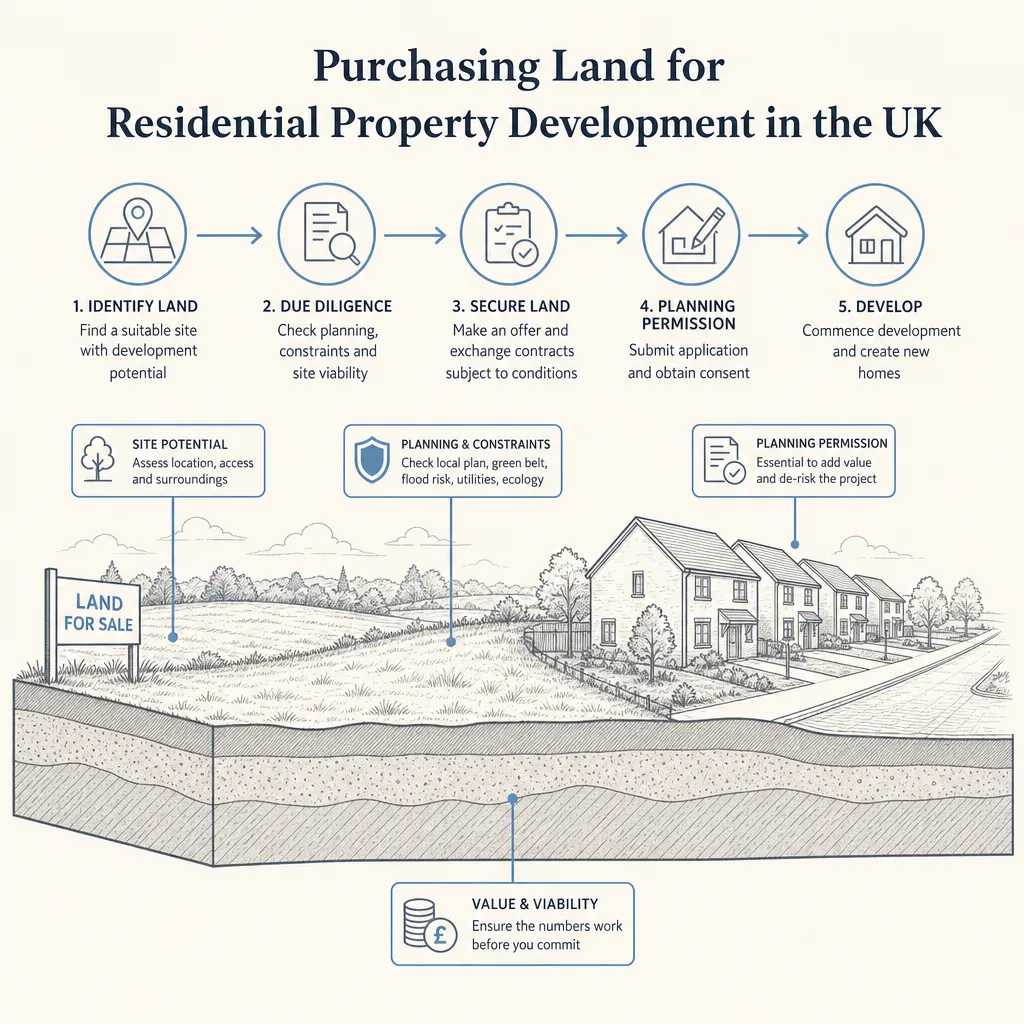
Purchasing Land for Residential Property Development in the UK
Buying development land in the UK involves due diligence on planning status, ground conditions, legal title, and utilities access before exchange.
 Planning & Pre-Build
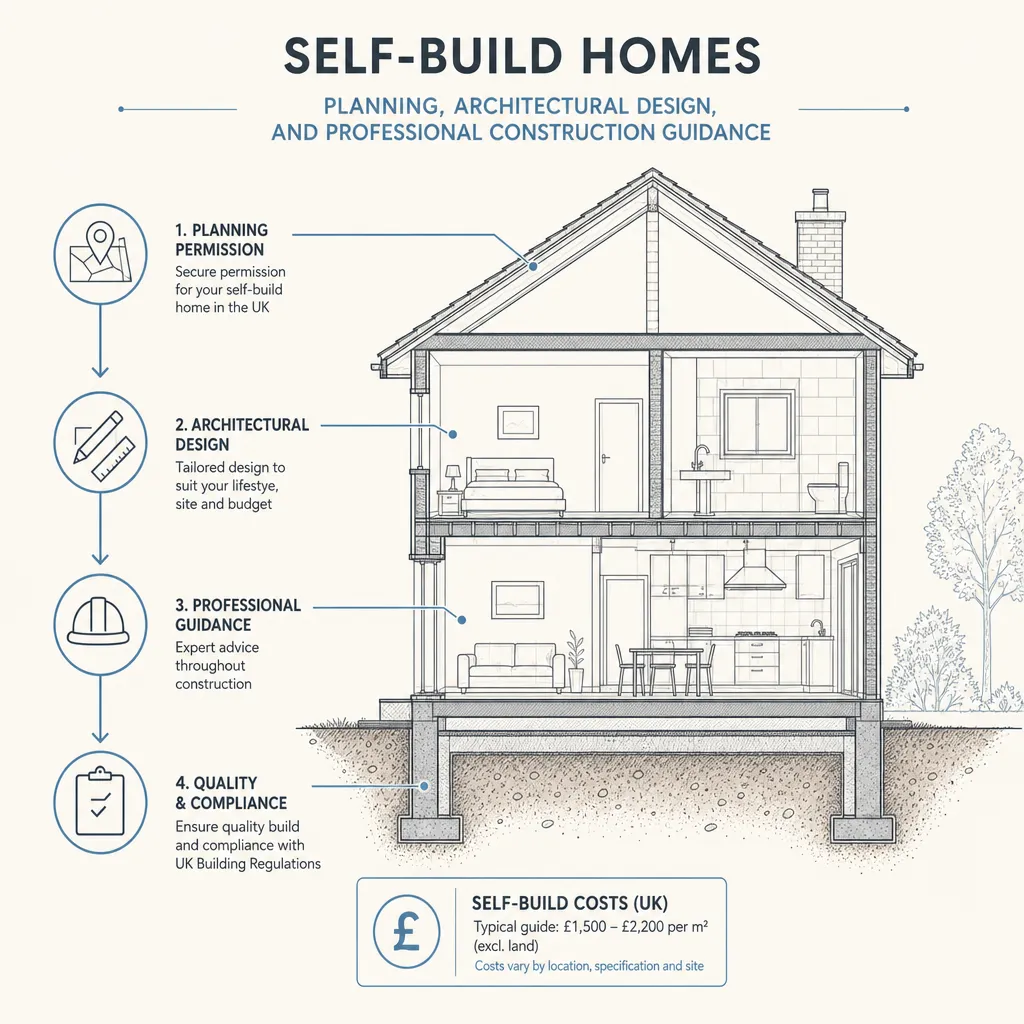
Self-build homes: planning, architectural design, and professional construction guidance
A UK self-build requires planning permission, separate building regulations approval, and a professional team typically including an architect, structural engineer, and building control body.
 Planning & Pre-Build
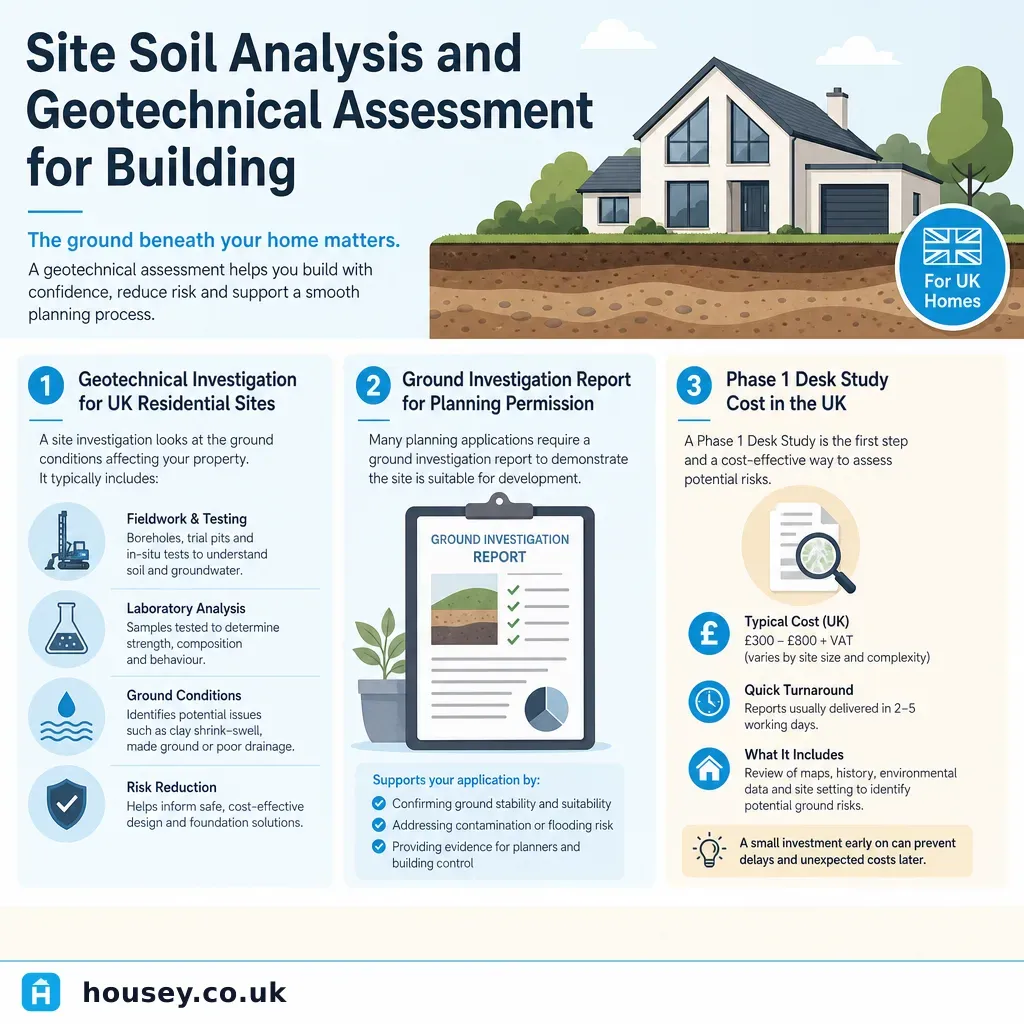
Site Soil Analysis and Geotechnical Assessment for Building
A geotechnical investigation assesses soil type, bearing capacity, groundwater, and contamination risk beneath a building site.
 Planning & Pre-Build
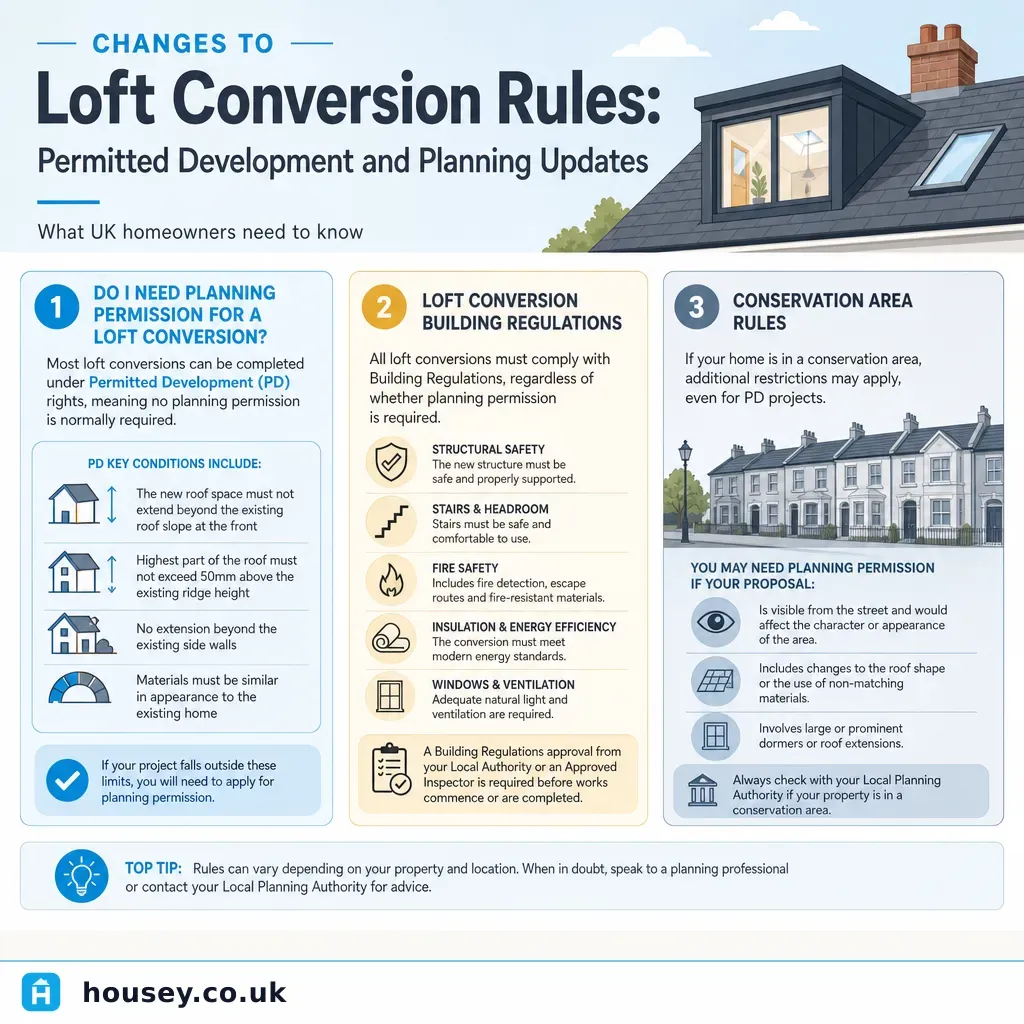
Changes to Loft Conversion Rules: Permitted Development and Planning Updates
In England, most loft conversions on standard houses qualify as Permitted Development under Class B of the GPDO 2015, allowing up to 40 cubic metres (terraced) or 50 cubic metres (detached or semi-detached) without a planning application — if conditions are met.
 Planning & Pre-Build
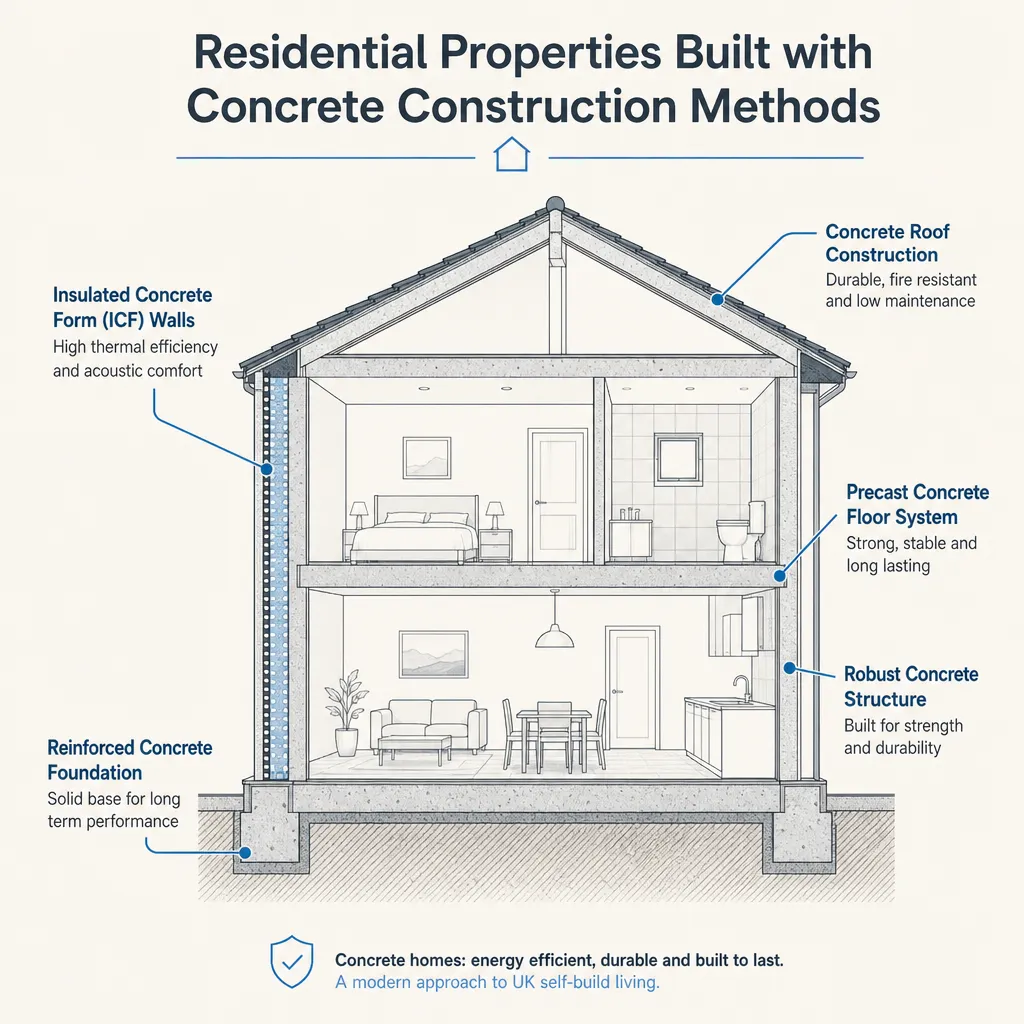
Residential Properties Built with Concrete Construction Methods
UK homes are built using several concrete methods: in-situ cast concrete, precast panel systems, insulating concrete formwork (ICF), and older non-traditional types such as Wimpey No-Fines and Laing Easiform.