Site Soil Analysis and Geotechnical Assessment for Building
By Housey · Last reviewed 11th of May 2026
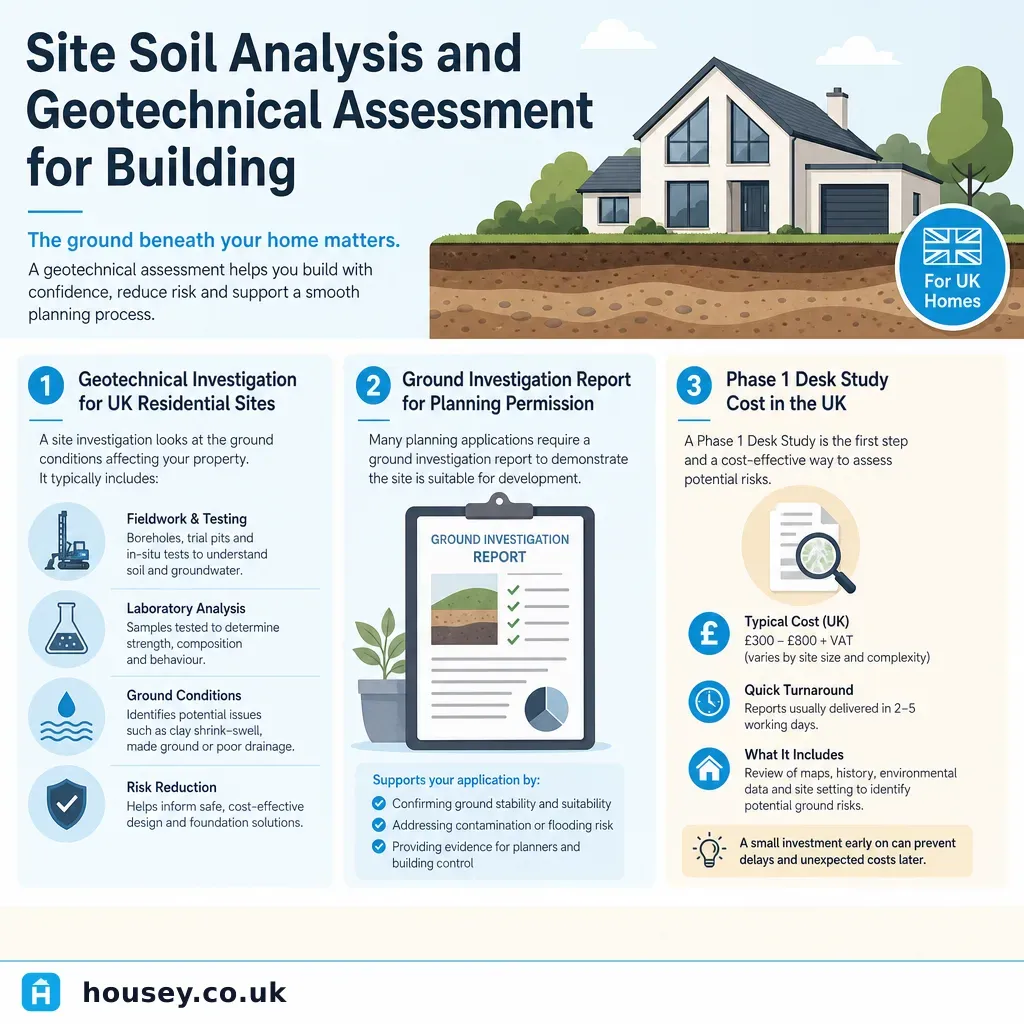
Site Soil Analysis and Geotechnical Assessment for Building
Planning a self-build, extension, or any structure that disturbs the ground raises a question that architects and structural engineers encounter on almost every project: what exactly lies beneath the site? Soil conditions across the UK vary from stable chalk downlands to shrinkable London Clay, from firm sandstone to former landfill and made ground. Getting foundation design wrong is expensive to correct once construction has started, and in some cases ground conditions determine whether planning permission will be granted at all. A geotechnical investigation — also called a ground investigation — is the systematic professional process of characterising what lies beneath a site before those decisions are made.
Key points
- Building Regulations Approved Document A (Structure) requires foundations to be designed to suit ground conditions; a geotechnical report provides the evidence a structural engineer needs to comply.
- Indicative UK costs, last reviewed 2026-05-11: Phase 1 desk studies typically range from £500–£2,000; Phase 2 intrusive investigations on a residential plot commonly cost £2,000–£10,000+, depending on access, number of boreholes or trial pits, and laboratory testing required.
- Shrinkable clay soils — present across much of the South East, East Anglia, and parts of the Midlands — may require foundations 1.0–1.5 m deeper than those on stable ground, significantly affecting build costs.
- The National Planning Policy Framework (NPPF) and Environment Agency guidance may require a ground investigation report as a pre-commencement planning condition on brownfield, contaminated, or flood-zone sites.
- Geotechnical reports are typically authored by Chartered engineers (via the Institution of Civil Engineers or the Geological Society) and feed directly into the structural engineer's foundation design and building control submission.
What is a geotechnical investigation?
A geotechnical investigation assesses the physical and chemical properties of the ground to determine what foundation type is safe and appropriate for a proposed structure. It is distinct from a topographical survey (which maps the site surface), an ecological survey (which assesses habitats and species), and a structural survey (which inspects an existing building's fabric).
Investigations normally proceed in phases:
Phase | What it involves | When typically used |
|---|---|---|
Phase 1: Desk study and walkover | Review of geological maps, historical Ordnance Survey maps, Environment Agency data, aerial photography, and a site walkover to record visible features | Almost always the starting point; may be sufficient for simple greenfield extensions on well-understood local geology |
Phase 2: Intrusive investigation | Trial pits (typically 2–4 m depth), cable percussion boreholes (up to 15 m+), in-situ testing, soil and water sampling, and laboratory analysis | Required when desk study reveals uncertainty, contamination risk, or poor ground; or when the structural engineer needs bearing capacity data to finalise foundation depth |
Phase 3: Contamination risk assessment | Detailed chemical analysis, risk assessment, and remediation design | Required on brownfield, former industrial, or suspected contaminated sites; often a pre-commencement planning condition |
When do you need a ground investigation?
Not every residential project requires a full intrusive investigation. This decision tree helps identify what applies to your situation:
- Commission a Phase 1 desk study if you are in the early stages of any project and have no documented information about ground conditions — it is low cost and invariably useful as a starting point.
- Proceed to a Phase 2 intrusive investigation if the desk study identifies made ground or fill, a history of industrial use, shrinkable clay within proximity of large trees, high groundwater, or if your structural engineer cannot confirm foundation depth from desk-study evidence alone.
- Require a Phase 3 contamination assessment if the site was previously a garage, petrol station, dry cleaner, industrial unit, or landfill — or if your local planning authority (LPA) requires it as a planning condition.
- Check with your LPA before commissioning any investigation, so the scope and reporting format match what any pre-commencement planning condition specifies.
- Consult a structural engineer or geotechnical engineer immediately if you observe stepped cracking through brickwork, sloping floors, sticking doors, or sinkholes on or near the proposed building footprint.
Soil types and their implications for UK foundations
Ground conditions vary significantly across the UK and have a direct bearing on foundation cost and complexity:
Soil or ground type | Bearing capacity | Key risk | Typical foundation implication |
|---|---|---|---|
London Clay and shrinkable clay | Moderate when not subject to moisture change near trees | Seasonal shrink-swell; desiccation by tree roots | Deep strip, piled, or pad foundations; NHBC Standards Chapter 4.2 applies |
Made ground or fill | Low and variable | Settlement, voids, contamination | Raft or piled foundations often required; contamination assessment needed |
River alluvium and soft silt | Low | Long-term consolidation; flood risk | Raft, piles, or ground improvement |
Chalk | Moderate to high | Dissolution cavities (swallow holes) in some areas | Specialist investigation to check for voids before finalising foundation design |
Sandstone or granite bedrock | High | Generally favourable for foundations | Shallower foundations often acceptable |
Peat | Very low | Long-term compression; gas generation | Ground improvement or piling essential; avoid building directly on peat where possible |
Which professionals carry out a geotechnical investigation?
Professional | Role in the process | Typical qualification |
|---|---|---|
Geotechnical engineer | Designs investigation scope, oversees fieldwork, authors the geotechnical report | Chartered via ICE (CEng MICivE) or Geological Society (CGeol FGS) |
Geoenvironmental consultant | Leads contamination assessment; authors Phase 3 risk assessment | CGeol, Chartered Environmentalist, or Chartered Waste Manager |
Structural engineer | Uses geotechnical report to design foundations and prepare building control submission | Chartered via IStructE (CEng MIStructE) or ICE |
Ground investigation contractor | Carries out boreholes, trial pits, and sampling under the engineer's direction | CSCS-carded operatives; work supervised by a Chartered engineer |
Important limitations
This article provides general information about geotechnical investigations in the UK. Ground conditions vary enormously by site location, geology, and land use history. Nothing in this guide constitutes structural or engineering advice for any specific site. Foundation design and geotechnical report interpretation should always be carried out by a qualified Chartered engineer with direct knowledge of your property. Planning requirements for ground investigation vary by local planning authority and site designation — always verify with your LPA before commissioning work.
What to ask a qualified professional
Before instructing a geotechnical engineer or ground investigation company, ask:
- Is a Phase 1 desk study likely to be sufficient for this site, or do you expect Phase 2 intrusive work will also be needed?
- Will the investigation scope satisfy any pre-commencement condition set by my local planning authority?
- Will the report give my structural engineer enough data to design foundations without further investigation?
- Who will author the final report — are they a Chartered engineer, and do they hold professional indemnity insurance?
- Which laboratory will process soil samples, and are they UKAS-accredited?
- What happens if contamination is found — can your firm advise on next steps, or will I need a separate specialist?
- What is the programme from instruction to delivery of the written report?
- Is VAT included in your fee, and what could cause the scope or price to change?
When to get professional help
Geotechnical investigation is inherently professional work. Instruct a qualified Chartered engineer before starting any groundworks if:
- Your structural engineer has requested a ground investigation report before finalising foundation design.
- Your planning permission includes a pre-commencement condition requiring site investigation.
- You observe cracking, settlement, or ground movement on or near the proposed building footprint.
- The site has a history of industrial use, made ground, or landfill.
- Large trees — particularly oak, poplar, elm, or willow — are within 10 m of the proposed structure on clay soils.
- The Environment Agency's flood risk mapping or a Phase 1 desk study indicates potential contamination.
How Housey can help
Housey connects homeowners and developers with qualified professionals offering geotechnical and soil investigations. Submit a quote request to receive proposals from vetted engineers in your area, and use the quote comparison dashboard to review scope, qualifications, and price before instructing.
Frequently asked questions
Is a geotechnical investigation always required for planning permission in the UK?
Not always. For straightforward extensions on established housing estates with well-documented ground conditions, your structural engineer may not require one. However, local planning authorities regularly impose pre-commencement ground investigation conditions on brownfield, flood-zone, or contaminated sites. Check with your LPA and structural engineer early in the design process before assuming one is not needed.
How long does a ground investigation take?
A Phase 1 desk study typically takes one to two weeks to produce. A Phase 2 intrusive investigation on a residential plot usually involves one to two days of fieldwork, with a written report delivered within two to four weeks. Sites requiring Phase 3 contamination assessment, or larger plots, may take six to twelve weeks from instruction.
Can I rely on a geotechnical report from a previous owner?
An existing report may provide useful background but may not cover the full extent of your site, may pre-date changes to the land, or may not satisfy your structural engineer's or planning authority's current requirements. Ask your engineer to review the existing report and confirm whether supplementary investigation is needed before relying on it.
What is the difference between a soil survey and a geotechnical investigation?
In UK practice these terms sometimes overlap informally. A 'soil survey' may refer to agricultural or ecological land classification. A 'geotechnical investigation' or 'ground investigation' specifically assesses soil and rock for construction purposes — bearing capacity, groundwater, stability, and contamination. Always confirm the scope and deliverables with any professional before instructing.
Sources and further reading
- Approved Document A: Structure — GOV.UK (Building Regulations)
- National Planning Policy Framework — GOV.UK
- Land contamination: how to manage the risks — Environment Agency / GOV.UK
- Ground engineering: guidance and best practice — Institution of Civil Engineers
Useful next reads
 Planning & Pre-Build
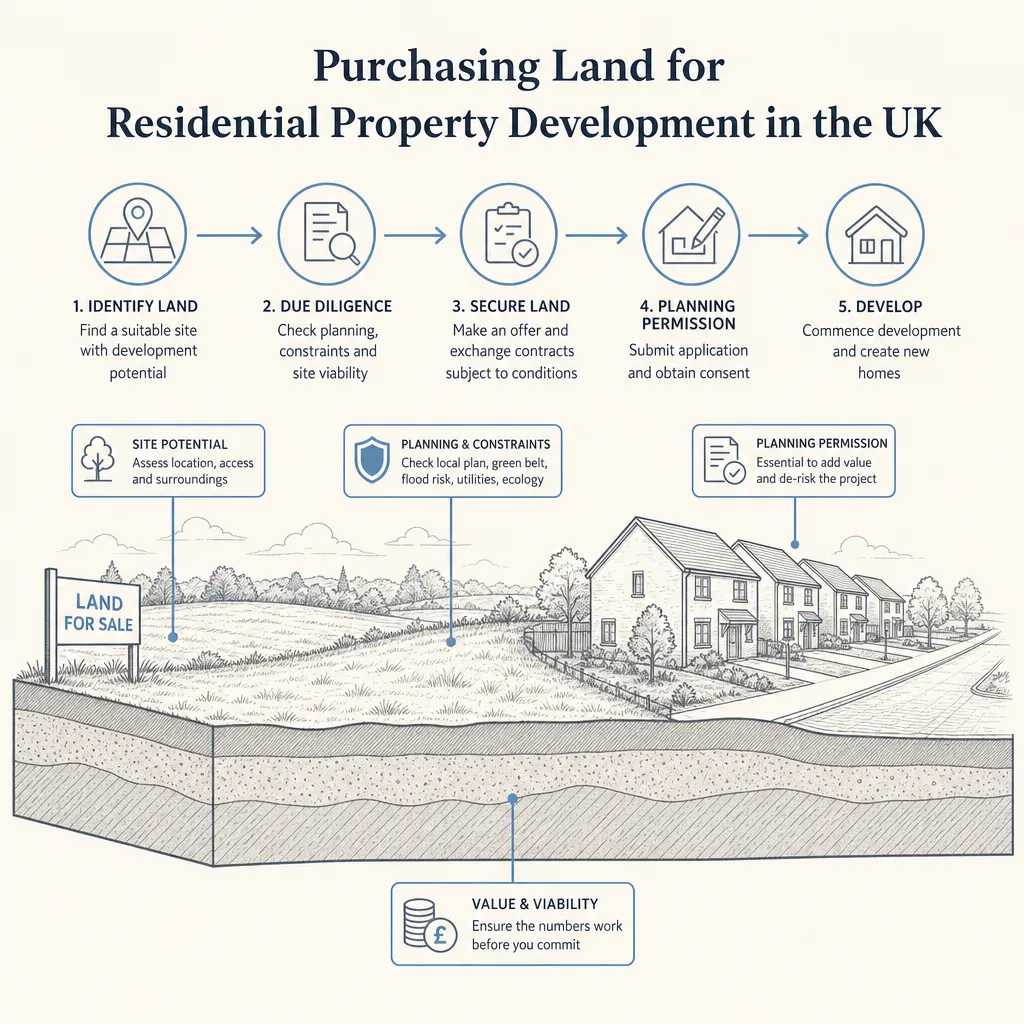
Purchasing Land for Residential Property Development in the UK
Buying development land in the UK involves due diligence on planning status, ground conditions, legal title, and utilities access before exchange.
 Planning & Pre-Build
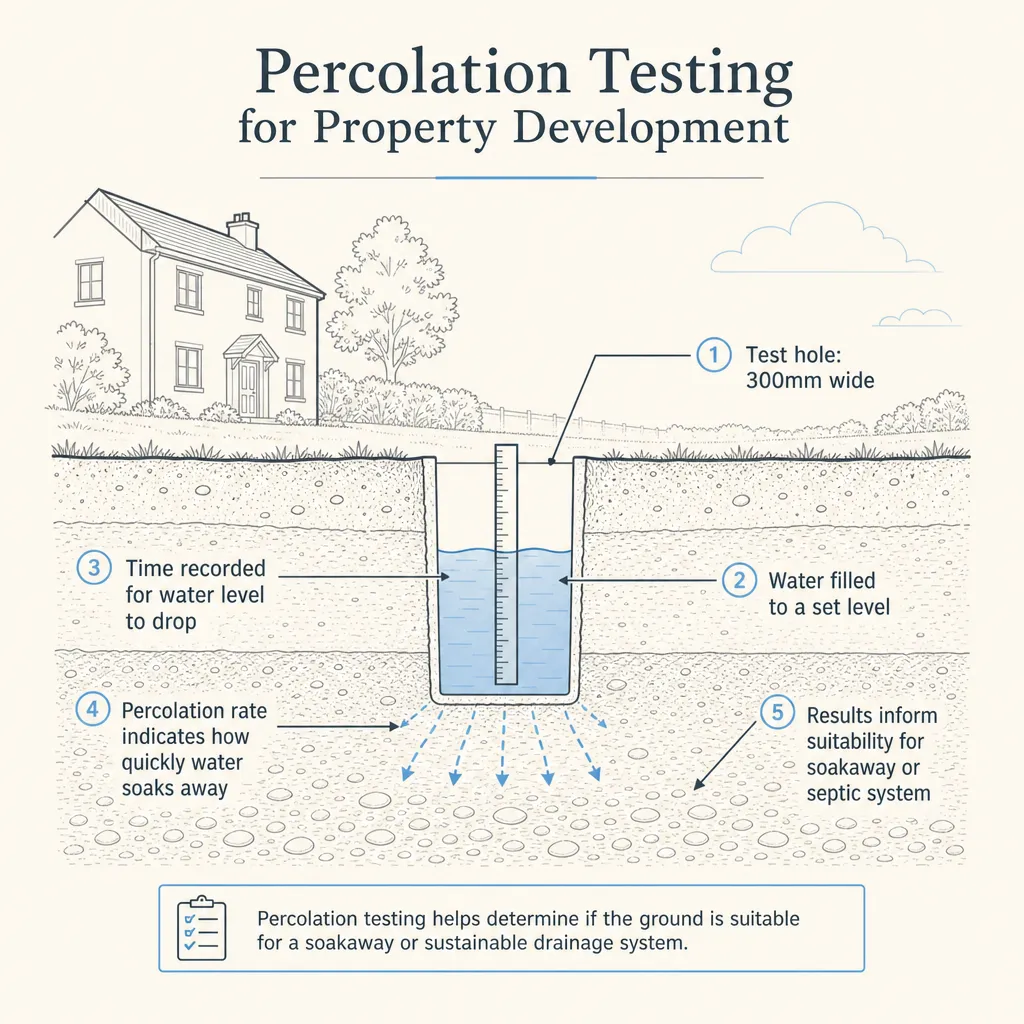
Percolation Testing for Property Development
A percolation test measures how quickly water drains through soil to determine whether a soakaway or septic system is viable.
 Planning & Pre-Build
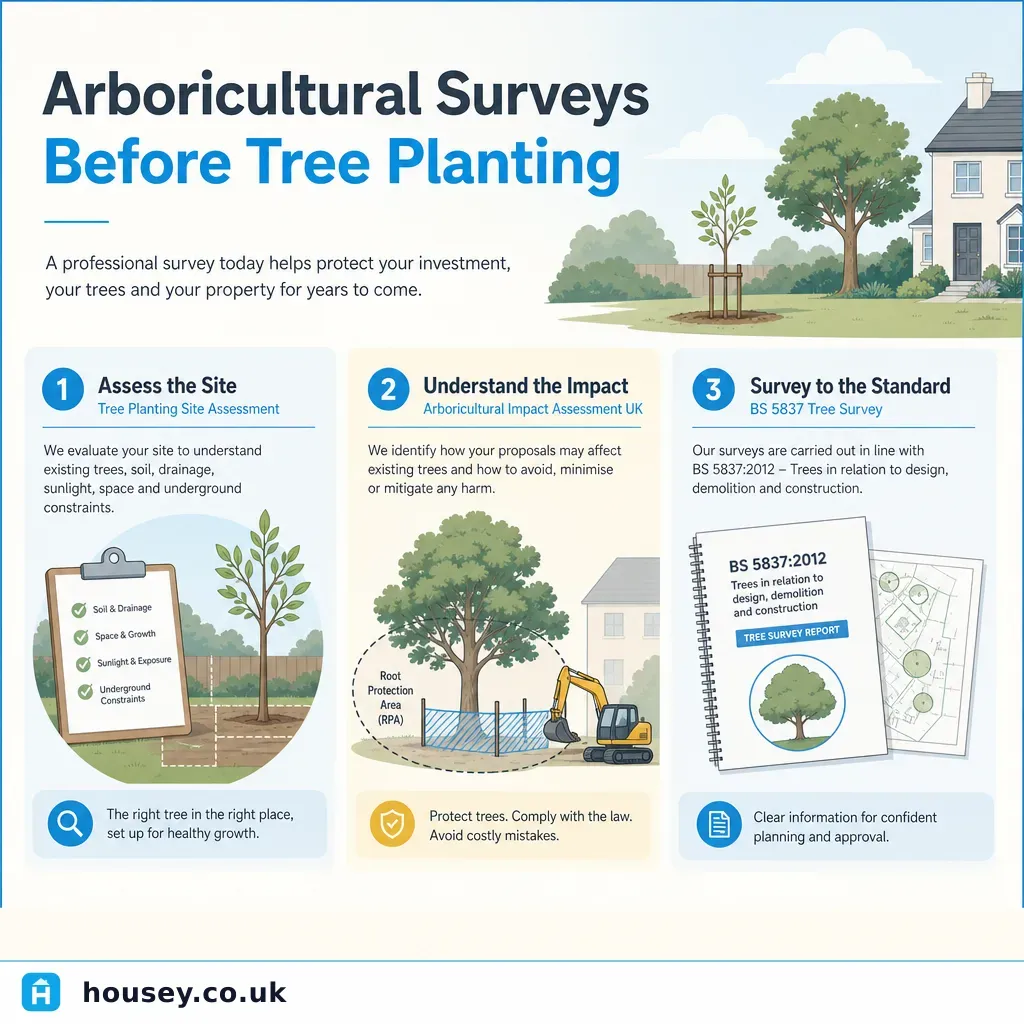
Arboricultural Surveys Before Tree Planting
A pre-planting arboricultural survey assesses soil type, drainage, existing tree root protection areas, and proximity to buildings so you can select species and positions that suit your UK site.
 Planning & Pre-Build
Changes to Loft Conversion Rules: Permitted Development and Planning Updates
In England, most loft conversions on standard houses qualify as Permitted Development under Class B of the GPDO 2015, allowing up to 40 cubic metres (terraced) or 50 cubic metres (detached or semi-detached) without a planning application — if conditions are met.
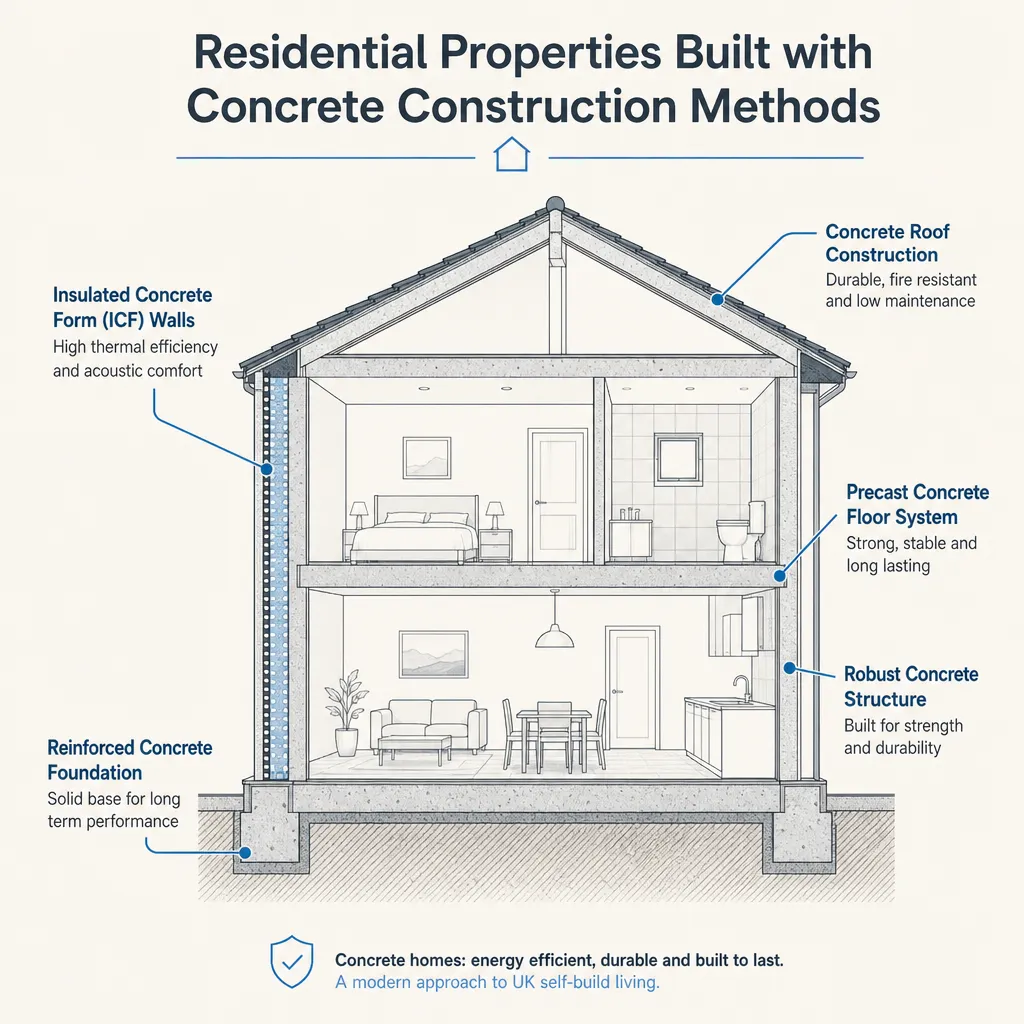 Planning & Pre-Build
Residential Properties Built with Concrete Construction Methods
UK homes are built using several concrete methods: in-situ cast concrete, precast panel systems, insulating concrete formwork (ICF), and older non-traditional types such as Wimpey No-Fines and Laing Easiform.