Choosing Between an Architect and Architectural Technologist
By Housey · Last reviewed 1st of June 2026

Choosing Between an Architect and Architectural Technologist
Deciding which design professional to appoint is usually one of the first practical steps a UK homeowner faces once a project moves beyond the ideas stage. The confusion arises because both types of professional can produce drawings for planning applications and building regulations submissions — yet their training, protected titles, and typical fee structures differ in ways that affect which is the better fit for your specific project. Getting this decision right before appointing anyone reduces the risk of scope mismatches and unexpected costs later.
Key points
- The title 'architect' is legally protected in the UK under the Architects Act 1997; only professionals registered with the Architects Registration Board (ARB) may use it — typically those who have completed all three parts of the RIBA professional qualification pathway.
- 'Architectural technologist' is a protected professional title governed by the Chartered Institute of Architectural Technologists (CIAT); full members use the designation MCIAT.
- Neither profession holds a legal monopoly on producing drawings for planning applications or building regulations submissions in England and Wales — both can lawfully provide these services.
- ARB registration is publicly searchable at arb.org.uk; CIAT membership can be verified at ciat.global — always check credentials before appointing any design professional.
- Architectural services for residential work are typically subject to 20% VAT unless the property is a listed building qualifying for zero-rating; clarify this with your professional at the fee proposal stage.
What each professional is trained to do
An architect's training emphasises the full design cycle — from conceptual brief and spatial thinking through to detailed design, specification writing, contract administration, and project oversight on site. An architectural technologist's training centres on building technology: the technical assembly of buildings, compliance documentation, building performance, and the constructional detail that bridges design intent and site execution.
In practice, for most domestic projects — rear extensions, loft conversions, garage conversions, and modest new builds — the technical skills required overlap considerably, and both types of professional are routinely and successfully used across the UK.
| Architect (ARB-registered) | Architectural Technologist (MCIAT) |
|---|---|---|
Governing body | Architects Registration Board (ARB) | Chartered Institute of Architectural Technologists (CIAT) |
Qualification route | ARB/RIBA Parts 1, 2, and 3 (typically 7 years total) | CIAT-accredited degree or equivalent (typically 3–4 years) |
Title protected by law? | Yes — Architects Act 1997 | Yes — CIAT-protected professional title |
Can produce planning drawings? | Yes | Yes |
Can submit building regulations? | Yes | Yes |
Contract administration? | Yes (with appropriate experience and scope) | Often yes, depending on project scope |
Typical fee for a standard extension (indicative, 2026) | £1,500–£5,000+ | £800–£2,500 |
Best suited to | Design-led, complex, large-scale, or heritage projects | Technical compliance, extensions, conversions, defined-scope new builds |
Indicative UK fees, last reviewed 2026-06-01. Actual fees depend on project complexity, scope of service, and region. Always request a written, itemised fee proposal.
Which professional suits your project?
Project type | Recommended professional | Why |
|---|---|---|
Complex new build or major renovation with strong design ambitions | Architect (ARB-registered) | Conceptual design leadership; broader creative and technical scope across all stages |
Rear or side extension, straightforward loft conversion | Either; architectural technologist often more cost-effective | Technical drawing and planning/BR compliance is the primary requirement |
Garage conversion, outbuilding, modest internal structural works | Architectural technologist | Technical detail and compliance documentation are the core outputs |
Listed building or conservation area project | Architect with heritage experience, or specialist heritage technologist | Heritage impact assessment, listed building consent drawings, conservation officer liaison |
Large or complex residential development | Architect | Project scale typically requires ARB-registered professional lead |
Project where the local planning authority has requested ARB credentials | Architect | Some authorities specify this in pre-application advice — check before appointing |
Decision guide: which professional should you appoint?
- Appoint an architect if the project is conceptually ambitious, involves significant structural change or heritage constraints, sits within a conservation area, or you want a single professional to lead from initial sketch through to contract administration and snagging.
- Appoint an architectural technologist if your primary need is technically sound planning drawings and a building regulations package for a defined project — extensions, loft conversions, and garage conversions are the most common examples — and cost-effectiveness is a priority.
- Either will serve well for a straightforward rear extension or loft conversion to a conventional UK property where the local planning authority has no specific professional requirements.
- Always ask at first meeting whether the professional holds ARB registration or MCIAT membership, carries professional indemnity insurance, and has recent experience of similar projects approved by the relevant local planning authority.
- Check credentials directly — ARB registration is searchable at arb.org.uk; CIAT membership at ciat.global — before committing any fee.
Understanding the fee structure
Fees for domestic architectural work in the UK are typically structured in one of three ways: a fixed fee for a defined scope (most common for extensions and straightforward conversions); a percentage of build cost (common for larger projects, typically 8–15% for architects and 3–8% for technologists providing a full service); or an hourly rate for advisory or early-stage work.
Always request a written fee proposal that lists which RIBA Work Stages — or equivalent service stages — are included. Clarify whether the fee covers drawings for planning only, building regulations only, or full service through to construction and snagging. Scope creep is the most common cause of disputes between homeowners and design professionals, and a clear written scope prevents most of them.
Indicative UK fee ranges, last reviewed 2026-06-01. Quotes vary significantly by project complexity, location, and professional.
What the protected title 'architect' means in practice
The Architects Act 1997 makes it a criminal offence to use the title 'architect' — in any combination — without ARB registration. This does not mean only architects can design buildings or produce drawings; it means only ARB-registered professionals can call themselves architects. An architectural technologist producing identical drawings for the same domestic project is acting entirely lawfully under their own protected professional title.
This matters because some homeowners assume 'architect' implies a higher standard of output and 'architectural technologist' implies lesser quality — this is not accurate. The difference is in training emphasis and professional title, not in the legal right to produce drawings for planning applications or building regulations submissions.
When to get professional help
For any project requiring planning permission or building regulations approval — extension, loft conversion, structural alteration, or new build — appoint a qualified design professional before submitting anything to the local planning authority or building control. Poorly prepared drawings are a common cause of planning refusals and building control rejections that add cost and delay to projects that would otherwise be straightforward. If a local planning authority has issued pre-application advice specifying a particular professional type, follow that guidance before incurring significant design fees.
How Housey can help
Housey connects homeowners with qualified architectural technologists who can advise on your specific project, produce planning and building regulations packages, and guide you through the approvals process from start to finish. Compare quotes and credentials from local professionals before you commit.
Frequently asked questions
Can an architectural technologist apply for planning permission on my behalf?
Yes. There is no legal requirement in England and Wales for a planning application to be submitted by an ARB-registered architect. Architectural technologists, planning consultants, and homeowners themselves can submit applications. What determines the outcome is the quality, accuracy, and policy compliance of the drawings and supporting documents submitted to the local planning authority.
Do I need a design professional for a permitted development extension?
Neither is legally required for permitted development works. However, most contractors, mortgage lenders, and future buyers expect building regulations drawings and a completion certificate. Many homeowners appoint an architectural technologist to prepare the technical package, confirm PD eligibility, and submit building control notices, reducing the risk of compliance issues during or after the build.
What is RIBA and how does it relate to ARB?
The Royal Institute of British Architects (RIBA) is a professional membership body; ARB is the statutory regulator. All practising architects must register with ARB to use the title. RIBA membership — designated RIBA Chartered Architect — confers professional development resources and a quality benchmark recognised by clients and contractors, but is separate from the legal ARB registration requirement.
How long does it take to get planning drawings produced?
For a typical rear extension, a professional usually needs two to six weeks to produce measured survey drawings, design proposals, and planning application documents, depending on workload and how quickly the brief is confirmed. Building regulations drawings typically follow planning approval and take a further two to four weeks, depending on project complexity.
Sources and further reading
- Architects Registration Board: register search — Architects Registration Board
- Chartered Institute of Architectural Technologists: find a technologist — CIAT
- Architects Act 1997 — legislation.gov.uk
- RIBA: find an architect — Royal Institute of British Architects
- Planning Portal: householder guidance — Planning Portal
Useful next reads
 Improvement & Build
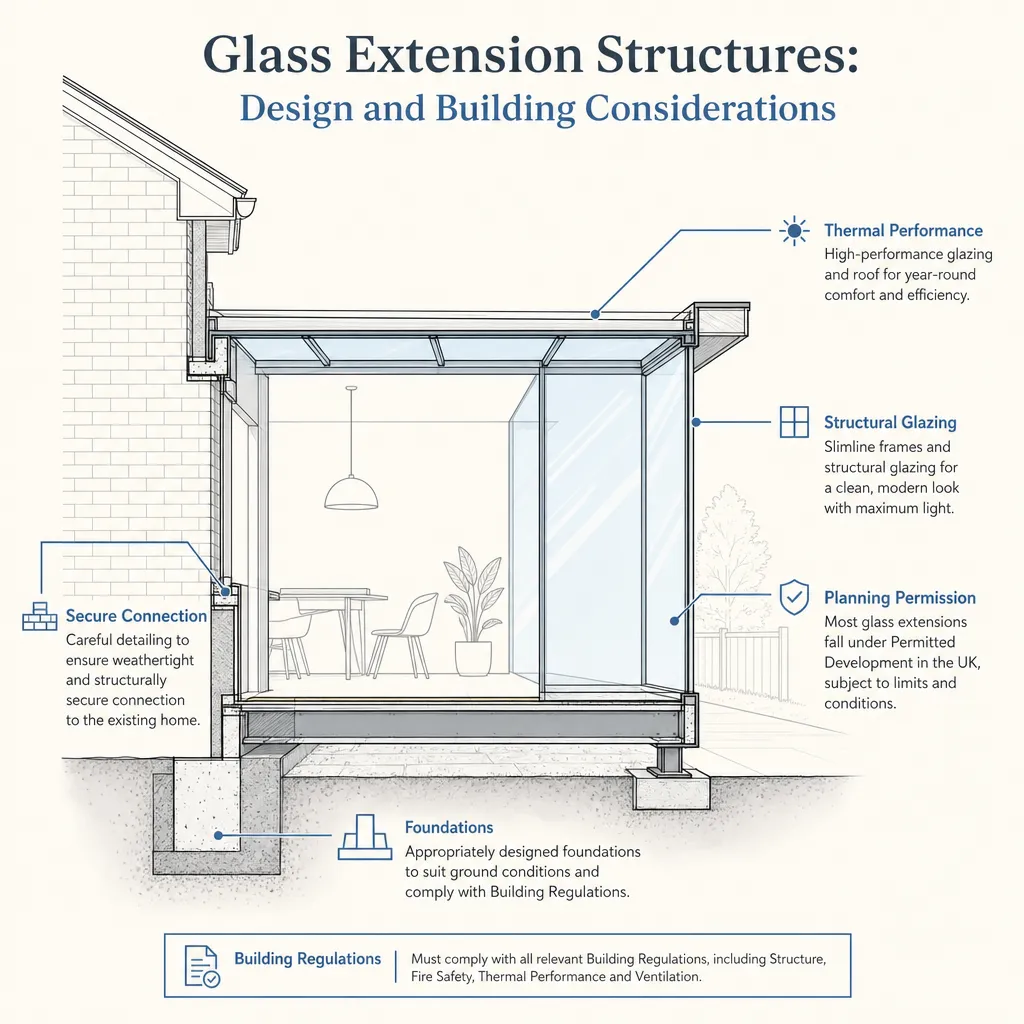
Glass Extension Structures: Design and Building Considerations
A glass extension uses structural glazing for walls, roof, or both to create a light-filled space connected to the garden.
 Improvement & Build
Agricultural and Pole Barn Construction Costs
Pole barn and agricultural building costs in the UK vary widely by size, frame type, cladding, and groundwork.
 Improvement & Build
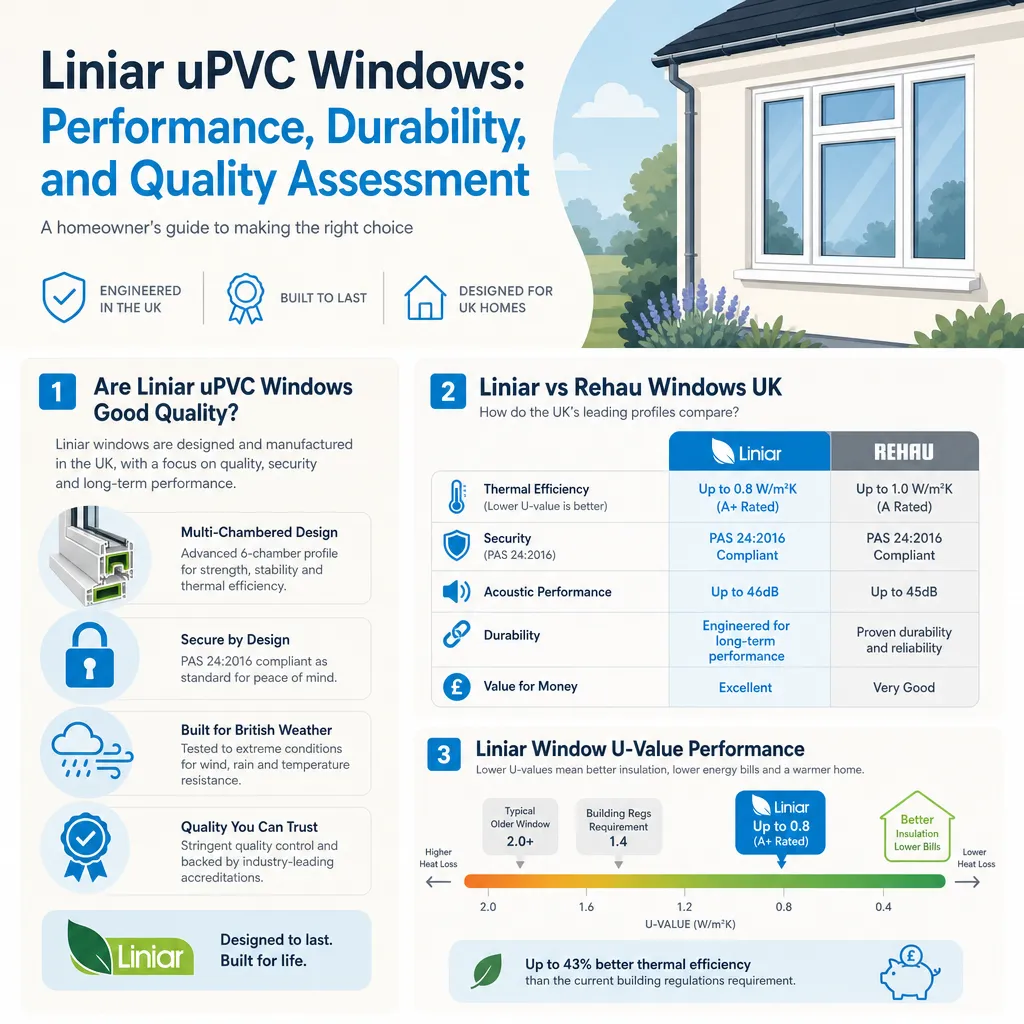
Liniar uPVC Windows: Performance, Durability, and Quality Assessment
Liniar uPVC window profiles are manufactured in the UK using multi-chambered, foamed frames.
 Improvement & Build
Garden Tap Installation with Hot and Cold Water: Plumbing Options
Adding a cold garden tap is a common DIY project, but routing hot water outdoors requires a plumber to connect to your domestic hot water system and comply with the Water Supply (Water Fittings) Regulations 1999.
 Improvement & Build
Sealing and Maintaining Historic Leaded Glass Windows: Preservation and Performance
Leaded glass windows are maintained using traditional linseed oil cement — not silicone or modern sealants, which prevent natural movement in the lead came.