Architectural Concrete: Design Choices and Cost Considerations
By Housey · Last reviewed 24th of May 2026
Architectural Concrete: Design Choices and Cost Considerations
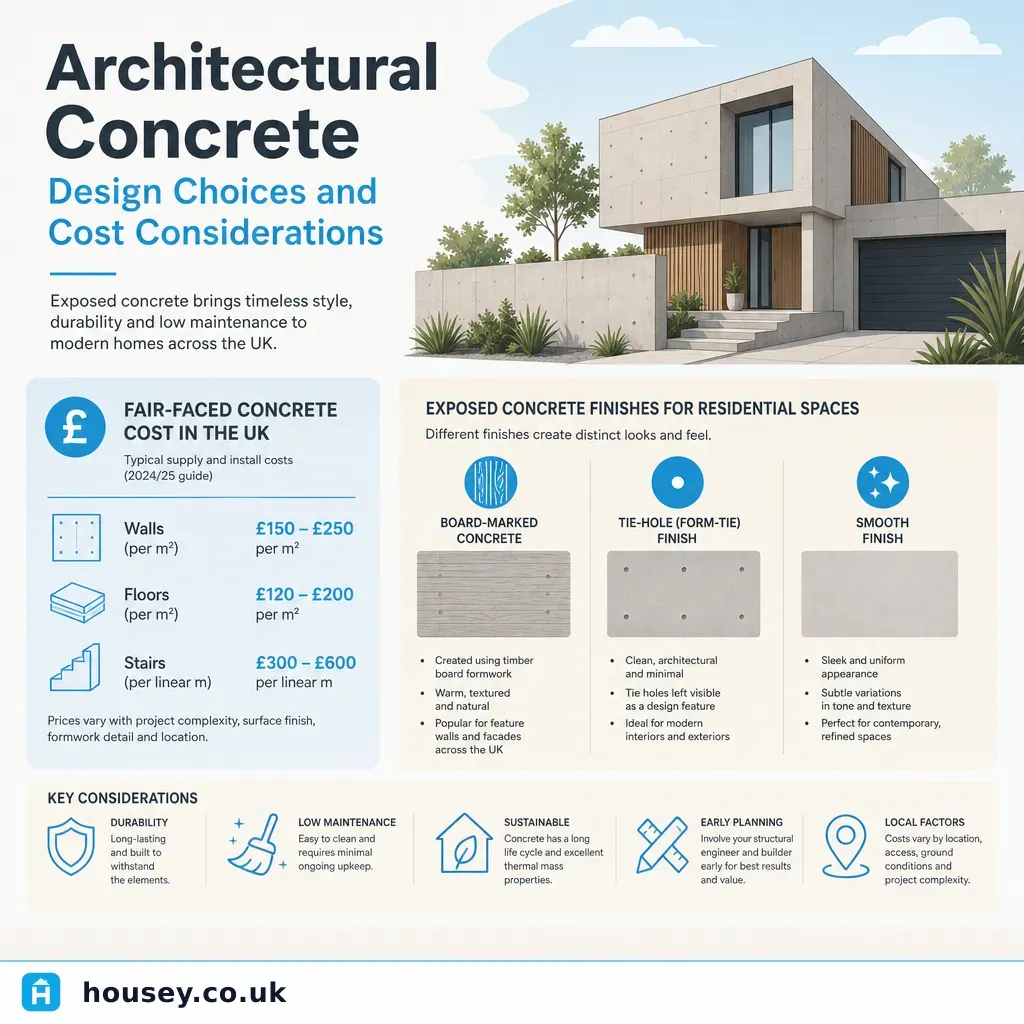
Architectural concrete — encompassing fair-faced poured walls, board-marked surfaces, exposed aggregate finishes, and polished floors — has moved steadily into UK residential design over the past decade, particularly in extensions, garden structures, and contemporary new builds. Its appeal lies in the combination of structural function, thermal mass, and a raw aesthetic that ages well. But the gap between an intended finish and the actual result is where many projects run into difficulty, and the cost premium over standard structural concrete is wider than many homeowners expect.
Key points
- Fair-faced concrete (FFC) is graded in the UK using the CIRIA classification system (FFC1 to FFC4), with FFC4 demanding the highest standard of formwork precision and mix control — typically reserved for architecturally exposed public buildings and demanding residential commissions.
- Mix design, formwork material and joint sealing, release agent, pour sequence, vibration technique, and curing conditions all influence the final appearance; changing any variable can alter the result significantly, and remediation after striking the shutters is difficult and expensive.
- Indicative UK costs for fair-faced in-situ concrete finishes range from approximately £150 to £400 or more per m² depending on complexity, finish grade, and contractor experience (Indicative UK costs, last reviewed 2026-05-24; quotes vary significantly by region and project).
- Precast architectural concrete panels offer greater quality control than in-situ pours and are increasingly used in UK residential extensions and garden rooms.
- Planning permission is not usually required solely because of the choice of concrete as a material, but conservation area designation, listed building status, and some Article 4 directions may impose restrictions on external finishes — always check with your local planning authority before finalising a specification.
What is architectural concrete and where is it used in UK homes?
Architectural concrete refers to concrete that is designed to remain visible and aesthetically considered, rather than being hidden behind render, cladding, or other finishes. In UK residential projects it typically appears as:
- In-situ poured walls and columns: cast in formwork on site; finish quality depends heavily on formwork precision, concrete mix design, and pour technique.
- Precast panels: manufactured off-site under controlled conditions and transported to site for installation — a more consistent finish, but requiring careful structural connection detailing and crane access.
- Polished concrete floors: ground and polished after curing; widely used in extensions and open-plan kitchen-living spaces.
- Exposed aggregate finishes: the surface is washed or blasted before the concrete fully sets to reveal the aggregate below, creating texture and colour from the stone.
- Board-marked surfaces: formwork lined with sawn or feather-edge boards leaves a timber grain texture imprinted on the concrete face — an industrial or rustic aesthetic popular in contemporary extensions.
- Bush-hammered surfaces: the surface is mechanically fractured after curing to expose aggregate, creating a coarser, mineral texture used in heritage settings and feature walls.
Design choices: finish types compared
Choosing the right finish early — before the structural specification is fixed — avoids costly changes during construction. The table below compares the main options for UK residential projects.
Finish type | Appearance | Best for | Complexity | Relative cost |
|---|---|---|---|---|
Smooth fair-faced FFC2–3 | Even, pale grey, minimal blemishes | Contemporary extensions; internal feature walls | High — precision formwork and mix essential | High |
Board-marked | Timber grain texture imprinted | Industrial or rustic aesthetic; garden walls | Medium — formwork lined with sawn boards | Medium–high |
Exposed aggregate | Textured; stone colour and size visible | External walls; garden structures | Medium — wash or blast timing is critical | Medium |
Bush-hammered | Rough, mineral texture | Feature walls; heritage or civic settings | High — specialist post-cure labour | High |
Polished concrete floor | Smooth, satin or gloss | Extensions; kitchen and living areas | Medium–high | Medium–high |
Precast panel (smooth or textured) | Consistent finish; pattern and colour options | Extensions; garden rooms; cladding | High — off-site fabrication plus structural connection design | High |
Cost considerations for architectural concrete
Architectural concrete costs more than standard structural concrete for several interconnected reasons: tighter mix specifications, purpose-made or lined formwork, slower pour rates, longer curing periods, potential remediation, and the need for experienced specialist subcontractors.
Indicative UK cost ranges (last reviewed 2026-05-24; quotes vary significantly by project and region):
- Fair-faced in-situ concrete wall, FFC2 standard: approximately £150–£250 per m²
- Fair-faced in-situ concrete wall, FFC3–4 standard: approximately £250–£400+ per m²
- Polished concrete floor (grind and seal): approximately £60–£120 per m²
- Precast architectural panel supply and installation: approximately £300–£600+ per m², depending on panel size, texture, and structural connection complexity
Seek at least three detailed quotes and ask each contractor to specify the mix design, formwork type, and pour sequence they propose.
What drives the cost of architectural concrete?
- Formwork: Standard structural formwork leaves blow holes and joint marks. Architectural-grade formwork — phenolic-faced plywood, steel, or glass-reinforced plastic — is more expensive and must be maintained meticulously between pours.
- Concrete mix: A carefully designed mix with consistent cement source, colour-stable aggregate, and admixtures for workability and durability costs more than standard ready-mix.
- Labour: Slower, more controlled pours with careful vibration and quality checking require more skilled, experienced operatives and more time on site.
- Remediation allowance: Surface blemishes — blow holes, colour variation, shuttering marks — may need specialist filling or treatment. Allowing 10–15% on top of the base cost for potential remediation is prudent.
- Curing: Maintaining moisture and temperature for the specified curing period affects the final colour and surface strength. Inadequate curing is a common cause of patchy or discoloured finishes that cannot be reversed.
A worked UK scenario: concrete feature wall in a 1930s semi extension
A homeowner in Leeds commissions a single-storey rear extension with a polished concrete floor and a fair-faced concrete internal feature wall. The architect specifies FFC3 fair-faced concrete for the feature wall (approximately 18 m²) and polished concrete for the floor (approximately 22 m²).
The specification requires phenolic-faced plywood formwork, a CEM I and CEM III cement blend for consistent colour, and a minimum 14-day curing period under polythene sheeting. Three contractors are approached: a specialist architectural concrete subcontractor tenders at £3,800 for the feature wall (approximately £211/m²) and £2,000 for the polished floor (approximately £91/m²); a general builder quotes £2,600 and £1,500 respectively.
The architect recommends the specialist despite the higher price, having checked references and visited two comparable completed projects. The general builder's quote made no reference to formwork specification, release agent, or curing method — all critical to achieving FFC3. The lesson: a contractor's experience with the specific finish grade is at least as important as the unit rate. A lower quote from a contractor unfamiliar with FFC grading frequently results in expensive remediation or an unsatisfactory finish that cannot be reversed once the shutters are struck.
What to ask before hiring an architectural concrete contractor
- Have you completed projects to FFC2, FFC3, or FFC4 standard? Can I see references and, ideally, visit a completed example?
- What mix design are you proposing, and who is the ready-mix supplier?
- What formwork system will you use, and how will joints be sealed to prevent grout loss?
- How will you control temperature and moisture levels during the curing period?
- What is your approach if blow holes or colour variation appear on the struck surface?
- Is your quote fixed-price, or is additional cost possible if remediation is required?
- Will you work with our architect or structural engineer to produce a written concrete specification before the pour begins?
Planning and regulatory considerations
Architectural concrete used as an external finish may be subject to planning requirements in conservation areas or on listed buildings. Permitted development rights for single-storey extensions do not usually impose material requirements, but some local planning authorities apply Article 4 directions that remove permitted development rights — requiring a planning application in which external finishes are assessed against local design guidance. Some authorities publish materials guidance notes specifying acceptable finishes for new residential extensions; check the local planning authority's website or seek pre-application advice before finalising an external concrete specification.
For internal architectural concrete — feature walls, floors, columns — no planning or building regulation approval is typically needed beyond structural sign-off on the slab or wall design.
When to get professional help
Engage an architect or architectural technologist with concrete specification experience if:
- The project features exposed in-situ concrete as a primary design element — wall, ceiling, or column
- You are working in a conservation area or on a listed building and need guidance on acceptable finishes
- You are specifying precast panels that require structural connection design
- A previous attempt at architectural concrete has produced an unsatisfactory finish and you need independent remediation advice
How Housey can help
Housey connects homeowners and developers with architects and architectural technologists experienced in concrete-led residential design. Whether you need full architecture services for a concrete-featured extension or technical specification support from architectural technologists, compare quotes from vetted local professionals through Housey.
Frequently asked questions
Is architectural concrete suitable for a residential extension in the UK climate?
Yes, with appropriate specification. Mix design should account for freeze-thaw resistance and low water absorption. External architectural concrete in exposed locations may benefit from a penetrating sealer applied after full curing. In coastal or upland locations, additional protective admixtures may be warranted. An architect or concrete technologist can advise on the correct specification for your location and exposure category.
Can architectural concrete be repaired if it is damaged?
Small cracks and blemishes can be filled using specialist repair mortars, but matching the original colour and texture is difficult — particularly on smooth fair-faced surfaces where any repair tends to be visible. Protecting architectural concrete from other trades, impact, and water ingress during construction is the most effective way to avoid costly remediation after the shutters are struck.
Does a polished concrete floor work with underfloor heating?
Polished concrete floors conduct heat readily and are well-suited to underfloor heating, both wet (water-based) and electric systems. The thermal mass of the slab means it heats and cools more slowly than a timber floor, which suits low-temperature heat pump systems particularly well. Ensure the slab specification accounts for the UFH pipes or elements and is confirmed by a structural engineer.
How thick should a fair-faced concrete feature wall be?
In-situ concrete walls are typically 200–250 mm thick for structural applications, though this varies with height, load, and reinforcement. Non-structural feature walls can be thinner — sometimes 100–150 mm — but require careful formwork design to resist wet-concrete pressure during the pour. An architect and structural engineer should agree the thickness based on the wall's structural role, visual requirements, and reinforcement arrangement.
Sources and further reading
- CIRIA guidance on fair-faced concrete specification — CIRIA
- Concrete finishes guidance — The Concrete Society
- Permitted development rights for householders: technical guidance — GOV.UK
- Planning Portal: extensions and alterations — Planning Portal
- RIBA guidance on specification and concrete design — RIBA
Useful next reads
 Planning & Pre-Build
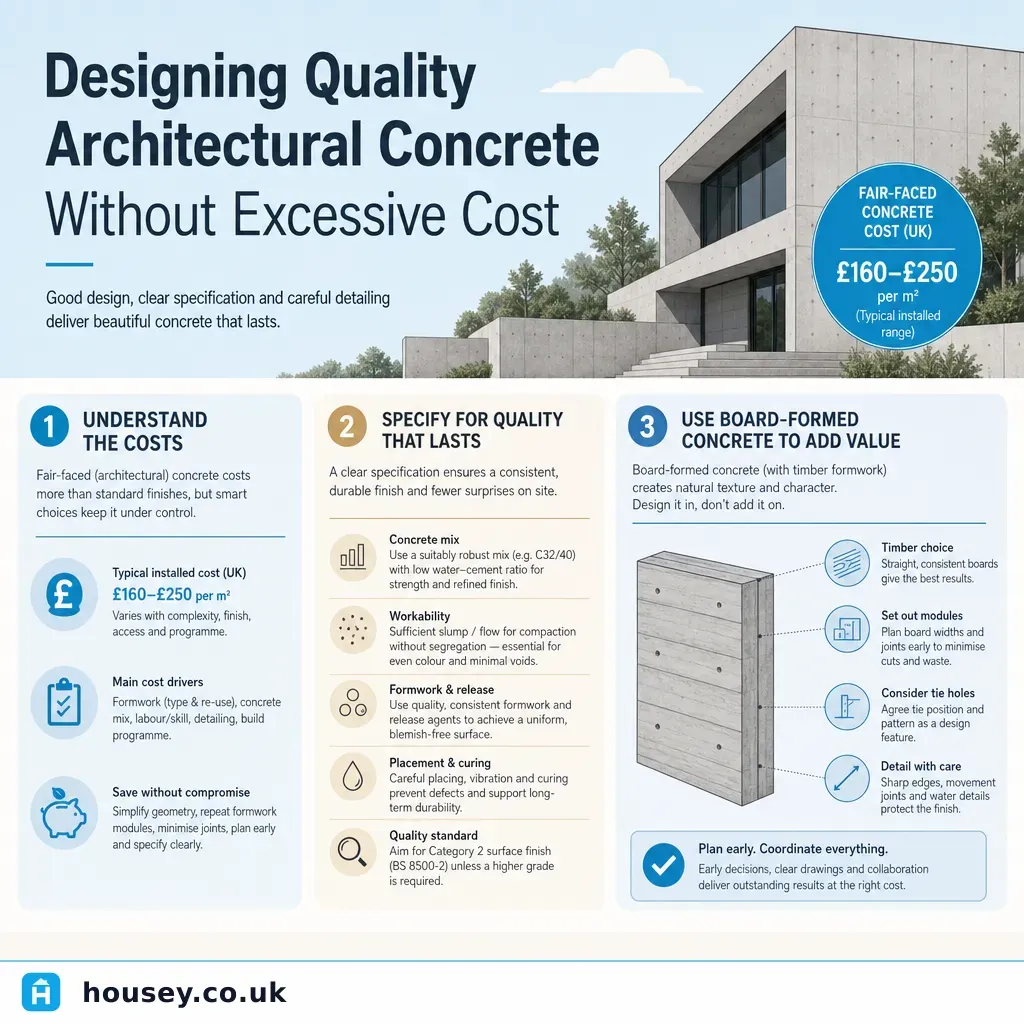
Designing Quality Architectural Concrete Without Excessive Cost
Architectural concrete costs can be controlled by repeating panel dimensions to reuse formwork, concentrating fair-faced finishes on high-visibility elements, and producing a detailed mix and workmanship specification before work starts.
 Planning & Pre-Build
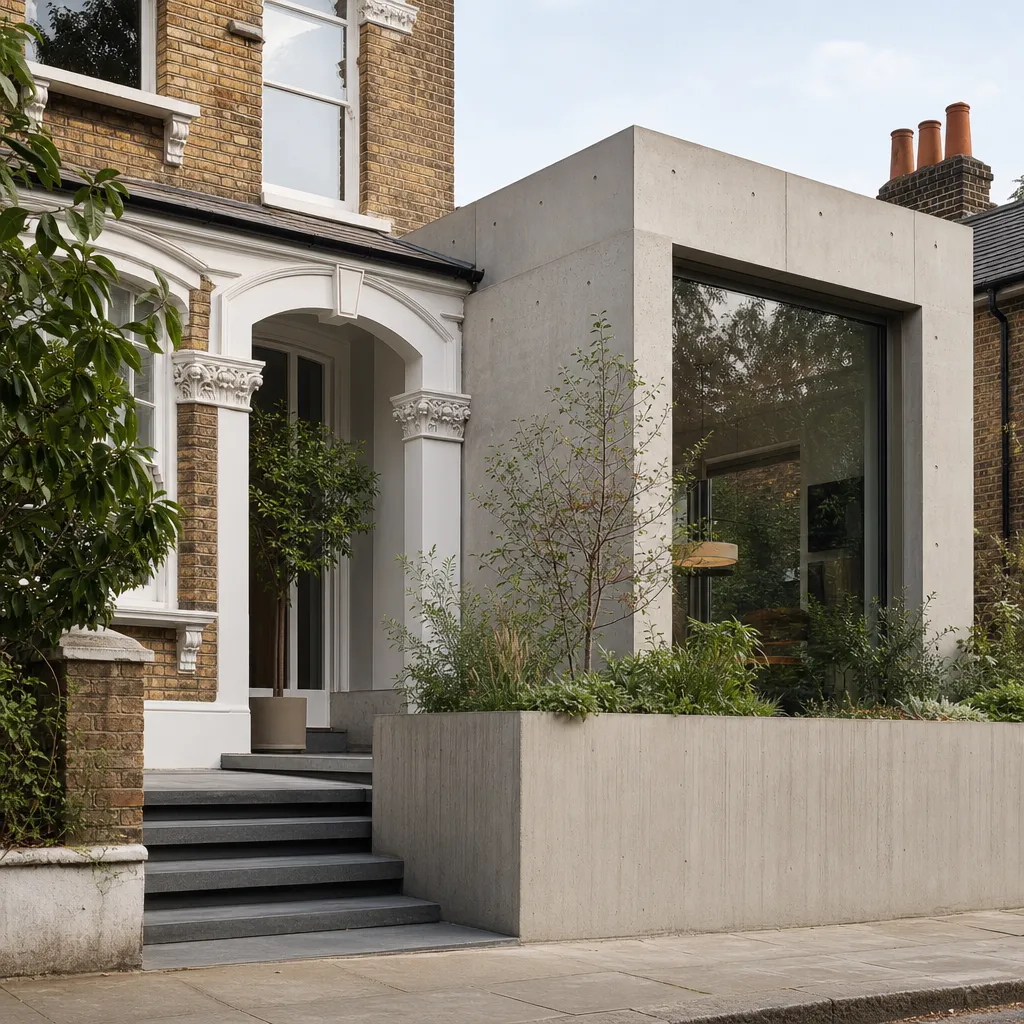
Contemporary Architectural Concrete: Blending New with Historic Buildings
Contemporary concrete can work well alongside historic buildings, but any extension to a listed building requires Listed Building Consent in addition to planning permission.
 Planning & Pre-Build
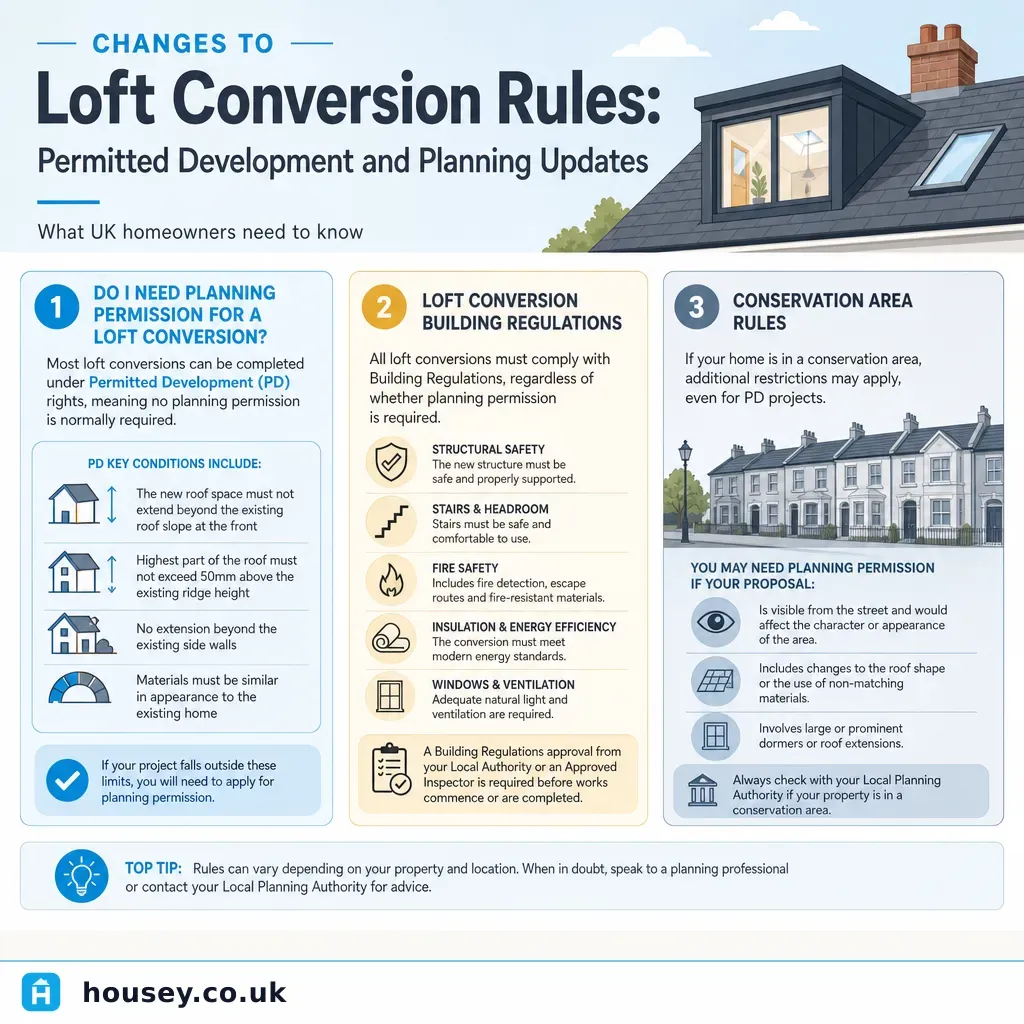
Changes to Loft Conversion Rules: Permitted Development and Planning Updates
In England, most loft conversions on standard houses qualify as Permitted Development under Class B of the GPDO 2015, allowing up to 40 cubic metres (terraced) or 50 cubic metres (detached or semi-detached) without a planning application — if conditions are met.
 Planning & Pre-Build
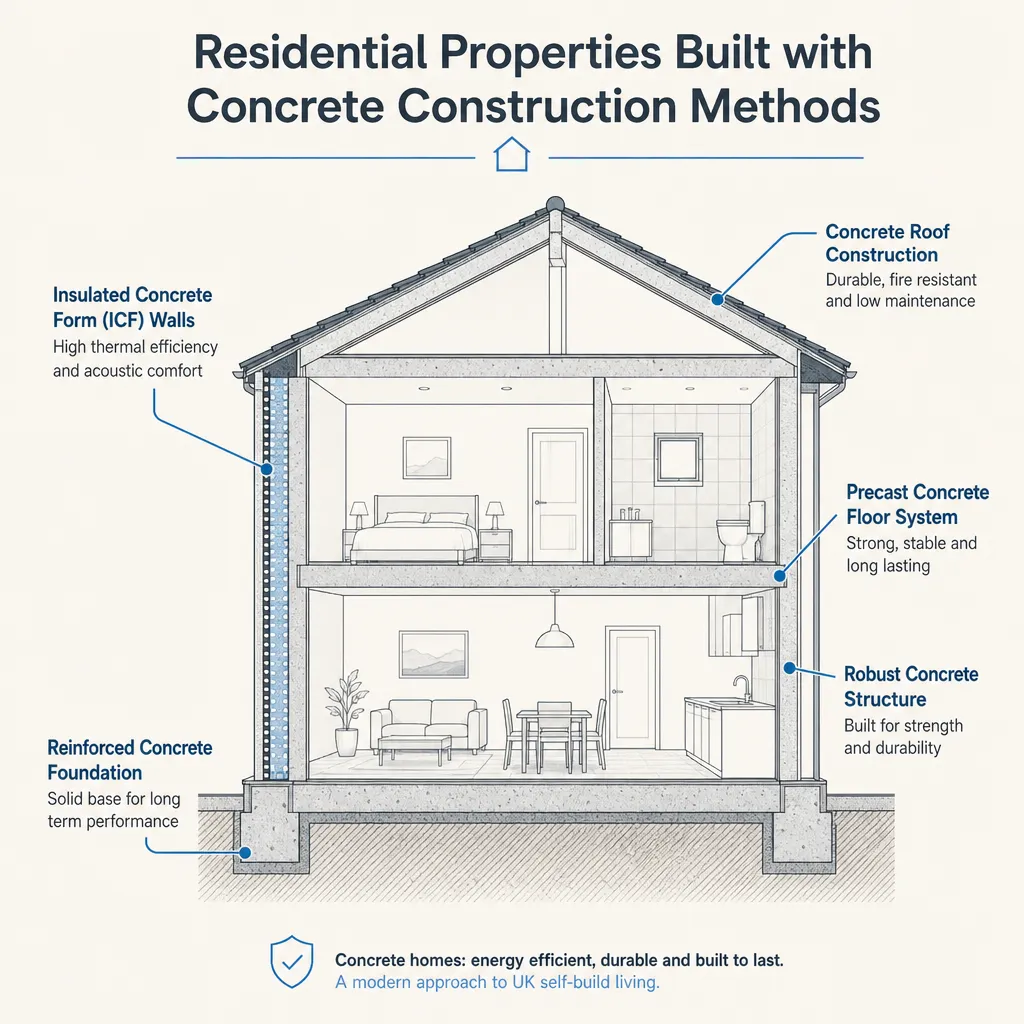
Residential Properties Built with Concrete Construction Methods
UK homes are built using several concrete methods: in-situ cast concrete, precast panel systems, insulating concrete formwork (ICF), and older non-traditional types such as Wimpey No-Fines and Laing Easiform.
 Planning & Pre-Build
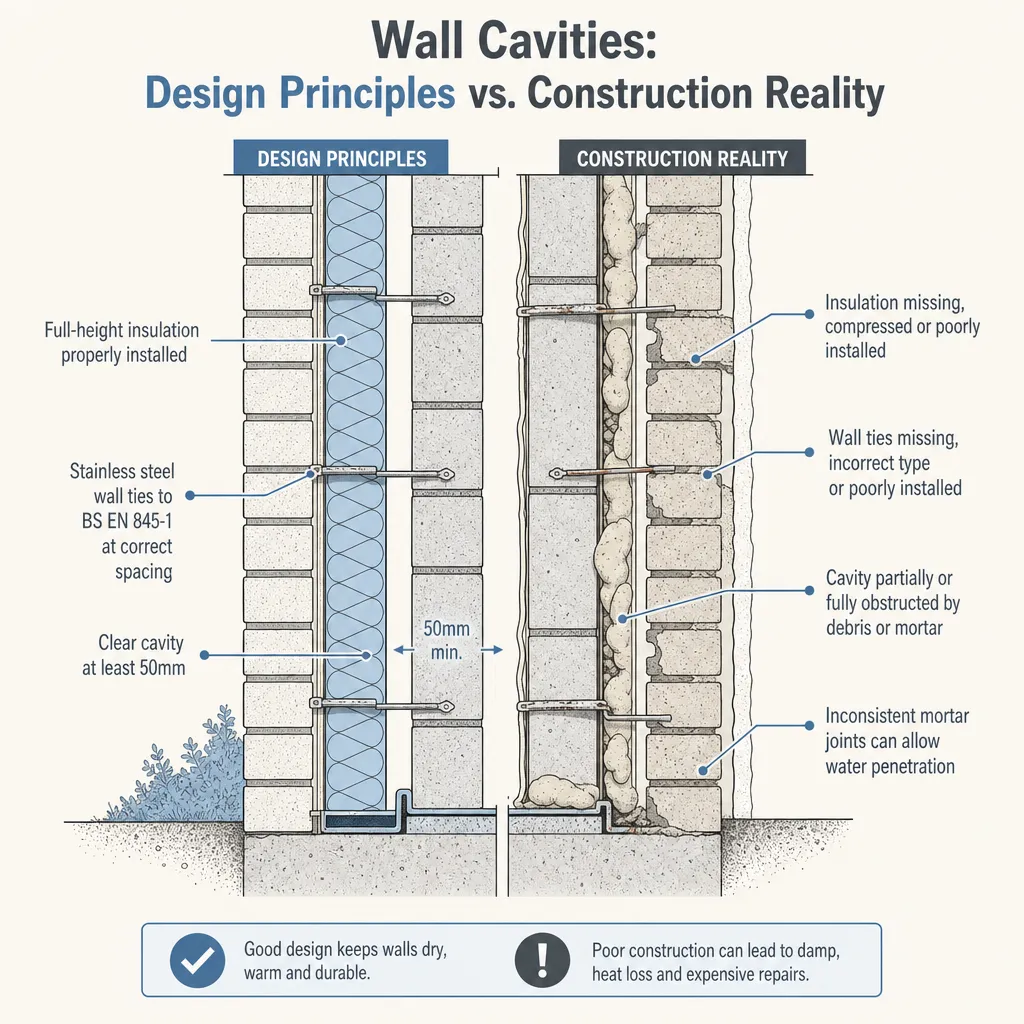
Wall Cavities: Design Principles vs. Construction Reality
A UK cavity wall is designed to resist weather, control heat loss, and structurally link two masonry leaves.