Designing Quality Architectural Concrete Without Excessive Cost
By Housey · Last reviewed 24th of May 2026
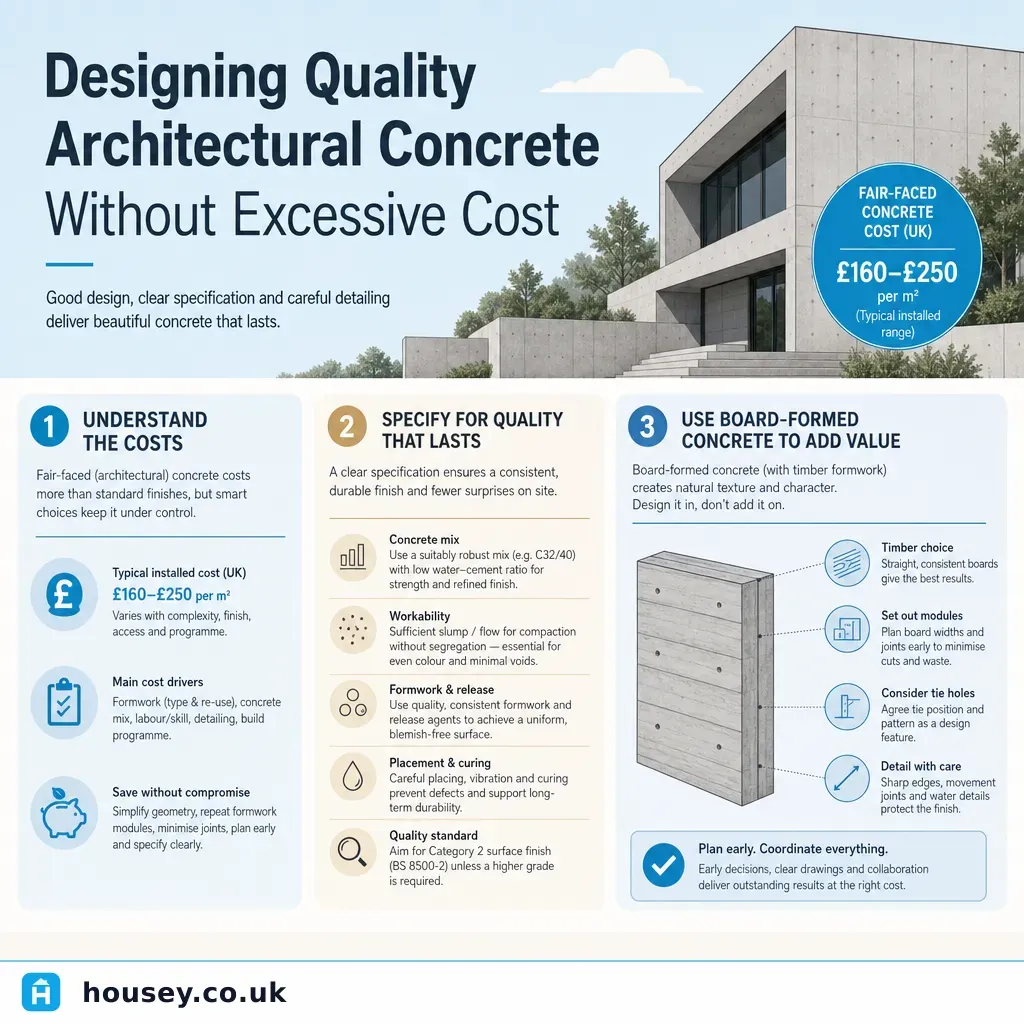
Designing Quality Architectural Concrete Without Excessive Cost
Architectural concrete — often called fair-faced or exposed concrete — is a popular choice among architects and homeowners seeking a material that is simultaneously structural and decorative. Budgets frequently tighten when specifications meet reality: a poorly planned concrete scheme can escalate quickly, while a well-considered approach can deliver striking results at a fraction of the expected outlay. Understanding where costs arise, and which decisions drive them, is the foundation of any sensible concrete design strategy.
Key points
- Fair-faced concrete typically costs £120–£250/m² for in-situ poured panels, depending on formwork quality, mix design, and location (Indicative UK costs, last reviewed 2026-05-24).
- Formwork materials and labour account for 40–60% of total in-situ architectural concrete cost — repeating panel sizes and reusing formwork liners directly reduces unit cost.
- Glass Fibre Reinforced Concrete (GFRC) panels can be manufactured off-site for complex geometries at lower installed cost than equivalent in-situ concrete.
- Surface finish selection — smooth (steel-formed), board-marked, bush-hammered, or acid-etched — affects both cost and how visible minor imperfections will be in the finished surface.
- Specifying concrete mix and workmanship requirements through NBS (National Building Specification) clauses reduces the risk of costly patching or remedial polishing on completion.
What drives the cost of architectural concrete?
Architectural concrete costs arise from three main sources: formwork, mix design, and surface treatment. Unlike standard structural concrete that will be hidden behind other finishes, exposed concrete is judged entirely on its appearance. Any blemish — a honeycombed surface, a cold joint, or a colour variation — may require expensive remedial work or, in the worst case, partial removal and repour.
Formwork is the single largest cost variable. Smooth, phenolic-faced plywood (Finnish birch ply) produces the most consistent surface, but the panels are expensive to procure and to fix precisely. Board-formed concrete — where rough-sawn timber boards imprint their grain texture — costs less in materials but requires careful detailing of joint lines and can produce unpredictable results if timber moisture content varies between deliveries.
Mix design for architectural concrete usually involves a carefully controlled water-cement ratio, a consistent cement source (changing cement batches mid-pour can cause colour variation), and sometimes white cement or pigment. Ready-mix suppliers can provide architectural-grade mixes, but the premium over standard C30 concrete is typically 10–25%.
Surface treatment chosen after striking can also alter final cost significantly. A standard steel-formed finish left as-struck is the least expensive option. Bush-hammering, grinding, or acid-etching adds labour cost but can disguise minor surface irregularities that would otherwise be conspicuous.
Which approach suits your project?
Decision tree: choosing your concrete method
- Choose in-situ fair-faced concrete if you want monolithic wall or floor elements, have simple repeated panel geometry, and have a contractor experienced in architectural concrete.
- Choose GFRC (precast GRC) panels if you need complex forms, curved surfaces, thin profiles, or where site access restricts in-situ pouring.
- Choose concrete blockwork with a polished or painted finish if budget is the primary constraint and the aesthetic can accommodate a jointed surface.
- Ask a specialist concrete contractor if the specification involves feature walls, textured formwork liners, or polished concrete floors over underfloor heating.
- Check building control if structural concrete also forms the building envelope — thermal bridging, insulation continuity, and U-value compliance under Building Regulations Part L will require engineering input.
Comparison: architectural concrete methods
Method | Best for | Typical finished cost per m² | Main risk | Skill required |
|---|---|---|---|---|
In-situ fair-faced concrete | Monolithic walls, bespoke geometry | £120–£250 | Surface defects, cold joints | High — specialist contractor |
Precast or GFRC panels | Complex shapes, off-site quality control | £150–£300 installed | Panel joints visible, crane access needed | Moderate — specialist manufacturer |
Polished in-situ floor | Interior slabs, screed over structural floor | £60–£120 | Cracking, reflective consistency | Moderate — polishing specialist |
Blockwork with render or polish | Budget facades, garden walls | £40–£90 | Jointing visible, block cracking | Low — standard masonry |
Indicative UK costs, last reviewed 2026-05-24. Costs exclude VAT, groundworks, and structural engineering fees. Obtain contractor quotes for your specific scheme.
Design economy: where to save and where not to
Good design economy in concrete is not about using less concrete — it is about being deliberate with every decision so that nothing is wasted and nothing needs to be redone.
Where to spend: formwork quality, mix specification, and experienced labour. A poorly poured panel that must be patched or demolished costs far more than any saving achieved by using cheaper ply or a less experienced crew.
Where to save: texture and finish complexity. A simple smooth finish, well executed, is frequently more impressive than a complex textured finish done badly. Repeating the same panel module across a project — a garden wall, a basement, an internal feature wall — allows formwork to be reused and priced more efficiently.
Concentrate spend on visible elements. Many homeowners achieve the architectural concrete aesthetic by specifying it only for elements that will be seen, using conventional masonry or timber frame elsewhere in the structure. This concentrates specialist spend where it delivers maximum visual impact.
Specification matters. Instruct your architect to produce a detailed concrete specification covering: cement source and batch consistency, water-cement ratio, admixtures, formwork type, tie-hole pattern, pour sequence, and remedial work acceptance criteria. Vague specifications lead to disputes at practical completion.
Homeowner checklist: commissioning architectural concrete
When to get professional help
Architectural concrete is not a material for untested contractors. Even experienced general builders may lack the skill to produce a consistently good fair-faced finish. Consider engaging:
- A specialist architect with a portfolio of concrete projects to develop and oversee the specification.
- A specialist concrete contractor or precast manufacturer for complex geometry or high-visibility surfaces.
- A structural engineer where concrete performs a load-bearing function.
- A building control inspector or approved inspector to sign off thermal bridging details and structural elements under Building Regulations.
Red flags: a quote with no written concrete specification; a contractor who cannot provide references for previous architectural concrete work; a quote that includes concrete patching as a standard line item rather than a remediation cost to be avoided.
How Housey can help
Planning a project involving architectural concrete — whether an extension, basement, or interior feature wall — benefits enormously from early architect involvement. Find a qualified architect for your concrete project through Housey to develop the right specification and obtain competitive contractor quotes from the outset.
Frequently asked questions
Is fair-faced concrete more expensive than brick or stone?
Fair-faced concrete can be cost-competitive with quality natural stone, but usually costs more per m² than facing brickwork. The comparison is not material cost alone: concrete can be structural and decorative in a single element, which may reduce overall build cost compared with a brick skin over a separate structural frame.
Can I patch architectural concrete if defects appear?
Minor patching is possible using pigmented repair mortars, but colour-matching poured concrete is difficult and patches are often visible on completion. A well-written specification should define the acceptance criteria for surface defects before work starts, preventing costly disputes at practical completion.
Does architectural concrete require planning permission?
Using concrete as an external material may require planning permission, particularly in conservation areas or where Article 4 Directions restrict permitted development rights. Always check with your local planning authority before committing to an external concrete finish. A conservation area may also limit material choices on visible elevations regardless of other permitted development baselines.
How long does concrete take to reach full strength before finishing?
Concrete typically achieves sufficient strength for formwork striking after 3–7 days, depending on mix design and ambient temperature, but continues curing for 28 days or more. Polishing or grinding should generally wait until the concrete has reached 28-day strength. Your architect or contractor can advise on the appropriate timing for your specific mix design.
Sources and further reading
- Building Regulations Approved Document A (Structure) — GOV.UK
- Building Regulations Approved Document L (Conservation of fuel and power) — GOV.UK
- The Concrete Centre: Architectural and Exposed Concrete — The Concrete Centre (MPA)
- NBS National Building Specification — RIBA Enterprises
- RICS construction cost management guidance — RICS
Useful next reads
 Planning & Pre-Build
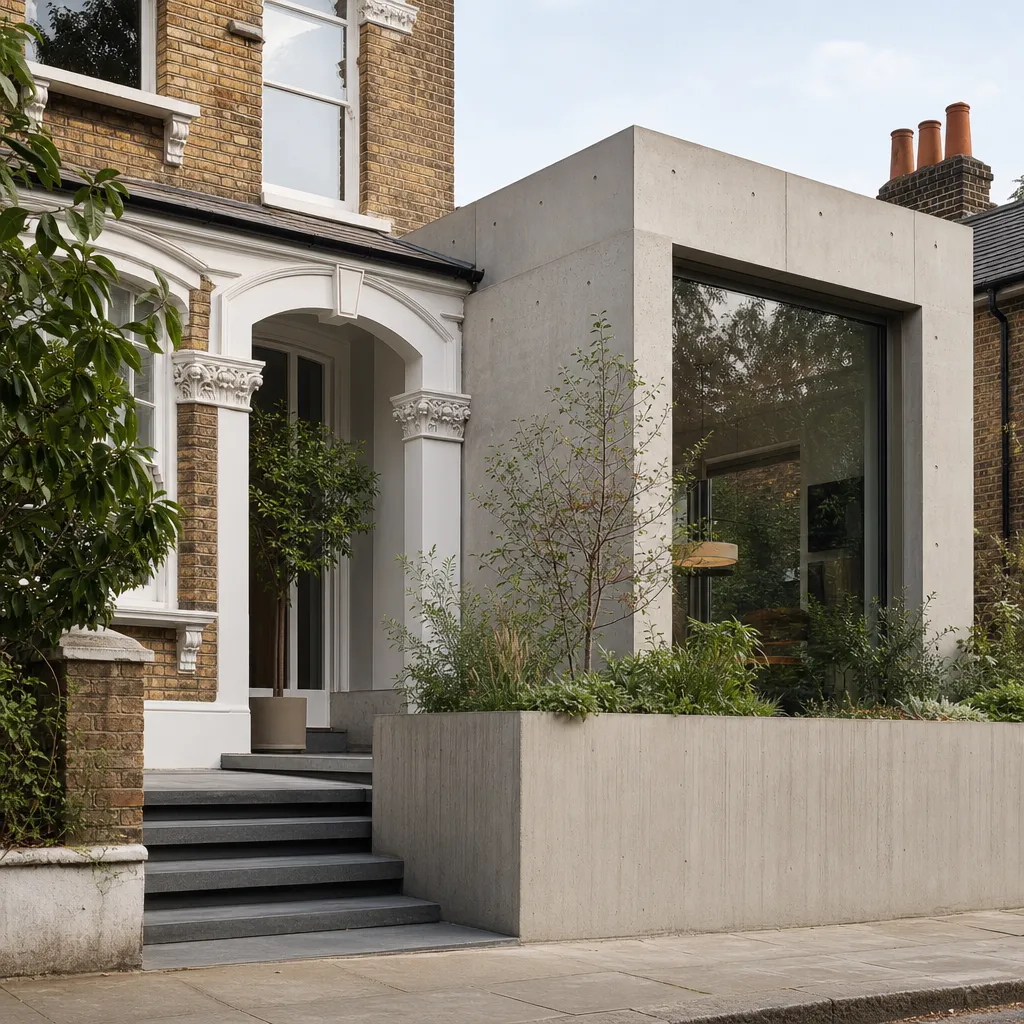
Contemporary Architectural Concrete: Blending New with Historic Buildings
Contemporary concrete can work well alongside historic buildings, but any extension to a listed building requires Listed Building Consent in addition to planning permission.
 Planning & Pre-Build
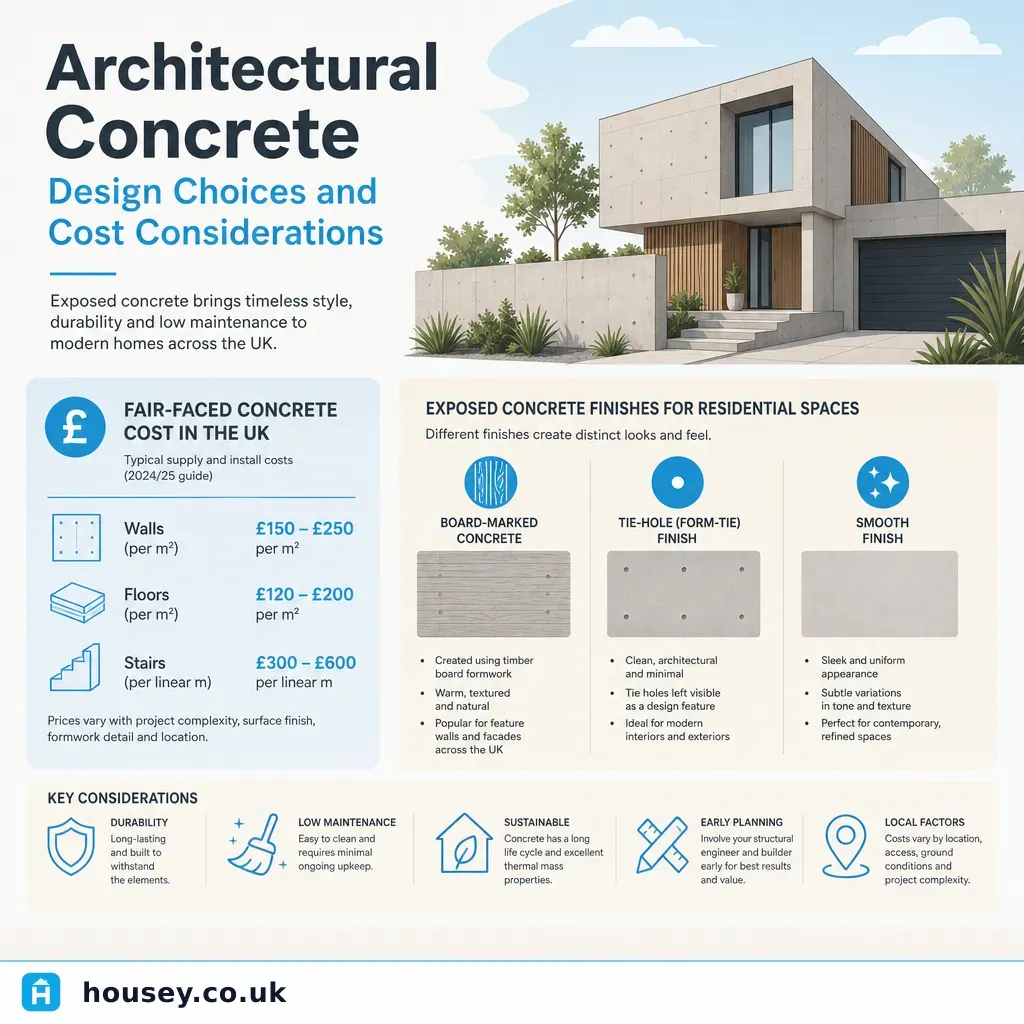
Architectural Concrete: Design Choices and Cost Considerations
Architectural concrete — including fair-faced, board-marked, and polished finishes — demands precise control of mix design, formwork, and curing to achieve a consistent result.
 Planning & Pre-Build
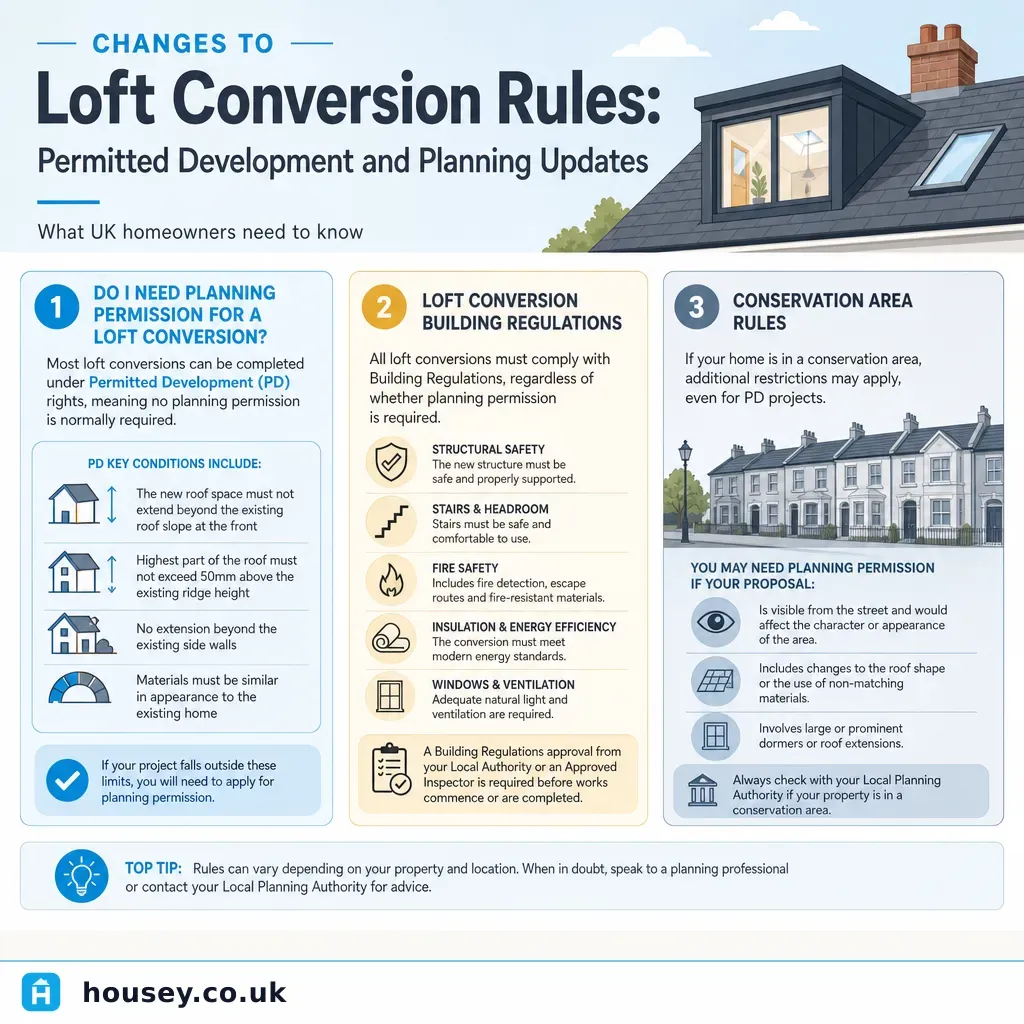
Changes to Loft Conversion Rules: Permitted Development and Planning Updates
In England, most loft conversions on standard houses qualify as Permitted Development under Class B of the GPDO 2015, allowing up to 40 cubic metres (terraced) or 50 cubic metres (detached or semi-detached) without a planning application — if conditions are met.
 Planning & Pre-Build
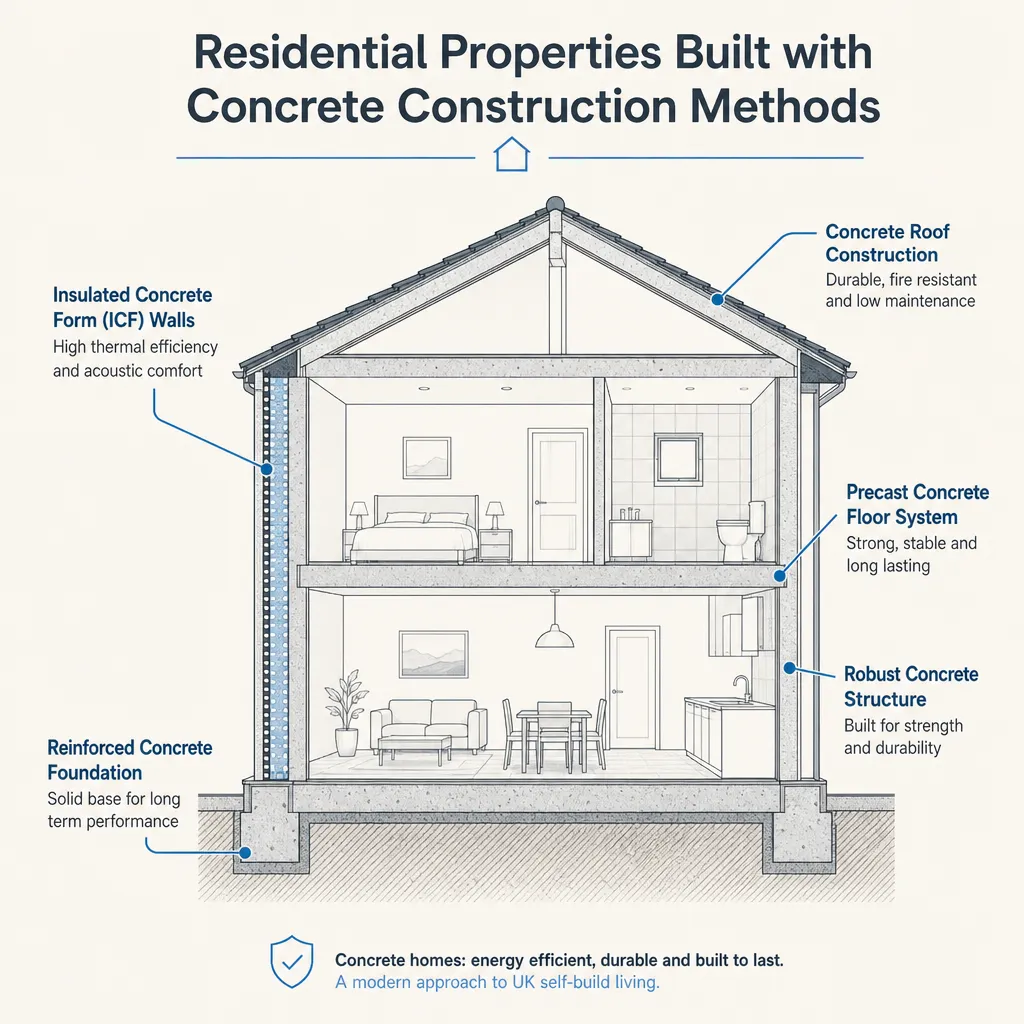
Residential Properties Built with Concrete Construction Methods
UK homes are built using several concrete methods: in-situ cast concrete, precast panel systems, insulating concrete formwork (ICF), and older non-traditional types such as Wimpey No-Fines and Laing Easiform.
 Planning & Pre-Build
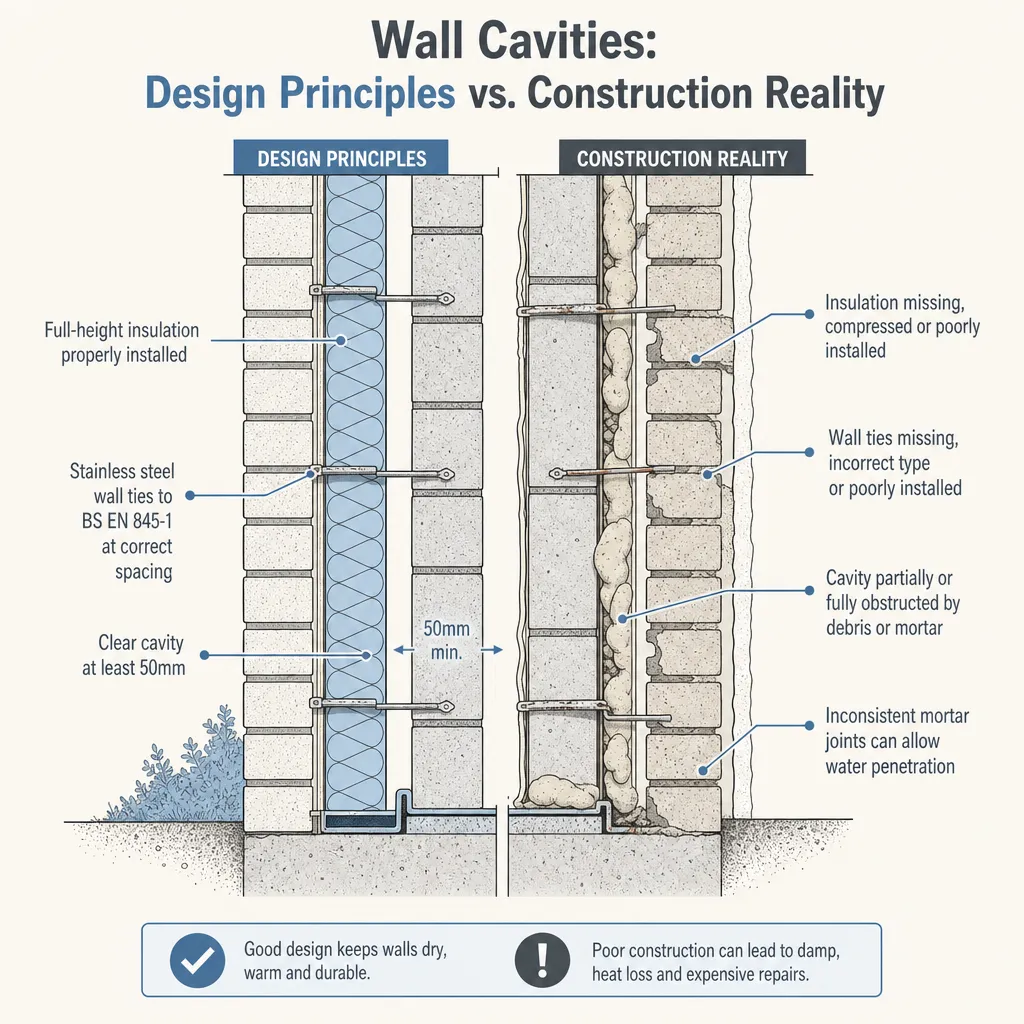
Wall Cavities: Design Principles vs. Construction Reality
A UK cavity wall is designed to resist weather, control heat loss, and structurally link two masonry leaves.