Architectural Design Services for Home Extensions and Renovations
By Housey · Last reviewed 31st of May 2026
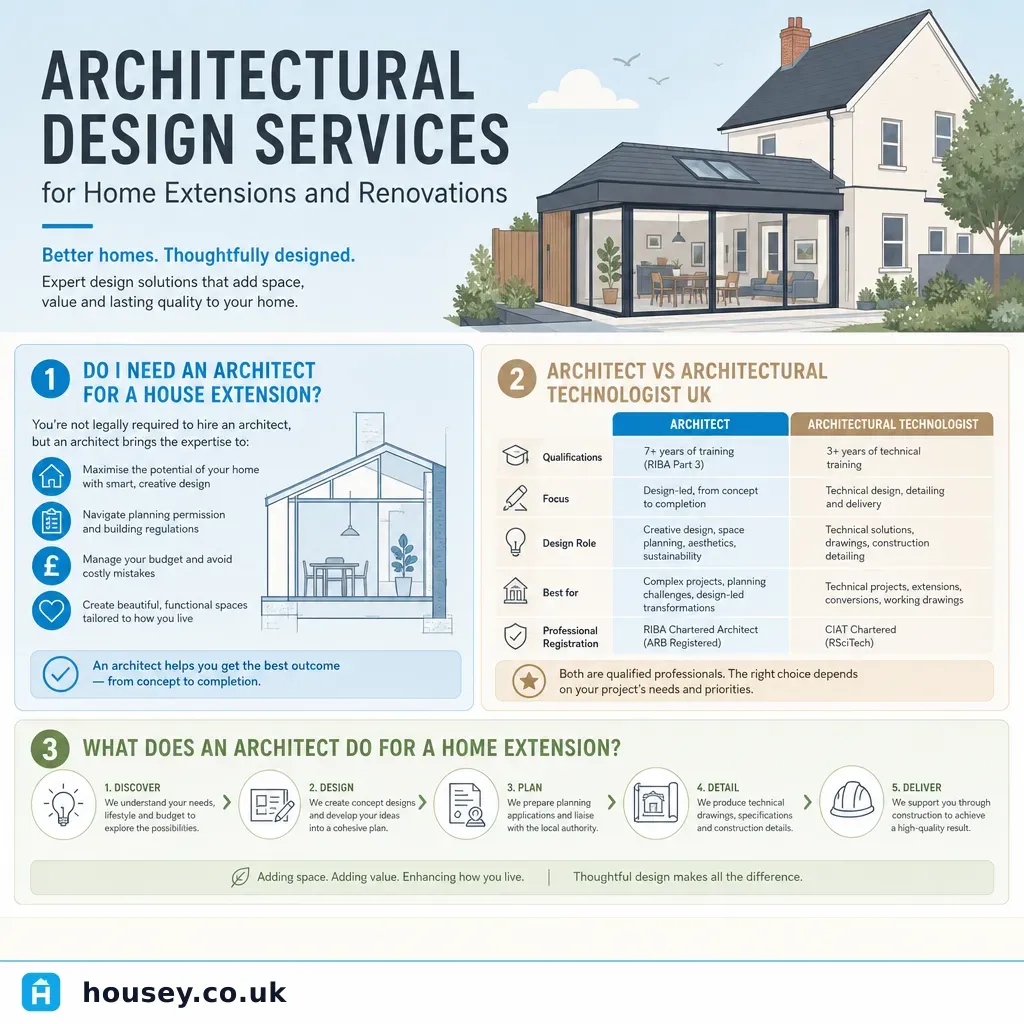
Architectural Design Services for Home Extensions and Renovations
Planning an extension or significant renovation in England or Wales typically means navigating planning applications, building regulations, and a series of technical drawings before a single brick is laid. Whether you are adding a rear extension to a 1930s semi or reconfiguring a Victorian terrace, understanding what design professionals do — and which one your project needs — can save months of delay and avoidable cost.
Key points
- The title 'architect' is legally protected under the Architects Act 1997; only those registered with the Architects Registration Board (ARB) may use it.
- RIBA design stages run from Stage 0 (Strategic Definition) to Stage 7 (Use), with planning permission typically sought at Stage 3 (Spatial Coordination).
- Building Regulations approval — covering structure, fire safety, energy efficiency, and ventilation — is required for most extensions and renovations, regardless of whether planning permission is also needed.
- Permitted development rights allow certain extensions without a full planning application, but limits apply by size, height, proximity to boundaries, and property type; listed buildings and properties in Article 4 Direction areas are excluded.
- An architectural technologist holding Chartered membership of CIAT can produce technical and planning drawings but cannot use the protected title 'architect'.
What does an architectural designer do for an extension or renovation?
A design professional translates your brief — more space, better light, improved layout — into drawings that can be submitted for planning approval and used by builders on site. Their work typically spans several distinct stages:
- Feasibility and brief: Reviewing the site, identifying planning constraints, and assessing what is achievable within your budget.
- Concept and design: Producing sketch proposals and developed layouts for your review.
- Planning drawings: Preparing location plans, block plans, proposed floor plans, elevations, and sections to the standard required by your local planning authority (LPA).
- Technical drawings: Producing construction drawings and specifications compliant with the relevant Approved Documents — particularly Part A (structure), Part B (fire), Part F (ventilation), and Part L (energy efficiency).
- Building control submission: Co-ordinating with a building control body (local authority building control or an approved inspector) for Building Regulations approval.
- Construction phase: Some designers offer contract administration, visiting site and issuing instructions to contractors on your behalf.
The extent of involvement varies by project. A straightforward single-storey rear extension may need only planning drawings and a building regulations pack. A loft conversion or side-return extension involving structural alterations will typically require more detailed specifications and co-ordination with a structural engineer.
Architect, architectural technologist, or design-and-build firm?
Choosing the right professional type depends on your project's complexity, your involvement preference, and your budget.
Option | Best for | Not ideal for | Typical output | Main risk if wrong choice |
|---|---|---|---|---|
RIBA-chartered architect | Complex extensions, listed buildings, conservation areas, full design service | Simple permitted development projects where cost is the priority | Concept drawings, planning pack, building regs drawings, contract admin | Higher fees than alternatives for straightforward work |
Architectural technologist (CIAT) | Standard extensions, loft conversions, building regulations applications | Projects requiring conservation area or listed building design expertise | Planning drawings, building regs drawings, specifications | May lack planning policy depth for complex applications |
Design-and-build firm | Single-point responsibility, straightforward extensions | Bespoke or architecturally ambitious projects | Design, planning, and build contract in one package | Less design flexibility; design may be value-engineered toward the firm's preferred systems |
Structural engineer (standalone) | Specific calculations only — RSJ sizing, beam specification, foundation design | Full design service | Structural calculations and drawings | Not a full design service; works alongside a designer |
Which professional do I need?
- Choose a RIBA-chartered architect if your project is complex or architecturally sensitive; if you are in a conservation area or working on a listed building; or if you want full design oversight including contract administration during the build.
- Choose an architectural technologist if your project is a standard extension or loft conversion; cost is a priority; and you need planning and building regulations drawings without extensive design development.
- Consider a design-and-build firm if you want a single contractor responsible for design, permissions, and construction; and you are working to a fixed budget and defined programme.
- Ask a structural engineer if you specifically need calculations for a load-bearing wall removal, steel beam specification, or foundation design — usually as part of a wider design team rather than as a standalone appointment.
- Check with your local planning authority if your property is in a conservation area, is listed, or falls within an Article 4 Direction area — permitted development rights may be removed, making a planning application compulsory even for smaller works.
What to expect at each RIBA design stage
RIBA publishes a Plan of Work covering eight stages (0–7). For a typical residential extension, the key stages are:
- Stage 1 (Preparation and Briefing): Site survey — usually a measured survey by the architect — initial brief, feasibility assessment, and outline budget.
- Stage 2 (Concept Design): Sketch proposals where you agree the general approach to layout, scale, and materials.
- Stage 3 (Spatial Coordination): Developed design and planning application drawings. Your designer co-ordinates input from structural engineers and other specialists.
- Stage 4 (Technical Design): Construction drawings and specifications for building regulations and tendering to builders.
- Stage 5 (Manufacturing and Construction): Site monitoring, contractor queries, and contract administration if included in your appointment.
Understanding these stages helps you define what service you are buying. Some homeowners commission only to Stage 3 and manage the builder relationship themselves; others retain their designer through to completion.
What goes into a planning application pack?
For a householder planning application in England, the standard documents required by most local planning authorities include:
- Application form and fee (currently £258 for most householder applications in England as of 2026).
- Location plan at 1:1250 scale showing the site within its surroundings.
- Site plan at 1:500 scale showing the site boundary, existing buildings, and proposed works.
- Existing and proposed floor plans, elevations, and roof plans at 1:50 or 1:100 scale.
- Design and Access Statement (required for listed building applications and some larger projects).
- Heritage Statement for listed buildings or properties in conservation areas.
Some LPAs require additional documents. A pre-application enquiry can clarify requirements before submission and reduce the risk of validation delays or late rejection on technical grounds.
When to get professional help
Any extension or structural renovation should involve a suitably qualified design professional. Seek expert input immediately if:
- Your property is listed or in a conservation area — unapproved works can lead to enforcement notices requiring reinstatement at your cost.
- The project involves removing a load-bearing wall or altering the roof structure.
- A neighbour dispute arises over the design — a Party Wall Award under the Party Wall etc. Act 1996 may be required.
- Your permitted development rights have been removed by an Article 4 Direction — your LPA's planning portal will confirm this.
- A planning application is refused — an experienced designer or planning consultant can advise whether to appeal or revise the scheme.
How Housey can help
Housey connects you with qualified local professionals for every stage of your project. You can request quotes from RIBA-qualified architects and architectural practices, compare proposals from chartered architectural technologists for planning and technical drawings, and find specialists for building regulations drawing packages. For projects where you want a single point of responsibility, design-and-build firms can cover design, permissions, and construction in one appointment.
Frequently asked questions
Do I need a chartered architect for a house extension?
Not necessarily. The title 'architect' is legally protected, but many extensions are designed competently by architectural technologists or experienced architectural designers. For standard extensions, a CIAT-chartered architectural technologist is usually sufficient. For complex, sensitive, or architecturally ambitious projects — particularly listed buildings or conservation areas — a RIBA-chartered architect generally offers greater depth of planning policy and design expertise.
What is the difference between an architect and an architectural technologist?
An architect is registered with the Architects Registration Board (ARB) under the Architects Act 1997 and has typically completed a seven-year RIBA-accredited education and work-placement programme. An architectural technologist holds Chartered membership of the Chartered Institute of Architectural Technologists (CIAT) and specialises in the technical design and specification of buildings. Both can prepare planning and building regulations drawings; the distinction matters most on complex or historically sensitive projects.
How much does an architect charge for a home extension?
Indicative UK costs, last reviewed 2026-05-31. Architectural fees vary widely by project complexity, location, and the scope of services. For a straightforward single-storey rear extension, expect approximately 8–15% of construction cost for a full service, or a fixed fee for drawings-only work. Always request itemised quotes and clarify exactly which RIBA stages and deliverables are included.
What planning drawings do I typically need for a householder application?
Most local planning authorities require a location plan (1:1250), a site plan (1:500), and existing and proposed floor plans and elevations (1:50 or 1:100). Some also require a Design and Access Statement, particularly for listed buildings. Your designer should check the local validation checklist before submitting, as requirements vary between authorities.
Sources and further reading
- ARB Register — Who can use the title architect — Architects Registration Board
- RIBA Plan of Work 2020 — Royal Institute of British Architects
- Planning Portal — Householder Application Guide — Planning Portal
- When is permission required (permitted development) — GOV.UK
- Chartered Institute of Architectural Technologists — CIAT
Useful next reads
 Planning & Pre-Build
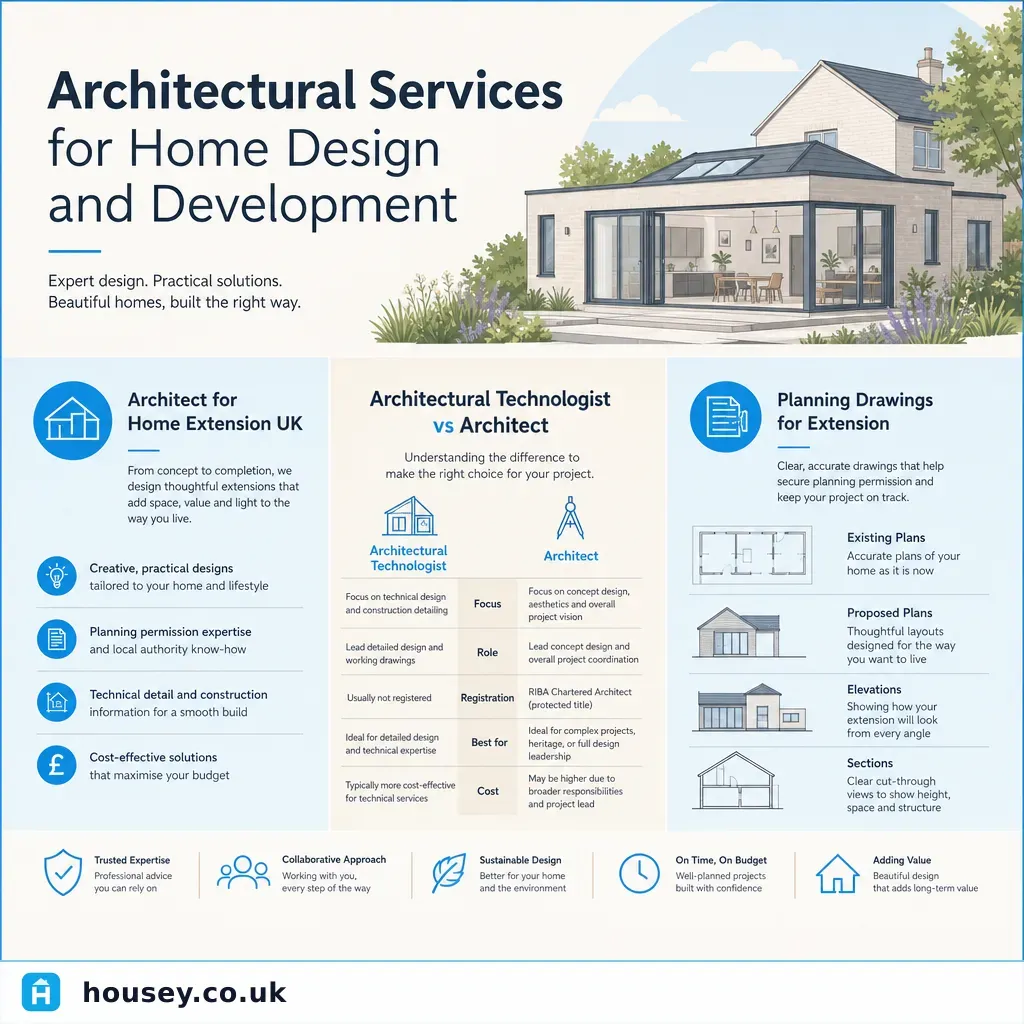
Architectural Services for Home Design and Development
Architects and architectural technologists handle design, planning applications, and building regulations drawings for UK home projects.
 Planning & Pre-Build
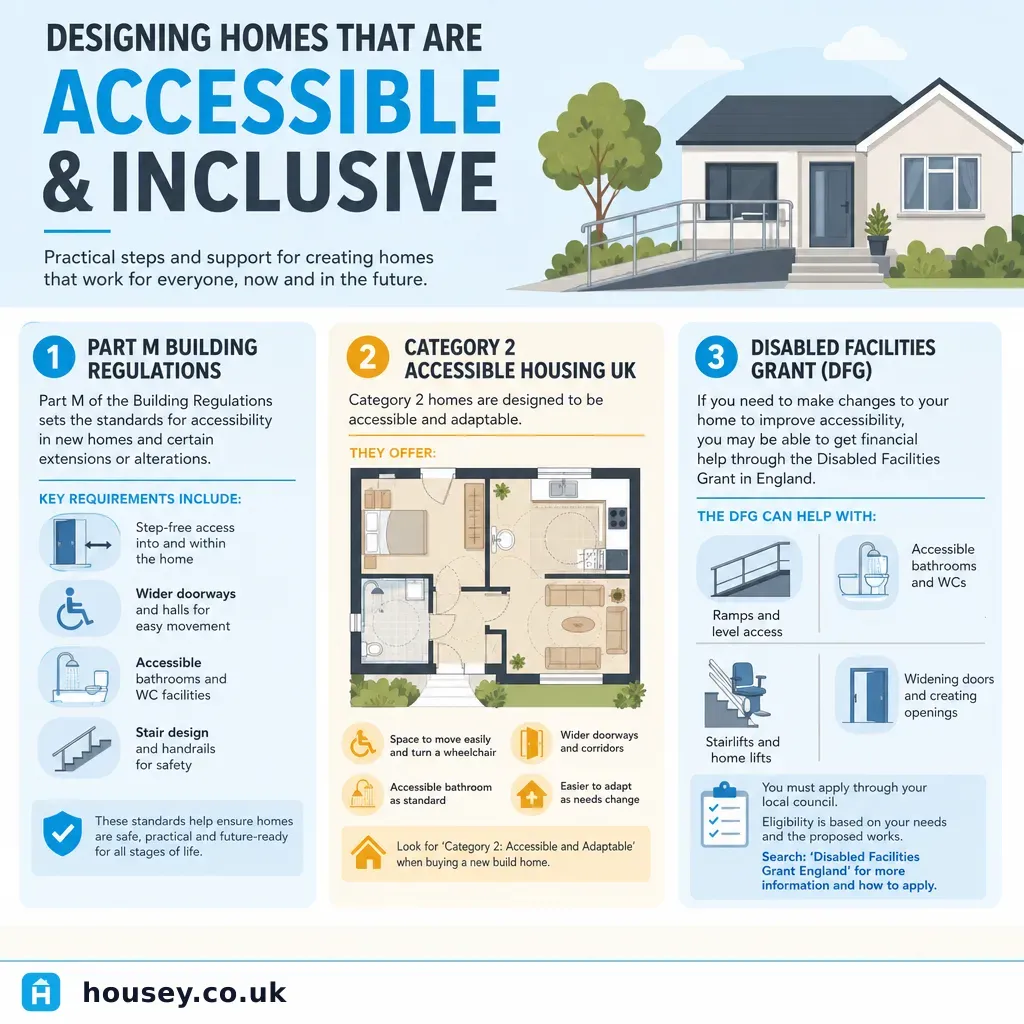
Designing Homes That Are Accessible and Inclusive
Accessible home design in the UK is guided by Building Regulations Approved Document M, which sets three standards for new dwellings: Category 1 (Visitable), Category 2 (Accessible and Adaptable), and Category 3 (Wheelchair User Dwelling).
 Planning & Pre-Build
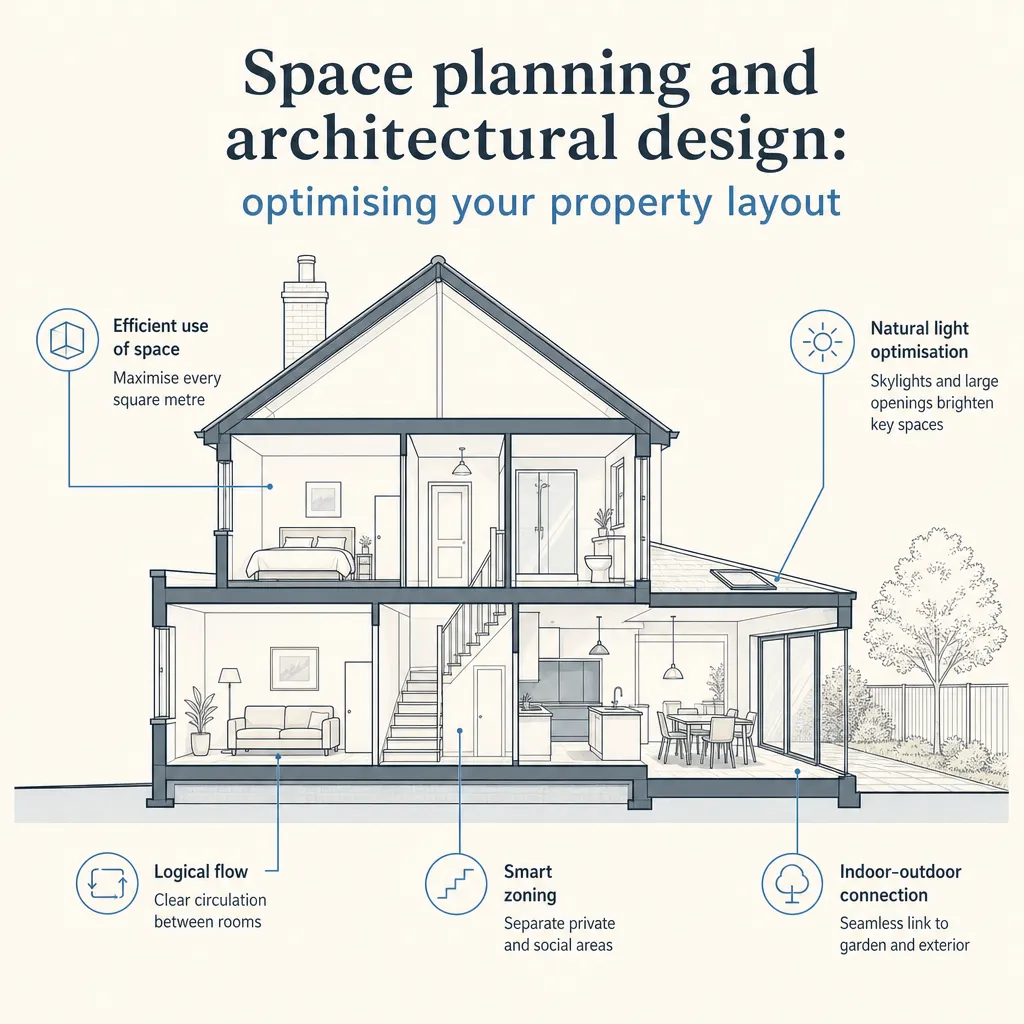
Space planning and architectural design: optimising your property layout
Space planning defines how rooms, circulation routes, and services are arranged within a property to make the best use of available area.
 Planning & Pre-Build
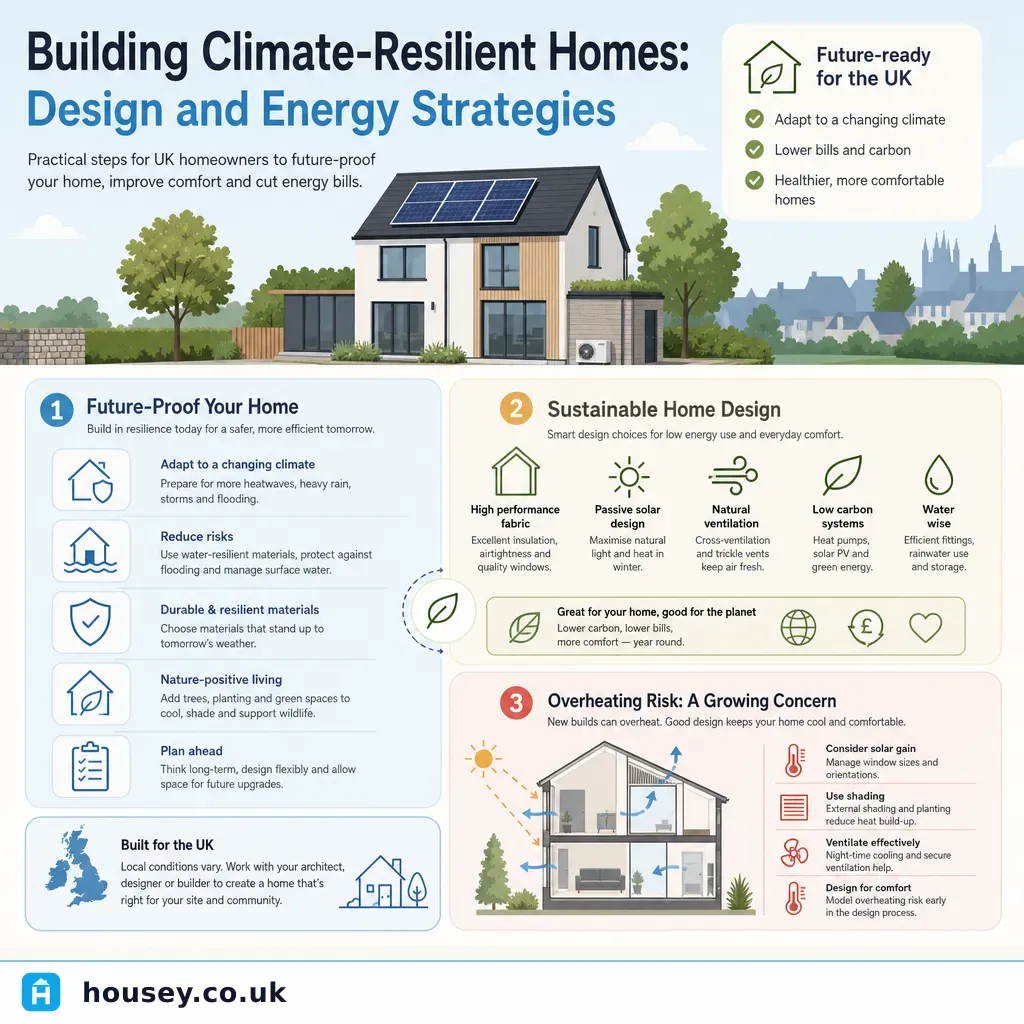
Building Climate-Resilient Homes: Design and Energy Strategies
A climate-resilient UK home handles hotter summers, wetter winters, and rising energy costs through high-performance insulation, overheating mitigation, flood-resilient construction, low-carbon heating, and good water management.
 Planning & Pre-Build
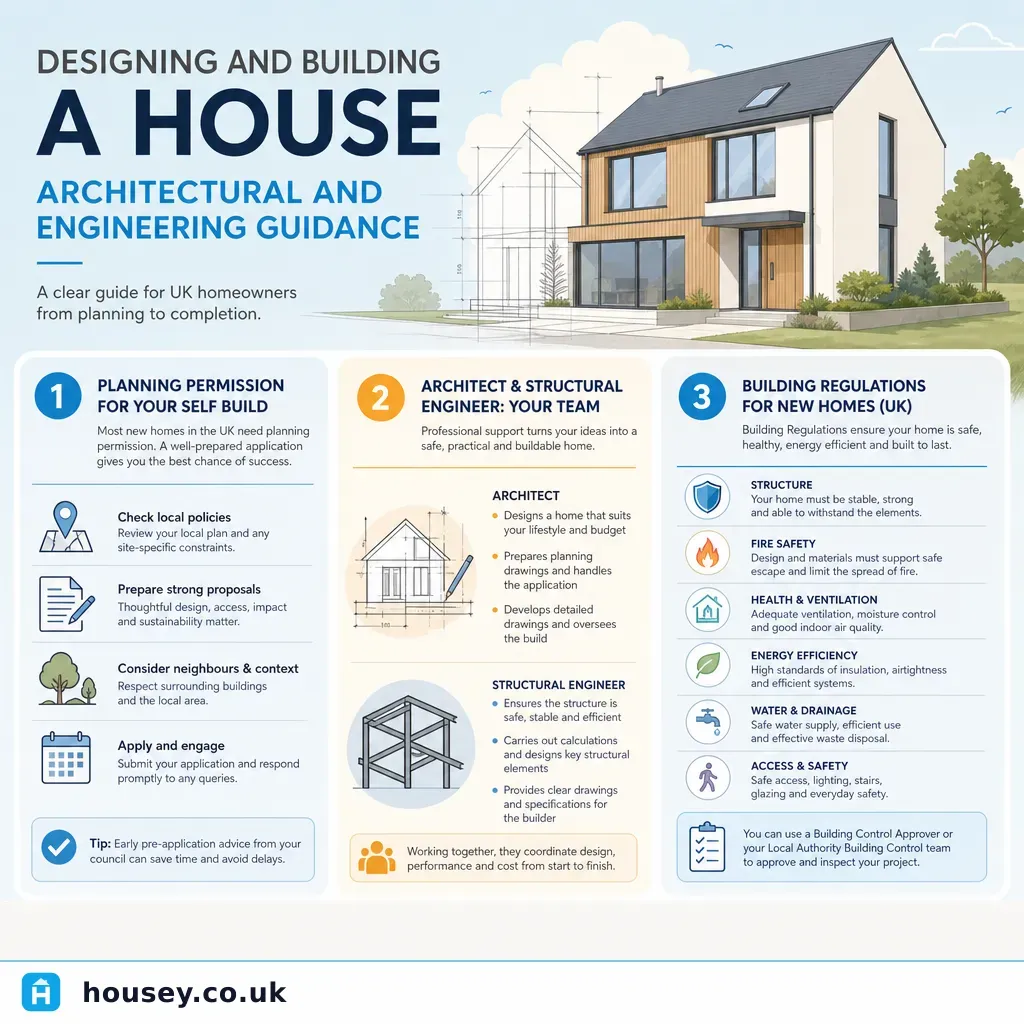
Designing and Building a House: Architectural and Engineering Guidance
Building a new house in the UK requires separate planning permission and Building Regulations approval, a professional team typically including an ARB-registered architect, a structural engineer, and often a civil or geotechnical engineer.