Building Climate-Resilient Homes: Design and Energy Strategies
By Housey · Last reviewed 10th of May 2026
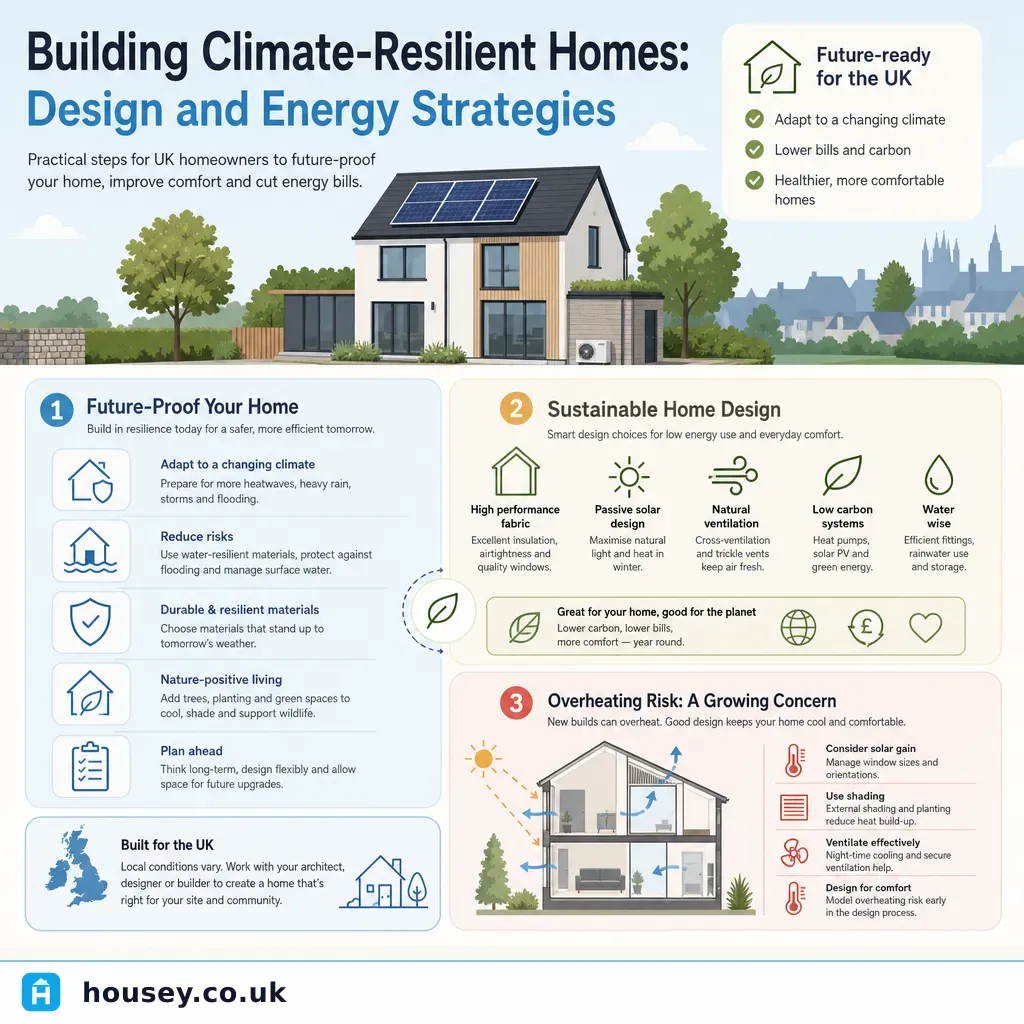
Building Climate-Resilient Homes: Design and Energy Strategies
The climate context for UK housing has shifted materially over the past decade — hotter, drier summers, wetter and stormier winters, and a greater frequency of flood events are now planning realities rather than distant projections. For anyone commissioning a new build, planning a significant extension, or undertaking a deep retrofit, how the building will perform over the next 30 to 50 years is becoming as important as how it performs on the first day of occupation. The decisions made at design stage — orientation, insulation specification, ventilation strategy, glazing area, and drainage design — are substantially cheaper to get right on the drawing board than to correct once the building is complete.
Key points
- Building Regulations Approved Document O (Overheating) came into force in England in June 2022 and requires new homes to limit solar gains and provide adequate purge ventilation — two compliance routes are available: simplified (glazing limits by orientation) and dynamic thermal modelling via CIBSE TM59.
- The Future Homes Standard is expected to require new homes built from 2025–2026 to produce 75–80% fewer carbon emissions than homes built to 2013 standards, effectively mandating heat pumps or other low-carbon heating in new construction.
- PAS 2035 — the retrofit standard for domestic buildings — requires a moisture and ventilation risk assessment as a mandatory step before insulation measures are installed in existing homes.
- The Environment Agency's Flood Map for Planning is the primary reference for assessing flood risk at site selection and design stage; sites in Flood Zone 2 or 3 typically require a Flood Risk Assessment (FRA) as part of a planning application.
- CIBSE TM59 overheating methodology is increasingly referenced by local planning authorities in design and access statements for new residential schemes, particularly in urban areas.
What climate resilience means for a UK home
A climate-resilient home performs well across a range of conditions — not just an average year but hotter summers, heavier rainfall events, and periods of sustained cold. The main challenges UK homes currently need to address through design are:
- Overheating — particularly in south-facing top-floor rooms, new builds with large glazed areas, and urban locations with high heat-island effects
- Flooding — both river and coastal flood risk and, increasingly, surface water flooding after intense rainfall events
- Wind-driven rain — relevant to solid-wall properties and exposed locations, affecting wall U-values and moisture risk in retrofits
- Energy cost resilience — reducing dependence on gas through improved fabric performance and integration of renewables
Design strategies: a comparison
Strategy | What it addresses | When to specify | Approximate benefit |
|---|---|---|---|
High-performance fabric insulation (EPC A / Passivhaus) | Heat loss; energy bills; peak demand reduction | New build; deep whole-house retrofit | Heating demand reduced by 50–90% vs pre-2000 stock |
Mechanical ventilation with heat recovery (MVHR) | Indoor air quality; moisture control; overheating risk in airtight homes | Airtight new builds; deep retrofits with improved airtightness | Recovers 70–90% of heat from exhaust air |
External shading (louvres, overhangs, external blinds) | Solar overheating; Part O compliance | South- and west-facing glazing in new builds or extensions | More effective than internal blinds at reducing solar gain |
Green or sedum roof | Rainwater attenuation; insulation uplift; biodiversity net gain | New build or extension with flat or low-pitch roof | Retains 50–80% of rainfall in moderate events |
Permeable paving and SuDS features | Surface water runoff; flood risk contribution; urban heat island | Any driveway replacement; new construction | Reduces peak runoff in line with Schedule 3 / SuDS requirements |
Air source or ground source heat pump | Low-carbon heating; future-proofing against gas regulation | New build; well-insulated existing homes | Achieves coefficient of performance of 2.5–4 in UK conditions |
Battery storage and rooftop solar PV | Energy cost resilience; reduced grid dependence | Most UK properties with south- or east/west-facing roof | 3–4 kWp system generates 2,700–3,500 kWh/year in typical UK location |
Flood-resilient construction (raised floors, water-resistant finishes, flood doors) | Flood damage limitation; reduced recovery time | Flood Zones 2 and 3; surface water flood risk areas | Can reduce flood repair costs by 30–50% compared with standard construction |
Indicative performance figures are approximate and depend on property size, orientation, and site conditions.
Overheating risk and Building Regulations Part O
Part O came into force in June 2022 for new residential buildings in England. It sets out two compliance routes:
- Simplified method — limits the proportion of solar-gain glazing on each elevation based on its orientation. No thermal calculation is required; suitable for straightforward, conventionally orientated designs.
- Dynamic thermal modelling — uses CIBSE TM59 methodology to demonstrate by calculation that the dwelling will not overheat under both current climate data and projected 2080 UK climate scenarios.
Key design responses that support Part O compliance include:
- Limiting south- and west-facing glazing to the proportions set out in Approved Document O
- Specifying external rather than internal shading — internal blinds have limited effect on reducing solar gain once heat has already passed through the glass
- Designing for natural cross-ventilation by positioning openable windows on opposing elevations
- Specifying high thermal mass materials (in-situ concrete, dense block, brick) to moderate internal temperature swings
Most architects and architectural technologists working on new residential projects are now familiar with Part O. Extensions and material changes of use are currently largely exempt, but some local authorities encourage voluntary overheating assessment for major residential extensions.
Flood resilience at design stage
For sites in Environment Agency Flood Zones 2 or 3, or identified in surface water flood mapping as at risk, key design decisions include:
- Finished floor levels raised above the predicted flood level relevant to the return period specified — the Environment Agency often sets this as a condition of planning permission
- Water-resistant floor finishes and service entry points — specifying finishes and materials that can be dried out rather than stripped out after a flood event
- Flood doors and airbrick covers — resilience measures that accept flood risk rather than relying solely on resistance
- Drainage design that uses SuDS features to attenuate peak runoff and avoids direct connection to a combined sewer
A planning application on a flood-risk site in England will normally require a Flood Risk Assessment prepared by a suitably qualified engineer and approved by the Environment Agency.
Future-proofing a retrofit under PAS 2035
Retrofitting for climate resilience involves more than adding insulation. PAS 2035 sets out a whole-house approach that requires:
- A retrofit assessment identifying current energy performance, moisture risks, and ventilation adequacy before any measures are designed
- A qualified retrofit coordinator overseeing the design of the improvement package and ensuring individual measures work together as a system
- Explicit attention to airtightness — improving fabric performance without corresponding ventilation improvement can cause condensation and moisture damage, particularly in pre-1919 solid-wall properties where the wall acts as a moisture buffer
For Victorian and Edwardian terraces and other pre-1919 solid-wall construction, internal or external wall insulation fundamentally changes the hygrothermal behaviour of the wall. Interstitial condensation risk must be assessed using dynamic vapour diffusion modelling, particularly in exposed or north-facing locations. PAS 2035 moisture risk assessment is the appropriate framework for managing this.
Which professional do I need?
Professional | When you need them | Key credentials |
|---|---|---|
Architect | New build design lead; planning applications; Part O compliance strategy; flood-resilient design | ARB registered; RIBA chartered |
Architectural technologist | Building Regulations drawings; design detailing; smaller projects where planning is not required | CIAT chartered |
Energy-efficiency consultant | Fabric performance modelling; SAP/EPC compliance; Part L; heat pump system sizing | TrustMark registered; relevant CIBSE or CABE qualification |
Retrofit coordinator (PAS 2035) | Overseeing retrofit projects on existing homes; ensuring measures work as a system | PAS 2035 qualified; TrustMark registered |
MCS-certified installer | Heat pump or solar PV installation and commissioning | MCS certification for the relevant technology |
When to get professional help
Climate resilience involves system-level design decisions that interact with each other and with the existing fabric of a building. Seek professional input at design stage if:
- The site is in Environment Agency Flood Zones 2 or 3 or is identified in surface water flood mapping as at risk
- The property is pre-1919 solid-wall construction and you are planning insulation measures
- You are designing a new build and want Part O compliance via the dynamic thermal modelling route
- You are specifying a heat pump for an existing property and are uncertain whether the existing fabric is sufficiently well-insulated for the system to perform efficiently
- You are seeking biodiversity net gain or planning conditions requiring a SuDS drainage scheme
How Housey can help
Housey connects you with qualified architects and architectural technologists who can design climate-resilient homes, manage planning applications, and ensure Building Regulations compliance across Parts L, O, and F. Housey also works with energy-efficiency consultants who can model fabric performance, specify the right retrofit package, and help you navigate the PAS 2035 process from assessment to completion.
Frequently asked questions
What does climate resilience mean for a UK home?
A climate-resilient UK home performs well in hotter summers, heavier rainfall events, and periods of sustained cold — and is less vulnerable to rising energy costs. Key features include high-performance fabric insulation, effective ventilation, overheating mitigation through design, drainage that handles increased rainfall, and low-carbon heating. For new builds, Building Regulations Part O and the Future Homes Standard set minimum requirements. For existing homes, PAS 2035 sets out the whole-house retrofit framework.
Does Building Regulations cover overheating risk in new homes?
Yes. Building Regulations Part O (Overheating) came into force in England in June 2022 for new residential buildings. It requires designers to limit solar gains and provide adequate means of purge ventilation. Compliance can be demonstrated via a simplified method or by dynamic thermal modelling using CIBSE TM59 methodology. Most extensions and existing buildings are currently largely exempt, though good practice encourages overheating consideration in all residential projects.
How do I make an older home more climate resilient?
Start with a retrofit assessment under PAS 2035 to identify current energy performance, moisture risks, and ventilation adequacy. Prioritise fabric improvement — loft and floor insulation first, then walls — alongside ventilation to avoid condensation risk. Install a low-carbon heating system once the fabric is adequately insulated. For flood risk, check your Environment Agency Flood Zone and consider water-resistant finishes and flood resilience measures alongside any planned renovation works.
Which professionals do I need for a climate-resilient new build?
For a new build, an architect or architectural technologist leads the design and manages Building Regulations compliance across Parts L, O, and F. An energy-efficiency consultant handles detailed fabric performance modelling, EPC targets, and heating system specification. MCS-certified contractors install heat pump and solar PV systems. For retrofits, a PAS 2035 retrofit coordinator oversees the project as a system, ensuring individual measures work together without creating moisture or ventilation problems.
Sources and further reading
- Approved Document O: Overheating — GOV.UK / DLUHC
- TM59: Design methodology for the assessment of overheating risk in homes — CIBSE
- Flood Map for Planning — Environment Agency
- PAS 2035: Retrofitting dwellings for improved energy efficiency — BSI
- Future Homes Standard — GOV.UK
Useful next reads
 Planning & Pre-Build
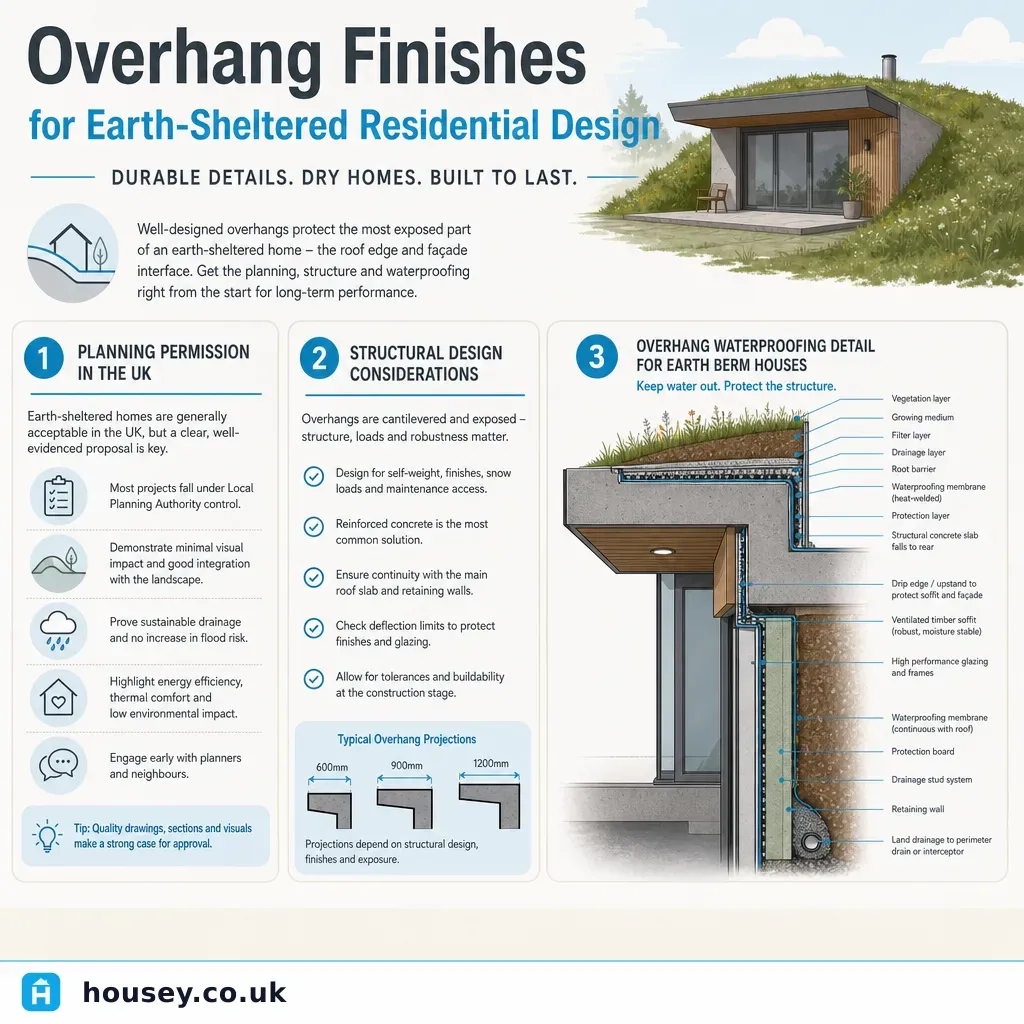
Overhang Finishes for Earth-Sheltered Residential Design
Overhang design in earth-sheltered homes combines structural, waterproofing, thermal, and planning requirements that must be integrated from the earliest design stage.
 Planning & Pre-Build
Architectural Design Services for Home Extensions and Renovations
Architectural design services for UK extensions and renovations span initial feasibility, planning drawings, building regulations packages, and site monitoring.
 Planning & Pre-Build
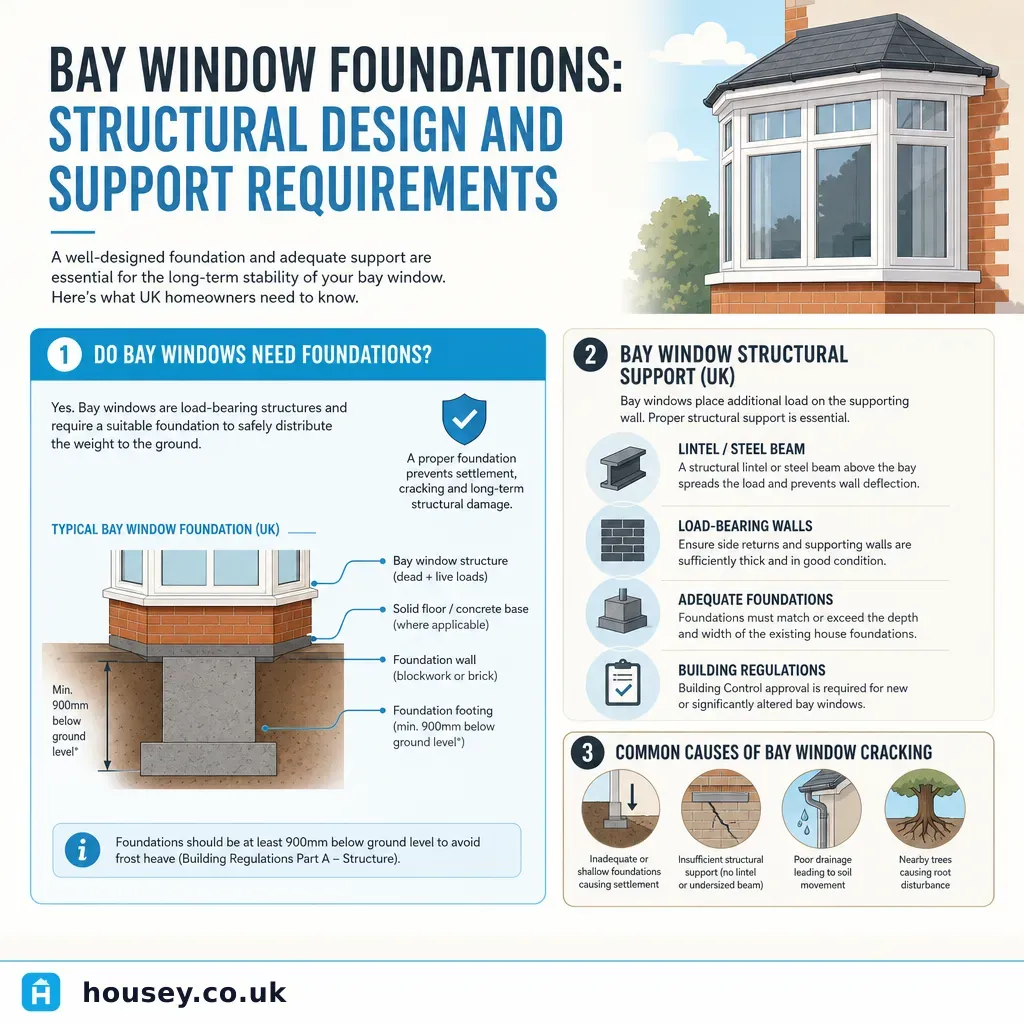
Bay Window Foundations: Structural Design and Support Requirements
Bay window foundations must transfer the bay's structural load to the ground independently of the main wall.
 Planning & Pre-Build
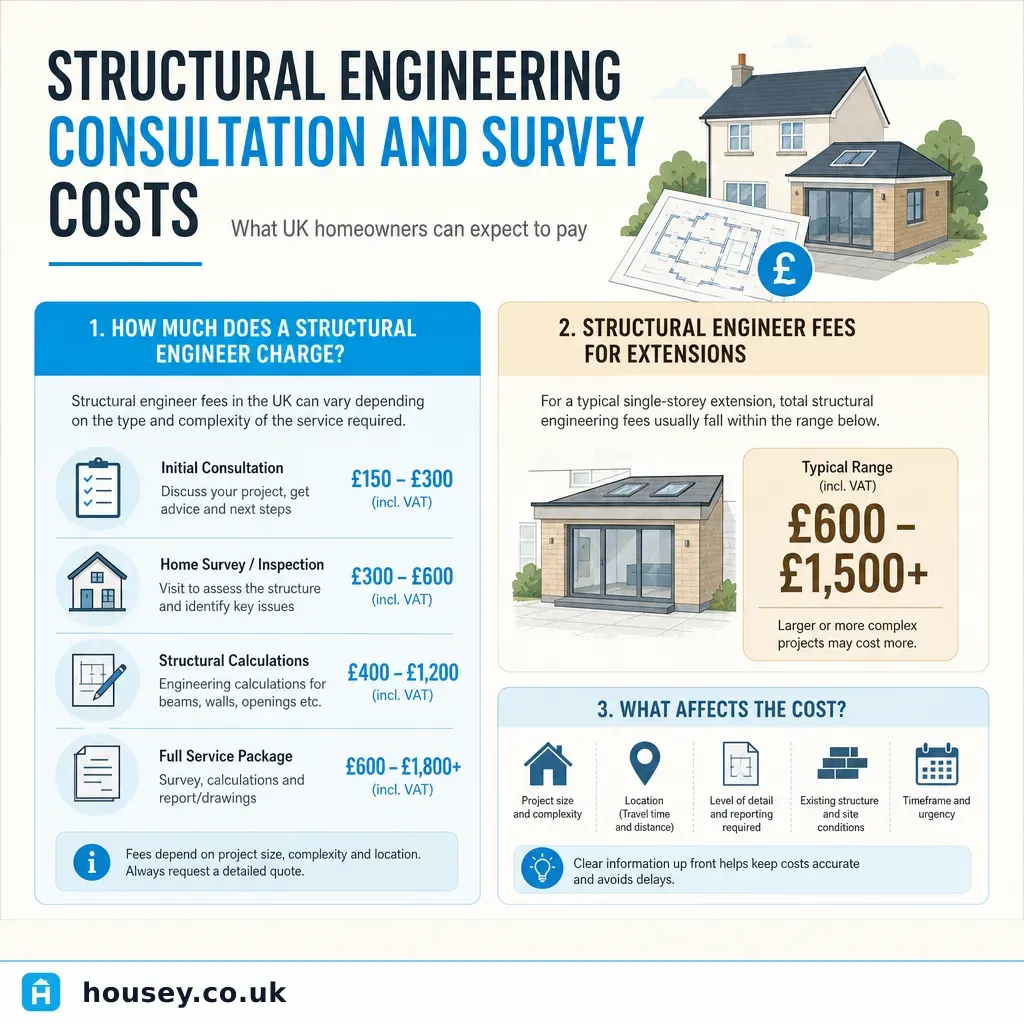
Structural Engineering Consultation and Survey Costs
A structural engineer consultation in the UK typically costs £300–£800 for a specific defect report or pre-purchase assessment.
 Planning & Pre-Build
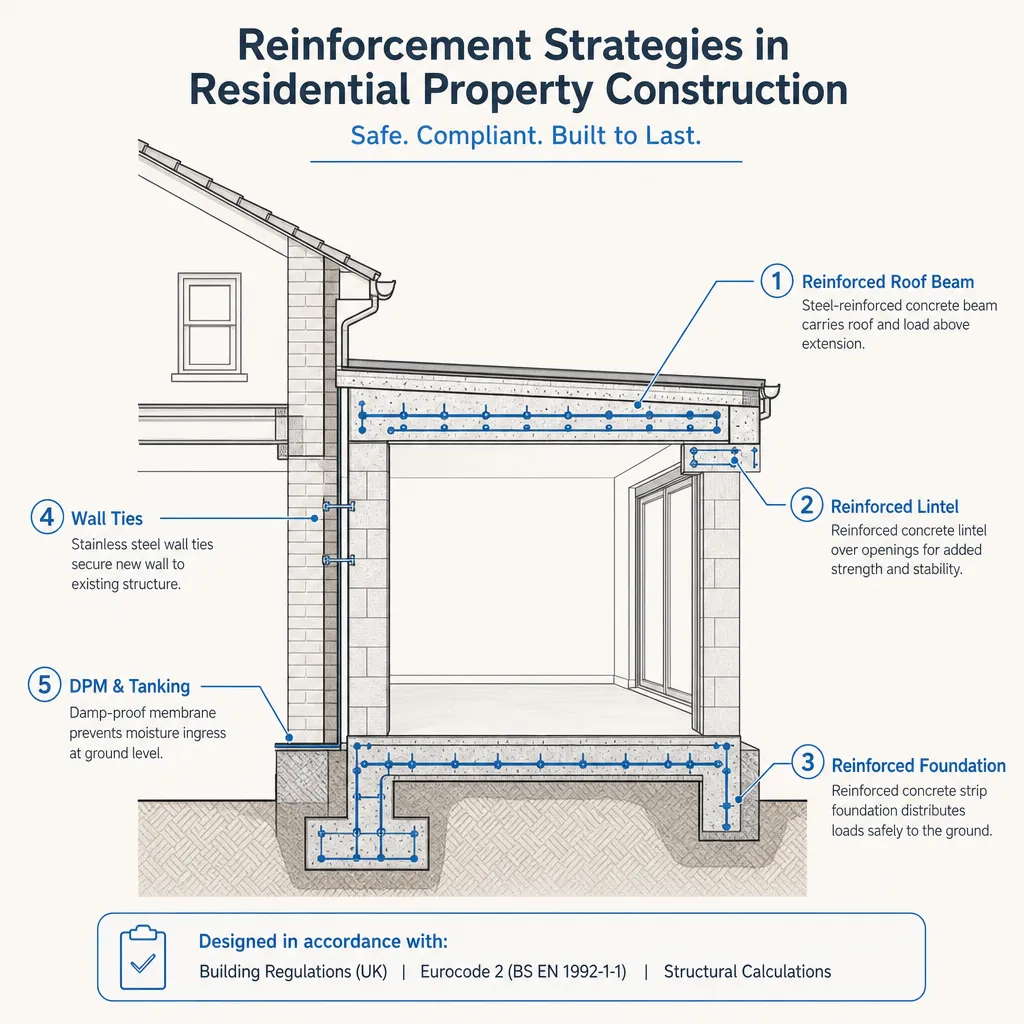
Reinforcement Strategies in Residential Property Construction
In UK residential construction, reinforcement is specified by a chartered structural engineer and must comply with Eurocode 2 and Building Regulations Approved Document A.