Designing and Building a House: Architectural and Engineering Guidance
By Housey · Last reviewed 19th of May 2026
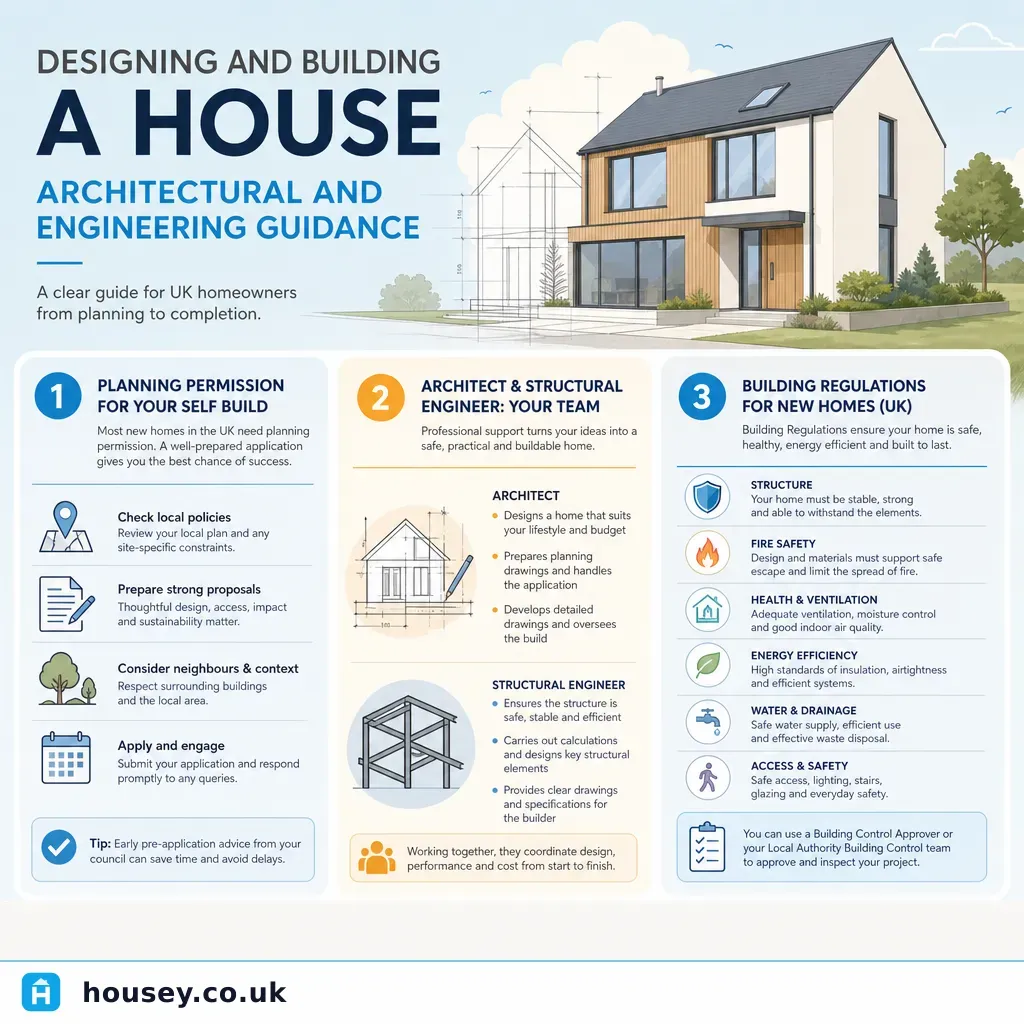
Designing and Building a House: Architectural and Engineering Guidance
Custom-building or self-building a house in the UK is one of the most rewarding — and technically complex — property projects a landowner or homeowner can undertake. The process involves planning policy, architectural design, structural and civil engineering, Building Regulations compliance, and site-specific ground assessment, with each stage creating critical dependencies on the next. Understanding which professionals do what, and in which order they are appointed, significantly reduces the risk of abortive cost and programme delay.
Key points
- Planning permission and Building Regulations approval are entirely separate processes: planning controls whether and how a dwelling can be built, while building regulations govern how it must be constructed to meet structural, fire, energy, and drainage standards — both must be obtained before work starts.
- Under HMRC's VAT431NB scheme, zero-rating applies to most new residential builds, allowing eligible self-builders to reclaim VAT on qualifying building materials and contractor charges.
- A topographic survey and, usually, a geotechnical ground investigation are needed before a structural engineer can design foundations and before an architect can finalise an accurate site layout — commissioning these early avoids abortive professional fees.
- A Building Regulations Full Plans application on a new dwelling triggers stage inspections at foundations, oversite, damp proof course, structural elements, insulation, and drainage; the completion certificate issued at the end is required for mortgage lending and future sale.
- CDM 2015 requires a Principal Designer and Principal Contractor to be appointed where more than one contractor is involved; as client, the homeowner has enforceable legal duties under the Regulations.
The design and build process: stage by stage
Each stage of a new-build project creates inputs for the next. Skipping or reordering stages — particularly starting detailed engineering before planning is secured — is one of the most common causes of abortive cost on self-build and custom-build projects.
Stage | Key activities | Lead professional | Output |
|---|---|---|---|
Site assessment | Topographic survey, ground investigation, utilities search | Land surveyor, geotechnical engineer | Site survey drawing, ground investigation report |
Concept design | Design brief, accommodation schedule, initial layouts | ARB-registered architect (RIBA Stages 1–2) | Sketch proposals, feasibility study |
Planning application | Detailed planning drawings, planning and design statement | Architect, planning consultant | Planning permission |
Technical design | Structural calculations, foundation design, M&E specification | Structural engineer, M&E consultant | Building Regulations drawings, structural report |
Building Regulations | Full Plans submission, compliance review, formal approval | Building control body or Approved Inspector | Building Regulations approval |
Procurement | Contractor selection, tender documents, contract | Quantity surveyor, architect | Signed building contract |
Construction | Site works, stage inspections, snagging, handover | Principal Contractor, building control inspector | Completion certificate |
Choosing your professional team
For a new-build house you will typically need a minimum of three professionals. The table below outlines who does what and when to appoint them.
Professional | Role on a new build | When to appoint | Recognised credential |
|---|---|---|---|
ARB-registered architect | Design, planning application, Building Regulations drawings, contract administration | Before planning application | ARB registration; RIBA membership preferred |
Chartered structural engineer | Foundation design, structural frame calculations, Building Regulations compliance | Before technical design stage | MIStructE or MICE |
Civil engineer | Drainage design, site earthworks, retaining structures, access road design | Before or alongside technical design on complex sites | MICE or CEng with residential experience |
Geotechnical engineer | Ground investigation, foundation recommendations, contamination assessment | After desk study, before structural design | MICE, MIGeol, or UKAS-accredited laboratory |
Which professional do you need?
- Choose an ARB-registered architect if you need planning drawings, design coordination, and contract administration across the full project.
- Appoint a chartered structural engineer (MIStructE or MICE) if you need foundation design, structural frame calculations, or are building on challenging ground.
- Engage a geotechnical engineer if ground investigation reveals made ground, high-shrinkage clay, former landfill, high water table, or slope instability.
- Instruct a civil engineer if the site requires drainage design beyond a simple scheme, retaining structures, access road construction, or significant changes in ground level.
Planning permission: what to expect
A full planning application for a new dwelling is assessed by the local planning authority (LPA) against the policies of its Local Plan and, at national level, the National Planning Policy Framework (NPPF). Key considerations:
- Design quality: Most LPAs require new dwellings to be contextually designed in terms of scale, materials, and character. Some areas have Design Codes or Character Assessments your architect must address.
- Ecology: A Preliminary Ecological Appraisal (PEA) is commonly required; protected species or habitats may require a full ecological survey and mitigation plan before the application can be validated.
- Flood risk: Sites in Flood Zones 2 or 3 require a site-specific Flood Risk Assessment and the sequential and exception tests before permission is granted.
- Timelines: Standard planning decisions are made within 8 weeks of validation (13 weeks for major applications). Pre-application consultation with the LPA is strongly advisable for complex or constrained sites and can materially improve the quality and speed of the formal decision.
Building Regulations: the Full Plans route
For a new dwelling, the Full Plans route is strongly recommended over the Building Notice route. Under Full Plans:
- Detailed drawings and specifications are submitted to the building control body before work starts.
- The body reviews and approves the plans, issuing formal approval with or without conditions.
- Stage inspections take place at: excavation and foundations, oversite, damp proof course, structural frame, insulation, drainage, and on completion.
- A completion certificate is issued on satisfactory completion — required for mortgage lending, future sale, and as evidence of regulatory compliance.
The Building Regulations cover: structural stability (Part A), fire safety (Part B), sound insulation (Part E), ventilation (Part F), hygiene (Part G), drainage (Part H), combustion appliances (Part J), energy efficiency and U-values (Part L), electrical safety (Part P), accessibility (Part M), and overheating (Part O, introduced for new dwellings in 2022).
Ground investigation: why it matters
A desk study followed by intrusive ground investigation (trial pits or boreholes) informs the structural engineer's foundation design. Without it, foundations must be sized on assumptions that may result in either structural under-design or significant over-design and cost waste.
Sites that particularly warrant early ground investigation:
- Former brownfield land or garden plots with made-up or disturbed ground
- Clay soils, particularly London Clay or Lias Clay — subject to seasonal shrink-swell movement that can affect shallow foundations
- Sloping sites or those with large trees in close proximity — roots can cause moisture variation and ground heave
- Sites with a history of industrial use — potential ground contamination that may require formal remediation
- High water table or floodplain-adjacent areas
A geotechnical site investigation report typically forms part of both the structural engineer's and civil engineer's design inputs and may be required by the planning authority or building control as a pre-commencement condition.
Important limitations
This article provides general information about the design and build process for new residential dwellings in England as of May 2026. Planning policy and building regulations differ in Scotland (Building (Scotland) Act 2003 and Scottish Planning Policy), Wales (Future Wales and Technical Advice Notes), and Northern Ireland (Planning Act (Northern Ireland) 2011). Local policies, site constraints, ecology, and ground conditions will significantly affect your project. This article does not constitute legal, planning, structural, or engineering advice. Professional advice should be obtained at each stage.
When this becomes urgent
- If you have purchased land assuming planning permission will be granted — seek formal pre-application planning advice before proceeding with any detailed design.
- If ground investigation reveals contamination, significant ground instability, or an unexpectedly high water table — do not proceed with foundation design until a geotechnical engineer has reviewed the findings and recommended a strategy.
- If the building control body raises compliance concerns during plan review — address these formally and obtain written confirmation before construction begins.
What to ask a qualified professional
For your architect:
- Are you ARB-registered and do you hold RIBA membership? Can you provide evidence of current professional indemnity insurance?
- Which RIBA stages does your appointment cover, and does it include construction-phase inspection services and contract administration?
- What consultants will you appoint or recommend, and how are their fees structured within or outside your appointment?
- What is your experience with similar sites in this local authority area, and have you undertaken pre-application consultation with this LPA before?
For your structural engineer:
- Are you a Member or Fellow of the Institution of Structural Engineers (IStructE) or the Institution of Civil Engineers (ICE)?
- Will your appointment produce Building Regulations-compliant structural drawings and calculations suitable for Full Plans submission?
- How will the foundation type be determined — will a ground investigation be required before you can proceed to design?
- Who will carry out structural inspections at key construction stages, and is this included within your fee?
When to get professional help
Every new-build dwelling project requires professional input at every stage — there is no route for a homeowner to self-certify planning compliance, structural safety, or Building Regulations conformity on a new house. The key decision is who to appoint and when. Where possible, instruct an architect before purchasing land: a pre-purchase feasibility review can confirm whether your intended project is viable on the site and within local planning policy, potentially saving a costly mistake.
How Housey can help
Housey connects landowners and homeowners with ARB-associated architects, chartered structural engineers, civil engineers, professionals producing building regulations drawings, and geotechnical companies providing a geotechnical site investigation. Whether you are at early feasibility stage or ready to submit a planning application, finding the right professional team at the right time is the most effective way to manage cost and risk on a new-build project.
Frequently asked questions
Do I need both planning permission and Building Regulations approval?
Yes — they are entirely separate processes with different applications and different assessors. Planning permission determines whether and how a development may proceed. Building Regulations approval determines how it must be built to meet structural, fire, energy, and drainage standards. Both must be in place before construction starts; beginning without either can result in enforcement action or a requirement to demolish.
Can I act as my own project manager on a self-build?
You can manage the programme and coordinate contractors, but you cannot act as Principal Designer or Principal Contractor under CDM 2015 unless you have the required competence. Where more than one contractor is involved, a competent Principal Designer must be appointed. Many self-builders appoint their architect in this role or instruct a specialist self-build project manager.
How long does it take to get planning permission for a new house?
A full planning application is typically decided within 8 weeks of validation. Applications requiring ecology surveys, flood risk assessment, or a planning committee hearing can take 4–6 months or longer. Pre-application consultation with the LPA — typically costing £150–£600 depending on the authority — is strongly advisable and can materially improve the quality and speed of the formal decision.
What is the difference between a structural engineer and a civil engineer on a new build?
A structural engineer designs the building's structural elements — foundations, beams, columns, and connections. A civil engineer handles drainage design, retaining structures, site earthworks, and access roads. Many new-build projects need both; on a straightforward flat site with simple drainage a structural engineer may suffice, but a civil engineer is usually needed for sloping plots or complex ground conditions.
Sources and further reading
- Planning permission: new dwellings — Planning Portal
- Building regulations approval — GOV.UK
- RIBA Plan of Work 2020 — Royal Institute of British Architects
- Construction (Design and Management) Regulations 2015 — Health and Safety Executive
- National Planning Policy Framework — GOV.UK
- VAT refunds for DIY housebuilders (VAT431NB) — HM Revenue & Customs
Useful next reads
 Planning & Pre-Build
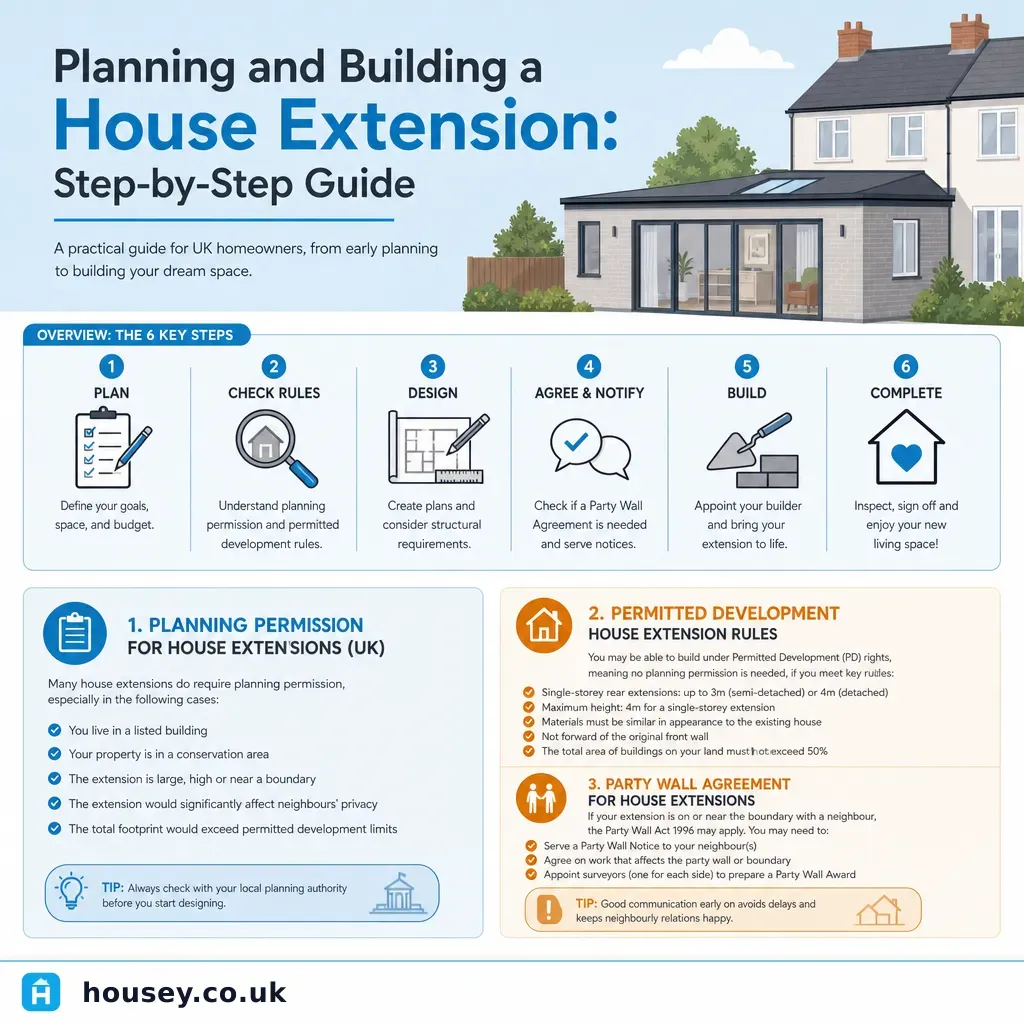
Planning and Building a House Extension: Step-by-Step Guide
A house extension in the UK usually requires either planning permission or confirmation of permitted development rights, Building Regulations approval, and — where work affects a shared wall or boundary — compliance with the Party Wall etc.
 Planning & Pre-Build
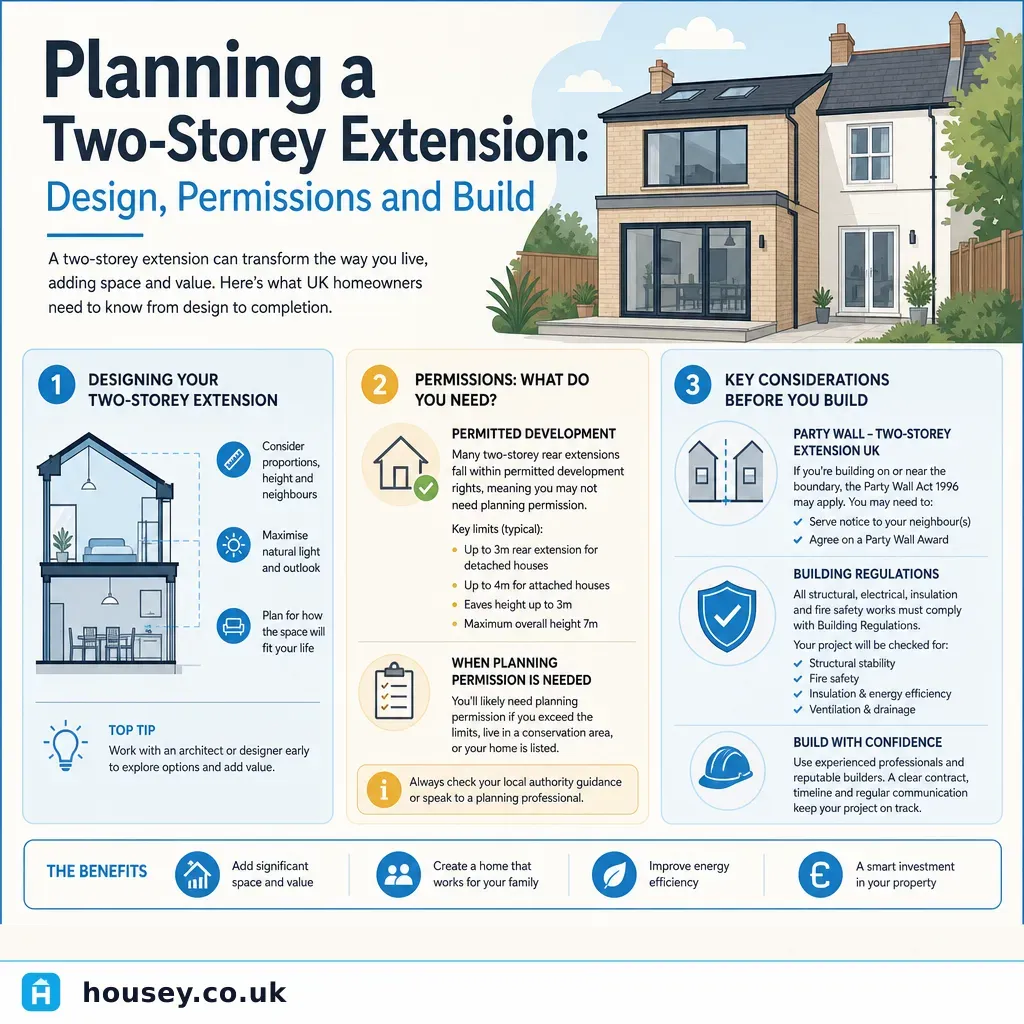
Planning a Two-Storey Extension: Design, Permissions and Build
A two-storey extension usually requires full planning permission, though a rear extension may fall within Permitted Development if it projects no more than 3 metres.
 Planning & Pre-Build
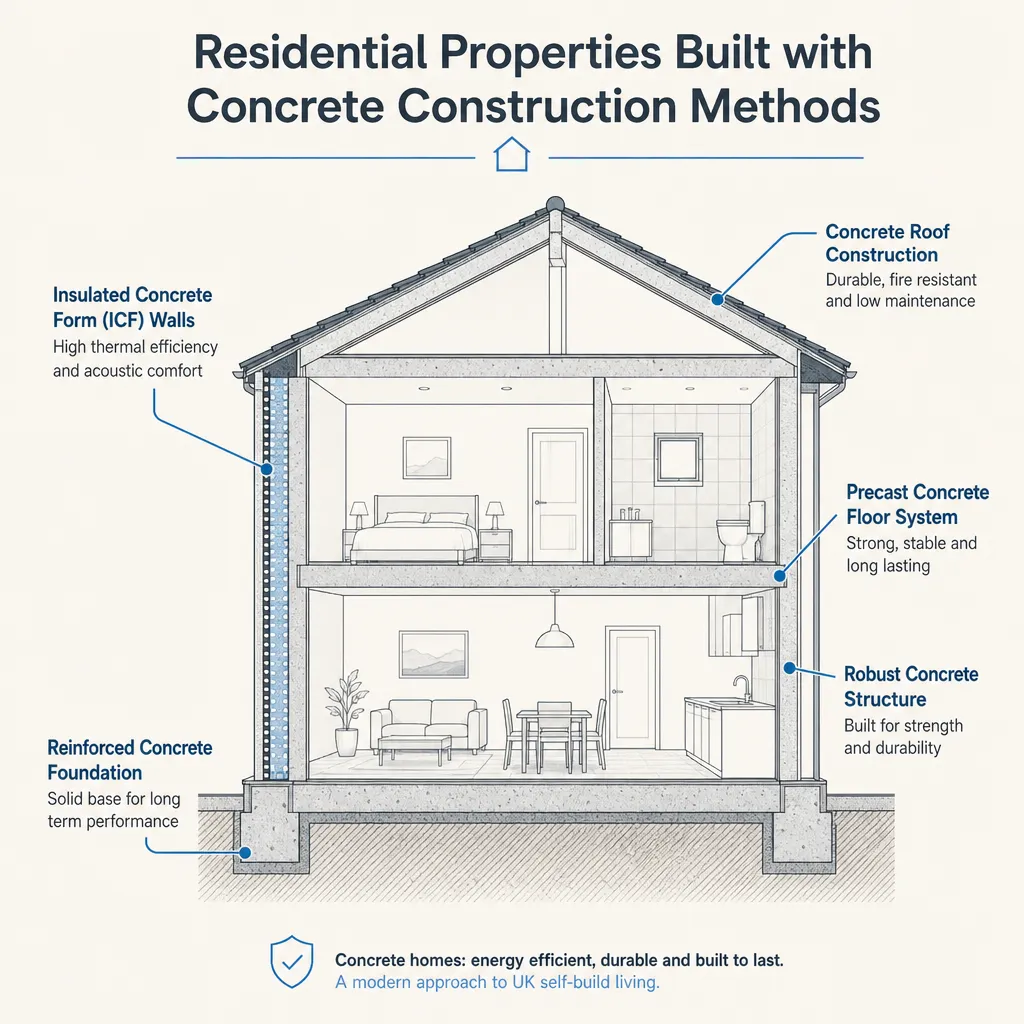
Residential Properties Built with Concrete Construction Methods
UK homes are built using several concrete methods: in-situ cast concrete, precast panel systems, insulating concrete formwork (ICF), and older non-traditional types such as Wimpey No-Fines and Laing Easiform.
 Planning & Pre-Build
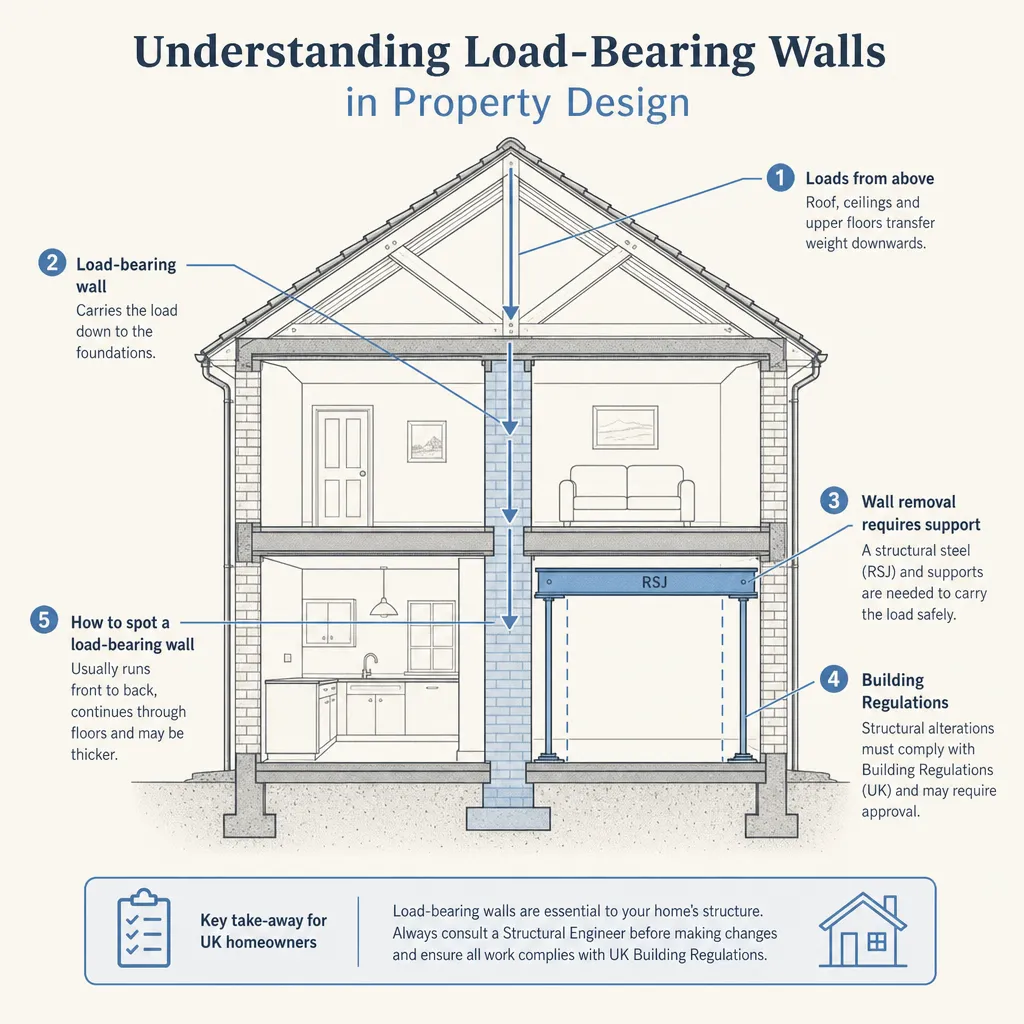
Understanding Load-Bearing Walls in Property Design
A load-bearing wall carries the weight of floors, roofs, or other walls above it down to the foundations.
 Planning & Pre-Build
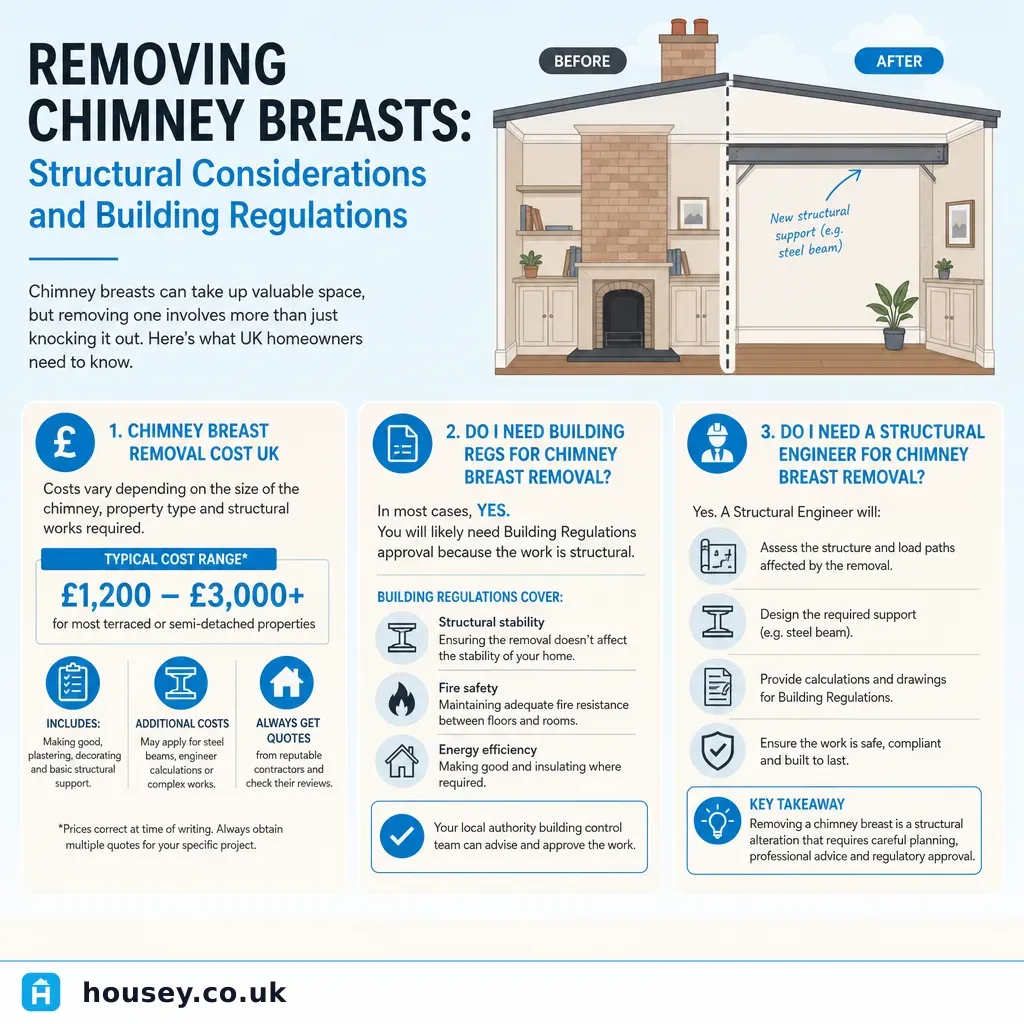
Removing Chimney Breasts: Structural Considerations and Building Regulations
Removing a chimney breast in England and Wales almost always requires building regulations approval because it is structural work.