Artex Surfaces and Property Market Perception
By Housey · Last reviewed 11th of May 2026
Artex Surfaces and Property Market Perception
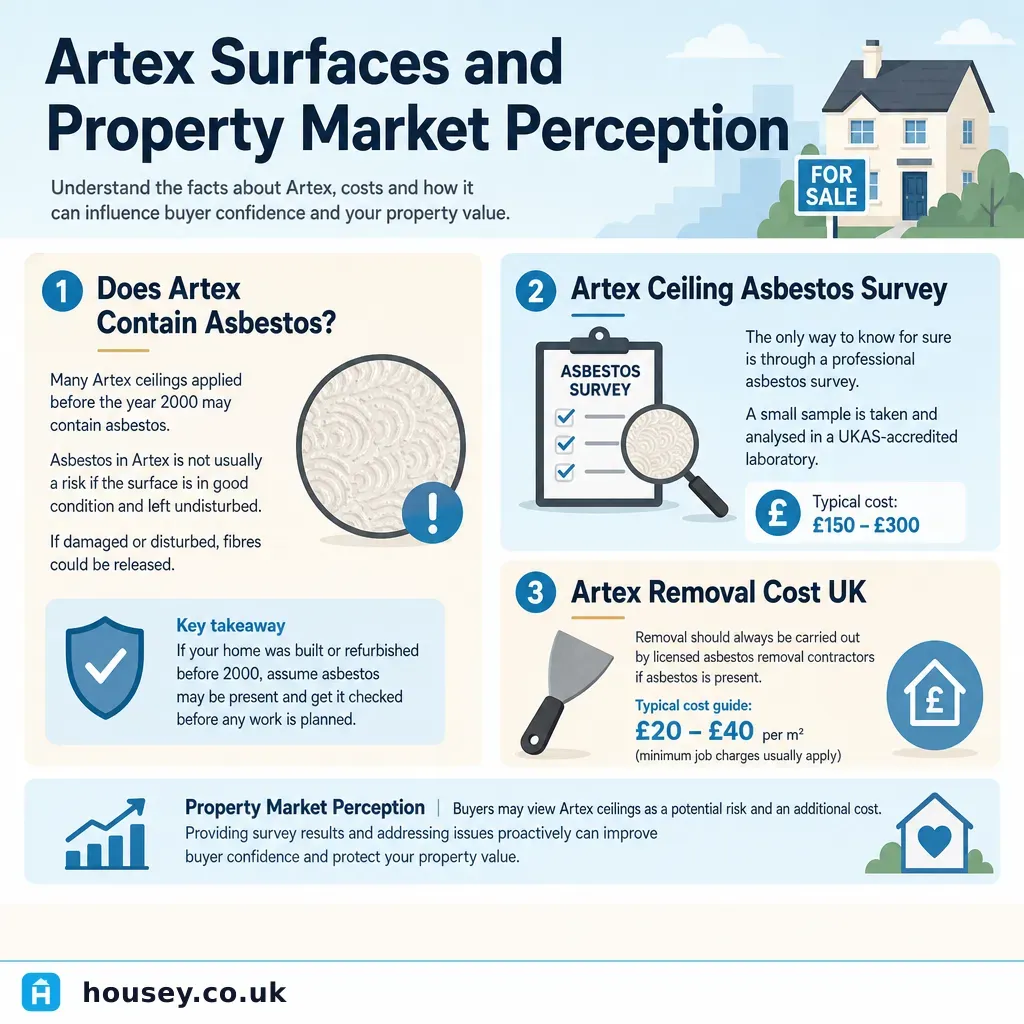
Textured Artex ceilings and walls are a familiar sight in homes built or decorated between the 1950s and early 1990s — from post-war semis to 1980s new-builds. For buyers, sellers, and surveyors, the key question is rarely aesthetic: it is whether the material might contain asbestos, and what that means for the property's condition rating, saleability, and legal obligations during any future renovation work.
Key points
- Artex and similar textured coatings applied before 2000 may contain chrysotile (white) asbestos at concentrations typically below 1%, but sufficient to require specialist handling if the material is disturbed.
- Under the Control of Asbestos Regulations 2012, work that disturbs asbestos-containing materials (ACMs) in quantities above defined thresholds requires a licensed contractor; the prohibition on unsafe disturbance applies universally, including in domestic properties.
- The HSE does not require Artex to be removed if it is in good condition and undisturbed; encapsulation — painting over or overboarding — is an accepted management approach in many cases.
- A RICS Level 3 Building Survey will typically note the presence of textured coatings in pre-2000 properties and recommend an asbestos management survey to HSG264 standard if sampling has not been carried out.
- Artex removal where asbestos is confirmed must be carried out by a licensed asbestos contractor; indicative costs range from approximately £500 to £3,000 or more per room depending on area, access, and disposal requirements (indicative UK costs, last reviewed 2026-05-11).
Does Artex contain asbestos?
Not all Artex contains asbestos. Products applied after approximately 1984 are less likely to contain asbestos fibre, and from 1999 asbestos was fully prohibited from use in construction products sold in the UK under the Asbestos (Prohibitions) Regulations 1992 as amended. However, homes decorated before 2000 — including those renovated in the late 1980s using older stock materials — cannot be assumed to be asbestos-free without laboratory analysis.
The only reliable way to determine whether a textured coating contains asbestos is bulk material sampling by a UKAS-accredited laboratory, carried out by a competent asbestos surveyor following HSE guidance document HSG264. Visual inspection alone cannot confirm or rule out the presence of asbestos fibres.
What not to assume
Several common assumptions lead homeowners and buyers into difficulty:
- "It looks fine, so it's safe to sand or scrape." Artex in good visible condition may be low risk when undisturbed, but sanding, scraping, or drilling into textured coatings that contain asbestos releases fibres and must not be done without professional assessment.
- "It's been painted over, so it's permanently encapsulated." Paint can form a degree of encapsulation, but multiple layers over deteriorating Artex may not be sufficient containment. A professional assessment is needed to determine whether the condition is adequate.
- "The surveyor mentioned it, so we have to remove it." A mention in a survey report does not mean removal is required. The surveyor is flagging the possibility of asbestos and recommending further investigation — not ordering remediation.
- "It's only in one room." Artex was often applied throughout a property by the same contractor using the same batch of material. If one area tests positive, other textured surfaces applied during the same period should also be sampled.
How does Artex affect a property survey?
RICS Level 2 Home Survey
A RICS Level 2 surveyor will note the presence of textured coatings in pre-2000 properties and typically assign a condition rating 2 or issue an advisory note. The report will usually recommend an asbestos survey if no sampling has been carried out. Buyers may use this finding to renegotiate the price or request that the seller arrange sampling before exchange.
RICS Level 3 Building Survey
A Level 3 survey provides a more detailed inspection. The surveyor will comment on the extent and condition of textured coatings, whether any visible disturbance is present, and what further investigation is recommended. If coatings are in poor condition — flaking, cracked, or water-damaged — the recommendation for specialist investigation is likely to be more urgent.
Which approach is appropriate: a decision guide
Property situation | Recommended action | Urgency |
|---|---|---|
Pre-1985 home, Artex throughout, never sampled | Commission asbestos management survey before works or listing | High if works planned; moderate before listing |
1985–2000 home, textured ceilings in good condition | Asbestos survey recommended if any disturbance is planned | Moderate |
Post-2000 decoration, no original coating visible | Standard survey; asbestos survey not typically needed for Artex specifically | Low |
Any era, Artex visibly damaged, flaking, or water-stained | Do not disturb; commission licensed asbestos survey immediately | High |
Seller holds an existing asbestos management survey | Request copy; check whether Artex was sampled and results noted | Depends on report scope |
How does Artex affect market perception and value?
Artex in good condition is unlikely to materially reduce a property's market value on its own — it is very common in pre-2000 stock and well understood by experienced buyers and agents. However, buyer perception can be affected by:
- Survey reports that flag the risk. A condition rating 2 or 3 in a survey report, or a recommendation for specialist investigation, may prompt buyers to request price reductions or delay exchange pending testing results.
- Visible deterioration. Flaking, stained, or damaged textured ceilings create a stronger negative impression and are more likely to attract a specific adverse recommendation.
- Buyer familiarity. First-time buyers may be more alarmed by asbestos references than experienced buyers who understand the distinction between undisturbed low-risk ACMs and actively harmful conditions.
- Renovation plans. Buyers intending to fit recessed lighting, extend into a room, or reconfigure a layout will face additional cost if asbestos is confirmed, and this is likely to be factored into offer negotiations.
Estate agents often advise sellers with widespread textured coatings in poor condition to commission an asbestos survey before listing, as this removes uncertainty and can prevent sale fall-throughs at the survey stage.
Red flags: when Artex becomes an urgent concern
Seek specialist advice promptly if any of the following apply:
- Artex is visibly flaking, crumbling, or has been water-damaged — do not attempt to clean, repair, or paint over it without professional guidance.
- A contractor has recently sanded, scraped, or drilled into textured coatings in a pre-2000 property without first checking for asbestos.
- Your RICS survey has assigned condition rating 3 to textured coatings or recommended urgent specialist investigation.
- You are planning to fit recessed lighting, extend, or remove partition walls in a pre-2000 property without an asbestos survey in place.
- Anyone has experienced respiratory symptoms following dusty work in an older property — seek medical advice and consider contacting the HSE if a contractor was involved.
Important limitations
This article provides general information about Artex, asbestos risk in residential properties, and property market perception. It does not constitute health and safety, legal, or surveying advice. Asbestos risk varies depending on fibre type, concentration, material condition, and the nature of any disturbance. The Control of Asbestos Regulations 2012 contain detailed legal requirements; their application in specific circumstances should be assessed by a competent asbestos professional. The HSE publishes authoritative guidance at hse.gov.uk/asbestos.
When this becomes urgent
Stop any work and seek professional advice immediately if:
- You suspect you have disturbed asbestos-containing material — ventilate the area, leave it undisturbed, and contact a licensed asbestos contractor before returning.
- A survey report has assigned condition rating 3 to textured coatings in your property.
- Anyone in the property has been exposed to visible dust from textured coatings being sanded or scraped without prior testing.
What to ask a qualified professional
Before instructing an asbestos surveyor or licensed contractor:
- Is this a management survey (to assess risk in situ) or a refurbishment/demolition survey (to clear an area for works)? Which type do I need for my situation?
- Is your laboratory UKAS-accredited for asbestos bulk analysis?
- Will the sampling process disturb the coating, and how will you manage that safely?
- If asbestos is confirmed, what are my options — encapsulation, overboarding, or licensed removal?
- What certificate or report will I receive, and is it in a format I can share with a buyer or their solicitor?
- Will removal require a licensed contractor under the Control of Asbestos Regulations 2012, and what are the disposal arrangements?
When to get professional help
Do not attempt to scrape, sand, or remove Artex from a pre-2000 property without first arranging an asbestos survey. If you are buying a property with widespread textured coatings, consider requesting a specific defect survey focused on the material, or ask the seller to provide laboratory sampling results before exchange. For broader condition questions — including damp, timber, and the effects of water damage on ceiling finishes — a damp and timber survey can complement an asbestos assessment.
How Housey can help
Housey can connect you with qualified surveyors offering specific defect surveys for Artex and potential asbestos concerns, and damp and timber surveys for properties where water damage may have affected textured coatings or the surrounding structure.
Frequently asked questions
Can I paint over Artex if it contains asbestos?
Painting over undisturbed Artex — a form of encapsulation — is generally an accepted management approach if the coating is in good condition. You should confirm the presence of asbestos through laboratory sampling first and document the encapsulation for future owners. Painting does not permanently eliminate the hazard; any future disturbance must still be managed by a licensed contractor.
Do I have to declare Artex or asbestos when selling a property?
Sellers must answer the TA6 Property Information Form honestly, including disclosing any known asbestos or asbestos surveys. If you are aware that textured coatings contain asbestos, or that a survey has been carried out, you should disclose this. Failing to do so may allow a buyer to claim misrepresentation after completion. Consult your conveyancer for advice on specific disclosures.
Will a mortgage lender refuse to lend on a property with Artex?
Most lenders do not decline mortgages solely because of Artex in good condition. However, if a survey report assigns a significant adverse condition rating and recommends specialist investigation, the lender may require a specialist report before proceeding. Some lenders have more conservative policies regarding confirmed asbestos-containing materials — check with your mortgage broker if you have concerns.
Sources and further reading
- Asbestos: the survey guide (HSG264) — HSE
- Control of Asbestos Regulations 2012 — legislation.gov.uk
- Asbestos in the home — HSE
- Artex and textured coatings — HSE
Useful next reads
 Surveys & Inspections
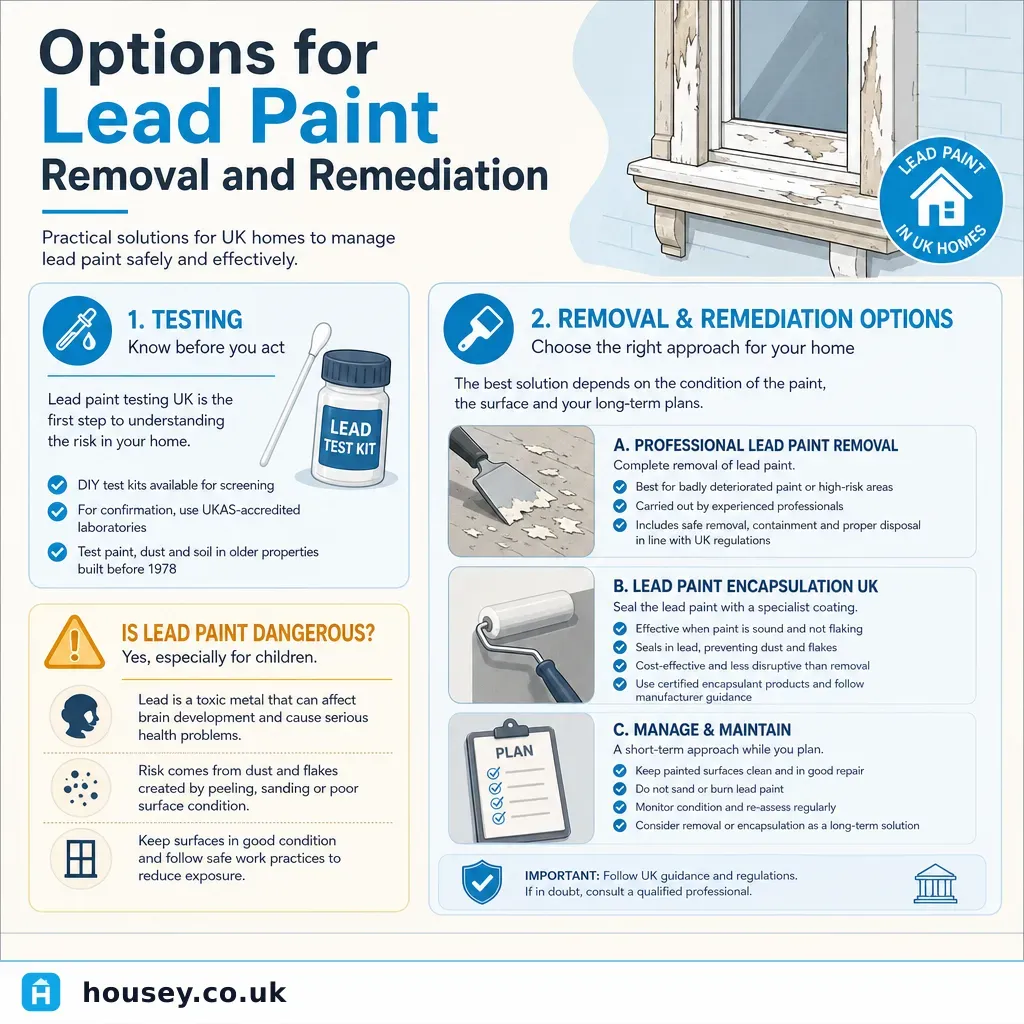
Options for Lead Paint Removal and Remediation
Lead paint in UK homes built before 1960 is common and not automatically hazardous if in good condition.
 Surveys & Inspections
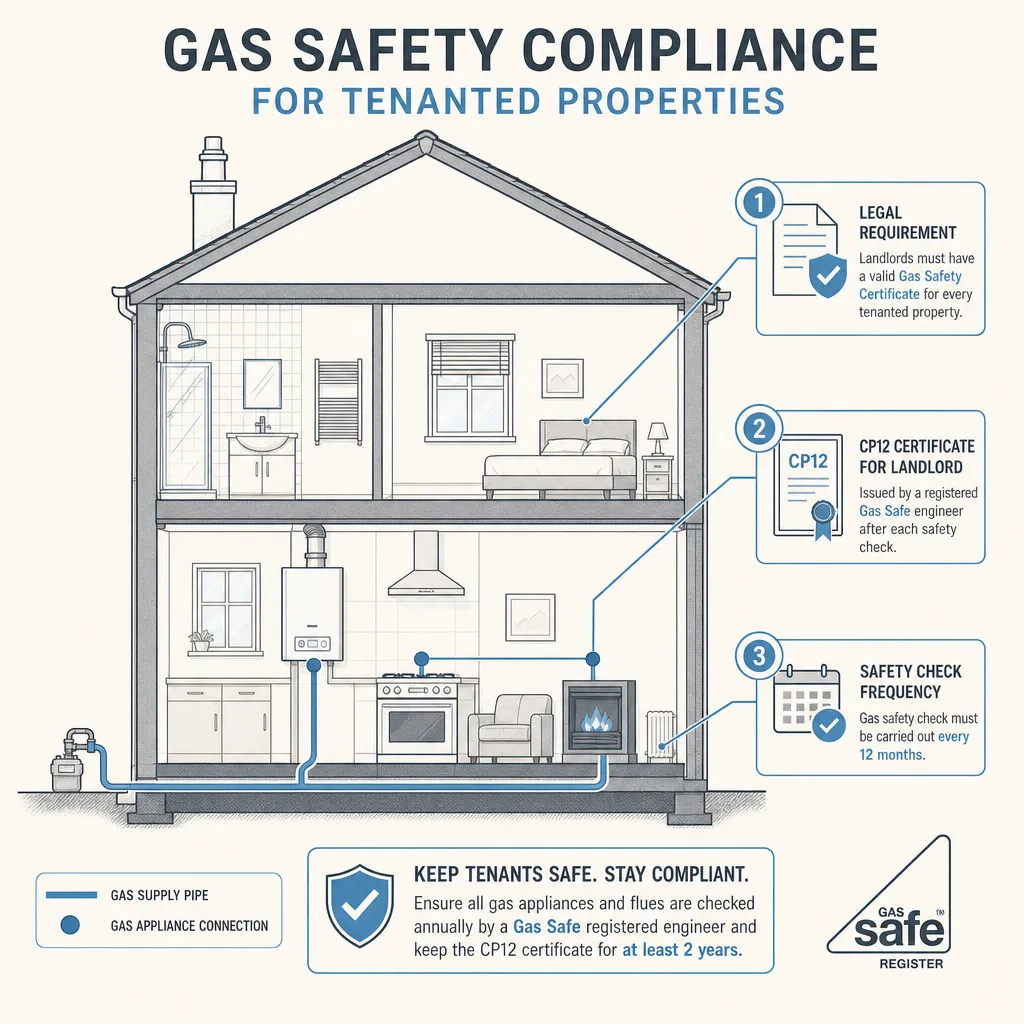
Gas Safety Compliance for Tenanted Properties
UK landlords are legally required to arrange an annual gas safety check by a Gas Safe registered engineer for every tenanted property with a gas appliance.
 Surveys & Inspections
What to Budget for Upgrading a Fuse Box or Consumer Unit
Replacing a consumer unit (fuse box) in the UK typically costs £400–£900 for a straightforward installation by a Part P registered electrician.
 Surveys & Inspections
Gas Safety Certificate: What Landlords and Homeowners Need
Landlords in England, Scotland, and Wales must arrange a gas safety check every 12 months by a Gas Safe registered engineer under the Gas Safety (Installation and Use) Regulations 1998.
 Surveys & Inspections
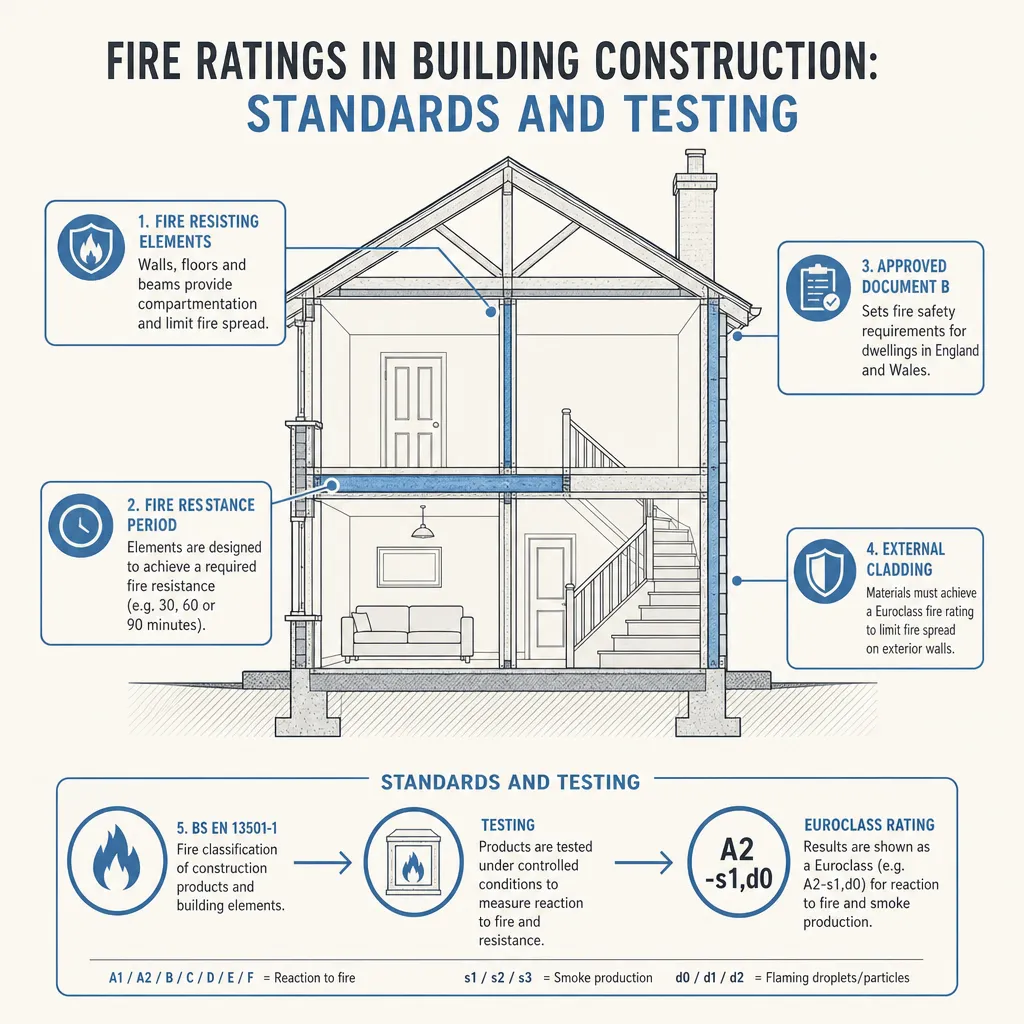
Fire Ratings in Building Construction: Standards and Testing
In UK construction, fire ratings describe how long a structural element or building assembly maintains load-bearing capacity, integrity, and insulation when exposed to a standard fire test — typically 30, 60, 90, or 120 minutes.