What to Budget for Upgrading a Fuse Box or Consumer Unit
By Housey · Last reviewed 6th of May 2026
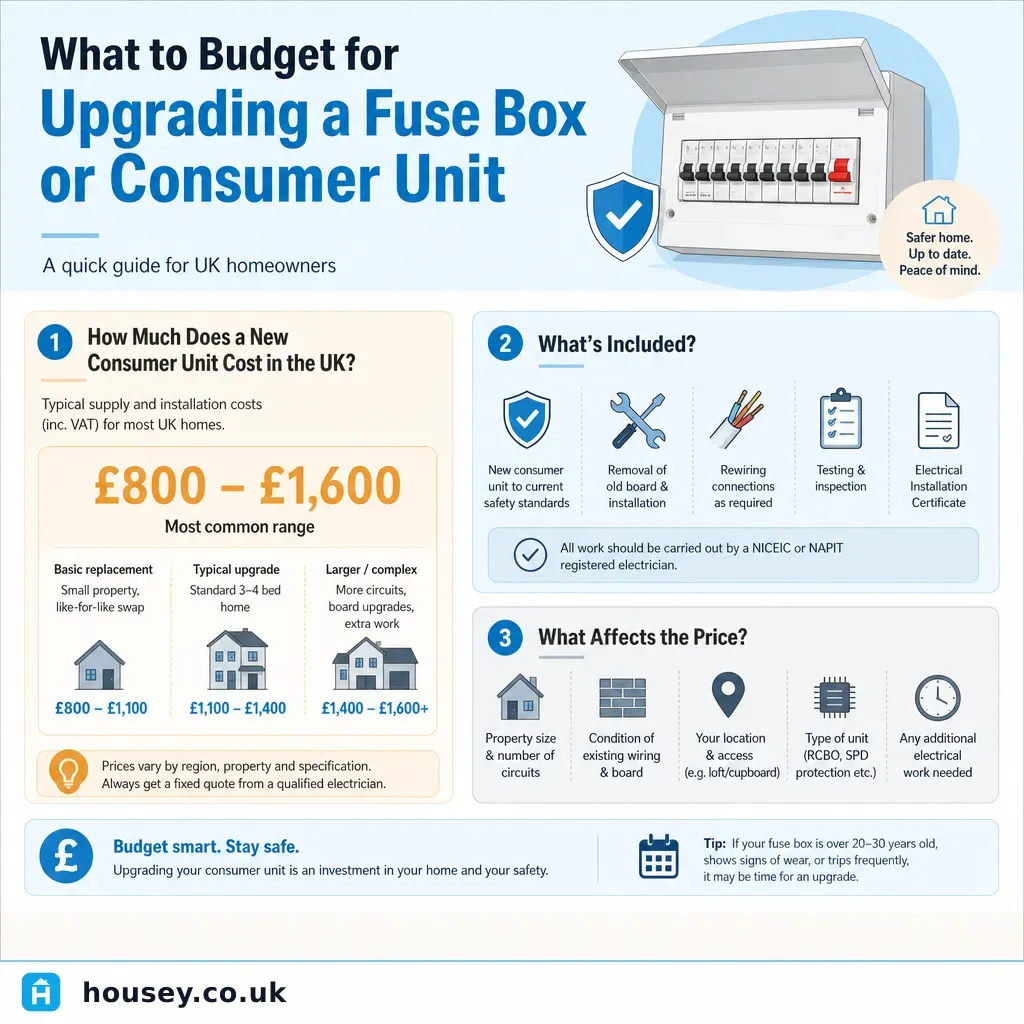
What to Budget for Upgrading a Fuse Box or Consumer Unit
A consumer unit replacement rarely appears on a homeowner's renovation wishlist — it typically arises after an Electrical Installation Condition Report (EICR) returns a C1 or C2 code, a surveyor flags the board during a house purchase, or an insurer asks for evidence of a compliant installation. Whatever the trigger, understanding the realistic cost range and legal requirements upfront means you can assess quotes accurately and avoid unexpected scope creep.
Key points
- Consumer unit replacement is notifiable work under Part P of the Building Regulations and must be carried out by an electrician registered with a government-authorised scheme (NICEIC, NAPIT, ELECSA, or BSI) or formally notified to your local building control body.
- All new domestic consumer units must use a metal enclosure — a requirement in place since 2016 following fire incidents involving plastic boards; any quote proposing a plastic enclosure should be queried.
- A full replacement typically costs £400–£900 for a small to medium UK home — indicative figures that vary by region, board size, and associated remedial work.
- The current standard is BS 7671:2018 (18th Edition IET Wiring Regulations), which requires dual RCD or RCBO protection on domestic installations; rewirable fuse boards and single-RCD boards do not comply.
- Landlords in England must hold a valid EICR renewed at least every five years under the Electrical Safety Standards in the Private Rented Sector (England) Regulations 2020; a consumer unit upgrade is commonly required following an unsatisfactory report.
What is a consumer unit and why does it need replacing?
A consumer unit (also called a fuse box or distribution board) distributes electricity from the meter throughout the home via individual circuits. It contains:
- Miniature circuit breakers (MCBs): trip automatically when a circuit is overloaded or short-circuits. In older homes these may be rewirable fuse carriers, which offer significantly less protection.
- Residual current devices (RCDs): detect earth faults and cut power within milliseconds to help prevent electrocution. Older rewirable boards do not have RCDs.
- Residual current circuit breakers with overcurrent protection (RCBOs): combine both functions in a single device; used in modern all-RCBO boards.
Older boards — particularly those with rewirable fuses, a single front-panel RCD, or plastic enclosures — are considered non-compliant under BS 7671:2018 and will typically attract C1 (danger present) or C2 (potentially dangerous) codes on an EICR.
What affects the cost?
Indicative UK costs, last reviewed 2026-05-06. Always obtain at least three like-for-like quotes from Part P registered electricians.
Cost element | Typical range | Notes |
|---|---|---|
Consumer unit (materials) | £80–£250 | Depends on number of ways, RCBO vs split-load board, brand |
Electrician's labour | £200–£500 | Typically 3–6 hours; more for complex or larger installations |
Minor remedial work during installation | £50–£300+ | Replacing damaged sockets, updating earth bonding, rerouting a circuit |
Building control notification fee (if applicable) | £100–£300 | Not needed if electrician self-certifies via a Part P scheme |
EICR (before or after the work) | £150–£400 | Depends on property size and number of circuits |
Estimated total (straightforward installation) | £400–£900 | Small to medium UK home; higher in London and the South East |
Obtaining an Electrical Installation Condition Report (EICR) before instructing the replacement helps establish the exact scope and lets you compare quotes on a like-for-like basis.
Building Regulations and legal requirements
Part P: electrical safety in dwellings
Consumer unit replacement is notifiable work under Approved Document P. The work must be:
- Carried out by an electrician registered with a government-authorised Part P competent person scheme (NICEIC, NAPIT, ELECSA, or BSI), who self-certifies the installation; or
- Notified to the local building control body before work starts, with an inspection and completion certificate to follow.
Always ask for your electrician's scheme registration number before instructing them, and request a completion certificate once the work is done — this is a material document when you sell the property.
Metal enclosure requirement
Since 2016, new consumer units in domestic premises must use a metal enclosure or equivalent non-combustible housing. This followed fire incidents involving early plastic consumer unit casings. If a quote proposes a plastic board, query it against current BS 7671:2018 Amendment 2 requirements before accepting.
The EICR connection
The Electrical Safety Standards in the Private Rented Sector (England) Regulations 2020 require landlords to obtain an EICR at least every five years. An unsatisfactory report commonly triggers a consumer unit replacement. Owner-occupiers are not legally required to hold an EICR, but it is strongly recommended before any electrical upgrade or when buying an older property.
Do you need a full replacement? A simple decision guide
- Choose full consumer unit replacement if your board has rewirable fuses, no RCDs, a plastic enclosure, or has received C1 or C2 codes on an EICR.
- Consider targeted remediation only if your existing metal board is a modern split-load or all-RCBO type and only isolated circuit faults were identified.
- Consult a Part P registered electrician before deciding if you have a partial EICR, an older report, or a second-hand assessment — the correct scope depends on what was tested and when.
- Do not delay action if you have repeatedly tripping circuits, scorch marks near the board, a burning smell, or a board original to a pre-1970 property.
What to ask a qualified professional
Before instructing an electrician for a consumer unit replacement, ask:
- Are you registered with a government-authorised Part P competent person scheme? Can I see your registration number?
- What size board (number of ways) and make are you proposing, and why is it suitable for my installation?
- Will the new unit use a metal enclosure complying with BS 7671:2018?
- Is an EICR included, or will you carry out installation testing and issue a completion certificate?
- What happens if you identify additional defects during the work — will you quote separately for any remediation?
- Is VAT included in the quoted price?
- What documentation will I receive, and will you notify building control if required?
Important limitations
This article provides general information about consumer unit costs and regulations in England and Wales as of May 2026. It is not a substitute for a professional electrical assessment of your specific property. Electrical installation standards, Part P competent person scheme requirements, and landlord regulations can change; verify current requirements with a Part P registered electrician or your local building control body before instructing work.
Do not attempt to replace or modify a consumer unit yourself. The incoming supply cables remain live at all times — even when the main switch is turned off — and cannot be isolated without involvement of your Distribution Network Operator (DNO).
When to get professional help
Instruct a Part P registered electrician promptly if:
- An EICR has returned a C1 (danger present) code relating to the consumer unit.
- You notice scorch marks, a burning smell, or discolouration near the fuse board.
- Circuit breakers are tripping repeatedly without a clear cause.
- You are selling a property and a surveyor or buyer's solicitor has flagged the consumer unit.
- You are a landlord and the five-year EICR renewal deadline is approaching.
How Housey can help
Housey makes it straightforward to find Part P registered electricians and to arrange an Electrical Installation Condition Report (EICR) before or after the replacement work. Getting an EICR first establishes the full condition of the installation, so you can compare electrician quotes on a like-for-like basis and avoid unexpected additional costs mid-job.
Frequently asked questions
How long does a consumer unit replacement take?
A straightforward swap on a small to medium UK home typically takes 3–6 hours for a qualified electrician. Larger properties with more circuits, or where additional remedial work is identified during the job, may take a full day or longer. Your electrician should give a clearer estimate after assessing the existing installation.
Can I replace my fuse box myself?
No. Consumer unit replacement is notifiable electrical work under Building Regulations Part P and must be carried out by a registered competent person or formally notified to building control. Attempting this yourself is unsafe, likely to invalidate your home insurance, and could cause serious injury or death — incoming supply cables remain live even when the main switch is off.
Will a new consumer unit add value to my property?
An updated, compliant consumer unit removes potential C1 or C2 codes from an EICR and reassures buyers the electrical installation is current. It is not a value-adding renovation in the way a loft conversion is, but an old or failing board can reduce saleability and may be flagged by a surveyor during a purchase inspection.
Do I need a new consumer unit if I am adding solar panels or an EV charger?
Not necessarily, but a qualified electrician must assess the existing board's capacity before new circuits are added. If the board is already at capacity, has inadequate RCD protection, or does not meet current standards, replacement may be recommended as part of the solar or EV charger installation and should be costed in the overall project quote.
What is the difference between a split-load board and an RCBO board?
A split-load consumer unit divides circuits between two RCD-protected sides, so a trip on one side does not cut all circuits. An RCBO board gives individual RCD and overcurrent protection per circuit, meaning a fault on one circuit does not affect others. Both comply with BS 7671:2018; your electrician can advise which suits your property.
Sources and further reading
- Approved Document P (Electrical Safety — Dwellings) — MHCLG, Building Regulations
- BS 7671:2018 IET Wiring Regulations (18th Edition) — Institution of Engineering and Technology
- Electrical Safety Standards in the Private Rented Sector (England) Regulations 2020 — legislation.gov.uk
- Find a registered electrician — NICEIC
- Consumer units: safety guidance — Electrical Safety First
Useful next reads
 Surveys & Inspections
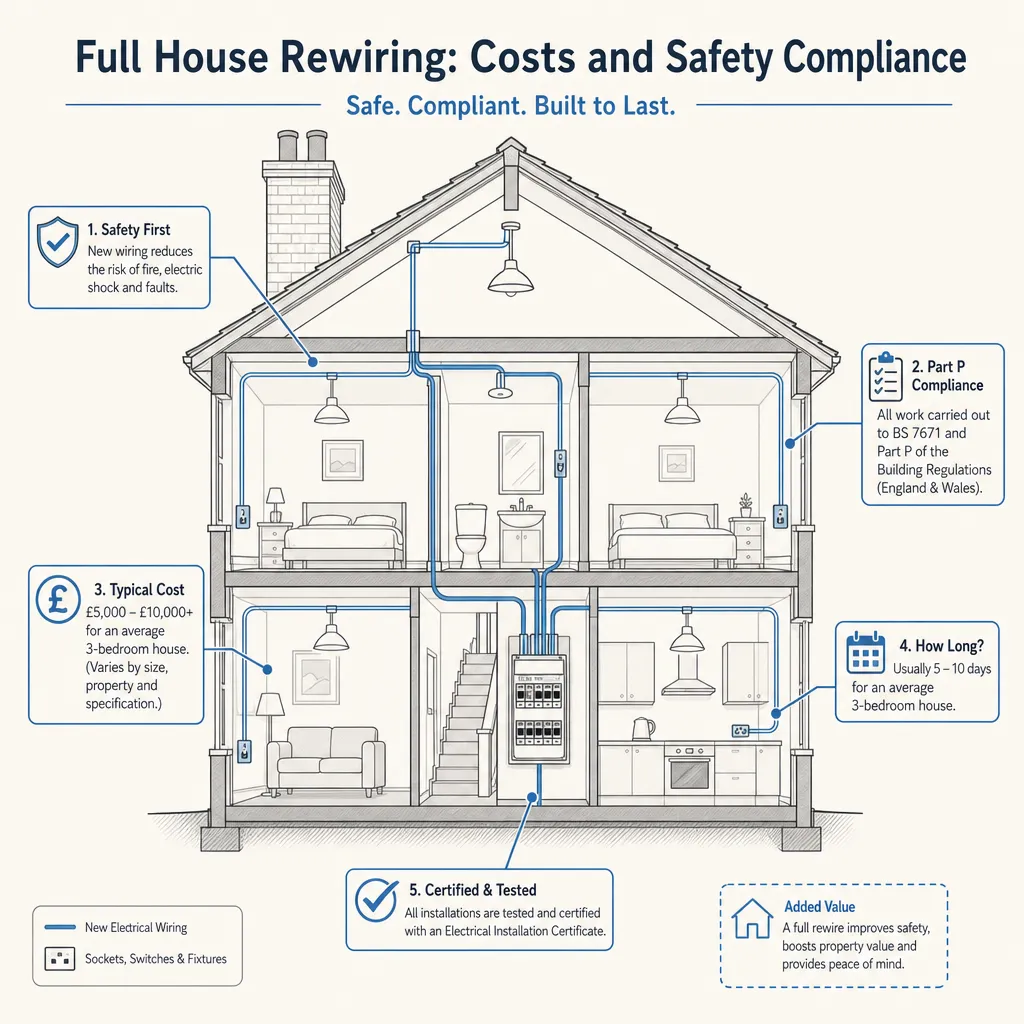
Full House Rewiring: Costs and Safety Compliance
A full house rewire in the UK typically costs £3,500–£6,000 for a three-bedroom semi and must comply with BS 7671:2018 and Building Regulations Part P.
 Surveys & Inspections
Artex Surfaces and Property Market Perception
Artex applied before 2000 may contain chrysotile asbestos, which is safe when undisturbed but hazardous if sanded or scraped without professional assessment.
 Surveys & Inspections
Safe Removal and Replacement of Asbestos Water Tanks
Asbestos cement cold water tanks, found in many UK homes built before about 1980, must not be drilled, cut, or broken without proper controls.
 Surveys & Inspections
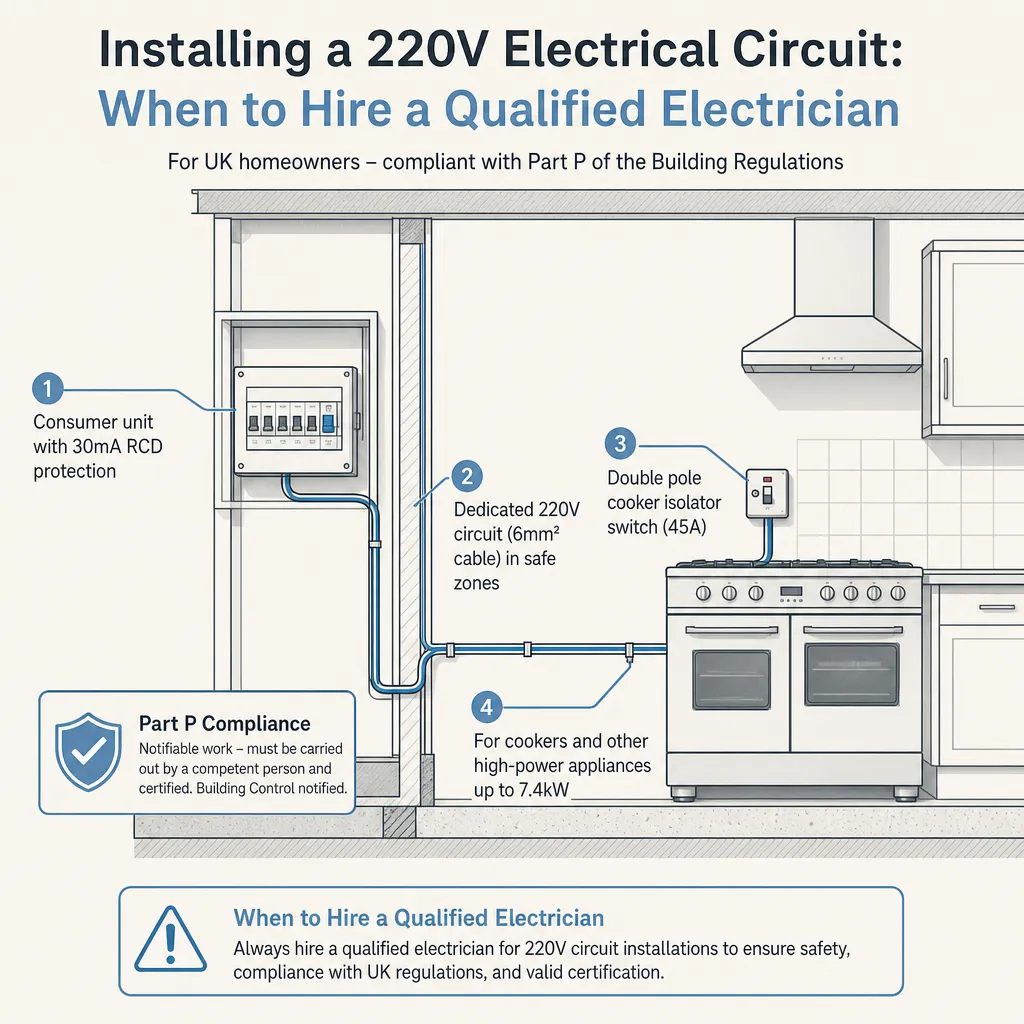
Installing a 220V Electrical Circuit: When to Hire a Qualified Electrician
In the UK, domestic mains supply is 230V — not 220V — and any dedicated high-current circuit for a cooker, shower, or EV charger is notifiable work under Part P of the Building Regulations.
 Surveys & Inspections
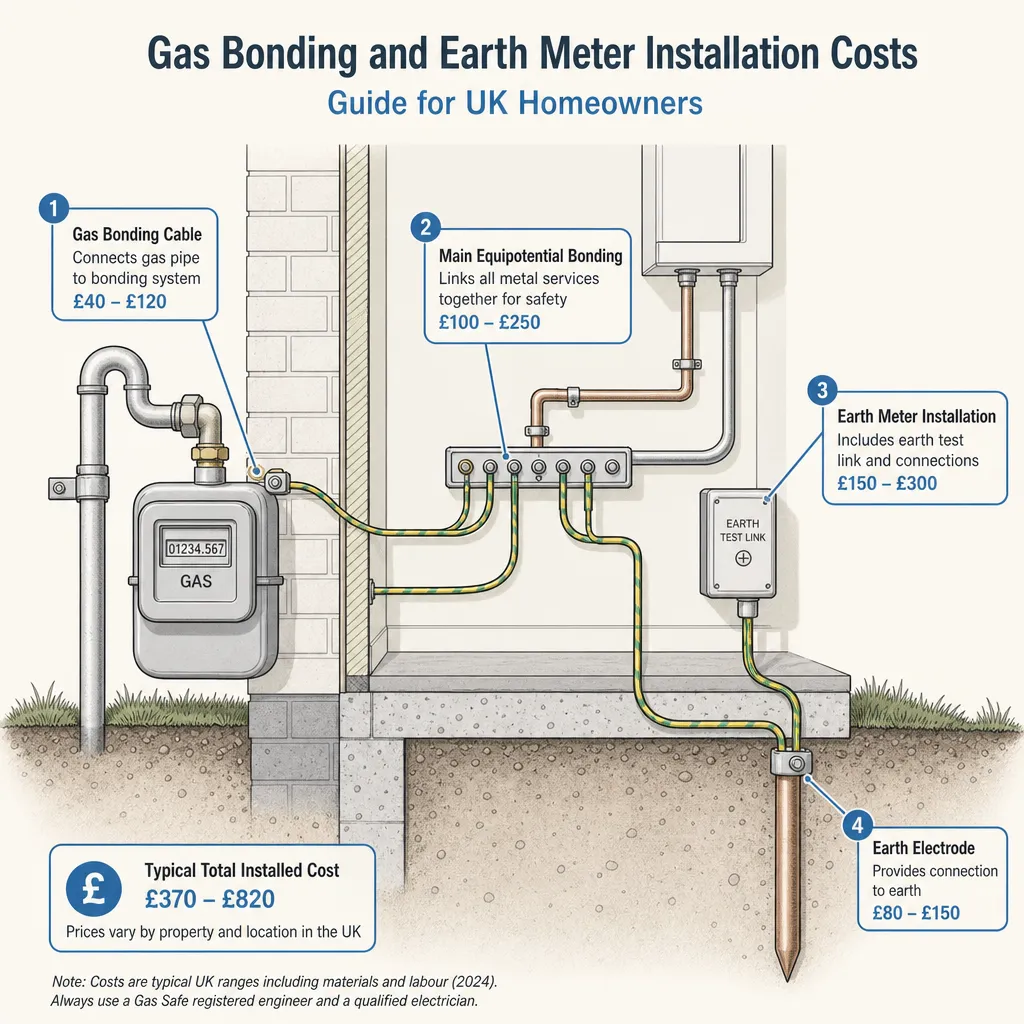
Gas Bonding and Earth Meter Installation Costs
Main gas bonding connects your gas pipework to the electrical earthing terminal, preventing dangerous voltage differences.