Gas Safety Certificate: What Landlords and Homeowners Need
By Housey · Last reviewed 7th of May 2026
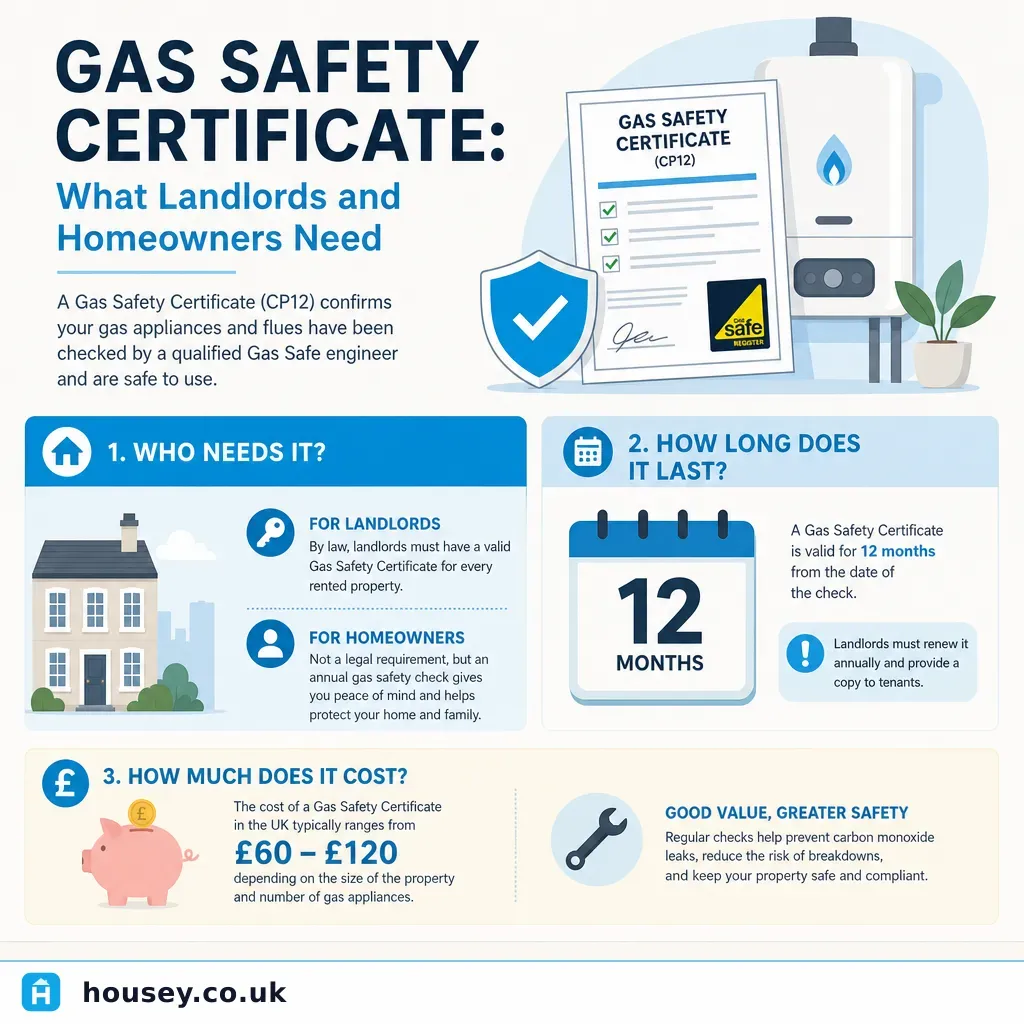
Gas Safety Certificate: What Landlords and Homeowners Need
Gas safety certificates come into focus when letting a property, buying or selling a home, or arranging annual maintenance — and the legal stakes for landlords who overlook them are significant. The rules differ considerably depending on whether you are a landlord, an owner-occupier, or a prospective tenant, and confusing a routine boiler service with the formal annual safety check is a common and potentially costly mistake.
Key points
- Landlords in England, Scotland, and Wales are legally required to arrange a gas safety check every 12 months under the Gas Safety (Installation and Use) Regulations 1998.
- Only a Gas Safe registered engineer can legally carry out a gas safety check — verify credentials at gassaferegister.co.uk before booking.
- New tenants must receive a copy of the current Gas Safety Record before they move in; existing tenants must receive it within 28 days of each annual check.
- A standard landlord gas safety check typically costs £60–£120 depending on the number of appliances and the engineer's location. Indicative UK costs, last reviewed 2026-05-07.
- A gas safety check confirms that appliances are safe to use at the time of inspection — it is not the same as a boiler service, which cleans and maintains the appliance for efficiency and longevity.
What is a gas safety certificate?
A gas safety certificate — formally called a Gas Safety Record, and widely referred to as a CP12 (a term carried over from the CORGI registration era) — is the document issued by a Gas Safe registered engineer after inspecting gas appliances, flues, and pipework at a property. The check confirms that appliances are operating safely, flues are drawing correctly, and there are no dangerous gas leaks or ventilation deficiencies.
The check typically covers:
- Gas boiler and central heating system
- Gas hob, cooker, or range
- Gas fires, decorative fuel-effect fires, and gas room heaters
- Flues, chimneys, and associated ventilation
- Accessible meter and pipework integrity
Who legally needs a gas safety certificate?
Situation | Legal requirement | Who carries it out | Validity |
|---|---|---|---|
Private landlord (England, Wales, Scotland) | Mandatory annual check under Gas Safety (Installation and Use) Regulations 1998 | Gas Safe registered engineer | 12 months |
HMO landlord | Mandatory — same regulations apply | Gas Safe registered engineer | 12 months |
Social housing provider | Mandatory | Gas Safe registered engineer | 12 months |
Homeowner (owner-occupier) | Not legally required | Gas Safe registered engineer recommended | Recommended annually |
Homeowner with boiler warranty | Check manufacturer terms — most require annual servicing to maintain warranty | Gas Safe registered engineer | Per warranty terms |
New-build buyer at handover | Builder must commission checks; request documentation at completion | Gas Safe registered engineer | At handover |
Landlord legal duties under the 1998 Regulations
Under the Gas Safety (Installation and Use) Regulations 1998 (as amended), landlords must:
- Maintain all gas appliances, flues, and associated pipework in a safe condition throughout the tenancy.
- Arrange a gas safety check at intervals of no more than 12 months.
- Use only a Gas Safe registered engineer for the check.
- Keep a record of each gas safety check for at least two years.
- Provide a copy of the current Gas Safety Record to each existing tenant within 28 days of the annual check.
- Provide a copy to new tenants before they move in, or before the tenancy begins.
The Health and Safety Executive (HSE) actively enforces these duties. Non-compliance can result in prosecution, unlimited fines, and — where unsafe appliances cause injury — potential criminal charges.
Red flags during a gas safety check
If an engineer identifies any of the following, they may issue an "immediately dangerous" or "at risk" notice and advise isolation of the appliance:
- Evidence of carbon monoxide risks from incomplete combustion or a blocked flue
- A confirmed gas escape or evidence of a past leak
- Appliances burning with an orange or yellow flame rather than blue
- Inadequate ventilation for the room where an appliance is installed
- Damaged, incomplete, or incorrectly fitted flue components
- Appliances that cannot be safely isolated or tested
An engineer who identifies an immediately dangerous appliance must warn the user and, if the user declines isolation, notify Gas Safe Register. Do not use an appliance that has been marked as immediately dangerous.
What the check covers and what it doesn't
A gas safety check confirms appliances are safe to use at the time of inspection. It is not a service. A boiler service — which involves cleaning the heat exchanger, checking the condensate trap, inspecting seals, and assessing overall efficiency — is a separate procedure that maintains performance and longevity.
The check will not normally include:
- Cleaning or servicing internal boiler components
- Replacing worn parts, filters, or seals
- A central heating performance or pressure assessment
- Gas points or connections with no appliance currently fitted
Many landlords and homeowners combine the annual safety check and boiler service in a single engineer visit, which is more cost-effective than booking them separately.
How much does a gas safety certificate cost?
Indicative UK costs, last reviewed 2026-05-07. Prices vary by region, property size, and number of appliances.
Scenario | Typical cost range |
|---|---|
Single appliance (boiler only) | £60–£90 |
Two or three appliances (boiler plus hob or fire) | £80–£120 |
Larger property with multiple gas appliances | £100–£150+ |
Combined boiler service and safety check | £90–£140 |
London and South East rates tend to be higher than the national average. Always confirm whether VAT is included in the quoted price.
Important limitations
This article provides general guidance based on current UK regulations and is not a substitute for professional legal or engineering advice specific to your property. Gas safety rules, HSE enforcement priorities, and appliance-specific requirements can vary by property type and installation. A Gas Safe registered engineer will assess your particular appliances, flues, and installation. Landlords who are uncertain about their compliance obligations should seek advice from a solicitor or professional letting agent in addition to arranging an annual check.
What to ask a qualified professional
Before booking a gas safety check, ask the engineer or company:
- Are you registered with the Gas Safe Register? (Request their Gas Safe licence number and verify it at gassaferegister.co.uk)
- Which appliances are included in the check, and are there any you will not inspect?
- Will you issue the Gas Safety Record on the day of the visit, or is there a delay?
- Is VAT included in your quoted price?
- Do you offer a combined boiler service and safety check, and what does that cost?
- If an appliance is found to be unsafe, what is your process — will you advise me before isolating it?
- How long will the check take, and do you need access to all appliances on the day?
When to get professional help
Gas work must only be carried out by a Gas Safe registered engineer — this is a legal requirement, not a recommendation. Seek immediate professional help if:
- You smell gas: leave the property immediately, avoid using light switches or electrical appliances, and call the National Gas Emergency Service on 0800 111 999
- A carbon monoxide alarm activates: evacuate immediately and call 999
- An appliance flame is orange or yellow rather than blue
- You are a landlord with a gas safety check overdue — every day without a valid record is a breach of the 1998 Regulations
- You are buying or selling a property and need to confirm the status of gas appliances
How Housey can help
Housey can help landlords and homeowners find a qualified Gas Safe registered engineer to carry out a gas safety certificate check. Request quotes from local engineers, compare what is included in each visit, and book with confidence.
Frequently asked questions
How long is a gas safety certificate valid for?
A Gas Safety Record (CP12) is valid for 12 months from the date of the check. Landlords must renew it before the current certificate expires to avoid any gap in compliance. It is advisable to book the renewal a few weeks in advance, particularly in busy periods when engineer availability may be limited.
Do homeowners need a gas safety certificate?
Homeowners are not legally required to hold a gas safety certificate. However, an annual check by a Gas Safe registered engineer is strongly recommended for safety, to maintain boiler warranty conditions required by most manufacturers, and because some home insurance policies expect evidence of regular annual servicing.
What happens if a landlord doesn't have a valid gas safety certificate?
A landlord without a valid Gas Safety Record is in breach of the Gas Safety (Installation and Use) Regulations 1998. The Health and Safety Executive can prosecute with no cap on the resulting fine. Where an unsafe appliance causes harm, criminal charges may follow. Letting agents may also refuse to manage a property without a current certificate.
Can a tenant refuse access for a gas safety check?
A landlord must take all reasonable steps to carry out the annual gas safety check. If a tenant refuses access, the landlord should document every attempt and seek legal advice. Being unable to gain entry does not automatically excuse the landlord from their legal obligation — reasonable steps must be demonstrable if the matter is later challenged.
What is a CP12?
CP12 is the informal name for the Landlord Gas Safety Record, a term carried over from the CORGI certification era. CORGI was the predecessor body to Gas Safe Register, which took over responsibility in 2009. The document is now formally issued by Gas Safe registered engineers and is the legal record required under the Gas Safety (Installation and Use) Regulations 1998.
Sources and further reading
- Gas Safety (Installation and Use) Regulations 1998 — legislation.gov.uk
- Landlord gas safety responsibilities — Health and Safety Executive (HSE)
- Check an engineer — Gas Safe Register — Gas Safe Register
- Report a gas leak — GOV.UK
- Gas safety in rented homes — Citizens Advice
Useful next reads
 Surveys & Inspections
Gas Safety Certification: Boiler Checks, Inspection Requirements, and Legal Compliance
A gas safety certificate — officially a Gas Safety Record — is issued by a Gas Safe registered engineer after inspecting all gas appliances, pipework, and flues in a property.
 Surveys & Inspections
Fire Risk Assessment for Properties: What You Need to Know
Most non-domestic properties in England and Wales require a fire risk assessment under the Regulatory Reform (Fire Safety) Order 2005.
 Surveys & Inspections
Mould Remediation and Treatment Costs
Professional mould remediation in the UK typically costs £150–£1,500+ depending on the extent of growth, underlying cause, and materials affected.
 Surveys & Inspections
Identifying Asbestos Insulation: What You Need to Know for Your Property
Asbestos insulation was widely used in UK properties built before 2000, commonly found in pipe lagging, ceiling tiles, loose-fill loft insulation, and around boilers.
 Surveys & Inspections
Gas Safety Compliance for Tenanted Properties
UK landlords are legally required to arrange an annual gas safety check by a Gas Safe registered engineer for every tenanted property with a gas appliance.