Options for Lead Paint Removal and Remediation
By Housey · Last reviewed 31st of May 2026
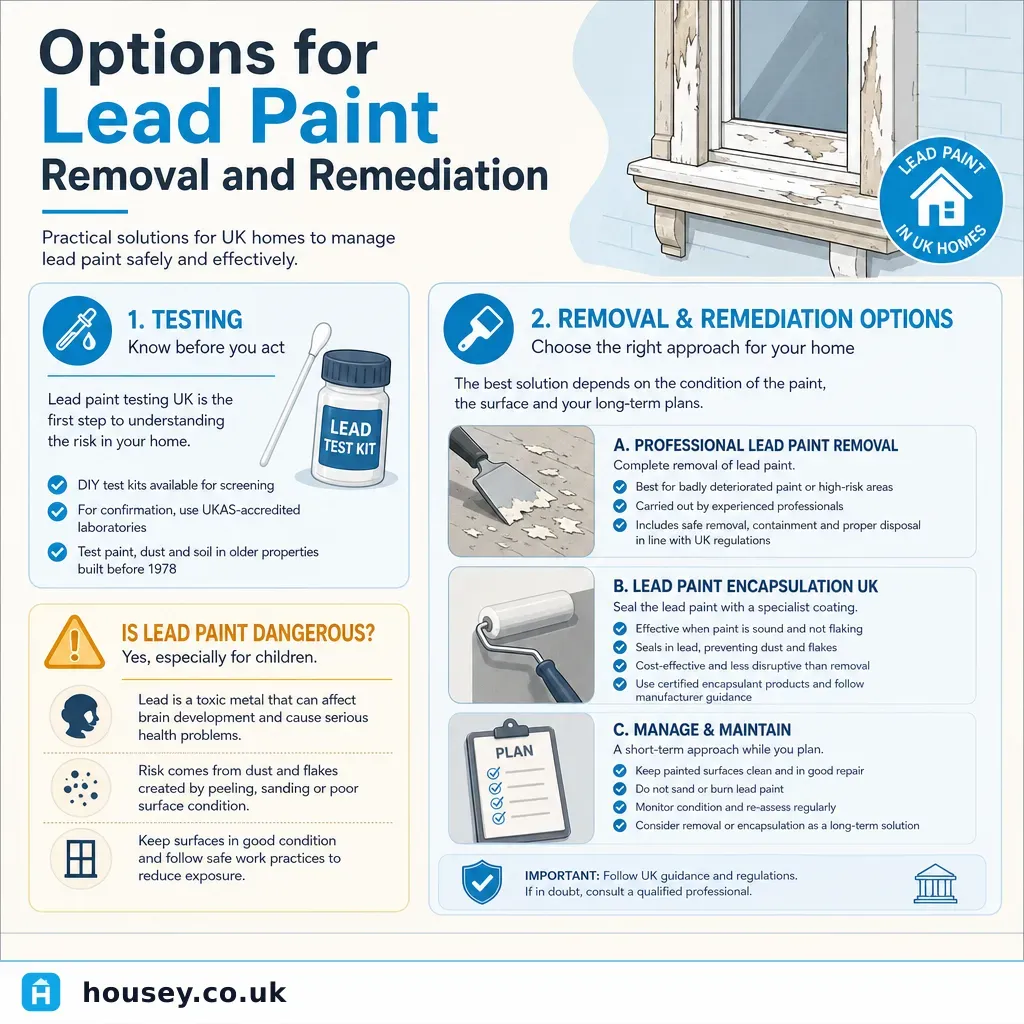
Options for Lead Paint Removal and Remediation
Lead paint is common in UK properties built before the 1960s and is still found in homes built as late as the 1980s, where lead-based primer was widely used on joinery and metalwork. It becomes a health hazard when disturbed — through sanding, scraping, drilling, or natural deterioration — releasing fine lead dust that is particularly dangerous to young children and pregnant women. The question of what to do about lead paint typically arises before redecoration, during renovation planning, or following a building survey that flags hazardous materials.
Key points
- The Control of Lead at Work Regulations 2002 requires a risk assessment before any work likely to disturb lead paint, setting out legal duties for anyone managing or undertaking such work.
- Lead paint in intact, stable condition is not automatically hazardous — the risk arises from disturbance or deterioration that generates dust or paint chips.
- HSE guidance identifies three principal approaches: leaving stable paint in place with monitoring, encapsulation under a bonding primer and durable topcoat, and full removal by a specialist contractor.
- Properties built before 1960 should be assumed to contain lead paint until tested; homes built between 1960 and 1992 may contain it in primers on windows, doors, and metalwork.
- Lead-contaminated waste from removal works is classified as hazardous waste under the Hazardous Waste (England and Wales) Regulations 2005 and must be collected by a licensed hazardous waste carrier.
Understanding the risk: when lead paint is and is not a problem
Lead paint that is well-bonded, in good condition, and not being disturbed poses a low immediate risk. The hazard increases significantly in the following situations:
- The paint is flaking, peeling, or chalking from the surface.
- You plan to sand, grind, heat-strip, or dry-scrape a painted surface.
- The property houses children under six, who are most vulnerable to lead poisoning from ingested dust or paint chips.
- Renovation work will cut through, drill into, or demolish surfaces coated with lead paint.
The Control of Substances Hazardous to Health (COSHH) Regulations 2002 require anyone managing or undertaking work that may expose workers to lead to carry out a suitable risk assessment before work begins. For domestic DIY, the legal framework differs, but the health risk is the same.
How to test for lead paint
Before deciding on a remediation approach, establish whether lead paint is present and in what condition.
Home swab test kits: Available from DIY retailers; they use a chemical reaction to indicate lead presence. They are a useful initial screen but may produce false negatives on some paint formulations and do not give concentration levels.
XRF (X-ray fluorescence) analysis: Non-destructive testing carried out by a specialist, giving a reading in milligrams per square centimetre. This is the most reliable method for in-situ assessment and is used by environmental hygienists and hazardous materials surveyors.
Laboratory analysis of paint chip or dust samples: Chips or dust samples are sent to a UKAS-accredited laboratory. This confirms lead presence and concentration but requires physical sampling from the specific layers of concern.
A professional environmental survey typically combines XRF testing with visual inspection and a written risk report, enabling homeowners and contractors to plan appropriate controls before any work begins.
Remediation options compared
Option | Best for | Not ideal for | Specialist required? | Outcome |
|---|---|---|---|---|
Leave in place and monitor | Stable, intact paint not subject to disturbance | Flaking paint, renovation planned, young children present | No — but reassess before any works | Paint remains; ongoing monitoring required |
Encapsulation | Stable paint on low-wear surfaces | Heavily flaking surfaces or high-wear areas | Recommended | Paint sealed; lead not removed |
Overpaint | Sound, well-adhered paint on low-risk areas | Surfaces that will be sanded or stripped later | No — use appropriate precautions | Paint covered; lead content unchanged |
Chemical stripping | Careful paint removal with minimal dust | Large areas — slow and costly at scale | Recommended for significant areas | Paint removed; hazardous waste disposal required |
Mechanical removal by specialist | Full removal from substrate; high-risk or high-priority areas | Where encapsulation is sufficient | Yes — licensed specialist contractor | Substrate exposed; waste disposed of correctly |
Whole-room decontamination | Extensive contamination or major renovation | Isolated patches in good condition | Yes — specialist contractor | Full decontamination of room and contents |
Indicative summary only. Method selection should follow a professional risk assessment.
How encapsulation works — and its limits
Encapsulation — applying a specialist encapsulant or bonding primer followed by a durable topcoat — is widely used in the UK because it is less disruptive and less costly than full removal. It works by sealing the lead paint so it cannot be ingested or inhaled. However:
- It is not appropriate where the underlying paint is flaking or the surface will be subject to significant wear or impact.
- It requires a stable substrate and careful surface preparation without sanding, which generates hazardous dust.
- It does not reduce the lead content — future contractors and buyers must be made aware that lead paint is present beneath the encapsulant layer.
Lead paint waste: disposal requirements
Lead-contaminated paint waste, dust, and debris are classified as hazardous waste under the Hazardous Waste (England and Wales) Regulations 2005. This means:
- It cannot be disposed of in general household bins or at standard household waste recycling centres.
- It must be collected and transported by a licensed hazardous waste carrier registered with the Environment Agency.
- A specialist remediation contractor will manage waste disposal as part of the service — confirm this is included in any quote before work begins.
Important limitations
This article provides general information only. Lead paint risks, remediation methods, and legal duties vary significantly depending on property type, paint condition, work scope, who is carrying out the work, and whether the property is residential or commercial. Nothing in this article constitutes legal or professional safety advice. A qualified environmental hygienist or hazardous materials surveyor should assess your specific property before any remediation work begins.
When this becomes urgent
Seek specialist assessment without delay if:
- Children under six live in, or regularly visit, the property and there are flaking or peeling painted surfaces they could access.
- Renovation work has already disturbed a suspected lead-painted surface and dust has spread through the property.
- A building survey report has identified lead paint as a priority hazard requiring action.
- You or others have experienced symptoms that may be linked to lead exposure — seek medical advice first, then arrange a professional survey.
What to ask a qualified professional
Before instructing an environmental hygienist or remediation contractor, ask:
- What testing method will you use, and will you provide a written risk assessment report?
- Do you hold the BOHS P402 qualification (or equivalent) for surveying lead in buildings?
- Which remediation method do you recommend for this property, and why?
- How will lead dust and debris be contained during works to protect the rest of the building?
- What clearance testing will you carry out after the work is complete?
- Will you provide a written report I can share with future contractors and conveyancers?
- Is your hazardous waste carrier licence current, and can I see a copy?
When to get professional help
Do not attempt to sand, grind, dry-scrape, or heat-strip paint in a property built before the 1990s without first establishing whether it contains lead. If lead paint is identified or suspected, instruct a specialist. Housey's environmental surveys service connects homeowners with qualified hazardous materials assessors.
A professional asbestos survey may also be worth commissioning at the same time if the property predates 1985, as many older UK homes contain both asbestos and lead paint — combining surveys can reduce disruption and overall cost.
How Housey can help
Housey connects UK homeowners with qualified specialists through our environmental surveys service. Whether you need an XRF survey, a written risk assessment, or a full remediation specification, our vetted providers can advise on the safest and most practical approach for your property.
Frequently asked questions
How do I test for lead paint in my home?
The most reliable method is XRF (X-ray fluorescence) testing by a qualified environmental hygienist, which provides a non-destructive concentration reading. Home swab kits are a useful initial screen but can produce false negatives. For any works that will disturb painted surfaces in a pre-1990 property, a professional test is strongly recommended before work starts.
Is lead paint illegal in the UK?
Lead-based paint was phased out for most domestic applications from the late 1980s, and its sale for interior use is restricted under UK product regulations. However, having lead paint in your property is not illegal — it is the disturbance of lead paint without appropriate controls that creates safety and legal issues under COSHH regulations.
Can I remove lead paint myself?
Wet scraping on small, well-contained areas may be possible following HSE guidance, but sanding, grinding, dry scraping, or heat stripping is strongly discouraged without specialist training and equipment. Larger areas should always be handled by a qualified contractor with appropriate controls, containment measures, and hazardous waste disposal arrangements in place.
Do I need to declare lead paint when selling my home?
Sellers are expected to disclose known material defects. If a survey has identified lead paint — particularly in poor condition — it is prudent to declare it to buyers and their solicitors. This is especially important where remediation works remain outstanding. Speak to your conveyancer for specific legal advice on disclosure obligations.
Sources and further reading
- Lead at work: HSE guidance — Health and Safety Executive
- Control of Lead at Work Regulations 2002 — legislation.gov.uk
- Hazardous Waste (England and Wales) Regulations 2005 — legislation.gov.uk
- Control of Substances Hazardous to Health (COSHH) — Health and Safety Executive
- BOHS: qualifications for hazardous materials work — British Occupational Hygiene Society
Useful next reads
 Surveys & Inspections
Identifying Asbestos Insulation: What You Need to Know for Your Property
Asbestos insulation was widely used in UK properties built before 2000, commonly found in pipe lagging, ceiling tiles, loose-fill loft insulation, and around boilers.
 Surveys & Inspections
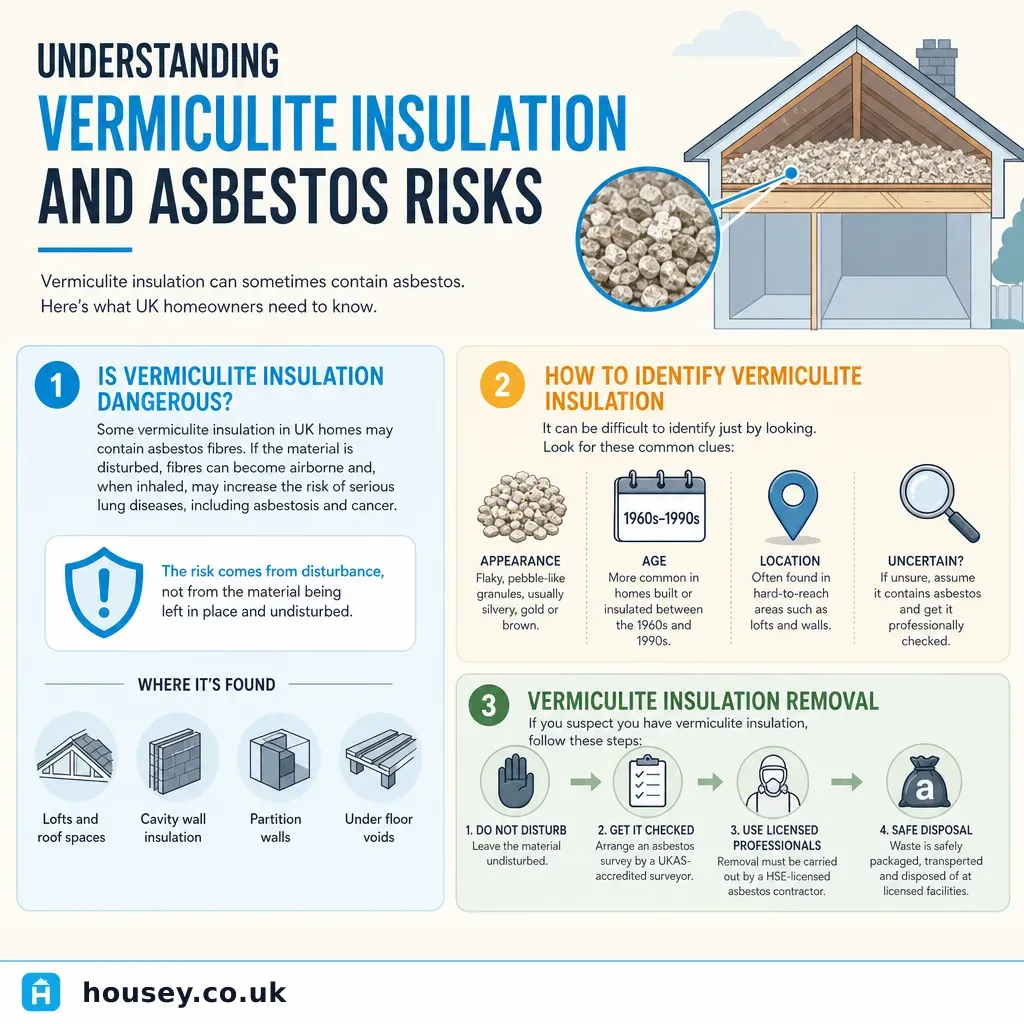
Understanding Vermiculite Insulation and Asbestos Risks
Vermiculite insulation is a lightweight granular mineral used in UK loft and cavity wall insulation from the 1960s to late 1980s.
 Surveys & Inspections
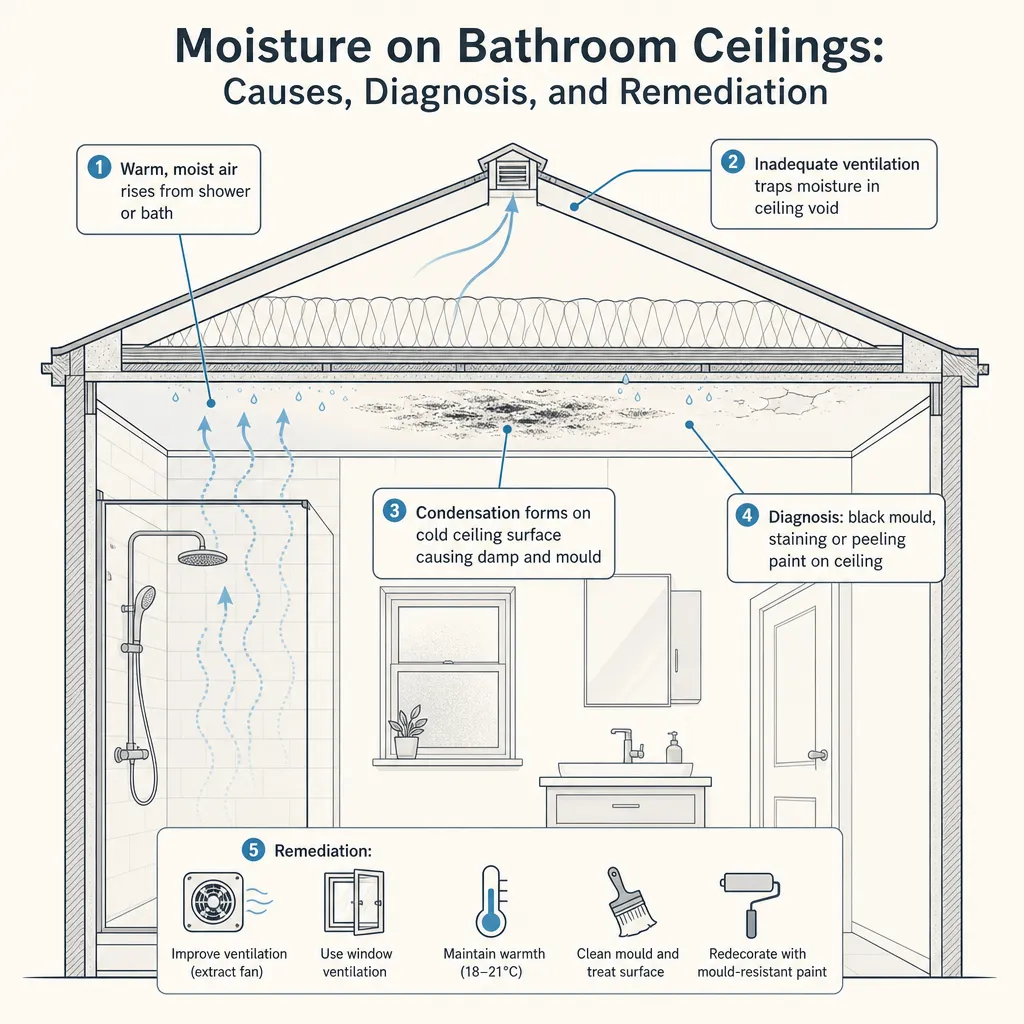
Moisture on Bathroom Ceilings: Causes, Diagnosis, and Remediation
Moisture on a bathroom ceiling is most often caused by condensation from poor ventilation, but can also indicate a leak from above or penetrating damp.
 Surveys & Inspections
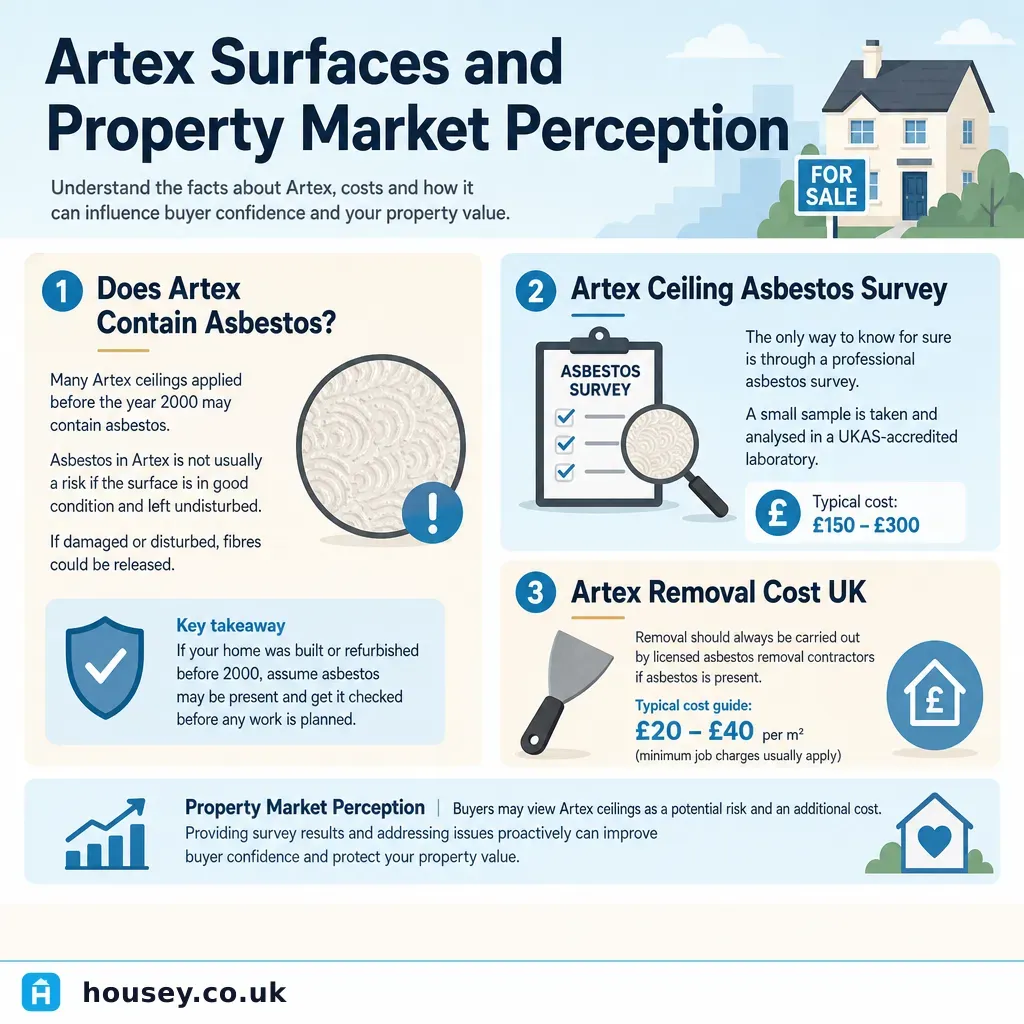
Artex Surfaces and Property Market Perception
Artex applied before 2000 may contain chrysotile asbestos, which is safe when undisturbed but hazardous if sanded or scraped without professional assessment.
 Surveys & Inspections
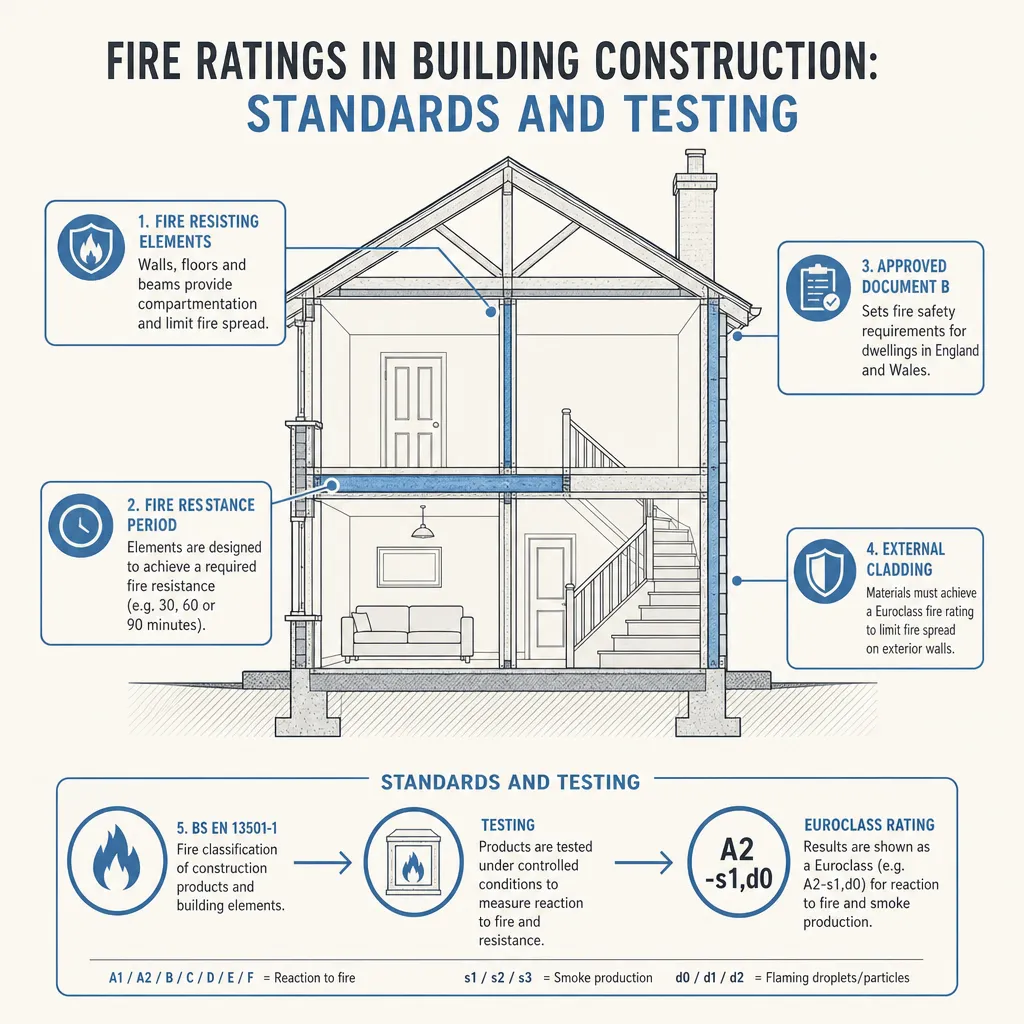
Fire Ratings in Building Construction: Standards and Testing
In UK construction, fire ratings describe how long a structural element or building assembly maintains load-bearing capacity, integrity, and insulation when exposed to a standard fire test — typically 30, 60, 90, or 120 minutes.