Gas Safety Compliance for Tenanted Properties
By Housey · Last reviewed 11th of May 2026
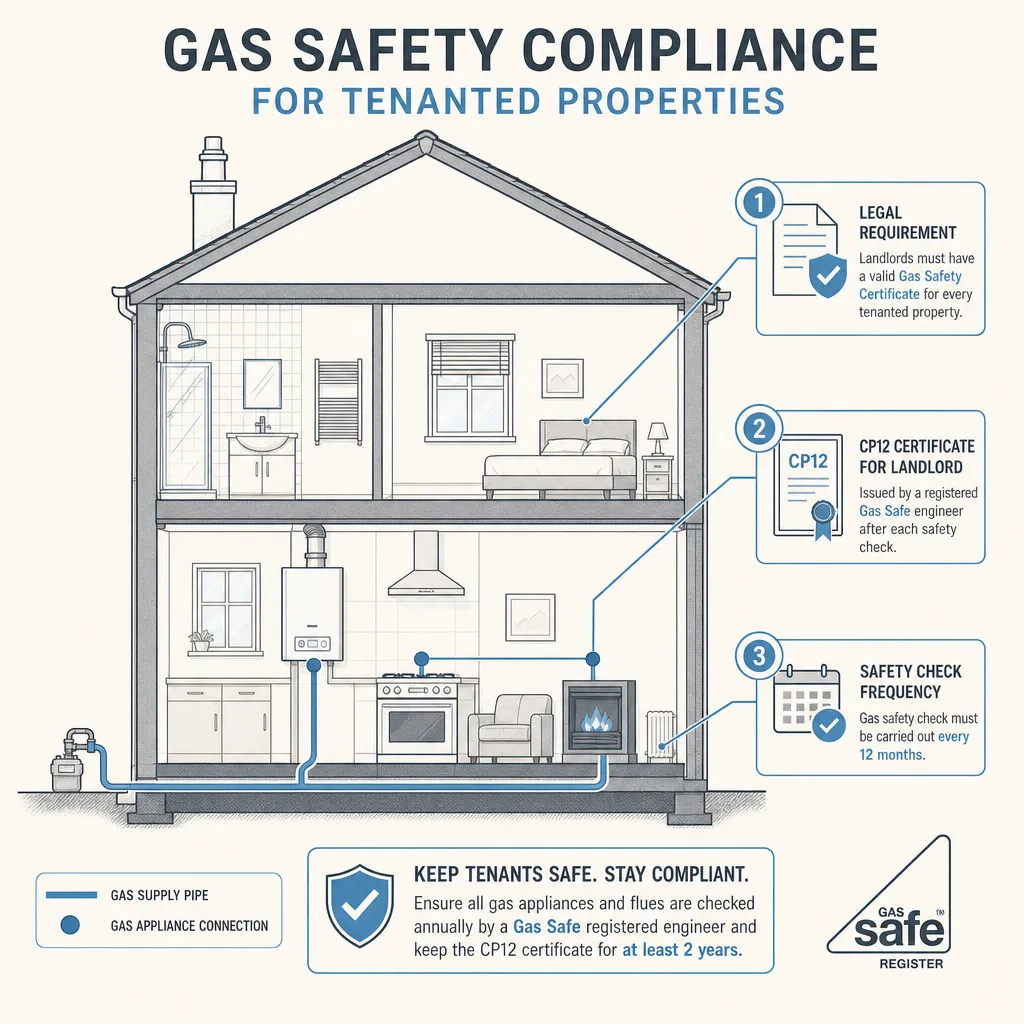
Gas Safety Compliance for Tenanted Properties
Renting out a property with gas appliances carries specific legal obligations that sit outside the scope of a standard tenancy agreement. Gas safety legislation applies from the first day of a tenancy, and a landlord's failure to comply — even without an incident — can result in enforcement action, unlimited fines, or imprisonment. The rules stem from the Gas Safety (Installation and Use) Regulations 1998, enforced by the Health and Safety Executive (HSE), and apply to virtually all residential tenancies in England, Scotland, and Wales.
Key points
- Landlords must arrange a gas safety check every 12 months by a Gas Safe Register-enrolled engineer under the Gas Safety (Installation and Use) Regulations 1998.
- The resulting Landlord Gas Safety Record — commonly called a CP12 — must be given to existing tenants within 28 days of the check and to new tenants before they move in.
- Landlords must keep copies of gas safety records for at least two years.
- Gas safety obligations extend to all gas appliances, pipework, and flues within a property that the landlord is responsible for — not just the boiler.
- Failure to comply is a criminal offence and can prevent a landlord from serving a valid Section 21 notice in England.
What the law requires
The Gas Safety (Installation and Use) Regulations 1998 place a duty on landlords — including social landlords and housing associations — to maintain all gas appliances, fittings, flues, and pipework for which they are responsible.
The annual gas safety check must be carried out by an engineer enrolled on the Gas Safe Register, the official UK register of gas engineers. It is a criminal offence for an unregistered person to carry out gas work on a domestic property.
Landlords who use a managing agent do not automatically transfer this legal responsibility. The obligation can be delegated in writing, but if the agent fails to arrange the check, the landlord may still be found liable. Always obtain written confirmation that the agent will discharge this duty, and verify records directly.
What a gas safety check covers
A Gas Safe registered engineer will inspect each gas appliance and associated pipework and flue in the property. The check typically covers:
- Boilers and central heating systems: combustion performance, flue integrity, safety device operation, and correct ventilation.
- Gas fires, cookers, and hobs: correct operation, seal integrity, and evidence of incomplete combustion.
- Pipework and meters: visible condition and tightness (pressure) testing where appropriate.
- Flues and chimneys: confirmation that products of combustion are safely discharged to the outside.
A gas safety check is not the same as a boiler service. A service cleans and adjusts the boiler; a formal safety check is a legal inspection that results in the CP12 document. Many engineers combine both in a single visit, but confirm in advance that the visit includes the formal check.
Landlord gas safety compliance checklist
Record-keeping and tenant documentation
The Landlord Gas Safety Record (CP12) must contain specific information: the date of the check, the address of the property, a description of each appliance inspected, any defects identified and the remedial action taken, the inspector's Gas Safe Register number, and the engineer's signature.
Landlords should retain records covering at least the previous two annual checks so that, if challenged, they can demonstrate an unbroken compliance history. Many landlords store digital copies alongside tenancy agreements and deposit documentation.
Providing records to tenants: The law requires a copy of the CP12 to be given to each tenant named on the tenancy agreement. For a House in Multiple Occupation (HMO), give a copy to each occupier, or display it in a communal area accessible to all occupants.
What happens if you miss a check
Failing to carry out an annual gas safety check is a criminal offence under the Gas Safety (Installation and Use) Regulations 1998. The Health and Safety Executive can issue improvement notices, prohibition notices, or bring a prosecution. On conviction, penalties can include an unlimited fine and, in serious cases, a custodial sentence.
There is also a significant civil risk. In England, a landlord cannot serve a valid Section 21 notice (no-fault possession) unless required safety documentation — including a current gas safety record — was provided to the tenant at or before the start of the tenancy and kept up to date throughout. A compliance gap may prevent recovery of possession even when the tenancy has legitimately ended.
Important limitations
This article provides general information only. Gas safety law is strictly enforced and can vary in procedural detail depending on property type, tenancy arrangement, and jurisdiction — separate regulations apply in Northern Ireland. All gas safety checks must be carried out by a Gas Safe registered engineer. This duty cannot be delegated to the tenant or fulfilled by a DIY inspection. Seek legal advice from a solicitor if you are uncertain about your obligations in relation to tenancy documentation or compliance history.
When to get professional help
Contact a Gas Safe registered engineer immediately if:
- A tenant reports the smell of gas, symptoms of carbon monoxide exposure (headache, nausea, dizziness), or a yellow or orange boiler flame instead of blue.
- Any gas appliance in the property has not been inspected within the past 12 months.
- You have taken on a tenanted property and have no record of a previous gas safety check.
- An engineer has identified an appliance as Immediately Dangerous (ID) or At Risk (AR) — in both cases the appliance should be disconnected and not used until it has been repaired or replaced.
If there is a suspected gas leak, call the National Gas Emergency Service on 0800 111 999 immediately. Do not use electrical switches or naked flames.
What to ask a qualified professional
Before instructing a gas engineer, ask:
- Are you enrolled on the Gas Safe Register, and may I see your ID card or verify your licence number at gassaferegister.co.uk?
- Does this visit include the formal CP12 Landlord Gas Safety Record, or is it a boiler service only?
- Which appliances will be inspected, and what is the procedure if you identify a defect?
- If an appliance is condemned, what category will it be assigned — Immediately Dangerous (ID) or At Risk (AR)?
- Will I receive a physical or digital copy of the CP12 on the day or shortly after the visit?
How Housey can help
Housey connects landlords with Gas Safe registered engineers who can carry out an annual inspection, issue the gas safety certificate, and advise on any appliances requiring remedial work before the record can be completed. Compare quotes and verify engineer credentials in one place before booking.
Frequently asked questions
How often must a landlord arrange a gas safety check?
Every 12 months. The check must be carried out before the anniversary of the previous CP12. Many landlords book slightly early to avoid any gap — an engineer can carry out a check up to two months before the expiry date without losing the original renewal date, provided the check is done by the same registered engineer or firm.
Can I use any gas engineer for a landlord gas safety check?
No. The engineer must be enrolled on the Gas Safe Register. You can verify any engineer's registration at gassaferegister.co.uk by entering their licence number. Only engineers registered in the relevant gas categories — for example, domestic natural gas — may legally inspect those appliances. Instructing an unregistered engineer is itself a criminal offence.
What happens if a tenant refuses access for a gas safety check?
You must take all reasonable steps to gain access and document every attempt in writing — letters, emails, or text messages. Courts have held that a landlord who can demonstrate diligent written attempts may avoid prosecution, but simply accepting a refusal and leaving the check undone is not a defence. Seek legal advice if a tenant persistently prevents access.
Does a gas safety certificate cover all appliances in the property?
The CP12 covers all gas appliances, pipework, and flues for which the landlord is responsible. Tenant-owned appliances — such as a tenant's own gas cooker — are generally the tenant's responsibility, though the landlord may still have a duty to ensure that the supply pipework connecting it is in a safe condition.
Is a gas safety certificate the same as a boiler service?
No. A gas safety check is a formal legal inspection that results in the CP12 document. A boiler service is a maintenance visit that cleans, adjusts, and checks components. Many engineers offer both in a single appointment — confirm when booking which elements are included in the quoted price and that a valid CP12 will be issued.
Sources and further reading
- Landlord gas safety responsibilities — GOV.UK
- Gas safety guidance for landlords — Health and Safety Executive (HSE)
- Gas Safety (Installation and Use) Regulations 1998 — legislation.gov.uk
- Find a Gas Safe registered engineer — Gas Safe Register
Useful next reads
 Surveys & Inspections
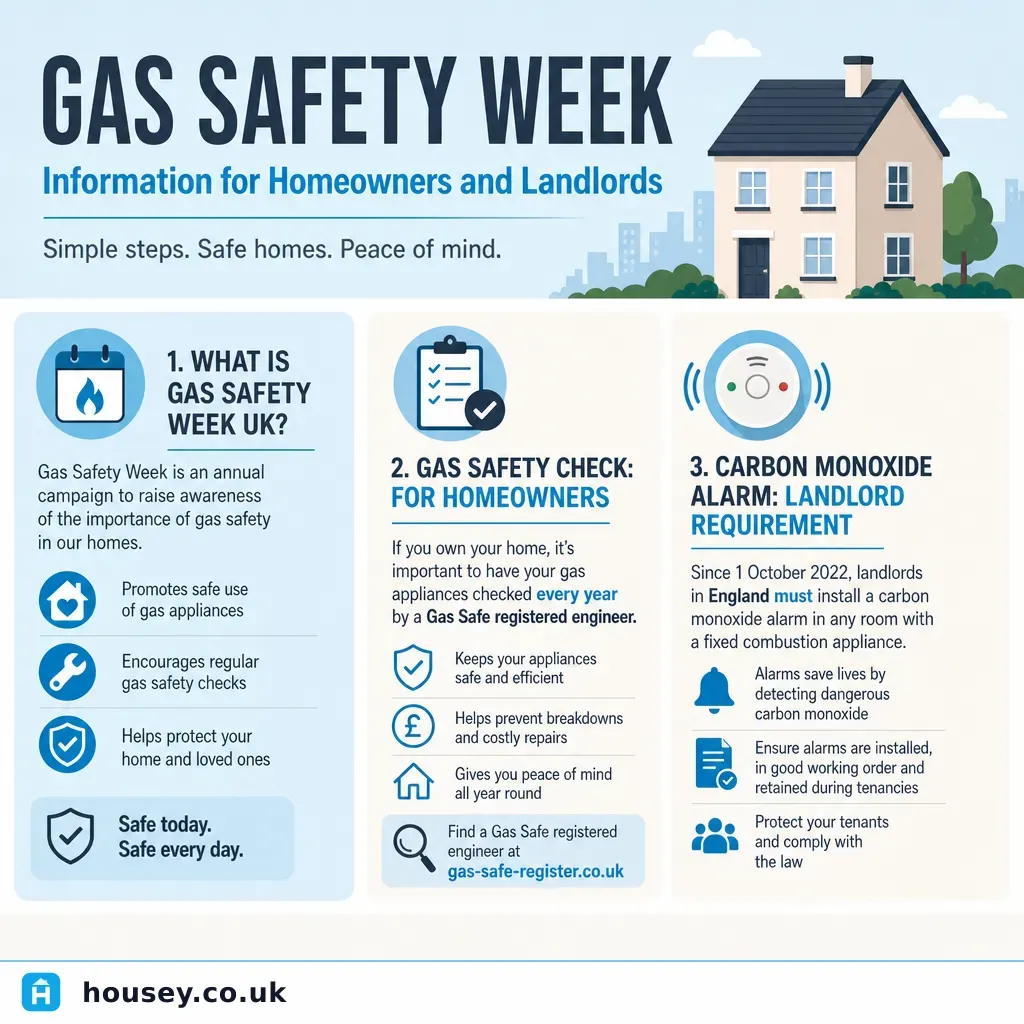
Gas Safety Week: Information for Homeowners and Landlords
Gas Safety Week, run each September by Gas Safe Register, highlights the risks of unsafe gas appliances and unlicensed gas work.
 Surveys & Inspections
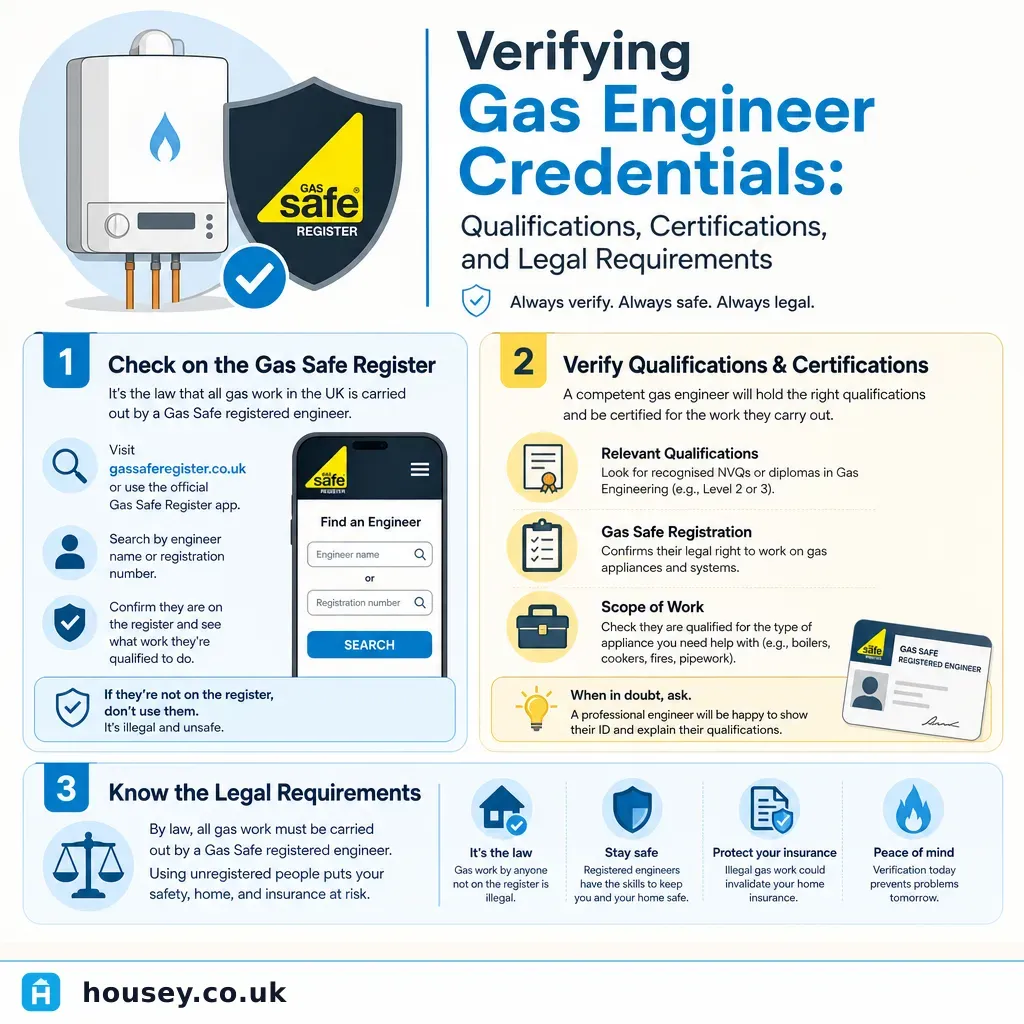
Verifying Gas Engineer Credentials: Qualifications, Certifications, and Legal Requirements
All gas engineers working on domestic properties in Great Britain must be Gas Safe registered — a legal requirement under the Gas Safety (Installation and Use) Regulations 1998.
 Surveys & Inspections
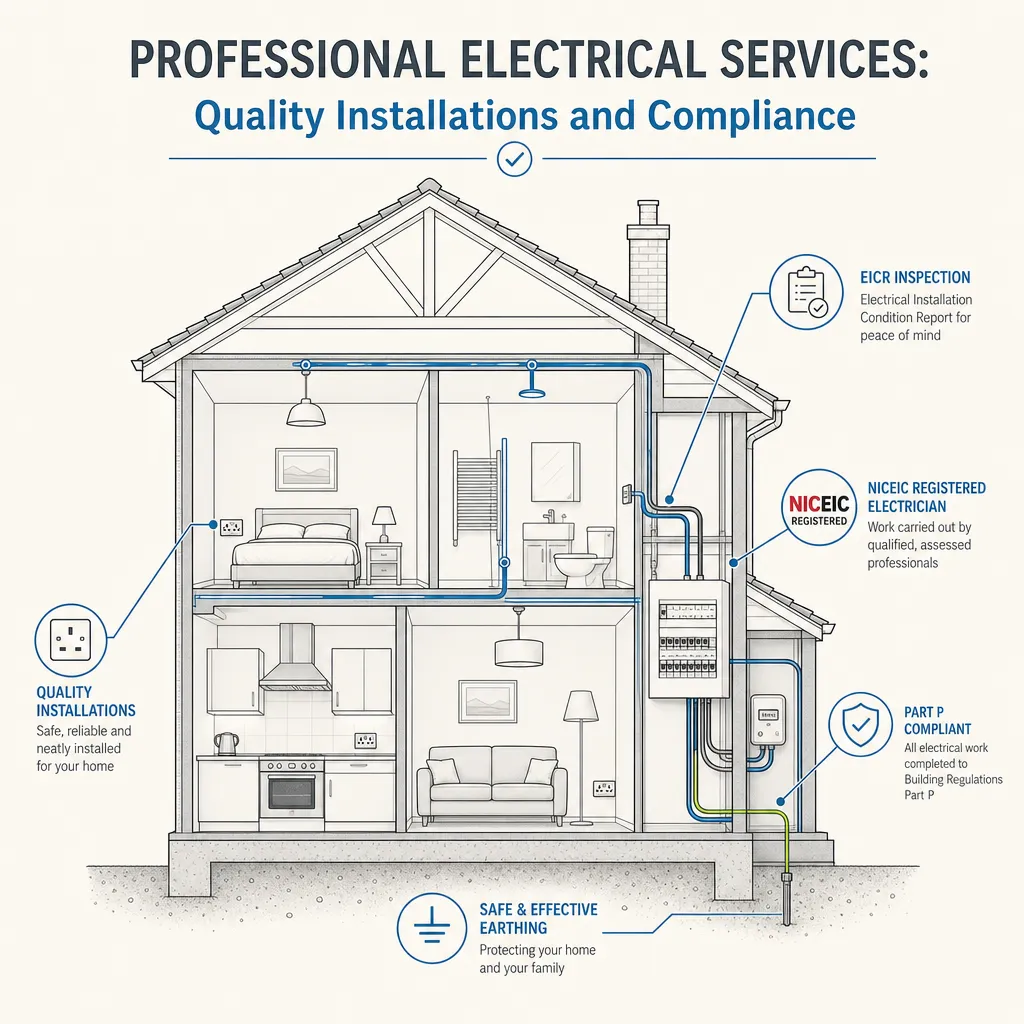
Professional Electrical Services: Quality Installations and Compliance
Professional electrical services in UK homes are governed by Part P of the Building Regulations and BS 7671 (18th Edition).
 Surveys & Inspections
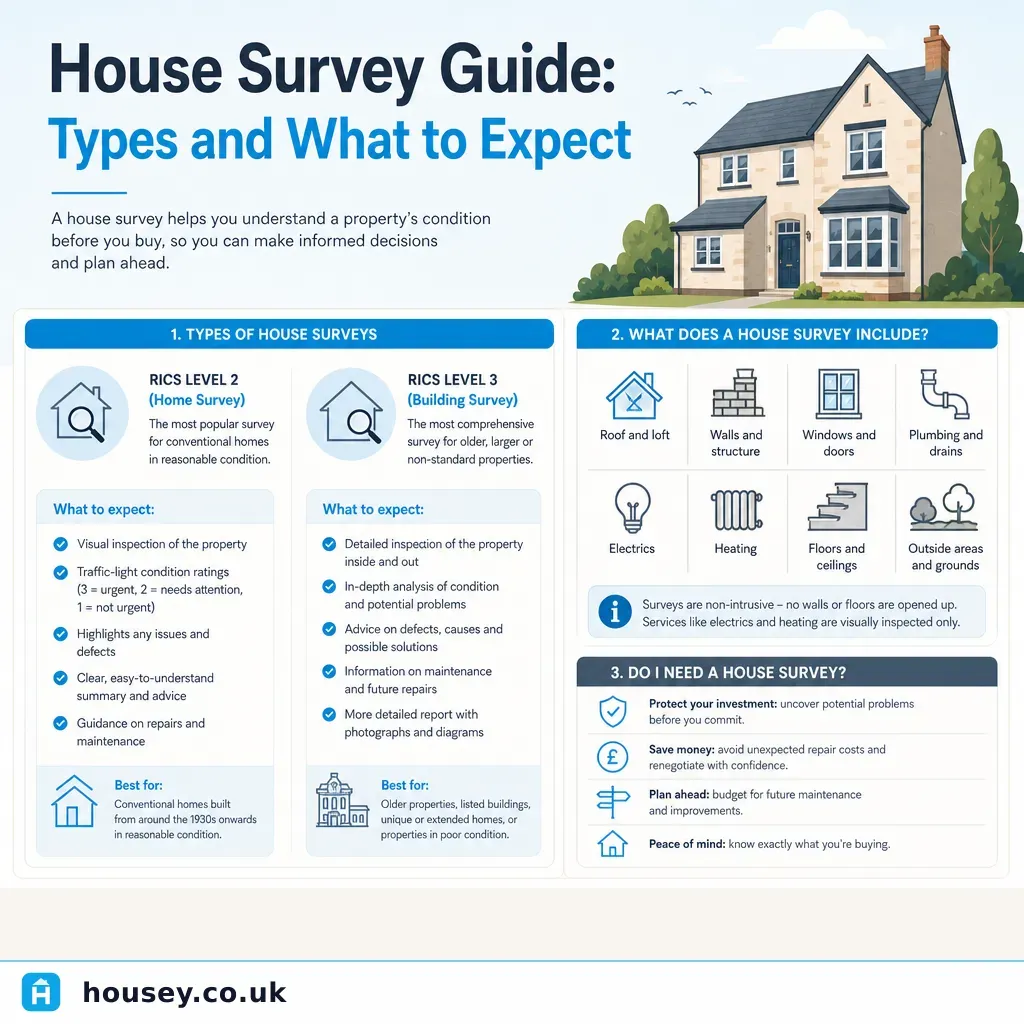
House Survey Guide: Types and What to Expect
UK house surveys come in three RICS-standardised levels: Level 1 (Condition Report) for new or near-new homes, Level 2 (Home Survey) for conventional post-war properties, and Level 3 (Building Survey) for older, altered, or defective properties.
 Surveys & Inspections
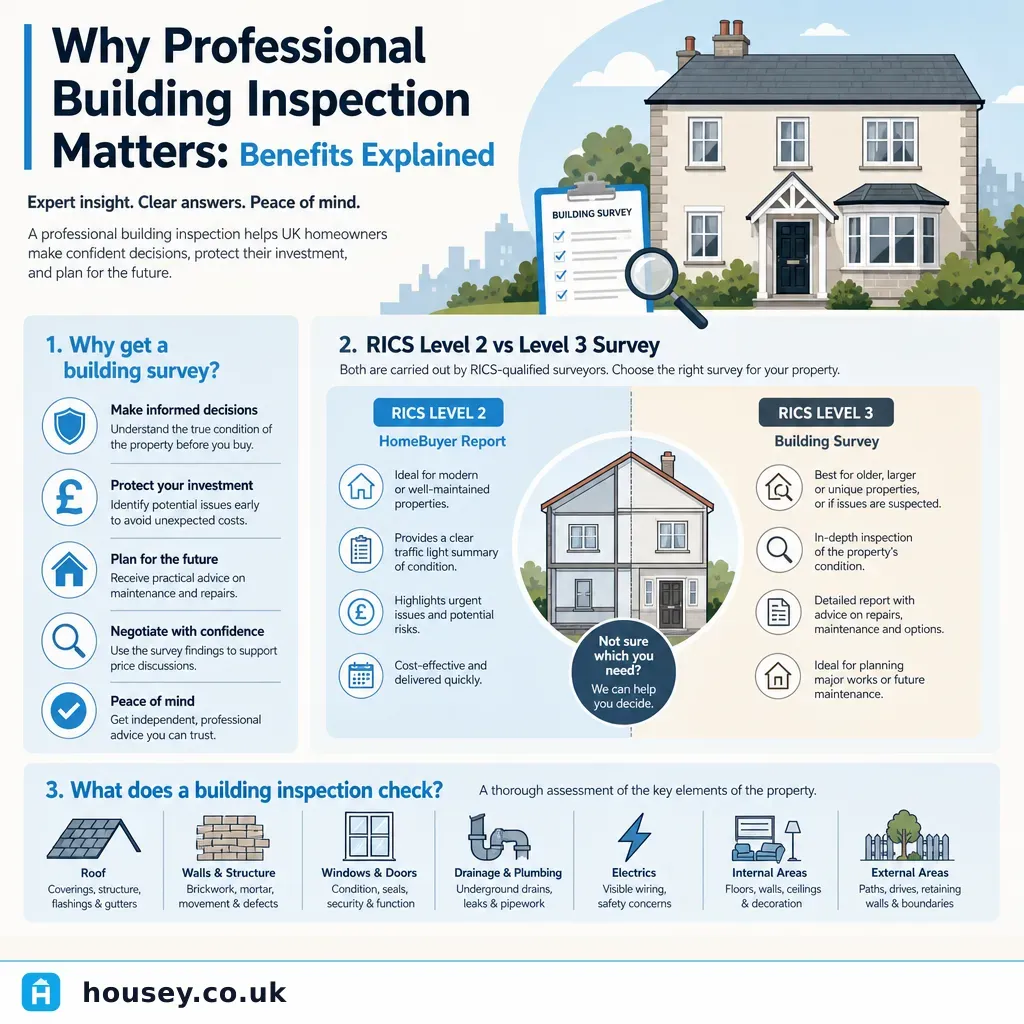
Why Professional Building Inspection Matters: Benefits Explained
Professional building inspection gives UK homeowners an independent, expert view of a property's condition and regulatory compliance.