Asbestos Cladding and Siding: Identification and Risk Management
By Housey · Last reviewed 31st of May 2026
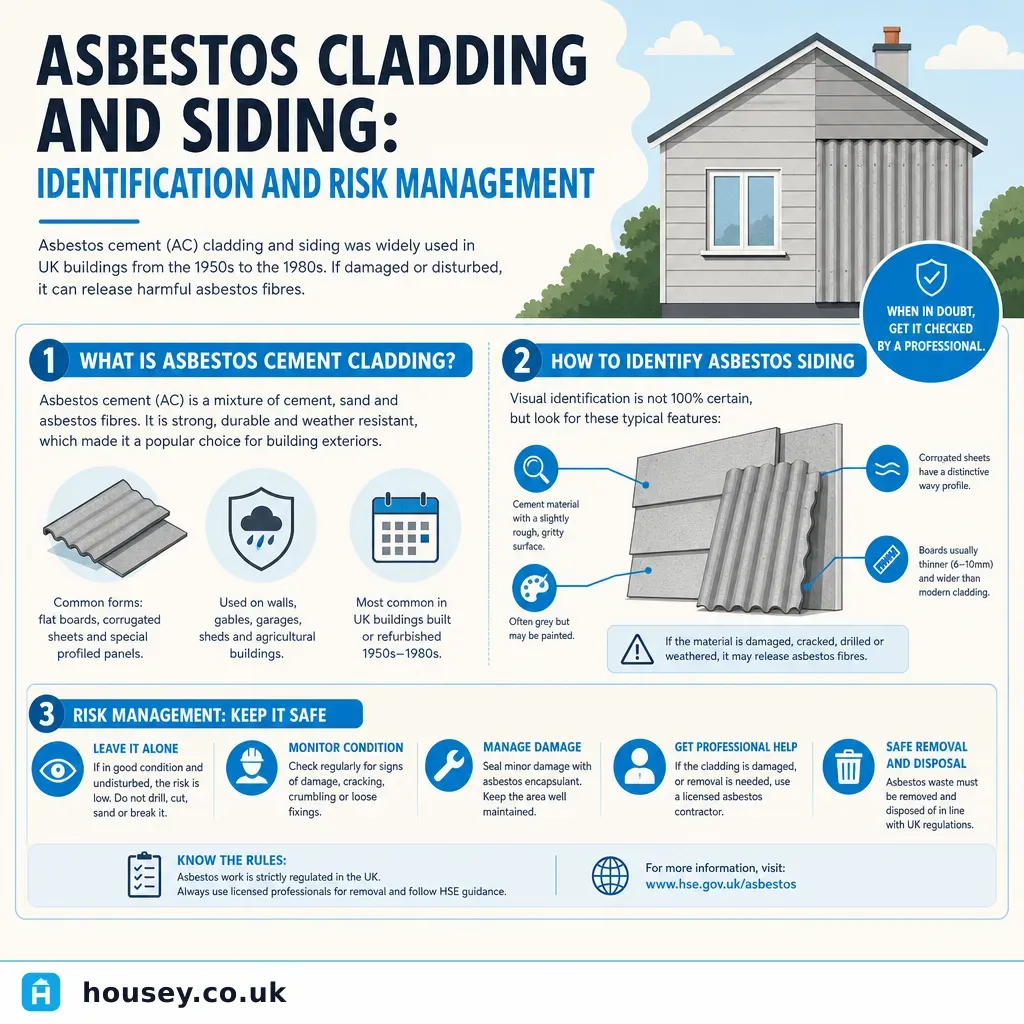
Asbestos Cladding and Siding: Identification and Risk Management
Asbestos cement cladding and siding panels were common across UK industrial, agricultural, and residential construction from the 1940s until the late 1990s, when all forms of asbestos were banned. If you own or are buying a property built before 2000, cladding on exterior walls, outbuildings, or garages could contain asbestos — and any planned renovation or demolition work triggers specific legal duties under the Control of Asbestos Regulations 2012. Decisions about whether to manage, encapsulate, or remove the material depend on its condition, your planned works, and property type — and getting those decisions wrong carries both legal and health consequences.
Key points
- All forms of asbestos were banned for use in new UK construction in 1999; any property built or clad before 2000 may contain asbestos cement products.
- Asbestos cement (AC) sheets typically contain 10–15% chrysotile (white asbestos) bonded in Portland cement — classified as a lower-risk bonded material, but still hazardous if damaged or disturbed.
- The Control of Asbestos Regulations 2012 (SI 2012/632) requires a refurbishment and demolition (R&D) survey before any works that will disturb suspect materials in pre-2000 buildings.
- Undamaged, well-maintained asbestos cement cladding in good condition does not require immediate removal — a written management plan, regular inspection, and record-keeping usually suffice.
- Removal of asbestos cement cladding above certain quantities requires notification to the HSE; heavily friable or high-risk removal work must be carried out by an HSE-licensed contractor.
Identifying asbestos cladding and siding
Asbestos cement was manufactured in several forms used on UK buildings. Common appearances include:
Product type | Common locations | Visual characteristics | Approximate era |
|---|---|---|---|
Corrugated AC sheet | Agricultural barns, garages, industrial roofs and walls | Wavy profile, grey-green colour, surface crazing over time | 1940s–1990s |
Flat AC sheet (Eternit-style) | Domestic soffits, fascias, exterior cladding | Smooth or lightly textured, grey, brittle edges | 1950s–1990s |
Profiled AC panel | Commercial and light industrial cladding | Ribbed or box-profile, similar to modern steel cladding but heavier | 1960s–1990s |
AC rainscreen tile | Domestic house cladding | Fish-scale or rectangular, sometimes painted | 1950s–1980s |
Visual identification alone is not reliable. Age, appearance, and location can suggest the presence of asbestos, but only laboratory analysis of a sample — taken by a competent professional — can confirm it. Some older panels carry trade names such as Asbestolux or Asbestoscellulose, which are strong indicators, but laboratory testing is the only reliable confirmation.
Understanding risk: bonded versus friable materials
Asbestos cement is a bonded material. The fibres are locked into the cement matrix, which significantly reduces the risk of fibre release under normal conditions. However, risk increases when the material is:
- Weathered, cracked, delaminating, or physically damaged
- Cut, drilled, sanded, or pressure-washed
- Struck by impact — for example, falling scaffolding or vandalism
- Broken during demolition or strip-out
Even bonded asbestos cement is classified as a hazardous material under the Control of Asbestos Regulations 2012. The key principle is: if in doubt, do not disturb the material, and obtain a survey before any works begin.
Legal duties for property owners and managers
Domestic homeowners
If you own and occupy your home, the duty to manage asbestos under Regulation 4 of the Control of Asbestos Regulations 2012 does not apply to purely domestic premises. However, you are still required to commission an R&D survey before any works that could disturb suspect materials, and to ensure any contractor is made aware of potential asbestos before they start work.
Landlords and commercial property owners
The duty to manage under Regulation 4 applies to non-domestic premises, common parts of HMOs, and shared areas of residential buildings. This means conducting a management survey, maintaining an asbestos register, sharing that register with anyone who may disturb the material, and reviewing the management plan periodically.
Which type of asbestos survey do you need?
- Choose a management survey if the building is in normal occupation and you need to locate and manage asbestos-containing materials (ACMs) in situ, with no major works planned.
- Choose a refurbishment and demolition (R&D) survey if you are planning any renovation, re-cladding, demolition, or works that will disturb the fabric of a pre-2000 building.
- Ask a licensed asbestos surveyor if survey results indicate friable, damaged, or high-risk materials — they can advise on whether removal is notifiable or licensable.
- Check HSE guidance at hse.gov.uk if you are unsure whether removal work requires a licensed contractor; the HSE publishes a licensing decision flowchart for this purpose.
What happens when asbestos cladding is found?
Not all asbestos cement requires immediate removal. The decision depends on three factors:
- Condition: Is the material intact, delaminating, or damaged?
- Location: Is it accessible to occupants or the public? Is it in a high-impact area?
- Planned works: Will any forthcoming renovation disturb it?
If the material is in good condition and no works are planned, a written management plan — including periodic photographic inspections — is often the appropriate response. If works are planned, removal before commencement is typically required.
Important limitations
This article provides general information about asbestos cement cladding in UK properties. Legal duties, risk levels, and appropriate management actions vary depending on property type, tenure, planned activities, and the specific condition of materials. This guide does not constitute legal or health and safety advice. A qualified asbestos surveyor or hygienist should assess your specific situation before any decisions are made or works instructed.
What to ask a qualified professional
Before instructing an asbestos surveyor or removal contractor, ask:
- Are you UKAS-accredited for asbestos surveys, or HSE-licensed for notifiable or licensable removal work?
- What type of survey do you recommend for my planned works, and why?
- Will samples be sent to a UKAS-accredited laboratory for analysis?
- What will your report include — an asbestos register, condition ratings, risk scores, and management recommendations?
- If removal is needed, will you notify the HSE and arrange licensed waste carrier disposal?
- What is included in the quote, and what additional costs could arise if further materials are identified?
Red flags: when to stop work immediately
Stop any work and seek professional guidance if:
- You discover corrugated grey sheets, soft grey panels, or brittle board material you did not expect during works on a pre-2000 building
- Cladding panels crumble, crack, or produce visible dust during handling
- A contractor proceeds with stripping external cladding without having first carried out an asbestos survey
- You notice unexplained fibrous dust inside or around an outbuilding or garage during renovation
- A RICS survey or homebuyer report flags a potential asbestos concern in external cladding
When to get professional help
Any situation involving suspected asbestos-containing cladding should be assessed by a competent professional before physical works proceed. Seek professional advice if you are planning to re-clad, render over, demolish, or repair any exterior element of a pre-2000 building, or if a survey has flagged suspected asbestos products. Do not attempt to cut, drill, break, or remove material you suspect contains asbestos. Disturbing asbestos without adequate controls is a criminal offence under the Control of Asbestos Regulations 2012.
How Housey can help
If you suspect asbestos cladding on your property, Housey can connect you with accredited professionals in your area. Compare quotes and credentials from local specialists through our asbestos surveys service, and ensure any work is carried out by a qualified, appropriately insured contractor before a single panel is touched.
Frequently asked questions
Can I paint over asbestos cement cladding to seal it?
Encapsulation — applying a sealant or paint designed for asbestos cement — can be an acceptable short-term management measure for intact, undamaged bonded material. It does not eliminate the hazard and must be documented in your asbestos management plan. A qualified asbestos surveyor should assess whether encapsulation is appropriate for your specific material and condition before any product is applied.
Does asbestos cement cladding have to be removed before I sell my house?
There is no legal requirement to remove asbestos cement cladding before selling a domestic property, provided it is in stable condition. You will need to disclose known asbestos to your solicitor during the sale process. Buyers and their surveyors may raise the issue, and mortgage lenders can sometimes require a survey or management plan before proceeding with an offer.
How much does an asbestos survey cost in the UK?
A management survey for a domestic property typically costs between £200 and £500 depending on size and location. A refurbishment and demolition survey for larger or commercial premises may cost more. Laboratory sample analysis is usually charged separately at approximately £20–£40 per sample. Always obtain at least three quotes and confirm UKAS accreditation before instructing. Indicative UK costs, last reviewed 2026-05-31.
Is weathered or chalking asbestos cement more dangerous?
Yes. Weathered, chalking, or delaminating asbestos cement presents a higher risk than intact material because the cement matrix is degrading, making fibre release more likely. Treat visibly chalking or crumbling cladding as a higher priority, seek a professional assessment promptly, and do not attempt to clean, pressure-wash, or remove it yourself.
Sources and further reading
- Control of Asbestos Regulations 2012 — legislation.gov.uk
- HSE: Asbestos — the basics — Health and Safety Executive
- HSE: Licensed contractors and notifiable non-licensed work — Health and Safety Executive
- HSE: Managing asbestos in buildings — Health and Safety Executive
- UKAS: Accreditation for asbestos testing — United Kingdom Accreditation Service
Useful next reads
 Surveys & Inspections
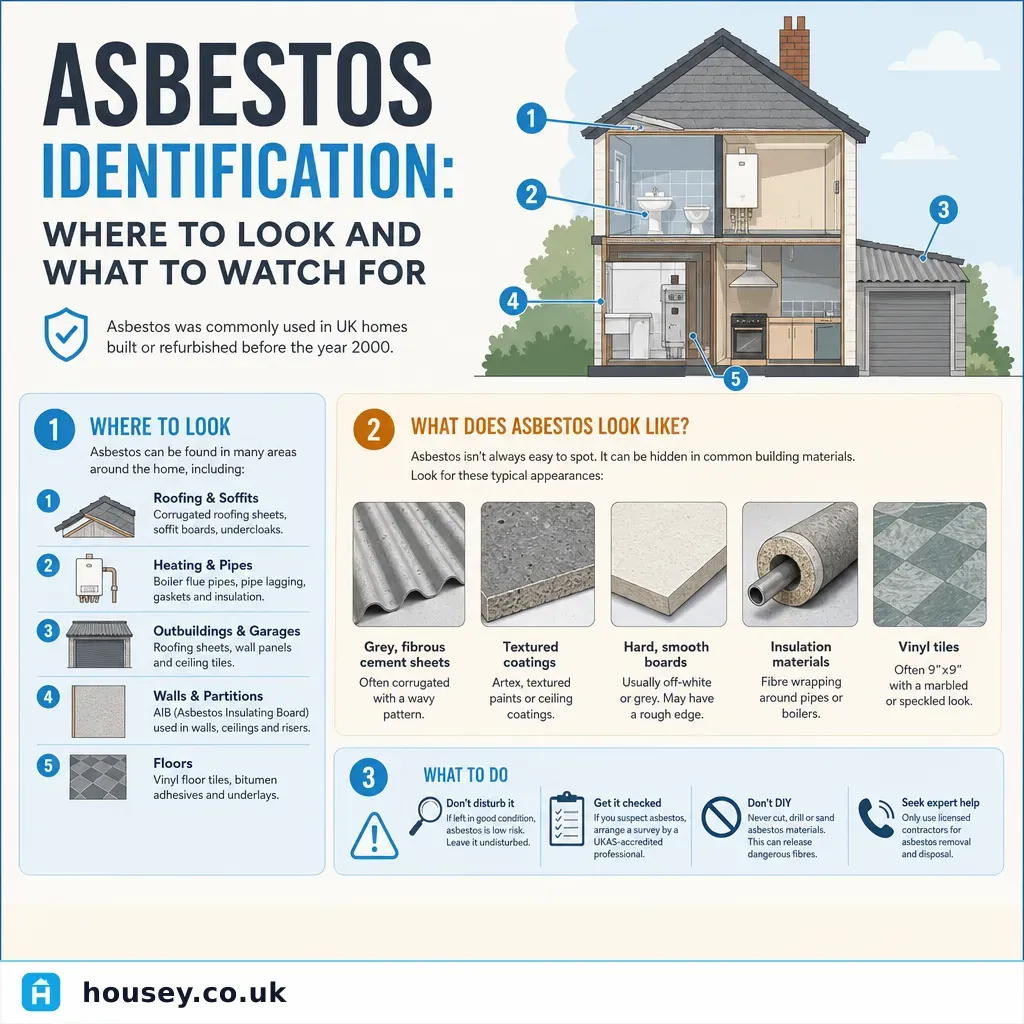
Asbestos Identification: Where to Look and What to Watch For
Asbestos can be present in dozens of locations in UK homes built before 2000, from textured ceiling coatings and floor tiles to pipe lagging and roof panels.
 Surveys & Inspections
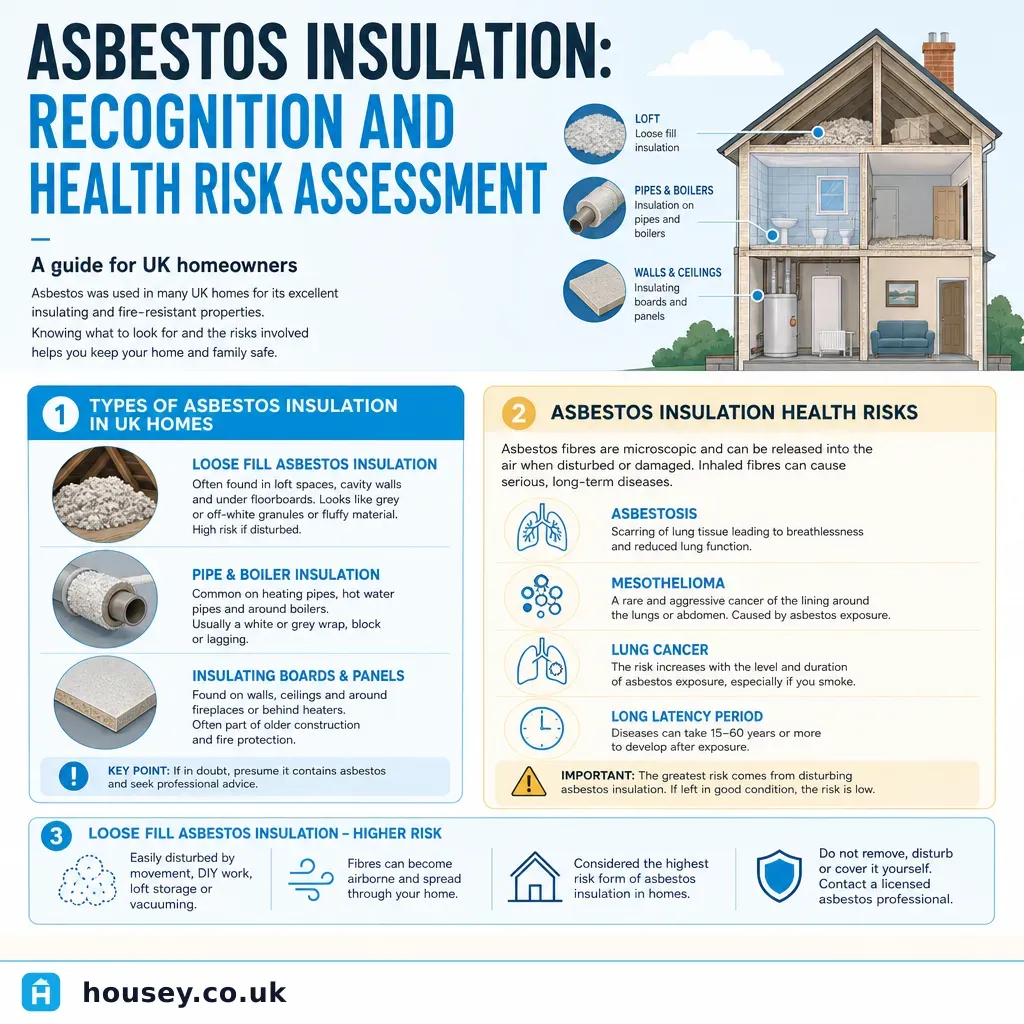
Asbestos Insulation: Recognition and Health Risk Assessment
Asbestos insulation in UK homes often appears as loose-fill loft insulation, pipe lagging, or sprayed coatings.
 Surveys & Inspections
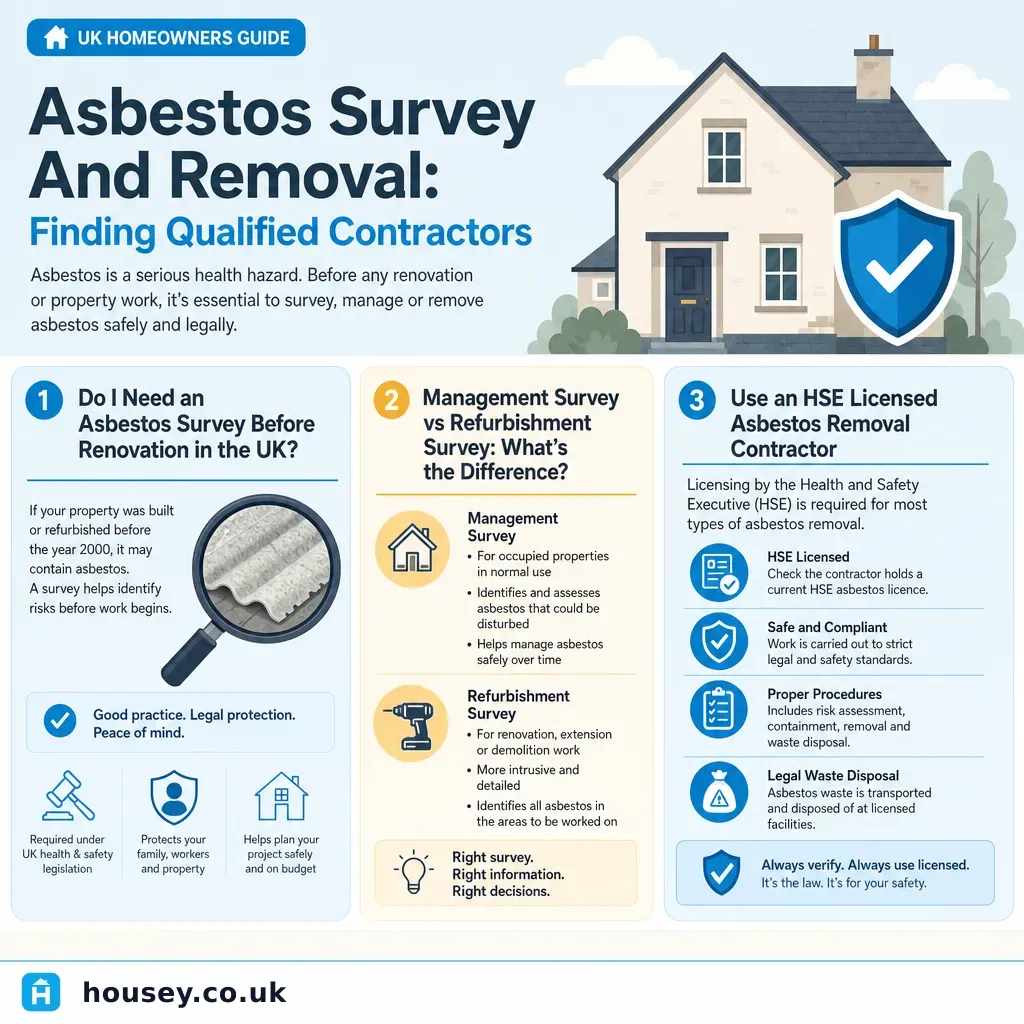
Asbestos Survey And Removal: Finding Qualified Contractors
An asbestos survey establishes whether asbestos-containing materials are present in your property and their condition.
 Surveys & Inspections
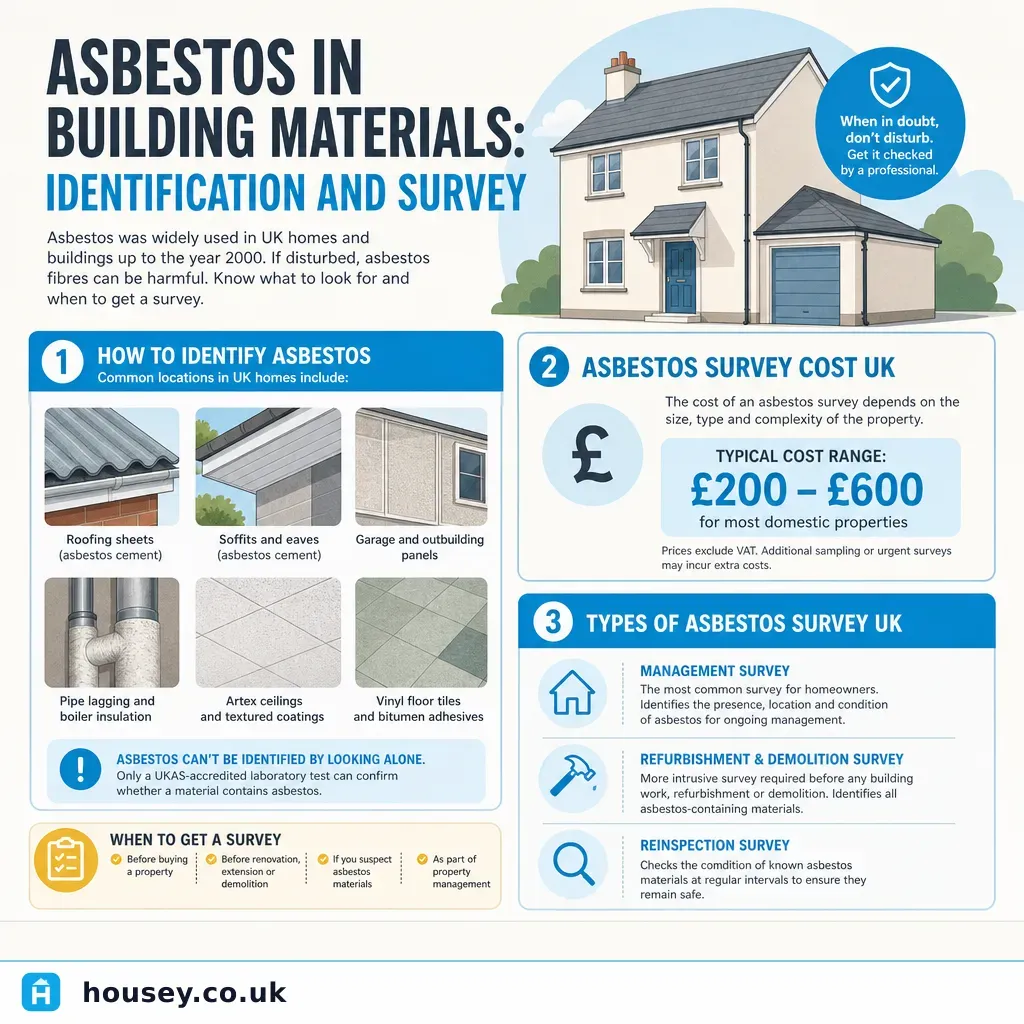
Asbestos in Building Materials: Identification and Survey
Asbestos-containing materials (ACMs) are present in many UK homes built before 2000, including floor tiles, textured coatings such as Artex, roof sheets, pipe lagging, and ceiling tiles.
 Surveys & Inspections
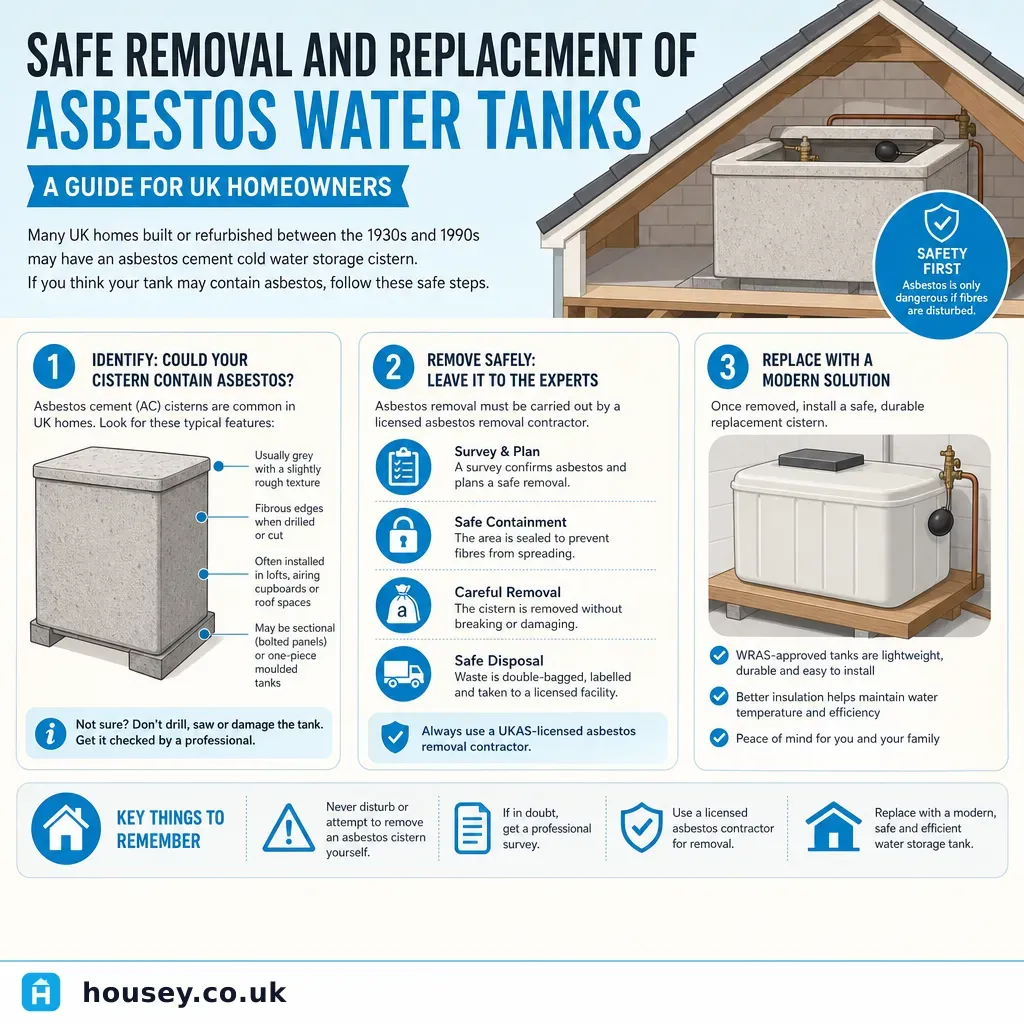
Safe Removal and Replacement of Asbestos Water Tanks
Asbestos cement cold water tanks, found in many UK homes built before about 1980, must not be drilled, cut, or broken without proper controls.