Asbestos Survey And Removal: Finding Qualified Contractors
By Housey · Last reviewed 31st of May 2026
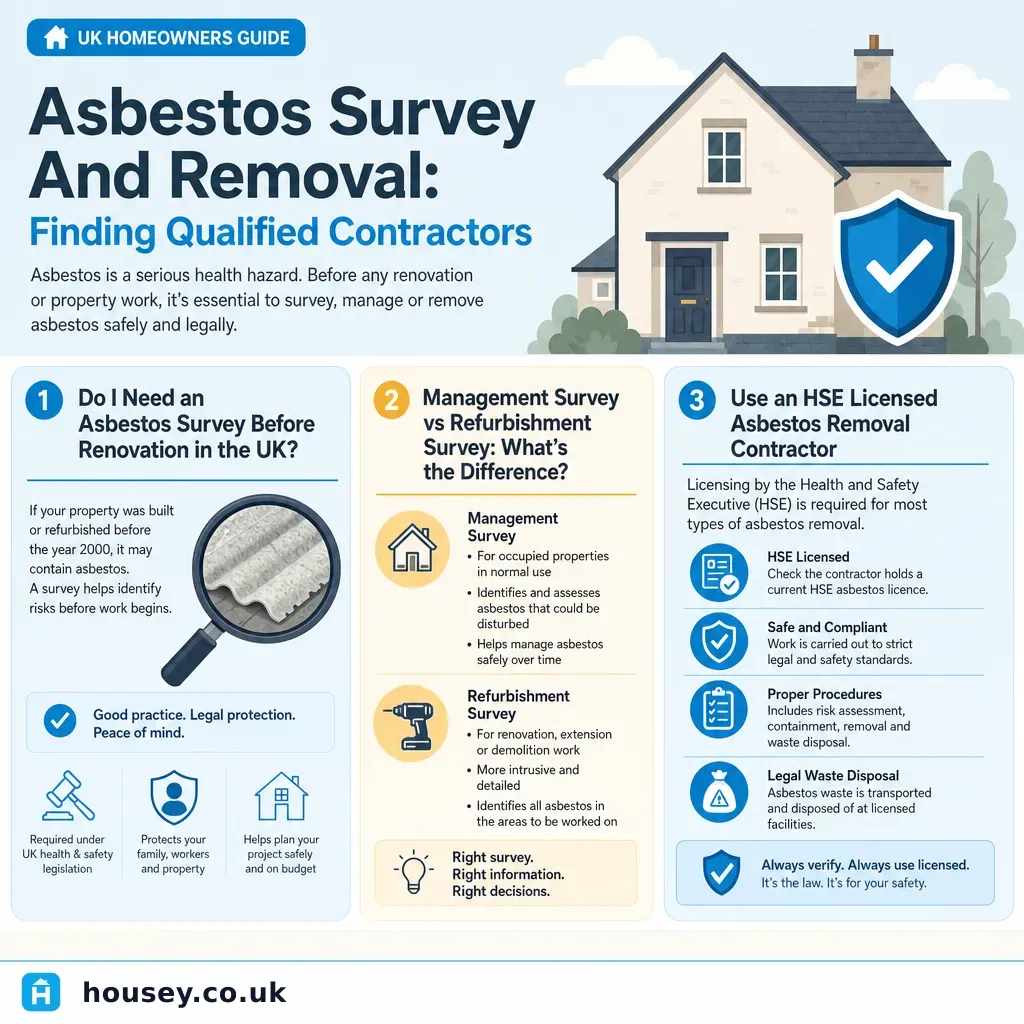
Asbestos Survey And Removal: Finding Qualified Contractors
Asbestos was widely used in UK building materials from the 1950s through to its full ban in 1999, meaning millions of homes — particularly those built or refurbished between 1950 and 2000 — may contain asbestos-containing materials (ACMs). When planning a renovation, extension, or any intrusive building work in an older property, identifying ACMs before work begins is not just good practice: for commercial premises it is a legal duty under the Control of Asbestos Regulations 2012 (CAR 2012), and for residential properties it is strongly recommended wherever disturbance of the fabric is planned.
Key points
- The Control of Asbestos Regulations 2012 (CAR 2012) is the primary legislation governing asbestos surveying, management, and removal in Great Britain.
- Asbestos surveys must be carried out by a surveyor working for a body accredited by the United Kingdom Accreditation Service (UKAS) to BS EN ISO/IEC 17020 — not all contractors offering surveys hold this accreditation.
- Most notifiable licensed asbestos removal work must be carried out by a contractor holding a current HSE licence; verify this against the HSE's public licensed contractor register before appointing anyone.
- Three fibre types are banned in the UK — crocidolite (blue), amosite (brown), and chrysotile (white) asbestos — and all three can be found in UK homes built or refurbished before 1999.
- After licensed removal, an independent clearance air test by a UKAS-accredited laboratory is required before reoccupation; this must not be carried out by the same contractor who removed the material.
What types of asbestos survey are there?
Two main survey types are defined under the HSE guidance document HSG264.
A management survey is the standard survey for an occupied or in-use building. It locates ACMs likely to be disturbed during normal occupation and minor maintenance, without significantly disrupting the fabric. It is appropriate for homeowners who want to identify and manage ACMs in a property they are living in without planned intrusive works.
A refurbishment and demolition (R&D) survey is required before any renovation, structural alteration, or demolition work begins. It is intrusive — accessing wall cavities, roof voids, floor voids, and other areas affected by planned works. This is the type needed before a loft conversion, extension, wall removal, full rewire, or major refurbishment of a pre-2000 property.
Survey type | When required | Invasiveness | Suitable for |
|---|---|---|---|
Management survey | Ongoing management of occupied building | Low — visual inspection and minor sampling | Managing known or suspected ACMs without planned intrusive works |
Refurbishment and demolition (R&D) survey | Before any intrusive building work | High — opens up structure systematically | Loft conversions, extensions, renovations, full refurbishments in pre-2000 properties |
Where is asbestos commonly found in UK homes?
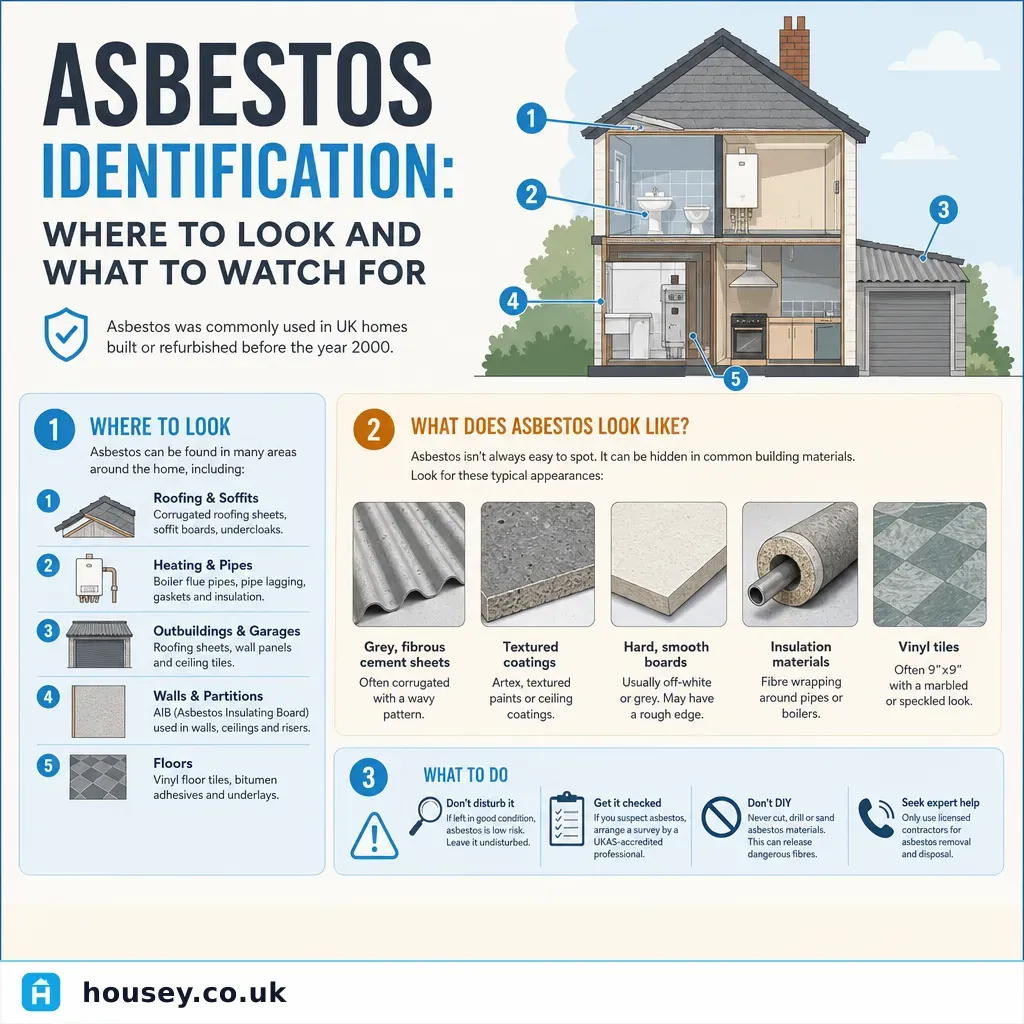
Asbestos can appear in many locations depending on a property's era and construction history:
- Artex and textured coatings on ceilings and walls (common in properties decorated before the 1990s)
- Floor tiles — particularly small-format vinyl floor tiles from the 1960s–1980s and their adhesive compounds
- Pipe lagging and boiler insulation in older heating systems
- Roof tiles, soffit boards, and guttering — often asbestos cement, particularly on 1960s–1980s properties
- Garage roofs and outbuildings — corrugated asbestos cement sheeting is very common on properties of this era
- Ceiling tiles in rooms decorated between 1950 and 1990
- Rope seals in older boiler and solid-fuel appliance flue connections
Decision guide: do you need a survey?
- Get an R&D survey if you are planning any intrusive building work — loft conversion, extension, wall removal, rewiring, replumbing, or full renovation — in a property built or significantly refurbished before 2000.
- Get a management survey if you have bought an older property and want to identify and record ACMs for ongoing management, without planned intrusive works in the near term.
- You may not need a formal survey if the property was built after 2000 using modern materials and has not been altered with pre-2000 materials.
- Contact an HSE-licensed professional immediately if you have already disturbed a material you suspect contains asbestos — stop work, minimise movement, and seek advice without delay.
How to find a qualified surveyor and removal contractor
For surveys, verify:
- UKAS accreditation to BS EN ISO/IEC 17020: The surveying body must hold this. Check the UKAS directory at ukas.com. Without accreditation, the survey may not be accepted by building control, your insurer, or a future buyer's solicitor.
- P402 qualification: This is the British Occupational Hygiene Society (BOHS) competency qualification for asbestos surveyors and confirms the individual has been assessed for competence.
For removal work, verify:
- HSE licence: Required for most notifiable licensed work (NLW). Check the HSE's licensed asbestos contractor register before appointing anyone. The licence should be current and applicable to the planned scope of work.
- Independent clearance air testing: After removal, the clearance certificate must be issued by a UKAS-accredited laboratory that is separate from the removal contractor — not an in-house arm of the same company.
Red flags when selecting a contractor
Avoid any contractor who:
- Cannot provide their UKAS accreditation reference or HSE licence number on request.
- Offers to remove suspected asbestos without carrying out a survey first.
- Proposes to carry out both the removal and the clearance air testing within the same organisation — these must be independent.
- Cannot clearly explain whether the planned removal is notifiable licensed work, licensed-notifiable, or non-licensed, and why.
- Offers to dispose of asbestos waste without issuing waste consignment notes as required under the Environmental Protection Act 1990.
- Quotes for the full scope without a site visit or review of existing survey data.
What to ask a qualified professional
Before instructing an asbestos surveyor or removal contractor, ask:
- What is your UKAS accreditation number, and what scope of survey are you accredited for?
- For removal: can I verify your HSE licence on the public register, and is it current and applicable to this scope of work?
- What type of survey do I need given my planned works — management or refurbishment and demolition?
- If asbestos is found, what options do I have — licensed removal, encapsulation, or managed in place — and what are the implications of each?
- Who will carry out the independent clearance air testing, and are they accredited separately from your removal team?
- How will asbestos waste be disposed of, and will I receive waste consignment notes for my records?
- What happens if additional ACMs are discovered once intrusive works begin?
When this becomes urgent
Stop work immediately and seek professional help without delay if:
- You have accidentally drilled, cut, sanded, or otherwise disturbed a material you suspect may contain asbestos.
- You notice deteriorating, friable, or visibly damaged materials in your property that could be ACMs — particularly crumbling pipe lagging, damaged ceiling tiles, or broken soffit boards.
- A previous owner, contractor, or surveyor has indicated asbestos may be present and you are about to begin building work.
- You find any loose, powdery, or fibrous insulation material in a roof void, loft, or around pipework in a pre-2000 property.
Do not disturb the material further. Leave the area, restrict access, ventilate where safe to do so, and contact an HSE-licensed professional for advice on decontamination and appropriate next steps.
Important limitations
This article provides general information on asbestos survey types and contractor selection only. Asbestos identification, risk assessment, and removal are highly regulated activities under the Control of Asbestos Regulations 2012. The presence, type, condition, and risk of ACMs varies by property and can only be determined by a qualified, UKAS-accredited professional. Do not attempt to test, disturb, or remove any material you suspect contains asbestos. This article does not constitute legal or safety advice — always instruct a licensed professional.
When to get professional help
Arrange a refurbishment and demolition survey before any intrusive building work in a pre-2000 property. If you have any doubt about whether a material contains asbestos, treat it as a potential ACM and arrange a survey before proceeding with any work that could cause disturbance.
How Housey can help
Housey connects homeowners with UKAS-accredited asbestos survey professionals across the UK. Describe your property type and planned works to receive quotes from qualified contractors who can identify the correct survey type for your situation.
Frequently asked questions
Is asbestos in my home dangerous if I leave it alone?
Asbestos-containing materials in good condition and undisturbed do not typically pose an immediate health risk. The danger arises when ACMs are damaged, deteriorating, or disturbed — releasing fibres that can be inhaled. A management survey helps you identify ACMs so you can monitor their condition and plan to avoid accidental disturbance during maintenance or future works.
How much does an asbestos survey cost in the UK?
A residential management survey typically costs £150–£350; a full refurbishment and demolition survey for a larger property can cost £300–£700 or more depending on size, construction type, and access requirements (indicative UK costs, last reviewed 2026-05-31). Removal costs vary considerably by type, quantity, and accessibility of the ACMs found. Always obtain multiple quotes from UKAS-accredited contractors.
Can I remove asbestos cement sheeting from my garage roof myself?
Asbestos cement roofing may fall into the non-licensed or licensed-notifiable category under CAR 2012 depending on scale and condition. Even non-licensed work requires strict precautions. Homeowners are strongly advised to use an HSE-licensed contractor rather than attempting removal themselves, as incorrect handling can release fibres. Check the HSE guidance and your local authority before considering any DIY approach.
What is a clearance certificate after asbestos removal?
A clearance certificate (or certificate of reoccupation) is issued after licensed asbestos removal following independent clearance air testing by a UKAS-accredited laboratory separate from the removal contractor. It confirms that airborne fibre levels meet the required standard and provides documentary evidence that the area is safe to reoccupy or for further works to continue.
Sources and further reading
Useful next reads
 Surveys & Inspections
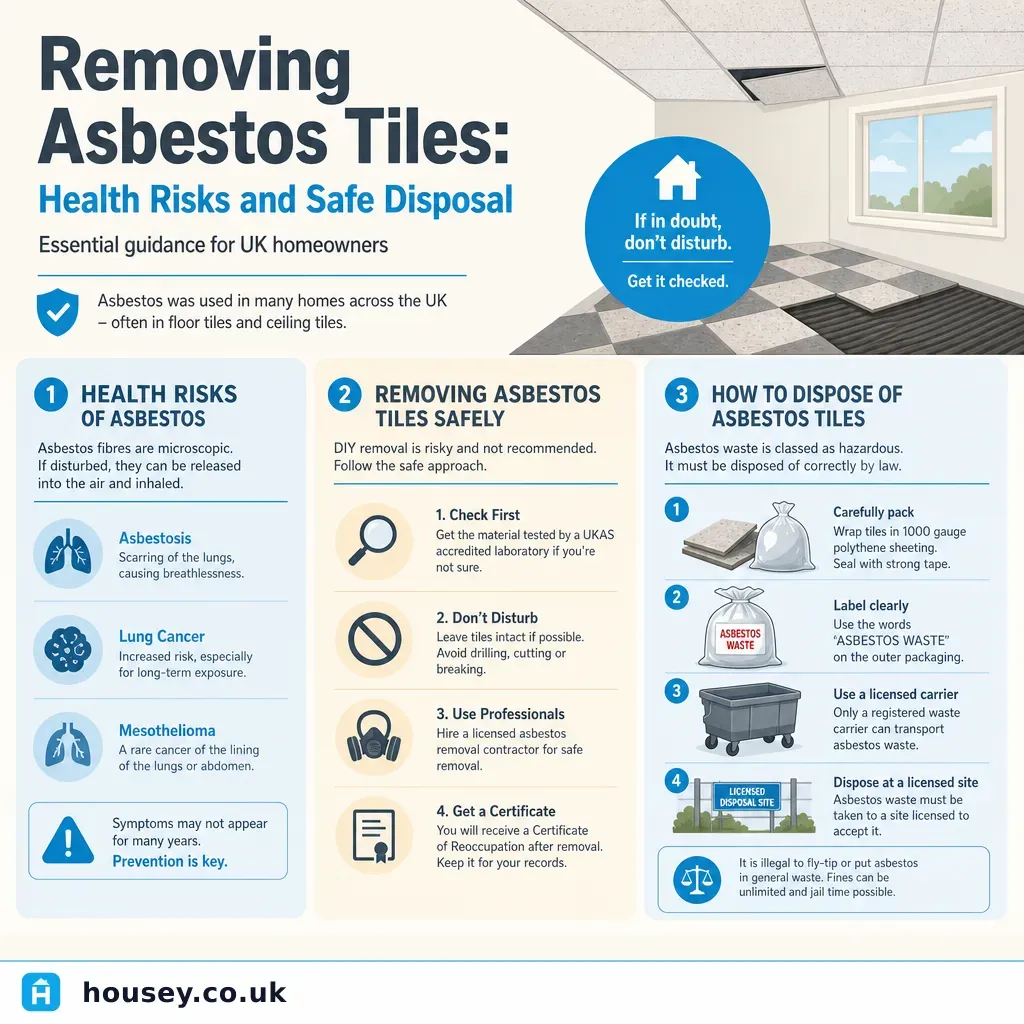
Removing Asbestos Tiles: Health Risks and Safe Disposal
Asbestos tiles in pre-2000 UK properties must not be disturbed without a refurbishment and demolition survey under HSG264.
 Surveys & Inspections
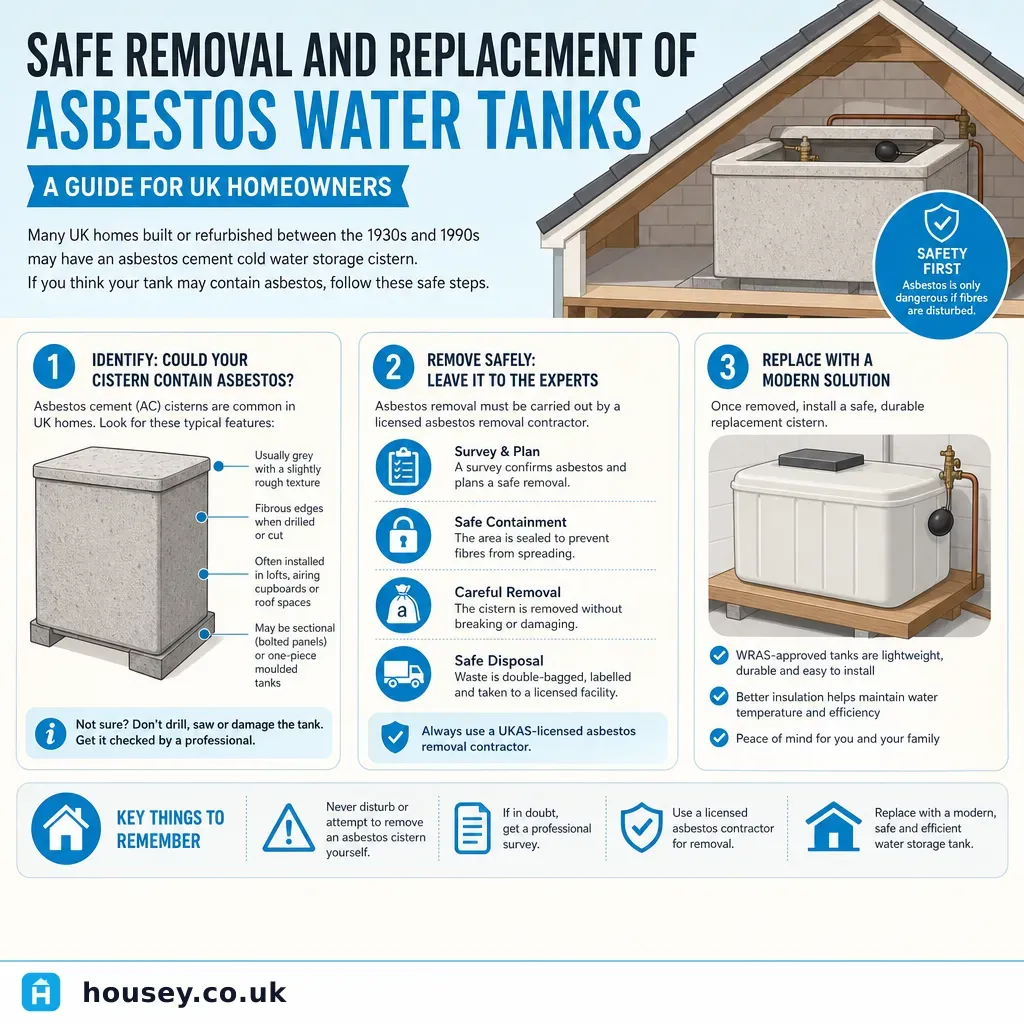
Safe Removal and Replacement of Asbestos Water Tanks
Asbestos cement cold water tanks, found in many UK homes built before about 1980, must not be drilled, cut, or broken without proper controls.
 Surveys & Inspections
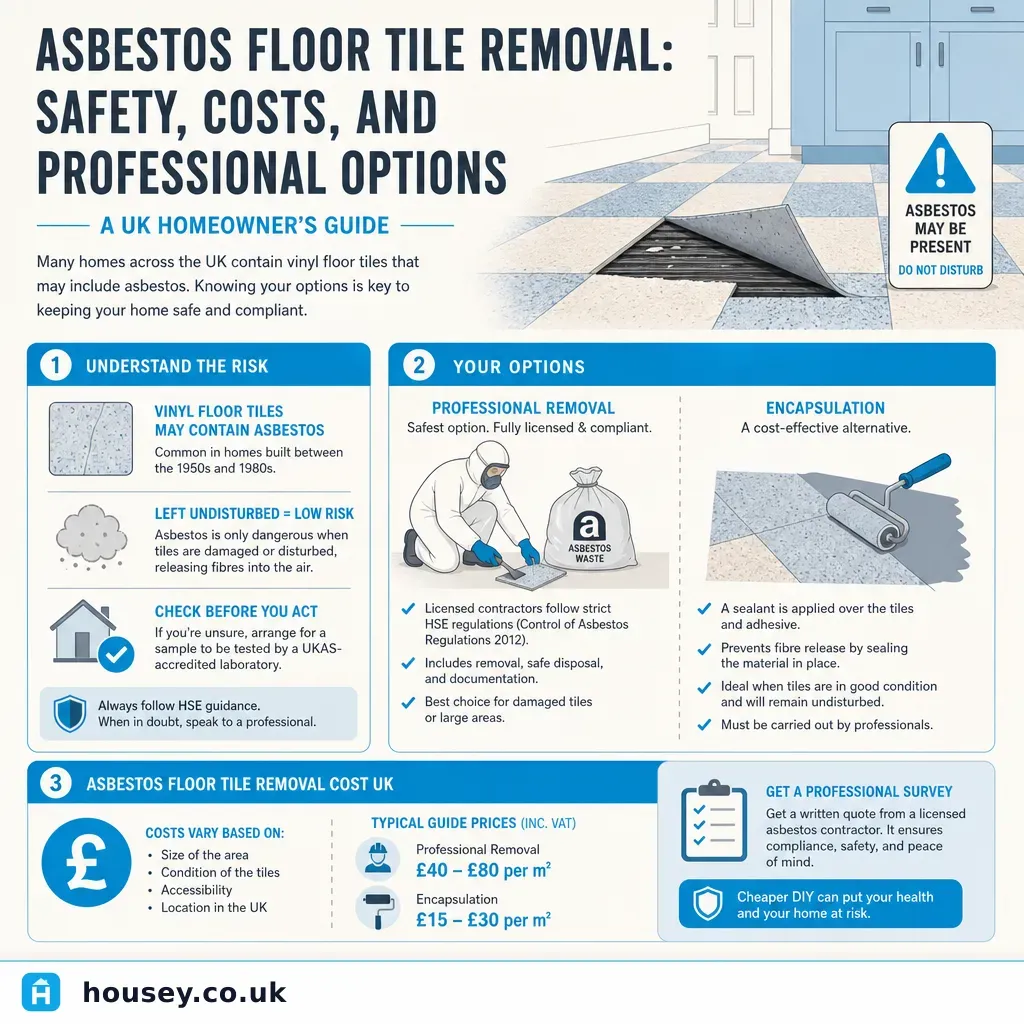
Asbestos Floor Tile Removal: Safety, Costs, and Professional Options
Asbestos floor tiles — common in UK homes built between the 1950s and late 1980s — must not be disturbed without a professional assessment.
 Surveys & Inspections
Asbestos Identification: Where to Look and What to Watch For
Asbestos can be present in dozens of locations in UK homes built before 2000, from textured ceiling coatings and floor tiles to pipe lagging and roof panels.
 Surveys & Inspections
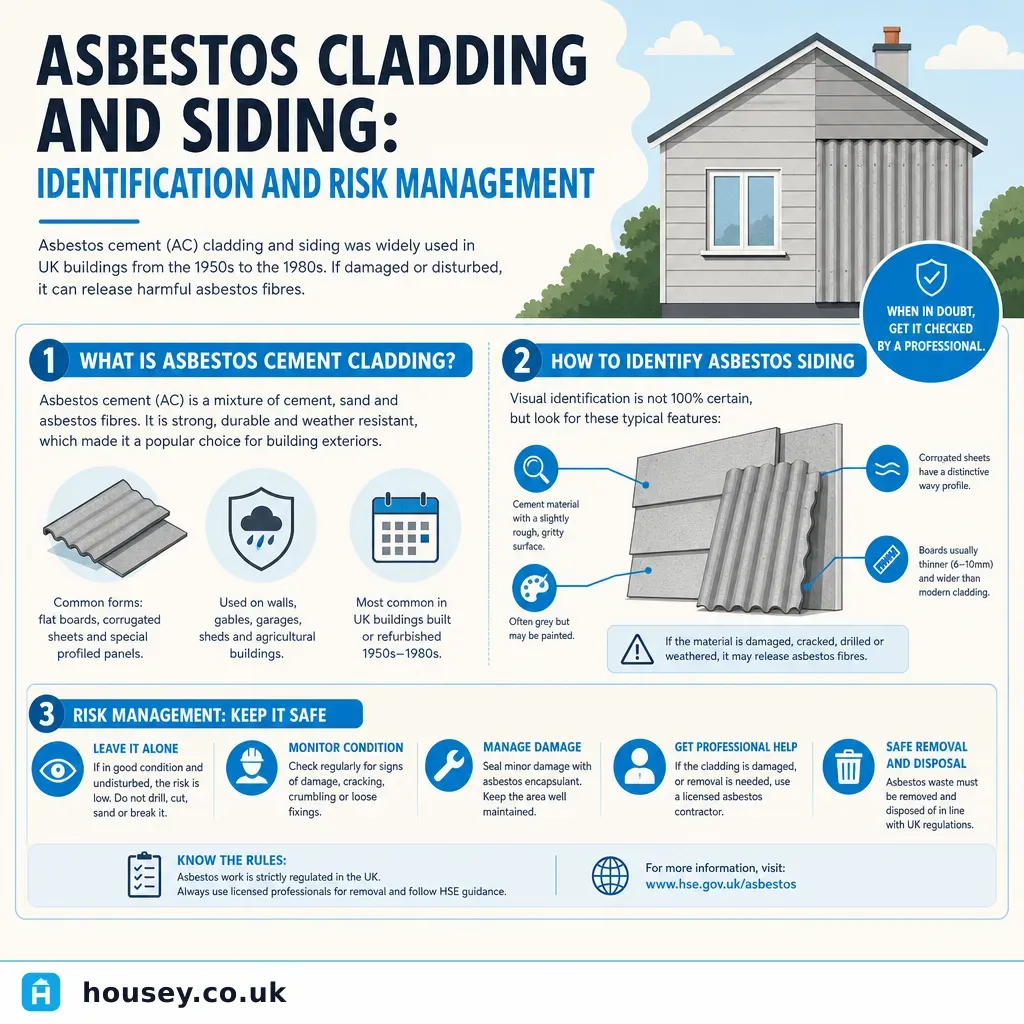
Asbestos Cladding and Siding: Identification and Risk Management
Asbestos cement cladding was widely used on UK buildings until 1999 and may be present on any property built before that date.