Asbestos Insulation: Recognition and Health Risk Assessment
By Housey · Last reviewed 31st of May 2026
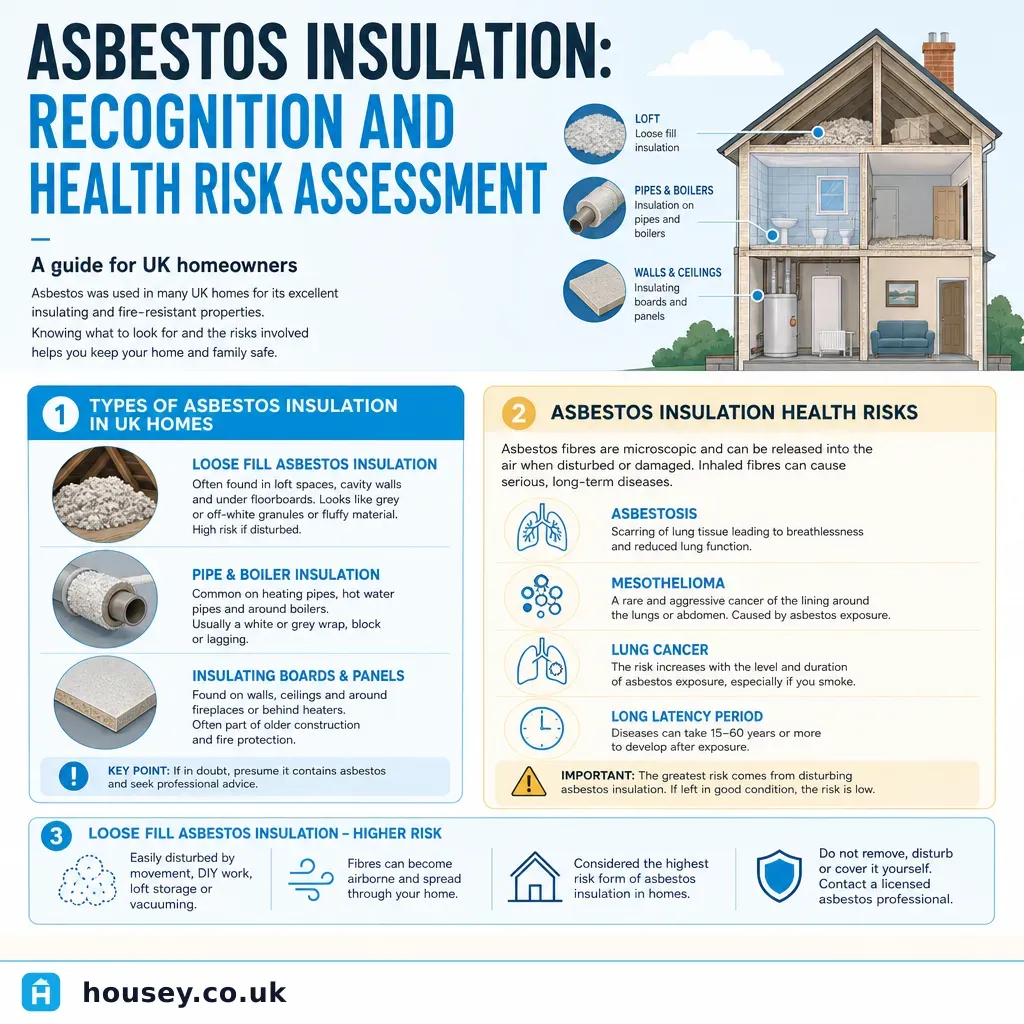
Asbestos Insulation: Recognition and Health Risk Assessment
Asbestos insulation was widely used in UK residential and commercial buildings from the 1950s through to the late 1990s, prized for its thermal properties and fire resistance. If you own, are buying, or are planning to renovate a property built or significantly altered before 2000, understanding where asbestos insulation may be present—and why it matters—is an essential first step before any work begins. The consequences of disturbing unsuspected asbestos-containing materials (ACMs) without proper precautions can be severe and long-lasting.
Key points
- The UK's full ban on the importation, supply, and use of all asbestos types came into force in November 1999; any property constructed or substantially refurbished before that date may contain ACMs.
- Asbestos-related diseases—including mesothelioma and asbestosis—are responsible for approximately 5,000 deaths per year in the UK, according to the Health and Safety Executive (HSE).
- There are three main types of asbestos fibre: chrysotile (white), amosite (brown/grey), and crocidolite (blue)—all are carcinogenic and all have been banned in the UK.
- Visual inspection alone can never confirm or rule out the presence of asbestos; laboratory analysis of a professionally collected sample is the only definitive method.
- The Control of Asbestos Regulations 2012 places a legal duty on those managing non-domestic premises to identify and manage ACMs; for domestic properties, the duty of care still applies when building work is planned.
What types of asbestos insulation are found in UK homes?
Asbestos was incorporated into a wide range of insulation products throughout the mid-to-late twentieth century. The table below summarises the most common types encountered in UK residential properties.
Insulation type | Where typically found | Likely asbestos type | Risk level when undisturbed |
|---|---|---|---|
Loose-fill loft insulation | Loft/attic floor between joists | Amosite or crocidolite | High — fibres can migrate |
Pipe lagging | Boiler flues, heating pipes, hot-water cylinders | Amosite or chrysotile | Moderate–high if damaged |
Sprayed coating (limpet asbestos) | Structural steelwork, ceilings, boiler rooms | Amosite or crocidolite | High — very friable |
Asbestos insulation board (AIB) | Ceiling tiles, partition boards, fire doors | Amosite | Moderate — higher if cut or drilled |
Boiler and flue insulation | Around boilers, flue pipes, storage heaters | Chrysotile or amosite | Moderate if intact |
Rope seals and gaskets | Around boiler doors, stove seals | Chrysotile | Low if undisturbed |
Loose-fill asbestos insulation deserves particular attention. In the 1960s and 1970s, government-backed insulation schemes funded the installation of loose mineral blends and, in some cases, loose asbestos fibre into loft spaces. Unlike bonded products, loose-fill asbestos is not fixed in place and can migrate through ceiling gaps into living areas—making it one of the highest-risk forms encountered in UK homes.
How does asbestos insulation affect health?
When asbestos-containing materials are disturbed—through drilling, cutting, demolition, or vigorous cleaning—microscopic fibres become airborne. Once inhaled, these fibres can lodge permanently in lung tissue and the pleura (the lining around the lungs). The principal diseases associated with asbestos exposure are:
- Mesothelioma — a cancer of the pleura or peritoneum, almost always caused by asbestos exposure. Median latency from first exposure to diagnosis is typically 30–40 years.
- Asbestosis — progressive scarring of lung tissue, causing breathlessness and reduced lung function.
- Lung cancer — asbestos exposure significantly increases lung cancer risk, particularly in combination with smoking.
- Pleural plaques — benign thickening of the pleural lining, a marker of past exposure that does not itself cause symptoms but indicates previous fibre inhalation.
No safe level of asbestos fibre exposure has been established. Risk is proportional to the duration and intensity of exposure and the friability of the material involved. A brief, incidental disturbance of a small intact panel presents a very different risk profile to cutting or removing loose-fill insulation—but neither should be treated casually.
Can you identify asbestos insulation by sight?
Not reliably. While experienced surveyors may have strong suspicions based on visual and tactile characteristics—texture, colour, friability, installation date, and location—these cannot constitute a definitive identification. The HSE is clear: only laboratory analysis, typically polarised light microscopy of a professionally collected sample, provides confirmed identification.
Attempting to collect a sample yourself is dangerous unless you are trained in asbestos sampling procedures and equipped with appropriate personal protective equipment (PPE). Do not disturb any suspected ACMs.
Decision tree: what should you do if you suspect asbestos insulation?
- If the material is intact and undisturbed, and no work is planned nearby → leave it in place, note its location, and consider commissioning a management asbestos survey to formally record and monitor it.
- If you are planning renovation work that may disturb any material in a pre-2000 property → commission a refurbishment and demolition asbestos survey before work begins.
- If the material is visibly damaged, friable, or deteriorating → treat as a priority; do not enter the area unnecessarily, and contact a licensed asbestos professional promptly.
- If you are buying a pre-2000 property → ask your surveyor whether an asbestos survey has been carried out; if not, factor the cost into your pre-exchange due diligence.
- If you are unsure → always err on the side of caution. Do not disturb the material and seek professional guidance.
Important limitations
This article provides general information only and cannot substitute for a professional assessment of your specific property. Asbestos risk depends on the type, condition, location, and extent of ACMs present, as well as the nature of any planned work. Rules governing asbestos management, removal, and disposal are set out in the Control of Asbestos Regulations 2012 and associated HSE Approved Codes of Practice, which should be consulted for any professional or commercial context. Always seek advice from a qualified asbestos professional before taking any action involving suspected ACMs.
When this becomes urgent
Seek professional help without delay if:
- You have already disturbed material that you now suspect may contain asbestos.
- Asbestos-containing loose-fill insulation is visible in your loft or has fallen into living areas.
- A material is visibly crumbling, powdering, or disintegrating.
- You are about to begin building work—including a loft conversion, extension, or major renovation—on a pre-2000 property without a refurbishment survey in place.
- You discover damaged pipe lagging on heating or hot-water pipework.
What to ask a qualified professional
Before commissioning an asbestos survey or arranging removal, ask:
- Are you licensed by the HSE to carry out asbestos surveys and/or licensed removal work?
- What type of survey are you recommending—management survey or refurbishment and demolition survey—and why?
- How will samples be collected, and which UKAS-accredited laboratory will analyse them?
- What will the survey report include, and will it record the location, condition, and risk rating of all suspected ACMs?
- If removal is recommended, will a licensed contractor carry out the work, and how will waste be disposed of under the Hazardous Waste Regulations?
- Can you provide proof of current HSE licensing and insurance before work begins?
When to get professional help
Contact a qualified asbestos surveyor before any building work on a property constructed before 2000. Red flags that warrant immediate professional contact:
- Powdery or fibrous material falling from ceilings or pipes.
- White, grey, or blue fibrous material visible between loft joists.
- An older property with no record of a previous asbestos survey.
- Any crack, impact damage, or water damage to ceiling tiles, pipe lagging, or insulation boards.
How Housey can help
If you need to establish whether your property contains asbestos insulation, Housey can connect you with qualified, HSE-licensed surveyors in your area. Our asbestos survey professionals can carry out management surveys for occupied homes or refurbishment and demolition surveys ahead of building work, providing a full written report with sample analysis from a UKAS-accredited laboratory.
Frequently asked questions
Is asbestos insulation dangerous if left undisturbed?
Asbestos-containing materials in good condition and unlikely to be disturbed are generally considered lower risk, as the primary danger arises when fibres become airborne. However, friable materials such as loose-fill asbestos can release fibres without deliberate disturbance. Regular monitoring of known ACMs is advisable, and a management survey will help determine the appropriate action for your property.
How do I know if my loft insulation contains asbestos?
Visual inspection alone is unreliable. If your home was built or substantially renovated between the 1950s and 1999 and has older grey or blue loose-fill insulation rather than pale yellow or white mineral wool, treat it as suspect. The only way to confirm is laboratory analysis of a professionally collected sample. Do not handle the insulation yourself.
What is the difference between a management survey and a refurbishment survey for asbestos?
A management survey locates and assesses ACMs in an occupied building that may be disturbed during normal use or minor maintenance. A refurbishment and demolition survey is intrusive and required before major renovation or demolition work, accessing hidden voids and structural elements. For most renovation projects on pre-2000 homes, a refurbishment survey is the appropriate starting point.
Can I remove asbestos insulation myself?
You should not attempt to remove asbestos insulation yourself. Certain minor non-licensable works may be carried out without an HSE licence under specific technical conditions, but loose-fill asbestos and sprayed coatings must be removed only by an HSE-licensed contractor. Always seek professional advice from a licensed asbestos specialist before any removal work.
Sources and further reading
- Control of Asbestos Regulations 2012 — legislation.gov.uk
- Asbestos: The hidden killer — Health and Safety Executive
- Mesothelioma: current and future statistics — Health and Safety Executive
- Asbestos essentials task sheets — Health and Safety Executive
- Types of asbestos survey — Health and Safety Executive
Useful next reads
 Surveys & Inspections
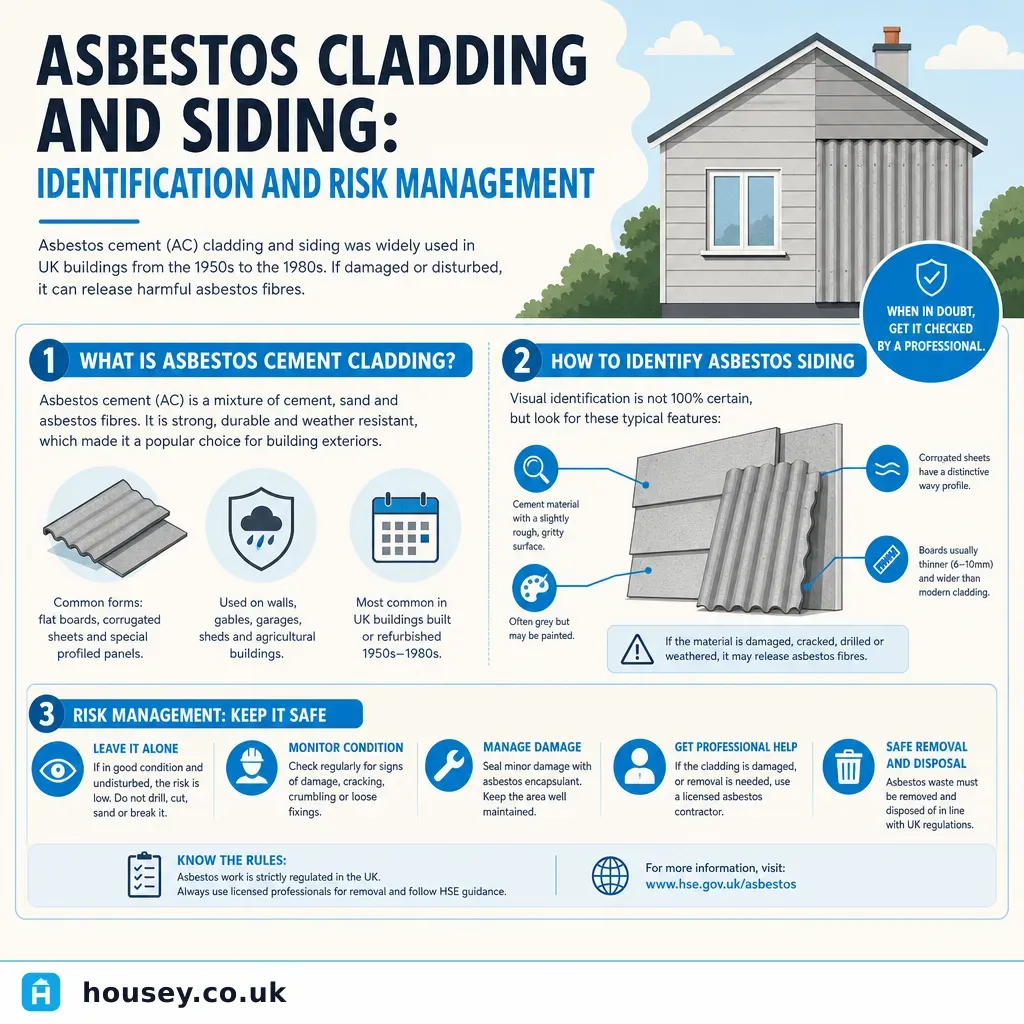
Asbestos Cladding and Siding: Identification and Risk Management
Asbestos cement cladding was widely used on UK buildings until 1999 and may be present on any property built before that date.
 Surveys & Inspections
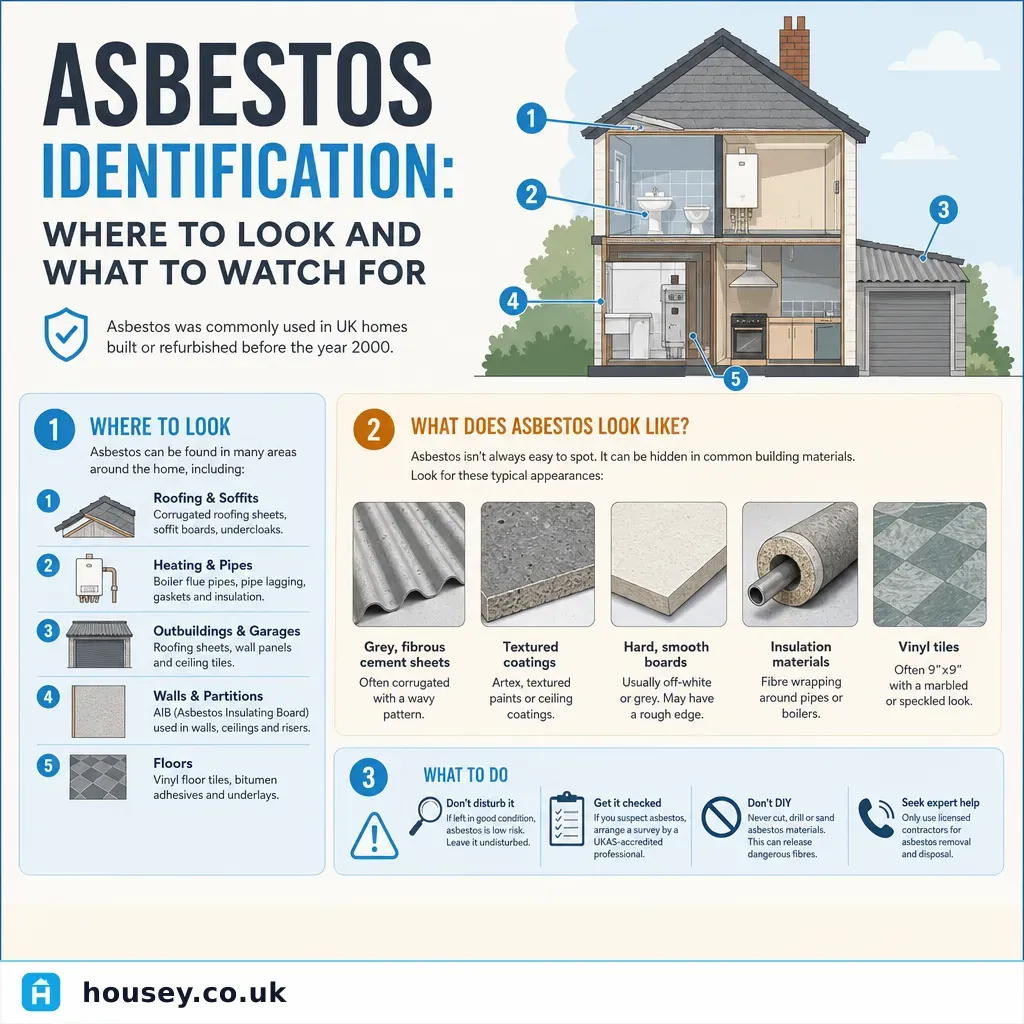
Asbestos Identification: Where to Look and What to Watch For
Asbestos can be present in dozens of locations in UK homes built before 2000, from textured ceiling coatings and floor tiles to pipe lagging and roof panels.
 Surveys & Inspections
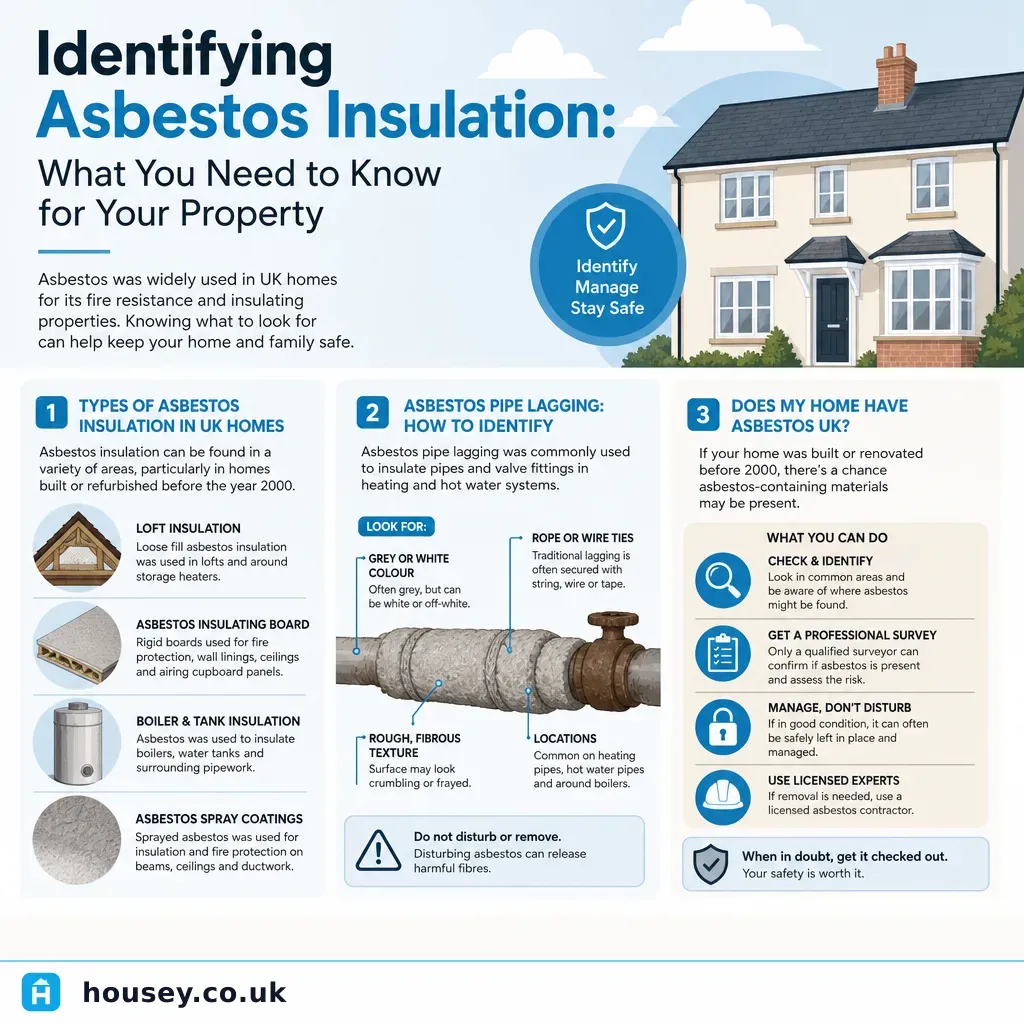
Identifying Asbestos Insulation: What You Need to Know for Your Property
Asbestos insulation was widely used in UK properties built before 2000, commonly found in pipe lagging, ceiling tiles, loose-fill loft insulation, and around boilers.
 Surveys & Inspections
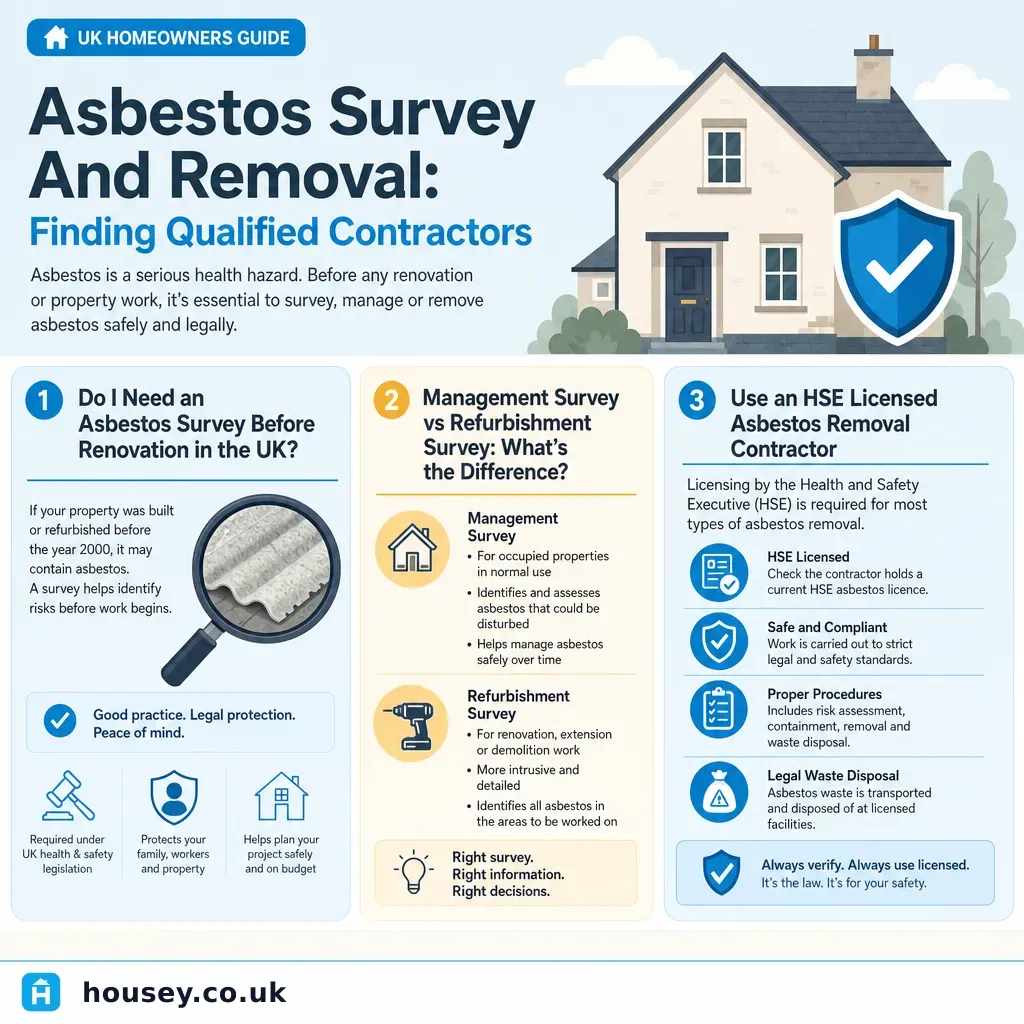
Asbestos Survey And Removal: Finding Qualified Contractors
An asbestos survey establishes whether asbestos-containing materials are present in your property and their condition.
 Surveys & Inspections
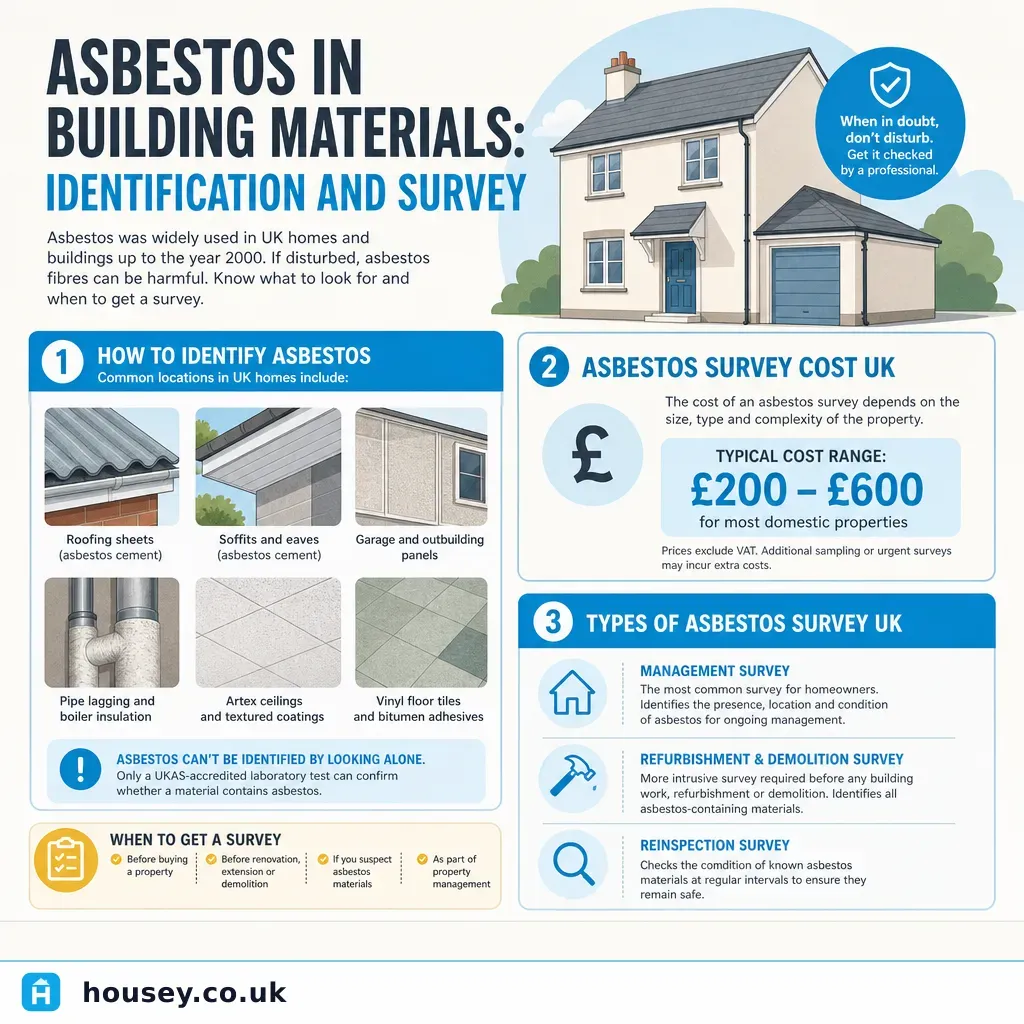
Asbestos in Building Materials: Identification and Survey
Asbestos-containing materials (ACMs) are present in many UK homes built before 2000, including floor tiles, textured coatings such as Artex, roof sheets, pipe lagging, and ceiling tiles.