Safe Removal and Replacement of Asbestos Water Tanks
By Housey · Last reviewed 6th of May 2026
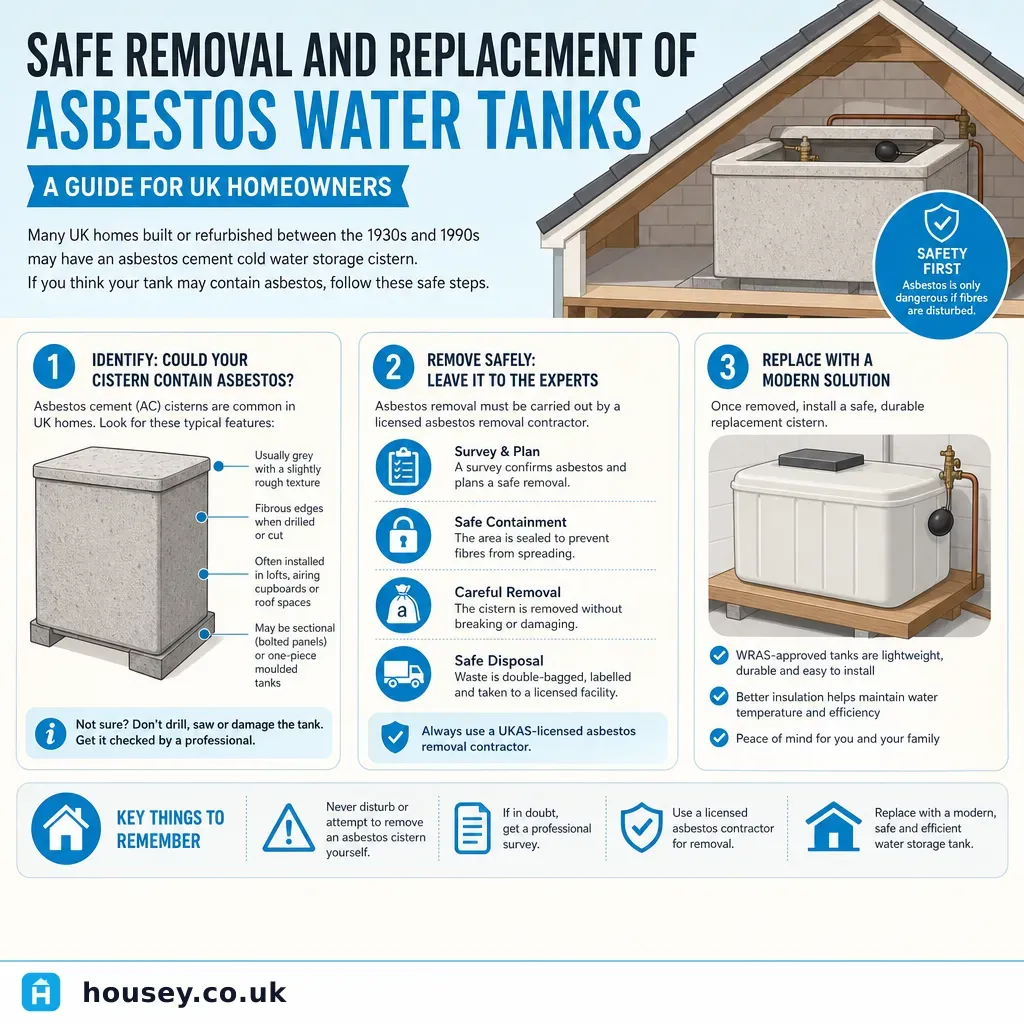
Safe Removal and Replacement of Asbestos Water Tanks
Cold water storage cisterns installed in UK homes during the 1950s through to the early 1980s were often moulded from asbestos cement — a mix of Portland cement and chrysotile (white asbestos) fibres. Millions of these tanks remain in loft spaces across the country, many undisturbed and apparently sound. The question of how to handle them becomes pressing when a tank fails, when a house purchase survey flags the cistern, or when loft work is planned that would bring people into close proximity with it.
Key points
- Asbestos cement (AC) cisterns typically contain chrysotile (white asbestos) fibres bound within a cement matrix; when intact and undisturbed, fibre release is low.
- The Control of Asbestos Regulations 2012 (CAR 2012) requires a written risk assessment before any work on asbestos-containing materials (ACMs).
- Most domestic AC cistern removal falls under non-licensed or notifiable non-licensed work (NNLW) under CAR 2012 — but classification is site-specific and must be confirmed by a competent professional.
- Asbestos waste is classified as hazardous waste under the Hazardous Waste Regulations 2005 and must be disposed of at a licensed facility — not in a skip or domestic bin.
- Replacement cisterns must comply with the Water Supply (Water Fittings) Regulations 1999; polypropylene and glass-reinforced plastic (GRP) tanks are the standard modern alternatives.
How to identify whether your water tank contains asbestos
Asbestos cement cisterns were installed from roughly the 1950s until the early 1980s. Visual clues alone are not definitive — laboratory analysis is the only reliable confirmation — but the following may indicate an AC tank:
- Age: Homes built or re-plumbed before about 1982 are more likely to have original AC tanks.
- Appearance: AC cisterns are typically grey-green or dark grey, rigid, and moulded — often rectangular with a flat lid. They may resemble thick fibre-cement sheet or slate.
- Surface condition: Ageing AC may appear dusty, chalky, or slightly fibrous at edges.
Do not drill, cut, or break any suspected ACM to test it. Commission a Type 2 (sampling and analysis) asbestos survey from a surveyor who arranges UKAS-accredited laboratory analysis.
Which professional do you need?
Stage | Professional | Why |
|---|---|---|
Confirming ACM presence | UKAS-accredited asbestos surveyor or analyst | Laboratory-confirmed Type 2 survey report |
Risk assessment | Asbestos surveyor or competent contractor | Required under CAR 2012 before any ACM work |
Removing the cistern | Competent contractor trained in asbestos cement work | Must follow HSE A-series task guidance; correct RPE required |
Disconnecting and reconnecting pipework | Qualified plumber (Water Regulations competent) | Compliance with Water Supply (Water Fittings) Regulations 1999 |
Disposing of asbestos waste | Licensed waste carrier with hazardous waste permits | Legal requirement under Hazardous Waste Regulations 2005 |
Installing the replacement tank | Qualified, WaterSafe-registered plumber recommended | Correct installation and regulatory compliance |
What the regulations require
The Control of Asbestos Regulations 2012 (CAR 2012) governs all work on ACMs in Great Britain. Before any ACM work, the contractor must complete a written risk assessment, ensure workers have appropriate training, select RPE matched to the assessed exposure level, and arrange hazardous waste disposal with a consignment note.
For asbestos cement products, HSE classifies most removal as non-licensed or NNLW. Where NNLW applies, the contractor must notify the enforcing authority (usually HSE) before starting and maintain records of exposure and health surveillance. The precise classification depends on site-specific conditions — always confirm with a competent professional before work begins.
What a safe removal involves
Do not attempt to remove an asbestos cement cistern without professional guidance. A correctly managed removal typically follows these steps:
- Type 2 survey and written risk assessment — confirms ACM presence, condition, and required controls.
- Isolation — loft space isolated; non-essential people excluded.
- Controlled removal — tank removed in one piece where possible; no drilling, cutting, or breaking.
- Wrapping and labelling — removed tank double-wrapped in heavy-duty polythene, sealed, and labelled as asbestos waste.
- Decontamination — work area cleaned with an H-class vacuum (never a standard domestic vacuum); PPE bagged within the work area.
- Waste documentation — hazardous waste consignment note issued for licensed facility disposal.
Choosing the replacement tank
Modern cisterns are polypropylene or GRP. Under the Water Supply (Water Fittings) Regulations 1999, the installation must be carried out by a competent person; a WaterSafe-registered plumber is recommended. The tank must be covered, insulated, and adequately supported. Typical domestic capacity is 115–230 litres. If you are switching to a mains-pressure unvented system, this is notifiable building work requiring a G3-qualified installer.
Document preparation checklist
Before instructing any contractor, gather:
Important limitations
This article is general information only. The Control of Asbestos Regulations 2012 and HSE guidance are detailed and highly situation-specific. The correct work classification, required RPE, and disposal route depend on site conditions, material condition, work method, and other factors only a qualified professional can assess. Do not rely on this article as a substitute for a professional survey and risk assessment before any work is planned or begins.
What to ask a qualified professional
Before instructing any contractor, ask:
- Are you trained and competent in asbestos cement work? Can you evidence your qualifications?
- Can I see the written risk assessment before work starts?
- Will you arrange a Type 2 survey with UKAS-accredited analysis, or has one already been completed?
- How will the tank be removed — in one piece or sections? How is fibre release controlled?
- How will you decontaminate the loft space and dispose of PPE?
- Who is your licensed waste carrier, and will I receive a hazardous waste consignment note?
- Is this work notifiable to HSE? If so, will you handle the notification?
- Does the quote include all disposal costs, and what could change the price?
When to get professional help
Do not begin any work on a suspected asbestos cement cistern without professional involvement. Contact a qualified asbestos surveyor or contractor if:
- You are buying or selling a property and a loft cistern of uncertain composition is present.
- The tank is cracked, leaking, or has been previously drilled or cut.
- There is visible debris or dust around the tank that may be AC particles.
- A previous survey identified the tank as an ACM but no management plan or removal has been arranged.
- You are planning loft insulation, boarding, or conversion work that would bring workers near the tank.
Never use a domestic vacuum cleaner, brush, or compressed air near a suspected ACM. Never dispose of asbestos waste in a skip, domestic bin, or general waste collection.
How Housey can help
If you need to confirm whether your water tank contains asbestos before arranging its removal, Housey can help you commission an asbestos survey from a qualified surveyor in your area. Request and compare quotes before deciding how to proceed.
Frequently asked questions
Is my old water tank definitely made of asbestos?
Not all older tanks contain asbestos. Galvanised steel and, later, polypropylene cisterns were also common in the same era. The only reliable way to confirm asbestos cement is laboratory analysis of a sample taken by a competent professional. Visual inspection alone is insufficient — commission a Type 2 asbestos survey before any work is planned.
Can I remove an asbestos water tank myself?
This is not advisable, even if the work category is technically non-licensed. Removing an asbestos cement cistern without correct training, appropriate RPE, and proper disposal arrangements risks exposing you and others to asbestos fibres and may constitute a breach of the Control of Asbestos Regulations 2012. Instruct a competent contractor.
How much does asbestos cistern removal cost?
Indicative UK costs, last reviewed 2026-05-06: a Type 2 asbestos survey in a loft space may cost £150–£400; removal of a typical domestic asbestos cement cistern by a competent contractor may cost £200–£600 plus disposal fees. Always obtain at least three written quotes. Actual costs depend on location, access, tank size, and condition.
Does an undisturbed asbestos tank pose an immediate health risk?
HSE guidance notes that asbestos cement in sound, undisturbed condition has low fibre-release potential and a correspondingly low immediate risk. Risk increases significantly when the material is cut, drilled, broken, or deteriorating. If the tank is intact and not being disturbed, commission a formal condition assessment from a qualified asbestos surveyor.
Do I need building regulations approval to replace a water tank?
Replacing a like-for-like cold water storage cistern is not normally notifiable building work in England under Schedule 2 of the Building Regulations 2010. However, converting to a mains-pressure unvented hot water system is notifiable and requires a G3-qualified installer. Check with your local authority or installer for your specific situation.
Sources and further reading
- Control of Asbestos Regulations 2012 — legislation.gov.uk
- Asbestos essentials: practical guidance for non-licensed work — Health and Safety Executive
- Asbestos cement task guidance sheets (A-series) — Health and Safety Executive
- Hazardous Waste Regulations 2005 — legislation.gov.uk
- Water Supply (Water Fittings) Regulations 1999 — legislation.gov.uk
- WaterSafe — find an approved plumber — WaterSafe
Useful next reads
 Surveys & Inspections
Asbestos Survey And Removal: Finding Qualified Contractors
An asbestos survey establishes whether asbestos-containing materials are present in your property and their condition.
 Surveys & Inspections
Asbestos Floor Tile Removal: Safety, Costs, and Professional Options
Asbestos floor tiles — common in UK homes built between the 1950s and late 1980s — must not be disturbed without a professional assessment.
 Surveys & Inspections
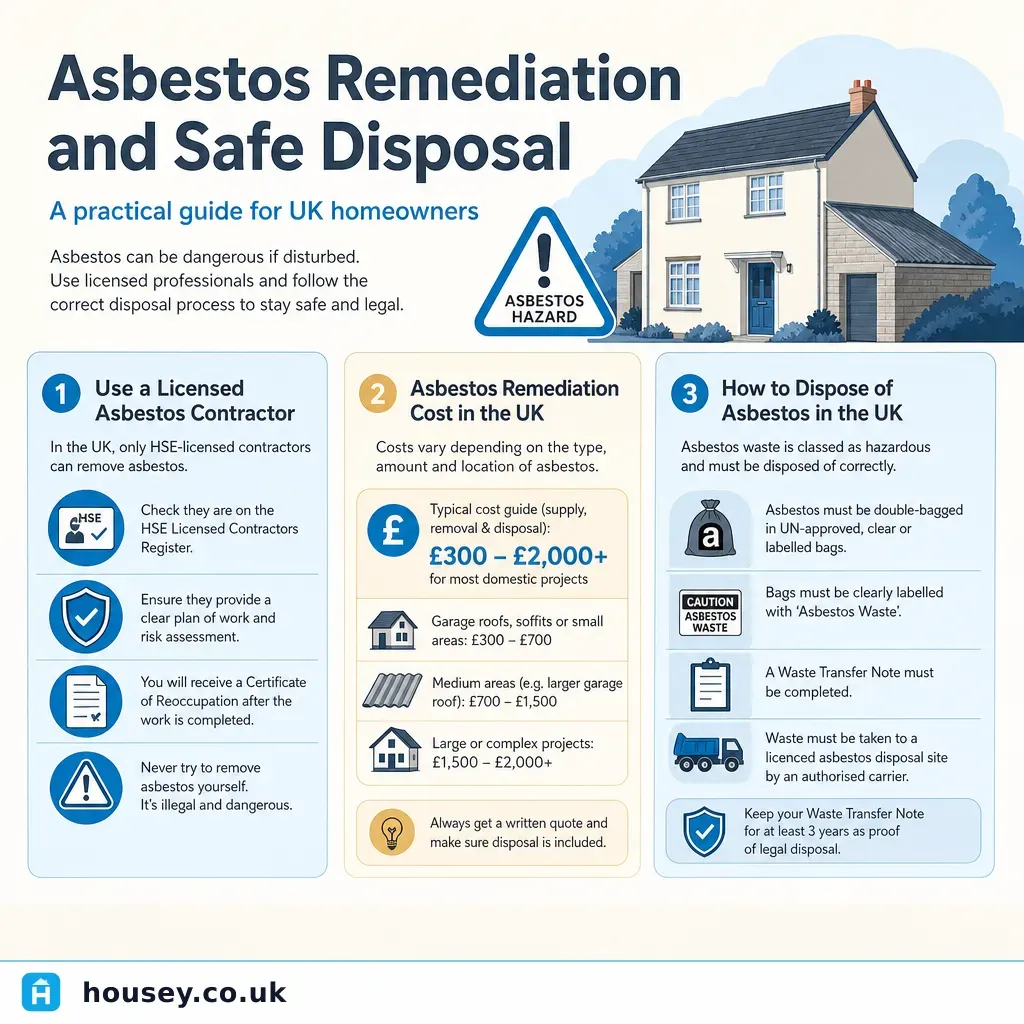
Asbestos Remediation and Safe Disposal
Asbestos remediation in the UK must follow the Control of Asbestos Regulations 2012.
 Surveys & Inspections
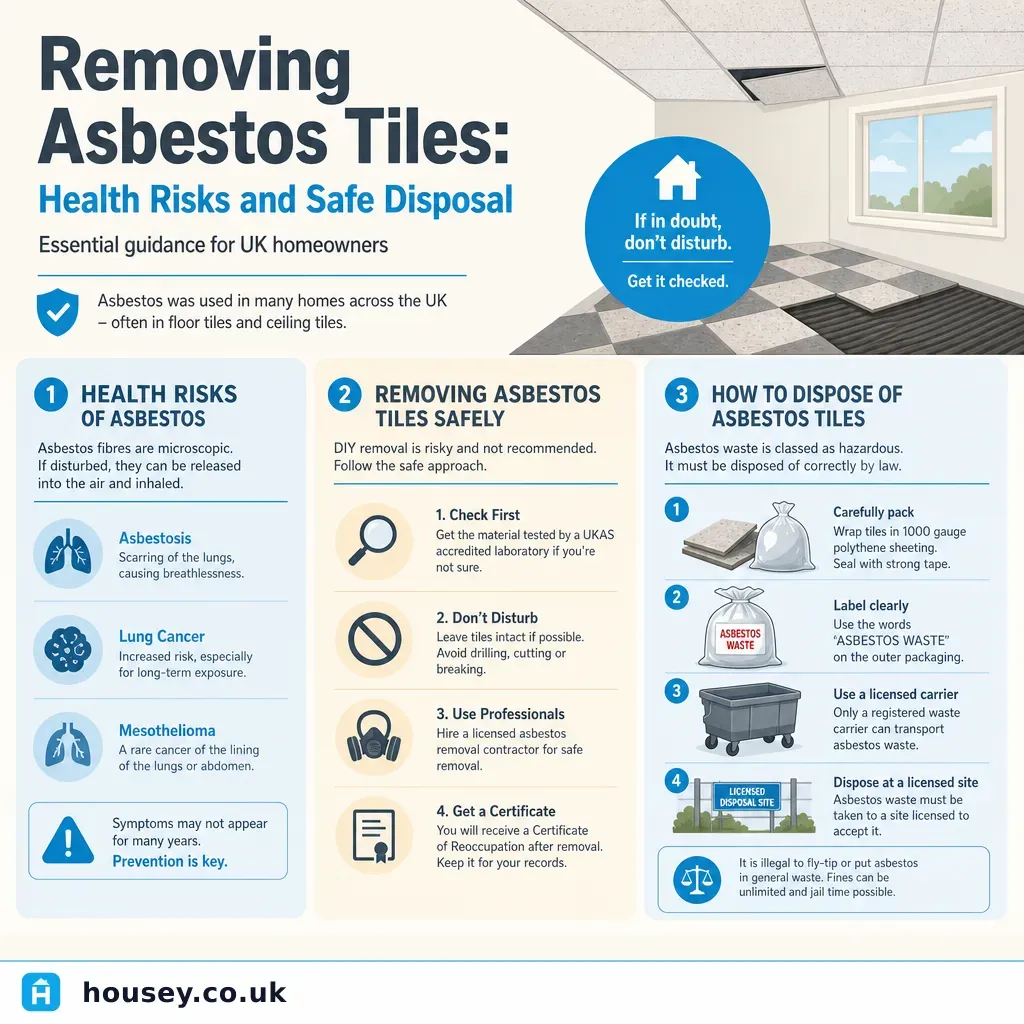
Removing Asbestos Tiles: Health Risks and Safe Disposal
Asbestos tiles in pre-2000 UK properties must not be disturbed without a refurbishment and demolition survey under HSG264.
 Surveys & Inspections
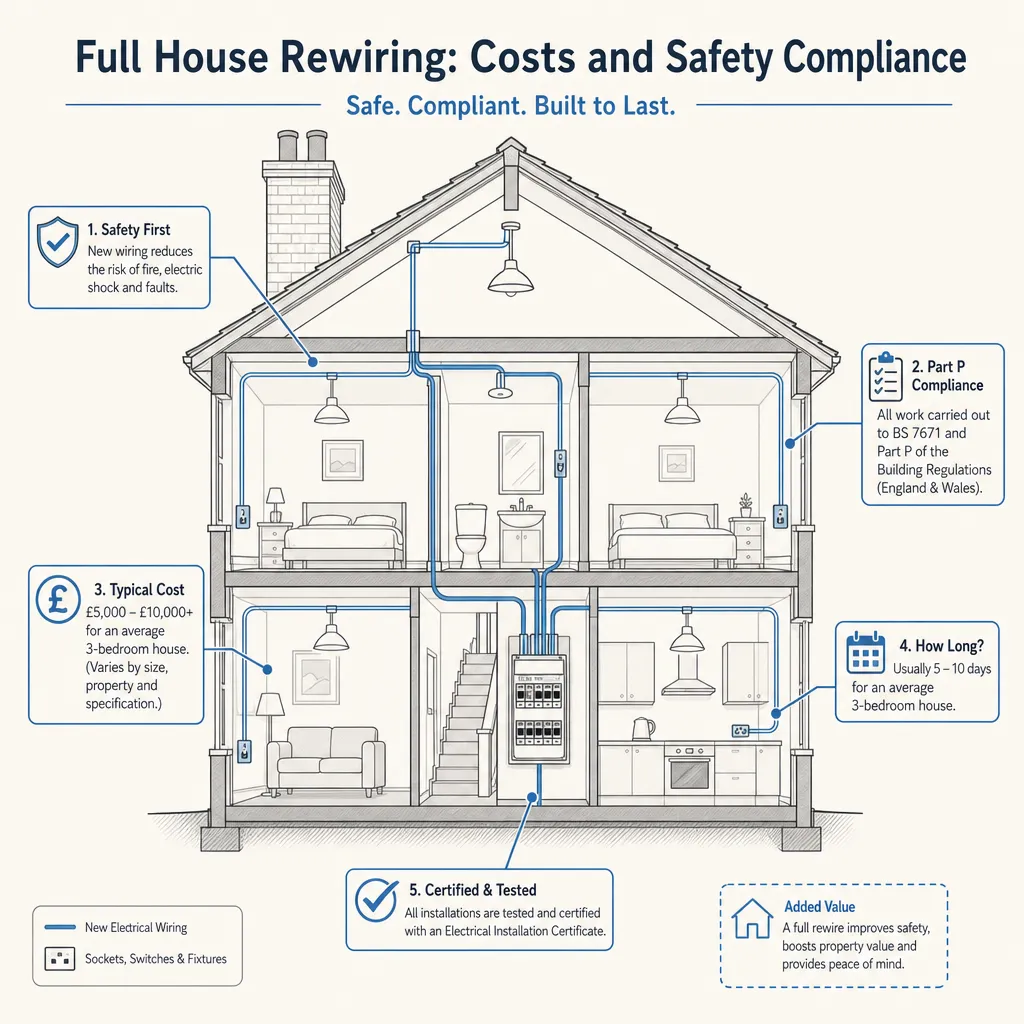
Full House Rewiring: Costs and Safety Compliance
A full house rewire in the UK typically costs £3,500–£6,000 for a three-bedroom semi and must comply with BS 7671:2018 and Building Regulations Part P.