Asbestos Identification: Where to Look and What to Watch For
By Housey · Last reviewed 31st of May 2026
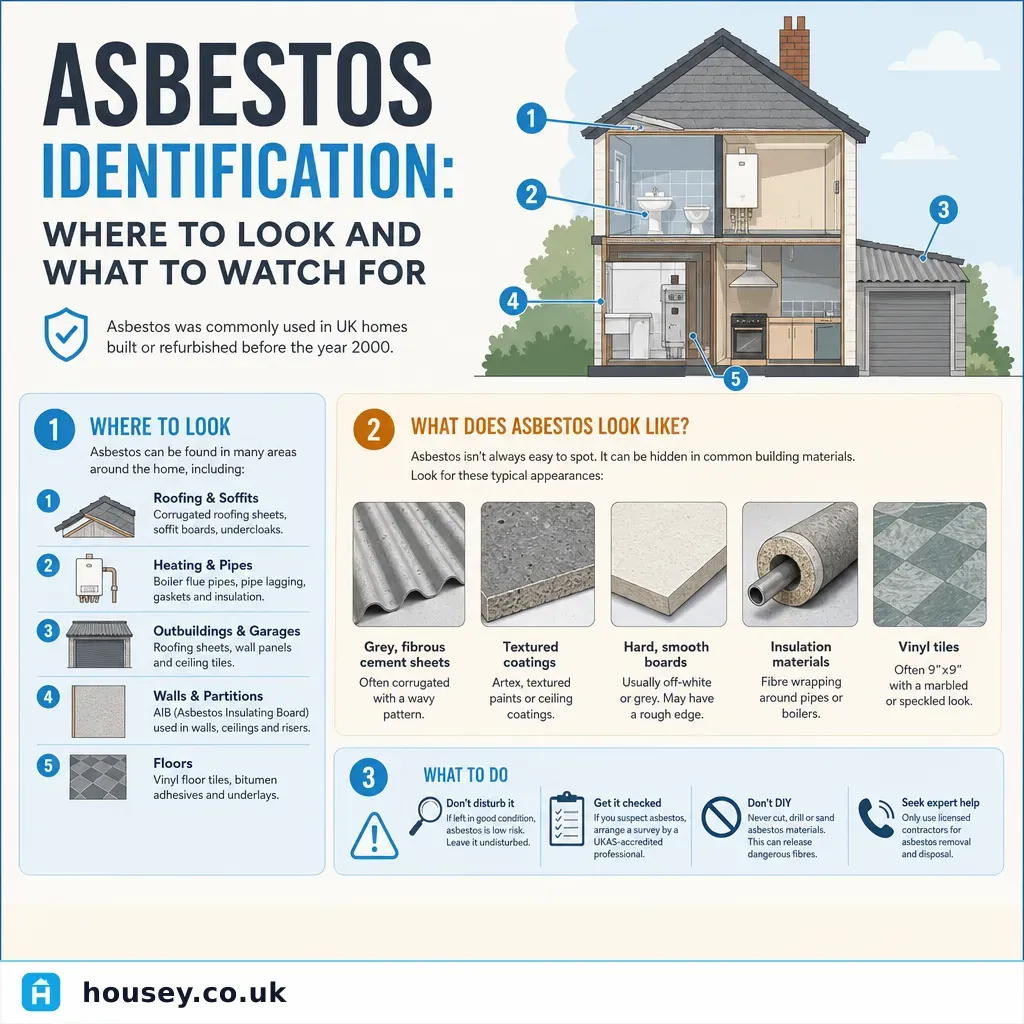
Asbestos Identification: Where to Look and What to Watch For
Discovering that a property may contain asbestos is one of the more unsettling moments in a renovation or purchase. Asbestos-containing materials (ACMs) were used widely in UK construction from the 1950s to the late 1990s, appearing in dozens of different products and locations throughout a typical home. Whether you are buying, renovating, or simply curious after reading a survey report, understanding where ACMs are most commonly found—and what visual cues should prompt professional assessment—can help you make safer, more informed decisions.
Key points
- UK asbestos use peaked in the 1960s and 1970s; any property built or substantially altered before November 1999 could contain ACMs, and some materials were still being imported and installed until the ban came into full effect.
- The HSE survey guide HSG264 defines two main survey types: management surveys for occupied buildings, and refurbishment and demolition surveys required before significant building works on any pre-2000 property.
- Chrysotile (white asbestos) accounts for the majority of ACMs in UK buildings; amosite (brown) and crocidolite (blue) are considered higher risk but less common in typical domestic settings.
- Artex and similar textured ceiling coatings applied before the mid-1980s frequently contained chrysotile; several million UK homes are estimated to still have textured ceilings that may contain asbestos.
- Visual identification of asbestos is never definitive—colour, texture, and location are indicators only; laboratory analysis of a professionally collected sample is the only confirmed method.
Where is asbestos most commonly found in UK homes?
The table below shows the most frequently encountered locations and materials in pre-2000 UK residential properties, alongside the asbestos types most commonly associated with each.
Location | Material | Likely asbestos type | Condition risk |
|---|---|---|---|
Loft/attic | Loose-fill insulation between joists | Amosite or crocidolite | High — fibres are mobile |
Ceilings | Artex or textured coating | Chrysotile | Moderate if intact; high if sanded or scraped |
Floors | Vinyl floor tiles and tile adhesive | Chrysotile | Low if intact; elevated when removed |
Walls and ceilings | Asbestos insulation board (AIB) panels | Amosite | Moderate — elevated if drilled or cut |
Boiler cupboard / utility | Boiler flue insulation and pipe lagging | Amosite or chrysotile | Moderate–high if damaged |
Roof | Corrugated or flat cement panels | Chrysotile | Lower if intact; elevated if broken |
Garage | Corrugated roof or wall cladding panels | Chrysotile | Lower if intact; elevated if broken |
Airing cupboard | Hot-water cylinder and pipe lagging | Chrysotile | Moderate if damaged |
Fire doors | Door panels and glazing gaskets | Amosite or chrysotile | Low if intact |
Partition walls | Asbestos insulation board panels | Amosite | Moderate — elevated if drilled or cut |
Visual cues: what to watch for
You cannot confirm asbestos visually, but certain characteristics should prompt you to treat a material as suspect and arrange professional assessment.
Textured coatings: Artex and similar stippled or swirled ceiling and wall finishes applied before the mid-1980s are among the most widespread ACMs in UK homes. The surface may be white, cream, or painted over multiple times. Intact, unpainted coatings are typically lower risk; the risk escalates sharply if the coating is sanded, scraped, or drilled.
Corrugated and flat cement panels: A grey, slightly grainy surface with a cement-like feel, often with pre-drilled fixing holes—common on garages, sheds, and lean-to extensions. Cracks, moss, algae, or brittleness may indicate weathering that increases fibre release risk.
Pipe lagging: Typically a beige, buff, or grey wrapping around pipes, especially in older boiler rooms, loft spaces, and airing cupboards. It may have a hessian or cloth outer covering and feel crumbly or soft if deteriorating.
Asbestos insulation board (AIB): Used in ceiling tiles, fire door panels, wall partitions, and around hearths. Usually a pale grey or cream board, sometimes with a slightly layered cross-section. Often screwed or nailed in place.
Loose-fill loft insulation: Light grey, silver, or pale blue loose fibrous material lying between loft joists. Unlike mineral wool—which is fluffy and may be yellow, white, or pink—loose-fill asbestos tends to appear more granular or silky in texture.
What NOT to assume: common misidentifications
Several assumptions about asbestos lead homeowners and tradespeople to misjudge the risk:
- "It looks old, so it must be asbestos" — not all older materials contain asbestos, and not all asbestos materials look old or damaged.
- "It's white, so it's probably safe" — chrysotile (white asbestos) is a known carcinogen; all asbestos types are hazardous regardless of colour.
- "The surveyor didn't flag it, so it's fine" — a standard RICS Level 2 or Level 3 survey is not an asbestos survey. These surveys may note suspected ACMs but do not include sample analysis or the investigative scope of a dedicated asbestos survey.
- "It's in good condition, so I don't need a survey" — material condition changes with time, temperature, humidity, and maintenance activity. A management survey provides a formal baseline and monitoring plan.
- "The property was built in 1985, so it's probably clear" — asbestos-containing products were still in use in the mid-to-late 1980s; the full UK ban was not in place until November 1999. Properties of this era still warrant professional assessment before building work begins.
Types of asbestos survey explained
The HSE sets out two main survey types under HSG264:
Management survey: Suitable for occupied buildings where routine maintenance may occur. The surveyor inspects accessible areas, takes samples from suspected materials, and produces a report used to create or update an asbestos management plan. Relatively non-intrusive and typically the right starting point for a property in normal use.
Refurbishment and demolition survey: Required before any significant renovation, refurbishment, or demolition work. This is an intrusive survey—the professional accesses concealed areas, voids, and structural elements. It should always be commissioned before a loft conversion, kitchen or bathroom gut, extension, or any works involving opening up walls, floors, or ceilings in a pre-2000 property.
Important limitations
This guidance is for general awareness only. The presence or absence of asbestos in any specific property cannot be determined from this article. Only a UKAS-accredited asbestos survey and laboratory analysis can provide a definitive result. Rules governing when surveys are legally required and the scope of licensed and non-licensed asbestos work are set out in the Control of Asbestos Regulations 2012. Always consult an HSE-licensed asbestos professional before taking any action involving suspected ACMs.
When this becomes urgent
Contact a qualified asbestos professional without delay if:
- You have already drilled, scraped, sanded, or otherwise disturbed a material you now suspect contains asbestos.
- You notice white, grey, or blue powdery or fibrous dust from an unknown material in an older property.
- Loose fibrous material is present in your loft and you have no record of its composition.
- You are about to begin building work on a pre-2000 property without a survey in place.
- Pipe lagging, ceiling tiles, or wall panels are visibly crumbling, cracked, or damaged.
What to ask a qualified professional
- Is your organisation accredited by UKAS to carry out asbestos surveys?
- Which type of survey do you recommend for my situation, and what does it cover?
- How will samples be submitted and by which UKAS-accredited laboratory will they be analysed?
- How will the survey results be presented, and will you provide a risk rating for each material identified?
- If I am buying a property, can you carry out a survey before exchange of contracts?
- If ACMs are found, can you advise on whether removal or management in place is the more appropriate course of action?
When to get professional help
Always commission an asbestos survey before starting renovation work on any property built or altered before 2000. Red flags that should prompt immediate action:
- Any fibrous, powdery, or friable material in loft, utility, or boiler areas of older properties.
- A survey report or seller's disclosure that notes possible ACMs without laboratory confirmation.
- Corrugated roof panels or wall cladding that are cracked, broken, or crumbling.
- Textured ceilings that you or a contractor are planning to sand, strip, or skim.
How Housey can help
Housey connects homeowners and buyers with HSE-licensed, UKAS-accredited professionals who carry out both management surveys and refurbishment and demolition surveys. If you are planning renovation work or want reassurance before purchasing a pre-2000 property, our asbestos survey specialists can arrange a professional assessment and deliver a full written report with laboratory-confirmed results.
Frequently asked questions
Does a standard house survey check for asbestos?
No. A RICS Level 2 or Level 3 building survey is a visual inspection of structure and condition. Surveyors may note materials they suspect could contain asbestos, but they do not take samples or carry out laboratory analysis. A separate, dedicated asbestos survey by a UKAS-accredited specialist is required for confirmed identification of asbestos-containing materials.
My house was built in 1989—do I need an asbestos survey?
Possibly. The full UK ban on asbestos was not implemented until November 1999, and some asbestos-containing products were still being used and installed in the late 1980s. If you are planning significant renovation work, commissioning at least a management survey is a sensible precaution before any building works commence.
What should I do if I find suspected asbestos during renovation work?
Stop work immediately. Do not re-enter the area until it has been assessed by a qualified professional. If dust or fibres have been released, ventilate the area and keep others away. Contact an HSE-licensed asbestos professional for sample analysis and advice on safe remediation. Employers and contractors also have specific legal duties under the Control of Asbestos Regulations 2012.
How long does an asbestos management survey take?
For a typical three-bedroom house, a management survey usually takes two to four hours, depending on access, the number of rooms, and construction complexity. The written report, including laboratory analysis results, typically follows within five to ten working days. Refurbishment and demolition surveys take longer due to their more intrusive and investigative nature.
Sources and further reading
- Control of Asbestos Regulations 2012 — legislation.gov.uk
- HSG264: Asbestos — The Survey Guide — Health and Safety Executive
- Asbestos in the home — Health and Safety Executive
- Artex and asbestos — Health and Safety Executive
- UKAS accredited testing laboratories — United Kingdom Accreditation Service
Useful next reads
 Surveys & Inspections
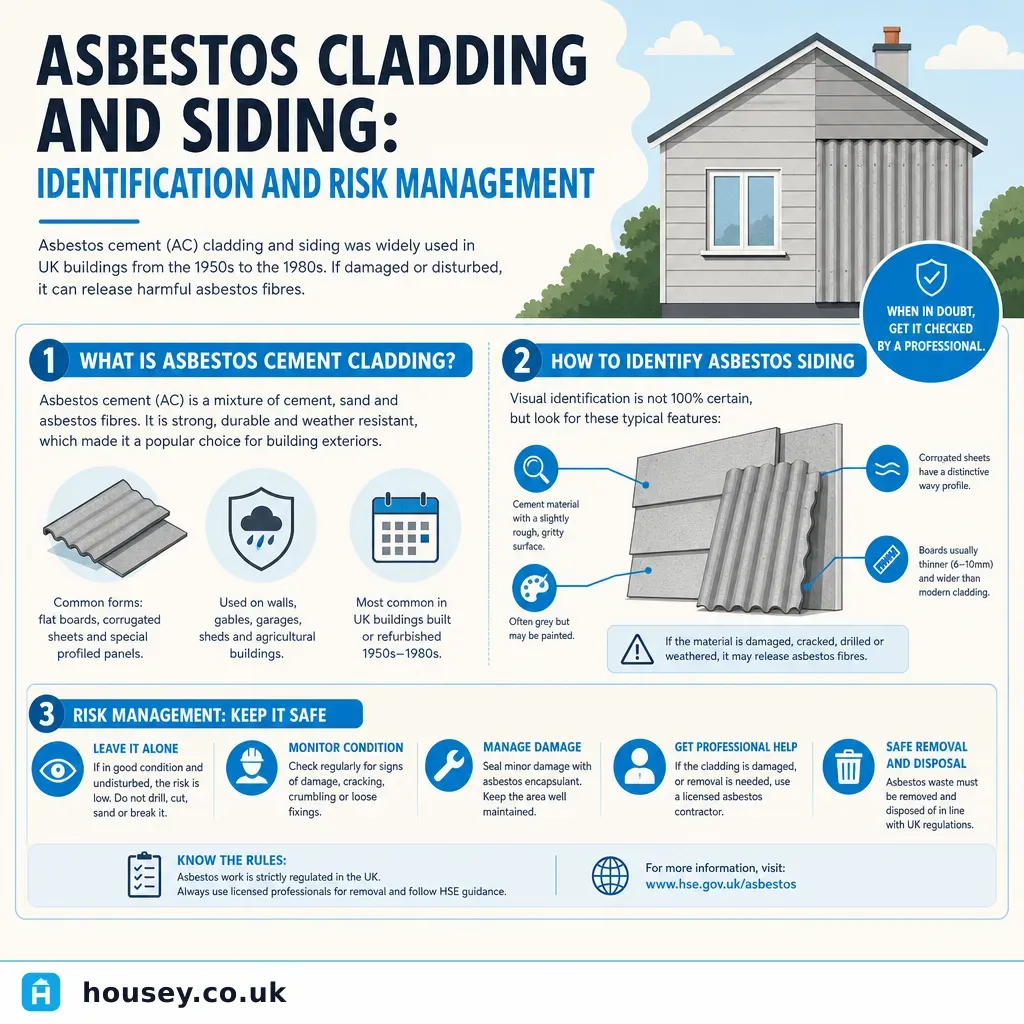
Asbestos Cladding and Siding: Identification and Risk Management
Asbestos cement cladding was widely used on UK buildings until 1999 and may be present on any property built before that date.
 Surveys & Inspections
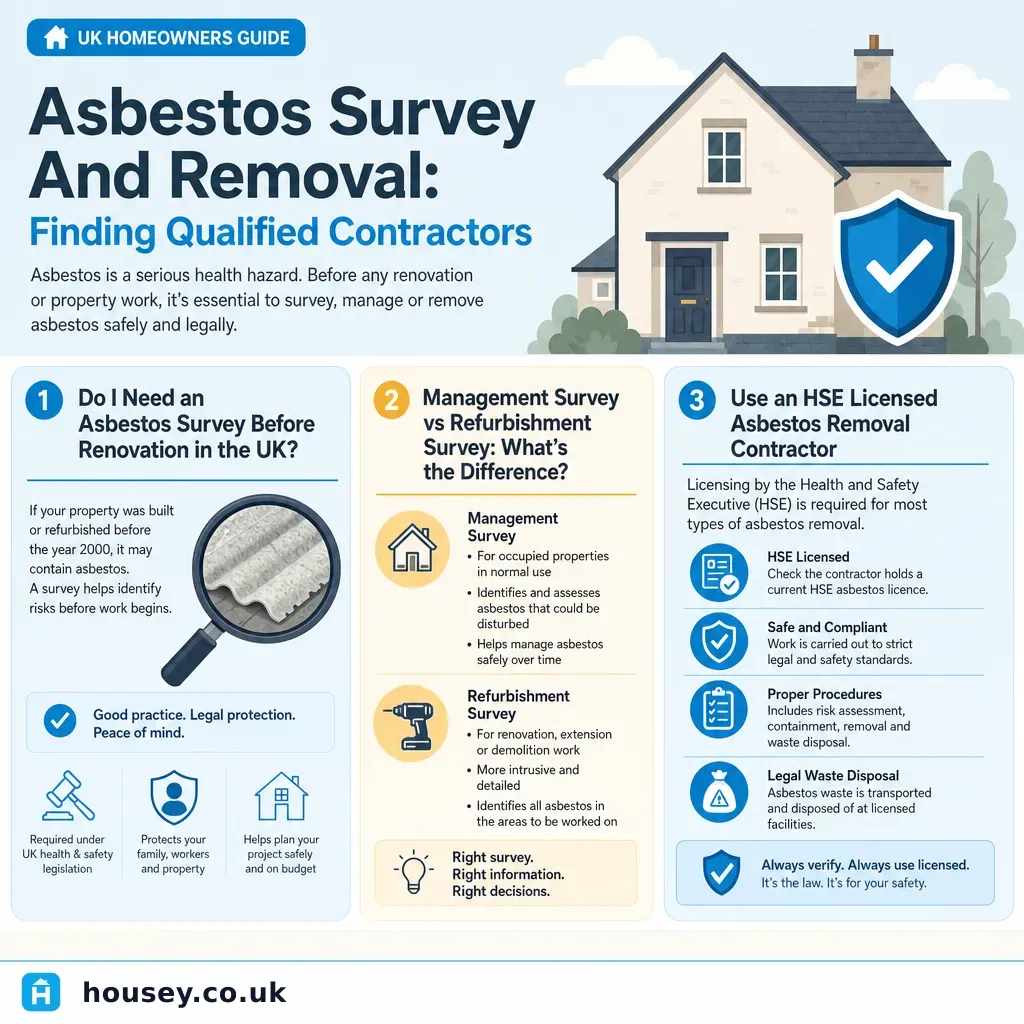
Asbestos Survey And Removal: Finding Qualified Contractors
An asbestos survey establishes whether asbestos-containing materials are present in your property and their condition.
 Surveys & Inspections
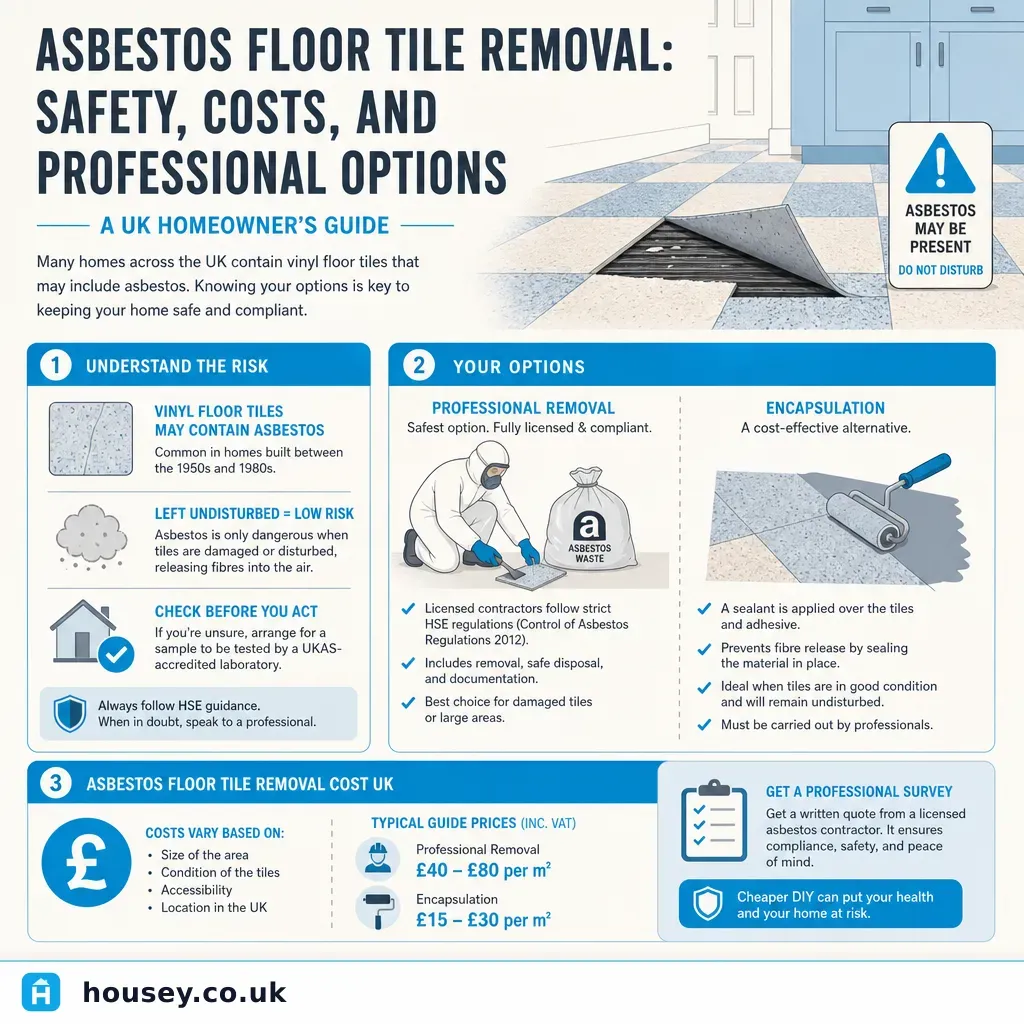
Asbestos Floor Tile Removal: Safety, Costs, and Professional Options
Asbestos floor tiles — common in UK homes built between the 1950s and late 1980s — must not be disturbed without a professional assessment.
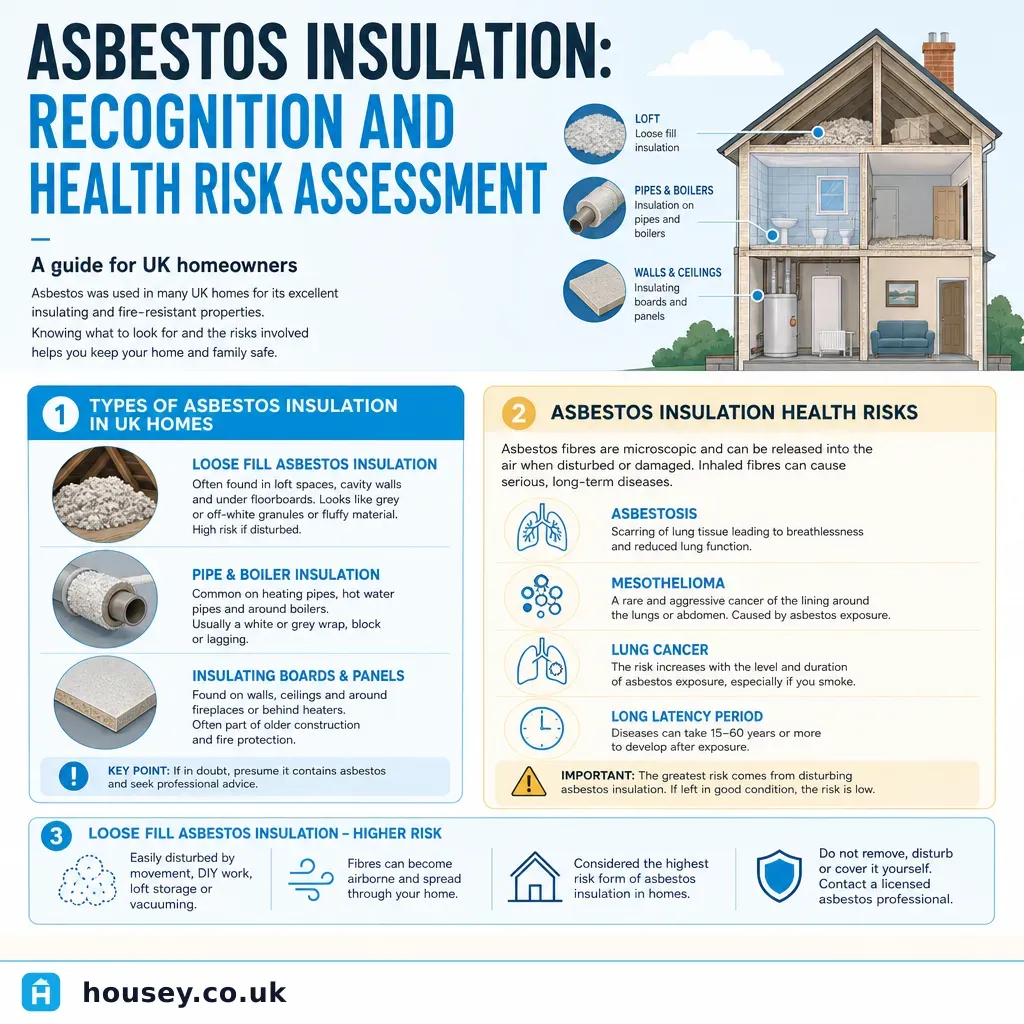 Surveys & Inspections
Asbestos Insulation: Recognition and Health Risk Assessment
Asbestos insulation in UK homes often appears as loose-fill loft insulation, pipe lagging, or sprayed coatings.
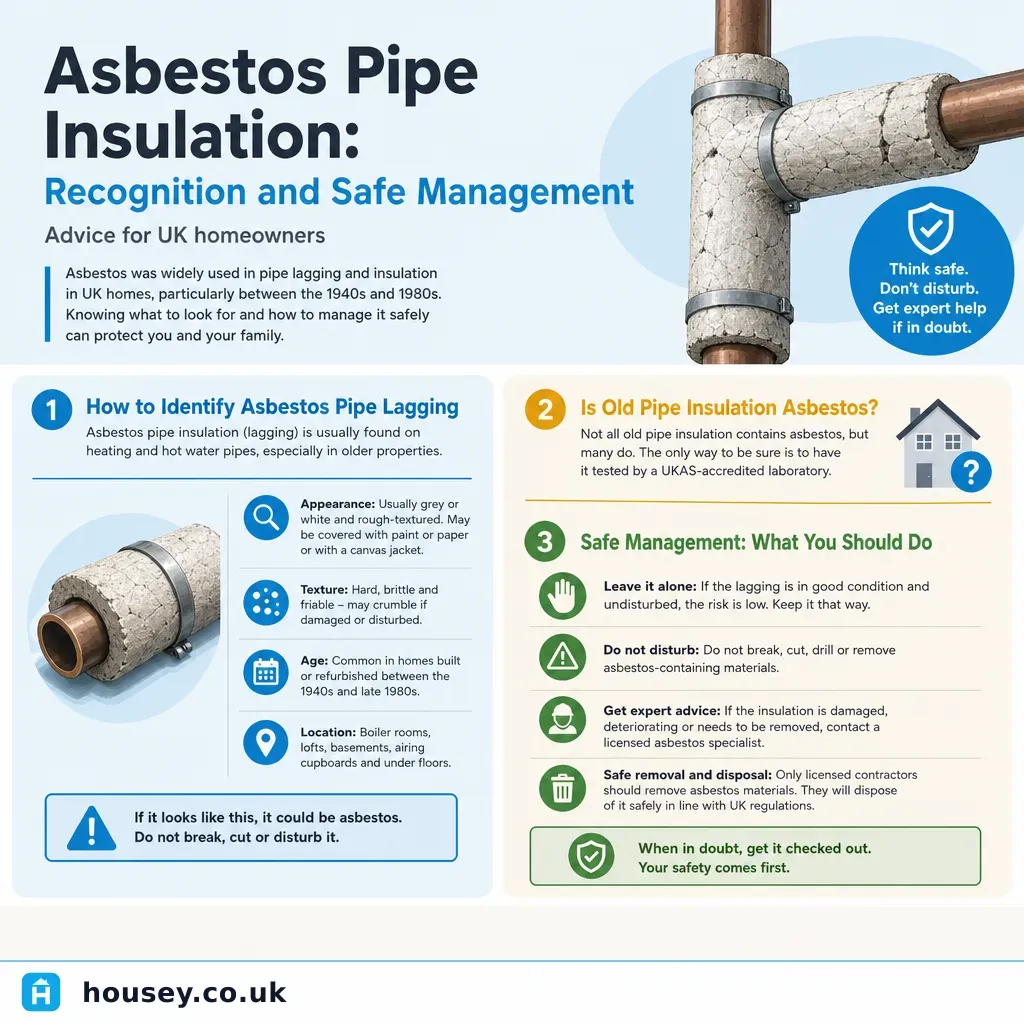 Surveys & Inspections
Asbestos Pipe Insulation: Recognition and Safe Management
Asbestos pipe insulation, commonly called pipe lagging, was widely used in UK homes until the late 1990s to wrap boiler flues, heating pipes, and hot-water cylinders.