Asbestos in Building Materials: Identification and Survey
By Housey · Last reviewed 10th of May 2026
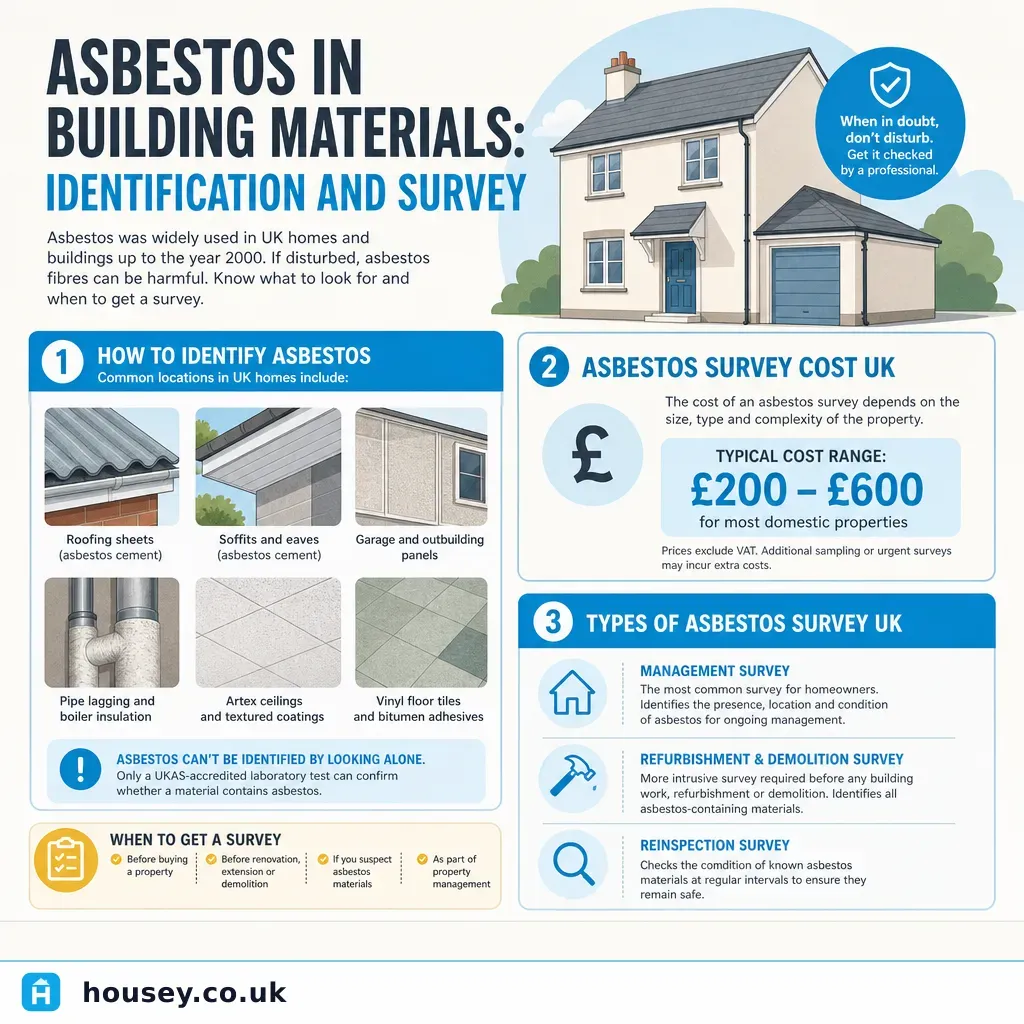
Asbestos in Building Materials: Identification and Survey
For UK homeowners, landlords, and buyers of pre-2000 properties, asbestos is a practical and ongoing concern. Asbestos-containing materials (ACMs) were used extensively in British construction from the 1950s through to the late 1990s, and their presence is not always obvious. Understanding which materials commonly contain asbestos, what a survey involves, and what to do if ACMs are found helps you manage risk safely — and avoid inadvertently disturbing materials that, if left alone, pose little day-to-day danger.
Key points
- Asbestos use in new building products was banned in the UK in 1999; any property built or substantially refurbished before that date may contain ACMs.
- The two principal domestic survey types — Management Survey and Refurbishment/Demolition Survey — are defined under the HSE's guidance document HSG264.
- Analytical work must be performed by a UKAS-accredited laboratory; visual identification of asbestos by sight alone is unreliable.
- The Control of Asbestos Regulations 2012 legally requires licensed contractors to remove high-risk materials including asbestos insulating board (AIB), lagging, and sprayed coatings.
- Disturbing ACMs without prior assessment is the most common cause of preventable asbestos exposure in UK domestic settings.
Which building materials commonly contain asbestos?
Asbestos was added to construction products for its fire resistance and insulating properties. The following materials are commonly found in UK homes built before 2000.
Material | Where typically found | Risk if undisturbed |
|---|---|---|
Textured decorative coatings (e.g., Artex) | Ceilings, upper walls | Low if intact; higher when sanded, drilled, or scraped |
Vinyl floor tiles and adhesive backing | Kitchens, bathrooms, hallways | Low if intact; higher when cut, sanded, or lifted |
Asbestos cement sheets (flat and corrugated) | Garage roofs, outbuildings, soffits | Low if intact; higher when cut, drilled, or weathered |
Pipe lagging and boiler insulation | Airing cupboards, lofts, basements | Higher — often friable if degraded or damaged |
Asbestos insulating board (AIB) | Partition walls, fire doors, bath panels | Higher — drilling or cutting releases fibres readily |
Ceiling tiles | Older kitchens and converted spaces | Low if intact and undisturbed |
Rope gaskets and flue seals | Behind fireplaces, old boiler fittings | Low if sealed and undisturbed |
Important: This table is a general guide only. Many materials visually identical to known ACMs do not contain asbestos, and some that look entirely ordinary do. Only laboratory analysis can confirm presence.
Can you identify asbestos by looking at it?
No. Asbestos fibres are microscopic and cannot be identified by sight, smell, or touch. Colour, texture, age, and surface finish are not reliable indicators. A 1975 floor tile may contain chrysotile; a visually identical 2002 tile will not. The only reliable identification method combines:
- A visual survey by a trained asbestos surveyor to locate and record all suspected ACMs.
- Bulk sample analysis by a UKAS-accredited laboratory using polarised light microscopy (PLM) or, for finer identification, transmission electron microscopy (TEM).
Attempting to take your own sample is not advisable. Sampling a suspected ACM can itself release fibres if not carried out by a competent person using proper containment techniques.
What types of asbestos survey are there?
Under HSE guidance HSG264, two main survey types are used in residential and commercial properties in the UK.
Management Survey
- Purpose: To locate and assess the condition of ACMs that could be disturbed during normal occupancy and maintenance.
- Scope: Accessible areas; minor intrusion such as lifting hatch covers and sampling surface coatings. Does not require opening up the building fabric.
- When to commission one: When buying a pre-2000 property, when carrying out routine maintenance, or when a lender or solicitor has requested one.
- Typical output: An asbestos register recording location, material type, condition, and a risk-priority score for each ACM found.
Refurbishment/Demolition Survey
- Purpose: To locate all ACMs in areas that will be disturbed during planned refurbishment or demolition.
- Scope: Destructive inspection — walls, floors, and ceilings in the affected area are opened up.
- When to commission one: Before any significant renovation, loft conversion, extension, or demolition work on a pre-2000 property.
- Legal position: Where notifiable construction work is involved, a refurbishment/demolition survey is a legal requirement under CDM Regulations 2015 before works begin.
What does a domestic asbestos survey involve?
A domestic management survey typically takes 1–3 hours for an average three- or four-bedroom house, longer for properties with extensive loft, cellar, or outbuilding access. The surveyor will:
- Carry out a visual inspection of all accessible areas, recording suspected ACMs.
- Take controlled bulk samples using a wetting agent and contained sampling approach.
- Submit samples to a UKAS-accredited laboratory for analysis.
- Produce a written report with an asbestos register, photographs, condition ratings, and risk-priority scores.
Indicative UK costs, last reviewed 2026-05-10: a domestic management survey typically costs £150–£350 for an average house including laboratory analysis. Refurbishment/demolition surveys cost more due to the destructive access work; quotes vary based on scope and property size.
What happens after asbestos is found?
Not all ACMs need immediate removal. The HSE's approved approach is to manage in place for intact, low-risk materials:
- Leave and monitor: If ACMs are in good condition and not likely to be disturbed, leave them in place, record them in an asbestos register, and check condition periodically.
- Encapsulate: Some materials can be sealed by a competent contractor to prevent fibre release without removal.
- Remove: Required when renovation will disturb the material or when condition is deteriorating. Removal of licensed materials — most forms of AIB, lagging, and sprayed coatings — must be carried out by a licensed contractor under the Control of Asbestos Regulations 2012.
Homeowners should never attempt to remove ACMs themselves, even materials often described as lower risk.
Decision guide: do I need an asbestos survey?
- Commission a management survey if you are buying a pre-2000 property, planning any maintenance work on suspected materials, or a lender or solicitor has requested one.
- Commission a refurbishment/demolition survey if you are planning renovation, a loft conversion, an extension, or any work that will open up walls, floors, or ceilings in a pre-2000 building.
- Stop work immediately if you encounter unexpected materials during renovation that may be ACMs — seal the area, do not vacuum (standard vacuums spread fibres), and commission a survey before continuing.
- Contact the HSE if uncontrolled disturbance of a suspected ACM has occurred and occupants may have been exposed.
Important limitations
This article provides general information about asbestos identification and surveys. The Control of Asbestos Regulations 2012 and HSE guidance (HSG264) set legally binding requirements that vary by material type, work scope, and property tenure. This article does not constitute legal or health and safety advice. Never disturb suspected ACMs on the basis of any general guide. A competent, accredited surveyor must assess your specific property and circumstances.
When this becomes urgent
Seek immediate specialist advice if:
- You have sanded, drilled, or cut into a material you now suspect may contain asbestos — leave the area, do not vacuum, and contact a competent asbestos professional.
- You have found deteriorating or crumbling insulation, lagging, or ceiling tiles in a pre-2000 property.
- You are buying a property where the seller's disclosure or a survey report mentions ACMs — obtain a management survey before exchange if one has not already been provided.
- A contractor has encountered unexpected materials during ongoing works — they are legally required to stop and assess under CDM Regulations 2015.
What to ask a qualified professional
- Are you trained to HSE-recognised standards for asbestos surveying, such as the P402 Building Surveys and Bulk Sampling certificate?
- Will all analysis be carried out by a UKAS-accredited laboratory?
- Does your quote include the full written report and asbestos register, or only the site visit?
- If ACMs are found, do you also offer removal, or will you refer me to a licensed removal contractor?
- Is licensed removal legally required for the specific materials identified in my property?
- How will samples be contained during the survey to prevent fibre release?
When to get professional help
Always commission a survey from a competent surveyor before carrying out renovation work on any pre-2000 property. If you suspect uncontrolled asbestos exposure has occurred, or if deteriorating ACMs are found, seek professional help without delay — do not rely on a general guide to determine next steps.
How Housey can help
Housey connects homeowners, buyers, and landlords with accredited professionals for asbestos surveys — from pre-purchase management surveys to full refurbishment/demolition surveys ahead of renovation work.
Frequently asked questions
Is asbestos still present in new-build homes?
Asbestos use in new building materials was banned in the UK in 1999. New-build homes constructed after 2000 should not contain asbestos in factory-supplied materials, though materials salvaged from older structures occasionally carried over during renovation work. For properties of mixed construction age, a survey remains advisable before any intrusive work begins.
Who is responsible for asbestos in a rented property?
Landlords of non-domestic premises have a legal duty to manage asbestos under the Control of Asbestos Regulations 2012 (Regulation 4). For residential lettings there is no identical statutory duty, but landlords may have common-law and contractual obligations to keep the property safe. Specialist legal advice should be sought if you are a landlord uncertain of your position.
How long does an asbestos survey report remain valid?
A management survey report remains valid as long as the property condition does not change significantly. If materials deteriorate, new works are planned, or building use changes, the register should be updated. For managed ACMs in commercial settings most surveyors recommend a condition review every 6–12 months; for residential properties, review whenever works are planned.
Can I sell a house that contains asbestos?
Yes. The presence of asbestos does not prevent a sale, but sellers are expected to disclose known ACMs. Buyers should be informed so they can factor management or removal costs into their offer. A valid management survey report is a helpful disclosure document and is often requested by a buyer's solicitor or surveyor during conveyancing.
Sources and further reading
- Asbestos: The Survey Guide (HSG264) — Health and Safety Executive
- Control of Asbestos Regulations 2012 — legislation.gov.uk
- Asbestos: manage it in buildings — Health and Safety Executive
- Find a UKAS-accredited testing laboratory — UKAS
- Asbestos in the home — Health and Safety Executive
Useful next reads
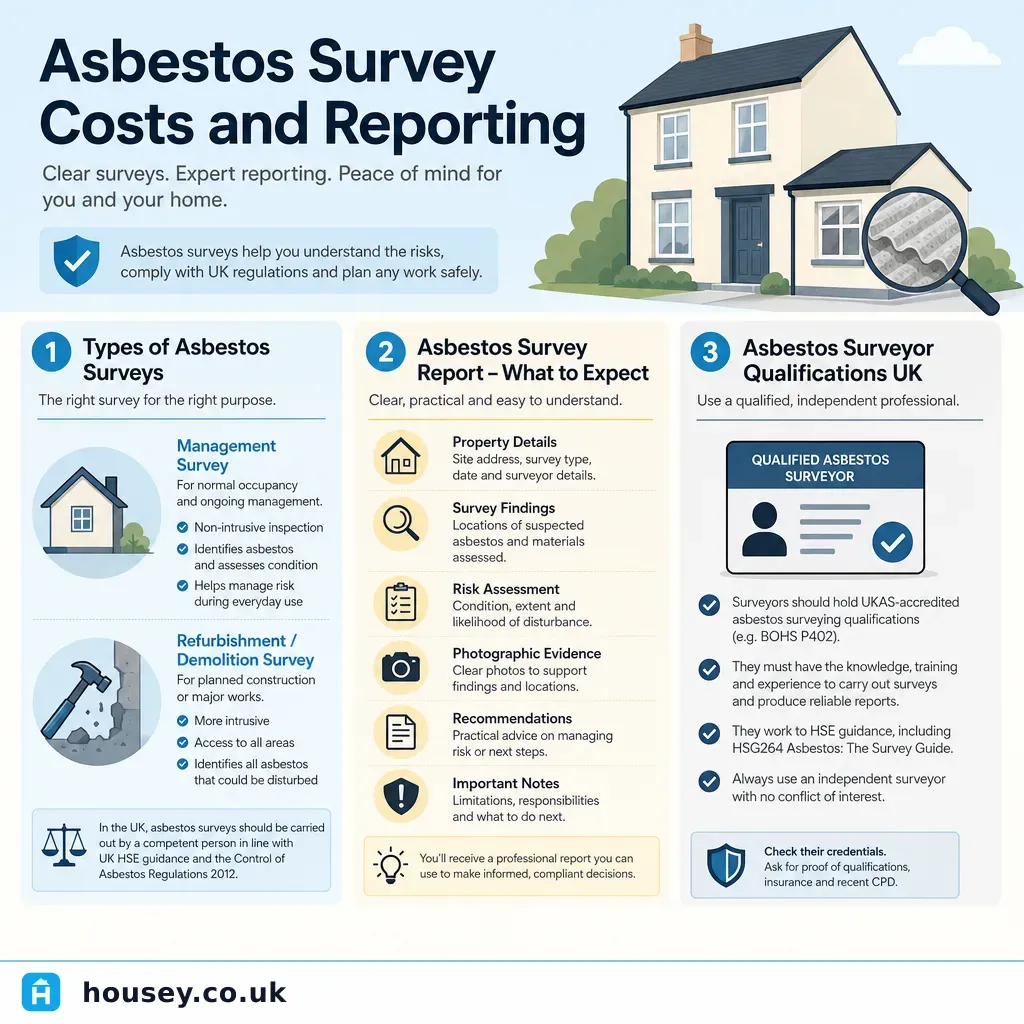 Surveys & Inspections
Asbestos Survey Costs and Reporting
A management asbestos survey typically costs £200–£400 for a standard UK home.
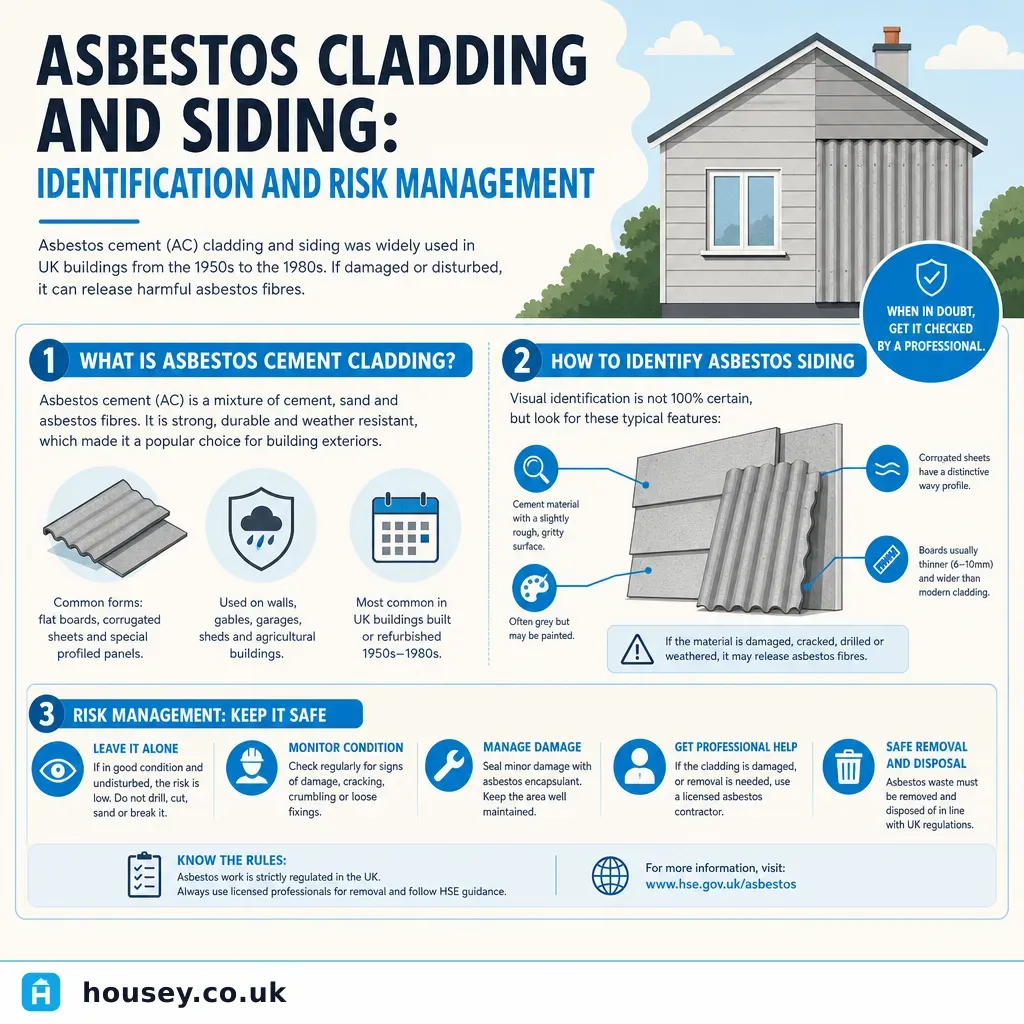 Surveys & Inspections
Asbestos Cladding and Siding: Identification and Risk Management
Asbestos cement cladding was widely used on UK buildings until 1999 and may be present on any property built before that date.
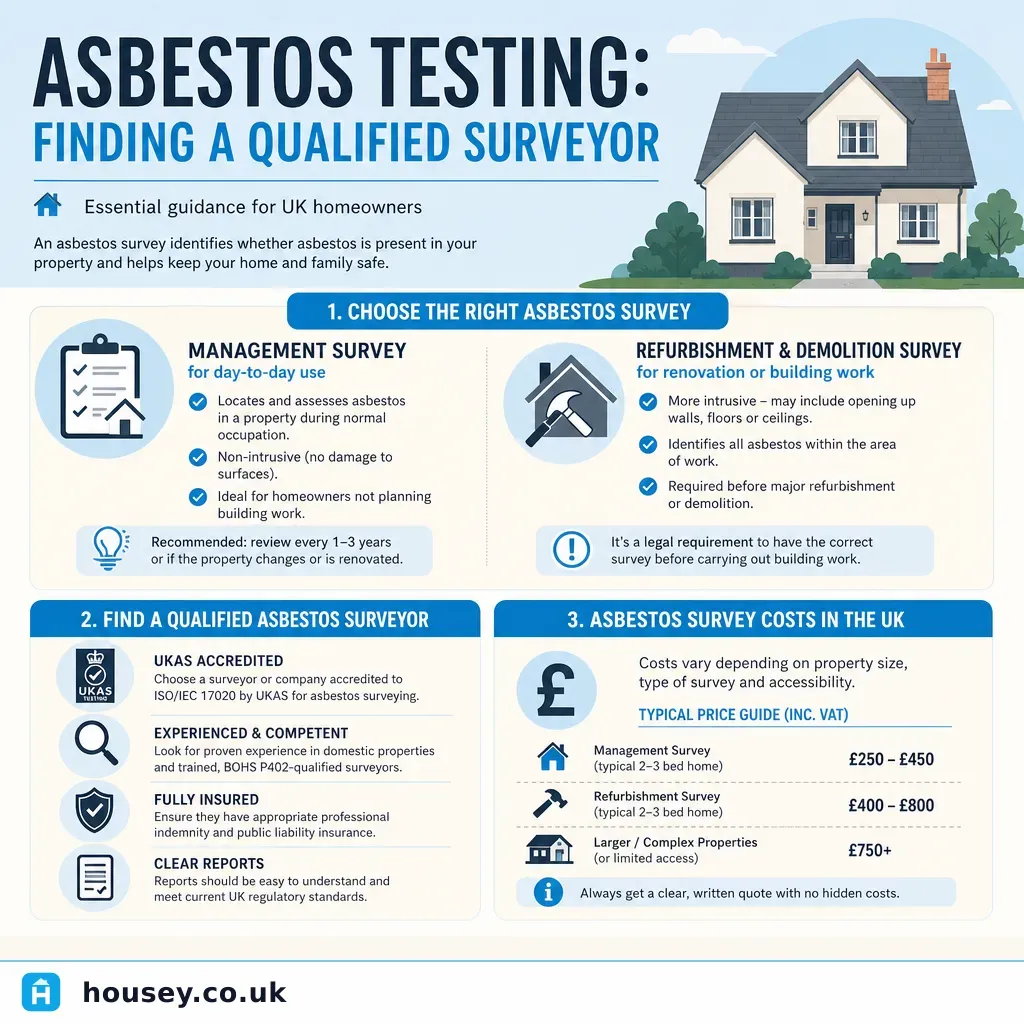 Surveys & Inspections
Asbestos Testing: Finding a Qualified Surveyor
Finding a qualified asbestos surveyor means choosing a company accredited by UKAS to ISO/IEC 17020, with analysts holding BOHS P402 or equivalent qualifications.
 Surveys & Inspections
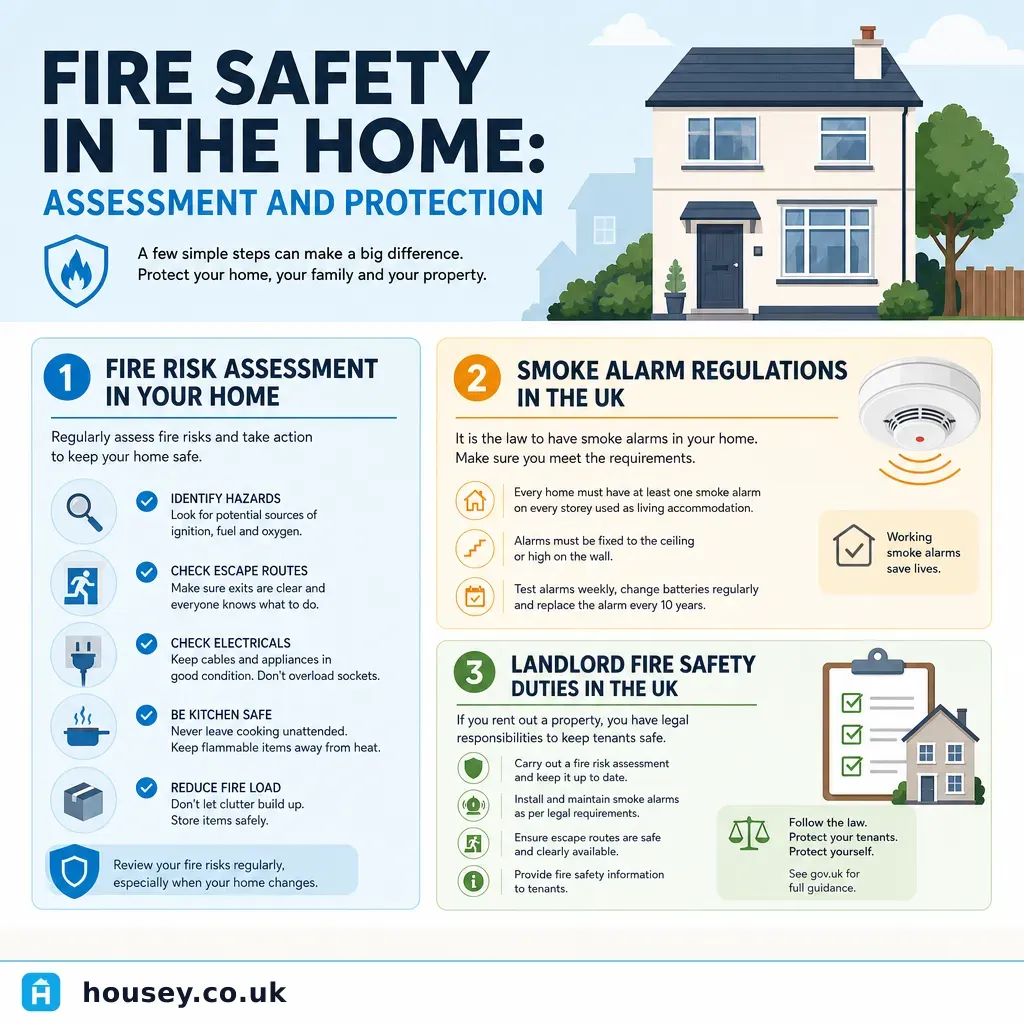
Fire Safety in the Home: Assessment and Protection
Most UK owner-occupied homes are the homeowner's responsibility to make fire-safe, while landlords have a legal duty to carry out fire risk assessments under the Regulatory Reform (Fire Safety) Order 2005.
 Surveys & Inspections
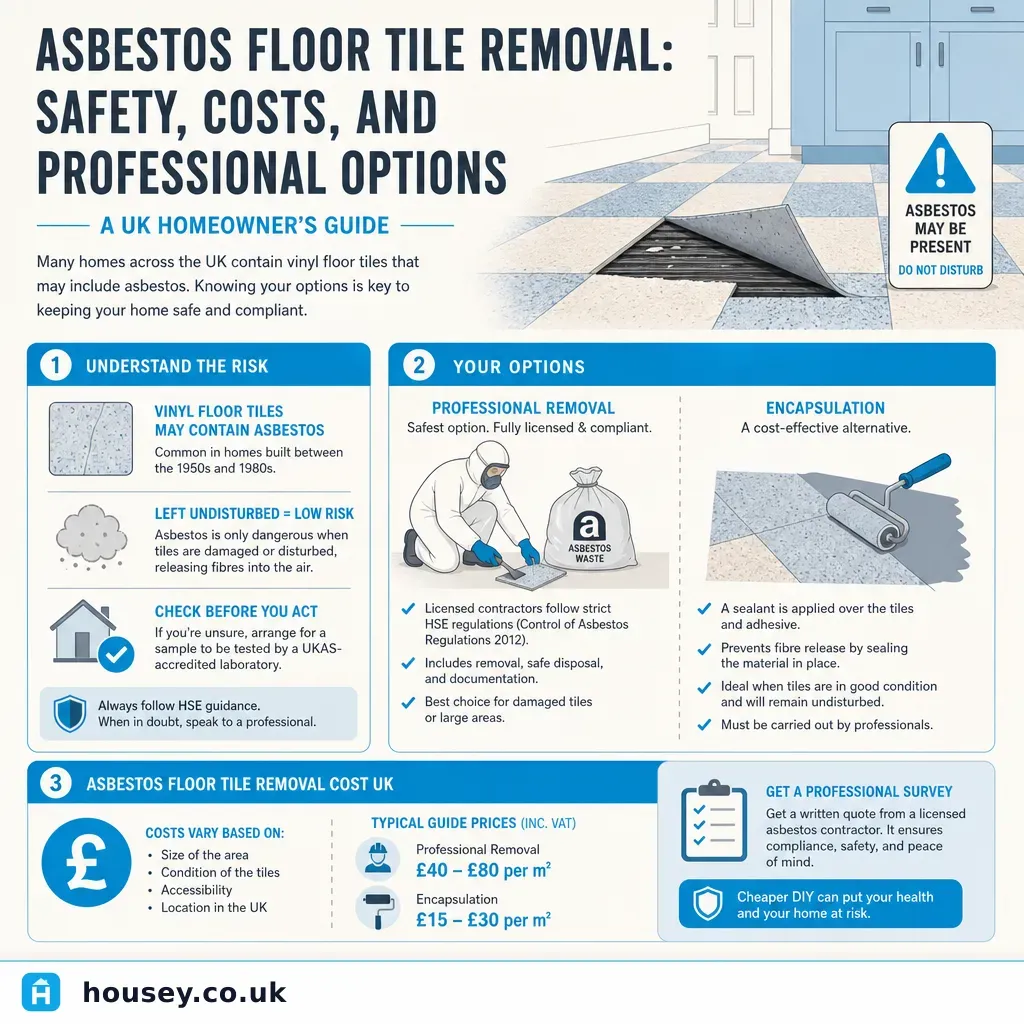
Asbestos Floor Tile Removal: Safety, Costs, and Professional Options
Asbestos floor tiles — common in UK homes built between the 1950s and late 1980s — must not be disturbed without a professional assessment.