Asbestos Floor Tile Removal: Safety, Costs, and Professional Options
By Housey · Last reviewed 12th of May 2026
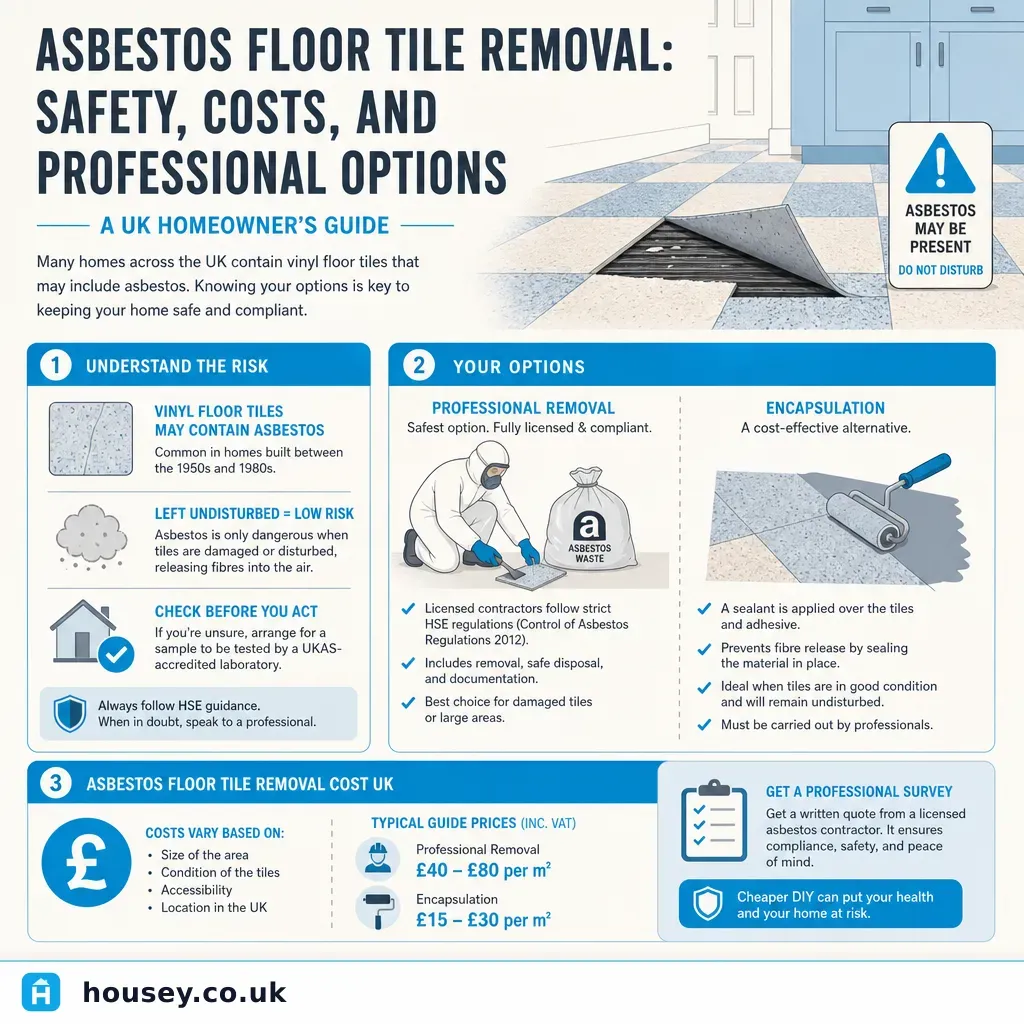
Asbestos Floor Tile Removal: Safety, Costs, and Professional Options
Discovering that floor tiles in an older property may contain asbestos is one of the most common concerns raised during renovation or pre-sale surveys. In UK homes built between the 1950s and late 1980s, vinyl floor tiles and the bitumen-based adhesive used to fix them frequently contained chrysotile (white) asbestos. Before any floor removal work begins — whether you are renovating a kitchen, fitting new flooring, or preparing a property for sale — understanding the legal and safety requirements is essential. Asbestos fibres are a known cause of mesothelioma and asbestosis, and the Control of Asbestos Regulations 2012 place clear legal duties on those who manage and commission building work.
Key points
- Vinyl floor tiles and associated adhesive (black mastic) in properties built before 2000 may contain asbestos; only laboratory analysis of a sample taken by a UKAS-accredited laboratory can confirm this — visual inspection alone is not reliable.
- The Control of Asbestos Regulations 2012 (SI 2012/632) govern all asbestos work in the UK; depending on fibre type and the nature of the work, removal must be carried out by an HSE-licensed contractor (for notifiable licensed work) or a trained non-licensed contractor following prescribed controls.
- A refurbishment and demolition asbestos survey must be completed before any floor removal or renovation that will disturb suspected asbestos-containing materials — a management survey alone is not sufficient for this purpose.
- Encapsulation — sealing tiles in place with a specialist coating, or overlaying with a new floor covering — is a legitimate and often lower-cost alternative to removal if tiles are in good, stable condition.
- Indicative costs for licensed asbestos floor tile removal range from £800 to £3,000 or more for a typical domestic room, excluding the separate cost of the refurbishment survey (Indicative UK costs, last reviewed 2026-05-12).
Important limitations
This article provides general information about asbestos floor tile removal in the UK and must not be treated as technical, legal, or safety advice for your specific situation. Asbestos risks vary with fibre type, tile condition, the extent of the affected area, and individual property circumstances. The Control of Asbestos Regulations 2012 impose legal duties on dutyholders, employers, and those commissioning building work. A BOHS-qualified asbestos surveyor and, where applicable, an HSE-licensed asbestos contractor should assess your property before any decisions are made.
Which floor tiles are most likely to contain asbestos?
Not all old floor tiles contain asbestos, but certain types carry a higher risk:
Tile type | Risk period | Likely asbestos type | Notes |
|---|---|---|---|
Vinyl floor tiles (9 in × 9 in or 12 in × 12 in) | 1950s–1980s | Chrysotile (white); amosite in some | Both the tile AND the adhesive (black mastic) may contain asbestos — sample both separately |
Thermoplastic (asphalt) tiles | 1950s–1960s | Chrysotile common | Often dark-coloured; common in kitchens and hallways |
Cork floor tiles | 1960s–1970s | Low risk in tile itself | The bitumen adhesive beneath may contain asbestos |
Cushion vinyl sheet flooring | 1960s–1980s | Some backing layers contain chrysotile | Sheet flooring is generally lower risk than tiles but should still be surveyed |
Modern tiles (post-2000) | 2000–present | Effectively zero (asbestos banned in UK 1999) | Confirm actual construction and renovation date |
The adhesive matters as much as the tile. Even if tiles themselves test clear, the bitumen-based black mastic adhesive beneath may be positive for asbestos. Both materials should be sampled separately during a refurbishment survey.
Should you remove or encapsulate?
Removal is not always the right answer. If tiles are in good, stable condition and are not being disturbed by planned works, encapsulation may be both safer and cheaper.
Approach | Best for | Not suitable for | Approximate cost range* | Regulatory position |
|---|---|---|---|---|
Encapsulation or overlay | Intact, stable tiles where floor level allows | Cracked, friable, or loose tiles | £200–£800 | Compliant — update asbestos management plan |
Non-licensed removal | Low-risk chrysotile tiles meeting specific HSE criteria | Notifiable work or higher-risk scenarios | £400–£1,200 | Must follow HSE non-licensed guidance |
Licensed removal | Notifiable licensed work and higher-risk scenarios | — | £800–£3,000+ | HSE-licensed contractor required; 14-day HSE notification |
*Indicative UK costs, last reviewed 2026-05-12. Costs vary with floor area, access, adhesive type, and disposal requirements.
Whether removal is classified as licensed or non-licensed depends on factors including fibre type, tile condition, and how the work is carried out. Your surveyor and contractor should advise on the classification before work begins.
The refurbishment and demolition asbestos survey
Before any removal, you need a refurbishment and demolition (R&D) survey — not a management survey. The distinction is significant:
- A management survey identifies asbestos-containing materials (ACMs) in their current condition for ongoing monitoring; it does not involve destructive sampling beneath fixed floor coverings.
- An R&D survey is fully intrusive and designed specifically to locate all ACMs that could be disturbed by the planned work. This is the correct survey type before any floor removal.
Surveyors must hold the BOHS P402 qualification or equivalent; laboratories used for sample analysis must be UKAS-accredited. A single-room R&D survey typically costs £150–£400 including laboratory analysis (Indicative UK costs, last reviewed 2026-05-12). The survey report is also required by any licensed contractor to plan and price the work safely.
The removal process
For licensed removal of asbestos floor tiles, the typical process is:
- HSE notification: The contractor notifies the HSE using form ASB5 at least 14 days before notifiable work begins.
- Site preparation: The work area is isolated using sheeting and signage; negative pressure enclosures may be used for higher-risk work.
- Removal: Tiles and adhesive are removed keeping materials as intact as possible; wet methods suppress dust and minimise fibre release.
- Four-stage clearance: An independent analyst (BOHS P404 qualified) conducts a visual inspection and air testing before the area is handed back for use.
- Disposal: ACM waste is double-bagged, labelled, and taken to a licensed hazardous waste facility; consignment notes are issued under the Hazardous Waste Regulations 2005.
You should receive a clearance certificate, waste consignment notes, and the contractor's risk assessment and method statement (RAMS) on completion.
When this becomes urgent
Seek professional advice immediately — and do not disturb the floor further — if:
- You have already started lifting tiles and suspect they may contain asbestos (stop work immediately, ventilate the room, and leave the area)
- Tiles are visibly cracked, crumbling, or have been sanded
- You are carrying out notifiable building work and a surveyor has confirmed ACMs in the floor
- A child or vulnerable person has been present in a room where asbestos-containing tiles have been disturbed
- You are a landlord and tenants have begun DIY floor work in a pre-2000 property
If asbestos fibres may have been released, do not use a domestic vacuum cleaner — this spreads fibres further. Contact an asbestos contractor immediately for decontamination advice.
What to ask a qualified professional
Before instructing a surveyor or removal contractor, ask:
- Are you BOHS P402-qualified (surveyors) or HSE-licensed (removal contractors)?
- Is the laboratory you use for sample analysis UKAS-accredited?
- Will the survey cover both the tile and the adhesive layer separately?
- Will you classify the work as licensed or non-licensed, and what is the basis for that decision?
- If removal is required, who carries out the four-stage clearance, and what does it involve?
- What waste documentation will I receive — consignment notes and clearance certificate?
- Will you notify the HSE on my behalf, and how far in advance?
- Does the price include isolation, removal, disposal, and clearance air testing?
- Do you carry adequate public liability insurance for asbestos work?
When to get professional help
Never attempt to remove suspected asbestos-containing floor tiles yourself. The legal and health risks are serious, correct disposal requires a licensed waste carrier, and disturbing ACMs without proper controls is an offence under the Control of Asbestos Regulations 2012. Always:
- Commission an R&D asbestos survey before any floor work in a pre-2000 property
- Use a BOHS P402-qualified surveyor and a UKAS-accredited laboratory
- Only instruct an HSE-licensed contractor for work classified as licensable
- Retain all survey reports, clearance certificates, and waste consignment notes — these documents are important for future sale or renovation work
How Housey can help
If you need an asbestos survey before floor removal or renovation work in a pre-2000 property, Housey can connect you with qualified professionals through our asbestos surveys service — carrying out refurbishment and demolition surveys in accordance with HSE guidance and the Control of Asbestos Regulations 2012.
Frequently asked questions
Are vinyl floor tiles from the 1970s likely to contain asbestos?
Possibly, yes. Vinyl floor tiles manufactured in the UK between the 1950s and mid-1980s frequently contained chrysotile (white asbestos), and the bitumen-based adhesive beneath them often did too. The only reliable confirmation is laboratory analysis of a sample taken by a qualified surveyor — visual inspection is not sufficient. Do not assume tiles are safe based on appearance, colour, or estimated age alone.
Can I leave asbestos floor tiles in place?
If tiles are in good, stable condition and are not going to be disturbed, leaving them in place is often the safest option, provided a management plan is maintained and condition is monitored. Encapsulation or overlaying with a new floor covering is a practical long-term solution in many cases. If planned work will disturb the tiles — including sanding the floor above or cutting through the subfloor — a refurbishment survey and appropriate controls are required first.
How much does asbestos floor tile removal cost in the UK?
Indicative costs for licensed asbestos floor tile removal range from approximately £800 to £3,000 or more for a typical domestic room, depending on floor area, tile and adhesive condition, access, and disposal requirements. The refurbishment and demolition survey adds £150–£400 separately. Non-licensed removal, where eligible, may cost somewhat less. Always obtain multiple quotes from HSE-licensed contractors and confirm disposal and clearance air testing are included. (Indicative UK costs, last reviewed 2026-05-12.)
Who is legally responsible for asbestos in a rented property?
Under the Control of Asbestos Regulations 2012 dutyholder provisions, the landlord or freeholder is typically responsible for managing asbestos in the fabric of a property. In residential lettings, landlords have a general duty of care to tenants. If asbestos floor tiles are identified, the landlord should obtain professional advice on management or removal and inform tenants accordingly. Tenants should not carry out any DIY work that could disturb asbestos-containing materials.
Sources and further reading
- Control of Asbestos Regulations 2012 — HSE guidance — Health and Safety Executive
- Control of Asbestos Regulations 2012 (SI 2012/632) — legislation.gov.uk
- HSE-licensed asbestos contractors register — Health and Safety Executive
- UKAS-accredited asbestos testing laboratories — United Kingdom Accreditation Service
- Asbestos: The survey guide, HSG264 — Health and Safety Executive
Useful next reads
 Surveys & Inspections
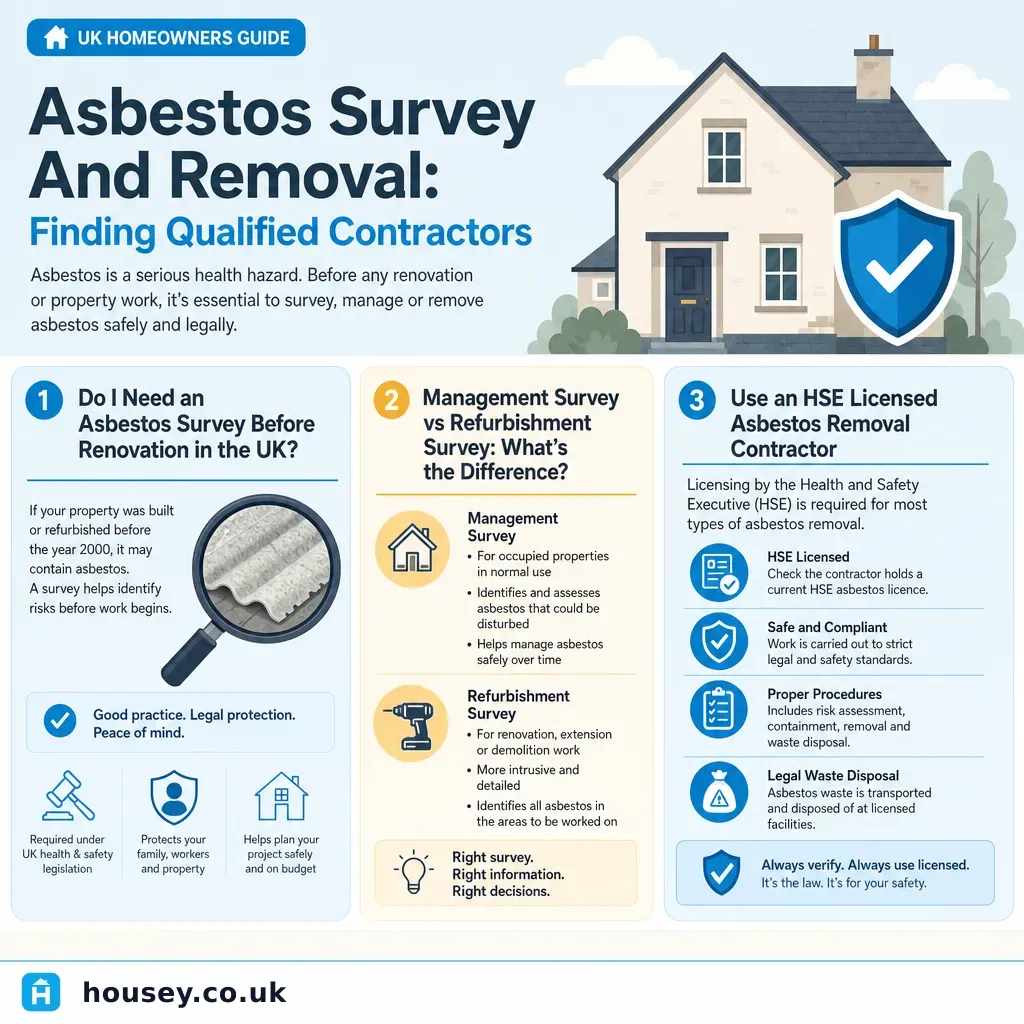
Asbestos Survey And Removal: Finding Qualified Contractors
An asbestos survey establishes whether asbestos-containing materials are present in your property and their condition.
 Surveys & Inspections
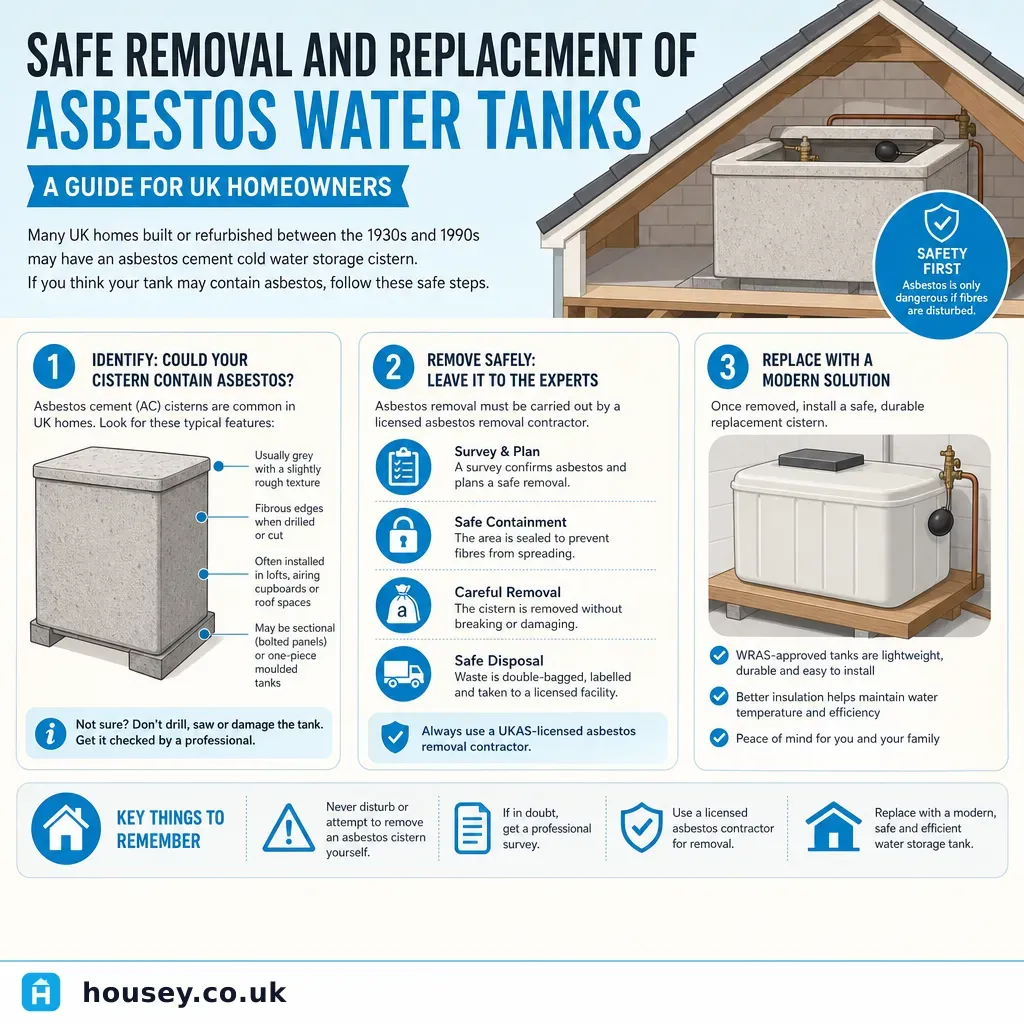
Safe Removal and Replacement of Asbestos Water Tanks
Asbestos cement cold water tanks, found in many UK homes built before about 1980, must not be drilled, cut, or broken without proper controls.
 Surveys & Inspections
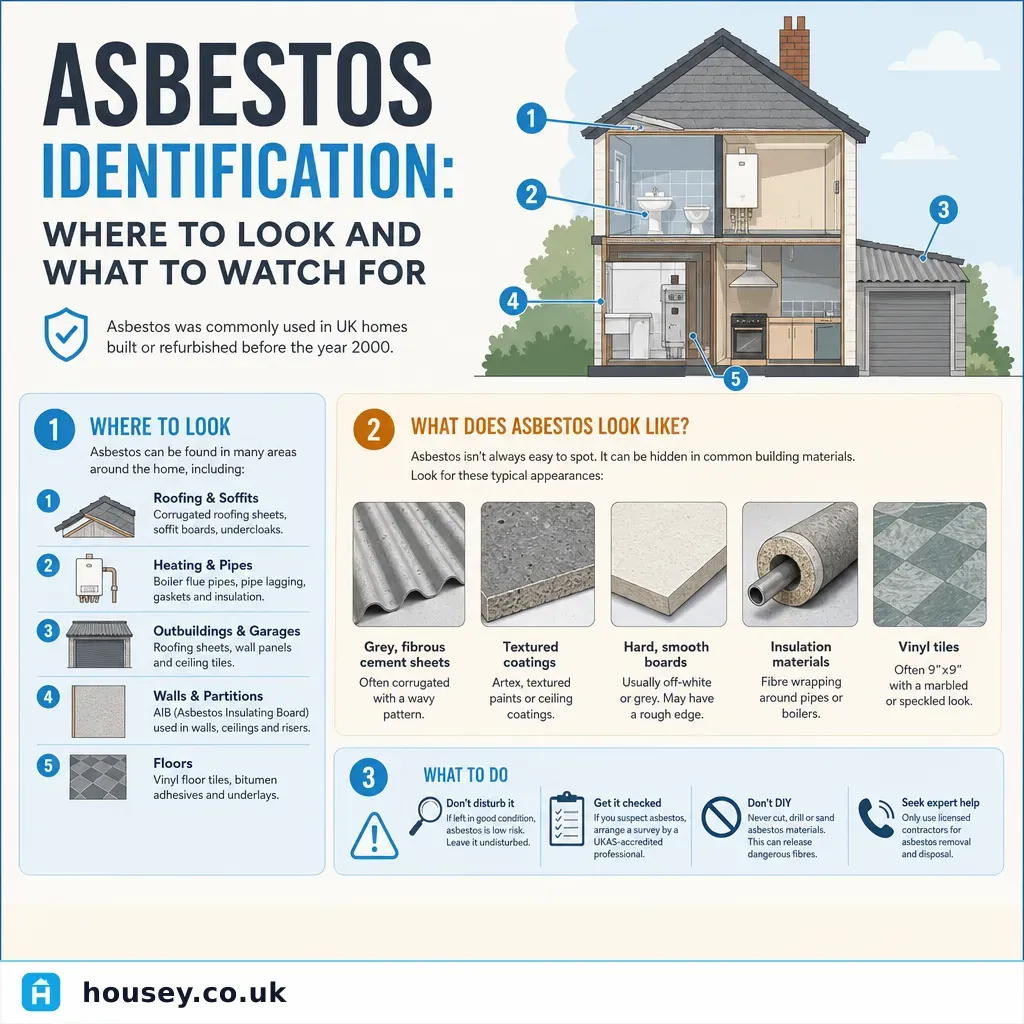
Asbestos Identification: Where to Look and What to Watch For
Asbestos can be present in dozens of locations in UK homes built before 2000, from textured ceiling coatings and floor tiles to pipe lagging and roof panels.
 Surveys & Inspections
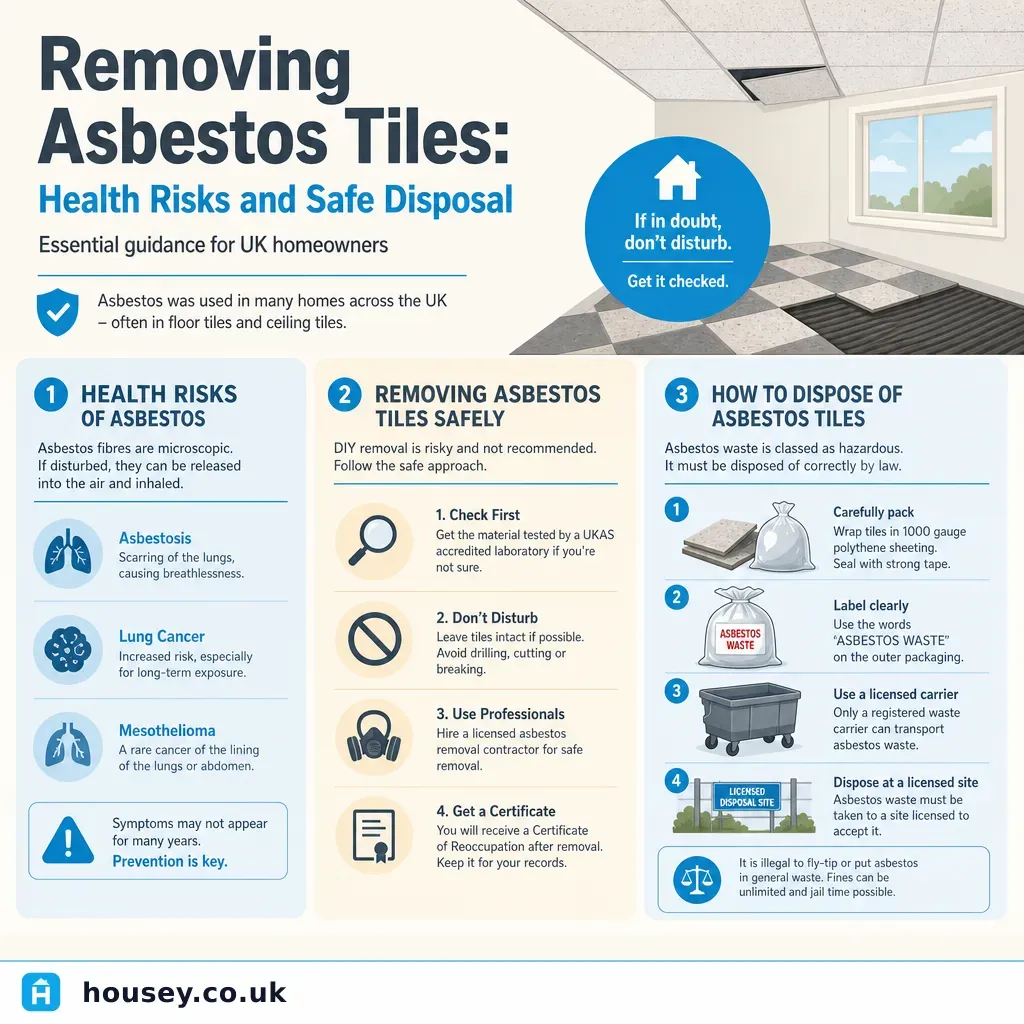
Removing Asbestos Tiles: Health Risks and Safe Disposal
Asbestos tiles in pre-2000 UK properties must not be disturbed without a refurbishment and demolition survey under HSG264.
 Surveys & Inspections
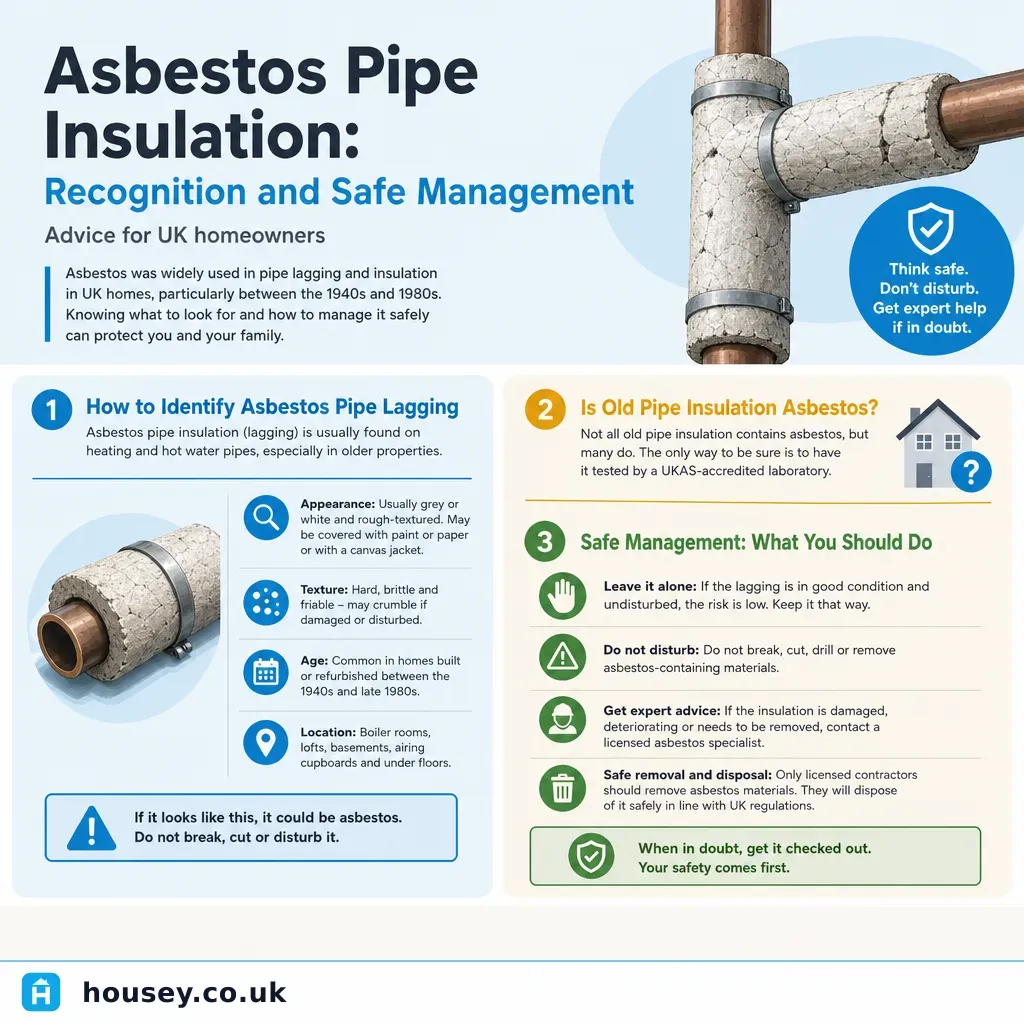
Asbestos Pipe Insulation: Recognition and Safe Management
Asbestos pipe insulation, commonly called pipe lagging, was widely used in UK homes until the late 1990s to wrap boiler flues, heating pipes, and hot-water cylinders.