Removing Asbestos Tiles: Health Risks and Safe Disposal
By Housey · Last reviewed 7th of May 2026
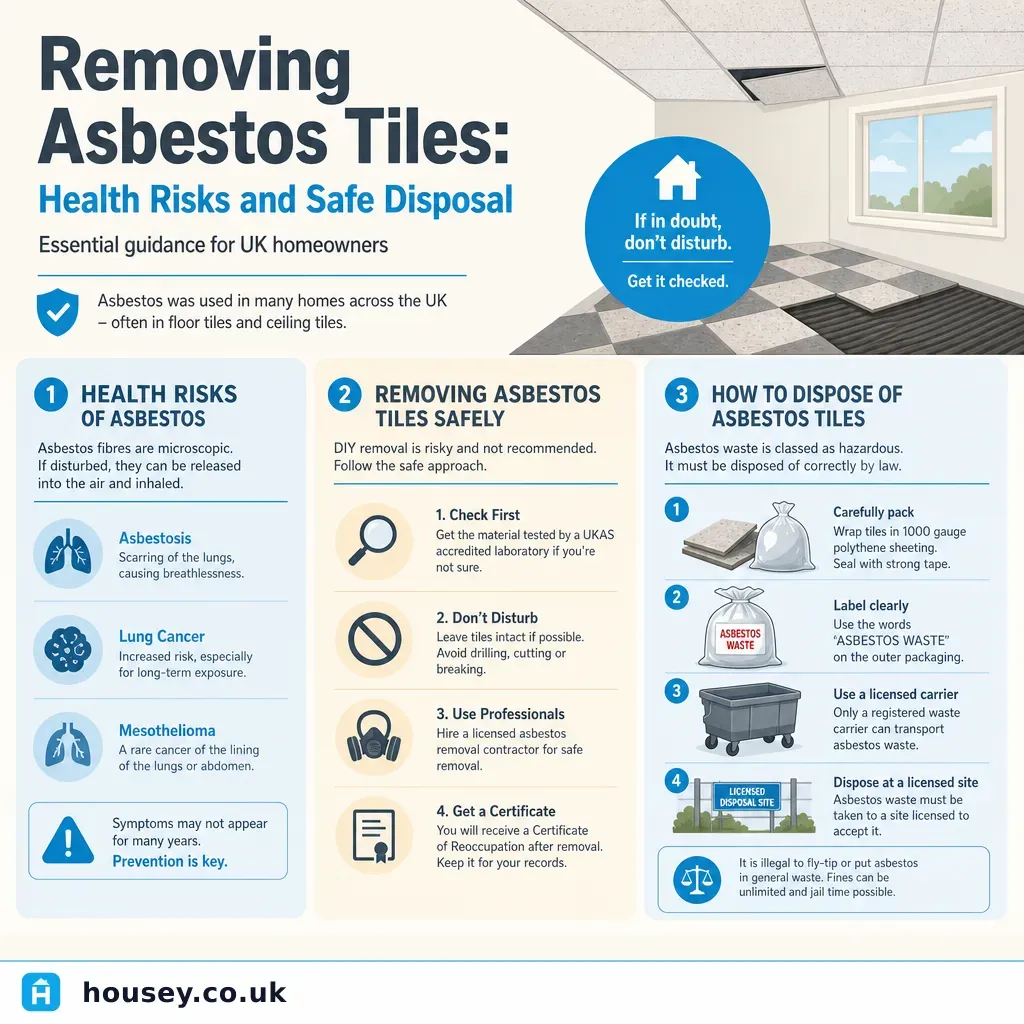
Removing Asbestos Tiles: Health Risks and Safe Disposal
Asbestos floor and ceiling tiles were used extensively in UK homes from the 1950s through to the late 1990s, when a full commercial ban on new asbestos products took effect under the Asbestos (Prohibitions) Regulations 1992, as amended in 1999. If your property was built or refurbished before 2000, there is a realistic possibility that some tiles — vinyl floor tiles, thermoplastic floor tiles, or suspended ceiling tiles — contain asbestos fibres. Disturbing or removing asbestos-containing materials (ACMs) without proper controls is a serious health risk and, in many circumstances, a criminal offence under the Control of Asbestos Regulations 2012 (CAR 2012). This is a topic where the consequences of getting it wrong can manifest decades later, making professional assessment essential before any renovation begins.
Key points
- The Control of Asbestos Regulations 2012 (SI 2012/632) governs all work with ACMs in the UK; notifiable non-licensed work (NNLW) — which covers most domestic tile removal — must be notified to the relevant enforcing authority before starting.
- A refurbishment and demolition (R&D) asbestos survey compliant with HSE guidance HSG264 is required before any renovation or demolition in a pre-2000 property.
- Asbestos waste is classified as hazardous waste under the Hazardous Waste (England and Wales) Regulations 2005 and must be disposed of at a licensed hazardous waste facility — not in a general skip or kerbside collection.
- The HSE estimates approximately 5,000 people die each year in the UK from asbestos-related diseases — more than from road traffic accidents.
- Visual inspection cannot confirm whether tiles contain asbestos; only laboratory analysis of a bulk sample provides a definitive answer.
What types of asbestos tiles are found in UK homes?
Several tile types used in UK residential properties may contain asbestos:
- Vinyl floor tiles (VFTs): 9-inch or 12-inch square tiles common in kitchens, hallways, and utility rooms from the 1950s to the 1980s. Many contain chrysotile (white asbestos) at concentrations of 10–25%.
- Thermoplastic (bitumen-backed) floor tiles: Darker, slightly brittle tiles from the same era, often containing chrysotile. The bitumen adhesive used to fix them may also contain asbestos.
- Ceiling tiles: Mineral fibre or compressed asbestos tiles used in suspended ceiling systems in 1960s–1980s properties.
- Asbestos cement tiles: Found in outbuildings, garages, and some external wall or roof cladding. More likely to contain amosite (brown asbestos) or crocidolite (blue asbestos), both of which carry a higher risk than chrysotile.
- Textured coatings such as Artex: Not tiles, but applied in the same era and subject to comparable controls.
Visual inspection cannot reliably identify ACMs. Only laboratory analysis of a sampled material confirms the presence or absence of asbestos fibres.
Health risks: why disturbing asbestos tiles is dangerous
When asbestos-containing tiles are drilled, cut, sanded, broken, or mechanically disturbed, microscopic fibres become airborne. Inhaled fibres — particularly amphibole types such as amosite and crocidolite — can lodge permanently in lung tissue, causing:
- Mesothelioma: an aggressive cancer of the lung or abdominal lining, caused almost exclusively by asbestos exposure, with a very poor prognosis.
- Asbestosis: progressive scarring of lung tissue leading to severe respiratory impairment.
- Lung cancer: risk is substantially elevated by asbestos exposure and compounded significantly by smoking.
- Pleural plaques: benign scarring of the pleural membrane — a marker of past exposure rather than a disease in itself, but indicating that fibres reached the lungs.
Symptoms typically appear 20–60 years after exposure. There is no safe level of asbestos fibre inhalation.
Encapsulation vs removal: which approach is appropriate?
Not all ACMs need to be removed. Where tiles are intact and in good condition, leaving them in place or encapsulating them is often safer — and is the approach preferred by the HSE — over removal that generates fibre release.
Approach | When appropriate | When not appropriate | Who carries it out |
|---|---|---|---|
Leave in place | ACM is intact, stable, and not at risk of disturbance during planned works | Any renovation or demolition that will disturb the material | Homeowner, with a written asbestos management plan |
Encapsulate or overlay | ACM is in good condition; a new floor covering can be laid over tiles without disturbing them | ACM is friable, damaged, or in an area requiring full strip-out | Trained contractor; licensed if the work becomes notifiable |
Remove (non-licensed) | Lower-risk intact ACMs such as undamaged vinyl floor tiles with low fibre-release potential, per HSE guidance | Any friable, damaged, or high-risk ACM | CAR 2012-trained operative, with NNLW notification if required |
Remove (licensed) | All notifiable high-risk ACMs; amosite or crocidolite materials; friable or damaged ACMs | N/A — if in doubt, treat as requiring licensed removal | HSE-licensed asbestos removal contractor |
In most domestic renovation scenarios, overlaying intact floor tiles with a new floor covering is the safest and most practical option. Removal should be considered only when the subfloor must be fully exposed, tiles are damaged or friable, or a structural change demands it.
The legal framework: Control of Asbestos Regulations 2012
CAR 2012 is the principal legislation governing asbestos work in the UK. Key requirements relevant to domestic renovation:
- Regulation 8: An R&D survey must be completed before refurbishment or demolition work in any building constructed before 2000.
- Regulations 17–21 (NNLW): Most domestic asbestos tile removal constitutes notifiable non-licensed work, requiring prior notification to the enforcing authority (typically the local HSE office), medical surveillance for workers, and air monitoring records.
- Licensed work: Required for the highest-risk ACMs, including friable materials and those containing amosite or crocidolite. Licensed contractors must appear on the HSE Asbestos Licensing Unit register.
- Regulation 23: Asbestos waste must be properly packaged, labelled, and disposed of at a licensed hazardous waste facility.
Breaching CAR 2012 can result in unlimited fines and up to two years' imprisonment.
What to expect from an asbestos survey
Before any renovation in a pre-2000 property, an R&D survey should be commissioned from a qualified surveyor. This is more intrusive than a management survey: it may involve sampling accessible voids, lifting floorboards, and removing fixtures to assess all materials that could be disturbed during the planned works.
A compliant HSG264 survey report will include:
- Location, type, extent, and condition of all identified or suspected ACMs.
- Risk assessment for each material based on type, condition, and likelihood of disturbance.
- Sampling data and laboratory analysis results from a UKAS-accredited laboratory.
- Management or remediation recommendations for each ACM.
Surveyors should hold relevant BOHS (British Occupational Hygiene Society) or RSPH qualifications — typically P402 for asbestos surveying. Verify UKAS accreditation for the laboratory analysing the samples.
Indicative UK costs for a domestic asbestos management survey: approximately £150–£350 for a three-bedroom property. R&D surveys are more expensive given their intrusive nature. Indicative UK costs, last reviewed 2026-05-07. Quotes vary by property size, location, and surveyor.
Safe disposal of asbestos waste
Asbestos waste removed from domestic properties is classified as hazardous waste. Legal disposal requirements include:
- Double-bag in heavy-duty polythene (minimum 250 micron) and seal securely with tape.
- Label packaging clearly: "Asbestos waste — do not open."
- Use UN-approved packaging for transport where required.
- Dispose only at a licensed hazardous waste disposal site.
- Some local authority household waste recycling centres (HWRCs) accept small quantities of asbestos waste from domestic sources — check with your council before attending, as acceptance policies vary.
- A licensed removal contractor will arrange compliant waste disposal as part of the contract; request a waste consignment note or waste transfer note as proof of legal disposal.
Never place asbestos waste in a general skip, kerbside bin, or standard refuse collection.
Red flags: when to stop and seek professional help immediately
Stop work and contact a professional without delay if:
- Tiles are crumbling, powdery, or releasing visible dust when walked on or touched.
- The adhesive bonding tiles to the subfloor is dry, flaking, or already significantly disturbed.
- Tiles appear to have been previously broken, scraped, or only partially removed, leaving exposed raw edges.
- Any dark brown or bluish fibres are visible in the broken cross-section of a tile — these may indicate amosite or crocidolite.
- Dust or debris from the tiles has been spread beyond the immediate work area.
- You are unsure whether any material in the building contains asbestos — do not proceed without testing.
Important limitations
This article provides general information about asbestos tiles and the relevant UK legal framework. It is not a substitute for a site-specific asbestos survey, professional risk assessment, or legal advice. The appropriate management approach depends on the specific ACM type, its condition, the extent of disturbance proposed, and the regulatory classification of the work. The Control of Asbestos Regulations 2012 is enforced by the Health and Safety Executive. Rules may differ in Scotland and Northern Ireland — check with the relevant enforcing authority. Always commission a pre-refurbishment R&D asbestos survey before starting any renovation in a pre-2000 property.
What to ask a qualified professional
Before instructing an asbestos surveyor or removal contractor, ask:
- Are you UKAS-accredited for asbestos surveying, or are you using a UKAS-accredited laboratory for sample analysis?
- What qualifications do your surveyors hold — P402 or equivalent RSPH/BOHS qualification?
- Is your survey report produced in accordance with HSE guidance HSG264?
- If carrying out removal: are you registered on the HSE Asbestos Licensing Unit register for this category of work?
- Will you notify the HSE or relevant enforcing authority before starting if the work is notifiable?
- How will asbestos waste be disposed of, and will you provide a waste consignment note?
- What air monitoring will be carried out during and after removal works?
- What clearance certificate will be issued on completion of removal?
When to get professional help
Always instruct a qualified professional for:
- Any asbestos survey before renovation or demolition in a pre-2000 property.
- Removal of any damaged, friable, or high-risk ACMs.
- Any work that is notifiable under CAR 2012, whether NNLW or licensed.
- Disposal of asbestos waste removed from the property.
Do not rely on visual identification alone — only laboratory analysis of a sample confirms the presence of asbestos.
How Housey can help
Housey connects UK homeowners with UKAS-accredited asbestos surveyors who can carry out pre-refurbishment R&D surveys, identify ACMs, and provide an HSG264-compliant report before any renovation begins. Request quotes from qualified local surveyors through Housey's professional asbestos survey service.
Frequently asked questions
Can I remove asbestos floor tiles myself?
For intact, non-friable vinyl floor tiles in good condition the work may fall outside the requirement for a licensed contractor — but it remains subject to the Control of Asbestos Regulations 2012, including NNLW notification requirements. In practice most homeowners should instruct a trained contractor. Never attempt DIY removal of damaged, friable, or high-risk asbestos materials. Always commission a survey first to confirm material type and risk category.
How do I know if my floor tiles contain asbestos?
Visual inspection cannot reliably confirm the presence of asbestos. The only dependable method is laboratory analysis of a bulk sample taken by a UKAS-accredited surveyor. Properties built or substantially refurbished before 1985 carry a higher probability — particularly 9-inch square thermoplastic floor tiles and vinyl tiles with a bitumen backing layer.
What should I do if I have already disturbed asbestos tiles?
Vacate the area immediately and avoid using a standard household vacuum cleaner, which spreads fibres. Ventilate the space if safe to do so without cross-contaminating other rooms. Contact a UKAS-accredited asbestos surveyor. The area may need air monitoring and decontamination. Inform anyone who was present, and notify the HSE if the disturbance was significant.
Is it safe to tile over existing asbestos floor tiles?
Overlaying intact asbestos floor tiles without disturbing them is often a safe and legally acceptable approach where tiles are undamaged and in good condition. The new covering encapsulates the material and prevents fibre release. Document the location and extent of ACMs in a written asbestos management plan for the property, and disclose this when selling.
Sources and further reading
- Control of Asbestos Regulations 2012 — legislation.gov.uk
- HSG264 Asbestos: The Survey Guide — Health and Safety Executive
- Asbestos essentials: task manual for building, maintenance and allied trades — Health and Safety Executive
- Working with asbestos in buildings — Health and Safety Executive
- Hazardous Waste (England and Wales) Regulations 2005 — legislation.gov.uk
- UKAS accreditation for asbestos testing laboratories — United Kingdom Accreditation Service
Useful next reads
 Surveys & Inspections
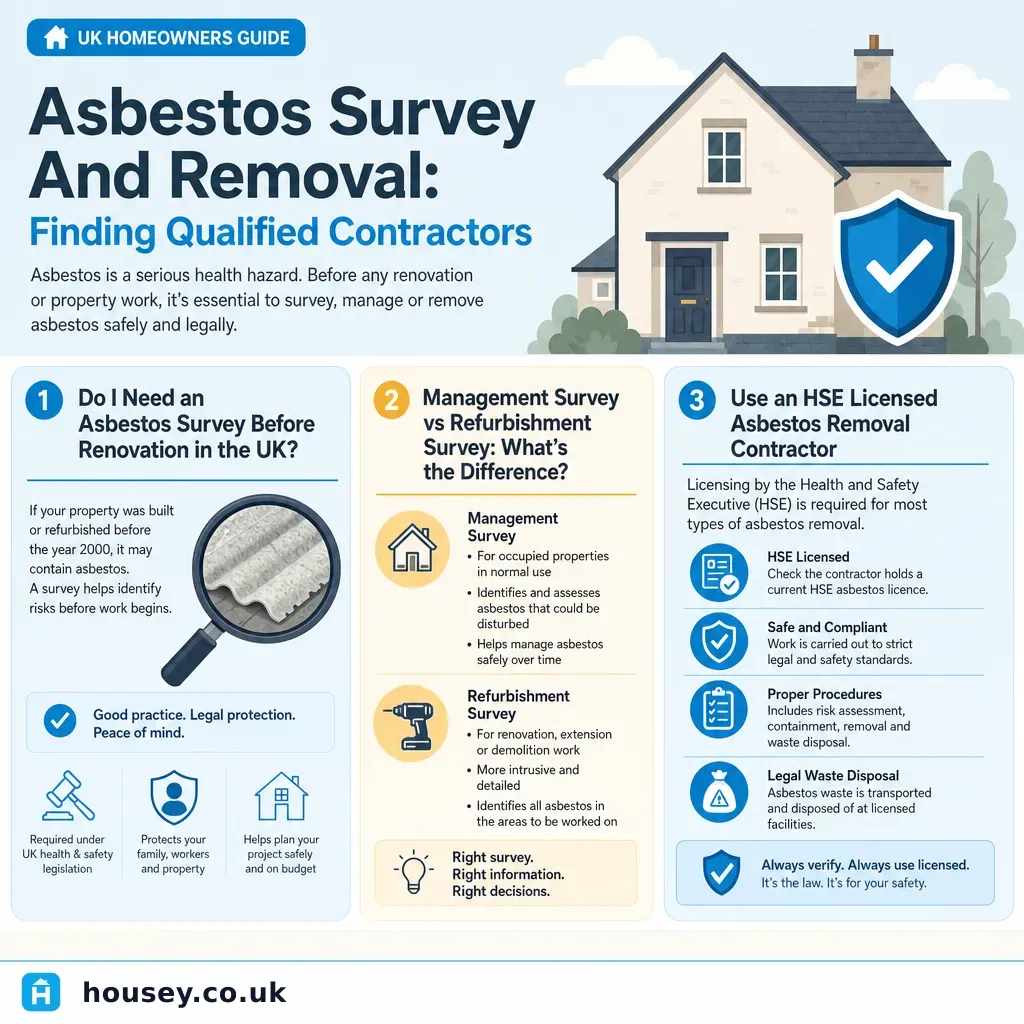
Asbestos Survey And Removal: Finding Qualified Contractors
An asbestos survey establishes whether asbestos-containing materials are present in your property and their condition.
 Surveys & Inspections
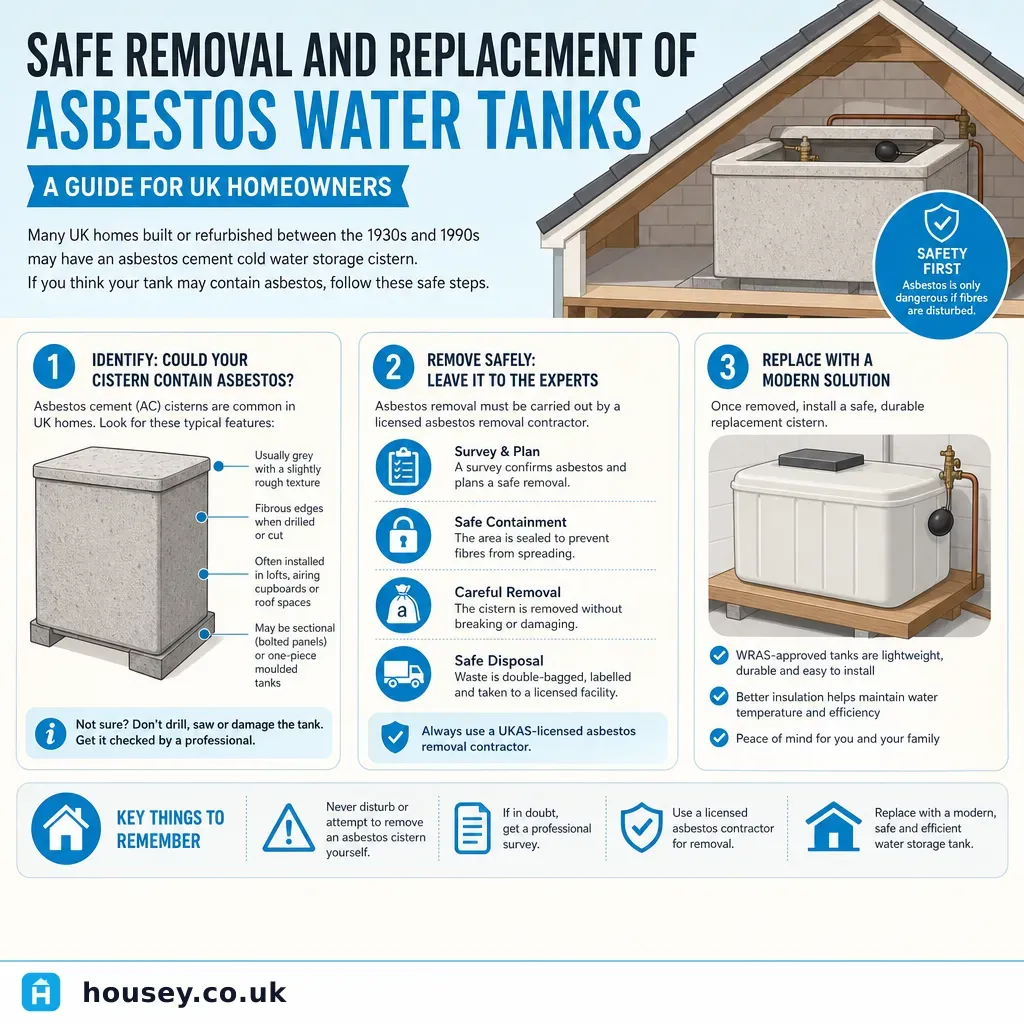
Safe Removal and Replacement of Asbestos Water Tanks
Asbestos cement cold water tanks, found in many UK homes built before about 1980, must not be drilled, cut, or broken without proper controls.
 Surveys & Inspections
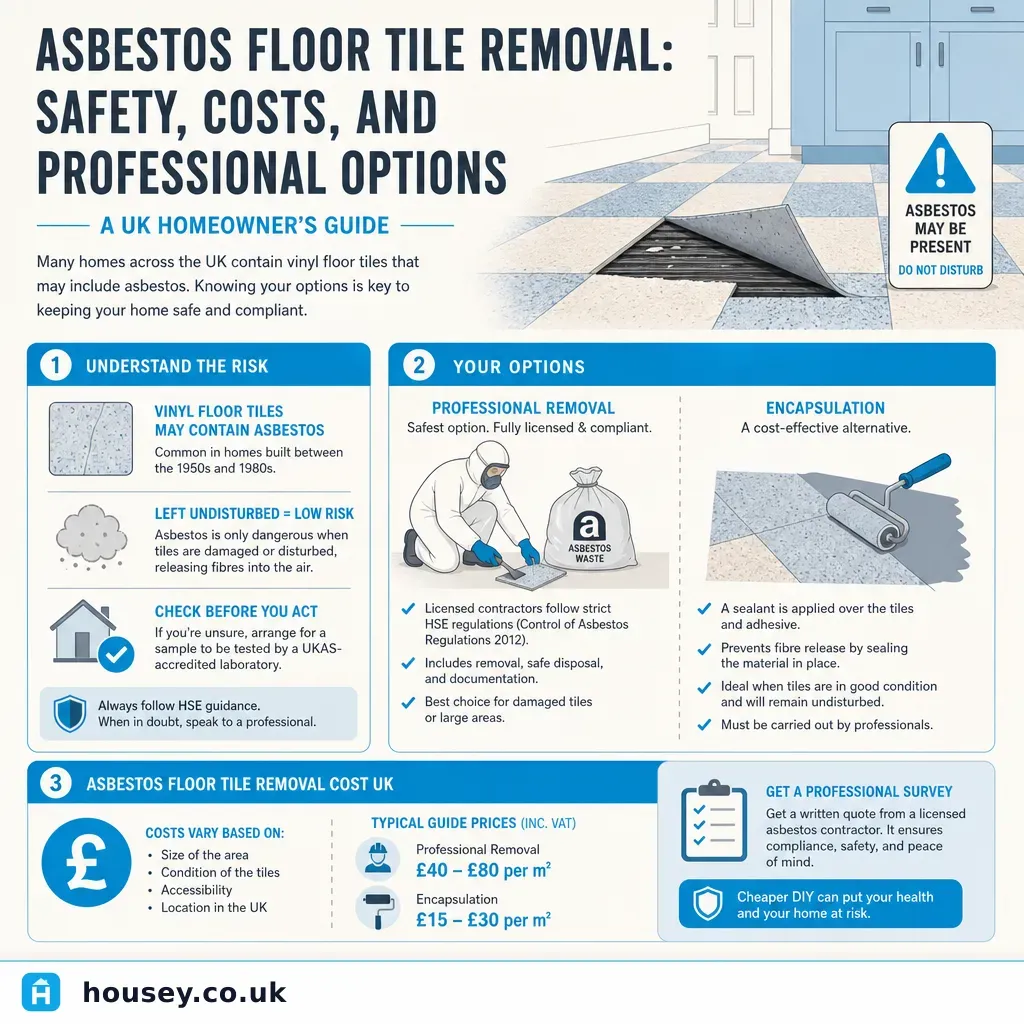
Asbestos Floor Tile Removal: Safety, Costs, and Professional Options
Asbestos floor tiles — common in UK homes built between the 1950s and late 1980s — must not be disturbed without a professional assessment.
 Surveys & Inspections
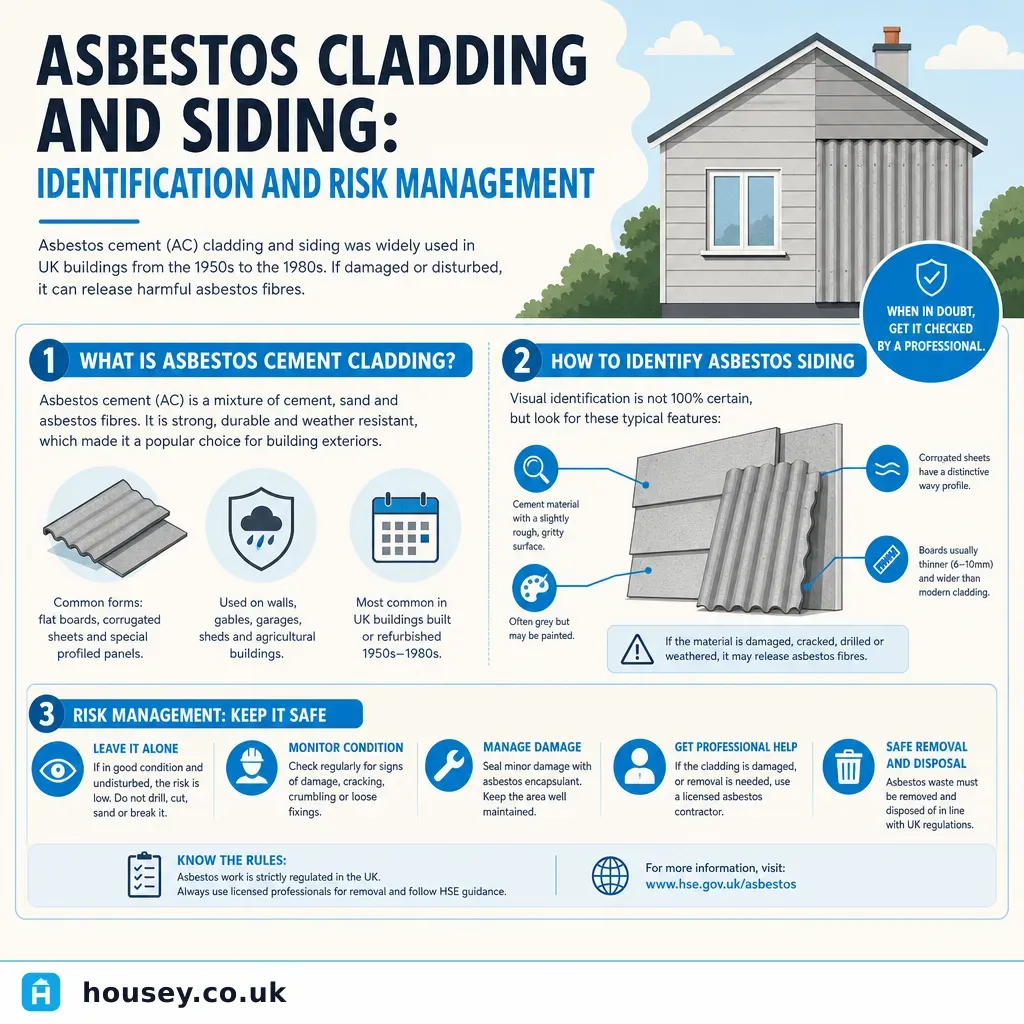
Asbestos Cladding and Siding: Identification and Risk Management
Asbestos cement cladding was widely used on UK buildings until 1999 and may be present on any property built before that date.
 Surveys & Inspections
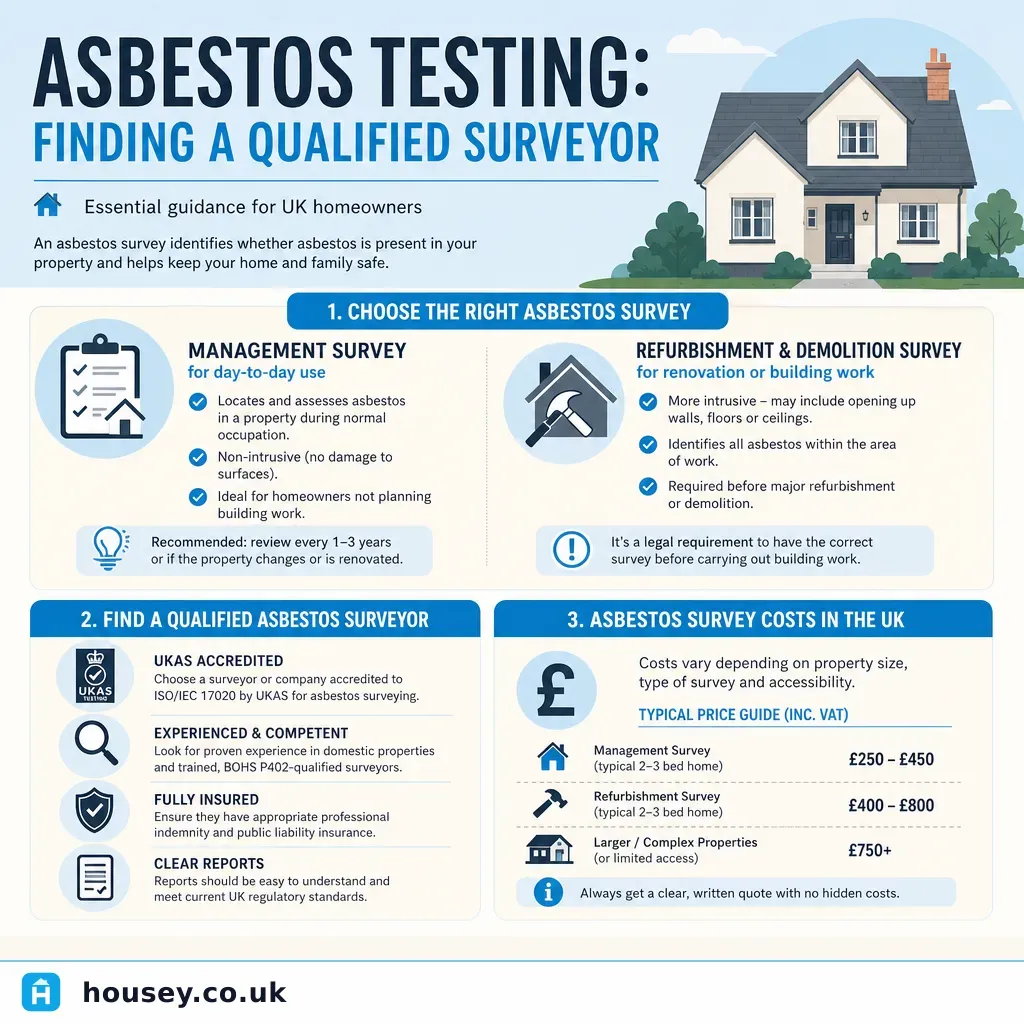
Asbestos Testing: Finding a Qualified Surveyor
Finding a qualified asbestos surveyor means choosing a company accredited by UKAS to ISO/IEC 17020, with analysts holding BOHS P402 or equivalent qualifications.