Asbestos Survey Costs and Reporting
By Housey · Last reviewed 5th of May 2026
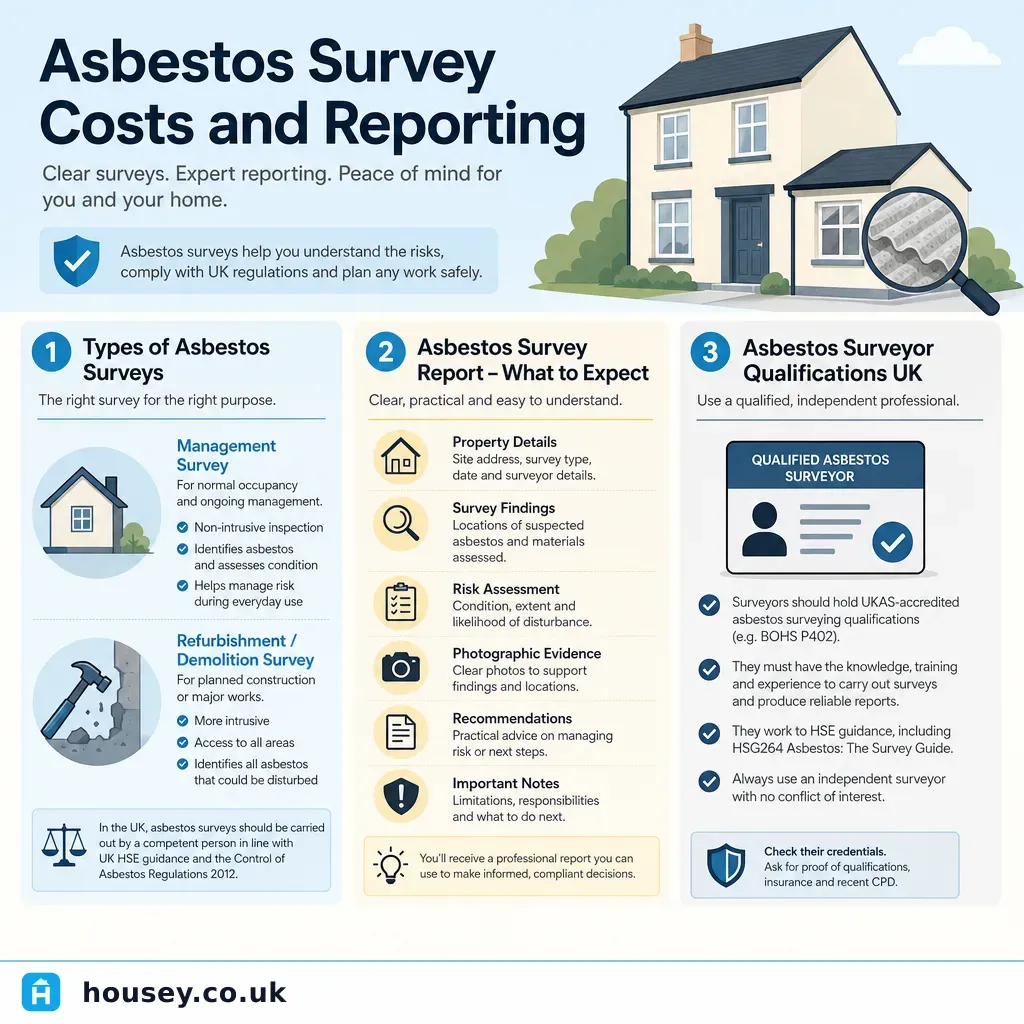
Asbestos Survey Costs and Reporting
Asbestos was used extensively in UK buildings constructed or refurbished before 2000, and it remains the country's leading cause of work-related deaths. Questions about survey costs and what a report should contain typically arise when a homeowner is buying an older property, planning renovation work, or managing a rental building where responsibilities for common areas apply. Understanding which type of survey you need — and what the resulting report must include — is essential before any significant work on the building fabric begins.
Key points
- The Control of Asbestos Regulations 2012 places a legal duty to manage asbestos on those responsible for non-domestic premises; owner-occupiers of dwellings face no equivalent statutory duty, but the health risks are identical.
- HSE guidance document HSG264 defines three survey categories — management surveys, refurbishment surveys, and demolition surveys — each suited to different circumstances and scopes of work.
- A management asbestos survey typically costs £200–£400 for a standard domestic property (indicative UK costs, last reviewed 2026-05-05); refurbishment and demolition surveys are more intrusive and generally cost more.
- Surveyors should hold a BOHS P402 qualification (Buildings Surveys and Bulk Sampling for Asbestos) and ideally work for an organisation accredited by UKAS under ISO/IEC 17020.
- An asbestos survey report is not the same as an asbestos management plan; the report identifies and characterises asbestos-containing materials (ACMs), while the management plan sets out what actions will be taken in response.
What type of asbestos survey do you need?
HSE guidance HSG264 defines three survey types. Which applies depends on the current use of the property and the scope of intended works.
Survey type | When it is used | What it covers | Typical domestic cost (indicative, 2026-05-05) |
|---|---|---|---|
Management survey | Routine occupation; identifying ACMs that could be disturbed during normal use or minor maintenance | Accessible areas sampled; minor intrusion only | £200–£400 |
Refurbishment survey | Before any refurbishment work that will disturb the building fabric | Fully intrusive in the areas to be worked on | £300–£700+ |
Demolition survey | Before full or significant partial demolition | Fully intrusive; the whole building | £500–£1,500+ |
A management survey is the most commonly required type for residential properties. It locates ACMs that could be damaged or disturbed during normal occupation and minor maintenance.
A refurbishment survey is required before any works that will disturb the building fabric — removing a ceiling, chasing walls, fitting a new kitchen, or carrying out a loft conversion. It involves a more intrusive inspection of the specific areas to be worked on. If you are buying a pre-2000 property and intend significant renovation, a refurbishment survey is likely to be needed rather than a management survey.
A demolition survey is required before any demolition and is the most thorough and costly of the three, covering the entire structure.
What affects the cost of an asbestos survey?
Several factors move survey costs beyond the indicative ranges above:
- Property size and age: Larger or more complex properties take more time to inspect and require more samples. Buildings constructed before 1985 are more likely to contain a wider range of ACMs, including materials such as Artex coatings, insulating board, floor tiles, and pipe lagging.
- Number of samples: Laboratory analysis of bulk samples is usually priced per sample — roughly £15–£30 each (indicative, 2026-05-05). Many surveyors quote a package that includes a set number of samples, with additional samples charged separately.
- Access requirements: Loft spaces, crawl spaces, or sealed voids requiring specialist access equipment add to the time and cost of the survey.
- Urgency: Same-day or 48-hour turnaround for both the site visit and laboratory results attracts a premium.
- Location: Surveyor rates vary by region; surveys in London and the South East tend to cost more than those in the Midlands, North of England, Wales, or Scotland.
- Survey type: Refurbishment and demolition surveys involve more intrusion, more samples, and more detailed analytical work than a management survey.
Always request an itemised quote that separates the site survey fee, the per-sample laboratory charge, the report preparation fee, and VAT.
What does an asbestos survey report contain?
A compliant report produced in accordance with HSG264 should include:
- Site and scope details: Address, survey type, date of survey, the surveyor's name and qualifications, and a clear statement of which areas were covered and which were excluded and why.
- Survey drawings or annotated plans: Marked-up floor plans showing the location of each sample point and any identified ACMs.
- Laboratory analysis results: Analytical results from a UKAS-accredited laboratory for each bulk sample collected, confirming the presence or absence of asbestos and the fibre type where identified.
- ACM register: A schedule of each identified or presumed ACM, including its location, material type, surface treatment, extent, and accessibility.
- Condition and priority scores: Each ACM is assessed for material condition (good, fair, or poor) and assigned a priority score indicating the urgency of action required.
- Recommendations: Guidance on whether each ACM should be managed in place, encapsulated, or removed, with a priority rating for follow-up.
The report is not the same as an asbestos management plan. The management plan — required for duty holders in non-domestic premises under the Control of Asbestos Regulations 2012 — is a separate document that sets out what actions will be taken and by whom.
Surveyor qualifications and accreditation
Before commissioning a survey, check the following credentials:
- The individual surveyor should hold a BOHS P402 qualification (Buildings Surveys and Bulk Sampling for Asbestos) or an equivalent qualification recognised by the HSE.
- The survey organisation should hold UKAS accreditation to ISO/IEC 17020 for asbestos inspections, verifiable via the UKAS website.
- The laboratory analysing samples should hold UKAS accreditation to ISO/IEC 17025 for asbestos fibre analysis.
- Membership of the Asbestos Testing and Consultancy Association (ATaC) or the Asbestos Removal Contractors Association (ARCA) provides an additional layer of professional assurance.
A survey from an unaccredited provider may not be accepted by building control, a contractor, or your insurer — and could leave you exposed to health and legal risk.
Red flags to watch for
- A report with no physical sampling or laboratory analysis — a visual-only assessment is not a compliant survey under HSG264.
- A report that does not identify the surveyor's qualifications or UKAS accreditation reference.
- No reference to a UKAS-accredited laboratory in the analytical results section.
- A quote that seems unusually low and does not itemise samples or laboratory costs separately.
- A surveyor who also offers immediate removal services at the same time — this represents a potential conflict of interest that is worth querying directly.
- Areas excluded from the survey scope that are not clearly explained or flagged within the report.
Important limitations
The information in this article is general guidance only and does not constitute professional or legal advice. Asbestos-related rules, risks, and duties depend on property type, construction era, planned works, tenure (freehold or leasehold), and specific regulatory context. The Control of Asbestos Regulations 2012 and HSE guidance HSG264 are the authoritative references for Great Britain. Always consult a qualified asbestos surveyor or occupational hygienist to assess your specific situation.
Do not disturb any material you suspect may contain asbestos. Even brief disturbance of ACMs in poor condition can release fibres. The HSE advises that if you are in any doubt, you should treat the material as asbestos until it has been tested by a competent person.
What to ask a qualified professional
Before instructing an asbestos surveyor, ask:
- What survey type do you recommend for my situation, and what are your reasons?
- Are you accredited under UKAS ISO/IEC 17020, and can you provide your BOHS P402 certificate number?
- Which UKAS-accredited laboratory will you use for bulk sample analysis?
- How many samples does your quote include, and what is the per-sample charge for additional samples?
- Which areas will be excluded from the survey, and why?
- What format will the report take, and will it be accepted by building control for the works I am planning?
- What are the most likely materials you expect to find in a property of this age and construction?
- Do you offer removal services, and if so, how do you manage any conflict of interest when also providing the survey?
When to get professional help
Commission a professional asbestos survey — and do not rely solely on general guidance — if:
- You are buying or renovating a property built or refurbished before 2000.
- You are a landlord responsible for common areas of a multi-occupancy building.
- A contractor has raised asbestos concerns during works already underway.
- You have disturbed a material and are uncertain whether it contains asbestos.
- You are applying for building regulations approval for renovation, extension, or demolition.
If any material has already been disturbed, stop work immediately, ventilate the area if it is safe to do so, and seek professional advice before re-entering.
How Housey can help
Housey connects homeowners and landlords with UKAS-accredited asbestos surveyors across the UK. You can request and compare quotes from qualified surveyors through our asbestos surveys service page, check credentials, and make a more informed decision before any works begin.
Frequently asked questions
Do I legally need an asbestos survey for my home?
For owner-occupied domestic properties, there is no legal duty to carry out a management survey under the Control of Asbestos Regulations 2012, which focuses on non-domestic duty holders. However, any contractor you instruct to carry out refurbishment work has a duty to check for asbestos before starting. Commissioning a survey before works begin protects both you and your contractors.
How long does an asbestos survey take?
A management survey for a standard three-bedroom house typically takes two to four hours on site. A refurbishment survey covering the whole property may take four to eight hours. Laboratory results for bulk samples usually take three to five working days, though some laboratories offer a faster turnaround for an additional charge.
Can I arrange asbestos removal myself after a survey?
Asbestos removal must be carried out by a licensed contractor for most notifiable asbestos work, and by a competent contractor for non-licensed work. You cannot legally remove most forms of asbestos yourself. The HSE sets out which types of work require a licensed contractor; your survey report should indicate which category applies to the materials identified.
Will my asbestos survey report be accepted by building control?
A report produced by a UKAS-accredited surveyor working to HSG264 is generally accepted by local authority building control and approved inspectors. Always confirm requirements with your building control body before commissioning the survey, as expectations can vary. The report should clearly reference the survey standard and the laboratory accreditation used for sample analysis.
How often should an asbestos management survey be reviewed?
For non-domestic premises with a duty to manage asbestos, the HSE recommends reviewing the management plan at least annually and after any incident or change of use. For owner-occupied homes there is no fixed statutory review period, but reviewing the register before any works that could disturb the building fabric is good practice.
Sources and further reading
- Control of Asbestos Regulations 2012 — legislation.gov.uk
- Asbestos: The Survey Guide (HSG264) — Health and Safety Executive
- Duty to manage asbestos in non-domestic premises — Health and Safety Executive
- Find a UKAS-accredited body — United Kingdom Accreditation Service
- P402 Buildings Surveys and Bulk Sampling for Asbestos — British Occupational Hygiene Society
- Licensed asbestos contractor register — Health and Safety Executive
Useful next reads
 Surveys & Inspections
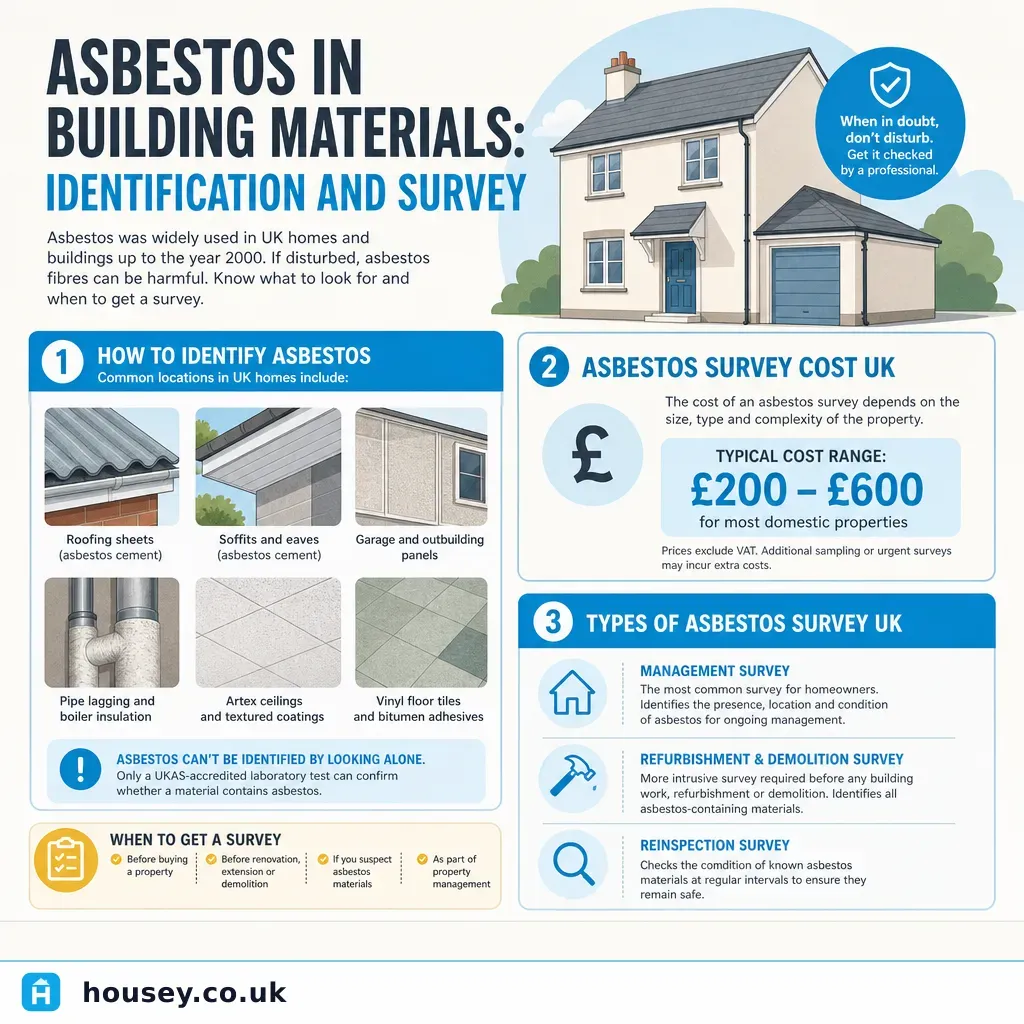
Asbestos in Building Materials: Identification and Survey
Asbestos-containing materials (ACMs) are present in many UK homes built before 2000, including floor tiles, textured coatings such as Artex, roof sheets, pipe lagging, and ceiling tiles.
 Surveys & Inspections
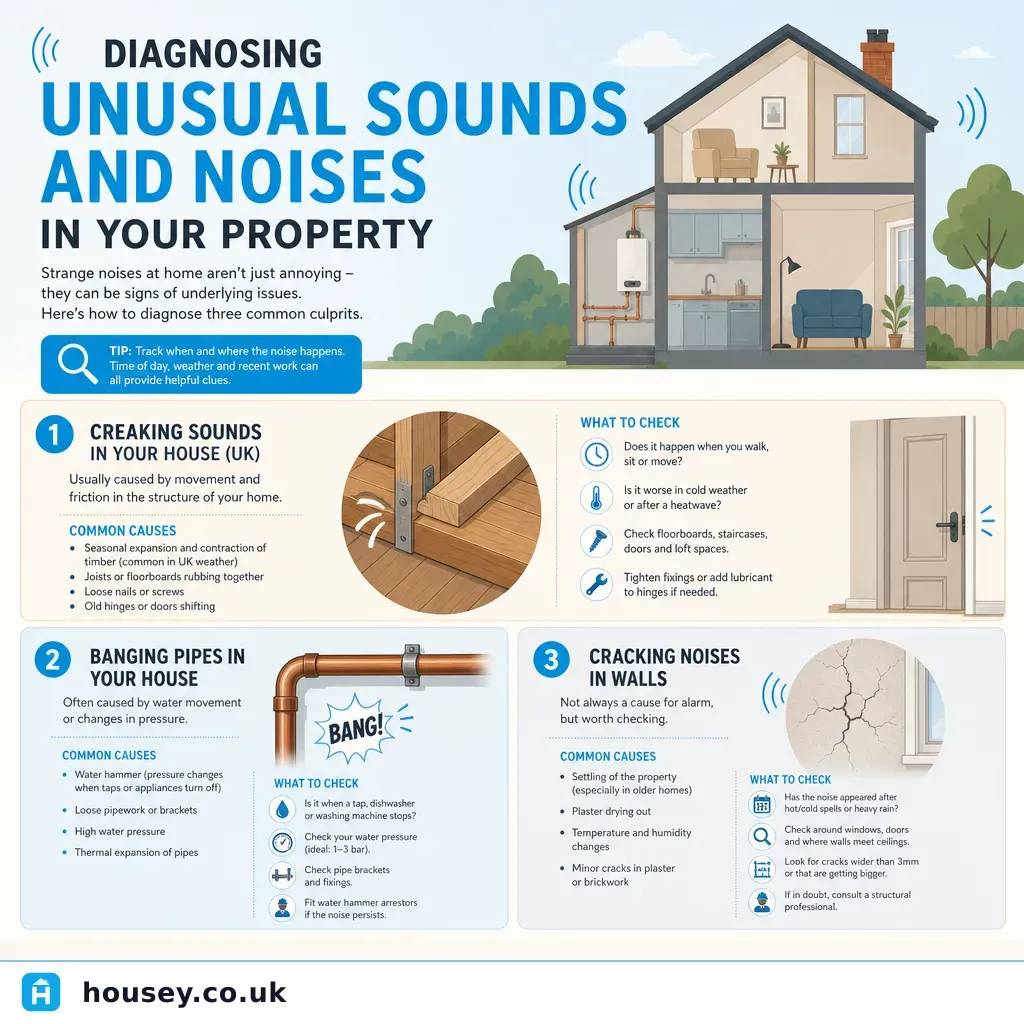
Diagnosing Unusual Sounds and Noises in Your Property
Most unusual sounds in a UK home have benign causes — thermal movement in roof timbers, water hammer in heating pipes, or normal settlement in new builds.
 Surveys & Inspections
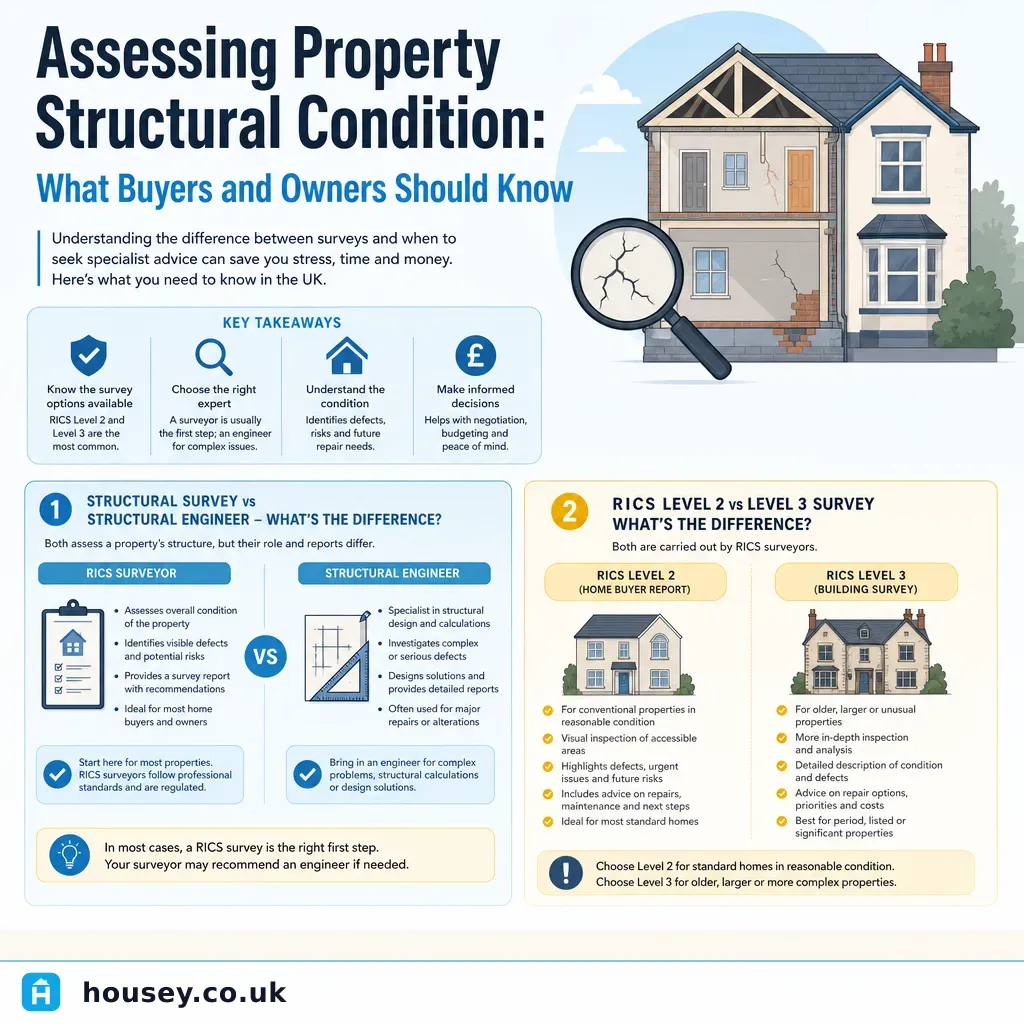
Assessing Property Structural Condition: What Buyers and Owners Should Know
A RICS Level 2 Home Survey suits conventional post-war properties in reasonable condition.
 Surveys & Inspections
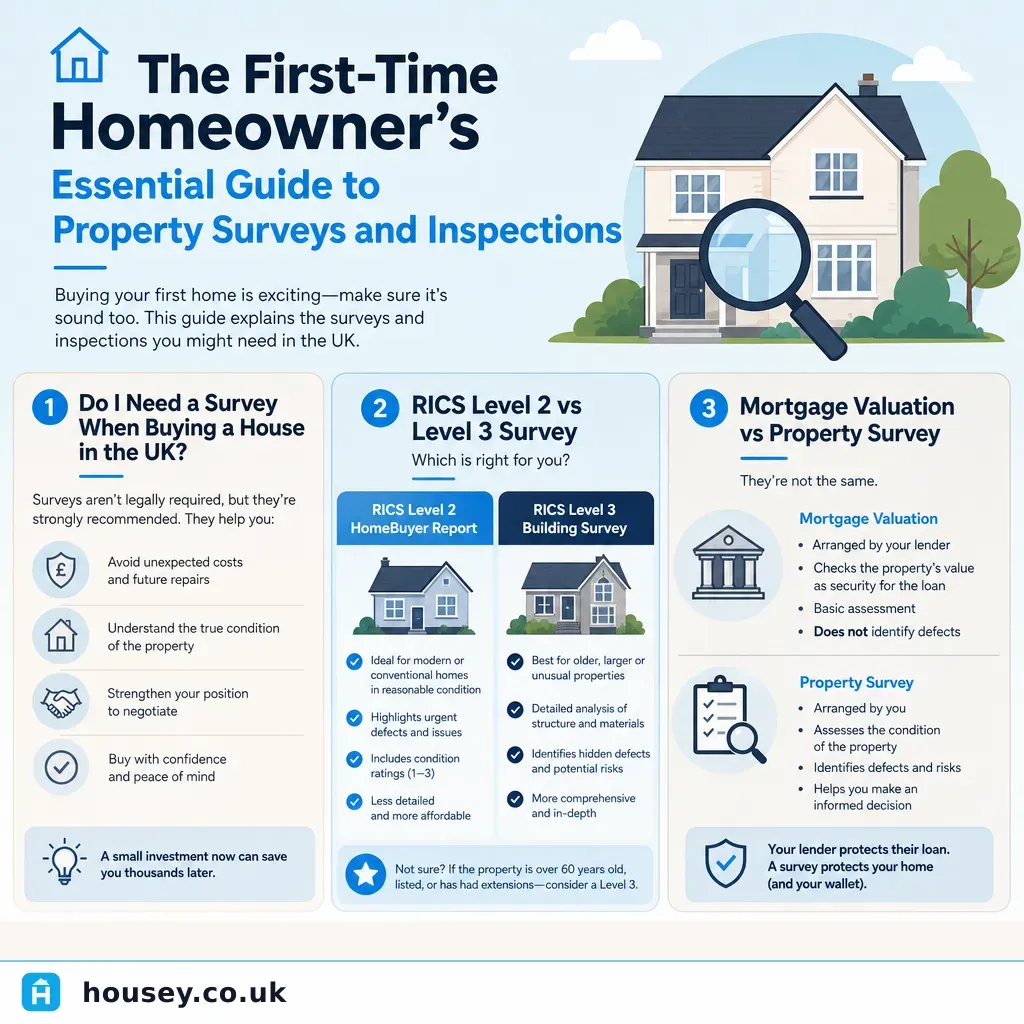
The First-Time Homeowner's Essential Guide to Property Surveys and Inspections
First-time buyers in the UK need more than the mortgage valuation — that report protects the lender, not you.
 Surveys & Inspections
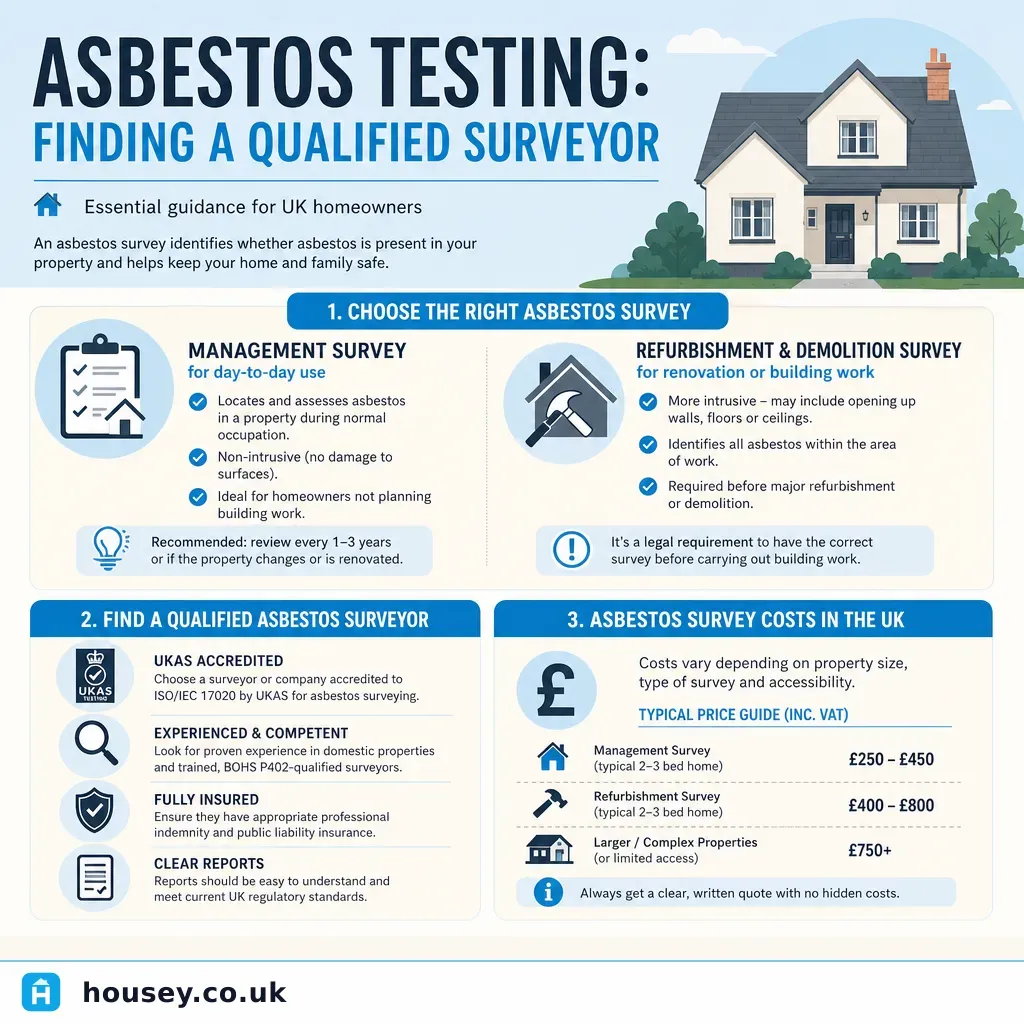
Asbestos Testing: Finding a Qualified Surveyor
Finding a qualified asbestos surveyor means choosing a company accredited by UKAS to ISO/IEC 17020, with analysts holding BOHS P402 or equivalent qualifications.