Asbestos Testing: Finding a Qualified Surveyor
By Housey · Last reviewed 31st of May 2026
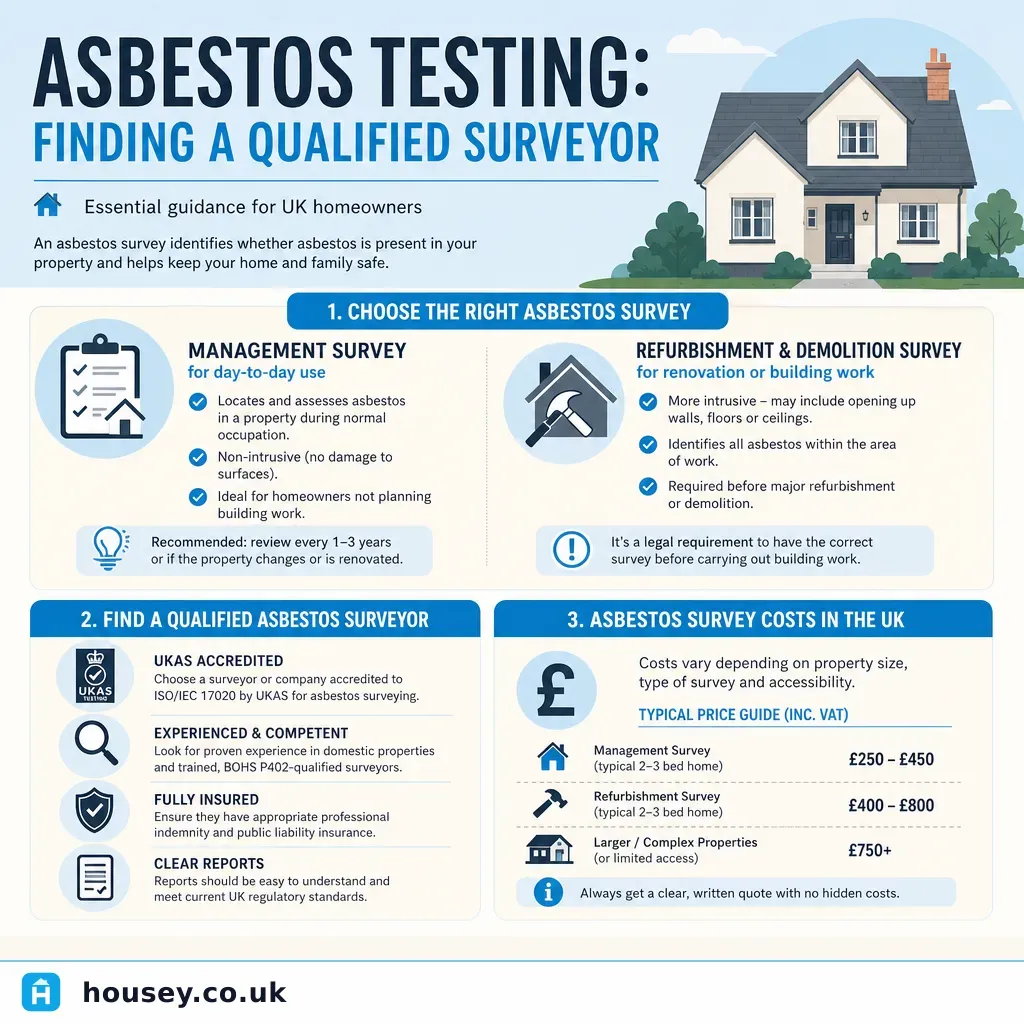
Asbestos Testing: Finding a Qualified Surveyor
Asbestos-related disease remains one of the leading causes of occupational death in the UK, and millions of homes and commercial buildings constructed or refurbished before 2000 contain asbestos-containing materials (ACMs). The question of whether to arrange asbestos testing most commonly arises before a renovation, loft conversion, extension, or when purchasing an older property — but the stakes are high enough that understanding who qualifies as a competent surveyor matters as much as understanding the survey itself. In a market with variable service quality, knowing exactly what accreditation and qualifications to look for is the single most important step before commissioning any asbestos work.
Key points
- The Control of Asbestos Regulations 2012 (CAR 2012) is the primary UK legislation governing asbestos management; it imposes a duty to manage on those responsible for non-domestic premises, including common parts of residential buildings such as blocks of flats.
- There are two main survey types: a Management Survey for buildings in normal use, and a Refurbishment and Demolition (R&D) Survey required before any structural or intrusive work begins.
- Asbestos surveying organisations must be accredited by UKAS (United Kingdom Accreditation Service) to ISO/IEC 17020 for inspection, or ISO/IEC 17025 for laboratory analysis — check the UKAS directory before appointing.
- Analysts taking bulk samples should hold BOHS P402 (buildings surveys and bulk sampling for asbestos) or an equivalent British Occupational Hygiene Society qualification.
- Asbestos was banned from all uses in the UK in November 1999 under The Asbestos (Prohibitions) (Amendment) Regulations 1999; any property built or last significantly refurbished before 2000 may contain ACMs.
Management Survey vs. Refurbishment and Demolition Survey: which do you need?
The type of survey required depends on what you plan to do with the building or space. Commissioning the wrong survey type can leave you legally exposed and unable to demonstrate that your contractor had adequate information before starting work.
Survey type | Purpose | Typical scope | When required |
|---|---|---|---|
Management Survey | Identify ACMs that could be disturbed during normal occupancy and maintenance | Presumptive assessment plus sampling of accessible areas; does not require destructive access | Ongoing building management; before letting a commercial property; strongly recommended before buying any pre-2000 home |
Refurbishment and Demolition (R&D) Survey | Fully identify all ACMs in areas to be disturbed before any intrusive works begin | Fully intrusive — walls opened, voids accessed, materials sampled destructively | Before any renovation, extension, loft conversion, rewiring, plumbing alteration, or demolition in a pre-2000 building |
Domestic properties do not carry the same statutory duty to manage as non-domestic premises, but the health risks are identical. A Management Survey is advisable before purchasing any home built before 2000, and an R&D Survey is essential before any renovation works in those properties.
What qualifications and accreditation should a surveyor hold?
This is the single most important check before appointing anyone. In the UK:
- The surveying organisation should be UKAS-accredited under ISO/IEC 17020 for asbestos inspection. Verify this on the UKAS directory — accreditation should be current and in the correct scope.
- The individual analyst carrying out bulk sampling should hold BOHS P402 or have completed equivalent training recognised by the British Occupational Hygiene Society.
- The laboratory analysing samples should be UKAS-accredited to ISO/IEC 17025 for asbestos fibre identification and bulk analysis.
- For air testing after removal works, analysts should hold BOHS P403 (air sampling and clearance testing following asbestos removal).
Avoid any company that cannot evidence UKAS accreditation or equivalent formal qualification for their analysts. Asbestos identification requires laboratory confirmation — visual inspection alone is never sufficient to confirm or exclude asbestos.
Red flags when choosing an asbestos surveyor
Watch out for these warning signs that a company may not meet the standards required:
- No UKAS accreditation — the company cannot show a current UKAS certificate for the relevant scope of work.
- Visual identification only — no bulk samples taken and sent to an accredited laboratory for analysis.
- No written asbestos register — a competent surveyor always provides a written report identifying the location, condition, and assessed risk of each ACM found.
- Unrealistically low prices — thorough surveying takes time; a price significantly below market rate may indicate corners are being cut on sample numbers or analyst qualifications.
- No site-specific information — a generic report that does not reference your specific property address, room-by-room descriptions, or precise material locations.
- Pressure to proceed without a survey — no contractor should begin intrusive work in a pre-2000 building without a prior R&D Survey in place.
What happens during an asbestos survey?
During a Management Survey:
- The surveyor visits the property and inspects all accessible areas — roof spaces, service voids, boiler rooms, ceiling finishes, floor tiles, textured coatings (such as artex), and pipe lagging.
- Suspected ACMs are either presumed (treated as asbestos without sampling) or sampled — a small amount of material is taken using a wet method to minimise fibre release.
- Samples are sent to a UKAS-accredited laboratory for analysis, usually by polarised light microscopy.
- A written asbestos register is produced, typically within five to ten working days.
During a Refurbishment and Demolition Survey:
- All areas to be disturbed by the planned works are fully investigated — this is an intrusive, potentially destructive process.
- Access to ceiling voids, wall cavities, structural elements, and service runs is required before the survey can be completed.
- All suspected ACMs in the works zone are sampled and sent for laboratory analysis.
- A written report with a materials risk assessment is produced and must be provided to the contractor before works begin.
Indicative asbestos survey costs
Indicative UK costs, last reviewed 2026-05-31. Costs vary by property size, age, access requirements, and number of samples required. Always obtain at least two quotes from UKAS-accredited organisations.
Survey type | Typical range (domestic property) |
|---|---|
Management Survey (2–3 bed house) | £200 – £400 |
Refurbishment and Demolition Survey (2–3 bed house) | £300 – £600+ (more intrusive; more samples) |
Laboratory analysis (per bulk sample) | £15 – £35 |
Air clearance testing after removal | £150 – £400 per area |
Always ask what is included in the quote — specifically how many bulk samples are covered, whether laboratory fees are included, the turnaround time for the written report, and what happens if additional suspect materials are found during the survey.
Important limitations
This article provides general information about asbestos survey types and surveyor qualifications in the UK. It is not a substitute for a site-specific assessment by a UKAS-accredited asbestos surveyor. Asbestos cannot be identified by visual inspection alone — laboratory analysis of bulk samples is required in all cases. The Control of Asbestos Regulations 2012 imposes specific legal duties on those managing non-domestic premises; if you are a landlord, managing agent, or employer, seek specialist legal or health and safety advice to confirm your specific obligations.
If you suspect a material may contain asbestos, do not disturb it. Keep the area clear and arrange a survey before any works proceed.
What to ask a qualified professional
Before appointing an asbestos surveyor, ask:
- Are you UKAS-accredited for asbestos inspection under ISO/IEC 17020, and can I see your current certificate?
- Which individual analyst will carry out the survey, and what qualifications do they hold — for example, BOHS P402?
- Which UKAS-accredited laboratory will you use for sample analysis, and can you confirm their ISO/IEC 17025 accreditation scope?
- What type of survey do you recommend for my planned works, and why?
- How many bulk samples are included in your quote, and what is the charge for additional samples?
- How long will the survey take on site, and when will the written report be delivered?
- What will the report contain — will it include a full asbestos register with condition and risk assessments for each material?
- If ACMs are found, what are my options for management or removal, and can you recommend an HSE-licensed removal contractor?
When to get professional help
Arrange an asbestos survey — and seek professional advice — in any of the following situations:
- You are about to carry out any renovation, extension, demolition, or intrusive maintenance work on a property built or refurbished before 2000.
- You have purchased a home built before 2000 and no previous asbestos survey report exists.
- You are a landlord with a property built before 2000 — common parts of residential buildings fall under the duty to manage in CAR 2012.
- A contractor has identified a suspect material during works — works should stop immediately until an R&D Survey confirms the position.
- You are breaking into ceilings, walls, or floors in any pre-2000 building for any reason.
Do not disturb suspect materials. Textured coatings (artex), floor tiles, pipe lagging, soffit boards, insulated ceiling tiles, and some roofing felt can all contain asbestos. Disturbing ACMs without a prior survey carries serious health and legal consequences.
How Housey can help
Housey can connect you with UKAS-accredited asbestos survey professionals who cover your local area. Use Housey to compare survey providers, verify accreditations, and obtain quotes — so you can proceed with renovation or property purchase with confidence.
Frequently asked questions
Does a domestic property legally require an asbestos survey before renovation?
There is no explicit legal duty on homeowners to commission a survey before personal DIY work, but the Control of Asbestos Regulations 2012 requires any employer or self-employed contractor to carry out a suitable risk assessment before disturbing materials that may contain asbestos. In practice, this makes an R&D Survey a practical necessity before any contractor begins intrusive work in a pre-2000 property.
How do I check if an asbestos surveyor is properly accredited?
Search the UKAS directory at ukas.com/find-an-organisation and look for the company's current accreditation to ISO/IEC 17020 (inspection bodies) for surveys. For laboratory analysis, check for ISO/IEC 17025 accreditation in the asbestos scope. A legitimate surveyor will provide their UKAS certificate number on request and name the accredited laboratory they use for sample analysis.
What is artex and does it contain asbestos?
Artex is a textured coating applied to ceilings and walls, most commonly in homes built or renovated between the 1950s and early 1990s. Artex applied before the mid-1980s commonly contained chrysotile (white) asbestos. It presents a low risk if undisturbed and in good condition, but must be sampled and confirmed asbestos-free by a UKAS-accredited laboratory before any sanding, scraping, or drilling.
Can I remove asbestos myself from a domestic property?
For most notifiable asbestos-containing materials — including insulation, sprayed coatings, and insulating board — removal must be carried out by an HSE-licensed asbestos removal contractor. In a domestic property, some limited work on lower-risk materials such as asbestos cement sheets in good condition may be possible without a licence, but must still follow strict HSE guidance and local disposal regulations. Seek professional advice before any removal.
How long does an asbestos management survey take?
For a typical two- or three-bedroom house, a Management Survey usually takes one to three hours on site, with the written report delivered within five to ten working days. Faster turnaround is available at additional cost. A Refurbishment and Demolition Survey takes longer, as it is fully intrusive and requires access to all areas to be refurbished.
Sources and further reading
- Control of Asbestos Regulations 2012 — legislation.gov.uk: primary UK asbestos legislation including the duty to manage
- HSE: Asbestos — the basics — Health and Safety Executive: guidance for duty holders, workers, and building owners
- HSG264: Asbestos — the survey guide — Health and Safety Executive: the definitive UK guide to asbestos survey types and methodology
- UKAS: Find an accredited organisation — United Kingdom Accreditation Service: directory for finding accredited asbestos surveyors and laboratories
- Licensed asbestos removal contractors — Health and Safety Executive: register of HSE-licensed asbestos removal contractors
Useful next reads
 Surveys & Inspections
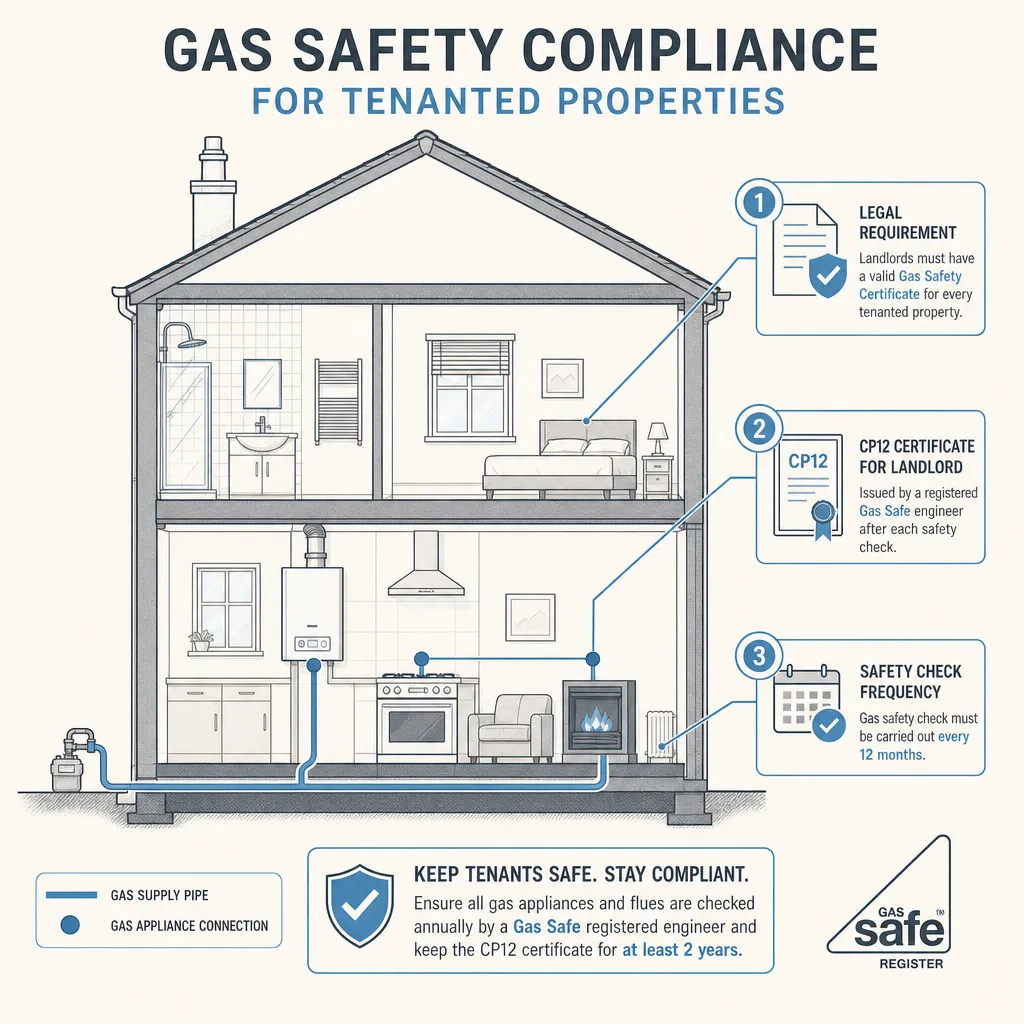
Gas Safety Compliance for Tenanted Properties
UK landlords are legally required to arrange an annual gas safety check by a Gas Safe registered engineer for every tenanted property with a gas appliance.
 Surveys & Inspections
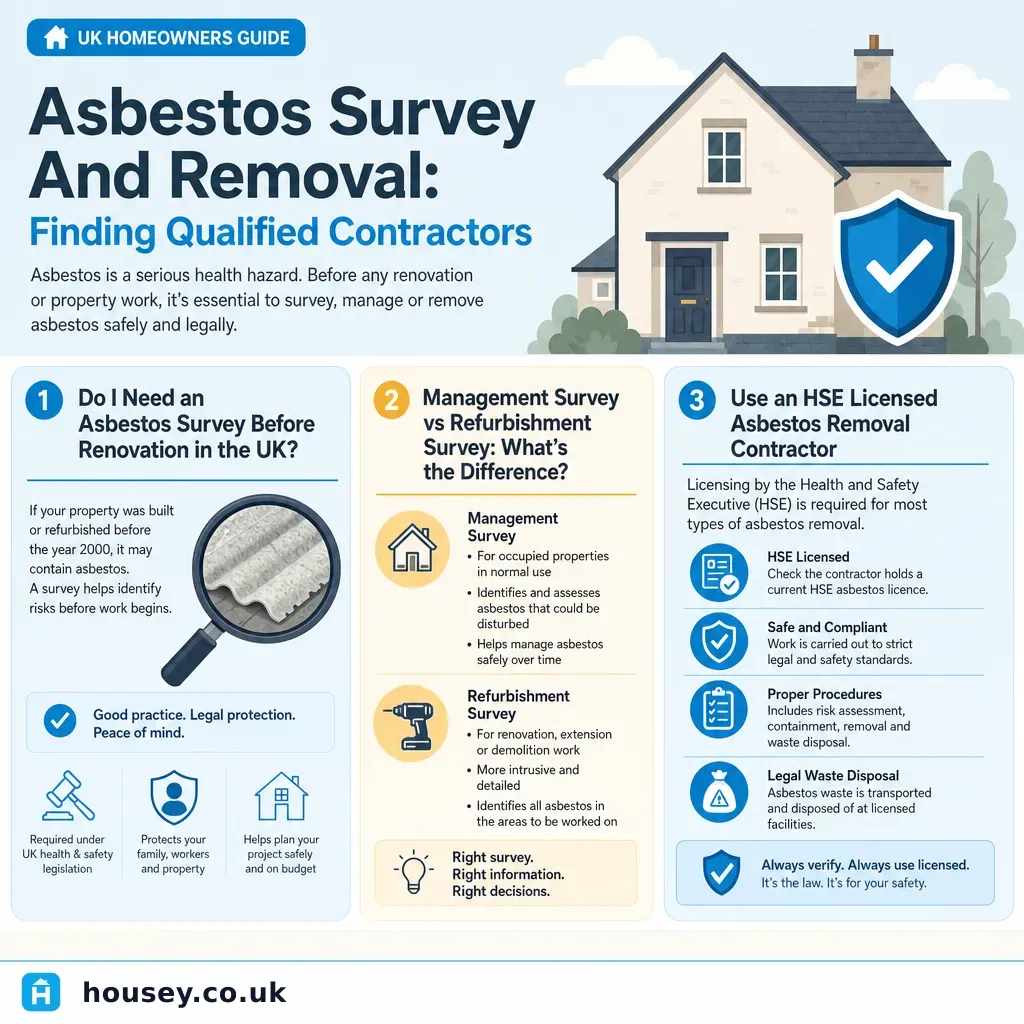
Asbestos Survey And Removal: Finding Qualified Contractors
An asbestos survey establishes whether asbestos-containing materials are present in your property and their condition.
 Surveys & Inspections
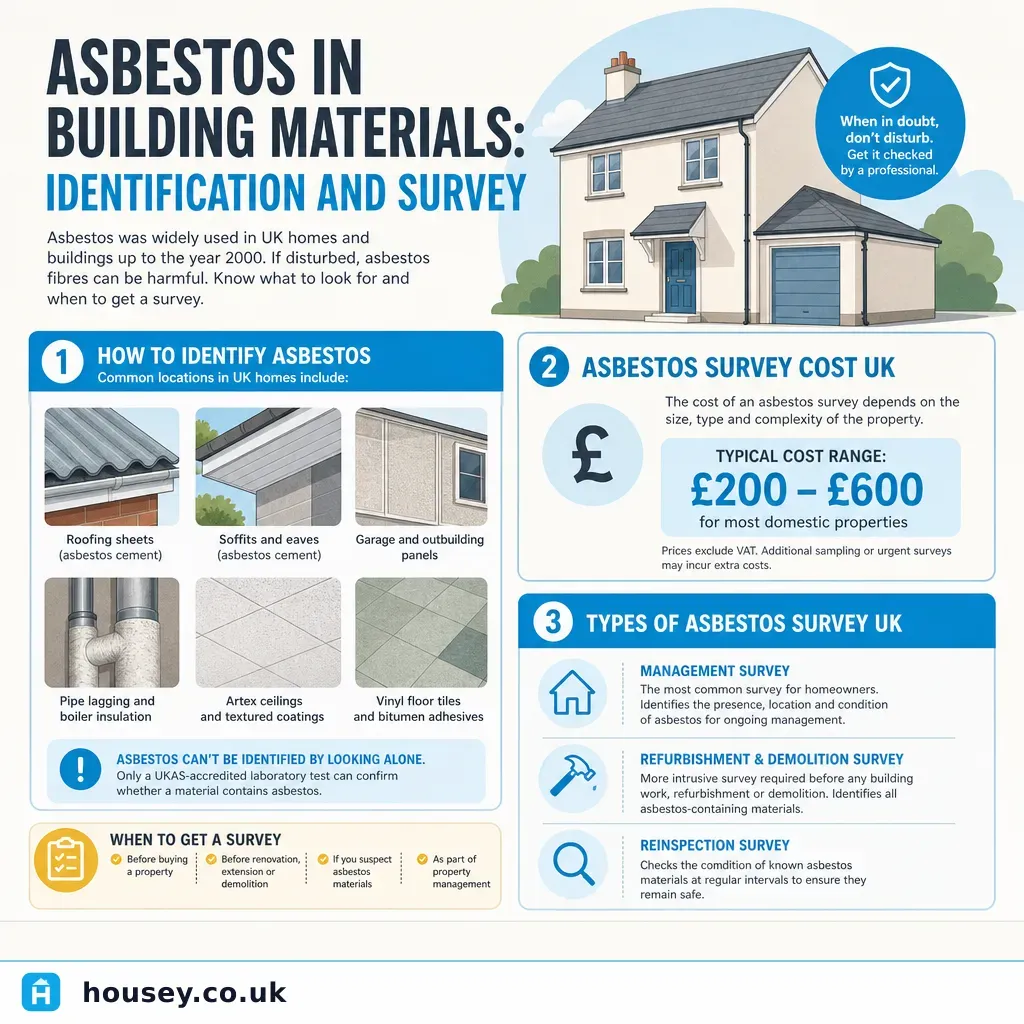
Asbestos in Building Materials: Identification and Survey
Asbestos-containing materials (ACMs) are present in many UK homes built before 2000, including floor tiles, textured coatings such as Artex, roof sheets, pipe lagging, and ceiling tiles.
 Surveys & Inspections
Drone Technology in Building Surveys and Roof Inspections
Drone surveys use unmanned aerial vehicles (UAVs) to capture high-resolution images of roofs, chimneys, gutters, and other inaccessible areas without scaffolding.
 Surveys & Inspections
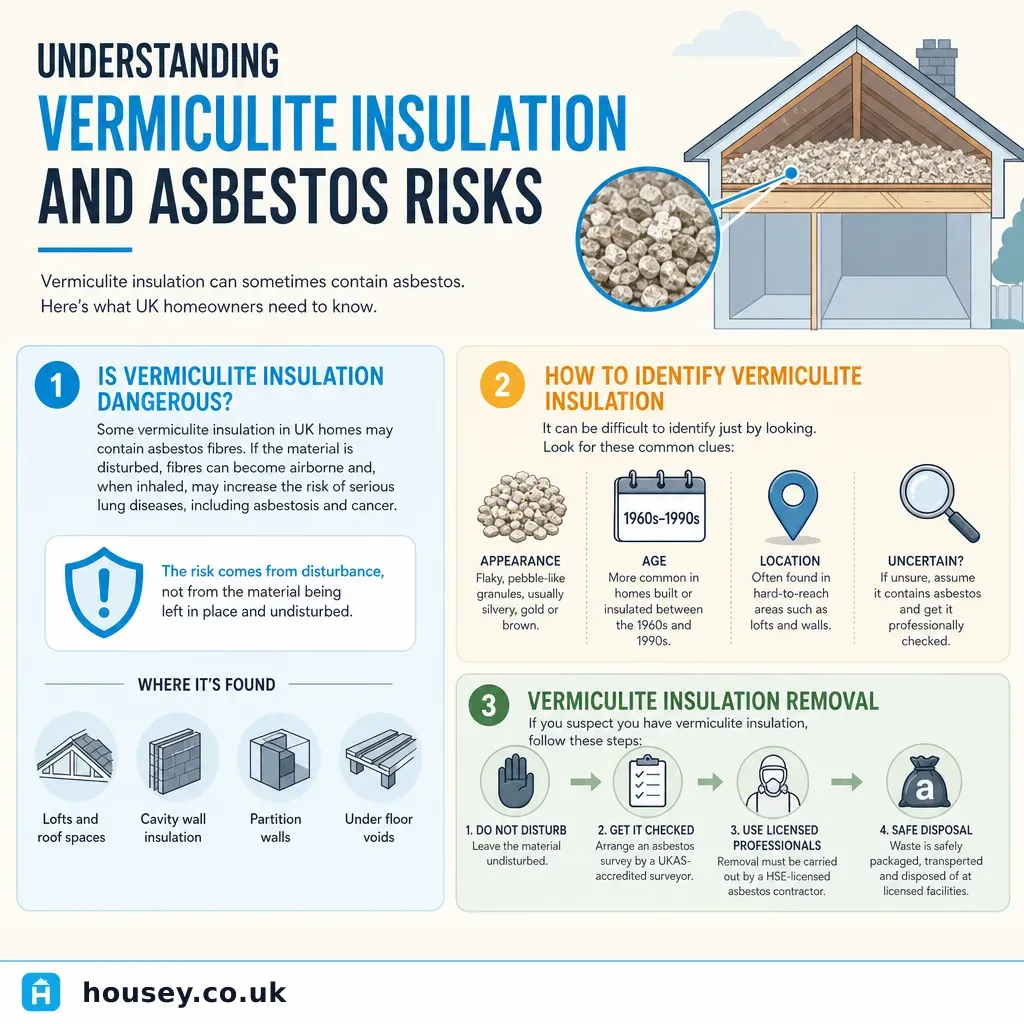
Understanding Vermiculite Insulation and Asbestos Risks
Vermiculite insulation is a lightweight granular mineral used in UK loft and cavity wall insulation from the 1960s to late 1980s.