Asbestos in homes: identification, risks and management
By Housey · Last reviewed 11th of May 2026
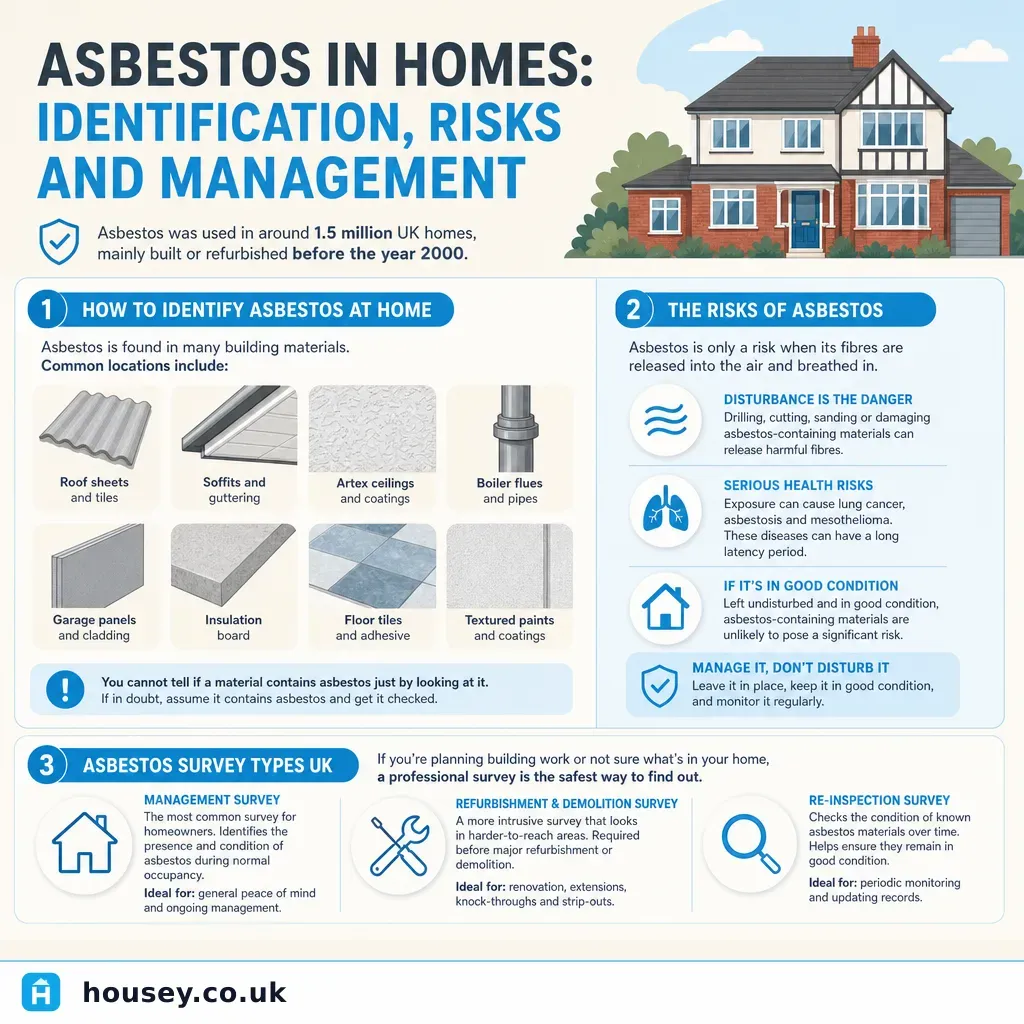
Asbestos in homes: identification, risks and management
For anyone buying, selling, renovating, or maintaining a property built before 2000, asbestos is a topic that cannot be set aside. The UK has one of the highest rates of mesothelioma in the world — a direct consequence of the widespread use of asbestos in construction throughout the mid-twentieth century. Understanding where asbestos-containing materials (ACMs) are typically found, how the two main survey types differ, and what the rules say about management and removal is essential knowledge before any works are planned or instructed on a pre-2000 property.
Key points
- All forms of asbestos were banned in the UK from November 1999; any property built or significantly modified before that date may contain ACMs.
- The Control of Asbestos Regulations 2012 is the primary UK legislation governing asbestos management, survey requirements, worker notification duties, and licensed removal work.
- There are two principal survey types: a management survey (for occupied properties with no intrusive work planned) and a refurbishment and demolition (R&D) survey (required before any intrusive renovation, structural alteration, or demolition).
- Certain high-risk asbestos work — including work with sprayed coatings, asbestos insulation board, and pipe lagging — must only be carried out by a Health and Safety Executive (HSE) licensed contractor.
- ACMs in good condition and unlikely to be disturbed are typically safer managed in place than removed; disturbance is the primary route of hazardous fibre release.
Where is asbestos commonly found in UK homes?
Asbestos fibres were added to hundreds of building products because of their fire resistance, insulating properties, and low cost. In a typical pre-2000 UK property, ACMs may be present in:
- Textured coatings such as Artex on ceilings and walls — common in homes decorated from the 1960s to early 1990s
- Roof tiles, corrugated roof sheets, and soffit boards, particularly on garages and single-storey extensions
- Vinyl floor tiles and the adhesive used to bond them
- Pipe lagging and boiler insulation in older heating systems
- Ceiling tiles, particularly in kitchens fitted before 1990
- Partition walls and ceiling boards, including Asbestolux and similar products used from the 1950s to 1980s
- Rope seals and gaskets in older solid-fuel appliances
- Window sill panels and exterior cladding boards on some 1950s–1970s properties
This is not an exhaustive list. If you cannot positively identify a material as asbestos-free, treat it as potentially containing ACMs until sampling and laboratory analysis confirm otherwise.
Types of asbestos and their risk profile
Asbestos type | Common name | Typical location in UK homes | Risk if disturbed |
|---|---|---|---|
Chrysotile | White asbestos | Cement products, textured coatings, floor tiles | Significant — fine persistent fibres |
Amosite | Brown asbestos | Insulation board, ceiling tiles, thermal insulation | High — widely used in mid-century building products |
Crocidolite | Blue asbestos | Pipe lagging, spray insulation | Very high — most hazardous type; less common in homes |
All three types are classified as human carcinogens. The risk to occupants arises when ACMs are damaged, drilled, sanded, or cut and fibres become airborne. Intact, undamaged ACMs in an undisturbed location present a much lower day-to-day risk than those that are deteriorating or subject to regular physical contact.
What UK law requires
Under the Control of Asbestos Regulations 2012, duty holders of non-domestic premises have a legal obligation to manage asbestos. For domestic properties, there is no equivalent statutory duty on the homeowner — but several requirements still apply to anyone carrying out or commissioning work:
- Anyone carrying out work likely to disturb ACMs must have received asbestos awareness training (Regulation 10).
- Certain notifiable non-licensed work (NNLW) must be notified to the relevant HSE enforcing authority, and medical surveillance records maintained for workers.
- Licensed work — including work with sprayed coatings, asbestos insulation board over 1 m², or pipe lagging — may only be carried out by an HSE-licensed contractor.
- Unlicensed work (for example, removing a small area of intact vinyl floor tiles) may proceed without a licence but still requires trained operatives and appropriate respiratory protective equipment (RPE).
- Asbestos waste is classified as hazardous waste under the Hazardous Waste Regulations and must be disposed of at a licensed facility — it cannot be placed in a skip or domestic bin.
The two main types of asbestos survey
Survey type | When you need it | What it involves | Who should use it |
|---|---|---|---|
Management survey | Occupied property, no intrusive work planned | Locates and assesses accessible ACMs without significant disruption; samples sent to UKAS-accredited laboratory | Homeowners needing a baseline register; landlords managing an existing property |
Refurbishment and demolition (R&D) survey | Before any renovation, extension, structural alteration, or demolition | Intrusive access to all areas including voids, roof spaces, and behind linings; all ACMs identified before any work begins | Required before any contractor starts intrusive work on a pre-2000 property |
A management survey is not sufficient before a loft conversion, kitchen refurbishment, or structural alteration. An R&D survey must be commissioned and its findings shared with all contractors before intrusive works begin. Failure to survey appropriately puts workers, occupants, and neighbours at serious risk and may expose the property owner to legal liability.
Red flags: when to act immediately
The following situations require prompt professional attention — do not attempt to investigate or remediate these yourself:
- Damaged or crumbling ceiling tiles, soffit boards, or textured coatings, particularly in areas of foot traffic or where they could be knocked.
- Pipe lagging that is visibly torn, split, or deteriorating around older heating pipework.
- Any planned renovation, extension, or building work on a pre-2000 property without a completed R&D survey.
- A RICS survey or homebuyer report that identifies materials potentially containing asbestos and recommends specialist assessment.
- Any situation where unidentified materials have been drilled, cut, or sanded and a fine dust residue is present — vacate the area immediately, do not sweep or vacuum, and contact an asbestos professional before re-entering.
If you believe asbestos may have been disturbed: ventilate the room if you can do so safely without entering, restrict access, and seek advice from a licensed asbestos contractor or the HSE helpline before anyone returns to the area.
Important limitations
This article provides general information about asbestos-containing materials in UK residential properties. The presence, condition, and risk of ACMs vary considerably by property age, construction type, previous works, and maintenance history. This article does not constitute professional asbestos management advice and should not be used as a substitute for a qualified survey. Rules and legal duties vary depending on tenure, property type, and the nature of the works planned. Always commission an assessment from a UKAS-accredited surveyor before making decisions about management or removal.
What to ask a qualified professional
Before commissioning a survey or instructing a contractor for asbestos-related work, ask:
- Are you or your organisation accredited to UKAS ISO 17020 for asbestos inspection? (Verify at ukas.com)
- What type of survey do I need — management or refurbishment and demolition?
- Will samples be sent to a UKAS-accredited laboratory for analysis?
- What will the survey report include, and how will ACMs be classified by material condition, accessibility, and risk priority?
- If removal is recommended, do you hold an HSE licence for notifiable licensed work?
- How will asbestos waste be disposed of, and can you provide a consignment note and waste transfer note?
- Which areas will be inaccessible during the survey, and how will those limitations be recorded in the report?
When to get professional help
Always seek professional advice before any of the following:
- Starting renovation, loft conversion, or extension work on a property built before 2000.
- Purchasing a pre-2000 property where no asbestos register, management plan, or previous survey is available.
- Drilling, cutting, sanding, or otherwise disturbing any unidentified material in a pre-2000 home.
- Finding damaged or deteriorating materials that cannot be positively identified as asbestos-free.
Do not attempt to remove suspect materials yourself without professional assessment. The health consequences of asbestos fibre exposure — including mesothelioma, asbestosis, and lung cancer — may not become apparent for 20–40 years, but are irreversible.
How Housey can help
If you are planning renovation work or have concerns about materials in your home, an asbestos survey from a qualified professional gives you the information needed to manage risk safely and lawfully. Housey connects you with UKAS-accredited surveyors who can carry out management or R&D surveys and advise clearly on next steps.
Frequently asked questions
Does all pre-2000 property in the UK contain asbestos?
Not necessarily, but the risk is significant — particularly in properties built between 1950 and 1980, when asbestos use in building products was at its peak. Properties from the 1990s may still contain ACMs in textured coatings, some floor tiles, and certain roofing products. The only reliable way to confirm the presence or absence of ACMs is to commission a survey with laboratory sample analysis.
Can I sell a property that contains asbestos?
Yes. The presence of ACMs does not legally prevent a residential sale. Sellers are expected to disclose known material information, however, and buyers' solicitors or surveyors may raise asbestos as a concern if no survey exists. Having an up-to-date management survey and asbestos register can reassure buyers and lenders and reduce the risk of delays at exchange.
Is Artex always asbestos?
Not always, but textured coatings applied before the early 1990s frequently contain chrysotile (white) asbestos. Production of asbestos-containing Artex declined from around 1984–85 but was not fully eliminated until closer to the 1999 ban. If you cannot confirm the age or formulation of a textured coating, treat it as potentially containing asbestos until laboratory sampling confirms otherwise.
Who pays for asbestos removal when buying a house?
Asbestos removal costs are a matter for negotiation between buyer and seller in a residential transaction. Buyers may request the seller arranges removal before exchange, renegotiate on price to reflect the expected cost, or accept the risk and manage it after completion. There is no legal requirement on either party in a private residential sale. A solicitor can advise on how best to handle asbestos findings identified during the conveyancing process.
Sources and further reading
- Control of Asbestos Regulations 2012 — legislation.gov.uk
- Asbestos: guidance for homeowners — Health and Safety Executive (HSE)
- Asbestos surveys: types and guidance — HSE
- UKAS accredited inspection bodies directory — UKAS
- Disposing of hazardous waste — GOV.UK
Useful next reads
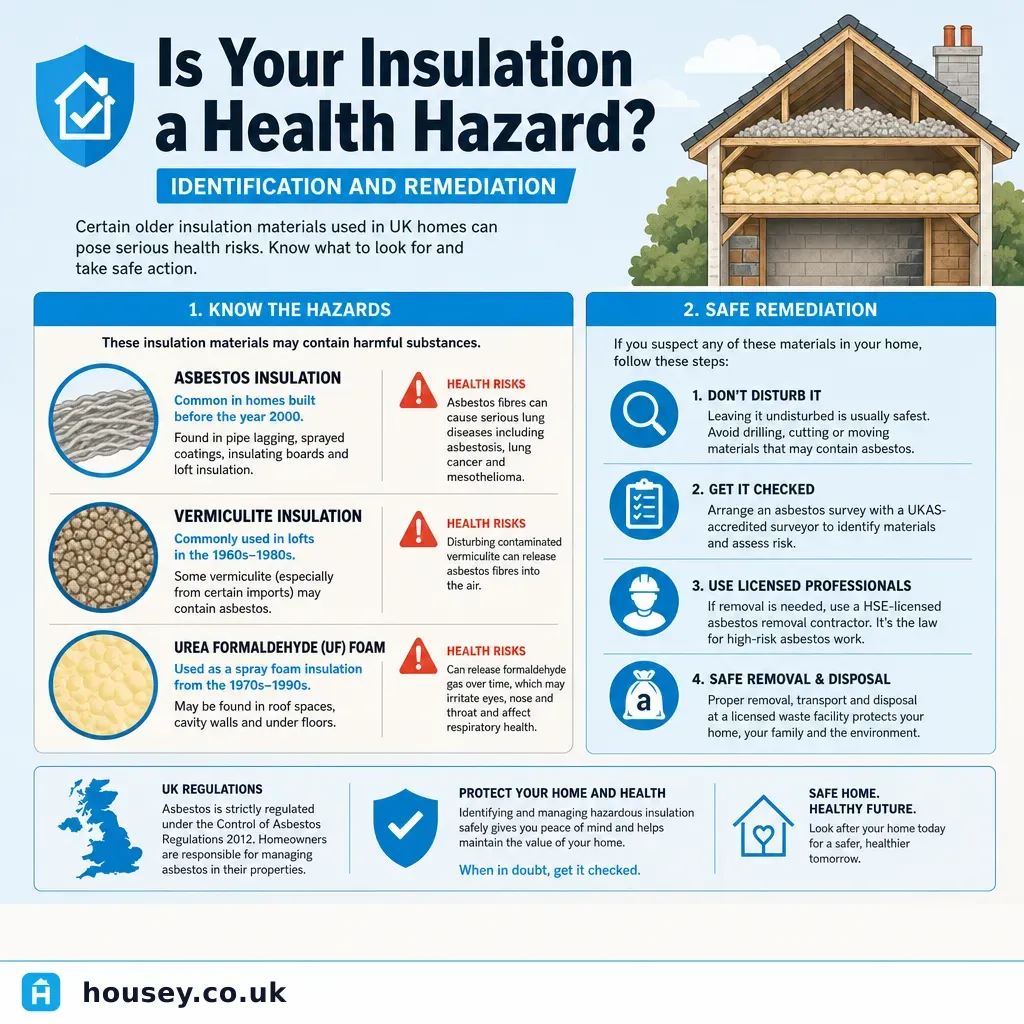 Surveys & Inspections
Is Your Insulation a Health Hazard? Identification and Remediation
Some insulation materials in pre-2000 UK homes may pose genuine health risks.
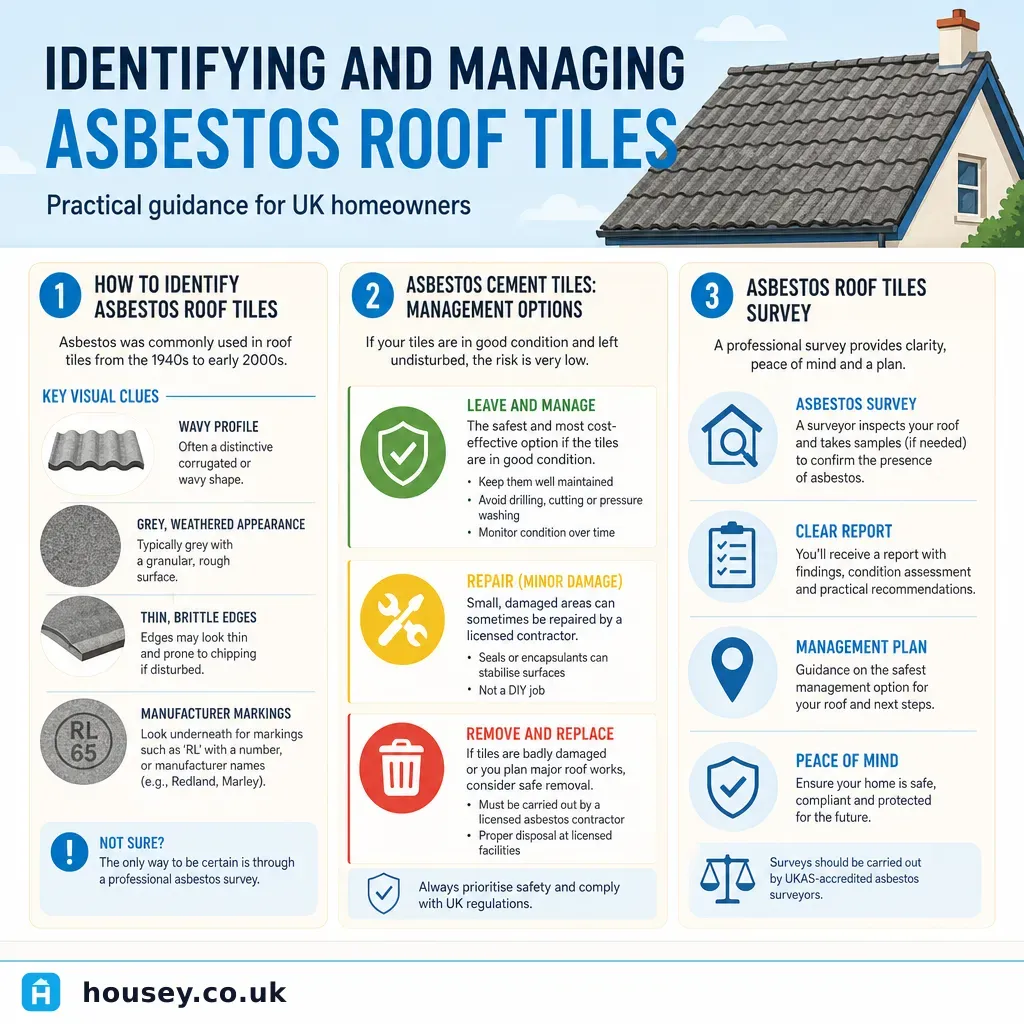 Surveys & Inspections
Identifying and managing asbestos roof tiles
If your roof was installed before 2000, asbestos cement tiles may be present.
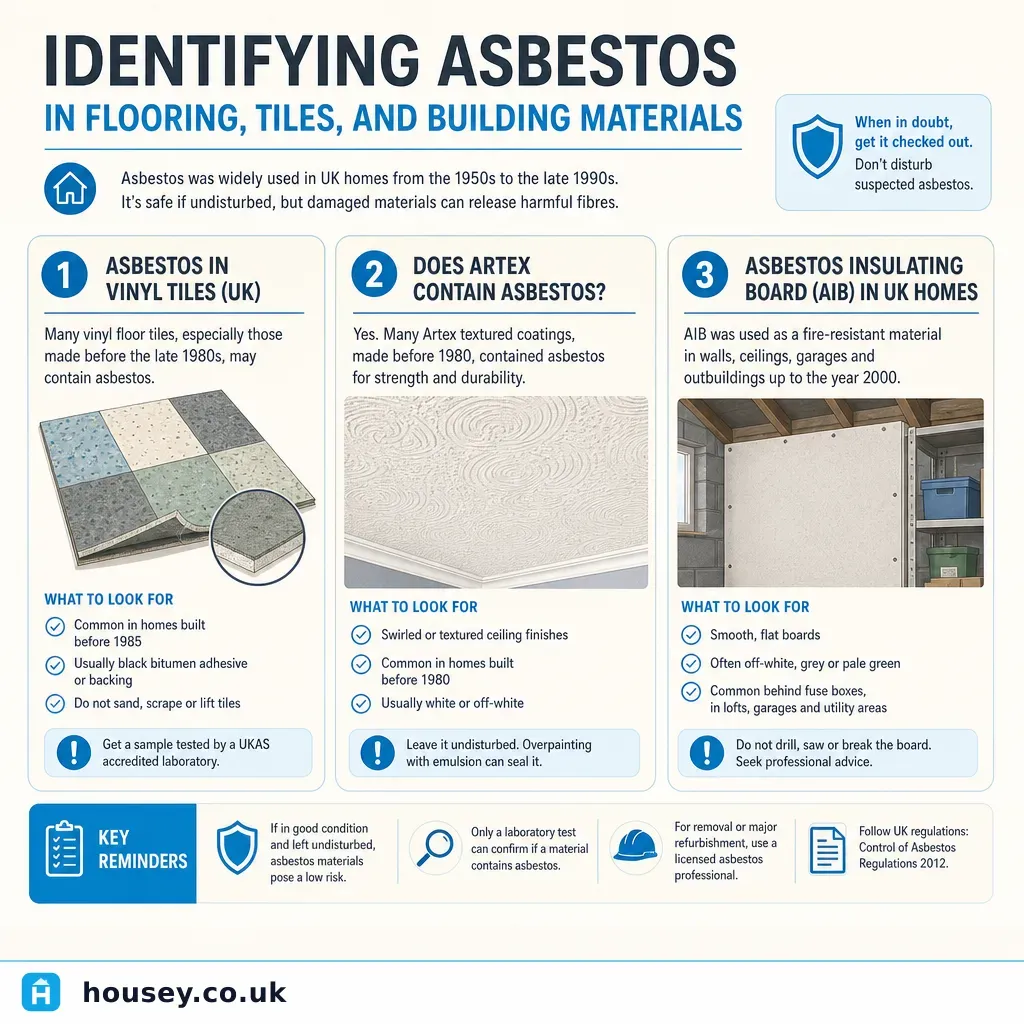 Surveys & Inspections
Identifying asbestos in flooring, tiles, and building materials
Asbestos-containing materials are common in UK properties built or refurbished before 2000.
 Surveys & Inspections
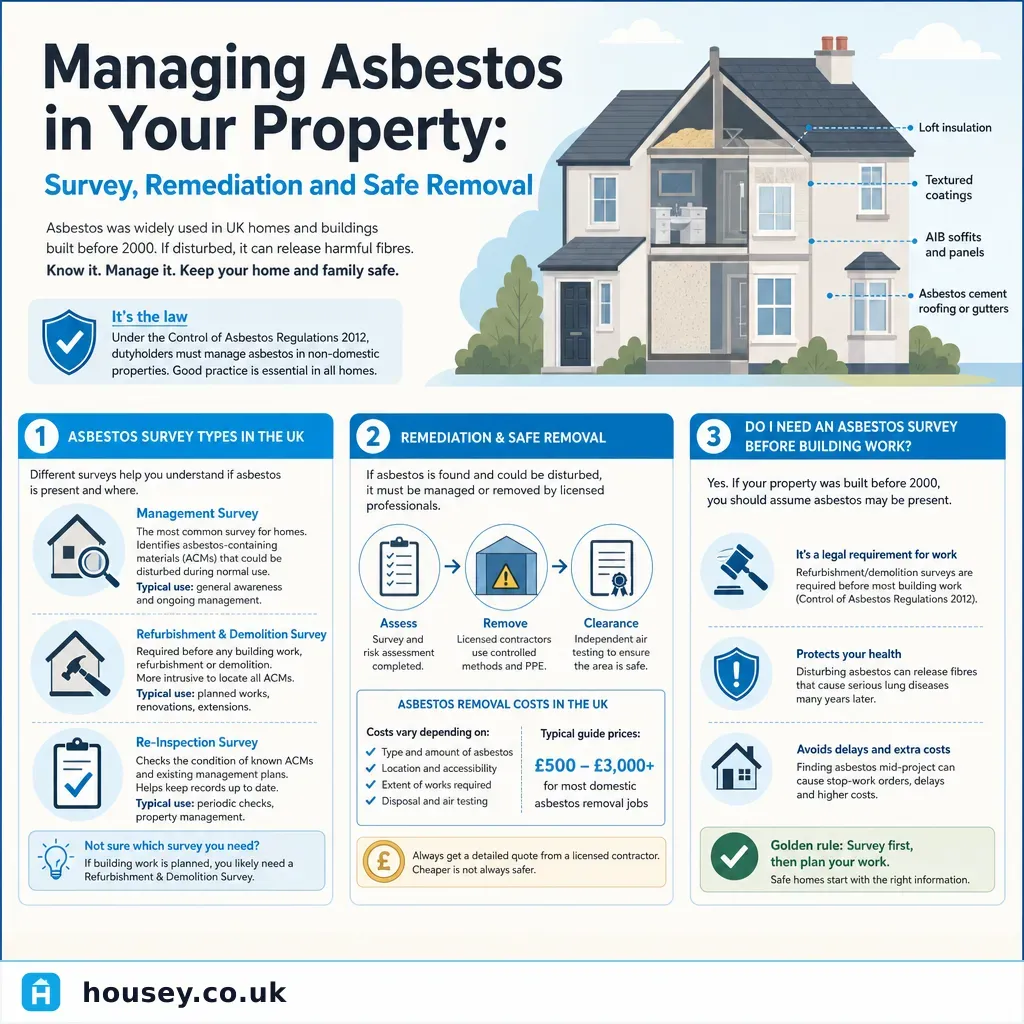
Managing Asbestos in Your Property: Survey, Remediation and Safe Removal
Asbestos was commonly used in UK buildings until its full ban in 1999.
 Surveys & Inspections
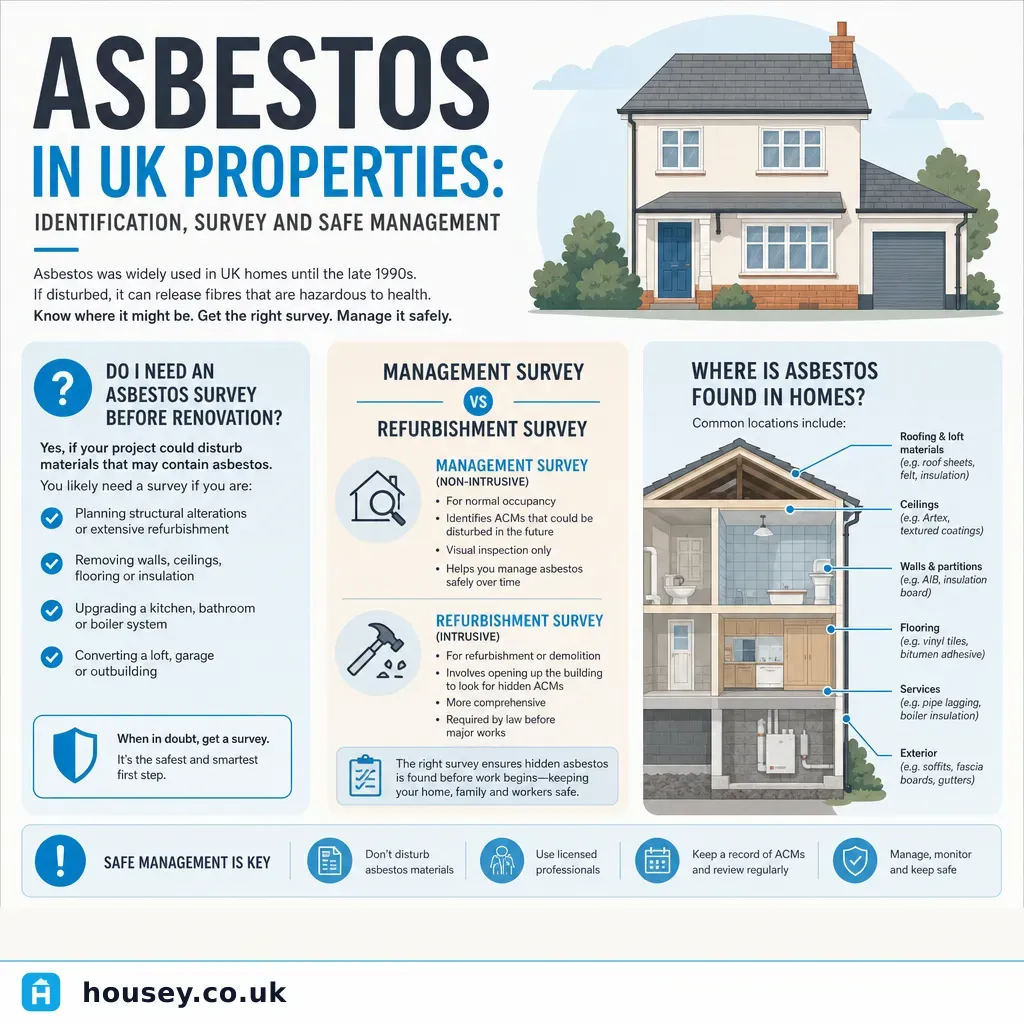
Asbestos in UK Properties: Identification, Survey and Safe Management
Asbestos may be present in any UK property built or refurbished before 2000.