Is Your Insulation a Health Hazard? Identification and Remediation
By Housey · Last reviewed 31st of May 2026
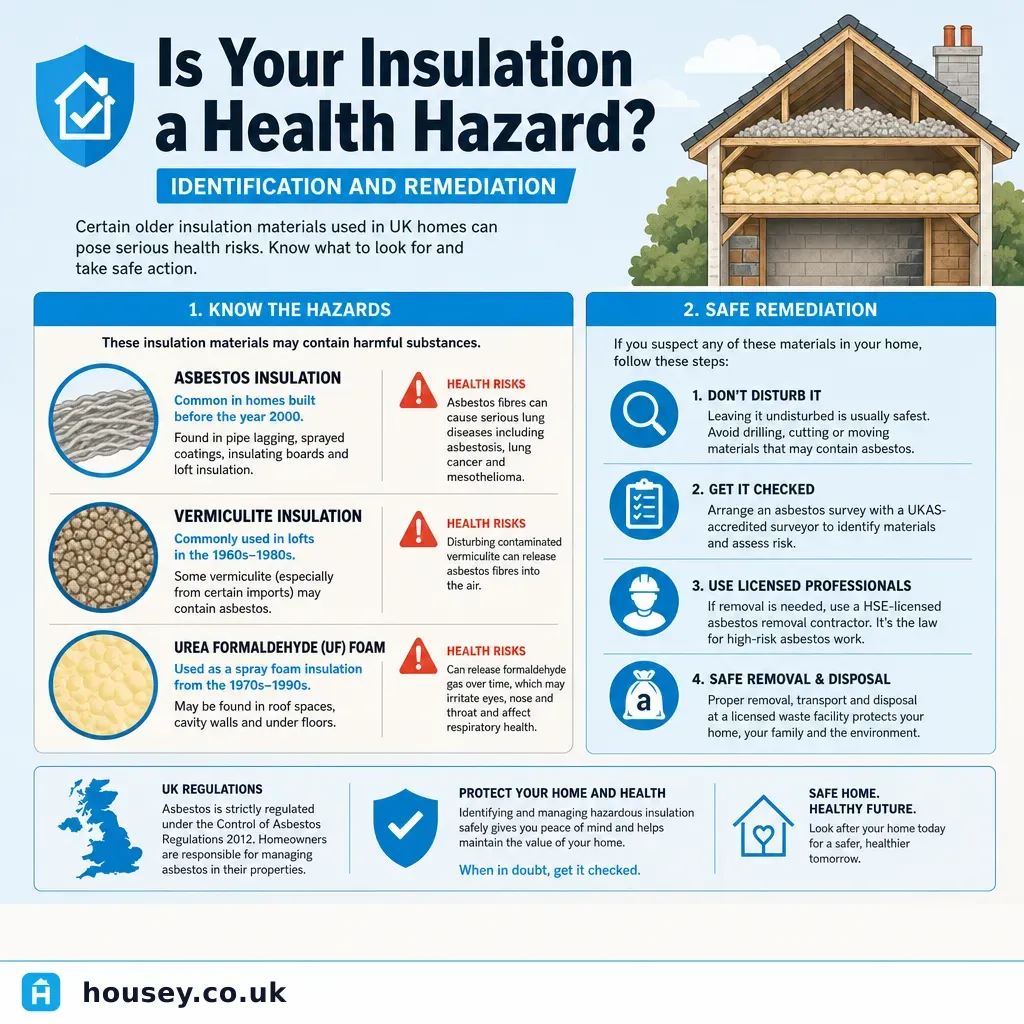
Is Your Insulation a Health Hazard? Identification and Remediation
Insulation is designed to protect your home — but in properties built or refurbished before the late 1990s, some insulation materials may themselves pose a risk to your health. This question most often arises during a loft clearance, cavity wall investigation, or survey ahead of a sale or retrofit project, and the stakes are significant: disturbing hazardous insulation without proper precautions can release fibres or gases that cause serious, long-term illness.
Key points
- Asbestos was used in a wide range of building products — including insulation boards, pipe lagging, spray-applied coatings, and loose-fill loft insulation — until the UK's complete ban came into force in 1999.
- Urea formaldehyde (UF) foam cavity wall insulation, widely injected during the 1970s and 1980s, can degrade over time and emit formaldehyde, a recognised respiratory irritant; the British Board of Agrément withdrew approval for UF foam in 1988.
- Vermiculite loose-fill loft insulation sold before 1990 — often under the brand name Zonolite — may be contaminated with amphibole asbestos from the Libby mine in Montana, and the HSE advises treating all pre-1990 vermiculite as potentially hazardous until tested by an accredited laboratory.
- Under the Control of Asbestos Regulations 2012, disturbing or removing most categories of asbestos-containing materials without a licensed contractor is a criminal offence in the UK.
- Mineral wool (glass wool and rock wool) is not classified as a carcinogen at modern manufactured fibre sizes, but causes skin, eye, and respiratory irritation during handling; appropriate PPE should always be worn.
Types of insulation that may carry health risks
Not all insulation is hazardous, but certain materials — particularly those installed in homes built or retrofitted before the late 1990s — warrant closer attention.
Asbestos-containing insulation
Asbestos was used in spray-applied insulation for structural steelwork, pipe and boiler lagging, insulation boards in lofts and around heating systems, and occasionally as loose-fill loft insulation. Properties built before 2000 may contain asbestos-containing materials (ACMs). The key distinction is whether an ACM is in good condition and undisturbed, or whether it is damaged, friable, or in an area where planned works will disturb it. The HSE's duty-to-manage guidance advises that ACMs in good condition can often be managed in place, but any planned disturbance requires a licensed asbestos contractor for most categories of licensable work.
Urea formaldehyde foam insulation
UF foam was injected into the cavity walls of thousands of UK homes between roughly 1974 and 1990, often through government-backed grant schemes. Over time the foam can degrade and crack, potentially releasing formaldehyde gas into the living space. If you suspect UF foam in your cavity walls, an environmental survey can test indoor air quality and formaldehyde levels.
Vermiculite insulation
Vermiculite is a naturally occurring mineral used as loose-fill loft insulation, commonly sold under the Zonolite brand in the 1970s and 1980s. A significant proportion of commercially mined vermiculite before 1990 came from a deposit in Libby, Montana, which was contaminated with tremolite asbestos. The HSE advises treating any pre-1990 vermiculite as if it may contain asbestos until laboratory analysis proves otherwise.
Mineral wool (glass wool and rock wool)
Modern mineral wool is not classified as a human carcinogen by IARC at current manufactured fibre diameters. During installation or disturbance, fibres can irritate the skin, eyes, and respiratory tract. Licensed removal is not required, but gloves, goggles, and a well-fitted FFP2 or FFP3 dust mask should always be worn when handling it.
How to identify potentially hazardous insulation in your home
Material | Where typically found | Era of installation | Visual indicators | Testing required? |
|---|---|---|---|---|
Asbestos lagging or boards | Boilers, pipes, loft hatch surrounds, under floors | Pre-2000 | Grey or white fibrous boards; wrapped pipe lagging | Yes — UKAS-accredited laboratory analysis |
UF foam | Cavity walls (externally injected) | 1974–1990 | White foam visible in drill holes; chemical smell indoors | Air quality and formaldehyde testing |
Vermiculite | Loose-fill in loft | Pre-1990 | Gold or silver granular material between joists | Yes — laboratory analysis strongly recommended |
Loose asbestos fill | Loft floor between joists | 1960s–1980s | Fluffy grey, blue, or white loose material | Yes — do not disturb; arrange survey first |
Mineral wool | Loft, cavity walls, stud walls | 1970s–present | Yellow, pink, or grey matted rolls or batts | Not usually required |
If you are unsure which insulation is present, a professional insulation assessment or an asbestos survey can identify materials before any work begins.
What not to assume
Several common misunderstandings lead to dangerous decisions around insulation safety.
- "If it is not crumbling, it is safe." Asbestos fibres can be released by vibration, cutting, drilling, or even foot traffic across a loft board. Condition is one factor, but proximity to planned disturbance is equally important.
- "It was installed recently, so it must be fine." Some buildings used stockpiled pre-ban materials into the early 2000s. Always verify the installation date or ask a surveyor if you are uncertain.
- "I can collect a sample myself and send it to a lab." Taking a sample from suspected ACMs without training is itself high-risk. An accredited surveyor uses appropriate personal protective equipment and sealed containers to avoid contamination.
- "My builder said it is fine." Unless your builder holds an asbestos licence or has had the material formally tested by an accredited laboratory, this is not a reliable assessment.
- "Removing it will solve the problem." For well-encapsulated asbestos in good condition, removal often creates more risk than careful management in place. A qualified surveyor should advise on the management-versus-removal decision based on material type, condition, and planned works.
Which professional do you need?
Scenario | Professional required | Relevant accreditation |
|---|---|---|
Identify whether insulation contains asbestos | Asbestos surveyor (management or refurbishment/demolition survey) | UKAS-accredited laboratory; surveyor trained to HSG264 |
Suspect UF foam or elevated formaldehyde | Environmental consultant or indoor air quality specialist | UKAS-accredited testing |
Remove asbestos before planned works | Licensed asbestos removal contractor | HSE-licensed under the Control of Asbestos Regulations 2012 |
Upgrade insulation where ACMs may be present | Retrofit coordinator — only after asbestos survey confirms scope | TrustMark registered; PAS 2035 qualified |
General condition assessment of insulation | Surveyor or insulation assessor | RICS or equivalent |
Red flags that require immediate professional advice
- Visible crumbling, powdering, or damaged insulation in a loft, around a boiler, or on pipework.
- White or grey fluffy loose-fill material in a loft that you cannot confidently identify.
- Granular gold or silver material in a loft (possible pre-1990 vermiculite).
- A persistent chemical smell in rooms adjacent to cavity walls in a property built between 1974 and 1990.
- Any planned building works — loft conversions, re-roofing, rewiring, or boiler replacement — in a pre-2000 property where no asbestos survey has been carried out.
- An asbestos management plan from a previous owner that lists ACMs in areas where you plan to work.
Important limitations
This article provides general information only. The identification of hazardous insulation materials, and any decisions about management, encapsulation, or removal, must be made by a qualified professional following a formal survey and laboratory analysis. Rules and requirements under the Control of Asbestos Regulations 2012 vary by material type, ACM condition, and scope of planned works. Nothing in this guide constitutes legal, safety, or regulatory advice.
When this becomes urgent
Seek professional advice immediately if: you have already disturbed material you suspect may contain asbestos without appropriate protection; visible dust or fibres have been released in an occupied space; or you are planning imminent works in a pre-2000 property and have not yet arranged an asbestos survey. Do not re-enter a dust-affected room until it has been assessed by a licensed specialist.
What to ask a qualified professional
- Is this a management survey or a refurbishment and demolition survey, and which type do I need for my planned works?
- What is the condition and extent of any asbestos-containing materials found?
- What is your recommendation — management in place or removal — and on what basis?
- Who would carry out any removal, and are they HSE-licensed for this category of material?
- Will I receive a written asbestos register or report after the survey?
- Are there other hazardous materials — lead paint, UF foam, or vermiculite — that should be assessed at the same time?
- What are the implications for selling or refinancing this property if ACMs are present?
When to get professional help
Do not attempt to identify, sample, or disturb insulation yourself if you have any reason to suspect it may be hazardous. The health risks associated with asbestos — mesothelioma, asbestosis, and lung cancer — have a latency period of 20–40 years and are not immediately apparent after exposure. The HSE recommends that any work liable to disturb asbestos-containing materials in a pre-2000 property be assessed by an accredited asbestos surveyor before it begins.
Seek professional advice if:
- You are planning any building works in a property constructed before 2000.
- You have purchased a property with no asbestos management plan.
- You can see damaged, loose, or crumbling insulation in a loft, around pipework, or in a service void.
- Your property was cavity-wall insulated in the 1970s or 1980s and you have concerns about off-gassing or foam degradation.
How Housey can help
Housey connects UK homeowners with qualified surveyors and environmental specialists. Whether you need an asbestos survey before planned works, an insulation assessment to understand which materials are present, or a broader environmental survey covering multiple hazardous materials, Housey can help you find and compare accredited local professionals.
Frequently asked questions
How do I know if my loft insulation contains asbestos?
You cannot tell by looking alone — asbestos fibres are microscopic. If your loft was insulated before 2000, particularly with loose-fill or board-type material, arrange an accredited asbestos survey. Do not disturb the material in the meantime. A UKAS-accredited laboratory can confirm or rule out asbestos content from a sample taken safely by a trained surveyor.
Is it safe to stay in a house with asbestos insulation?
Asbestos in good condition that is undisturbed poses a much lower risk than friable or damaged material. However, this assessment must be made by a qualified asbestos surveyor following a formal management survey — not a general visual inspection. If you have concerns, arrange a survey before undertaking any works that could disturb the material.
Does selling a house require disclosure of asbestos?
In England and Wales, sellers complete a TA6 property information form, which asks about known hazardous materials including asbestos. Failure to disclose known hazards can lead to misrepresentation claims. If an asbestos survey has been carried out, its findings should be disclosed to prospective buyers and their solicitors.
Can I remove vermiculite insulation myself?
The HSE advises treating pre-1990 vermiculite as potentially asbestos-contaminated until laboratory testing confirms otherwise. If testing is positive for asbestos, removal must be carried out by a licensed contractor. Do not attempt to bag or remove vermiculite yourself without prior testing and professional guidance on safe handling procedures.
Sources and further reading
- Control of Asbestos Regulations 2012 — legislation.gov.uk
- HSG264: Asbestos — The Survey Guide — Health and Safety Executive
- Asbestos guidance for building owners and managers — Health and Safety Executive
- Urea formaldehyde foam insulation guidance — GOV.UK
- Vermiculite and asbestos — Health and Safety Executive
Useful next reads
 Surveys & Inspections
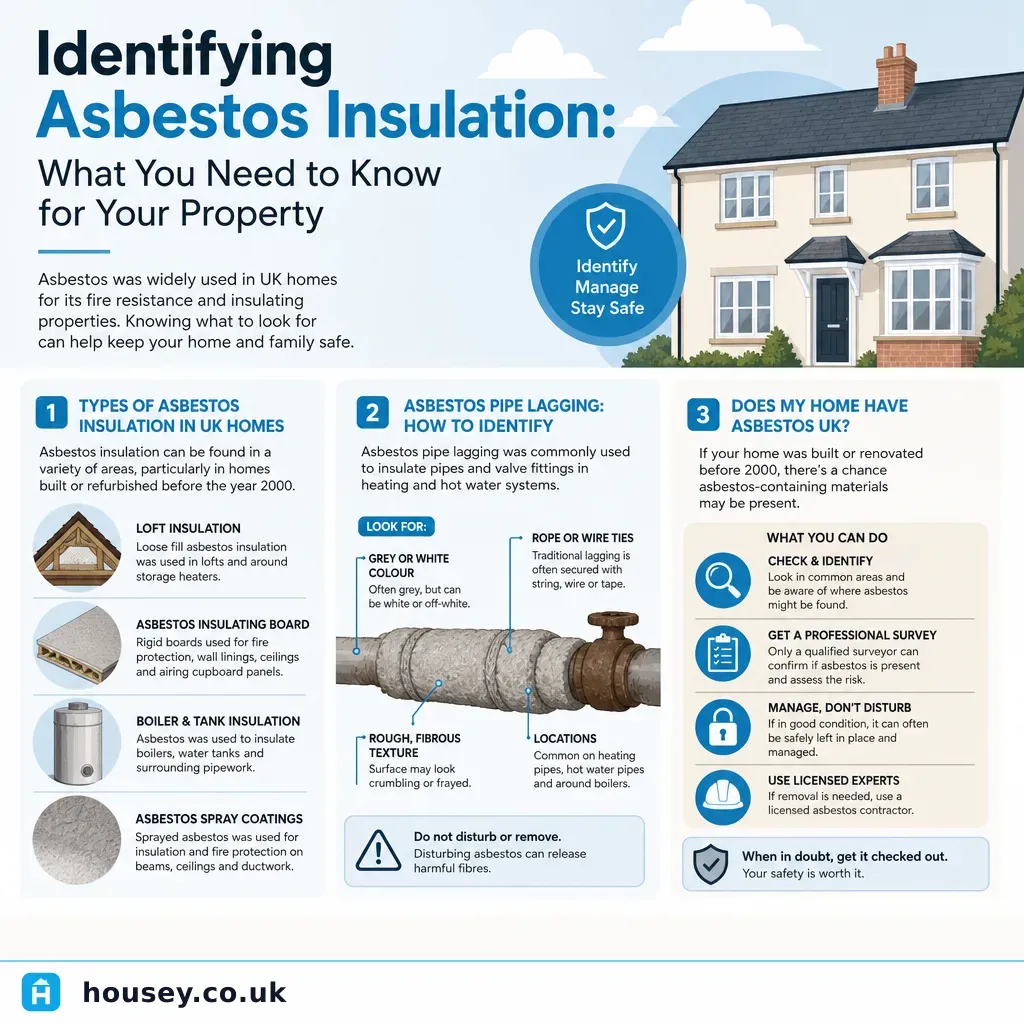
Identifying Asbestos Insulation: What You Need to Know for Your Property
Asbestos insulation was widely used in UK properties built before 2000, commonly found in pipe lagging, ceiling tiles, loose-fill loft insulation, and around boilers.
 Surveys & Inspections
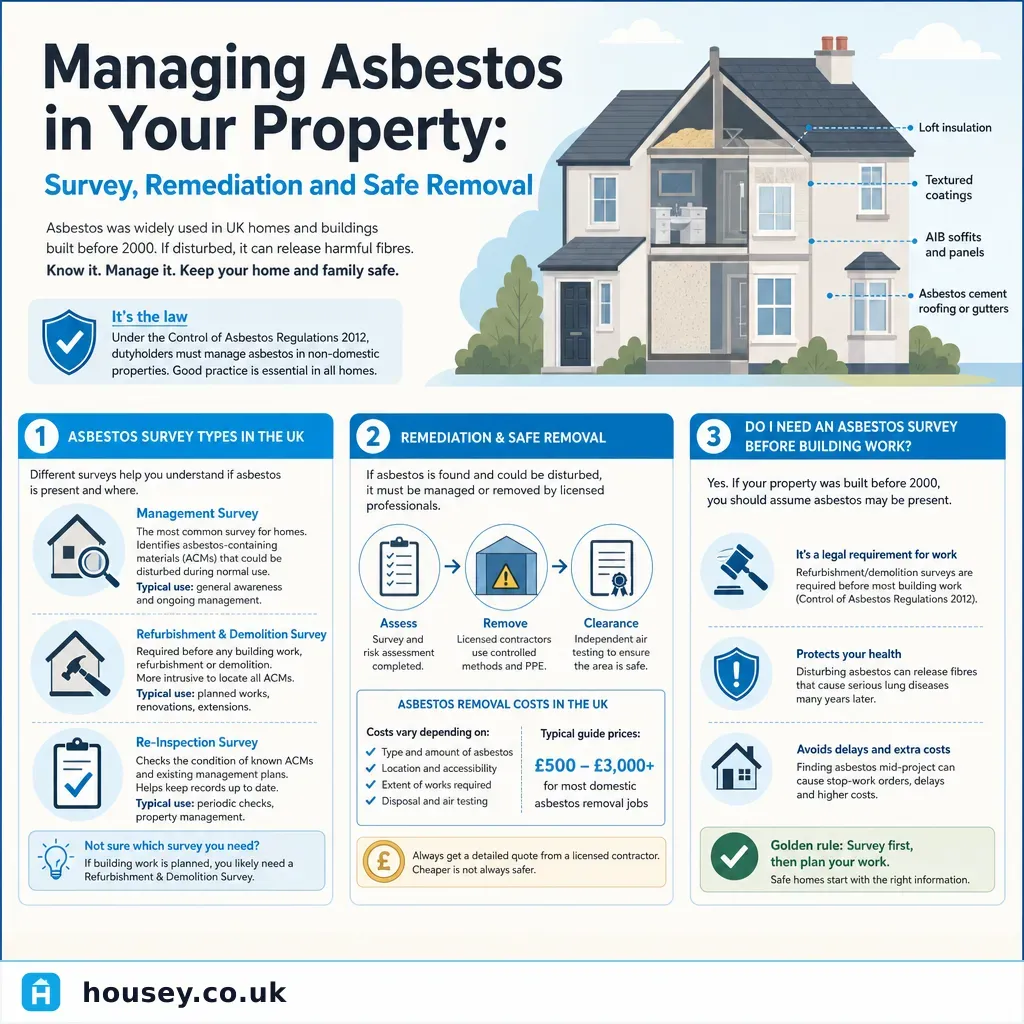
Managing Asbestos in Your Property: Survey, Remediation and Safe Removal
Asbestos was commonly used in UK buildings until its full ban in 1999.
 Surveys & Inspections
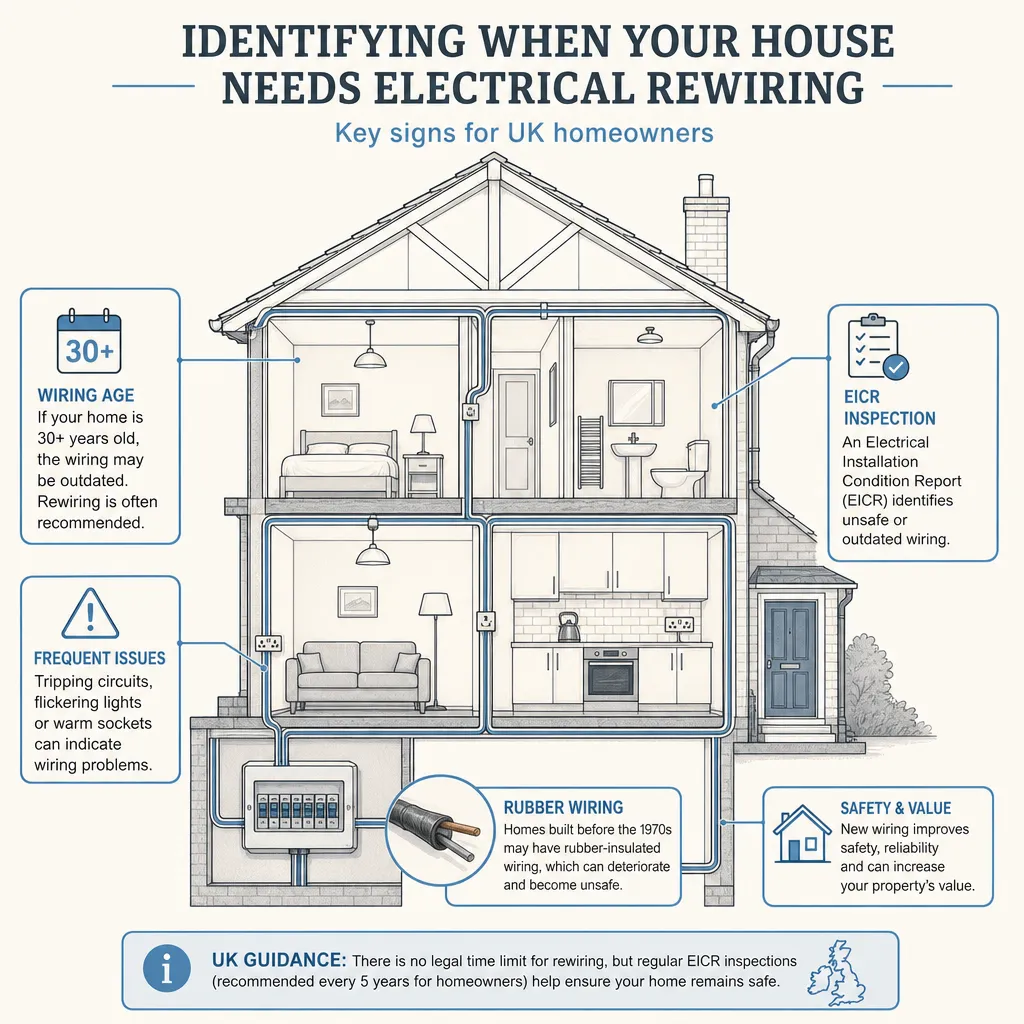
Identifying When Your House Needs Electrical Rewiring
A house may need rewiring if it has rubber-insulated cables (pre-1966), round-pin sockets, rewirable fuses, or no RCD protection.
 Surveys & Inspections
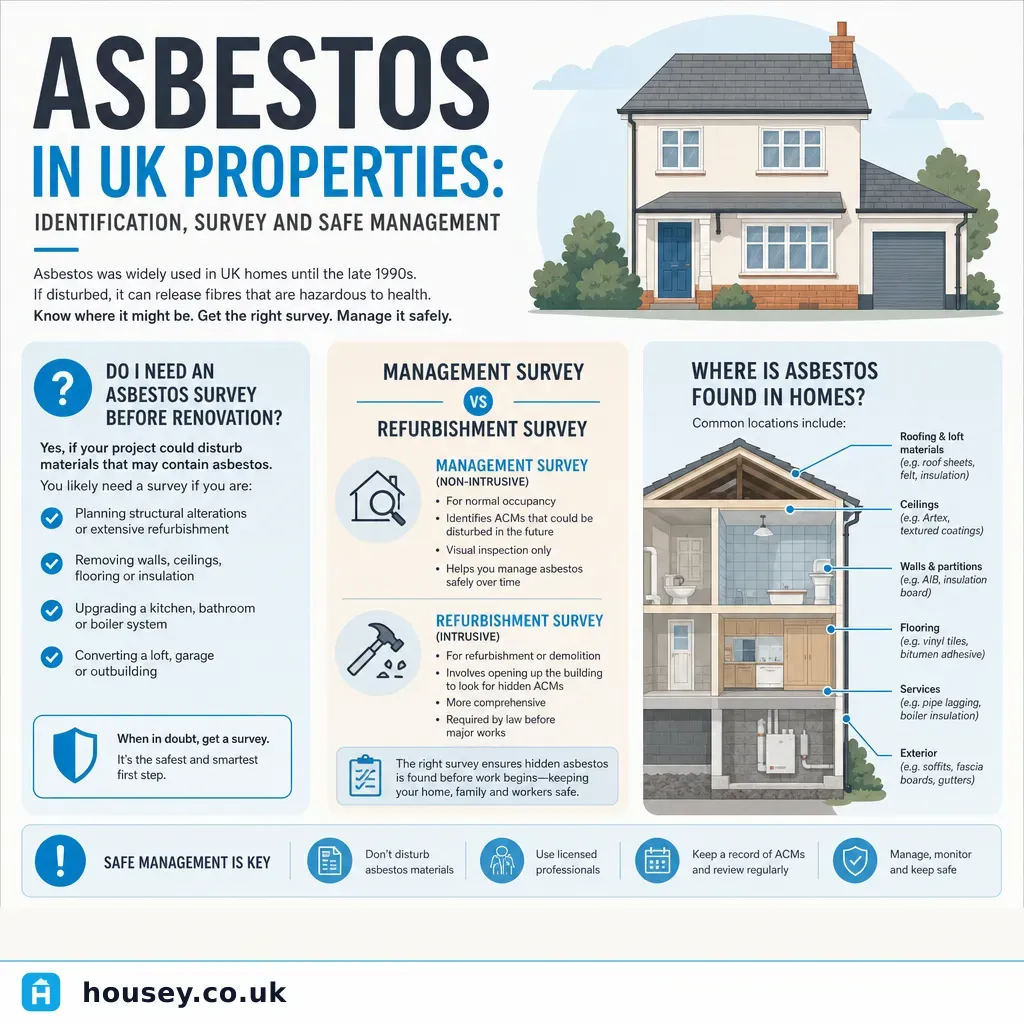
Asbestos in UK Properties: Identification, Survey and Safe Management
Asbestos may be present in any UK property built or refurbished before 2000.
 Surveys & Inspections
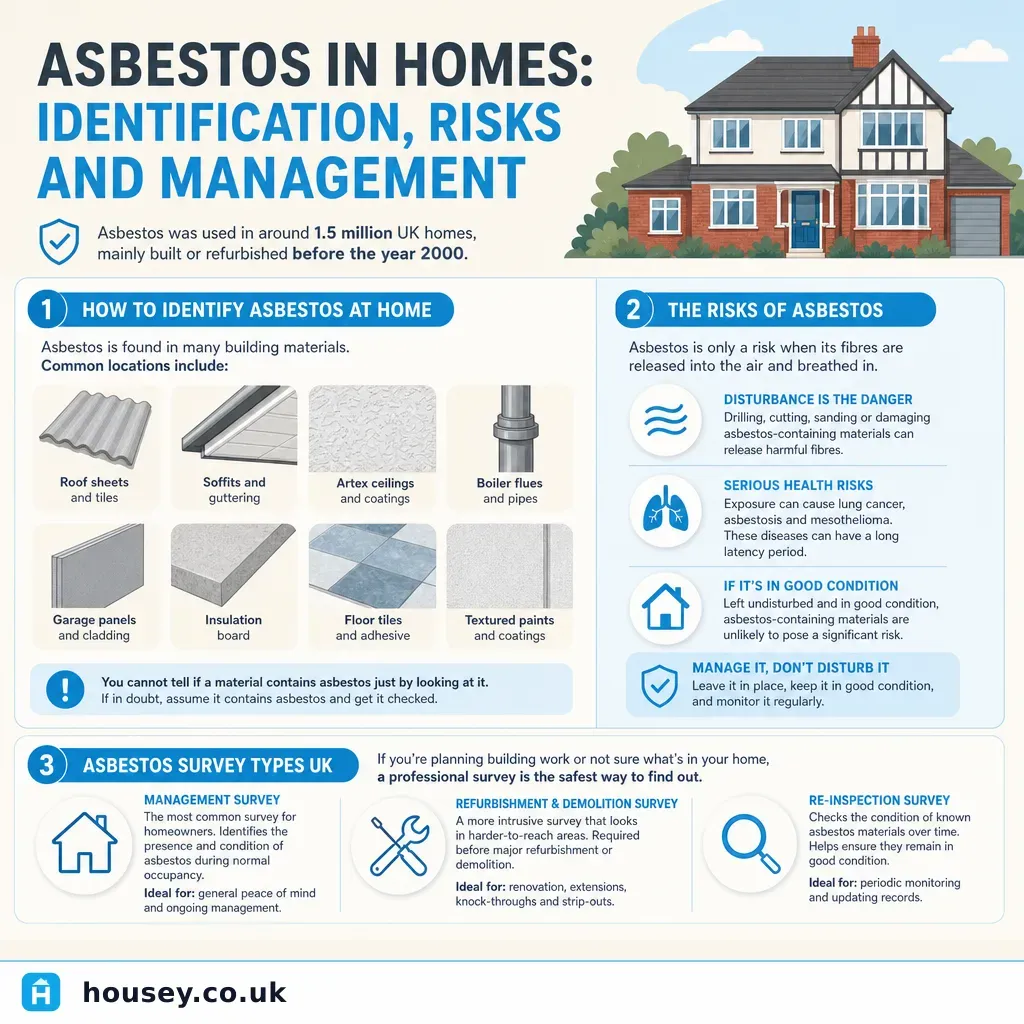
Asbestos in homes: identification, risks and management
Asbestos was widely used in UK construction until it was banned in November 1999, so any home built before 2000 may contain asbestos-containing materials.