Identifying asbestos in flooring, tiles, and building materials
By Housey · Last reviewed 30th of May 2026
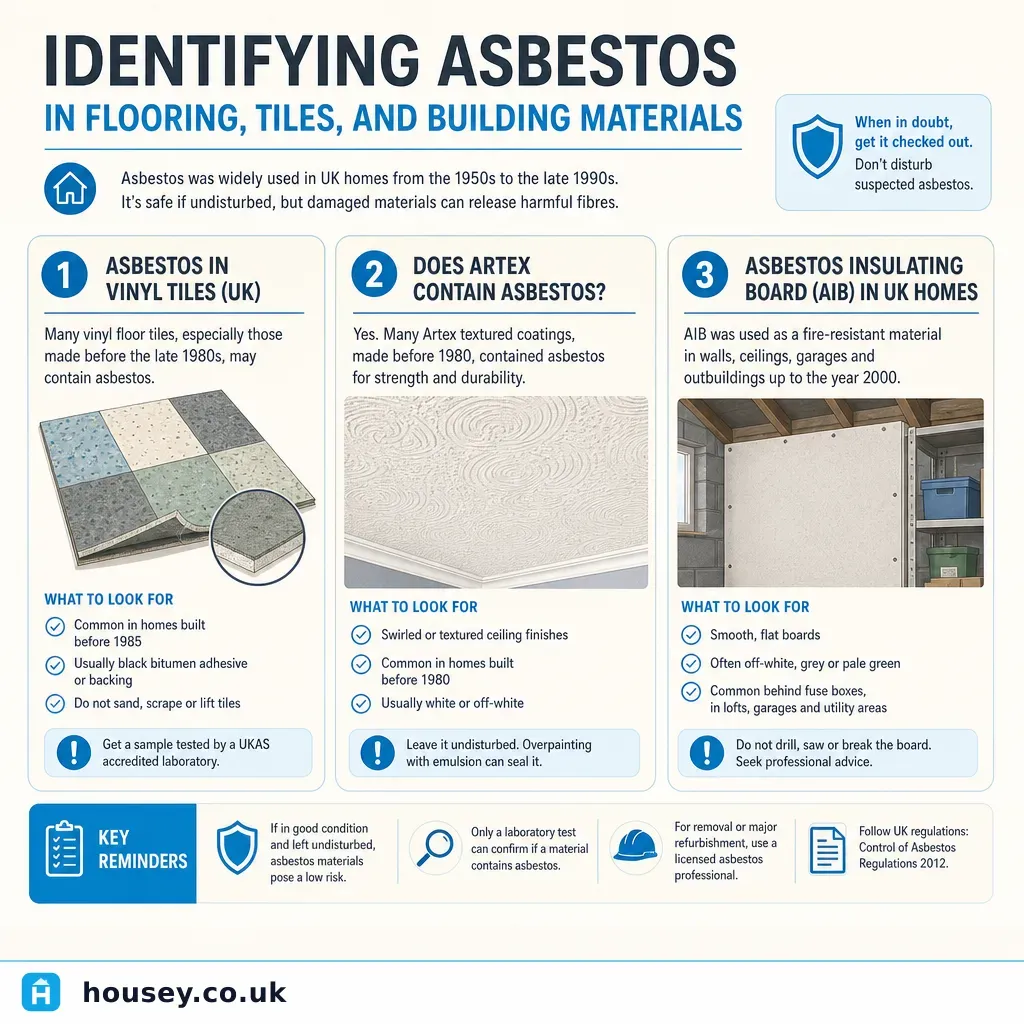
Identifying asbestos in flooring, tiles, and building materials
Asbestos-containing materials (ACMs) are present in a significant proportion of UK properties built or substantially refurbished before 2000 — the year the final remaining asbestos products were banned from use in Great Britain. The concern most often arises during renovation work, particularly when lifting old floor tiles, stripping a textured ceiling, or clearing out a dated kitchen, or when a pre-purchase survey on an older property flags potential ACMs. Identifying what is present before any disturbance is both a critical safety step and, in many circumstances, a legal requirement under the Control of Asbestos Regulations 2012.
Key points
- All forms of asbestos were banned from use in new UK building materials in 1999 under the Asbestos (Prohibitions) (Amendment) Regulations 1999; any property built or substantially refurbished before 2000 may contain ACMs.
- Vinyl and thermoplastic floor tiles installed pre-2000 — especially the 9"×9" (229 mm×229 mm) and 12"×12" (305 mm×305 mm) formats common in 1950s–1980s housing — frequently contain chrysotile (white asbestos) in both the tile body and the bituminous black mastic adhesive used to fix them.
- Artex and similar textured coatings applied before 2000 often contained chrysotile; these are among the most widespread ACMs in UK domestic properties and are generally low risk when intact but hazardous when sanded, drilled, or scraped.
- Asbestos insulating board (AIB) — used in ceiling tiles, fire doors, partition board, and airing cupboard linings — is a higher-risk ACM and requires particular care before any disturbance.
- The Control of Asbestos Regulations 2012 sets out duties for managing and working with ACMs; these apply to employers and the self-employed including tradespeople carrying out work in domestic premises.
Where asbestos is commonly found in UK homes
Floor coverings
Vinyl and thermoplastic floor tiles manufactured before 2000 are among the most widely encountered ACMs in UK residential properties. Both the tile body and the black or brown bituminous adhesive used to bond them to concrete or timber sub-floors may contain chrysotile. Indicators that increase the probability of ACM content:
- 9"×9" (229 mm×229 mm) or 12"×12" (305 mm×305 mm) square hard tiles — the standard dimensions used when ACM tiles were in production
- Mottled, marbled, or plain hard tiles in post-war, 1960s, and 1970s properties
- Visible black or brown rubbery adhesive at tile edges or where tiles have lifted
- Sheet vinyl flooring laid over existing hard tiles (the underlying layer may contain asbestos even if the surface layer does not)
Ceilings and wall coatings
Textured decorative coatings — commonly known as Artex, though this is a brand name — were applied widely in UK homes from the 1960s through to the 1990s. Products manufactured before 1985 routinely contained chrysotile. The material presents a low risk when it is intact and painted over, but becomes hazardous when sanded, scraped, drilled, or otherwise disturbed.
Asbestos insulating board (AIB) was used in:
- Ceiling tiles in suspended grid systems and fixed board ceilings
- Soffit boards and partition panels in older homes and blocks of flats
- Airing cupboard and boiler cupboard linings
- Panels fitted behind storage heaters in post-war housing
Other common locations in UK residential properties
Location | Typical ACM | Risk notes |
|---|---|---|
Pipe and boiler lagging | Amosite (brown) or crocidolite (blue) — higher-risk fibre types | Any remaining lagging in pre-1990 properties should be assessed before disturbance |
Garage, outbuilding, and extension roofs | Chrysotile cement (corrugated or flat sheet) | Often painted; do not drill or cut without a survey |
Soffit boards under eaves | AIB or chrysotile cement board | Fragile when aged; painting does not eliminate risk if disturbed |
Textured wall and ceiling coatings | Chrysotile | Stairwells, hallways, and kitchens are common locations |
Floor tile adhesive (black mastic) | Chrysotile | May be present even where the tile itself does not contain asbestos |
What not to assume about asbestos in your home
These are common misconceptions that can put homeowners and their families at risk.
Do not assume:
- That good-looking tiles are safe. ACM tiles are often undamaged precisely because they have never been disturbed. Visual condition is not a reliable indicator of composition.
- That a previous renovation means the property is clear. Past works may have removed some ACMs but not others; the scope of earlier surveys may have been limited to specific areas or work types.
- That Artex only matters in neglected homes. Many well-maintained properties retain pre-1985 textured ceilings containing chrysotile under subsequent layers of paint.
- That only deteriorated materials are dangerous. Intact asbestos cement on a garage roof generally presents lower risk than disturbed AIB from a ceiling tile, regardless of how each looks.
- That you can identify ACMs by appearance alone. Asbestos fibres are invisible to the naked eye; the only reliable identification method is laboratory analysis of a physical sample taken by a competent person.
- That lifting old floor tiles is a low-risk DIY task. Scraping ACM tiles from a bituminous adhesive bed can release fibres. Proper risk assessment and, in many cases, professional removal is required.
Red flags: when to stop work and seek professional advice
Stop any renovation, repair, or maintenance work immediately and contact a qualified asbestos professional if you encounter:
- Brittle, dusty, or crumbling tile or board material in any pre-2000 property
- A distinctive black, rubber-like bituminous adhesive visible beneath or around floor tiles
- Any material that is labelled or marked as containing asbestos (though most ACMs are unlabelled in domestic settings)
- Damaged or partially removed lagging around pipes, boilers, or ductwork
- Corrugated or flat sheet roofing on outbuildings that produces fine white dust when touched or knocked
- A textured ceiling coating that is flaking, crumbling, or has been partially scraped away
- A surveyor's or contractor's report identifying a "probable" or "possible" ACM awaiting laboratory confirmation
Important limitations
This article provides general information about where asbestos-containing materials are commonly found in UK residential properties built or refurbished before 2000. It does not constitute an asbestos survey, a site-specific risk assessment, or professional advice. The identification of specific ACMs requires physical sampling and laboratory analysis carried out by a competent person holding appropriate qualifications. Regulatory requirements — including what constitutes licensable work, notifiable non-licensed work (NNLW), and which working methods are permitted — vary depending on the ACM type, its condition, and the planned activity. Always consult a qualified professional before disturbing or arranging removal of any suspect material.
When this becomes urgent
Seek immediate professional advice if:
- You have already disturbed a material you now suspect contained asbestos. Leave the area, do not use a domestic vacuum cleaner on any debris, and contact an asbestos specialist without delay.
- You are a landlord and a tenant has reported possible disturbance of suspected ACMs.
- A contractor has identified a suspected ACM during active works on your property.
- You are a duty holder in non-domestic premises and have not yet carried out a management survey as required by the Control of Asbestos Regulations 2012.
What to ask a qualified professional
When instructing an asbestos surveyor or consultant, ask:
- Are you accredited under UKAS to BS EN ISO/IEC 17020 for asbestos inspection, and can you provide your accreditation certificate?
- What type of survey is appropriate for my situation — a management survey or a refurbishment and demolition survey — and why?
- Will samples be sent to a UKAS-accredited laboratory for analysis, and will I receive a copy of the analytical report?
- What will the asbestos register tell me, and what decisions can I make from it?
- If ACMs are found, what options do I have: management in place, encapsulation, or removal?
- For removal work: is the material licensable under the Control of Asbestos Regulations 2012, and if so, are you currently licensed by the HSE?
- Does the planned work need to be notified to the relevant enforcing authority as notifiable non-licensed work (NNLW)?
- What documentation will I receive on completion, and is a clearance air test or certificate required for the area?
When to get professional help
Any suspected ACM in a UK property built or refurbished before 2000 warrants professional assessment before any work that could disturb the material proceeds — whether by a contractor or a homeowner undertaking DIY. A UKAS-accredited asbestos surveyor can carry out a management survey to document existing ACMs and their condition, or a refurbishment and demolition survey before planned works. Both produce an asbestos register recording the location, probable fibre type, condition, and risk rating of any materials found.
How Housey can help
Housey connects homeowners with qualified, UKAS-accredited professionals who can carry out asbestos surveys — whether you need a management survey to understand what is present, or a pre-refurbishment survey before renovation work begins. Use Housey to get quotes from accredited surveyors in your area before starting any work in a pre-2000 property.
Frequently asked questions
How do I know if my floor tiles contain asbestos?
You cannot tell by looking at them. Chrysotile fibres are microscopic and visually indistinguishable from non-asbestos materials. The only reliable method is laboratory analysis of a physical sample. As a practical guide, if your home was built or refurbished before 2000 and has hard square floor tiles, treat them as potentially containing asbestos before any work that involves lifting, cutting, or sanding.
Is Artex always dangerous?
Artex and similar textured coatings applied before 1985 often contained chrysotile, but the material is generally considered low risk when intact, in good condition, and undisturbed. The risk arises when it is sanded, scraped, or drilled during decoration or renovation. If you are planning any work that could disturb a textured ceiling applied before 2000, have a sample tested by a qualified analyst before proceeding.
Do I need a licensed contractor to remove ACM floor tiles?
Floor tile removal is classified as non-licensed work under the Control of Asbestos Regulations 2012 if carried out under controlled conditions, but it is notifiable non-licensed work (NNLW), meaning the employer must notify the relevant enforcing authority before starting. For domestic homeowners the legal position differs, but the health risk remains significant; professional removal by a trained and equipped contractor is strongly recommended to avoid fibre release.
What is the difference between a management survey and a refurbishment and demolition survey?
A management survey locates and assesses ACMs in a building in normal occupation, allowing safe in-place management and an ongoing asbestos register. A refurbishment and demolition survey is more intrusive and is required before any work that will disturb the building fabric — such as a loft conversion, kitchen strip-out, or significant renovation. The right survey type depends on your planned activities and which areas are to be worked on.
Sources and further reading
- Control of Asbestos Regulations 2012 — legislation.gov.uk
- HSE: Asbestos in homes — Health and Safety Executive
- HSE: Asbestos — the analysts' guide (HSG248) — Health and Safety Executive
- Asbestos (Prohibitions) (Amendment) Regulations 1999 — legislation.gov.uk
- UKAS: Accreditation for asbestos inspection bodies — United Kingdom Accreditation Service
Useful next reads
 Surveys & Inspections
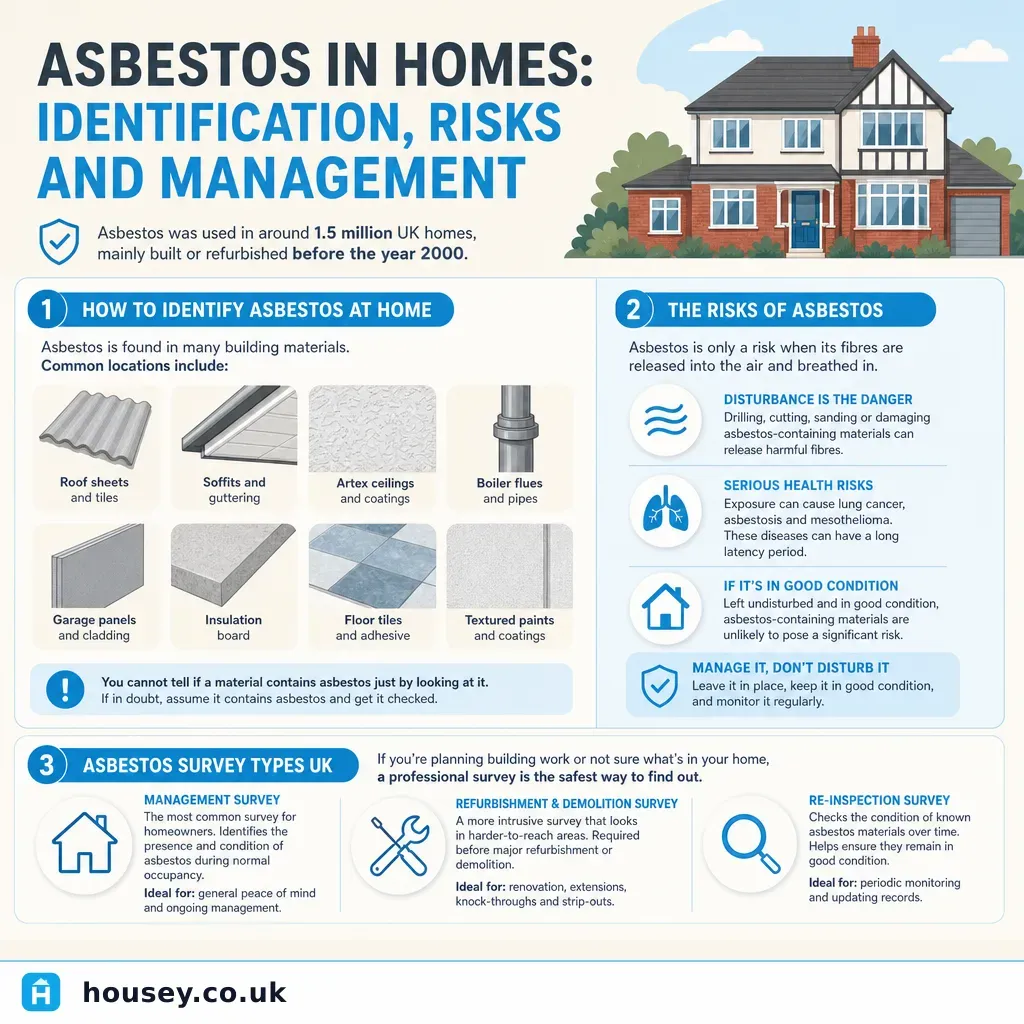
Asbestos in homes: identification, risks and management
Asbestos was widely used in UK construction until it was banned in November 1999, so any home built before 2000 may contain asbestos-containing materials.
 Surveys & Inspections
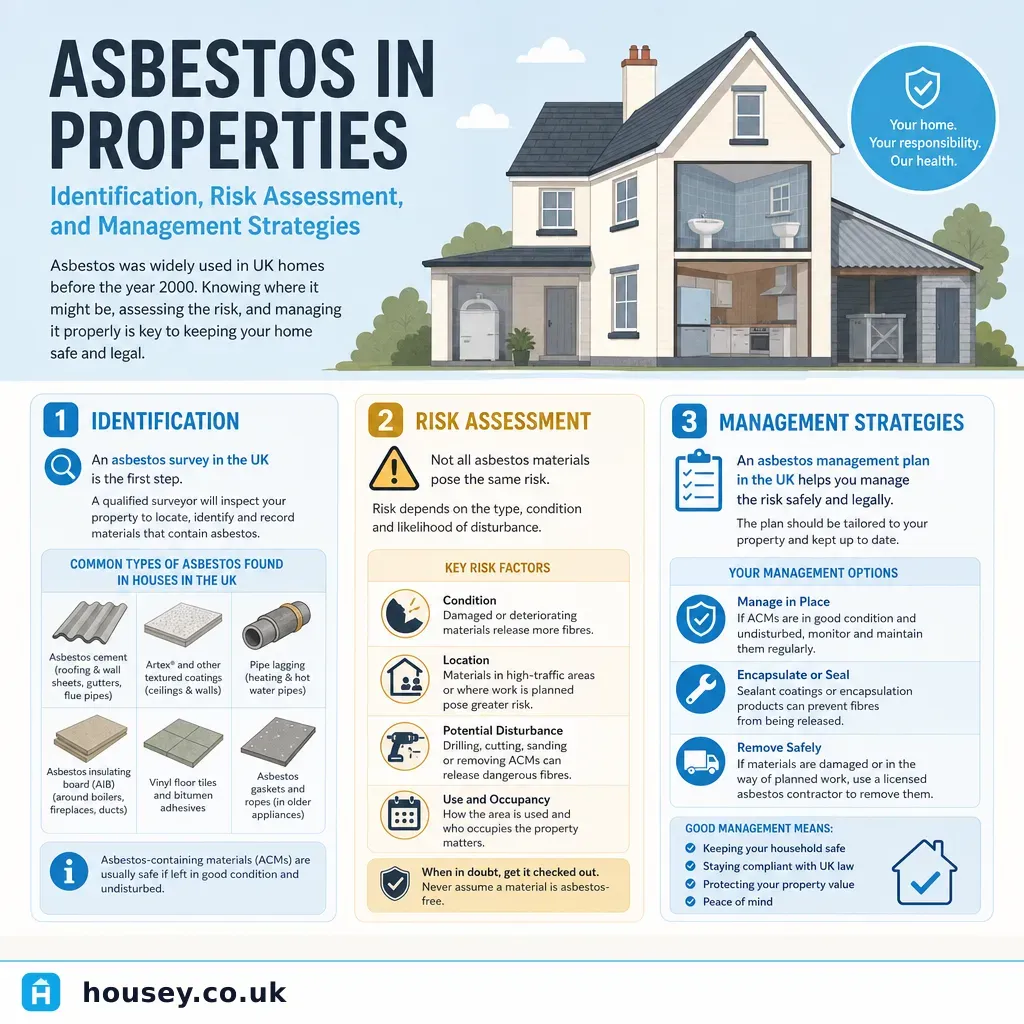
Asbestos in Properties: Identification, Risk Assessment, and Management Strategies
Asbestos-containing materials may be present in any UK property built before 2000.
 Surveys & Inspections
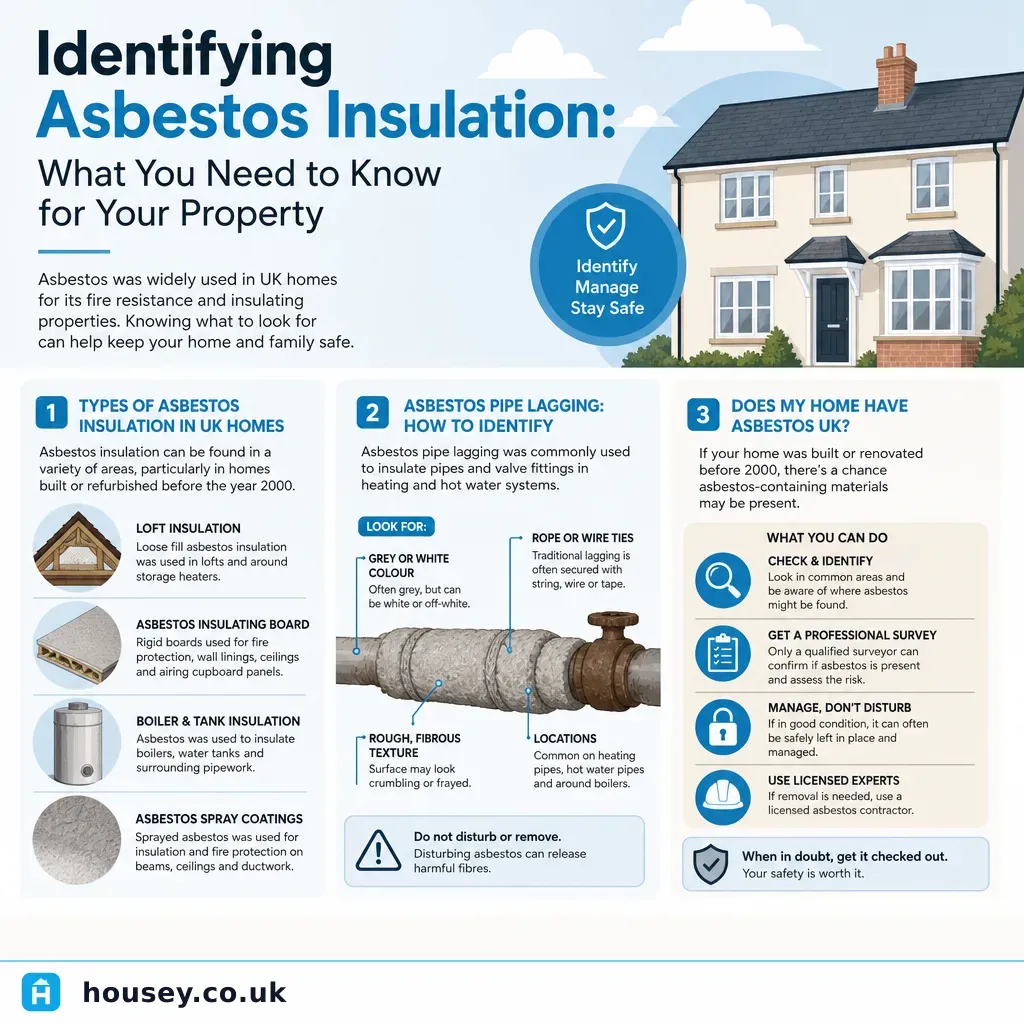
Identifying Asbestos Insulation: What You Need to Know for Your Property
Asbestos insulation was widely used in UK properties built before 2000, commonly found in pipe lagging, ceiling tiles, loose-fill loft insulation, and around boilers.
 Surveys & Inspections
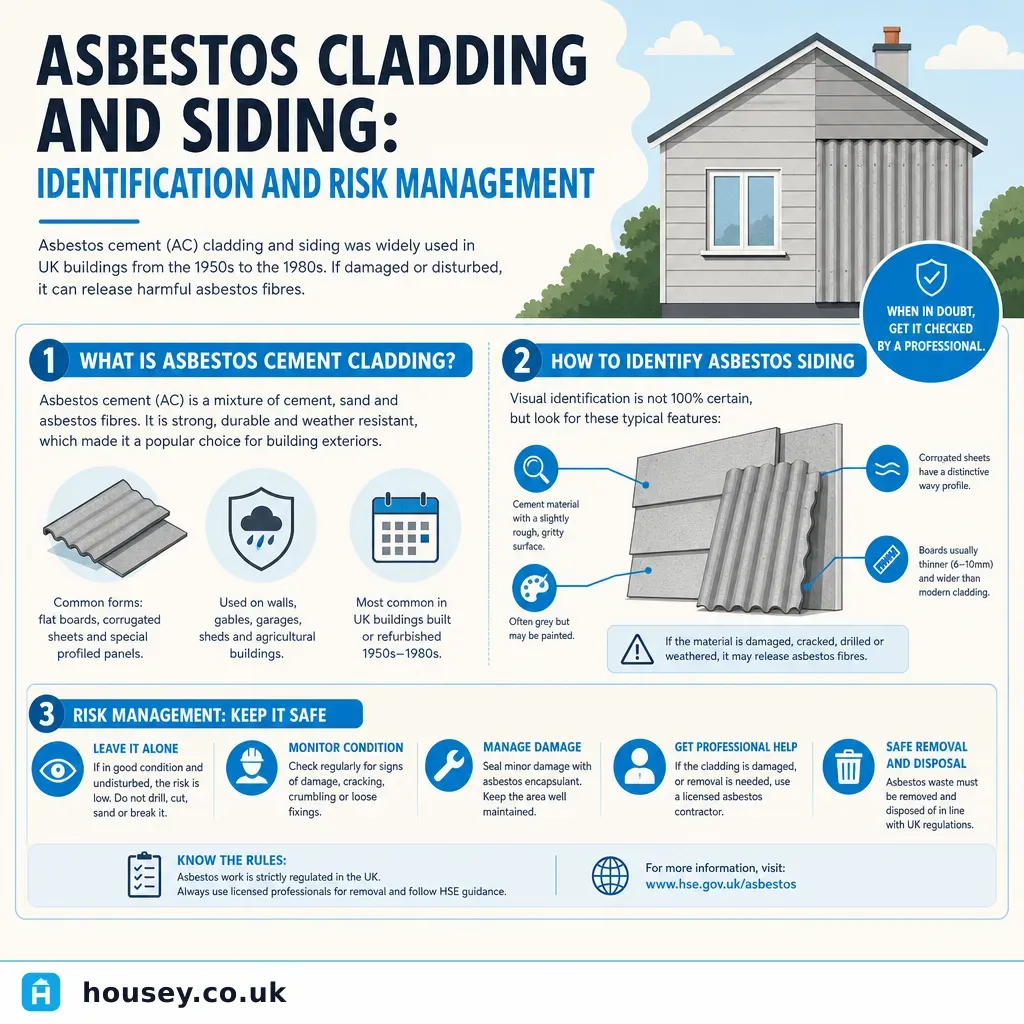
Asbestos Cladding and Siding: Identification and Risk Management
Asbestos cement cladding was widely used on UK buildings until 1999 and may be present on any property built before that date.
 Surveys & Inspections
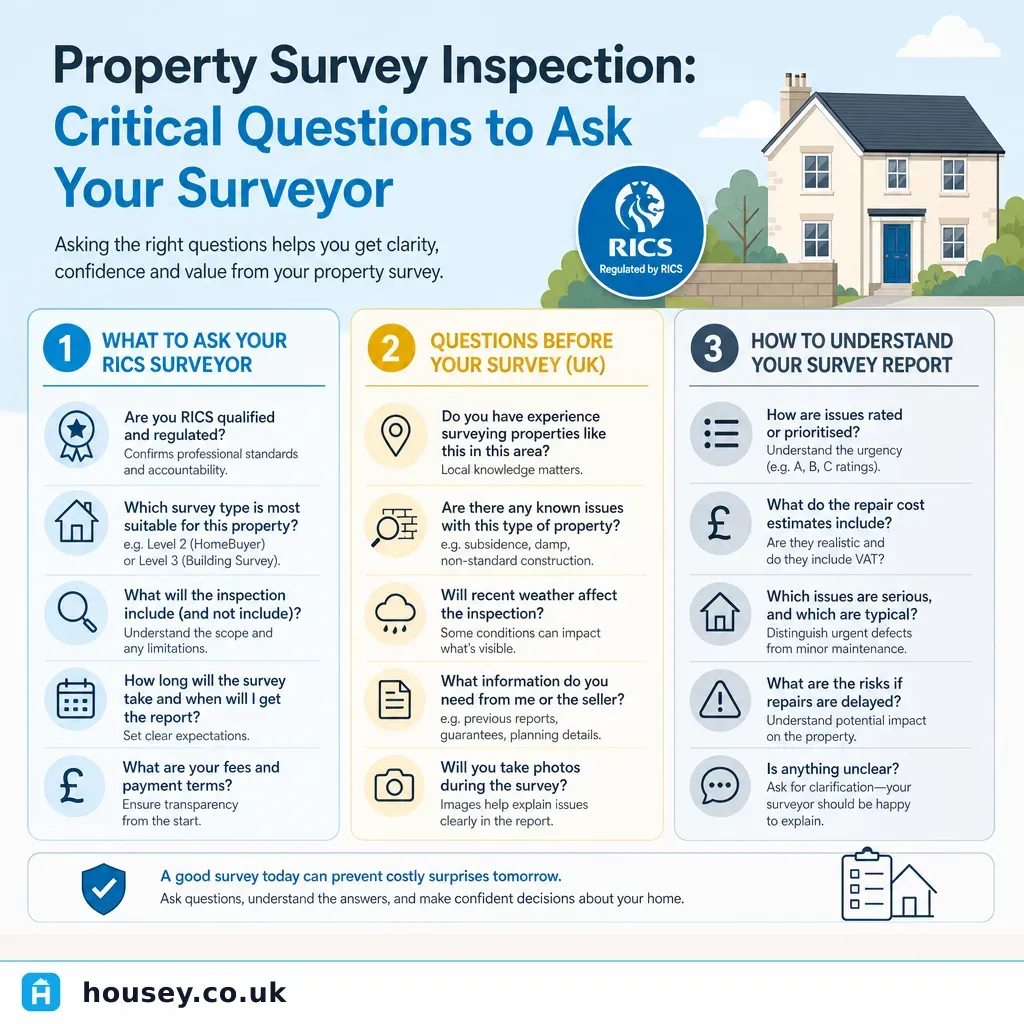
Property Survey Inspection: Critical Questions to Ask Your Surveyor
Before instructing a surveyor, ask which RICS level suits your property and what the report will and will not cover.