Identifying and managing asbestos roof tiles
By Housey · Last reviewed 11th of May 2026
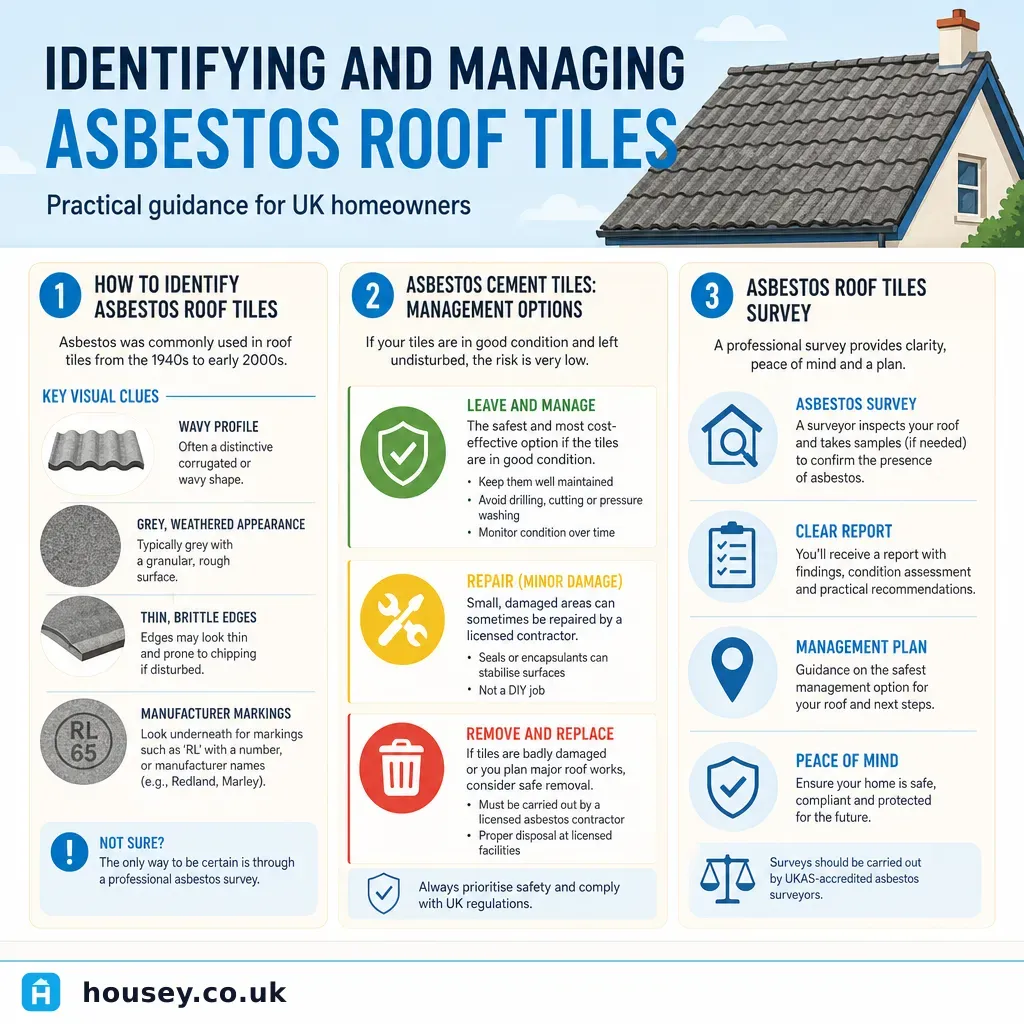
Identifying and managing asbestos roof tiles
Asbestos-containing roofing materials were widely used across the UK until the total ban on asbestos came into effect in 1999, meaning many properties built or re-roofed before that date may still have asbestos cement tiles or sheets overhead. The question of what to do with them typically arises when a homeowner is planning roof repairs, a buyer's survey flags a concern, or a roofer raises the issue during a routine inspection. Asbestos in roofing is generally classed as bonded (non-friable) material — fibres are locked into the cement matrix and present a lower risk when undisturbed — but it still requires careful assessment and, if disturbed, expert management.
Key points
- Asbestos was banned from use in new UK building products in 1999; any roof installed or re-roofed before that date may contain asbestos cement.
- Asbestos cement roof tiles are typically a bonded material — fibres are locked into the cement matrix and pose lower risk when undisturbed and in good condition.
- The Control of Asbestos Regulations 2012 sets out legal duties for managing asbestos in non-domestic premises; for domestic properties the statutory duty is less formal, but health risks are identical.
- A management survey is the standard first step; a refurbishment and demolition (R&D) survey is required before any significant roof work begins.
- Removal of asbestos cement roofing is classed as non-licensed work, but notifiable non-licensed work (NNLW) rules apply — the employer must notify the relevant enforcing authority before work starts.
How to identify asbestos roof tiles
Visual identification alone is unreliable. There is no safe way to confirm asbestos content without laboratory analysis of a sample taken by a competent person. However, the following characteristics are commonly associated with asbestos cement roofing:
- Age: Roofs installed before 2000 are most suspect. Products manufactured between the 1920s and late 1990s commonly contained chrysotile (white asbestos).
- Appearance: Asbestos cement sheets and tiles are typically grey-blue or grey-green, with a slightly textured or rippled surface. Corrugated asbestos cement is common on garages, outbuildings, and agricultural buildings.
- Weight and brittleness: Asbestos cement is heavier and more brittle than modern fibre cement or concrete alternatives.
- Property type: Victorian and Edwardian terraces, bungalows, 1950s–1970s semi-detached homes, and pre-2000 garages and sheds are particularly common locations.
If there is any doubt, commission an asbestos survey before disturbing the material. The Health and Safety Executive (HSE) strongly advises against cutting, drilling, or pressure-washing any material suspected to contain asbestos.
Management options: what are your choices?
Option | Best for | Licensed contractor required? | Key conditions |
|---|---|---|---|
Leave in situ | Tiles in good condition; no planned roof works | No | Must be monitored regularly; condition and location should be logged |
Encapsulation (sealing) | Tiles with minor surface weathering, no structural damage | No — but use a competent specialist | Suitable encapsulant for asbestos cement must be used; not a long-term fix for badly degraded tiles |
Over-roofing | Structurally sound roof capable of additional load | No — but asbestos remains underneath | Asbestos survey required first; ACMs must continue to be managed in place |
Full removal | Damaged or crumbling tiles; demolition or major re-roof planned | Non-licensed, but NNLW notification required | Waste must be double-bagged and disposed of at a licensed facility |
Indicative UK costs, last reviewed 2026-05-11. Costs vary significantly by roof area, pitch, access requirements, and disposal charges. Obtain at least three written quotes from competent contractors.
Red flags: when to act immediately
Stop work and contact a qualified asbestos professional without delay if you notice any of the following:
- Tiles that are crumbling, cracked, or visibly deteriorating — particularly where fine dust or loose material is present near the roof line.
- Moss or lichen being cleared by scrubbing or pressure washing, which can release asbestos fibres from the cement matrix.
- A roofer who proposes to cut, break, grind, or drill into roofing material without first confirming whether it contains asbestos.
- Any planned renovation, loft conversion, solar panel installation, re-roofing, or demolition on a pre-2000 building without a prior refurbishment and demolition survey.
- Evidence that previous occupants disturbed the roof without proper asbestos controls in place.
Survey types: which do you need?
Two main survey types apply to roofing asbestos:
Management survey: Assesses the location, condition, and risk of asbestos-containing materials (ACMs) in a building during normal use. Appropriate when you want to understand what is present and manage it safely without planned structural work.
Refurbishment and demolition (R&D) survey: More intrusive; required before any significant structural work, re-roofing, loft conversion, or demolition. This is a legal requirement under Regulation 7 of the Control of Asbestos Regulations 2012 for non-domestic premises, and strongly recommended best practice for residential properties. A roof survey can sometimes incorporate an asbestos assessment where appropriate.
Surveyors should ideally be accredited under the United Kingdom Accreditation Service (UKAS) scheme for asbestos surveying, and samples must be sent to a UKAS-accredited laboratory for analysis.
Important limitations
This article provides general information only. Asbestos identification, risk assessment, and management must be carried out by a competent professional who can inspect your specific property and roof. Legal duties differ between domestic and non-domestic premises. The Health and Safety Executive publishes detailed and regularly updated technical guidance — always check current HSE guidance before acting. Nothing in this article constitutes health and safety or legal advice.
When this becomes urgent
- Tiles are visibly degraded, crumbling, or have already been disturbed by previous works.
- Urgent roof repairs cannot be safely deferred pending a formal survey.
- You are buying or selling a property where a survey has flagged suspected asbestos roofing.
- Workers — roofers, builders, or solar panel installers — are about to begin work on a pre-2000 roof without a prior asbestos assessment.
In any of these situations, stop non-emergency work immediately and contact a UKAS-accredited asbestos surveyor or competent asbestos management professional before proceeding.
What to ask a qualified professional
- Are you UKAS-accredited for asbestos surveying, or do you hold the P402 qualification for surveying and sampling?
- Which survey type do I need — management or refurbishment and demolition?
- Will samples be analysed by a UKAS-accredited laboratory?
- What does the written report include — location, condition rating, priority score, and management recommendations?
- If removal is recommended, who will carry it out, and how will asbestos waste be transported and disposed of?
- Is the removal work notifiable under the Control of Asbestos Regulations 2012, and who is responsible for notifying the enforcing authority?
- Will you provide a clearance certificate after removal is complete?
When to get professional help
Do not attempt to sample, remove, or disturb any material you suspect contains asbestos. Contact a competent asbestos surveyor if:
- You are uncertain whether your roof contains asbestos-containing materials.
- Any planned work — re-roofing, solar panel installation, or loft conversion — will disturb the roof structure.
- Tiles are visibly degraded or have been physically damaged.
- You are preparing a property for sale and want to understand the ACM status before marketing begins.
How Housey can help
Housey connects homeowners with qualified professionals for asbestos surveys and roof surveys. Submit a single request and receive quotes from accredited local surveyors who can assess your roof, take samples for laboratory analysis, and advise on the most appropriate management strategy for your property.
Frequently asked questions
How do I know if my roof tiles contain asbestos?
Visual inspection alone cannot confirm asbestos content. Tiles installed before 2000 — particularly grey, corrugated, or cement-based sheets — should be treated as potentially containing asbestos until proven otherwise. A UKAS-accredited asbestos surveyor can take a sample for laboratory analysis. Do not disturb the material before the survey is carried out.
Can asbestos roof tiles be painted or sealed?
In some cases, encapsulation using a suitable sealant can extend the serviceable life of intact, lightly weathered asbestos cement tiles. This is not a long-term solution for badly degraded tiles and must be carried out by a competent professional. Check that any encapsulant is appropriate for asbestos cement and that the underlying tile is structurally sound before proceeding.
Do I need a licensed contractor to remove asbestos roof tiles?
Asbestos cement roofing is generally classed as non-licensed work under the Control of Asbestos Regulations 2012. However, it is notifiable non-licensed work (NNLW), meaning the employer must notify the relevant enforcing authority before work begins. Workers require appropriate training, medical surveillance, and PPE. All asbestos waste must be double-bagged and disposed of at a licensed facility.
Will asbestos roof tiles affect my property sale?
Asbestos-containing materials identified in a survey must be disclosed. A well-managed roof with a current asbestos management plan is generally less concerning to buyers than an unknown situation. A professional management survey and written report can demonstrate the material has been assessed and is being managed appropriately, helping to reassure buyers and their solicitors.
Sources and further reading
- HSE: Asbestos — the basics — Health and Safety Executive
- Control of Asbestos Regulations 2012 — legislation.gov.uk
- HSG264: Asbestos: The Survey Guide — Health and Safety Executive
- UKAS: Accreditation for asbestos surveying and testing — United Kingdom Accreditation Service
- GOV.UK: Managing asbestos in your home — GOV.UK
Useful next reads
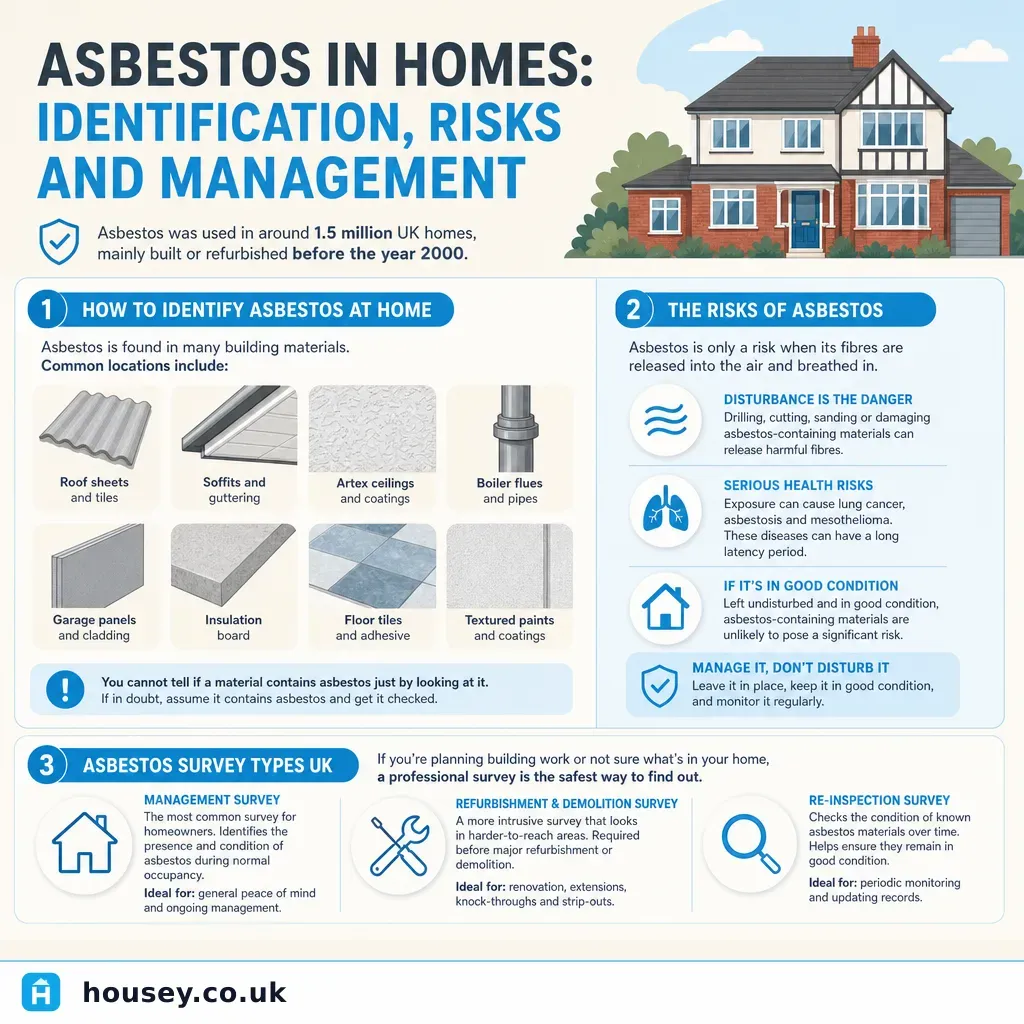 Surveys & Inspections
Asbestos in homes: identification, risks and management
Asbestos was widely used in UK construction until it was banned in November 1999, so any home built before 2000 may contain asbestos-containing materials.
 Surveys & Inspections
Roof Snow Removal: Safety and Structural Considerations
In the UK, most pitched roofs in good condition can tolerate typical snowfall without intervention.
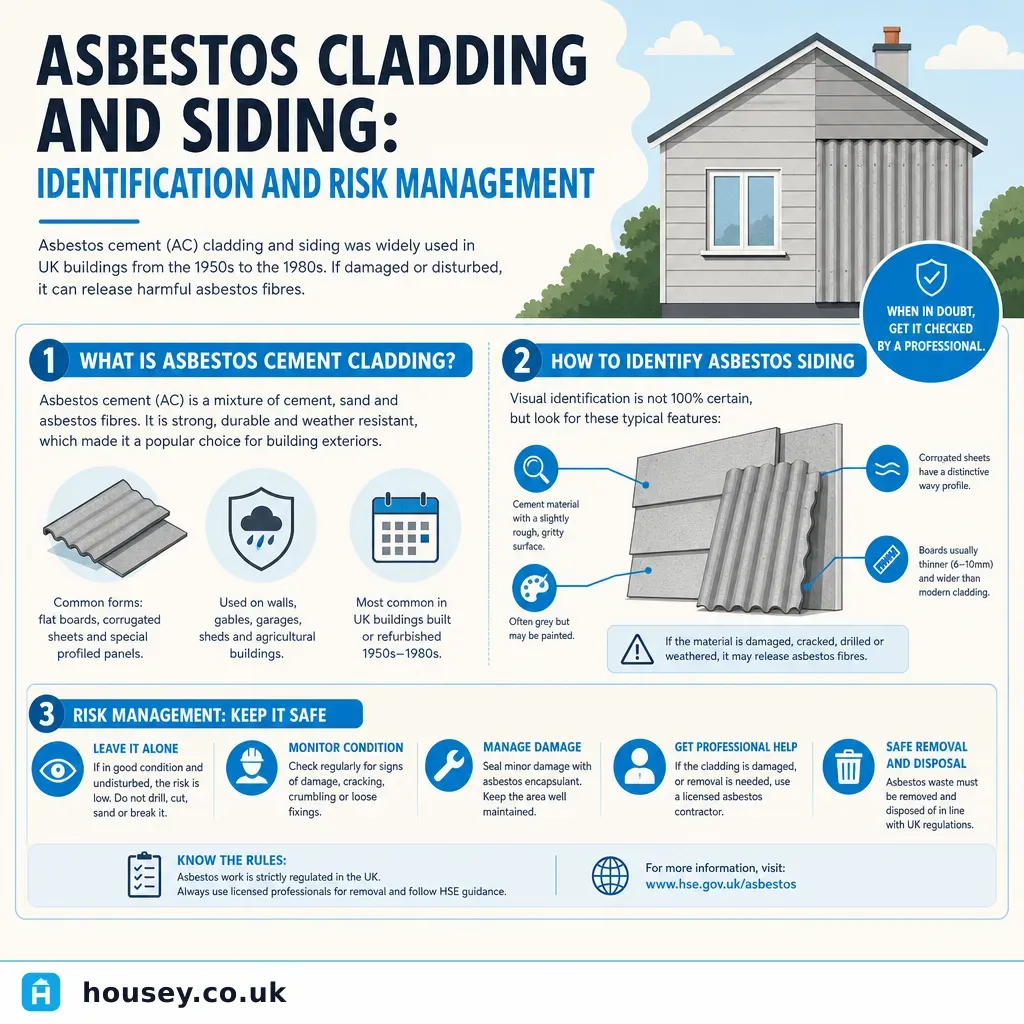 Surveys & Inspections
Asbestos Cladding and Siding: Identification and Risk Management
Asbestos cement cladding was widely used on UK buildings until 1999 and may be present on any property built before that date.
 Surveys & Inspections
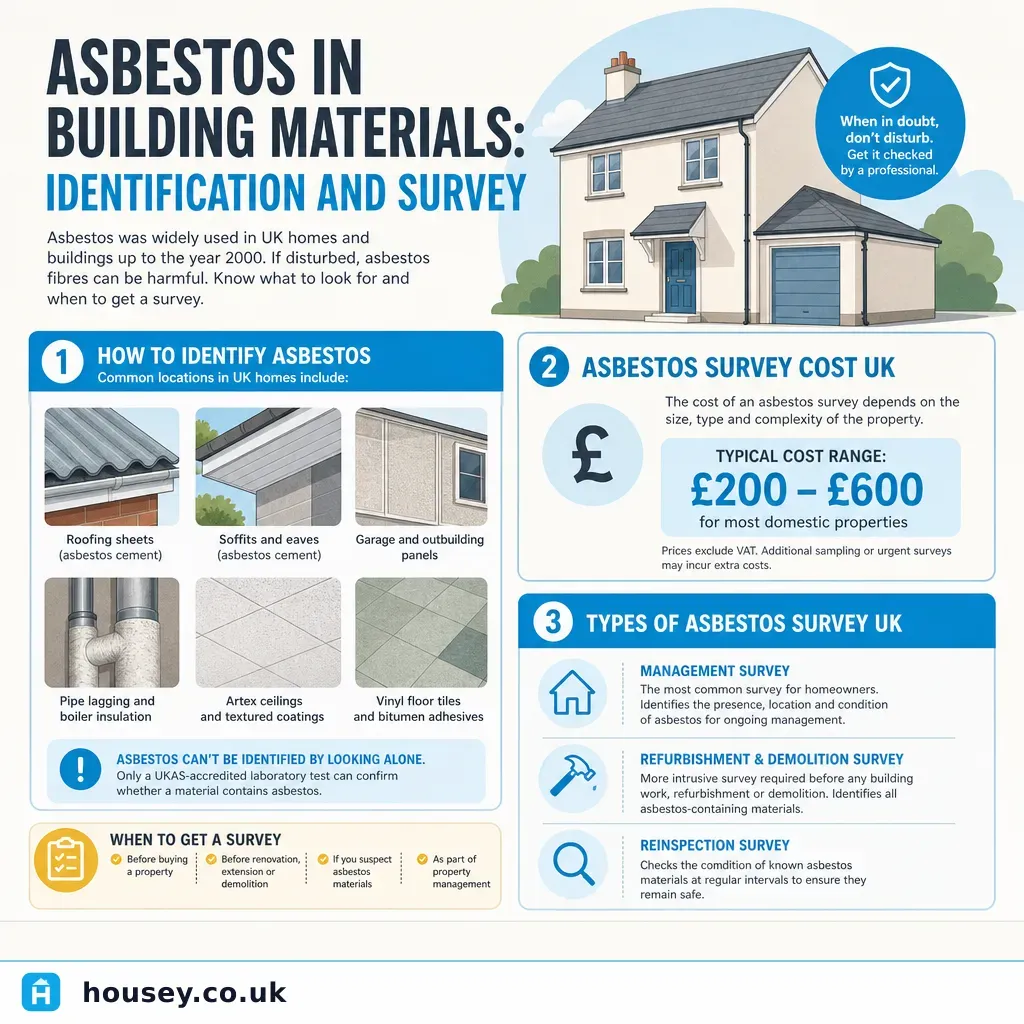
Asbestos in Building Materials: Identification and Survey
Asbestos-containing materials (ACMs) are present in many UK homes built before 2000, including floor tiles, textured coatings such as Artex, roof sheets, pipe lagging, and ceiling tiles.
 Surveys & Inspections
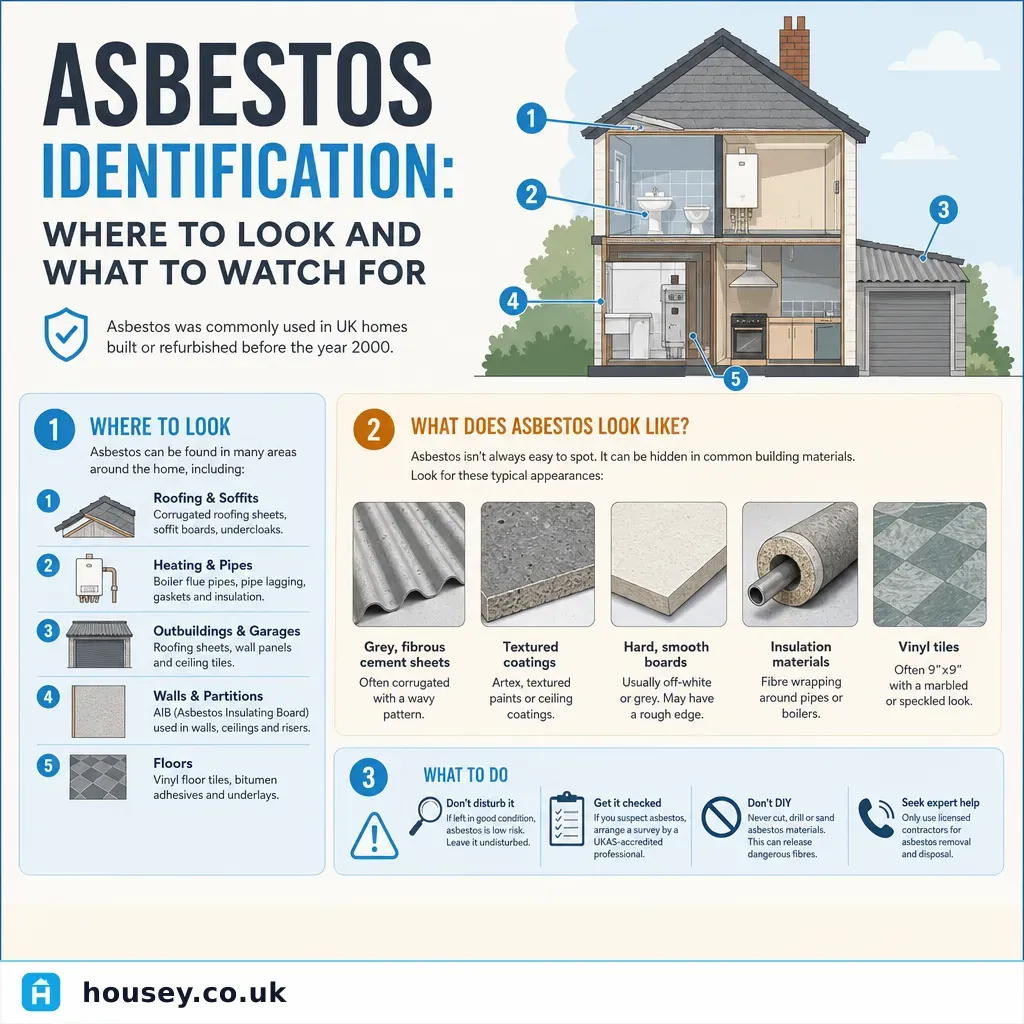
Asbestos Identification: Where to Look and What to Watch For
Asbestos can be present in dozens of locations in UK homes built before 2000, from textured ceiling coatings and floor tiles to pipe lagging and roof panels.