Managing Asbestos in Your Property: Survey, Remediation and Safe Removal
By Housey · Last reviewed 19th of May 2026
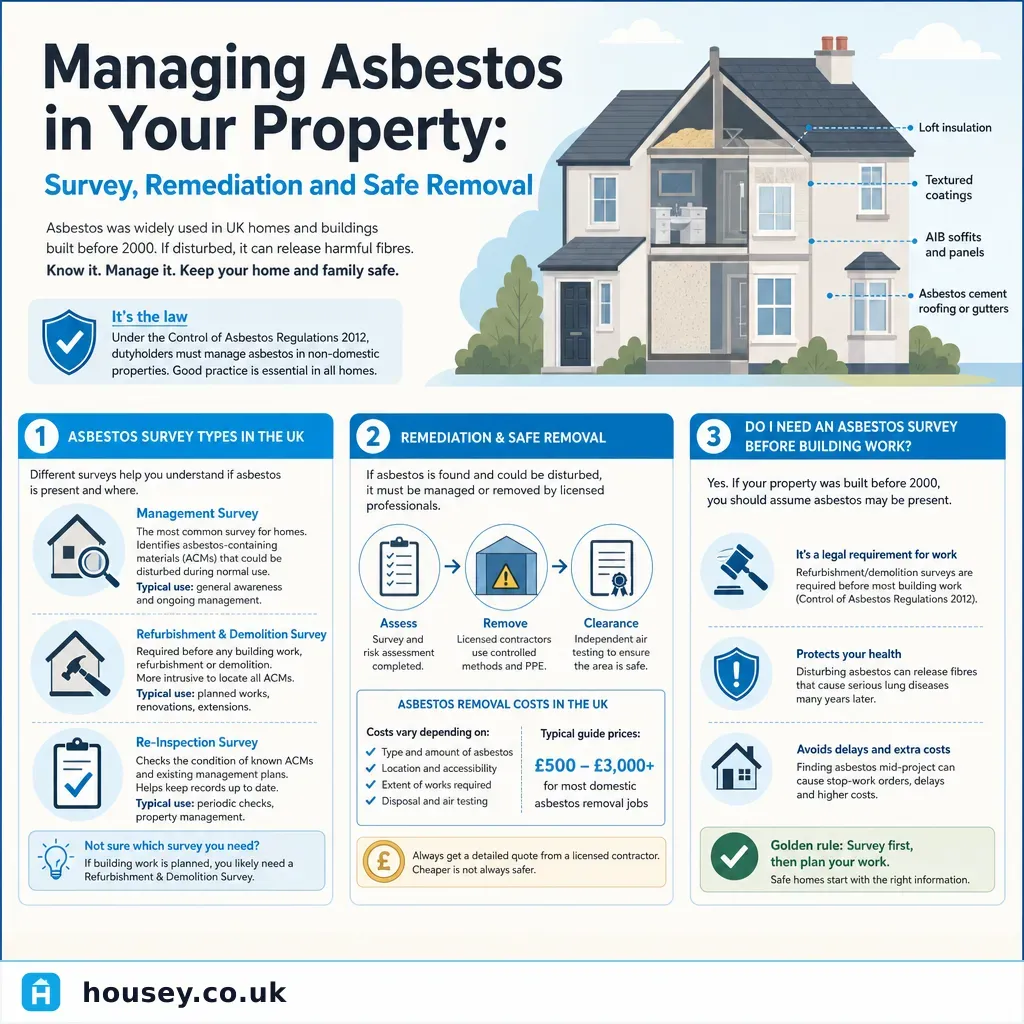
Managing Asbestos in Your Property: Survey, Remediation and Safe Removal
The question of asbestos most often surfaces when a homeowner is planning building work, buying an older property, or commissioning a refurbishment or extension. Asbestos was widely used in UK residential and commercial construction until successive bans — culminating in the final prohibition on chrysotile (white asbestos) in November 1999. Any home built or significantly altered before that date may contain asbestos-containing materials (ACMs), and the potential for harm arises when those materials are damaged or disturbed during routine maintenance, renovation, or demolition.
Key points
- Asbestos use in UK buildings was effectively banned in 1999; any property built or refurbished before that date may contain ACMs in locations ranging from roof panels and floor tiles to ceiling coatings and pipe lagging.
- The HSE recognises two primary survey types under guidance document MDHS100: a management survey for normal occupancy conditions and a refurbishment and demolition survey required before any intrusive work.
- Under the Control of Asbestos Regulations 2012, dutyholder obligations apply formally to non-domestic premises; residential owners have no statutory survey duty but remain responsible for the safe management of any ACMs they are aware of.
- Licensed asbestos removal — covering asbestos insulation, asbestos insulating board (AIB), and loose-fill insulation — must be carried out by a contractor holding a current HSE licence.
- A four-stage clearance procedure including independent air testing and a formal clearance certificate is required before a remediated area is reoccupied following licensed removal work.
What is asbestos and where is it found in homes?
Asbestos is a naturally occurring fibrous silicate mineral, valued historically for its fireproofing, insulation, and binding properties. In UK residential properties, common locations include:
- Roof and soffit panels — asbestos cement sheets on garages and outbuildings, particularly those built before 1985
- Artex and textured coatings — ceilings and walls in 1970s and 1980s properties
- Floor tiles and adhesive — 9×9 inch vinyl tiles common in homes built from the 1950s to 1970s
- Pipe lagging and boiler insulation — amosite (brown asbestos) and chrysotile wrapping on older heating systems
- Loose-fill loft insulation — crocidolite (blue) or amosite fill used in some 1960s and 1970s local authority homes; among the highest-risk ACMs
- Cement guttering, flues, and downpipes — asbestos cement products on properties from the 1940s through to the 1990s
- Partition boards and ceiling tiles — Asbestolux or Marinite board in older commercial conversions and some domestic extensions
Not every pre-2000 home contains asbestos, and not every ACM poses an immediate risk. Condition and the likelihood of disturbance are the key factors.
Survey types: management versus refurbishment and demolition
The HSE guidance document MDHS100 sets out two main survey categories for UK properties:
Survey type | Purpose | Scope | When required |
|---|---|---|---|
Management survey | Locate ACMs in normal occupancy conditions and assess their condition and risk | Non-intrusive; samples suspected materials without opening up the building fabric | Before drawing up a management plan; recommended on older residential property before selling, letting, or planning works |
Refurbishment and demolition survey | Locate all ACMs in the work area before intrusive works or demolition | Fully intrusive and destructive where necessary; covers all areas where work will occur | Before ANY refurbishment, extension, loft conversion, or demolition; mandatory for licensed contractors prior to notifiable licensable work |
A management survey is unsuitable as preparation for refurbishment work — commissioning the wrong survey type may leave ACMs unidentified before your builder begins.
Understanding the risk: condition, type, and disturbance potential
Not all ACMs carry the same risk level. The HSE asbestos material scoring system weighs three main factors:
- Asbestos type — crocidolite (blue) and amosite (brown) are generally considered more hazardous than chrysotile (white), though all three types are classified carcinogens under UK and international frameworks
- Material condition — whether the material is intact, delaminating, damaged, or friable (crumbles easily, potentially releasing airborne fibres)
- Accessibility and likelihood of disturbance — a sealed ceiling panel rarely accessed carries a very different risk profile to damaged pipe lagging inside a frequently opened boiler cupboard
The risk comes not from the mere presence of asbestos but from inhaling airborne fibres. Intact, well-bonded cement panels on an external garage present a lower immediate risk than deteriorating pipe lagging inside a utility room.
What happens during an asbestos survey?
A qualified asbestos surveyor — typically holding the BOHS P402 certificate of competence or an RSPH equivalent — will:
- Inspect accessible parts of the property methodically, recording suspected materials
- Take bulk samples (small pieces removed to sealed containers) for analysis by a UKAS-accredited laboratory
- Assess condition and accessibility for each material using the HSE scoring matrix
- Produce a written survey report identifying ACM locations, suspected fibre types, condition scores, and recommended management actions
For a management survey on a typical three or four-bedroom house, survey time is usually a few hours. The report should include an ACM register, a site plan indicating locations, laboratory analysis certificates, and risk-prioritised recommendations.
Indicative UK costs for a residential management survey range from approximately £200 to £500 for a standard house, rising for larger or more complex properties. Indicative UK costs, last reviewed 2026-05-19. Costs vary significantly by property size, location, and the number of suspected materials requiring sampling.
Management, encapsulation, and removal: choosing the right approach
Once ACMs are identified, there are three broadly recognised management options:
Manage in place: If a material is in good condition, not at risk of disturbance, and monitored regularly, managing in place — with a written management plan — is often the appropriate response. This applies to many intact external asbestos cement sheets, for example.
Encapsulation: A specialist contractor seals or over-coats the ACM to reduce fibre release risk. Common for Artex ceilings in reasonable condition. Encapsulation does not remove the asbestos and requires ongoing condition monitoring.
Removal: Full removal by a licensed contractor (for licensable work such as asbestos insulation, AIB, and loose-fill insulation) or a competent contractor for lower-risk non-licensed materials such as asbestos cement products within regulatory scope limits. Following licensed removal, a four-stage clearance procedure — including independent air testing and a formal clearance certificate — is required before reoccupancy.
Red flags: when to treat asbestos as urgent
Stop work and seek professional advice immediately if you observe any of the following:
- Damaged or friable pipe lagging in a boiler cupboard, under floors, or in a roof space — loose fibres may already be present in the air
- Crumbling or damaged Artex that has been drilled, sanded, scraped, or is visibly flaking — particularly in 1970s and 1980s properties
- Broken or cracked asbestos cement sheets on a garage, shed, or outbuilding roof where pieces have fallen or the surface is actively deteriorating
- Disturbed loose-fill loft insulation that appears fluffy, grey, or blue — crocidolite loose-fill was used in some council properties and carries a high-risk profile
- Any suspected ACM that has already been worked on by trades without a prior survey — stop work and arrange professional assessment before proceeding
Do not vacuum suspected asbestos debris with a household vacuum cleaner — this disperses rather than contains fibres.
Homeowner checklist before commissioning works on a pre-2000 property
Before authorising any builder, electrician, or plumber to start work on a property built before 2000:
Important limitations
This guide provides general information about asbestos management in UK residential property. Asbestos is a serious and complex health hazard; individual properties, ACM conditions, work scopes, and regulatory requirements vary significantly. Nothing in this article constitutes professional health and safety or legal advice. A qualified asbestos surveyor must assess your specific property and situation before any management, encapsulation, or removal decision is made.
What to ask a qualified professional
Before instructing an asbestos surveyor or removal contractor, ask:
- What qualifications and accreditations do you hold? (BOHS P402 for surveyors; HSE licence number for removal contractors)
- Which survey type is appropriate for my planned works — management or refurbishment and demolition?
- Will bulk samples be analysed by a UKAS-accredited laboratory, and will I receive the laboratory certificates?
- What will the survey report include, and what are your typical turnaround times?
- If removal is required, is this work notifiable to the HSE and are you currently licensed to carry it out?
- What does the four-stage clearance process involve, and will I receive a formal air-test clearance certificate?
- What assumptions has the quote been based on, and what circumstances could change the price or scope?
- Is VAT included in the quoted fee?
When to get professional help
Arrange a professional asbestos survey if:
- The property was built or substantially altered before 2000
- You are planning any intrusive work including loft conversions, extensions, rewiring, plumbing alterations, or demolition
- You have identified suspected ACMs in damaged or deteriorating condition
- You are selling or letting a property and have no existing survey records
- Trades have already worked on suspected ACMs without a prior survey
Never attempt to cut, drill, sand, or remove suspected asbestos yourself. This is specialist work requiring appropriate training, personal protective equipment, and in many cases a current HSE licence.
How Housey can help
Housey connects homeowners with qualified professionals for asbestos surveys, specific defect surveys, and environmental surveys. Submit a request, receive quotes from vetted local specialists, and compare their credentials and scope before instructing.
Frequently asked questions
Do I have to have an asbestos survey before selling my home?
There is no statutory requirement for residential sellers to commission an asbestos survey before sale. However, if you are aware of asbestos-containing materials on the property, non-disclosure could raise legal questions. Buyers increasingly request survey records, and some lenders and conveyancers ask for management surveys on pre-2000 properties. Check with your solicitor before marketing.
Is it safe to leave asbestos in place?
Intact, well-bonded asbestos-containing materials that are not at risk of disturbance are often best managed in place rather than removed. Removal itself carries a risk of fibre release if not carried out correctly. Your surveyor's management recommendations should reflect the condition score and disturbance risk of each material identified.
Who needs a HSE licence to remove asbestos?
Licensed work covers asbestos insulation (lagging), asbestos insulating board (AIB), and loose-fill asbestos insulation — all high-risk materials. Lower-risk materials such as asbestos cement sheets and guttering are non-licensed work but remain subject to the Control of Asbestos Regulations 2012. Check the HSE website for the current definitive list of licensable and non-licensable work.
How do I find a qualified asbestos surveyor?
Look for surveyors holding the BOHS P402 certificate of competence or an equivalent RSPH qualification. Removal contractors undertaking licensable work must hold a current HSE licence, verifiable on the HSE licensed asbestos removal contractors database. Membership of a trade body such as ARCA (Asbestos Removal Contractors Association) is also worth checking before instructing.
Sources and further reading
- Control of Asbestos Regulations 2012 — legislation.gov.uk
- HSE asbestos: the survey guide (MDHS100) — Health and Safety Executive
- HSE licensed asbestos removal contractors database — Health and Safety Executive
- Asbestos in homes — Health and Safety Executive
Useful next reads
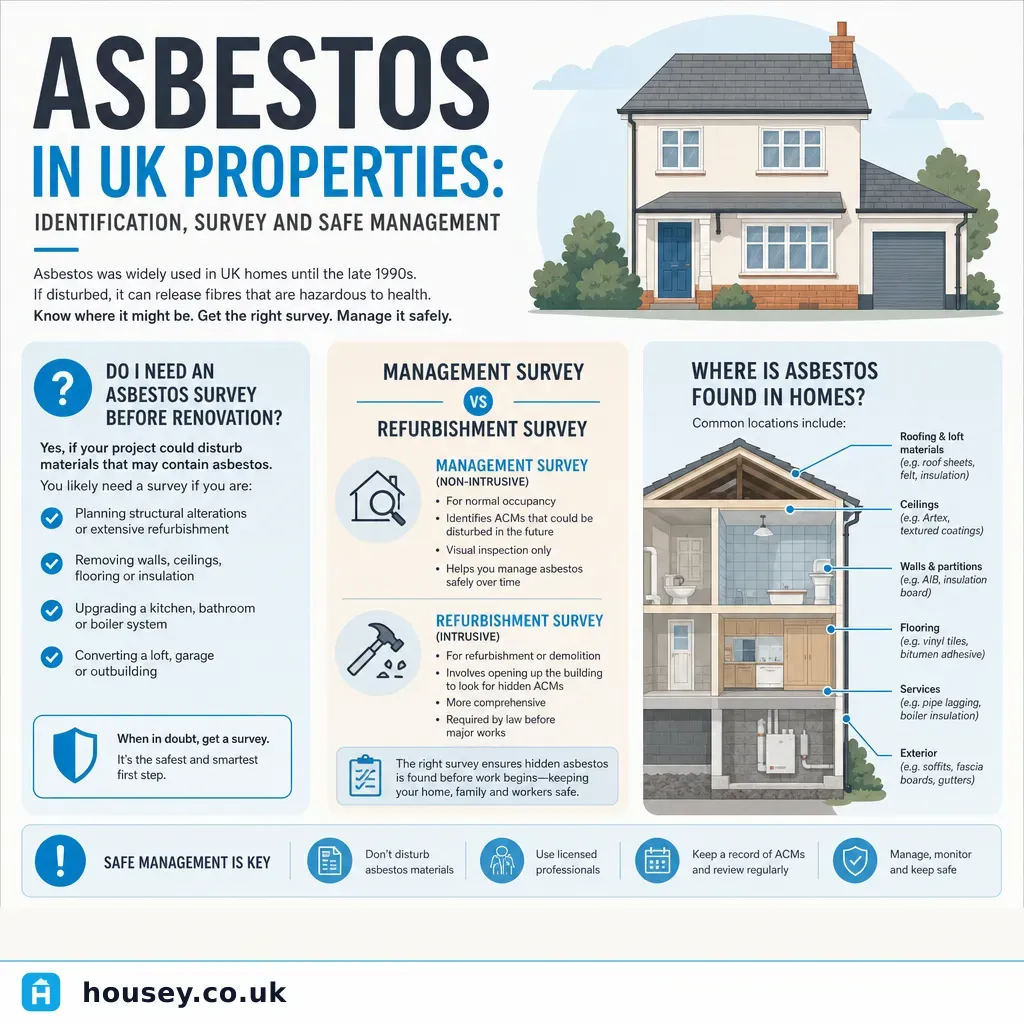 Surveys & Inspections
Asbestos in UK Properties: Identification, Survey and Safe Management
Asbestos may be present in any UK property built or refurbished before 2000.
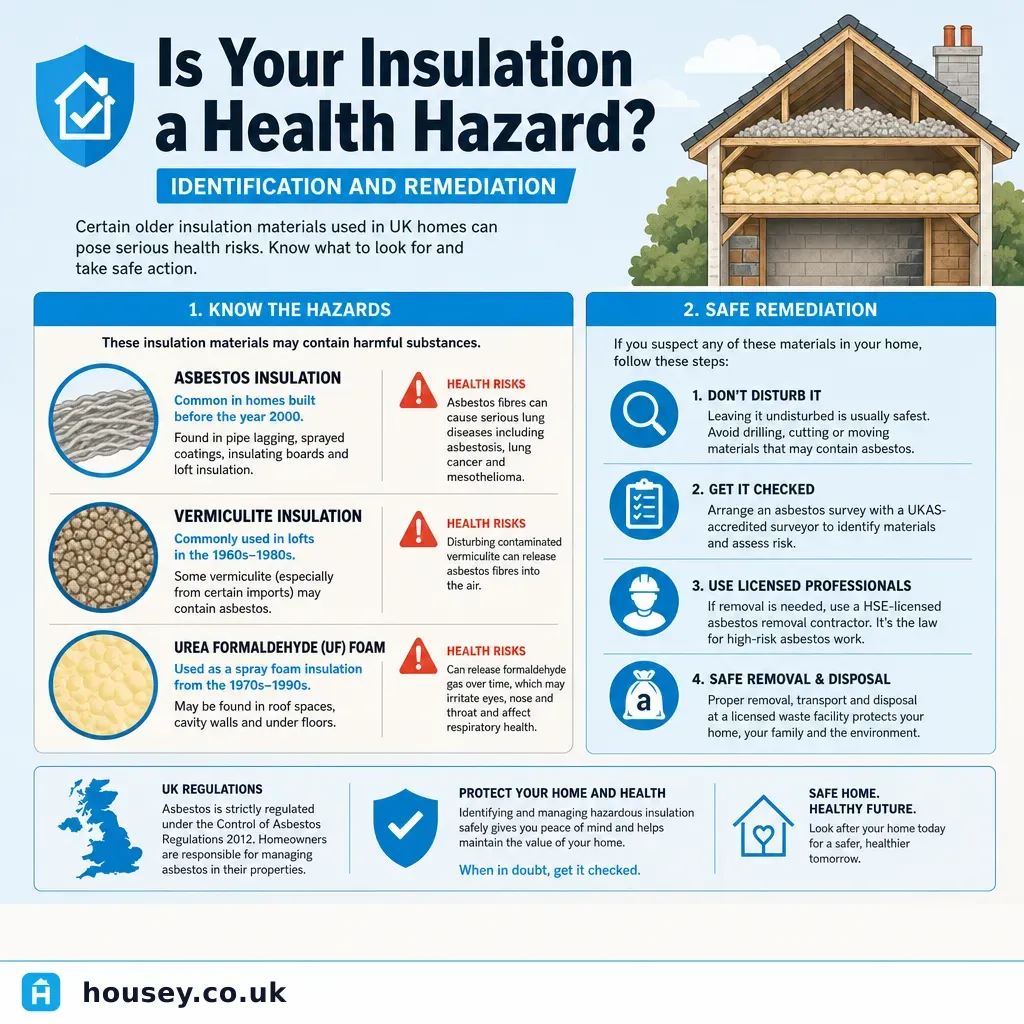 Surveys & Inspections
Is Your Insulation a Health Hazard? Identification and Remediation
Some insulation materials in pre-2000 UK homes may pose genuine health risks.
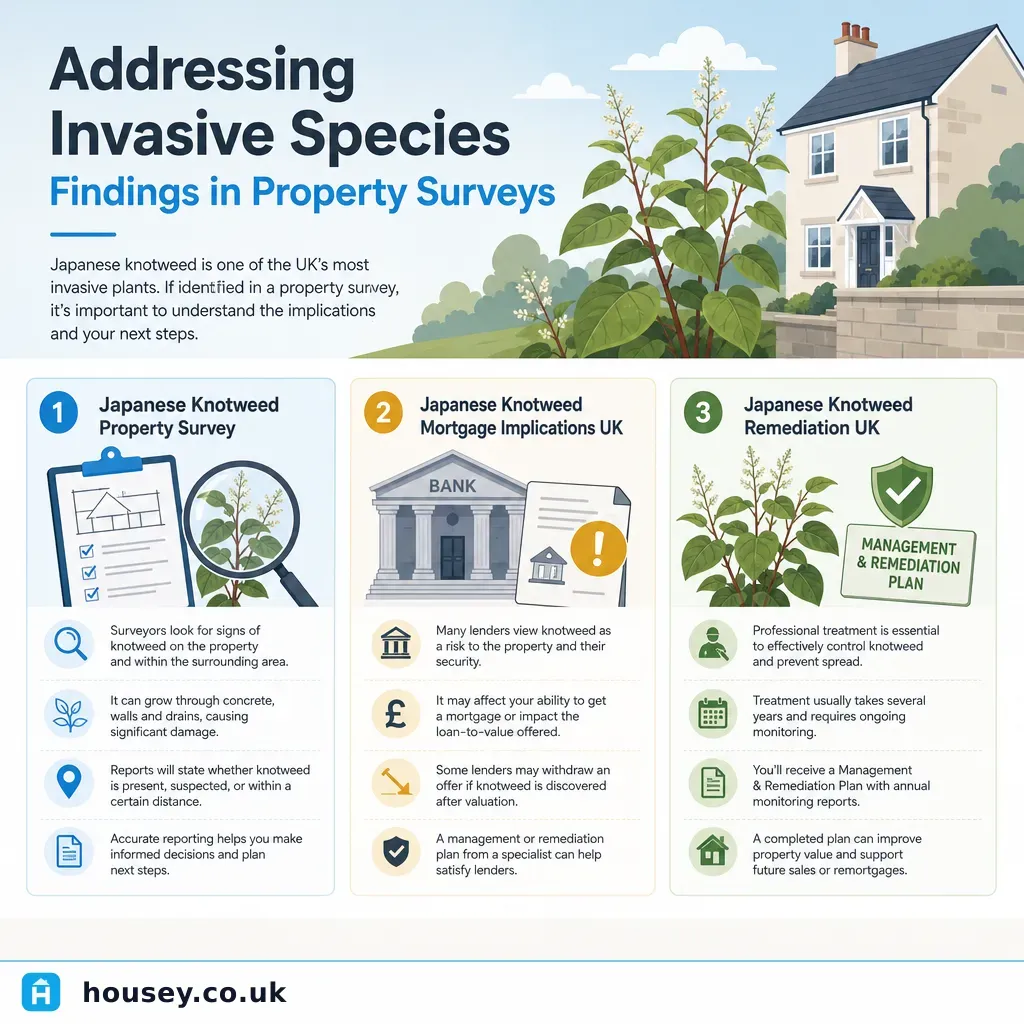 Surveys & Inspections
Addressing Invasive Species Findings in Property Surveys
If a property survey flags an invasive species such as Japanese knotweed, you should commission a specialist ecological or knotweed survey to confirm the extent and obtain a management plan.
 Surveys & Inspections
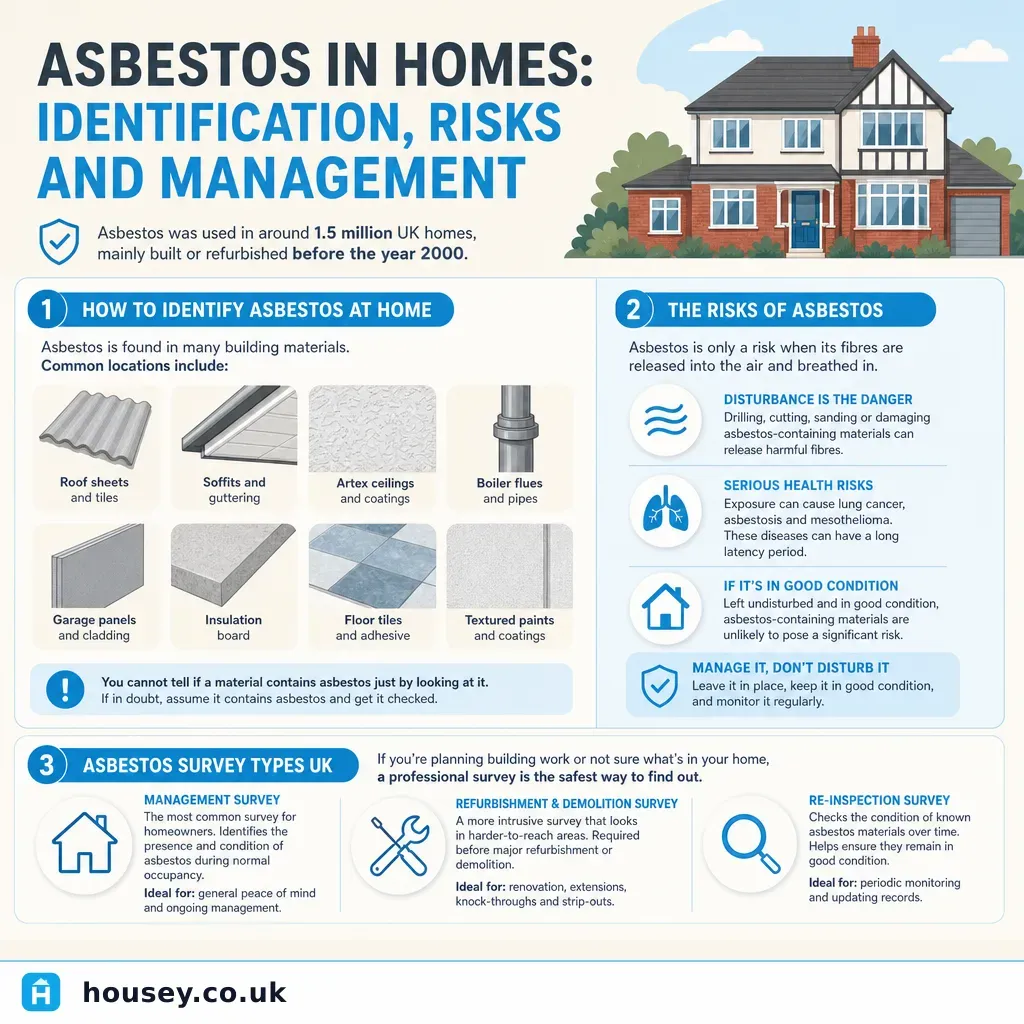
Asbestos in homes: identification, risks and management
Asbestos was widely used in UK construction until it was banned in November 1999, so any home built before 2000 may contain asbestos-containing materials.
 Surveys & Inspections
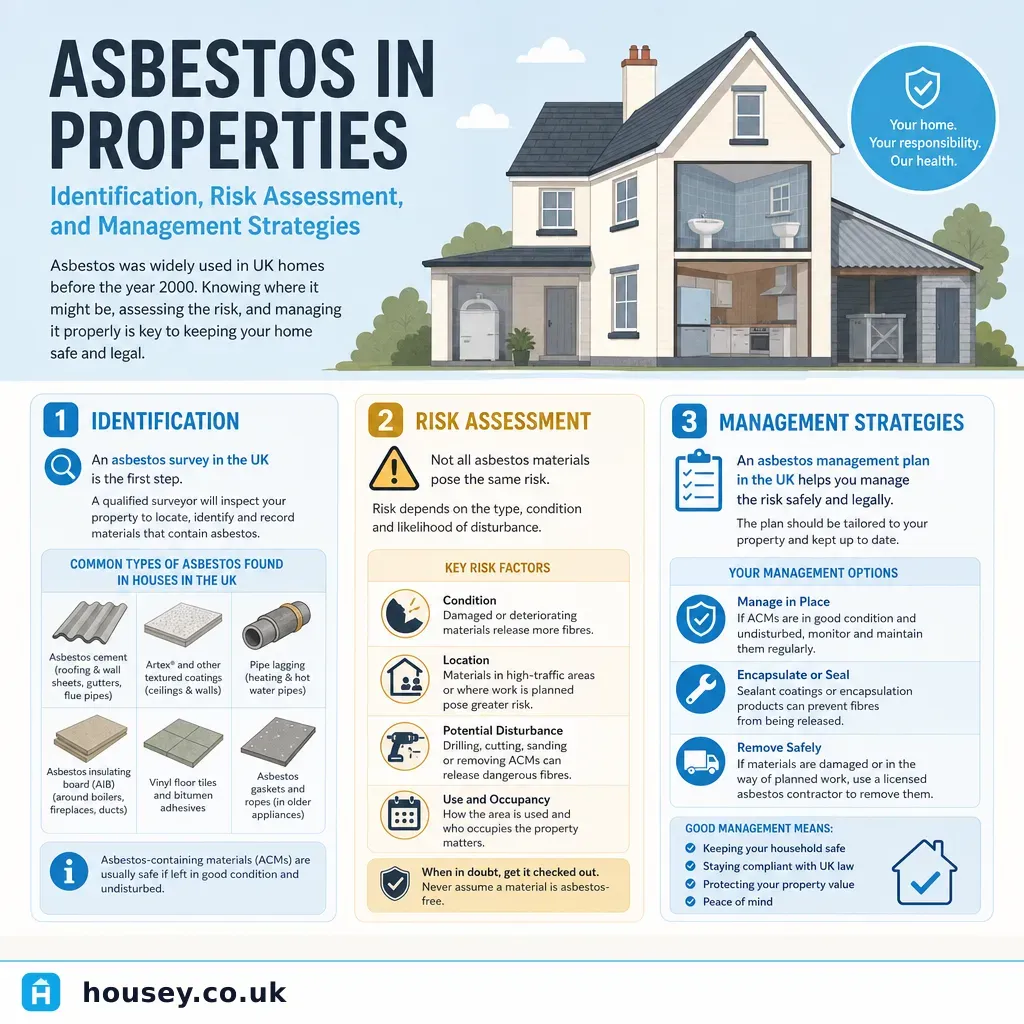
Asbestos in Properties: Identification, Risk Assessment, and Management Strategies
Asbestos-containing materials may be present in any UK property built before 2000.